Dramatic success of Perth Solar City Program
 Perth Solar City’s Stunning Success http://www.energymatters.com.au/index.php?main_page=news_article&article_id=3573 by Energy Matters, 31 Jan 13, Over 16,000 households have participated in the Perth Solar City Program and collectively saved over a million dollars on their electricity bills last year. The most comprehensive energy efficiency initiative in Western Australia, the Perth Solar City Program developed and implemented more than 30 energy efficiency and renewable energy projects within Perth’s Eastern Region.
The Program together with SunPower installed 673 residential solar panel systems at an average size of 2.30kW, for a total installed capacity of 1.56MW. Analysis shows the average solar household used 41% less electricity from the network, or 8.15kWh per day. Continue reading
Solar photovoltaic plant for Mildura region, in Victoria
 Green light for solar farm near Koorlong http://www.abc.net.au/news/2013-01-24/green-light-for-solar-farm-near-koorlong/4481736
Jan 24, 2013 A planning application has been approved for another solar farm in north-west Victoria.The Mildura council has given German company Belectric the nod to build a five-megawatt photovoltaic plant near Koorlong.
A similar project, Solar Systems’ 1.5-megawatt station, is also being built at Carwarp.
The Mildura Development Corporation’s Anne Mansell says it is an important project for the region.
“This is classed as medium scale, five megawatts is classed as medium scale,” she said.
“It’s still quite significant for the area, one thing I would add, it certainly complements the solar systems development at Carwarp and it shows we’re developing into a solar hub in this region.”
Mining companies turn to solar power, to cut costs
perhaps the most important news from an Australian perspective has been the move by mining companies to adopt solar technologies to reduce their dependence on fossil fuels, particularly diesel, and to keep a lid on their soaring energy costs.
The development of off-grid solar projects, particularly with remote and mining communities, is expected to be a central theme of the newly established Australian Renewable Energy Agency
a “huge opportunity” in the replacement of expensive diesel, both in remote and off-grid areas, and the fringe-of-grid areas
 Miners embrace solar power – as a cost saving measure REneweconomy, By Giles Parkinson 18 January 2013 The New Year is barely more than two weeks old, and already solar is grabbing headlines: China has confirmed it expects to install 10GW of solar in 2013, a development that would take its total installed capacity close to 50GW by 2015, and well beyond the most optimistic forecasts of 100GW by 2020 if the growth rate continues to expand.
Elsewhere, the Middle East expects to intall 3GW of solar by 2015, the state of New York has announced a$1.5 billion extension to its solar program, France doubled its solar targets to 1GW, India is about to tender 1GW of projects, Warren Buffett has invested another $2.5 billion in solar projects, Italy and Spain have set new solar generation records, and Germany increased its solar production by 45 per cent after adding another 7.3GW of capacity. Continue reading
Australia’s potential for concentrated thermal solar power
 Around 40% of Australian renewable energy could be generated by wind farms but the real key to success would be the enormous empty landscape of the interior with the high levels of solar power it receives.
An example of suitable technology is the Gemasolar power station in Spain which is a 19.9MW plant expected to generate 110 GWh per year. The plant’s molten storage tank allows for independent electrical generation for up to 15 hours. Although solar power in Australia could be produced from solar PV arrays on buildings, most of the country’s solar power could come from concentrated solar power (CSP) plants similar to that in Spain.
A 100% renewable energy grid could create at least 80,000 jobs during construction and 45,000 in operation. 30,000 jobs would also be created in manufacturing assuming half the plant was made in Australia itself.
Australia could be self-sufficient in renewable energy within 10 years http://www.renewableenergymagazine.com/article/australia-could-be-selfsufficient-in-renewable-energy-20130117 Robin Whitlock, 17 January 2013 A new report published by the Energy Research Institute of the University of Melbourne finds that existing renewable energy could wean the country off fossil fuels
Australia is currently the world’s largest exporter of coal and also has one of the highest global greenhouse gas emissions rates per capita. The country has, until fairly recently, been particularly obstinate in its resistance to tackling climate change. The University of Melbourne report says that with the right political will Australia’s enormous renewable potential could be harnessed within a decade, creating thousands of new jobs and making the country carbon neutral. Continue reading
Solar panel rating system for Australia
Australia To Have Its Own Solar Panel Rating System http://www.energymatters.com.au/index.php?main_page=news_article&article_id=3552, 16 Jan 13,
The Clean Energy Council (CEC), Australian Solar Institute (ASI) and Australian Photovoltaic Association (APVA) have partnered to develop a climate-based solar panel performance and module rating system. Continue reading
In Western Australia it’s the battler households taking up solar panels
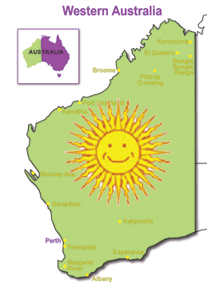 Battler Households Driving Western Australia’s Solar Uptake http://www.energymatters.com.au/index.php?main_page=news_article&article_id=3550 by Energy Matters, 15 Jan 13, In Western Australia, like elsewhere in the nation, solar power uptake isn’t being driven by the rich, but by the mortgage belt. Western Australia now boasts over 100,000 rooftop solar panel arrays across Perth and the South West.
According to The West Australian, figures provided by Synergy show the southern suburb of Canning Vale had highest number of solar panel installations (2239) as of December 19, followed by Thornlie (1513), Baldivis (1376), Willetton (1299) and Ellenbrook (1198).
None of Perth’s affluent suburbs featured in Synergy’s top 20 list of solar panel installations in Western Australia.
The results again bust the myth that solar rebates and subsidies have primarily benefited the wealthy. Western Australia’s experience has been repeated throughout the country.
In an analysis of solar energy systems installed under the Renewable Energy Target carried out last year by REC Agents Association (RAA); the Association found suburbs with the highest solar uptake were typically in the outer metropolitan mortgage belt.
The Clean Energy Council’s Solar Power Australia 2011-12 report states over half of solar households have an annual income of less that $100,000 annually and more than a quarter earn less than $65,000 a year.
Solar panel uptake is being driven primarily by ongoing and substantial electricity price rises.
According to solar provider Energy Matters, a 3kW solar power system installed in Perth will generate more than 12kWh a day on average. Based on the price of a good quality system supplied and installed by the company; the electricity produced will work out to cost under 6c per kilowatt hour over the life of the system – far cheaper than retail rates.
Households in Western Australia can also benefit from the state’s feed in tariff that pays 8 – 50c per kilowatt hour for surplus electricity exported to the mains grid, depending on location. Solar feed in tariff incentives are also available in other states; but with the price of electricity so expensive now the focus is increasingly on self-consumption.
Recommendation to keep Australia’s Renewable Energy Target, including Small Scale Scheme
Small-scale Renewable Energy Scheme (SRES) to be retained and improved Whilst the CCA recognises that merging the LRET with the SRES may be cost-effective, the CCA recommends keeping the two schemes separate as it considers that there are less disruptive ways of addressing concerns over costs.
Australia: Renewable Energy Target to be maintained http://www.mondaq.com/australia/x/215886/Renewables/Renewable+Energy+Target+to+be+maintained13 January 2013Article by Elisa De Wit and Florence Riviere
Following the stakeholder consultation in October 2012, the Climate Change Authority (CCA) has recently released its final report (Report) on the Renewable Energy Target (RET).
The CCA has recommended that the key elements of the RET be retained. This recommendation is based on the CCA’s view that the RET has a continuing role to play in supporting investment in renewable generation in an uncertain policy environment. Instead of challenging the existence or the substance of the RET, the Report focuses on ways to improve the RET.
No changes to key elements Continue reading
Quite a litany of mothballing of fossil fuel power generators in Australia
Gas fired power stations for NSW and Victoria placed on hold as demand slumps http://indymedia.org.au/2012/12/28/gas-fired-power-stations-for-nsw-and-victoria-placed-on-hold-as-demand-slumps
28 Dec 2012
By takver
EnergyAustralia has announced shelving plans for construction of a 1000MW gas fired power station in the Latrobe Valley at it’s Yallourn site saying that low wholesale energy prices and reduced electricity demand did not make the project viable. Continue reading
New fossil fuel plant shelved, as Victorians use less electricity, (and more from solar power)
 Solar Helps Delay Power Station Construction http://www.energymatters.com.au/index.php?main_page=news_article&article_id=3532 28 Dec 12, In another example of solar power helping to stave off construction of fossil fuel based power plants, Energy Australia has decided to put the brakes on what was originally to be a 1GW gas fired power station. According to The Age, Energy Australia had applied to build the station at Yallourn in Victoria, but then revised plans to construct a smaller peaking power plant – which it has now also shelved due to suppressed wholesale electricity prices and demand for electricity less than expected.
The company says there is no need to build the facility until much later this decade.
The Australian Energy Market Operator stated earlier this year weakening demand was due to a number of factors, including uptake of rooftop solar panel systems and households and businesses stepping up energy efficiency efforts. Continue reading
Kerang, Victoria, getting two solar farms in 2013
 Another 30 MW Solar Farm For Victoria http://www.energymatters.com.au/index.php?main_page=news_article&article_id=3530, 27 Dec 12, Gannawarra Shire Council last week approved plans for another 30MW solar farm to be constructed near Kerang, Victoria. The latest 30MW PV solar project will be situated on 36 hectares south of the town and is expected to produce 52 gigawatt hours of clean electricity annually; enough to power 14,300 homes and avoid 62,000 tonnes of carbon emissions each year.
“Construction of the $38 million solar farm is expected to commence in mid 2013, with an expected construction timeframe of around 14 months. The project is likely to provide significant employment and service opportunities for Kerang,” Manager Economic Development Roger Griffiths said.
Gannawarra Shire Council Mayor Cr Neville Goulding said Council is actively encouraging utility scale renewables in the area.
“The development follows strategic work by Council’s Economic Development unit to facilitate and promote the option of large scale solar projects within the Shire, to Australian and overseas companies seeking to invest in the Australian green energy market. Council looks forward to further developments in the renewable energy sector.”
Albury based ECO for LIFE will be developing the project.
Another 30MW solar farm is already under construction in the Kerang region after being approved in August. The facility is being developed by AKK Consulting Group and is located off the Loddon Valley Highway, 4 kilometres south of the town centre.
Kerang is situated 279 kilometres north-west of Melbourne. In addition to substantial solar radiation resources, the town has access to a large capacity sub-station, a 220kV transmission line that runs from Bendigo to Broken Hill in NSW, two 66kV sub transmission lines running directly to Swan Hill and one 66kV sub transmission line to Cohuna.
Australian town powered by solar energy 1981 – 2004
 Historic Australian Solar Farm To Become A Museum http://www.energymatters.com.au/index.php?main_page=news_article&article_id=3526 25 Dec 12, Long before the solar power boom in Australia, the White Cliffs Solar Power Station was generating clean electricity for a town.
Located at White Cliffs, New South Wales, which had no grid connection at the time; it was constructed in 1981 by a team from Australian National University.
The solar farm originally featured fourteen three-metre parabolic dishes covered in thousands of mirrors and mounted on heliostatic mountings; which followed the sun throughout the day. Continue reading
Mixed reactions to Climate Change Authority’s Renewable Energy Target review report
Even given these major issues, Australia’s solar trade bodies have generally welcomed the final report; perhaps taking a “it could have been worse” approach – particularly given the coal lobby reportedly pushed to gut the Renewable Energy Target right up until the last possible moment.
Australia’s Solar Coaster To Continue? http://www.energymatters.com.au/index.php?main_page=news_article&article_id=3521 20 Dec 12, by Energy Matters It appears the spiel ‘the best time to buy solar is always now’ could remain true for prospective home solar power system purchasers in the time ahead.
As mentioned yesterday, the Climate Change Authority’s Renewable Energy Target review report contained recommendations for commercial and residential solar that if implemented will ensure a degree of uncertainty for the sector for years to come.
A gradual phase-out of the Small-scale Renewable Energy Scheme (SRES) and also what the CCA refers to as an “emergency brake”; whereby the level of subsidisation can be further reduced, have been suggested.
The suggested phase-out aspect wouldn’t kick in until 2017, but if Australia’s solar subsidy history has demonstrated anything, it’s that when tools are in place to remove support for small-scale solar, they are used – and often prematurely. Continue reading
Last ditch effort by coal industry to destroy Australia’s Renewable Energy Target (RET)
“Without the RET you wouldn’t really see wind development …or any renewable energy being developed,”
 Coal industry in last-minute push against renewable energy goal, SMH December 19, 2012 Peter Hannam
Carbon economy editor Coal miners have launched a last-minute lobbying bid against the extension of the Renewable Energy Target (RET), releasing a study challenging the policy’s effectiveness.
The independent Climate Change Authority is due to reveal its final recommendations on the RET review at 10am AEDT this morning, in a decision likely to be closely watched by the electricity industry.
The authority’s draft report in October backed the retention of the current settings even though renewable energy sources such as wind and solar power are on course to exceed the goal of 20 per cent of total generation by 2020, arguing changes to the policy would create uncertainty for investors in the sector…… The ACA earlier called for the RET to be removed, with existing rights to be “grandfathered” or compensated, in its submission to the CCA’s review.
The coal industry’s complaint echoes calls from large fossil-fuel based electricity generators, many of which are struggling to remain profitable as weaker-than-expected power demand has sent wholesale electricity prices tumbling.
RET backing The renewable energy industry, meanwhile, remains confident the CCA will recommend leaving the key goals of the RET unchanged, particularly the target of sourcing 41,000 gigawatt hours a year by 2020 from large-scale sources.
“Given what CCA said in the draft report, we’re not expecting significant changes” to the large-scale renewable energy target, said Russell Marsh, policy director of the Clean Energy Council. Continue reading
Commercial solar power will further reduce Australia’s demand for fossil fuel electricty
 Hot Tips For Australia In 2013 — Energy Storage, Big Solar, Clean Technica December 18, 2012 Giles Parkinson“…… Dr Saddler ( Hugh Saddler, principal consultant in the climate change business unit of Pitt & Sherry) said. “There’s also been a dramatic increase in residential use of small-scale reverse cycle air-conditioners, whichhave become very much more efficient in recent years.”
Using electricity demand in 2008-09 as the base, annual demand to the end of November 2012 has seen an 11 per cent fall in Victoria, 8 per cent in NSW, with smaller drops in other states.
“Changes in demand of electricity on this scale are unprecedented in the entire 120-year history of the electricity supply industry in Australia,” the Pitt & Sherry report said.
The rapid spread of solar photovoltaic panels is also beginning to erode demand, although the full impact may not be felt until more companies rather than homes install the technology, he said. Commercial power demand typically matches solar PV output more closely than residential use.
Solar boost
Meanwhile, one of Australia’s biggest PV installers, Mark Group, has begun offering additional solar payments to foster demand even as state governments roll back feed-in tariffs. Earlier this year, Victoria cut its feed-in tariff from 25¢ per
kilowatt-hour to 8¢. Mark Group, along with retailer Diamond Energy, has lifted that rate to 33¢, with plans to roll out similar programs in NSW, Queensland and South Australia next year.
A surge in Chinese PV production has seen the cost of panels drop from $1.80 to 65¢ per kilowatt capacity in the past two years. “We’re not that far from operating without subsidies,” Rob Grant, chief executive of Mark Group’s Australian operations, said. “The biggest uptake is going to commercial.” : http://www.smh.com.au/business/carbon-economy/emissions-sink-as-consumers-turn-off-coal-20121217-2bj3t.html#ixzz2FS0PZJzR
Business leaders ahead of Australian government on renewable energy for 2013
Hot Tips For Australia In 2013 — Energy Storage, Big Solar, Clean Technica December 18, 2012 Giles Parkinson RenewEconomy passed around the hat this past week for a few ideas on what would be big in 2013 in clean energy in Australia. What emerged was a couple of key themes – the continued proliferation of solar PV and the growing interest in energy storage. And it might just be the year that big solar (solar thermal) makes its mark.
“Watch solar thermal for a vision of what is likely to become the more dominant technology five to 10 years from now,” said one executive. There is certainly much interest – internationally, many countries are throwing billions at the technology, and it is thought that ARENA and/or the CEFC may finally find a way to make it work here too.
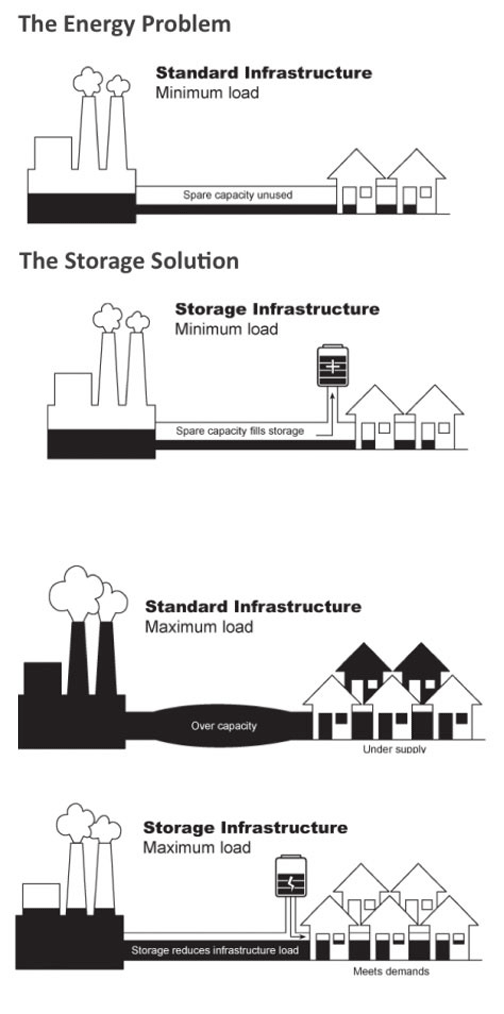
Battery storage was another popular choice. Many hinted at their own plans to introduce storage technologies at the commercial, industrial, and residential level. As one said: Everyone seems to think you need a lot of storage to make a difference, but this is not necessarily the case. Many households now use less than 5 kWh per day, so even 1-2 kWh
of storage could allow them to manage a large proportion of their peak demand.”
This could be done with ultra-capacitors, lithium-ion, or the CSIRO developed ultrabattery, which recently won the contract for the King Island renewables integration project, and has signed a deal with the largest lead acid battery manufacturer in the world.
The most depressing tip for 2013 was the prediction that regulators and governments will again fail to keep up with the pace of change, “leading to a complex, backward looking and confusing market picture dominated by the status quo and the powerful voices of incumbent players”, as one executive put it.
Here’s what the executives said in their own words:……… Read more at http://cleantechnica.com/2012/12/18/hot-tips-for-australia-in-2013-energy-storage-big-solar/#9GW7xQZjsFeMTM7L.99
1 This month

of the week – Australians for War Powers Reform (AWPR)
To see nuclear-related stories in greater depth and intensity
 Antinuclear