Queensland Premier will demolish environmental funding programs
 Australia: Queensland Premier axes environmental funds 28. MARCH 2012 PV Magazine, BY: SHAMSIAH ALI-OETTINGER The new premier of Queensland Liberal National Party’s (LNP) Campbell Newman plans to axe the state’s climate change and renewable energy programs, including funds allocated for solar flagship programs. The Newman government is said to be planning the abolishment of eight of the former Labor government’s environmental funds, the 300 million Australian dollars (AUD) climate change fund and the AUD50 million renewable energy fund.
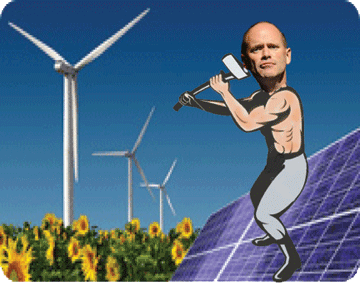
The other funds identified were the Queensland smart energy savings fund, the future growth fund, solar initiatives
package, waste avoidance and resource efficiency fund and the local government sustainable future fund. The FITs will however remain for Queensland’s home solar power systems at AUD0.44/kWh for surpluselectricity fed into the grids….
Victoria backs out too The state of Victoria also decided to back out of the 2020 20% emissions reduction target that was set by the Labor government. The conservatives supported this scheme when Labor was in power. The pressure mounted on the Victorian government from opponents such as Exxon Mobil.
: http://www.pv-magazine.com/news/details/beitrag/australia–queensland-premier-axes-environmental-funds_100006254/#ixzz1qXst4p48
Commercial Eco Whisper wind turbine installed near Tullamarine, melbourne
 The Eco Whisper Turbine is set to revolutionise delivery of renewable electricity supply to midsize commercial, manufacturing or industrial facilities, particularly in rural or remote locations that rely on diesel replacement.
Queensland renewable energy company Eco Whisper installs first commercial turbine, NewsMaker, , March 28, 2012 – The first commercial application of the Eco Whisper turbine, the world’s quietest 20kW wind turbine, is being installed and will be connected to the grid near Tullamarine in Melbourne. Produced and developed by Queensland-based Renewable Energy Solutions Australia (RESA), the 30 blade Eco Whisper turbine delivers virtually silent operation and produces up to 30 percent more power than conventional 3-bladed turbine designs.
Ideal for mid-sized facilities and perfect to replace diesel generation facilities, the Eco Whisper collects wind more efficiently and can operate in both high and low wind conditions. One turbine can produce enough power for around three average homes. Continue reading
Lake Macquarie Council not happy with NSW’s restrictions on wind farms
Concerns over wind farm guidelines, ABC News, Newcastle, March 28, 2012 Lake Macquarie Council will write to the state Planning Department outlining its concerns over the Government’s Draft Wind Farm Guidelines. The Planning Minister Brad Hazzard has described the draft document as the “toughest wind farm guidelines in Australia and possibly the world”.
But the guidelines have been criticised by environmentalists and renewable energy lobbyists as unnecessarily restrictive. Greens Councillor Hannah Gissane agrees. “We’ve endorsed a submission to the draft guidelines exhibition which would pick apart the bits and pieces of it that make the process too onerous,” she said.
“We’ve also endorsed wind farms as a key mechanism in achieving 20 per cent renewable energy by 2020. “And that any guidelines should be part of a strategic facilitative approach to renewable energy.”
Councillor Gissane says the guidelines are too tough and criticism of wind turbines is not warranted.
“Our beautiful Lake Macquarie has ash dams, has coal-fired power stations, has coal mines, has subsidence all from non-renewable energy sources,” she said.
“I’d like to see future for the city where the glint of a solar panel and the whirl of a wind turbine were actually features of the city.” http://www.abc.net.au/news/2012-03-28/concerns-over-wind-farm-guidelines/3916620/?site=newcastle
Australian renewables Venture Capital fund ready to be up and running
 Australian renewables VC fund ready to invest A$200m, Environmental Finance, 27 March 2012 An Australian renewable energy venture capital fund backed by the government is to start looking for investment opportunities.
The A$200 million (US$210 million) co-investment fund was set up in December, when the Australian government and Softbank China Venture Capital each provided A$100 million to the fund, which is managed by the Southern Cross Venture Partners (SXVP).
Last Thursday, the investment criteria were finalised, meaning the fund is now ready to invest, said SXVP.
The 13-year fund will provide start-up and early expansion capital to Australian renewable energy technology companies and assist with management skills needed to “commercialise their technologies”, said SXVP. “The fund’s investment approach is founded on the conviction that Australian entrepreneurs need to be internationally aware and
connected to be truly competitive,” said SXVP.
The Southern Cross Renewable Energy Fund will form part of the government’s $3.2 billion Australian Renewable Energy Agency when it starts on 1 July 2012…. http://www.environmental-finance.com/news/view/2394
Ballarat, Victoria launches drive for big solar energy
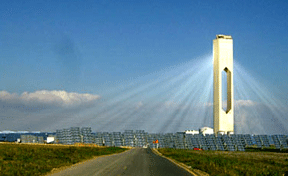 National campaign aims to shine spotlight on big solar. ABC Ballarat, By Margaret Burin, 26 March, 2012 Renewable energy advocates have begun a national campaign to promote large-scale solar power generation. About 50 groups around Australia are behind a campaign to push building large solar energy plants.
Supporters from Ballarat are the latest to launch the movement. Andrew Bray from the 100% Renewables group says large-scale solar energy is an underutilised resource in Australia. “We’re the sunniest country on Earth pretty much and we have no operating large-scale solar stations,” he says.
Mr Bray says large-scale solar power projects – which includes building solar towers and constructing panels in paddocks – are economically viable and can counter coal-fired power stations. “To give you some proportion, the normal coal-fired station is 750 to 1000 megawatts, and there’s no reason why solar power stations can’t scale up to that size.
“There’s a lot of know-how, lots and lots of know-how, in fact some of the major solar advances have come out of Australian universities and CSIRO, but industry needs to start putting out modest sized ones to learn how to do it and teach the financiers that the risks are quite modest.”
The Gillard Government has committed $10billion towards a new commercial fund, the Clean Energy Finance Corporation. Mr Bray says if parliament passes the legislation, it will help drive funding for big solar projects….
http://www.abc.net.au/local/audio/2012/03/26/3464085.htm
Australia needs to speed up its switch to renewable energy
The shift to wind and solar power in Australia has been driven in large part by the purchase of GreenPower, a scheme under which people pay slightly higher energy bills, with the difference invested in energy generated from renewable sources and bought by their energy provider.
Contrary to some reports, rooftop solar panels are not a middle-class luxury but a prudent, money-saving investment in more working-class and rural areas,
Winds of change blow, but breaking habits is no breeze, SMH March 23, 2012 Households have helped drive up the share of power production from renewables in Australia, but it still trails far behind the ambitious plans of other developed countries, writes Ben Cubby.
 When Sydney held the first Earth Hour event in 2007, renewable energy made up just under 5 per cent of the power produced in Australia. It now stands at 10 per cent, and that total must be doubled again over the next eight years if the national target for wind, solar, hydro and biomass energy is to be met.
This represents a vast, fast change for Australia’s coal, oil and gas-dependent society, yet the country still lags a long way behind most other developed nations. An index developed by the non-profit think-tank the Climate Institute and the energy company GE, released this week, placed Australia 16th out of the G20 countries for its ability to remain competitive in a low-carbon environment. Continue reading
Australian Renewable Energy Agency (ARENA) to kick off with large investment
 Fund ready to plough $200m into renewables sector, Climate Spectator, 23 Mar 2012 The Southern Cross Renewable Energy Fund is ready to begin investing in Australian renewable energy companies, the federal government said
today.The $200 million Southern Cross Renewable Energy Fund is now the largest venture capital fund dedicated to renewable energy in Australia..
… The Southern Cross Renewable Energy Fund will make equity investments in early-stage Australian renewable energy
companies to help them overcome capital constraints, develop technologies, increase skills and forge international connections. The fund will form part of the federal government’s $3.2 billion Australian Renewable Energy Agency (ARENA) when it commences on July 1. http://www.climatespectator.com.au/news/fund-ready-plough-200m-renewables-sector
Wind energy a winner for South Australia
Wind Power costs a lot less than the savings it makes – it’s like a preventative measure; an insurance that you buy against high electricity prices. In the case of South Australia, they did just that and it paid off.
Wind Works. It’s giving South Australia climate security through decarbonising its economy, energy security through reduced imports of expensive volatile fossil fuels. And it works so well that South Australia can now go further and target 50 per cent of the state to run on wind power and put much more solar on rooftops while planning to integrate this with
Baseload Solar Thermal plants installed in locations like Port Augusta.
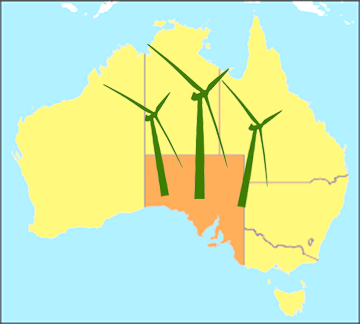
South Australia’s big win with wind, REneweconomy, By Matthew Wright 21 March 2012 Wind Power in South Australia has been a howling success; it now provides more electricity in the state than coal and in just a decade the wind industry has developed into one of the world’s leaders – and all to the benefit of South Australians. Continue reading
3000 jobs and cheaper electricity for South Australia with wind power
They are reportedly unpopular but a CSIRO report in January found there was stronger community support for wind farms across Australia than suggested by media coverage.
It found rural residents often backed the developments but did not seek media attention or political engagement to express their views.
SA wants to lead with renewable energy, Business Spectator, 22 March 12, South Australia’s Labor government wants to be a leader in renewable energy and wants more wind farms to do it. SA has more than half of Australia’s wind farms and they provided 26 per cent of the state’s electricity last year, up from 18 per cent in 2010, and less than one per cent just five years ago…… Continue reading
Australia’s Clean Energy Finance Corporation (CEFC) gets a good rap from business analysts

 The CEFC: A good first step, 19 Mar 2012, Climate Spectator, Kane Thornton A recent report by Deloitte, based on consultation with over 40 senior executives in Australian banks, super funds, venture capitalist firms and major investors, has revealed that they see clean energy as a good bet.
This should come as no great surprise: last year, local investments in renewable energy totalled $5.2 billion, while globally the pool reached more than $260 billion. What was perhaps surprising about the Deloitte findings was the
overwhelming support respondents gave to the government’s $10 billion Clean Energy Finance Corporation (CEFC), to be funded by carbon pricerevenue collected from the country’s 500 biggest polluters. Continue reading
Huge commercial rooftop photovoltaic solar system for Port Melbourne
 Australia’s Largest Rooftop Commercial Solar Power Project Announced, by Energy Matters, 19 Mar 12, NEXTDC Limited (ASX:NXT) (“the Company” or “NEXTDC”) has made another unprecedented move for the Australian data centre industry by committing to build what will be Australia’s largest privately-owned rooftop photovoltaic solar system at its Port Melbourne data centre called “M1”.
NEXTDC will spend approximately $1.2 million to install up to 400kW of solar panels to generate around 550 MWh (megawatt hours) of electricity per annum. A system of this size will offset over 670 tonnes of CO2 per annum. This equates to taking around 200 cars off the road, or powering NABERS 4 star office space for over 890 people….
NEXTDC has already incorporated energy efficient measures into its new-build data centres such as trigeneration plant and outside free air-cooling. After successful deployment of the solar panels at M1, additional investments will be made at their other data centres around Australia.
“We are proud to be the first data centre operator in Australia to invest in solar energy,” Mr Slattery said. “In fact, we are also committing to install up to 1MW of solar energy within the next 12 months at our upcoming data centre facilities”….
http://www.energymatters.com.au/index.php?main_page=news_article&article_id=3109
The Eco Whisper – small, silent wind turbine in operation in Geelong
New polish on the factory floor, The Age, Jo Chandler, March 16, 2012 Geelong manufacturer Austeng ticks many of the boxes nominated by industry gurus as crucial to survival in the globalised world. Is this modest firm the template for the future?……..
The latest proud product of their collective skills sits outside in the yard. It’s a prototype 21-metre high wind turbine, its blades whizzing silently in the breeze, generating 20 kilowatts of energy. It’s emblematic of the kind of future George is determined to be part of. He has put his money where his mouth is, buying back the Eco Whisper prototype that he had built for a renewable power company, and he estimates it will generate about a third of the energy required for his factory. Continue reading
National Party M.P. John Cobb urged to support new $10 billion renewable energy fund
 Participants are calling on member for Calare John Cobb to get behind the renewable energy fund.
Groups shine light on solar energy http://www.centralwesterndaily.com.au/news/local/news/general/groups-shine-light-on-solar-energy/2490146.aspx. Central Western Daily, BY TRACEY PRISK 16 Mar, 2012 ORANGE Climate Action Now and the Environmentally Concerned Citizens of Orange joined forces on the weekend to support a national push for the formation of a $10 billion clean energy fund. Continue reading
South Australia’s wind energy experience debunks the myths of the anti wind lobby
Australia can draw on real-life experience in South Australia. And it serves to debunk a few myths: wind does not need like-for-like back-up, or anything near it. It does achieve abatement, it does displace fossil fuel generation, and it is not anywhere near as expensive as some claim.
wind accounts for more than 20 per cent of SA’s electricity consumption, making it the second largest in percentage terms in the world after Denmark, and the highest on a per capita basis.
 State’s wind farms help debunk a few myths BY: GILES PARKINSON, The Australian March 16, 2012 IS wind energy as useless as its critics say it is? Is it really so expensive and ineffective that its emissions abatement is achieved at 10 times
the cost of gas-fired generation?
That was the conclusion of a British study sponsored by the Global Warming Policy Foundation, chaired by former Conservative chancellor and noted climate sceptic Nigel Lawson. Wind power upsets a few people, not least the climate sceptics who simply can’t comprehend its utility. Continue reading
Wind farms unhealthy for Australians, but not for 1 million Danes?
our wind resource is twice as powerful as in Europe.
 Australia’s twist in the wind, CLIMATE SPECTATOR: Matthew Wright, 13 Mar 2012 Denmark’s renewable energy achievements and its ambitious targets demonstrate a serious plan to lead the world in tackling global climate and energy security. Wind turbine technology will power half of its plan.
At the end of last year, Denmark announced that it will increase its share of wind power in the electricity supply mix from 25 per cent, its total today, to 50 per cent by 2020. The earlier plan was to do the same, but by 2025.
Denmark’s bullish drive towards wind energy comes from the public’s ongoing strong support for the industry and technology. Over one million Danes currently live within one kilometre of an operating wind farm. Many of these wind farms are being, or are scheduled to be, upgraded with newer turbines. This ongoing process of upgrades shows that support for wind energy stays strong in the local vicinity even after communities have lived with a generation of turbines that have served their useful lives.
Denmark will reach its 50 per cent wind power target through three main tracks. They’re building a generation of new onshore wind farms as well as the establishing a brand new offshore wind industry. A very important part of the plan involves the repowering of existing wind farms. Continue reading
1 This month
7 April – WEBINAR – Australia and the Doomsday Clock – Preventing nuclear war through NoFirstUse and other policies
Online | Tuesday April 7, 4:00-5:30pm, Australian Eastern Time / 8:00-9:30am Central Europe Time
– Access the registration link
15 April – Zoom –Nuclear Power is Not the Solution
Apr 15, 2026 01:00 AM in Canberra, Melbourne, Sydney

Join the International Physicians for the Prevention of Nuclear War (IPPNW) on Tuesday, April 14th for a timely webinar exploring the risks associated with nuclear power and challenging the myth that it offers a simple, safe, carbon-free solution to the climate crisis

21 April Webinar: No Nuclear Weapons in Australia
Start: 2026-04-21 18:00:00 UTC Canberra, Melbourne, Sydney (GMT+10:00)
End: 2026-04-21 19:30:00 UTC Canberra, Melbourne, Sydney (GMT+10:00)
Event Type: Virtual
A virtual link will be communicated before the event.
Host Contact Info: australia@icanw.org

of the week – Australians for War Powers Reform (AWPR)
To see nuclear-related stories in greater depth and intensity
 Antinuclear