Turnbull lies – calling coal a “dispatchable”power source
 The new policy redefines coal as dispatchable, despite it having the opposite technological characteristics.
This is not an entirely new approach. Before the government  decided to abandon the proposed Clean Energy Target it put a lot of effort into redefining coal as “clean”.
The government’s energy policy hinges on some tricky wordplay about coal’s role https://theconversation.com/the-governments-energy-policy-hinges-on-some-tricky-wordplay-about-coals-role-85843?utm_source=twitter&utm_medium=twitterbutton, The Conversation, The most important thing to understand about the federal government’s new National Energy Guarantee is that it is designed not to produce a sustainable and reliable electricity supply system for the future, but to meet purely political objectives for the current term of parliament.
Those political objectives are: to provide a point of policy difference with the Labor Party; to meet the demands of the government’s backbench to provide support for coal-fired electricity; and to be seen to be acting to hold power prices down.
Meeting these objectives solves Prime Minister Malcolm Turnbull’s immediate political problems. But it comes at the cost of producing a policy that can only produce further confusion and delay.
The government’s central problem is that, as well as being polluting, coal-fired power is not well suited to the problem of increasingly high peaks in power demand, combined with slow growth in total demand.
Coal-fired power plants are expensive to start up and shut down, and are therefore best suited to meeting “baseload demand” – that is, the base level of electricity demand that never goes away. Until recently, this characteristic of coal was pushed by the government as the main reason we needed to maintain coal-fired power.
The opposite of baseload power is “dispatchable” power, which can be turned on and off as needed.
Classic sources of dispatchable power include hydroelectricity and gas, while recent technological advances mean that large-scale battery storageis now also a feasible option. Continue reading
Turnbull’s National Energy Guarantee works against battery energy storage
Battery storage proponents despondent about future under National Energy Guarantee, http://www.abc.net.au/news/rural/2017-10-19/concern-energy-policy-will-stymie-growth-in-battery-storage/9061948, ABC Rural, By Babs McHugh, Some in the fledgling tech-metals mining and processing industry are dismayed that the Federal Government’s new energy policy does not appear to support renewable energy storage such as batteries.
Australian Vanadium chief executive Vincent Algar said the National Energy Guarantee (NEG) unfairly pitted the batteries and renewable energy storage sector against fossil fuel electricity producers such as oil and gas.
“With coal and gas considered a dispatchable energy source under the NEG, what incentive will there be to source dispatchable energy from a battery?” he said.
Dispatchable power can be turned on and off and used immediately as needed.
The NEG will mandate that energy retailers need to buy a certain amount of energy from dispatchable sources, which include coal, gas, and pumped hydroelectricity storage.
Lower cost makes coal and gas more attractive
Mr Algar, whose company will mine and process vanadium, as well as promote vanadium battery technology, believes pure economics dictates that energy retailers will go to the much cheaper coal and gas producers.
“If a company is building a renewable energy project, what incentive will there be for them to put that dispatchable energy in the form of a battery?” he said.
“On top of that is the removal of subsidies for renewable energy, and no clean energy target, so it further reduces any incentives.
Mr Algar is also concerned the NEG will bring to a halt the research and development of advanced renewable energy and battery technologies.
“Australia has the runs on the board. It has invented things like the flow battery [which uses vanadium], and they’re doing brilliant work in eastern states that will improve the efficiency of solar panels, for example,” he said.
“These are developments that will generate jobs and make us a net exporter of renewable technology, but this policy could really put a dampener on that.”
Does Western Australia need its own renewables target?
National Energy Plan: Does WA need its own renewables target?, ABC, By Nicolas Perpitch, 19 Oct 17 The Federal Government’s flagship new energy plan was signed off by the Coalition partyroom this week with great fanfare — but there’s growing uncertainty about what it means for WA.
The McGowan Government has not yet received a briefing on the national energy guarantee (NEG) policy, which is designed to operate through the National Energy Market.
WA is not a part of this market.
The new policy will see the Clean Energy Target and subsidies for renewables cut in 2020, and Prime Minister Malcolm Turnbull says there will be an opportunity to import the principles of the new system into the WA market.
While the general consensus — including from Energy Minister Ben Wyatt — is that there will be no immediate impact on WA, some in the state’s energy sector are concerned.
Solar ‘may still need boost’
Solar panel distributor and managing director of BayWA Renewable Energy Durmus Yildiz said the Government had not considered whether the fledgling solar industry was able to compete with other providers………
Energy Minister Ben Wyatt has already flagged the possibility of WA following other states and setting its own renewable energy target (RET) once the Clean Energy Target is cut.
Sustainability Energy Now WA chairman Ian Porter said such a move would provide certainty to the market.
“It provides an indication to investors that their policies are favourable to ‘x’ amount of generation being put into the system via renewables,” Mr Porter said. “It provides certainty. Investors want certainty. People know then the target is set and they can bid for it.”
Murdoch University Engineering and Information Technology School lecturer Tania Urmee said it would replace lost federal incentives.
“The cost of renewable energy technology is going down, so if the states have their own policy and their own trigger for renewable energy, that will be really good,” Dr Urmee said.
“And I think that keeps (investment) going.”…….http://www.abc.net.au/news/2017-10-19/energy-reform-explainer-how-will-it-affect-wa/9065974
20 October Reneweconomy News
 RenewEconomy
-
-
Why Turnbull’s plan could be disaster for renewables, climate, pricesNEG appears to be the most ill-considered, poorly detailed and potentially useless policy that anyone can remember, and a disaster for renewable energy, climate targets and consumer prices. It appears to be the work of Australia’s so-called “energy mafia”, hungry to retain power of incumbent oligopoly.
-
It’s the end, not the means that countAmongst all the sound and fury regarding the Government’s energy plan there is a central question going unanswered – what is the level of emissions reduction being proposed by the Government? And at what cost?
-
The no-name policy with little chance of reducing power pricesThe runway to strong emission reductions at an affordable price is at risk of being thrown away under the Coaliton’s new policy, which could require retailers to buy the output from its own expensive Snowy Hydro project. The energy mafia would approve.
-
States gobsmacked by lack of detail, research in Turnbull’s NEGStates stunned by lack of detail in new energy policy. In a testy phone hook-up they were told all the government had was a press release and an eight-page letter.
China set to add 50GW new solar PV in 2017China has installed 42GW of new solar PV in 2017 so far, putting it on track to reach a record 50GW for the year. Meanwhile, in battery storage…The NEG: A carbon price by any other nameAssuming it is implemented, the Turnbull government’s National Energy Guarantee will in effect establish a de facto price on carbon emissions from the power sector.Replacing the Clean Energy Target with a dirty one?The decision to walk away from a Clean Energy Target makes no sense. But small communities will forge ahead with the transition to renewable energy. -
Why Turnbull’s energy plan could be disaster for renewables, climate, prices
 REneweconomy, By Giles Parkinson on 18 October 2017 http://reneweconomy.com.au/why-turnbulls-plan-could-be-disaster-for-renewables-climate-prices-57822/
On the face of it a twin-pronged system focusing on reliability and environmental outcomes could have appeal. But we just don’t know because the details of Malcolm Turnbull’s National Energy Guarantee (NEG), and even the basics of how it will work, have not been explained.As one clean energy advocate said on Tuesday: “We’re still trying to understand whether we love or hate the NEG”. Part of that hesitation is based around the oft-made assumption that it might be better to have something, rather than nothing. But that remains to be seen.
The mainstream media certainly embraced it, but analysts see red flags all over the place – it is potentially bad news for renewables, bad news for emissions, and bad news for prices. It is potentially Turnbull’s energy trilemma turned upside down.
Most of all, the proposal appears to be the most ill-considered, poorly detailed and potentially useless policy that anyone can remember – the work of Australia’s so-called “energy mafia” hungry to defend the power of the incumbent oligopoly, commercial interests and their ideology.
The emissions reduction target that the ESB was asked to work with – a 26 per cent cut in electricity emissions from 2005 levels by 2030 – is manifestly inadequate, for even Australia’s current climate commitment (it loads a lot of effort on to other sectors), but also to the ultimate goal of capping global warming well below 2°C.
Even Origin Energy recognises this, noting the cavernous gap between the Paris target and the current emissions trajectory, a trajectory made worse by the government’s hint that any emissions targets will be “back-ended” to 2030. Continue reading
Turnbull govt – dumping clean energy target for “national energy guarantee”
 Turnbull dumps clean energy target for “national energy guarantee”, REneweconomy, By Giles Parkinson on 17 October 2017 (note: This story updates a previous article, based on the release of further policy details).
Well, looks like he has actually done it. The Turnbull government has formally abandoned the idea of a Clean Energy Target, proposed by chief scientist Alan Finkel and endorsed by nearly everyone, in favour of a new policy that will protect fossil fuel generation and slow down the uptake of renewable energy.
The new National Energy Guarantee marks a major switch in government policy – at least on the face of it. But the major problem is, we just don’t know because there are so few details.
But it appears to hand extraordinary market power to the country’s big utilities and fossil fuel generators, and gives no obvious incentive to introduce new generation, which one would expect would be the key to lowering prices.
Dumped is any form of visible subsidy scheme – be it a renewable energy target, or carbon price, or clean energy mechanism – in favour of changes to energy market rules that put an additional burden on retailers for a “reliability guarantee” and an “emissions guarantee.”
But these guarantees can also be traded – in the form of contracts between utilities. Potentially, it will generate credits in dirty energy, as this table above [on original] illustrates.
Quite how this works is not clear, and energy participants were struggling to get their heads around it. They may struggle for a while, because the levels of these reliability and emissions guarantees have not been set, and the reliability settings will vary from state to state, depending on their level of wind and solar.
Western Australia, for instance, has been ignored and is not part of the plan, because it only applies to the National Electricity Market, which excludes WA.
It appears to allow enormous discretion on the part of the Australian Energy Market Operator and the Australian Energy Market Commission. Some described it as an emissions intensity scheme in disguise, but couldn’t be sure because of the lack of detail.
It also appears that retailers may be able to satisfy their emissions guarantee through international carbon markets. One thing is certain, the Turnbull government has undertaken not to go any further than its current Paris target of a 26-28 per cent reduction by 2030, and that is a blow to renewables.
This appears to be the minimum demand of the Coalition’s right wing, and is in effect an abrogation of the Paris climate treaty, which is to make all efforts to keep global warming well below 2°C.
The impact on the renewable sector is hard to predict, but it is clearly not good. Modelling for the government suggests that the share of renewables in total generation will be 28-36 per cent by 2030 – and the level of wind and solar 18-24 per cent.
This compares to a level of 42 per cent suggested by Finkel, Labor’s 50 per cent target, and the 70 per cent deemed necessary if Australia was to get serious about meeting the international 2°C target.
This new modelling represents only a modest increase in renewables, and possibly a virtual stop, particularly if it includes behind the meter rooftop solar, which it appears to do. If it does represent some sort of target, then it could likely bring new large-scale development of wind and solar to a halt…….
The fact that this proposal comes from the Energy Security Board also raises some questions. Finkel took nearly a year to put together his review and his painstaking modelling of a clean energy target.
The ESB, chaired by Kerry Schott, and including the heads of the AEMC, AEMO and the AER, was formed less than two months ago and only had its first meeting four weeks ago.
Little wonder that the details are so vague. Apparently it was delivered to the government last week. Investors may be mindful of Schott’s comments a few weeks ago: harnessing demand management in Australia, means “we can all stop worrying about building new plants of any description.”
The other issue about the ESB is that it is required only to look at the issue of energy security, not emissions. It appears to have been given the arbitrary number of electricity accounting for one-third of anticipated emission reductions by 2030. Who is going to do the rest?
But the involvement of the ESB has provided Turnbull with an element of political cover, saying that he was “relying on the experts”. Indeed, at the press conference, he refused to answer any question in detail, deferring instead to the members of the ESB.
Minutes later, in question time, it was obvious that the political rhetoric hadn’t changed. Quoting complete nonsense from The Australian and other conservative commentators, Turnbull claimed that the renewable energy target would cost $66 billion in renewable energy certificates, a cost imposed on consumers.
It’s rubbish, of course. Most new projects ascribe no value at all to those renewable energy certificates.
And it is this that raises concerns. The conditions of the right wing rump of the Coalition, which have been holding the government, and the nation, hostage to their demands, were laid clear by Craig Kelly, the climate change science denier who acts as chair of the Coalition’s environmental committee.
Kelly says the target must not allow renewables to get near 50 per cent, and must not go further than the 26-28 per cent committed by the Abbott government, and certainly not the 45 per cent emission cuts recommended by the Climate Change Authority, and other climate scientists, and endorsed by Labor.
In other words, it wants Australia to tear up its Paris climate commitment to keep global warming well below 2°C, and possibly as low as 1.5°C……
market power remains with the big generators – the very ones that have been dudding consumers on retail and wholesale costs for the last few years. The ESB modelling effectively locks in the recent high prices, offering only an 8-10 per cent fall over the next decade.
The ESB says this may translate into consumer savings of some $100 a year – over a 10-year period – over and above the Finkel Review. But it is not clear how if the wholesale savings are so small……. http://reneweconomy.com.au/turnbull-dumps-clean-energy-target-for-national-energy-guarantee-32239/
18 October REneweconomy news
-
Abbott 1, Consumer 0. Turnbull’s energy fudge locks in high pricesIf one thing is clear from the Coalition’s new energy policy announcement today, it is that Tony Abbott has won, and consumers have lost. Even in the most optimistic scenario presented by the government, energy consumers will see little reduction in their energy bills over the next decade. And that’s outrageous.
-
Origin teams with UK start-up in SA demand-response trialOrigin Energy rolls out flexible energy trial in South Australia, allowing commercial and industrial customers to align demand with renewables output.
-
Live: Turnbull unveils new energy plan – national energy guaranteeThe Turnbull Coalition government unveils its new energy policy.
-
Know your NEM: Laws of physics grind slowly, but surelyWith energy policy set to remain a political battleground in Australia, physics, in the form of global warming, will continue to gradually push decarbonization to the top of the policy agenda.
-
Can solar on the roof really power your EV?With China, India, Norway, UK, France and California planning to ban manufacture and sales of new internal combustion engine cars, and EVs on the rise, will a solar roof become popular add-on option for plug in EV’s?
-
Innovation: UNSW “microfactories” transform waste into green goldA team of Australian researchers is turning the notion of recycling on its head, while also building a new green manufacturing sector.
-
Battery storage? Australia’s rooftop solar boom has only just begunThe buzz might be about batteries, but the mass adoption of solar PV by Australian homes – and the efficient use of this asset – has only just begun, as prices reach levels that appeal to the late majority, and as early adopters look to upsize their systems.
-
A futuristic family car at the World Solar Challenge
Guardian 15th Oct 2017, A futuristic family car that not only uses the sun as power but supplies
energy back to the grid has been hailed as “the future” as the annual
World Solar Challenge wrapped up in Australia. The innovative bi-annual
contest, first run in 1987, began in Darwin a week ago with 41 vehicles
setting off on a 3,000km (1,860-mile) trip through the heart of Australia
to Adelaide. A Dutch car, Nuna 9, won the race for the third-straight time,
crossing the finish line on Thursday after travelling at an average speed
of 81.2kmh (55.5 mph).
https://www.theguardian.com/environment/2017/oct/15/this-is-the-future-solar-powered-family-car-hailed-by-experts
Small-scale solar cutting $billions from electricity bills
 http://www.theage.com.au/business/energy/smallscale-solar-cutting-billions-from-electricity-bills-20171012-gyzf2c.html, Cole Latimer, 14 Oct 17,
Small-scale solar systems have cut wholesale electricity costs by up to half in the past 12 months, a study has shown.
The report by consulting firm Energy Synapse, commissioned by a community-based organisation Solar Citizens Australia, found solar photovoltaic (PV) installations in NSW had saved consumers up to $2.2 billion from May 2016 to April 2017
During this period, small solar PV systems are estimated to have generated 1540 gigawatt hours of power within the state.
The report says the volume-weighted average price of wholesale electricity would have been between $29 and $44 per megawatt hour higher than the actual average price for the period of $88 per megawatt hour.
The study found that small-scale solar had the largest impact during February, when record heatwaves were experienced, reducing the volume-weighted average price of wholesale electricity by between $119 and $258 per megawatt hour.
There has been a massive increase in renewable energy investment and construction this year. New solar energy generation has grown by 50 per cent globally, according to a report by the International Energy Agency. The IEA’s Renewables 2017 report says 165 gigawatts of new energy came online from renewables as a whole – including solar, wind and hydro power.
“We see renewables growing by about 1000 GW by 2022, which equals about half of the current global capacity in coal power, which took 80 years to build,” IEA executive director Fatih Birol said.
“What we are witnessing is the birth of a new era in solar PV. We expect that solar PV capacity growth will be higher than any other renewable technology through 2022.”
In Australia, there are more than 40 large-scale renewable energy projects that have either started, or will start, construction this year.
Clean Energy Council chief executive Kane Thorton said this represented an investment of more than $8 billion.
“These 41 projects will deliver over 4330MW of new capacity, which is crucial to increasing supply in the energy market, replacing old coal-fired generation that continues to close, and ensuring downward pressure on power prices,” Mr Thornton said.
There are 26 projects being built, and another 14 projects that have secured finance with the expectation that construction will start before the end of the year.
“We have already seen six times the investment value in 2017 of what we saw in 2016, and the new capacity will also help with energy security,” Mr Thornton said.
“In 2016, the combined capacity from all projects completed stood at 264.1 MW. This year 2210.2 MW of projects have been committed and 1881.2 MW are in construction with a whole financial quarter still to go.”
Solar power juggernaut is catching Australia by surprise
Australia’s solar juggernaut is coming – quicker than anyone thinks, [excellent diagrams and graphs] REneweconomy By Giles Parkinson on 13 October 2017 It is perhaps not surprising that the fossil fuel industry has hit the panic button and is pushing hard for the Turnbull/Abbott Coalition government to dump the proposed clean energy target and replace it with something that might be called a coal energy target.
They can see what’s coming – and there is probably no better way to describe it than a solar juggernaut.
The fact that solar will become the dominant energy source appears to be under no doubt, even the International Energy Agency admits it. And the CSIRO and AEMO appear to be in agreement that even behind the meter solar will account for around half of all demand by the 2040s or 2050s.
But what if it happened a lot quicker than that? Australia’s grid prices have jumped again to absurdly high levels, and this has lit a fire under the rooftop solar market, which will be followed by a major push by corporate buyers into the large-scale market. The solar sector could boom in ways not previously imagined.
At this week’s All-Energy Australia conference he was asked to speak about the implications of a continued solar boom in the Australian energy market, and what it means for incumbent fossil fuel generators, and others – particularly the storage industry. It was a fascinating insight.
First of all, it should be noted that Hoogesteger focused only on solar – so his observations take no account of the 4.5GW of wind energy already in the market, and the likely doubling of that capacity in coming years (particularly as it defies doubters and matches the falling cost of solar)………
Hoogesteger says most forecasts are based around a continued linear uptake of solar, that puts the country’s capacity at about 21GW in the mid 2030s……… Base on his experience, with a near doubling of just rooftop installations, the massive investment in large-scale solar, and the technology’s falling costs, along with high grid prices, he says it could happen a lot quicker than that……http://reneweconomy.com.au/australias-solar-juggernaut-is-coming-quicker-than-anyone-thinks-70985/
14 October REneweconomy news
-
 How to fix Australia’s embarrassing failure in electric vehiclesTAI report shows 64% of all party supporters in favour of policies to increase EV uptake – so what aren’t governments doing?
 -
The UK Government has announced an ambitious new Clean Growth Strategy to drastically cut carbon emissions and combat climate change.
-
UK solar fund buys stakes in three Queensland projectsUK-based Foresight Solar Fund Limited continues Australian buying spree, taking shares in three Queensland projects under development.
-
Don’t waste time on CET – there are other options for renewables, efficiencyWe will never have an effective broad-based emission reduction policy – no matter who is in government. Best to look at alternatives, like reverse auctions.
-
NSW network to trial 1MWh grid support battery, as new suburbs boomMPower tapped by Endeavour Energy to install 1MWh battery on network in NSW, in a trial hoped to save $1m a year on grid costs.
-
Storage on hold as Victoria still reviewing battery tenderClock ticks down on Victoria government’s plans to have two large scale battery storage projects in place by January 1, with the winners still not known.
-
China halts more than 150 coal-fired power plantsChina is to stop or delay work on 151 planned and under-construction coal plants as Beijing struggles to respond to a flat-lining of demand for coal power.
-
Shark Tank’s Steve Baxter joins climate science deniers and islamophobes for Australian LibertyFestWhat do you get when you bring together some of Australia’s most fervent climate science deniers with anti-Islam activists, fledgling right-wing political groups, and an American “free market” Libertarian?
13 October More REneweconomy news
-
Victoria attracts another wind farm proposalAustralian outfit Synergy Wind has proposed building a 34 turbine wind farm in Victoria’s south-east.
-
Politics be damned – consumers jump aboard the energy revolutionAustralian energy politics might have reached peak stupid, but Australia’s energy revolution – led by innovators and incumbents alike, all focused on delivering smarter, cheaper power – is just hitting its stride. And consumers are getting into it.
What does “baseload power” actually mean? And do we need it ?
Base load power: The dinosaur in the energy debate http://www.abc.net.au/news/science/2017-10-12/renewable-energy-baseload-power/9033336 ANALYSISABC Science, By environment reporter Nick Kilvert, 12 Oct 17, Base load power is a term we’re hearing a lot in discussions about our energy future. But what does it mean, and is it really relevant?
Because wind and solar are intermittent, the argument goes, we need a constant power source chugging away in the background to cover supply when the sun goes down and the wind stops.
Key points:
The ‘base load’ concept is misinterpreted and outdated
Demand varies hugely and energy production needs to be responsive
Hydro can be used to balance intermittent solar and wind
But energy researchers say the term is a “dinosaur” that has been misunderstood, and that it no longer applies to our dynamic energy market.
What is base load power? Continue reading
13 October REneweconomy news
-
Solar park to drive plastic heliostat developmentA field trial to develop highly efficient solar energy heliostats made from plastic has opened in South Australia.
-
Smart grid, dumb grid: Conservatives hit peak stupid over demand responseTechnology troglodytes in conservative media have collective meltdown over “demand response” – a new initiative to encourage consumers, particularly industry, to shift loads to help manage demand peaks and moderate prices.
-
Award winners light the way for booming solar industryThe Clean Energy Council congratulates the winners of the 2017 Solar Design and Installation Awards, which were announced yesterday at the All-Energy Australia Exhibition and Conference in Melbourne.
-
Carnegie Clean Energy Board of Directors UpdateCarnegie is pleased to announce the appointment to its Board of Directors of two new, non-executive directors
-
Darius Salgo joins Wattwatchers team to drive business growth‘New energy sector’ innovator Darius Salgo is joining Wattwatchers in a part-time business development role with a focus on Australian and international market opportunities.
-
Telstra unveils its big battery – its nearly 10 times bigger than Tesla’sNever mind Tesla’s big battery in SA, Telstra has 1GWh of battery storage in its current fleet, and plans to put it to use on the energy market.
Australia’s climate policy just like Trump’s , while Chief Scientist Alan Finkel makes last plea for Clean Energy Target
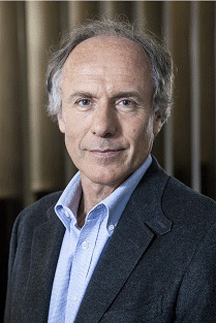 Chief Scientist Alan Finkel makes last ditch plea for clean energy target, SMH, James Massola, Cole Latimer, 9 Oct 17 Australia’s Chief Scientist Alan Finkel has made a last-ditch plea to save the proposed clean energy target, even as the Turnbull government signalled it will reject the proposal by the end of the year.
South Australian premier Jay Weatherill responded on Monday to the apparent standstill, saying the states should “bypass the federal government and provide investment certainty for the electricity sector” by adopting their own target.
The Turnbull government asked Dr Finkel to review Australia’s electricity market to set a policy path that would ensure reliability in the electricity system while also providing clear policy settings to drive investment in generation – something the business community has been demanding.
But in the face of strong opposition from sections of the Coalition backbench to the clean energy target, the Turnbull government delayed any decision on the target while adopting the other 49 recommendations in the Finkel review.
Now, it appears all but certain the target is dead in the water. The expectation is that by the end of the year, an alternative policy proposal that will focus on energy affordability and reliability – and removes incentives for renewable energy – will be brought by Energy and Environment Minister Josh Frydenberg to the cabinet and party room for approval.
Speaking at the Australian Financial Review‘s energy summit on Monday, Dr Finkel said his proposal offered a mechanism to solve the energy crisis and was still needed, while arguing that going back to coal was not the answer as Australia was making the transition away from fossil fuel energy………
The Australian Conservation Foundation’s chief executive, Kelly O’Shanassy, said: “Australia’s climate policy is now looking more and more like Donald Trump’s.” http://www.smh.com.au/federal-politics/political-news/chief-scientist-alan-finkel-makes-last-ditch-plea-for-clean-energy-target-20171008-gyww1o.html
1 This month

of the week – Australians for War Powers Reform (AWPR)
To see nuclear-related stories in greater depth and intensity
 Antinuclear