-
Queensland energy minister stands down amid email investigation
A blow to the state-based renewable energy and climate effort as Queensland energy minister Mark Bailey is sidelined by allegations of corruption.
-
Hazelwood gone today – Liddell gone tomorrow. Are we ready?
Early action on transmission should be at the top of the new Energy Security Board’s agenda if we are to connect enough wind and solar and hydro to replace retiring coal generators.
EnergyAustralia signs PPA for 150MW Neoen solar farm in NSW
EnergyAustralia has agreed to buy 100MW of output from planned Neoen solar farm in NSW – its 5th renewables PPA in seven months.
Rooftop solar shock for consumers, installers as rebate price falls by one-third
Price of rooftop solar to jump 10%, and catch many installers unawares, due to sudden fall in price of rebate certificates after record amounts of new solar in past 6 months.
-
Former Wallaby player and European energy veteran joins Wirsol Energy Pty Ltd
WIRSOL Energy, part of the WIRCON Group, has appointed Bill Calcraft as non-executive director of its Australian operations, to focus on expanding WIRSOL Energy’s relationships in Australia, bringing a wealth of experience in the European energy sector to WIRSOL Energy’s thriving business.
-
GreenSync awarded CEC innovation award
GreenSync has won the 2017 Clean Energy Council Innovation Award in conjunction with AusNet Services and Power Tech for their work on the Mini Grid project in Mooroolbark, Victoria.
-
Photon Energy mandates Pottinger as financial advisors for Australian project pipeline
Global solar power solutions provider Photon Energy NV has mandated financial and strategic advisory firm Pottinger Co Pty Limited, to advise on a capital raising for a solar PV project pipeline with a total generation capacity of over 1 GW in Australia.
-
Transgrid: 100% renewables is feasible and affordable
Network operator Transgrid says 100 per cent renewable energy is both feasible and affordable, and says only incremental increases in renewable energy will not achieve potential falls in the cost of electricity.
-
July 21, 2017
Posted by Christina Macpherson |
AUSTRALIA - NATIONAL, energy |
Leave a comment
-
Lawyer Steven Skala named new chair of Clean Energy Finance Corp
Lawyer and ABC director Steven Skala named chair of $10 billion CEFC, three women appointed to board.
-
Australia becomes 35th member of International Solar Alliance
Launched in Paris during the COP21 summit, the International Solar Alliance, spearheaded by India and France, has this week welcomed Australia to the fold.
July 21, 2017
Posted by Christina Macpherson |
AUSTRALIA - NATIONAL, energy |
Leave a comment
-
COAG: Can democracy weed out climate deniers?
Turnbull’s recent use of the word “delusional” reminds us that climate denial is still alive and kicking in mainstream Australian politics.
Australian coal, gas miners seek renewable energy projects
Australian oil, gas and coal mining body, NERA, issues call for cleantech, renewable energy partnerships, says timing is “spot on” for collaboration.
Base-cost renewables: When wind and solar finally kill coal
BNEF says building new solar plants will be cheaper than shovelling coal into existing coal generators within 15 years. This will trigger a complete re-make of the energy system, and a share of wind and solar far beyond that contemplated by the Finkel Review.
Frydenberg says Zibelman “doing really great job” at AEMO
Frydenberg defends AEMO chief Audrey Zibelman from attacks by conservative commentators.
-
-
Greens Senator for SA visits battery storage facility in Southern California
Australian Greens Senator for South Australia Sarah Hanson-Young has called on Malcolm Turnbull to intervene to end the delay in fixing energy market rules, including the 5-minute rule, to allow battery storage to compete fairly.
-
Leaders’ pledge to galvanise renewable energy leaders to champion gender diversity
Better gender diversity across the renewable energy industry requires leaders from both genders to step up and drive change, the Clean Energy Council said in launching its Women in Renewables Leaders’ Pledge today.
-
Business slowly wakes up to reality that renewables are cheap
ARENA report shows less than half Australian businesses have tapped renewables. But there’s no doubt the idea is starting to catch on.
July 19, 2017
Posted by Christina Macpherson |
AUSTRALIA - NATIONAL, energy |
Leave a comment
-
Coal has lost the energy war, so why are we still fighting?
The political fight for coal power in Australia is already lost. Meanwhile, we are missing all the clean energy opportunities that have fallen into our lap.
LO3 unveils ‘game-changing’ solar sharing microgrid in South Australia
US-based energy sharing company LO3 partners with Yates Electrical to build 6MW solar microgrid in SA Riverland region.
Turnbull’s coal delusions as COAG “changes course” on energy
If COAG did change the course of energy in Australia, it is not immediately obvious, given Turnbull’s coal delusion comments. Much will depend on how Finkel recommendations are put in place, and the storage equation and the make-up of the energy security board are critical.
Know your NEM: Generator Reliability Option might be dumb idea
The COAG endorsement of the Finkel Review (apart from the CET) won’t mean much in the short term, but the generator reliability option might be a dumb idea. Meantime, smart companies are showing how to save costs with solar and storage.
National Electricity Market has served its purpose – it’s time to move on
The NEM has failed. Its very narrow economic objective was to provide low prices, reliable and safe energy, and to act in the long term interests of consumers. It hasn’t.
July 19, 2017
Posted by Christina Macpherson |
AUSTRALIA - NATIONAL, energy |
Leave a comment
-
NSW launches home battery guide, as race to “plug hole” threatens industry
New South Wales issues set of home battery storage guidelines, as industry warns against “jumping to an endgame” on safety.
-
Peer-to-peer electric vehicle charging network launched in Sydney
Sydney start-up Everty launches P2P platform allowing electric vehicle owners to rent out their parking space, and home charger, to others.
-
Barnaby’s warning: Biggest threat to renewables is lights out in Sydney
Deputy PM says Sydney blackout could be end of road for renewables, although NSW Coalition minister earlier praised role of wind and solar in preventing blackout.
July 19, 2017
Posted by Christina Macpherson |
AUSTRALIA - NATIONAL, energy |
Leave a comment
 COAG splits over clean energy target, but 49 Finkel ideas approved http://reneweconomy.com.au/coag-splits-over-clean-energy-target-but-49-finkel-ideas-approved-97105/ By Giles Parkinson on 14 July 2017
Four Labor states and governments have formalised their push to purse their own clean energy target mechanism, officially breaking away from the federal government after the Coalition refused to endorse the Finkel Review’s recommendation on the issue.
The COAG energy council meeting in Brisbane endorsed 49 of the 50 recommendations from the Finkel Review, and endorsed the decision to get rid of the “limited merits review” that affects network spending. However, the federal government said it could not commit to a clean energy target.
South Australia, Victoria and Queensland, along with the ACT, said they would ask the Australian Energy market Commission to study how a CET might be implemented by the states saying “they can’t wait any longer”.
It is not clear how long this will take, and how quickly legislation can be introduced, or if it can survive state-based partisan politics given that both the South Australia and Queensland Labor governments are facing elections in the next 12 months.
The role of the ACT is also unclear, given that it will reach its target of 100 per cent renewable energy by 2020.
These same states this week all committed to zero net emissions by 2050, in a ceremony marking the visit of former vice-president and climate campaigner Al Gore.
“It is incredibly frustrating that despite the overwhelming community support for a market mechanism, the Federal Government is still resisting committing to all 50 Finkel recommendations,” South Australia energy minister Tom Koutsantonis said in a statement.
“Opposition from the coal lobby and the right wing of his party is preventing the Prime Minister from acting in the interests of all Australians.”
The federal Coalition has been riven by divisions over the proposed CET, with conservative commentators unanimously condemning the idea, and the rump of Far Right Coalition MPs also voicing their opposition.
Federal energy minister Josh Frydenberg said COAG had agreed a “significant set of reforms …. to ensure a more affordable and reliable energy system.”
The recommendations include the creation of an Energy Security Board. Each jurisdiction will send through a name; and the next few weeks the states will agree on a chair and deputy chair. The other members will be the heads of the three main energy industry regulators, rule-makers and operators.
July 17, 2017
Posted by Christina Macpherson |
AUSTRALIA - NATIONAL, energy, politics |
Leave a comment
This government needs to get its head around renewables
Peter FitzSimons
http://www.smh.com.au/comment/smh-letters/peter-fitzsimons-government-needs-to-get-its-head-around-renewable-energy-20170714-gxbn81.html
Queensland
Bonanza tipped from clean power plan
Mark Bailey
QUEENSLAND has seen a clean energy boom, with unprecedented levels of renewable energy investment. And it’s about to pay off.
http://www.couriermail.com.au/news/opinion/opinion-bonanza-tipped-from-clean-power-plan/news-story/8685e735a2b5b906661eda311889d395
Western Australia
Energy-saving hobbit house in WA’s South West
A man from the small West Australian town of Quindalup lives in a home covered by almost 1,000 tonnes of dirt and is proud to refer to himself as a modern-day hobbit.
http://www.abc.net.au/news/2017-07-15/quindalup-man-builds-hobbit-house-to-save-on-energy/8711758
July 17, 2017
Posted by Christina Macpherson |
AUSTRALIA - NATIONAL, efficiency, energy |
Leave a comment
 States harden threat to got it alone on clean energy target, THE AUSTRALIAN, 15 July 17 ROSIE LEWIS, Reporter, Canberra @rosieslewis and SID MAHER, NSW Editor, Sydney@sidmaher
Labor states have ramped up pressure on the Turnbull government to adopt a clean energy target but refused to lift bans on gas exploration, triggering warnings from industry leaders that time was running out for a national approach to lowering electricity costs and securing supply.
A crucial meeting of the nation’s state and federal energy ministers yesterday signed 49 of the 50 recommendations handed down by Chief Scientist Alan Finkel, but Queensland, Victoria, South Australia and the ACT stuck to their threat to “go it alone” on a target and moved to “immediately develop and design” options for implementing the mechanism………
The Australian Energy Council, representing major gas and electricity businesses, said brokering a national and bipartisan CET was fundamental to overcoming the energy crisis.
“Successful reform and lower energy bills will only come from bipartisan support and national implementation. Investment behind this reform will run for decades, so we need to find broad and enduring agreement to give it the confidence to proceed.’’
Key Finkel recommendations agreed to at the Council of Australian Governments Energy Council meeting in Brisbane include an obligation on intermittent sources of generation such as wind and solar to provide appropriate levels of backup power to guard against blackouts; a requirement for large generators to give at least three years’ notice before closing; and the establishment of an energy security board to scrutinise the National Electricity Market’s health, security and reliability.
The states also backed the federal government’s decision to abolish the Limited Merits Review — a tool the government says has been used by power companies to increase electricity prices — and accelerate the timetable for gas pipelines reform.
The price and availability of long-term electricity retail contracts will be published so big consumers can understand the market they are competing in.
Grattan Institute energy director Tony Wood said the only factors likely to drive any easing of prices were a decision by the Queensland government to order its generators to lower their returns, and the final commissioning of the Gladstone LNG export facilities, which could see more gas made available for domestic use and ease gas prices……
The Australian Pipelines and Gas Association was dismayed that energy ministers had brought forward reforms to pipeline operations by a month. Information disclosure and arbitration rules will now begin on August 1.http://www.theaustralian.com.au/national-affairs/climate/states-harden-threat-to-got-it-alone-on-clean-energy-target/news-story/2cd2a87bd563c1e940aeeee83a831cc2
July 15, 2017
Posted by Christina Macpherson |
ACT, energy, politics, Queensland, South Australia, Victoria |
Leave a comment
Zibelman is not on board the coal-power train with former Prime Minister Tony Abbott, Nationals leader Barnaby Joyce and Jones.
Views such as Jones’s are alien to virtually anyone who works in – or closely observes – the energy industry.
Energy executives are impressed. “I was quite buoyed by Audrey’s approach on demand response,” said Steven Neave, head of electricity networks for Powercor and Citipower, the largest Victorian distributor, who attended the CEDA lunch.
Zibelman said while the CET and consistent national policy would be useful for energy companies – because it would make their investment decisions easier – it wouldn’t make much difference to AEMO’s actions because the shift to renewables is happening and they have to deal with it.
How has she done this? In one word, “energy”.
Energy policy has become one of the most polarising issues in the country. Electricity and gas prices are soaring, blackouts and shortages plagued South Australia, NSW and Victoria last spring and summer, and debates about whether wind and solar power are to blame – even whether they can “kill people” – have hit fever pitch.
Zibelman landed in this cauldron in March, fresh from New York, to run the Australian Energy Market Operator – one of three agencies responsible for delivering stable, secure and affordable energy markets.
She is a cleanskin in the local energy debate but is hugely experienced, most recently as chair of the New York state utilities regulator–- responsible for implementing New York’s pro-wind and solar “Reforming the Energy Vision” plan – under Democratic governor Andrew Cuomo. Before that she was chief operating officer of PJM, a huge utility company covering 13 north-eastern states and Washington DC. Continue reading →
July 15, 2017
Posted by Christina Macpherson |
AUSTRALIA - NATIONAL, energy, politics |
Leave a comment
 Josh Frydenberg warns states against going it
  alone on clean energy target, The Age, Adam Gartrell, 14 July 17 The Turnbull government has warned the states their threat to “go it alone” on a clean energy target will only create chaos and inefficiency in the nation’s electricity system.
Energy ministers will clash on Friday as the states seek to pressure the Turnbull government to decide whether it will adopt a clean energy target – the key recommendation of Chief Scientist Alan Finkel’s review of Australia’s energy security – despite ongoing internal divisions over the policy proposal.
Led by South Australian Treasurer Tom Koutsantonis, the Labor states on Thursday threatened to bypass the federal government altogether. Without swift progress on Friday they would ask the Australian Energy Market Commission to model how a state-based target would work, Mr Koutsantonis said.
“The time to act is now – Australian households and businesses cannot be held hostage by the impotence of the federal Liberal government,” he said.
But federal Energy Minister Josh Frydenberg cautioned against the move, urging patience from the states…..
The renewed debate over Finkel came as a Liberal backbencher came under heavy fire for suggesting “people will die” as a result of renewable energy subsidies……http://www.theage.com.au/federal-politics/political-news/josh-frydenberg-warns-states-against-going-it-alone-on-clean-energy-target-20170713-gxafok.html
July 14, 2017
Posted by Christina Macpherson |
AUSTRALIA - NATIONAL, climate change - global warming, energy, politics |
Leave a comment
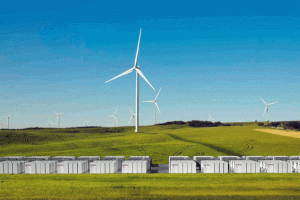 What Elon Musk’s investment tells us about our energy crisis, The Age, Perry Williams and Jason Scott JULY 14 2017 – Elon Musk’s intervention in Australia’s energy crisis is widening a divide over the future of coal.
The billionaire Tesla founder, who’s promised to help solve South Australia’s clean energy obstacles, sees no place for the fossil fuel. That conflicts with the federal government’s push for it remaining a mainstay source of electricity generation, as well as the “clean, beautiful coal” technologies that US President Donald Trump sees helping to save American mining jobs.
“Coal doesn’t have a long-term future,” Musk told reporters in Adelaide last week during a short trip to Australia. “The writing’s on the wall.” His declaration in energy-strapped South Australia, where the 46-year-old entrepreneur announced plans to build the world’s biggest battery to support the state’s blackout-plagued power grid, has rankled politicians.
Energy minister Josh Frydenberg, 45, accused the state of tapping a celebrity to paper over its patchy clean energy record. Tesla’s battery plan “is a lot of sizzle for very little sausage”, Frydenberg, a member of the conservative Liberal-led federal government, said on Monday. Deputy Prime Minister Barnaby Joyce, 50, said Musk’s plan “doesn’t make a hell of a lot of difference” to the nation’s struggles over energy security.
Most of Australia’s states and territories – free to determine their own energy and climate policies independent of the national government – beg to differ. Just hours after Musk’s announcement, the neighbouring state of Victoria closed the door on new coal-fired power stations, saying energy companies would rather invest in renewables.
Adani project
Queensland, where India’s Adani Group is planning to develop the $16.5 billion Carmichael coal mine, expects a move to clean energy will completely wipe out its carbon emissions by 2050.
Energy policy is a fraught subject with a push by the majority of Australians for more renewable power sources from the Australian majority is clashing with the government’s political imperative to keep a lid on soaring power prices. Currently, some 76 per cent of Australia’s electricity is drawn from coal-fired power stations which, while a cheap supply source, are at odds with a commitment to lower climate emissions……
The economics of building new coal plants don’t stack up and increasingly renewables will dominate base-load power, AGL chairman Jeremy Maycock said last week. Australians overwhelmingly want the government to focus on clean energy, according to a June poll by the Sydney-based Lowy Institute.
‘Highly improbable’
“It’s highly improbable that AGL will be constructing new coal-fired power stations because we don’t think the economics are likely to favour that,” Maycock said in a phone interview. “As the largest generator, we want to play our fair share in the country’s emissions reduction targets.”
For Prime Minister Malcolm Turnbull, banging the drum on coal is proving a treacherous task…….
the existing and perceived political and environmental costs attached to coal are deterring lenders.
“The high risk and cost associated with new coal plants make investors and financiers run a million miles from it in Australia,” said Ali Asghar, an analyst with Bloomberg New Energy Finance in Sydney. “The only way new coal could get built is if the government funds it and indemnifies any private entity against all future carbon risks.”
And doing so makes little sense, given that the cost of building cleaner, so-called high-efficiency, low-emission coal plants in Australia exceeds that of new projects relying on solar, wind, or gas, Asghar said.
“As solar and wind become cheaper and continue to undermine the economics of operating coal, investment in new coal plants become an even riskier proposition.” http://www.theage.com.au/business/energy/what-elon-musks-investment-tells-us-about-our-energy-crisis-20170714-gxb3i7.html
July 14, 2017
Posted by Christina Macpherson |
AUSTRALIA - NATIONAL, energy, politics, South Australia, Victoria |
Leave a comment
 Gore power to you: former vice-president launches Victoria’s green energy plan http://www.theage.com.au/victoria/gore-power-to-you-former-vicepresident-launches-victorias-green-energy-plan-20170713-gxaggu.html, Adam Carey, 13 July 17,
New battery storages that can deliver four hours of power to two regional Victorian towns of 100,000 people, and a solar farm that would power more than 400 trams are key projects in Victoria’s new plan to increase renewable energy supply and reduce reliance on burning coal.
 The battery will be up and running by this summer, the state government says, and will provide at least 40 megawatts of power in western Victoria, where the electricity network is relatively weak, boosting reliability in towns including Bendigo, Horsham, Ararat, Red Cliffs and Kerang.
Proposals that Bendigo or Ballarat lose electricity during a record-breaking east coast heatwave in February to guarantee power to NSW were angrily rejected by Victoria’s energy minister Lily D’Ambrosio, who told the Australian Energy Market Operator “it was absolutely not appropriate that Victoria had to pay consequences for failures in New South Wales”.
Victoria’s roll-out of renewable energy supply has gained extra urgency since the April closure of the Hazelwood coal-fuelled generator, which provided 20 per cent of the state’s baseload power supply.
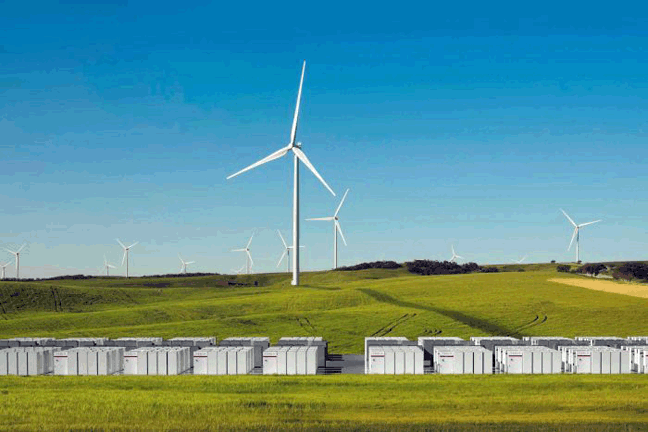
Tenders for the $25 million project are being evaluated by the Department of Environment, Land, Water, and Planning, and is part of a nationwide embrace of battery energy, including Tesla founder Elon Musk’s commitment this month to build the world’s largest lithium-ion battery in South Australia.
Grid-scale batteries can store renewable energy to be used at times of peak demand, improving energy security and shielding consumers from severe price spikes.
The Andrews Government announced on Thursday its plan to spend $146 million on a series of renewable energy initiatives in a bid to meet its target of 40 per cent green energy for the state by 2025.
The renewable energy action plan, launched by former US vice-president Al Gore, will underpin the state’s attempt to achieve zero net greenhouse gas emissions by 2050.
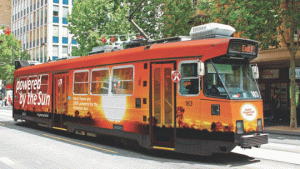
It includes $48.1 million for the purchase of renewable energy certificates, much of which will go towards solar power for Melbourne’s trams.
 A 75mw solar farm that will power Melbourne’s 410 trams is due to open in the state’s north-west late next year. The powering of Melbourne’s tram network with solar energy is notional. Electricity from the solar farm will flow into the general power supply and the government will purchase renewable energy certificates for 35mw of power, which is enough to operate the city’s tram system.
The plan also features $8 million for small-scale “micro-grid” initiatives to create power at a local level, independent of the energy grid.
Mr Gore said the renewable energy plan was a “highly impressive” example of a state taking the initiative to create jobs through projects that will cut carbon emissions.
“All over the world there has been a dramatic change in the marketplace, with electricity generated with renewable sources falling below the cost of electricity generated by fossil fuels,” Mr Gore said.
Before taking a short ride on an E-Class tram, Mr Gore predicted Melbourne’s solar-powered trams “will become a symbol of the renewable energy revolution worldwide”.
Energy and Environment Minister Lily D’Ambrosio said the renewable energy plan “represents the most significant government investment in renewable energy in Victoria’s history”.
She said the plan would also drive down power prices for Victorians, who face a 15 to 20 per cent hike in their power bills from January 1.
Ms D’Ambrosio said the global economy was moving away from coal-generated power and Victoria had no option but to head in the same direction.
“When we stand still at a national level we are actually taking Australians backwards,” she said.
“The only investment that is occurring globally in new generation is around renewable energy.”
The government’s launch of a new renewable energy plan follows recent comments by Ms D’Ambrosio that Victoria might work with other states and set a renewable energy target to the exclusion of the Turnbull government.
 The Turnbull government has not committed to a renewable energy target, despite it being one of the recommendations of the Finkel review it commissioned into Australia’s energy needs.
State energy ministers are due to meet with federal Energy Minister Josh Frydenberg this week, however, Mr Frydenberg has signalled there will be no resolution on a clean energy target for Australia at the meeting, because the federal cabinet is still debating the issue.
July 14, 2017
Posted by Christina Macpherson |
energy, Victoria |
Leave a comment
 Broadcaster Alan Jones launches ugly attack on AEMO’s Zibelman http://reneweconomy.com.au/broadcaster-alan-jones-launches-ugly-attack-on-aemos-zibelman-66561/, By Giles Parkinson on 14 July 2017
Prominent radio Broadcaster Alan Jones has launched an extraordinary and unhinged attack on Audrey Zibelman, the new head of the Australian Energy Market Operator, saying “that woman” should be “run out of town.”
In a reprise of Jones’ nasty attacks on former prime minister Julia Gillard over the carbon tax, and on the same day that the head of the Coalition’s energy policy committee Craig Kelly said “people will die” from renewable energy, Jones described Zibelman as “ideologically constipated” and “full of rubbish.”
“The woman is a global warming advocate and a promoter of wind turbines,” Jones said, while repeatedly confusing the name of the organisation she runs. “That woman, watch out for her, she should be run out of town”.
Zibelman was appointed early this year and has impressed nearly everyone in the industry with her drive, clarity and understanding of the issues in how to navigate the path through the energy transition.
Her crime? Her apparent support for renewable energy – which she accepts is the cheapest form of new generation, and her push for smart, demand side responses which she says is cleaner and cheaper than building new fossil fuel plants.
Jones was also apoplectic about Zibelman’s acceptance of climate science – which he rejects – and her comments that the Hazelwood closure would not put Australia’s energy security at risk. Jones described her as a “global warming hoax alarmist.”
Zibelman led the New York state’s ground-breaking “reform the energy vision” program which looked at using localised, renewable energy and micro-grids to boost energy security after Hurricane Sandy destroyed the centralised energy infrastructure and left millions without power for weeks.
Jones’ bombast is well known. But it is of great concern that the conservative attacks on all things clean energy – solar, wind, battery storage, carbon pricing and vehicle emissions – have now turned personal and ugly as the campaign by the fossil fuel lobby and their apologists turns even more toxic.
Conservative commentators, almost all as one, turned their barbs on chief scientist Alan Finkel even before the release of his report, for failing to toe the fossil fuel line.
They have continued relentlessly since the release and when it appeared it may be possible that the Coalition might consider his recommended clean energy target, and as Finkel and numerous others made the point that renewables are clearly cheaper than new coal or gas plants.
Interestingly, Jones wasn’t the only one to attack Zibelman, with Alan Moran, the former Institute of Public Affairs regulatory boss, accusing her of “being a refugee” from Hillary Clinton’s failed presidential bid.
Jones also led a conservative attack against Tesla found and CEO Elon Musk this week after the announcement of the 100MW/129MW battery storage installation in South Australia, apparently on the belief that it was designed to power the whole state, not just make up any potential shortfalls and boost grid security.
“Elon Musk won’t be able to produce a thirtieth of the energy demand of South Australia,” Jones said, echoing comments made by federal energy minister Josh Frydenberg, adding that Musk should also be “sent home” and not paid any money.
Jones was the instigator of a series of extraordinary attacks on former PM Gillard at the height of the carbon tax debate, appearing in Canberra, along with Tony Abbott, amid signs of “ditch the witch” and calling for her to be put “into a chaff bag” and hoisted into the sea.
Jones also led the “wind fraud” rally in Canberra in 2013 which barely attracted 100 people, and forced to admit he “got it wrong” after making ludicrous claims about the cost of renewable energy on the ABC’s Q&A program in 2015.
In 2012, in a humiliating episode, Jones and his Sydney radio station 2GB agreed with the country’s radio broadcasting watchdog to undergo training in fact-checking after complaints about a statement Jones had made about climate change.
Clearly, the training did not work.
July 14, 2017
Posted by Christina Macpherson |
AUSTRALIA - NATIONAL, energy |
Leave a comment
Queensland’s door would be open to Elon Musk: Trad, The Age, Felicity Caldwell, 13 July 17, Queensland’s door would be open to billionaire Elon Musk if he wanted to talk about a project in the Sunshine State, Deputy Premier Jackie Trad said following a leaders’ roundtable featuring former US vice president and climate change activist Al Gore.
Last week, South Australia announced Mr Musk’s Tesla company as the principal builder of the world’s largest lithium ion battery to expand the state’s renewable energy supply.
Mr Musk has promised to have the SA system installed and operating within 100 days, otherwise it will be free.
Ms Trad said Queensland would say yes to Mr Musk if he wanted to turn his attention to the state once the South Australian battery was built. “The door would be absolutely open,” she said.
Ms Trad said Queensland had already released an expression of interest process for a major solar battery manufacturing facility for Townsville…….
Would she hope Mr Musk might come knocking and set up a facility in Townsville?
“I think that would be incredibly exciting for Townsville and for Queensland as a whole,” she said.
On July 11, the Queensland government announced its plan for zero net emissions by 2050 and reducing emissions by 30 per cent on 2005 levels by 2030. Ms Trad spoke to Fairfax Media from Melbourne, where Queensland, Victoria, South Australia and the Australian Capital Territory have signed a “leadership declaration” at a roundtable attended by Mr Gore, who narrowly lost the 2000 US presidential election……
Australia’s states and ACT have agreed to work together to meet obligations under the Paris Agreement, a zero net carbon emissions by 2050 policy and to share information on their successes.
“We want to share innovation, understanding and learning in this space so that as a nation we can move towards what we committed to do and that is to do our bit, to reduce our emissions and keep global temperatures below an increase of 2 degrees,” Ms Trad said.
“We know that this [the Paris Agreement] is a big challenge, we know this is something that Australia signed up for.
“But what we also know is that the Turnbull government has failed to show the necessary leadership for us to move in that direction.”……http://www.theage.com.au/queensland/queenslands-door-would-be-open-to-elon-musk-trad-20170713-gxaty0.html
July 14, 2017
Posted by Christina Macpherson |
energy, Queensland |
Leave a comment
-
Redflow seeking $14.5m, shifts focus on lead-acid market
Redflow taps shareholders to back new focus on market “sweet-spot” including south-east Asia’s off-grid, telecom, commercial and industrial sectors.
-
What people just don’t get about electric vehicles
Germany’s election campaign shows we still have to get our heads around how fundamentally different electric vehicles will be.
-
How did Australia get this stupid about clean energy?
Australia’s public debate around clean energy plumbs new depths, with rebooted attacks on wind and solar, new attacks on battery storage and vehicle emission standards, and targeted attacks on key individuals. How did Australia get this stupid? And this ugly?
-
True Value Solar announces new managing director
One of Australia’s largest independent residential solar installers announces the appointment of former Conergy executive David McCallum as managing director.
-
CEFC tips $150m into logistics park, to slash truck freight emissions
CEFC backs landmark NSW project to slash freight transport emissions by shifting containers from road to rail, and powering operations with renewable energy.
July 14, 2017
Posted by Christina Macpherson |
AUSTRALIA - NATIONAL, energy |
Leave a comment







 Antinuclear