100%. Transitioning to renewable energy: The South Australian case
 The power of renewables and the South Australian example, Independent Australia 12 July 2017 While the Turnbull Government persists in spruiking “clean coal”, renewables continue to be the quiet achievers in energy generation. Jade Manson reports.
THE FUTURE of Australia’s energy generation has been a topic of impassioned debate in recent years.
This has been spurred on by sharp reductions in the installation price of renewable energy.
Solar and wind energy have now in many cases reached parity with installation prices for coal, and gas and is cheaper in the long-term. In December 2016, the World Economic Forum reported that solar and wind had the same installation price as fossil fuel companies in more than 30 countries. In 2016, clean energy investment grew by almost 50% in Australia. We have reached a tipping point, where investment in renewable energy will continue to rise, while investment in fossil fuels will fall.
Lazard’s energy analysis shows that the levellised cost of energy for wind and solar now outperforms fossil fuel sources of power. Levellised cost represents every cost component – installation, operations and maintenance and fuel costs – divided by the total energy generated during the plant’s lifetime.
Discussions comparing renewable and fossil fuel electricity generation usually centre around the up-front costs and do not consider the generation costs, or the social and environmental consequences of different energy sources. Renewable energy has significantly lower generation costs and does not require continued fuel supply. With installation costs now being similar – and likely to decrease significantly over the next decade – renewable energy is a tremendously worthwhile investment that will break even rapidly and continue to provide returns indefinitely.
This economic competition is making fossil fuel companies nervous and contributing to the heated debate around the issue. Fossil fuel companies still hold a significant amount of power and influence after decades of being at the top of the economic food-chain. Companies such as China National Petroleum, Sinopec Group, Shell Global and ExxonMobil are all in the top ten largest businesses globally, with over $100 billion in annual revenue. These companies are using the wealth they have accumulated since the beginning of the industrial revolution to influence politics and the global market toward their own interests.
This can be seen clearly in the fact that, despite the economic, health and social benefits of renewable energy, those in Parliament continue to support fossil fuel companies……..
Increasing renewable energy investment will also create more jobs and will allow Australians to capitalise on the renewable energy investment boom. While the Coalition declares “coal is good for humanity“, solar jobs are rising and in 2016, made up 665 of open energy job postings. According to Solar Citizens, renewable jobs increased by 34% in the first quarter of 2016. Indeed, data showed that solar positions made up 66% of open energy job postings, against oil with a 21% share and coal with 10%.
Transitioning to renewable energy: The South Australian case
South Australia has sped past its renewable energy target of 50% renewable generation eight years in advance, putting it on track to reach 100% renewable generation by 2030. This should be achieved more easily than in the previous 15 years due to the falling cost of renewable energy.
A deal has recently been made between the South Australian Government and Tesla CEO, Elon Musk, to install the world’s largest battery in South Australia………
Electricity prices in South Australia are very high compared to the Eastern States. The Eastern States are part of a highly interconnected grid, while South Australia only connects to Victoria via two locations. Typically 90% of energy prices in South Australia come down to generation (45%) and distribution (45%). The generation component is made up of several power sources, including gas, diesel and renewable energy sources. These suppliers bid into the market, and the lowest bids are accepted by the Australian Energy Market Operator (AEMO) until demand is reached. When renewable energy is in the mix, the market price for generation is very low.
The distribution component is a duopoly run by the companies ElectraNet (owned by State Grid Corporation of China, YTL Corporation Malaysia and Hastings Funds Management) and SAPN (owned by Cheung Kong Infrastructure Holdings Hong Kong). This international ownership of South Australia’s electricity grid has raised security concerns, as these companies may not act in South Australia’s best interests. A bid by Cheung Kong Infrastructure Holdings to buy the NSW electricity grid was knocked back in 2016, on national security grounds.
Due to lack of competition, there is the potential for unnecessary price increases by the power distribution companies. As renewable energy becomes more prevalent, power distribution will make up a larger share of energy costs and these problems will need to be addressed. Renewable energy infrastructure should lead to reduced electricity prices, due to their significantly decreased running costs. If this is not the case, then it calls into question the pricing by the power suppliers and distribution companies. If pricing becomes disproportionate to the service provided, then the government may need to introduce increased regulation or buy back the grid from private distribution companies.
You can follow Jade Manson on Twitter @JadeAlanaM. https://independentaustralia.net/environment/environment-display/the-power-of-renewables-and-the-south-australian-example,10495
14 July More REneweconomy news
-
As Tesla prepares to deliver its potentially game-changing mass market EV, Australia goes into meltdown about the very idea of improving vehicle efficiency.
-
Australia needs to cut electricity sector emissions by 60% by 2030Renewables must play key role in ramping up the abatement from the electricity sector in Australia.
-
AEMO: Politics needs to catch up with falling cost of wind, solar, storageAEMO chief Audrey Zibelman says politics needs to deal with falling cost of wind, solar and batteries, and customer preference around rooftop solar.
-
AES, Siemens combine to tackle Tesla, dominate battery storage marketTwo of biggest energy companies in the world join forces to dominate global battery storage market, at least at grid scale. Australia is high on their list of targets, with a series of projects that could dwarf Tesla’s newly announced project.
-
Genex solar/storage project shortlisted for funds from NAIFSolar PV and pumped hydro project proposed for abandoned gold mine in north Queensland shortlisted for funding by Northern Australia Infrastructure Facility.
-
Frydenberg says storage ratio for wind/solar to be decided by AEMOFederal energy minister says AEMO is best placed to assess what storage levels are needed to stabilise Australia’s grid.
-
New Energy Security Taskforce prepares Queensland for summerSecuring Queensland’s future energy supply was the number one agenda item when the newly commissioned Queensland Energy Security Taskforce met for the first time today.
-
Conservative billionaire building biggest wind farm in heart of coal countryA conservative billionaire is building the country’s largest wind farm. Republican lawmakers want to raise the tax on wind.
-
Clean energy spending hits 43% share of total supply investmentGlobal spending on energy fall by 12% overall in 2016 but clean energy spending is on the up.
Latst news from REneweconomy
-
Vehicle emissions standards: Why Australia needs them, and why they’re NOT a carbon taxLight vehicle emissions standards is good public policy that will deliver savings for motorists and cut Australia’s carbon emissions. No Elvis comeback required.
-
Another 1GW solar pipeline flagged, with eye to Australian coal hubsGerman Wirsol Energy partners with Australian Renew Estate to announce 1GW+ solar pipeline, including battery ready projects.
-
Cutting Edge grid controls could kill need for coalOne of the fiercest defenders of brown coal generators now says they can be replaced with wide adoption of voltage regulation technologies that can make there grid more efficient.
-
Canergie’s Grant funding update on wave, microgrid projectsOver the past weeks, Carnegie received approximately $850,000 of grant funding from ARENA and the European Regional Development Fund.
-
States threaten to go it alone on clean energy as Coalition loses plotStates threaten to go it alone on clean energy target as influential Coalition MP warns “people will die” because of renewable energy, and conservatives harden opposition to wind and solar and demand Australia returns to 19th century technologies.
-
Clean Energy Award finalists leading change in the energy sectorA community mini grid in Victoria which helped customers to halve their power bills over summer, an innovative approach to project finance, and electricity billing based on mobile phone plans are some of the finalists announced today in the 2017 Clean Energy Council Awards.
-
Unlocking the potential of Australia’s tidal energyAustralia’s tidal energy resource will be mapped in unprecedented detail in a new study funded by the Commonwealth Government through the Australian Renewable Energy Agency (ARENA).
Australian Energy Market Operator warns on over-loading storage on wind, solar
 AEMO cautious about over-loading storage on wind, solar farms http://reneweconomy.com.au/aemo-cautious-about-over-loading-storage-on-wind-solar-farms-18966/, By Sophie Vorrath & Giles Parkinson on 11 July 2017 The head of the Australian Energy Market Operator, Audrey Zibelman, has expressed caution about suggestions that new wind and solar farms should have to match their entire capacity with an equivalent amount of battery storage.
The need for wind and solar farms to include battery storage was raised by chief scientist Alan Finkel in his recently released review, although it left such requirements at the discretion of the AEMO.
However, energy minister Josh Frydenberg has been arguing, in both the Coalition party room and in public lectures, that the ratio should approximate one megawatt hour for every megawatt of installed capacity.
Although many wind and solar farms, both new and existing, are considering adding storage to shift their load or provide network services, the requirement of matching each MW for MWh is seen as overkill, and an attempt to turn wind and solar into baseload generators, when flexibility and reliability is the key.
“This is a dynamic issue. So having generators purchase a certain amount (of storage) and thinking (in terms of) once that is done, is probably not going to be the optimal way forward.
“Is that the optimal way to get resources in – in other words to have a static approach – or should we create a dynamic approach where AEMO identifies the amount of reliability that’s required; there’s a mechanism to procure it in the system; and we do it in the most economic way?” Zibelman said.
“We need to make sure the system remains reliable. …The concern I have… is that if you leave it and we set a static number, there’s only one thing that we can be clear about, and that is that it is probably going to be wrong. It’s either going to be too much or too little.
“So we’re going to want think about how do we approach this in a much more dynamic way, with changing the nature of the system.
”So, while I get the desire, I think we would like an opportunity to explore, is that the best result for consumers.”
The CSIRO and Energy Networks Australia have pointed out that most Australian grids will likely not need significant amounts of storage anytime soon because anything less than 30-50 per cent penetrations is “trivial”.
South Australia, however, is reaching saturation, which is why the world’s biggest lithium-ion battery storage project will be located there, followed by others which will allow more wind and solar farms.
Zibelman, speaking at a CEDA conference in Melbourne, said her organisation and others wanted to “get on with it” and implement some of the much needed reforms in the energy market, including some of those identified in the Finkel Review.
“100 per cent of people I have talked to across the industry are saying ‘we’ve got to get on with it,” she said.
“Paula and John and I want to get on with it. … we’ve got to make these changes. We don’t want to waste this crisis.”
Zibelman said she was looking forward to the COAG meeting on Friday and wants them to endorse broad recommendations of Finkel.
“(We’re not only solving issues for Australia) …we’re solving issues for the rest of the world,” she said. “We have to remember that economics is driving all of this. It’s not just about policy.”
Peter Martin on the role of gas in causing Australia’s high electricity prices
It’s not the wind, it’s the gas. Why power prices are going berserk http://www.brisbanetimes.com.au/comment/it-not-the-wind-its-the-gas-why-power-prices-are-going-berserk-20170712-gx9lxe.html, Peter Martin, 12 July 17
Prepare for a shock. On July 1 electricity prices jumped 15 to 20 per cent in NSW, 16 to 20 per cent in South Australia, 19 per cent in the Australian Capital Territory and 11 per cent in Western Australia.
All this, three years to the day since the Coalition axed the carbon tax.
Victoria gets six months’ grace, with increases of about the same size due in January.
And those are just the retail prices. Wholesale prices and those charged to businesses that buy directly are up an extraordinary 60 to 70 per cent. It’s renewables that are doing it, along with the closure of Victoria’s giant Hazelwood coal-fired power generator, according to Tony Abbott.
The truth is simpler, and speaks volumes about the appalling way we’ve handled energy planning.
In his latest emissions audit prepared for the Australia Institute, the Australian National University’s Hugh Saddler graphs the South Australian wholesale price since 1999 alongside the share of its electricity output produced by wind. There’s no relationship. As the share of wind has climbed to 45 per cent, the wholesale electricity price has moved both up and down in real terms, and even now is slightly below the peak reached in the days when wind powered just 5 per cent of the state.
His second graph shows an ultra-clear relationship. The electricity price has moved up and down in tandem with the gas price, almost exactly.
“The correlation is striking,” Saddler says. “It confirms that higher wholesale electricity prices, and hence higher retail prices, are almost entirely caused by higher gas prices.”
“A similar, though less stark effect is seen in the other mainland eastern states – this is not a malfunction of the National Electricity Market, but precisely how it was expected to operate.”
Gas is the swing fuel. Although it doesn’t supply a particularly large portion of Australia’s electricity, it usually provides the last bit when nothing else is available, and at those moments it determines the price.
Things were set up that way because back in the 1980s and 1990s electricity suppliers around the world realised they would need to transition to low-emission fuels. They wouldn’t go straight away to zero emissions because that would be expensive and low emissions weren’t yet required by law. Instead they met the future halfway, knowing that if instead of building new coal-fired power stations they built new gas-fired ones, they would be better able to deal with the carbon price or carbon rules when they came.
It helped that gas was ridiculously cheap.
But then at about the same time they moved towards a carbon tax, the Rudd and Gillard governments approved massive gas export terminals in Queensland with the ability to suck up gas from as far afield as Bass Strait and ship it to Japan.
For a while, gas prices actually fell as production ramped up in anticipation of the export deals, but couldn’t leave the country. Then, when the terminals were complete and exports began, prices went berserk. Whereas once it had cost gas-fired power stations very little to come in as the swing supplier, suddenly it cost them and their customers big-time.
And there are few other swing suppliers. Coal-fired plants usually can’t do it. They are either on or off, and they take a long time to turn on. Wind can’t do it. The blades are either turning or they’re not. Same with the sun. Only hydro-electricity is as good as gas at rapidly responding to peaks (better, actually) but when the water that turns the turbines is used up, it can’t turn them again until it rains.
Elon Musk and the South Australian government have begun to find a way out. The 100-megawatt battery farm the Tesla chief has promised South Australia (the biggest in the world) will indeed be tiny compared to South Australia’s needs, as Josh Frydenberg, Barnaby Joyce and all manner of Coalition MPs have been quick to point out. But, as the central role of gas has made clear, you don’t need to produce the bulk of the power in order to determine the price for power. What’s needed is to be able to provide the last bit, very quickly, when all alternatives have been exhausted. Far from creating the problem of high prices, South Australia may be able to help solve it.
And it’ll do something else. Its lights went out on September 28 when its gas and wind generators shut down during a storm. Most of them stayed off even after the storm was over because, just like gas cooktops, they can’t be started without electricity. Musk and South Australia are about to gift us a battery.
Shortcomings of the Finkel Energy Review
Finkel: Let’s not be railroaded into a bad deal on clean energy http://reneweconomy.com.au/finkel-lets-not-be-railroaded-into-a-bad-deal-on-clean-energy-77145/, By John Grimes on 13 July 2017 The last decade of climate wars has ground everyone down. People, understandably, want to see a resolution. They want to see a consensus on climate and energy policy and they have looked to the Finkel Review to provide that consensus.
Some have even gone so far as to say that a bad deal is better than no deal at all.
But a bad deal IS a bad deal and neither industry nor the community should put up with a climate change or energy agreement that locks in poor climate change and energy outcomes.
A false consensus has emerged over the Finkel Review and it is important to point out the significant weaknesses with this approach.
It is particularly important that State and Federal Energy Ministers, meeting tomorrow, do not lock in poor climate change and energy outcomes and continue to push for energy market reform.
The Australian Solar Council and Energy Storage Council, as peak national bodies for the solar and energy storage industries, strongly supported the Finkel Review as an independent exercise and we appreciated and applauded the consultation process undertaken by the Review.
The preliminary Finkel Review report stated “we have a once in a generation opportunity to reform the national electricity market” and we agreed.
We expected a blueprint for energy market reform, but the final Finkel Review report fell well short of that mark.
Instead of a blueprint, the Finkel Review delivered a set of piecemeal recommendations that do not represent a design for a 21st century electricity market or pathways to the necessary transformation of our electricity system.
The Finkel Review has five major shortcomings:
- Ignoring the evidence demonstrating the need for major cuts in greenhouse emissions from the electricity sector to meet current and future international greenhouse gas emission targets;
- Underestimating the transformation that is occurring and accelerating in the electricity sector and downplays the likely uptake of household batteries and smart energy systems and fails to recognise the capacity to integrate these systems by a transition to a distributed energy storage system, as envisaged by the CSIRO-ENA Energy Transformation Roadmap;
- Seeking to impose unfair obligations on new renewable energy generation whilst imposing no obligations on existing coal or gas-fired generators – requiring energy storage to be attached to specific projects rather than taking a network systems approach to energy storage will drive up the cost of new renewable energy projects;
- Recommending a Clean Energy Target and proposing emission levels which would lock in higher emissions, when its own evidence indicates the cheapest and most efficient option for the electricity sector are the ‘lowest’ emissions renewable technologies; and
- Recommending an additional regulatory body and giving existing energy regulators additional responsibilities rather than consolidating the number of regulators and reforming the regulatory environment.
- Greenhouse gas emissions
The Finkel Review has modelled the Federal Government’s emissions reduction target of a 26-28% reduction in Australia’s emissions by 2030, rather than responding to the recognised emissions reductions required to meet Australia’s current international treaty obligations.
Further the Review has recommended that the electricity sector targets should be proportional at 28% – ignoring that worldwide the electricity sector offers a greater opportunity for emissions reduction using existing commercial technologies and systems.
It is widely recognised that electricity generation is one of the easiest and lowest cost means of reducing emissions and that the electricity sector can contribute much more than a simplistic proportional share to achieve emissions reductions.
The Climate Change Authority has suggested the electricity sector could reduce its emissions by 66 per cent by 2030 to meet Australia’s international climate change commitments.
The Finkel Review should have modelled significantly greater reductions in electricity sector emissions and drawn its conclusions and recommendations from that.
Transformation of the electricity sector
The Finkel Review states “battery storage is poised to be the next major consumer-driven deployment of energy technology. Upfront costs for solar photovoltaic systems with storage are currently high, with long payback periods for most consumers.
Bloomberg expects the average payback period for residential consumers to fall below 10 years in the early 2020s, with around 100,000 battery storage systems to support rooftop solar photovoltaic generation predicted to be installed by 2020.”
The Australian Solar Council and Energy Storage Council is currently undertaking a comprehensive analysis of the Australian energy storage market and we estimate 120,000-500,000 battery storage systems are likely to be installed in Australia by 2020.
CSIRO and Energy Networks Australia have forecast there could be almost eight gigawatt hours of storage in Australia by 2020.
It is likely the Finkel Review will significantly underestimate the uptake of battery storage and the capacity to integrate residential and small business energy storage systems into a much larger peoples power plant or virtual power station.
This is not simply a large missed opportunity, it is a failure to plan for the likely reality.
The history of solar technology deployment shows us that cost reductions and uptake have always exceeded forecasts. Bloomberg itself draws attention to the innate and consistent conservatism in its new energy technology forecasts.
Generator Reliability Obligations on new renewable energy plants
The Finkel Review’s recommendation to require all new generators to have energy storage could significantly increase the number of large-scale energy storage projects up to and beyond 2020, although it may also artificially drive up the cost of large-scale renewable energy projects, reducing their viability.
This is a requirement not imposed on current generators of any technology. Coal and other fossil fuel generators, are intermittent generators: they provide firm power only when they are generating– and in Australia that is around 85% of the time. The other 15% is provided by providing additional capacity into the network.
The proposed Generator Reliability Obligation (GRO) will almost certainly be a higher cost approach than a market-based approach to firm capacity in the network.
It is discriminatory ultimately at the customers’ expense and ignores the engineering and network systems-based solutions that are being implemented world-wide to meet the outcomes sought.
The GRO may also ignore the potential for off-river pumped hydro to provide a range of services to the network including firm power to the grid complementary to variable renewable generators.
The Review has proposed a backward-looking engineering solution when it should have simply defined the outcomes desired.
The world is moving to transform grids to intelligent distributed two-way energy flow systems because they offer increased security, reliability and quality of supply at a lower cost than new fossil fuel or nuclear based generation.
There are more effective ways to add storage to the national electricity market through a system-wide approach.
One option would be to encourage the market to develop proposals through reverse auctions, which would determine the price and locations of energy storage systems. Another option would be through a capacity market.
Evidence was given to the Review on the importance of demand response and demand management tools and the critical role of digitisation and software management which it appears has not been understood.
Closure of coal-fired power stations
The Finkel Review has suggested there be a minimum notification period of at least three years for the intention to close coal-fired power stations.
This is an administrative arrangement with no financial or planning signals for closure and is not as efficient as a market mechanism. It provides no mechanism for the orderly closure of coal-fired power stations.
All this proposal does is to provide a small amount of certainty over a three-year period. It provides no means of ensuring continued operation, or operation on demand, and provides no specific incentive for new generation.
It also fails to match closures to emissions reductions. Less polluting power stations could close before more emissions intensive power stations.
We urge COAG Energy Ministers to take a different approach and develop a plan for the orderly closure of coal-fired power stations. We believe the model from the ANU, developed by Professor Frank Jotzo and others, offers a better path using market based mechanisms.
Clean Energy Target
The proposal for a Clean Energy Target appears to be a political solution to a political problem, rather than an attempt to introduce the most effective mechanisms for reducing emissions and encouraging renewable energy generation and energy storage.
The Australian Solar Council and Energy Storage Council support the continuation of current state government reverse auction programs in the absence of a national reverse auction scheme for renewable energy or a national price on carbon.
If the Government proceeds with a less efficient Clean Energy Target, the emissions intensity threshold must be set at a level that helps deliver Australia’s international climate change commitments and must be flexible enough that it can be changed to capture Australia’s future climate change commitments.
Governance
The National Electricity Market is not functioning effectively and the multitude of agencies responsible for the NEM adds to the confusion and inefficiency. Australia is the only country where the two energy market functions sit in separate bodies.
In its 2012 report on network regulation, the Productivity Commission was particularly critical of what it saw as the unusual role of AEMC in setting policy, rather than serving policy makers.
Unfortunately, the Finkel Review increases this complexity by recommending a new body, the Energy Security Board, and giving new responsibilities to existing agencies.
Governance arrangements need to be streamlined, with the Australian Energy Market Operator and the Australian Energy Market Commission merged. The new body should be led by someone who understands the extraordinary transformation that the electricity sector is going through globally and in Australia.
We believe that Energy Ministers need to take responsibility for preparing a national energy plan that takes a broader view of the changes needed for the future and puts implementation in the hands of governments as far as possible. The previous issues caused by outsourcing policy making to the AEMC should be avoided.
Other Matters
The Australian Solar Council and Energy Storage Council calls on all Energy Ministers to endorse the following measures:
- Establish a plan for the orderly closure of coal-fired power stations;
- Make action on climate change a key objective of the National Electricity Market and ensure that all climate change and energy policies are consistent with Australia’s international climate change obligations;
- Commit to at least 50 per cent renewables by 2030;
- Introduce a 5-minute settlement rule;
- Enable markets in peer to peer trading and demand response; and
- Replace the Australian Energy Regulator and Australian Energy Market Commission with a new combined energy market rule maker and regulator.
A bad deal is not better than no deal at all.
A bad deal locks in poor climate change and energy outcomes.
Energy Ministers still have a “once in a generation opportunity to reform the national electricity market” and we urge them to continue that work.
World’s first solar-powered train – for Byron Bay
Byron Bay to get world’s first solar-powered train, courtesy of a coal baron http://www.smh.com.au/technology/sci-tech/byron-bay-to-get-worlds-first-solarpowered-train-courtesy-of-a-coal-baron-20170702-gx31yo.html Marcus Strom, A coal baron is delivering the world’s first solar train to Australia.
And while bringing solar to Byron Bay might be a bit like taking coals to Newcastle, that’s just what the Byron Bay Railroad Company is doing. “I think this is a world first,” said John Grimes, chief executive of the Australian Solar Council, which is not connected to the project.
“There is a train in India that has solar panels to power lights and fans, but not a whole train.” The Byron Bay Railroad Company, operated by mining executive Brian Flannery, expects to have its two-carriage heritage train running before Christmas, said Jeremy Holmes, a spokesman for the company.
It will operate on part of the disused Casino-to-Murwillumbah line, which closed in 2004.
Dan Cass, a renewable energy specialist at the Australia Institute, said: “This is the first we have heard of a train this size that is literally solar powered, with PV modules on the roof.”
South Australia’s big energy storage battery
Tesla to supply world’s biggest battery for SA, but what is it and how will it work? ABC By political reporter Nick Harmsen and Alle McMahon, 7 July 17 The “world’s biggest” lithium ion battery is to be built in South Australia by Tesla and French company Neoen.
It is to be close to the French renewable energy company’s wind farm near Jamestown and ready by the start of summer.
What is it?
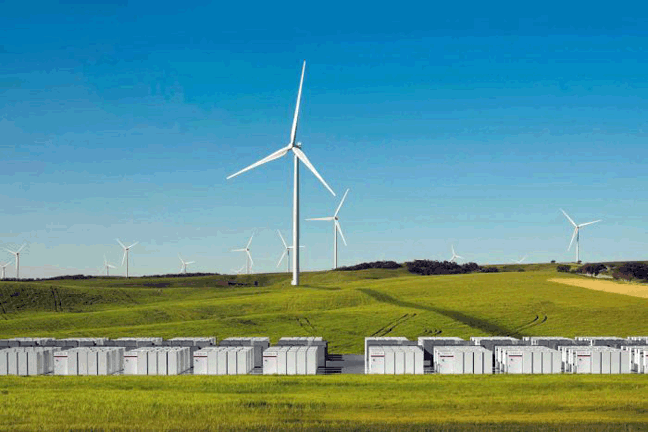
An array of lithium ion batteries will be connected to the Hornsdale wind farm, which is currently under construction in SA. It will look like a field of boxes, each housing Tesla commercial-scale Powerpack batteries.
The array will be capable of an output of 100 megawatts (MW) of power at a time and the huge battery will be able to store 129 megawatt hours (MWh) of energy so, if used at full capacity, it would be able to provide its maximum output for more than an hour.
It will be a modular network, with each Powerpack about the size of a large fridge at 2.1 metres tall, 1.3m long and 0.8m wide. They weigh in at 1,200 kilograms each.
How will it stack up against the next biggest?
It will have just slightly more storage than the next biggest lithium battery, built by AES this year in southern California. But Tesla’s 100 MW output would be more than three times larger than the AES battery and five times larger than anything Tesla has built previously.
The largest lithium ion battery storage system that Tesla has built to date sits on a 0.6-hectare site at Mira Loma in southern California.
American electricity company Southern California Edison was also involved. It has a storage capacity of 20 MW, or 80 MWh, and is said to be capable of powering 15,000 homes.
The California array took three months to build. Tesla says the lithium ion batteries in the Jamestown array will have a life of about 15 years, depending on their usage and how aggressively they are recharged.
The company says the battery components are replaceable and the circuitry should last 20 to 30 years……..
How will it be used?
Neoen said the battery would primarily provide stability for the power grid, something traditionally the domain of coal, gas and hydro, rather than wind or solar………http://www.abc.net.au/news/2017-07-07/what-is-tesla-big-sa-battery-and-how-will-it-work/8688992
Elon Musk to build South Australia’s big storage battery, as he promised earlier thisyear
Billionaire Elon Musk to build SA battery, – on July 7, 2017 Billionaire entrepreneur Elon Musk will build the world’s biggest battery in South Australia and if it’s not finished in 100 days, it’s free. Mr Musk first made the bold promise in a Twitter exchange earlier this year, as debate raged over South Australia’s energy woes.
On Friday he said he will stand by the pledge, which has been written into the contract to construct the 100 megawatt lithium ion battery. It will be more than three times larger than any storage station anywhere in the world. “That’s what we said publicly, that’s what we’re going to do,” he told reporters in Adelaide.
Mr Musk’s company Tesla will partner with French renewable energy group Neoen to build the battery near Jamestown in South Australia’s mid-north.
It will be paired with Neoen’s existing Hornsdale Wind Farm to store energy, stabilise and bring added security to SA’s electricity grid, and put downward pressure on prices.
It forms a key part of the state government’s $550 million energy plan which was developed in response to last year’s statewide blackout.
The clock will start ticking on Mr Musk’s 100-day commitment once regulators approve the project, clearing it for grid connection. He said he was confident he could deliver on his promise but admitted the project was not without risk.
“This is not like a minor foray into the frontier. This is going three times further than anyone has gone before,” he said. “The technical challenges are those that come with scale. When you make something three times as big, does it still work as well?” the Tesla boss said. “We think it will, but there is some risk in that.”
Mr Musk said a failure to deliver the project on time would cost his group about $50 million, though the details of the contract have not been revealed.
Premier Jay Weatherill said both Tesla and Neoen were experts in energy security and the project would place SA as a world leader in the integration of renewable energy.
He expects the battery to be up and running in time for next summer. “Battery storage is the future of our national energy market and the eyes of the world will be following our leadership in this space,” he said.
Clean Energy Council spokeswoman Natalie Collard said the pioneering project would set a benchmark for the rest of Australia and the world to follow. “The South Australian government has again cemented its place as a world leader in renewable energy and we look forward to other states following their lead,” she said.”These kinds of projects have a huge role to play in modernising Australia’s energy system and enabling much higher levels of renewable energy.”
Solar Panels on One-quarter of Australian homes
 One-quarter of Australian homes now have solar http://reneweconomy.com.au/one-quarter-of-australian-homes-now-have-solar-70886/, By Sophie Vorrath on 6 July 2017, One Step Off The Grid New data has confirmed the effects of a second rooftop solar boom taking place around Australia – driven by falling technology costs and increasingly volatile electricity prices – with nearly one quarter of all Australian households found to have invested in solar panels. The survey, published by Roy Morgan on Thursday, shows that on average almost one in four Australian households (23.2 per cent) own a “Home Solar Electric Panel”, as at March 2017. Uptake is shown to be strongest in South Australia, at 32.8 per cent; then Queensland, at 30.2 per cent; and Western Australia, at 26.6 per cent.
The numbers are in keeping with the findings of May 2017 data from SunWiz, which suggested Australian households – and businesses – were installing rooftop solar PV at a rate not seen since 2012.
In its May 2017 report, SunWiz said that a total of 5.7GW of rooftop PV had been installed on 1.7 million households and businesses at the end of May, capping off a record first five months of installs in any year in Australia’s history.
The survey, published by Roy Morgan on Thursday, shows that on average almost one in four Australian households (23.2 per cent) own a “Home Solar Electric Panel”, as at March 2017. Uptake is shown to be strongest in South Australia, at 32.8 per cent; then Queensland, at 30.2 per cent; and Western Australia, at 26.6 per cent. The numbers are in keeping with the findings of May 2017 data from SunWiz, which suggested Australian households – and businesses – were installing rooftop solar PV at a rate not seen since 2012. In its May 2017 report, SunWiz said that a total of 5.7GW of rooftop PV had been installed on 1.7 million households and businesses at the end of May, capping off a record first five months of installs in any year in Australia’s history.
And in Western Australia – as we reported here – the residential PV uptake has resulted in a dramatic reduction in both the scale and the timing of peak demand in the state, reducing peak demand by 265MW, or 7.2 per cent in the last summer. Continue reading
Latest renewable energy news from REneweconomy
-
Musk praises SA’s “gumption” for building global example of energy futureElon Musk says Earth can be “powered with solar and battery,” praises South Australia for its “gumption” in leading the way.
-
Energy Locals defies industry and cuts consumer electricity ratesEnergy Locals announces cut to electricity tariffs, and a jump in solar tariffs as rest of industry lifts rates by nearly 20%.
-
Tesla Powerpack to enable large scale sustainable energy to South AustraliaThe Tesla Powerpack system will further transform the state’s movement towards renewable energy and see an advancement of a resilient and modern grid.Melbourne-ANU to lead new Energy transition hubThe Energy Transition Hub will generate collaborative and world-leading research to help the technical, economic and social transition to new energy systems and a low emissions economy.
-
Urgent need for Australia to act as world races ahead on electric vehiclesFrance’s announcement that it willban all petrol and diesel vehicles by 2040 is an urgent wake-up call for Australian governments to take immediate action to support growth in the domestic industry.
And MORE renewable energy news from REneweconomy
-
 Two more solar farms approved for Queensland’s northAnother 141MW of utility-scale solar farms approved for development, as Sunshine State starts to live up to its massive PV potential.
-
The new standard that could kill the home battery storage marketIndustry warns that if proposed new battery installation standards remain unchanged, the Australian behind-the-meter battery storage market will be stopped dead in its tracks – and the estimated by the CSIRO at up to 85GWh by 2040 – will simply fail to materialise.
-
Wind output contrained in South Australia as it blows above 1200MWAEMO constrains wind farms in South Australia for first time because there were not enough “synchronous units” as wind output blew above 1200MW.
-
Minerals Council makes believe on coal and renewable costsMinerals Council halves cost of coal, doubles cost of wind and solar and comes up with fantasy number of $27bn for a 650MW renewable plant.
-
Know your NEM: Prices fall, but say goodbye to the good old daysThere will be a cost to decarbonise the economy, its’ just a lot less than the cost of not decarbonising. Generation prices will stay high, network prices will be sticky, and the incentive for “grid defection” is going to continue.
-
Buzz Lightyear: first solar-powered family car hits the marketThe Lightyear One, developed by Dutch startup Lightyear, now available sale at retail price of €119,000. Company hopes to secure 200 orders by end of year.
-
Tilt Renewables pushes go button on 54MW Victoria wind farmTilt Renewables says will push ahead with 54MW Salt Creek wind farm in Victoria, and will go “merchant” without a power purchase agreement.
Garnaut: CET may be useless without higher emission targetsGarnaut says Australia could likely meet its reduction targets without a CET, rendering it useless and debate about it irrelevant. He proposes a dual pathway to resolve the political impasse. -
-
SA Water tenders for solar and battery storage to manage high power pricesSA Water Corporation seeks to build grid-connected, rooftop solar PV system of more than 100kW, plus 50kWh battery storage system and “smart controls.”
News from REneweconomy today
-
What will incumbents do next? “I expect them to go broke”Garth Heron, who is now the head of Wind Power Development at Neon Australia, shares his blunt assessment of what incumbents will do next in their war against renewables in Adelaide.
-
Changes to Green Star set the scene for carbon zero buildingsAfter a lengthy industry consultation period, the GBCA has released new versions of the Green Star Interiors rating tools which promise to drive the uptake of low-carbon buildings, incentivise new industries and challenge the market leaders to innovate.
-
Renewable Energy Market Report – steady as she goesThe market for renewable energy certificates steadied in June as traders absorbed the implications of the Finkel Review for the current RET.
-
New back-up rule means end of cheap wind power in South AustraliaThe ability of wind power to deliver significant price falls in South Australia has been eroded by new rules that require more expensive gas generators to operate at times of high wind output. The days of “negative pricing” may be over.
-
Photon Energy plans 316MW solar farm for southern NSWNetherlands-based solar developer reveals plans to build largest solar farm in NSW – and one of biggest in Australia – a 316MW project near Gunning.
-
1 July REneweconomy news
-
WA garnet miner to build 3MW solar, wind, battery storage plantGMA Garnet in WA becomes latest Australian big energy user to turn to renewables and battery storage for a cheaper, more reliable power supply.
-
Another blow to CCS, as EU power giants bow out of Dutch projectEuropean power giants Engie and Uniper pull out of major Dutch carbon capture and storage project in same week as US project abandoned.
-
Electric vehicle charging networks rolled out across WA, QldAustralia’s two biggest states are rolling out extensive electric vehicle charging networks, to cater for soon to be “ubiquitous” EVs.
-
Energy storage already cost-competitive in commercial sector, finds studyCheaper battery prices sees storage playing a broader role in energy markets, particularly for commercial customers seeking to reduce peak consumption, research from McKinsey shows.
1 This month
Chernobyl: The Lost Tapes – A good documentary on Chernobyl on SBS available On Demand for the next 3 weeks– https://www.sbs.com.au/ondemand/tv-program/chernobyl-the-lost-tapes/2352741955560
15 April – Zoom –Nuclear Power is Not the Solution
Apr 15, 2026 01:00 AM in Canberra, Melbourne, Sydney

Join the International Physicians for the Prevention of Nuclear War (IPPNW) on Tuesday, April 14th for a timely webinar exploring the risks associated with nuclear power and challenging the myth that it offers a simple, safe, carbon-free solution to the climate crisis

21 April Webinar: No Nuclear Weapons in Australia
Start: 2026-04-21 18:00:00 UTC Canberra, Melbourne, Sydney (GMT+10:00)
End: 2026-04-21 19:30:00 UTC Canberra, Melbourne, Sydney (GMT+10:00)
Event Type: Virtual
A virtual link will be communicated before the event.
Host Contact Info: australia@icanw.org

of the week – Australians for War Powers Reform (AWPR)
To see nuclear-related stories in greater depth and intensity
 Antinuclear