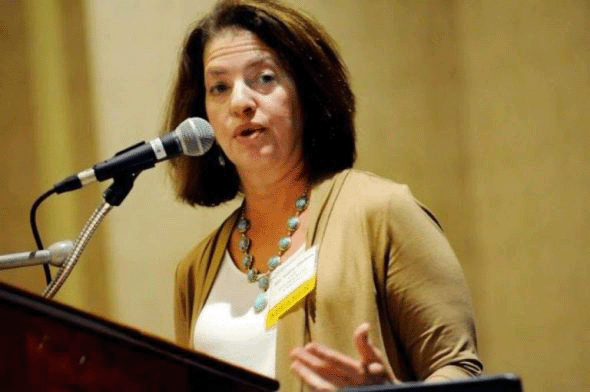
Turnbull, ScoMo and coal-lovers look out: Here comes Audrey Zibelman, Independent Australia, Norm Sanders 10 April 2017, Once they work out that Audrey Zibelman is pro-renewables, her appointment as AEMO’s new CEO is bound to upset the Coalition, writes Dr Norm Sanders.
WHO IS Audrey Zibelman?
On 17 March 2017, she became the new CEO of AEMO, that’s who! And what is AEMO? It is the Australian Energy Market Operator.
Although few are aware of it, AEMO plays a major role in our lives. It manages the NEM(National Electricity Market) and the Victorian gas transmission network. It also oversees retail electricity and gas markets in eastern and southern Australia and is working on the establishment of a Short Term Trading Market (STTM) for gas.
AEMO is also responsible for national electricity transmission planning. It investigated the South Australian blackouts and had a brief moment of media fame when the results of the investigation were released. ……..
Since the Turnbull Government was too busy shooting itself in the foot to exert any leadership over the energy situation, the task was left to AEMO. That organisation surprised some observers and delighted others by recruiting Audrey Zibelman from New York to head the task of sorting out the mess.
Once they understand what this means, the Government will be appalled by the appointment. Not only is Ms Zibleman extremely knowledgeable in the field of electricity generation, she was a major force in New York State’s the Reforming the Energy Vision (REV) plan, which has 50 per cent renewables by 2030 as one of its goals. (Hang in there, Bill!) REV’s other 2030 goals are to achieve a 40 per cent reduction in greenhouse gas emissions from 1990 levels and a 23 per cent decrease in energy consumption from buildings from 2012 levels. Ms Zibelman’s appointment is an indication of a new direction for AEMO’s culture and technology……. Continue reading →
April 12, 2017
Posted by Christina Macpherson |
AUSTRALIA - NATIONAL, energy |
Leave a comment
 People who blame sickness on windfarms ‘may be bypassing doctor’ Windfarm commissioner’s first report says complainants may fail to seek medical advice ‘due to the possibly incorrect assumption’ that nearby turbines are to blame,Guardian, Elle Hunt, 10 Apr 17 The office of the national windfarm commissioner is concerned people are not going to the doctor because they are incorrectly attributing symptoms of illness to windfarms.
Commissioner Andrew Dyer published his first report to the Australian parliament on 31 March which revealed the office had received 90 complaint between November 2015 and 31 December 2016.
Complainants cited health conditions including “sleep disturbance, headaches, earaches, ‘pounding’ in the ears, tinnitus, tachycardia, high blood pressure, sight impairment, diabetes, chest-tightening, nausea and general fatigue”, which they blamed on both audible and low-frequency noise, “including infrasound, emanating from turbines”.
Because complainants gave only “anecdotal evidence” it was difficult to establish causality with the windfarm’s operations, the report noted. It expressed concern that complainants may fail to seek medical advice “due to the possibly incorrect assumption” that a nearby windfarm was to blame.
But the report also noted that the presence of a windfarm or concerns about a proposed one could cause stress, annoyance or anxiety that could, in turn, result in health conditions. When relating to a proposed windfarm, that pressure could extend for several years.
In February last year, Dyer said half the complaints his office had received pertained to windfarms that had yet to be built.https://www.theguardian.com/environment/2017/apr/10/people-who-blame-sickness-on-windfarms-may-be-bypassing-doctor
April 12, 2017
Posted by Christina Macpherson |
AUSTRALIA - NATIONAL, wind |
Leave a comment
 Telco, online energy retailer merge to take on coal-laden utilities, REneweconomy, By Giles Parkinson on 10 April 2017
Junior telecommunications company amaysim has agreed to pay $120 million for online energy retailer Click Energy in a move designed to challenge the dominance of the big utilities in both the telco space and the energy sector.
The potential merger of telecommunications and energy offerings has long been mooted. But, despite Telstra snapping up PowerShop’s Ben Burge last year to head the newly created Telstra Energy and promising its own line of solar and storage, little has happened to date, although combined offerings have become common in the US and Europe.
“I think it will be standard here in the next few years time,” says Dominic Drenen, who will continue his role as CEO of Click Energy. “We think we can put together a bundled product that is quite compelling. For consumers, they will be dealing with one platform, so it’s just one less hassle.”
The two companies think there are significant opportunities for an “asset-light” retailer that is not burdened by legacy assets such as ageing coal-fired power stations.
“Retailing industry players are burdened with complex legacy systems and pricing structures, with most major providers also owning ageing coal-fired generating assets,” amaysim CEO Julian Ogrin said in a presentation. “Customers face large confusing bills, bill shock, no real online engagement or DIY experience and poor customer service is common.”
Ogrin sees a “once-in-a-generation” opportunity in the forced migration of around 8 million Australian homes changing their broadband service by 2020. He says the telco and energy sectors are typically “inert”, so the opportunity to increase market share in the forced migration of NBN is a unique opportunity.
It expects to have its first combined offers available in 2018, and sees major savings in “back-end” IT platforms and other synergies of around $5 million a year…….http://reneweconomy.com.au/telco-online-energy-retailer-merge-to-take-on-coal-laden-utilities-99299/
April 12, 2017
Posted by Christina Macpherson |
AUSTRALIA - NATIONAL, business, energy |
Leave a comment
 Polling brief: renewable energy http://apo.org.au/node/75503, Tom Swann, 10 April 2017
Summary:
New polling shows that despite a concerted campaign from sectors of the federal government and coal and gas industries, public support remains very high for renewable energy, and for the strengthening of state and federal targets.
The poll, conducted by The Australia Institute through Research now, asked a representative sample of 1420 Australians about renewable energy policy.
- 67% said Australia was moving into renewable energy too slowly. Only 9% said Australia was moving too fast.
- 77% of Australians support a state renewable energy target to provide extra renewable energy in their state – virtually unchanged over the last 18 months.
- 52% supported increasing the current federal Renewable Energy Target for 2020, only 9% wanted to reduce it.
April 12, 2017
Posted by Christina Macpherson |
AUSTRALIA - NATIONAL, energy |
Leave a comment
 Coalition supporters back quicker shift to renewable energy, The Age, Adam Morton 10 Apr 17, (excellent graphs) The wisdom of a campaign by the Turnbull government emphasising the risks of moving too rapidly to renewable energy has been thrown into question by polling that suggests a majority of its supporters don’t agree. Left-leaning think-tank the Australia Institute surveyed 1420 voters on whether the country was moving too slowly or too quickly in embracing renewable sources wind and solar.
It found two-thirds of voters – and 55 per cent of those who identified as Coalition voters – believed the shift was too slow. Only 9 per cent – and 17 per cent of Coalition supporters – said it was happening too fast.
Forty-five per cent believed electricity prices would go up if the national renewable energy target of about 23.5 per cent by 2020 was abolished. Only 19 per cent thought bills would go down.
Again, Coalition supporters were broadly in step with the majority: 41 per cent said ending the target – a step floated by former prime minister Tony Abbott, among others – would actually push up prices; 23 per cent believed they would come down.
On cost, voters appeared to reject claims that renewable energy was the cause of the significant power bill increases. The support for clean energy is consistent with a Fairfax/Ipsos Poll a fortnight ago that found a third of voters believed the country should continue to use coal-fired power, and 61 per cent said it was time to turn to other sources.
Australia Institute executive director Ben Oquist said clean options were becoming increasingly economically and politically attractive as the price of renewable energy and battery storage came down.
“The war on renewables looks like the political version of the Somme. Furious attacks have not made any ground on the popularity of renewable energy,” he said.
The Australia Institute poll did not test whether views on clean energy would change how people voted.
It found a narrow majority of voters (52 per cent) backed an increase of the renewable energy target, while only 9 per cent wanted it cut.
A clearer majority (73 per cent) supported the introduction of a higher target for 2030.
More than three-quarters of voters (77 per cent) supported state renewable energy targets to drive further investment. Neither question considered what more ambitious policies would cost. (See data tables at the end of this story.- [on original] )……http://www.theage.com.au/federal-politics/political-news/coalition-supporters-back-quicker-shift-to-renewable-energy-20170409-gvgzh6.html
April 10, 2017
Posted by Christina Macpherson |
AUSTRALIA - NATIONAL, energy, politics |
Leave a comment
Green is the new black: ESG investors turn to green bonds to meet mandates, SMH, Myriam Robin, 9 Apr 17
As the billions of dollars in ethical and environmental funds swell, Australian corporates and governments are issuing increasing amounts of “green bonds” to access the cash.
Green bonds function just like normal corporate or government bonds, but the issuer has to promise to use the funds to fund some type of environmentally beneficial development. This investment doesn’t have to sustain a commercial rate of return itself – if the bond is instead underwritten by the total balance sheet of the issuer, it shares the issuers’ credit rating. Because of this, green bonds typically have identical yields to equivalent regular bonds.
Between 2014 and 2016, the total amount of money put in funds with some social or green investment principles grew from $US148 billion to $US516 billion across Australia and New Zealand, according to the Global Sustainable Investment Review, released in March.
Most of this growth, the report stated, came from professionally managed funds choosing to incorporate such principles into their main funds. Funds specifically targeting green or social impact investors amount to 3.8 per cent of Australia’s total professional managed assets market, up from 2.5 per cent in 2014.
The style of investments by such funds is changing in a way that shows increasing demand for green bonds. In Canada and Europe, the only two regions for which asset allocations were available to the Global Sustainable Investment Review report, a majority (64.4 per cent) of such funds were invested into green bonds – a rapid reversal of the dominant trend in 2014 when equities dominated.
The surging investment in green bonds, the review suggested, could reflect rising environmental concerns. According to Bank of America Merrill Lynch, $US90 billion of green bonds were issued in 2016, taking the total market past $US200 billion in early 2017. $US19 billion in green bonds were issued globally in the first two months of this year. At the end of February, $US2.3 billion in green bonds had been issued so far in Australia.
Australian governments and banks have led the way in green bond investments – their issuances have been oversubscribed, showing heavy local demand for the products. In a $300 million NAB green bond raising in December 2014, 54 per cent of the bond distribution went to fund managers, with another 30 per cent being purchased by institutions and pension funds.
HSBC’s Violeta Jovanoska, director of debt capital markets in its Sydney office, was involved in the first corporate green bond issue in Australia, a Euro-donominated bond issued by Stockland Trust Management in November 2014, as well as the NAB bond, which HSBC was a joint bookrunner on.
She said corporates were turning to green bonds as a way to access this swelling pool of money placed in funds with an environmental, social or governance mandate. As many investment managers have signed up to responsible investment or climate change agreements, green bonds are a way to meet that commitment………..
The lack of regulation around green bonds has meant some critics dismiss the area as “greenwash” marketing – an environmental sheen on what is essentially a regular corporate bond. It’s hard to say whether green bonds allow new green projects to be completed or if organisations are using them just to easily fund the more environmentally friendly parts of their investment agenda, with the green bond money going towards projects they would have funded anyway. Companies don’t have to turn green in any significant way to issue a green bond……http://www.smh.com.au/business/markets/green-is-the-new-black-esg-investors-turn-to-green-bonds-to-meet-mandates-20170404-gvd2v6.html
April 10, 2017
Posted by Christina Macpherson |
AUSTRALIA - NATIONAL, business, energy |
Leave a comment
 Transgrid gets 6,000MW solar proposals in 2017, sees 95% renewables by 2050 http://reneweconomy.com.au/transgrid-gets-6000mw-solar-proposals-2017-sees-95-renewables-2050/ By Giles Parkinson on 7 April 2017 Transgrid, the owner and operator of the main transmission line in New South Wales, reports that is has received “enquiries” about more than 6,000MW of large scale solar so far in 2017.The figure, revealed by business development manager Gustavo Bodini at the Large Scale Solar conference hosted by RenewEconomy and Informa earlier this week, is more than a six fold increase over 2016, and highlights the huge interest in solar as it matches wind on costs and beats new gas (and new coal) by a significant margin.
Of course, not all that 6,000MW will be built, or even get to development approval stage, but large scale solar is clearly the energy source of choice at the moment, accounting for at least half of new projects for the renewable energy target – a share that is likely to increase in coming years.
Amy Kean, the renewable energy advocate for the NSW government, showed this slide (on original) at the conference, indicating the amount of large scale solar already installed, under construction, and those in the pipeline and the “stealth” projects, which may well refer to the Transgrid enquiries.
This graph above from Transgrid’s Bodini is the most striking – because it predicts that by 2050, 95 per cent of the demand will be delivered by renewable energy – some 65 per cent from large scale renewables like wind and solar and hydro, and another 30 per cent from “distributed energy”.
That’s why, says Bodini, we need to get out and test new technologies, such as battery storage, to see how they operate and integrate with the grid.
There is some grace. There will be enough synchronous generation, Bodini says, within the whole National Electricity Market by 2030 to provide the inertia required to keep the grid stable. From that point, as more of the legacy coal and gas plants retire, it will be up to new technologies to take over.
The grid of the future, he says, will focus on better ways of managing peak demand, energy efficiency, widespread deployment of distributed generation (mostly solar), network based storage and new market rules to allow this to happen and one that promotes “genuine competition” and protects consumers when there is ineffective competition.
April 8, 2017
Posted by Christina Macpherson |
New South Wales, solar |
Leave a comment
February recorded more capacity than November. And now March capacity has shot 16 per cent higher than December.
This has got us thinking at Green Energy Markets that more fundamental and longer term drivers are potentially supporting this increased capacity.
it doesn’t quite work out the way the fossil fuel industry that dreamed up the PR campaign intended. Households and businesses start worrying and think I need to take things into my own hands – and that happens to mean a solar system.
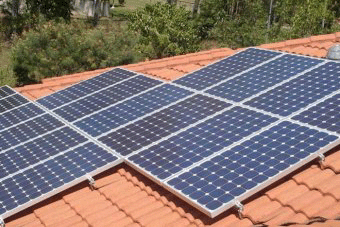
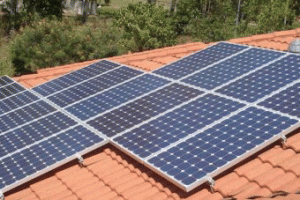 Rooftop solar enjoys second boom as fossil fuel scare campaign backfires, REneweconomy By Tristan Edis on 7 April 2017 It appears the fossil fuel industry’s scare campaign over renewable energy driving up the price of electricity is having the same desired effect that it had back in 2011, when they campaigned against placing a penalty on polluting the atmosphere with global warming gases.
Yep you guessed it – households and businesses are flocking to install solar on their rooftops.
Green Energy Markets’ Solar Report assessment of STC creation data shows that March hit levels of capacity not seen since the days of 45c to 60c premium feed-in tariffs in 201, when there was also an STC rebate that was twice to five times its current level.
All up, we estimate almost 92MW (92,000 kilowatts) of rooftop solar PV capacity created certificates in March………. Continue reading →
April 8, 2017
Posted by Christina Macpherson |
AUSTRALIA - NATIONAL, solar, storage |
Leave a comment
 Solar + Tesla battery storage offered in new-build Queensland homes http://reneweconomy.com.au/solar-tesla-battery-storage-offered-in-new-build-queensland-homes-64366/ By Sophie Vorrath on 5 April 2017 One Step Off The Grid
Another of Australia’s major housing developers, the Melbourne-Based group Metricon, will offer rooftop solar and storage as an optional extra in a range of its new-build homes in Queensland, via a new partnership with local installer and Tesla battery reseller CSR Bradford.
CSR Bradford – whose NSW-based company started in insulation more than 80 years ago, and has since expanded into energy efficiency and solar and storage through Bradford Solar – is an accredited Tesla Powerwall reseller, and has been watching the growth of the battery storage market closely over the past few years.
The deal with Metricon, announced this week, takes the company one step closer to its vision of solar and battery storage being included as a standard feature in all newly built houses in Australia – something the company’s managing director, Anthony Tannous has predicted will be the norm in just a few years’ time.
According to the Metricon website, Queensland customers who upgrade to the builder’s “luxury living” offer will get CSR Bradford’s a 5-6kW Solar ChargePack, which includes solar panels, a SolarEdge inverter and Tesla’s 14kWh Powerall 2 lihtiu-ion battery pack.
As Tesla has itself claimed, the Metricon 5kW offer promise to give the average house of four up to 90 per cent electricity self sufficiency on an average day, while the 6kW solar offer is said to give the average Australian family “little or no reliance on the grid.”
In financial terms, households choosing the Luxury Living” upgrade – which costs $1,999 for a single story home and $4,999 for a double story home – is expected to save the Metricon households $2,100 a year on energy costs.
CSR Bradford has similar packages being offered in Victoria, through Arden Homes, and in New South Wales with Mojo Homes.
“I have a vision that every house built in a few years time will have a battery installed, it just makes so much sense,” Tannous told One Step Off The Grid in an interview last month. “We’ve been working with most of the major builders across Australia and a lot of them are starting to include storage as standard… while others offer it as an upgrade,” he said. “And that will just gain more momentum.”
April 7, 2017
Posted by Christina Macpherson |
Queensland, solar, storage |
Leave a comment
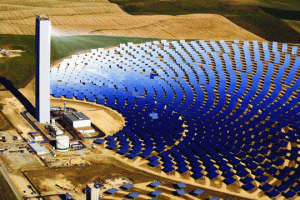 Arrival of big solar puts renewable energy target back on track, REneweconomy, By Sophie Vorrath on 4 April 2017 Australia is now on track to meet its renewable energy target of 33,000GWh by 2020, Australia’s Clean Energy Regulator has said, driven largely by the current burst of growth in the large-scale solar market.
Jay Hender, the Regulator’s general manager of technical assessment and support, said that while building another 6000MW of installed renewable energy capacity between now and 2020 remained a “significant task”, activity in Australia’s renewables sector was mounting by the week.
“We had a very slow start to 2016, which built up to big action in the last quarter, leading into the beginning of (2017),” Hender told the 2017 Large-Scale Solar Conference co-hosted by RenewEconomy and Informa on Monday. He said that 2,000MW of wind and solar had been committed in 2016, and this trend continued into 2017, with another 1GW of commitments.
“We’re tracking pretty well, I would say, for this point in time.”
Hender pointed to the big uptick in large-scale solar activity, that gained momentum at the end of 2016 and was continuing to do so this year, as a big driver of this progress.
Big solar has become a bigger and bigger portion of new installed capacity, and is currently sitting at around 50:50 with wind, Hender said. “That’s a pretty big change over a short period of time,” he added.
And he said the quieter achievements of Australia’s commercial solar sector – big solar’s “poor little cousin” – was also an increasingly important contributor to the 2020 target.
“(Here) you’ve got large, significant energy consumption during the day, and large roof space,” he said, noting the largely untapped potential of the commercial and industrial solar sector.“In essence there’s been a doubling of the capacity of (commercial solar) projects, year on year, year on year.“You don’t have to be a mathematician to know that … amounts to exponential growth. From big things little thing grow,” he said.
Bloomberg New Energy Finance associate Leonard Quong warned that despite this new build, shortfalls could be expected in LGC deliveries in 2018, keeping LGC prices at near penalty prices and maintaining pressure on politicians about the “cost of renewables”, even though the actual cost of the technology continued to fall…….http://reneweconomy.com.au/arrival-of-big-solar-puts-renewable-energy-target-back-on-track-56713/
April 7, 2017
Posted by Christina Macpherson |
AUSTRALIA - NATIONAL, solar |
Leave a comment
The “off-grid” guy is not happy with his off-grid system http://reneweconomy.com.au/the-off-grid-guy-is-not-happy-with-his-off-grid-system-58229/ By Giles Parkinson on 5 April 2017 One Step Off The Grid
Michael Mobbs has been involved in sustainability for more than two decades, leading public discourse with his “sustainable house” blog, cutting his connections to mains water and sewer more than two decades ago, and finally cutting the electricity wires to his inner-Sydney terrace home in March, 2015.
His exploits and determination to lead a self-suficent lifestyle earned him the sobriquet of the “off-grid-guy”. But two years after cutting the link to the electricity grid, Mobbs is deeply frustrated – his off-grid system is not working anywhere near as well as he expected.
For the last few weeks, in cloudy, rainy Sydney, Mobbs has had to turn off the fridge during the day to ensure that the house, which he shares with two others, has enough power for a “civilised life” at night-time. Worse than that, his system has a bug in it that causes it to trip every two days. Flashing digital lights have become part of his life.
“I’m running short of power,” Mobbs complains. He reckons that the system that he has in place is delivering 1kWh a day less than he expected. “I thought this would be a walk in the park, but I appear to have tripped over.”
Mobbs in now looking to replace the system, and has even launched a public ‘invitation” for people to suggest solutions. (Submissions are due on April 13).
But he wants this to be a public discourse, because from his experience he sees a cautionary tale for anyone looking to install battery storage, and particularly those who are looking to go off grid.
“I don’t live off-grid just for myself,” he writes on his blog. “I live off-grid to trial and to show options, create and publish real-life data for others, to give hope through action and accountability. ”
But he admits that his particular journey for going off-grid for electricity is incomplete. “When complete, and the new replacement system is installed soon, the project will show what is feasible.”
Although battery storage has been used for decades, mostly in remote areas that don’t easily connect to the grid, the mass-market is new, and so are many of the products now available to those in the inner city, suburbs, and regional towns.
And battery storage is a complex business – it relies so much on the consumer’s usage pattern, available solar power, local weather, orientation and how it is configured and paired with other hardware and software such as inverters and solar panels. Going off grid requires a bespoke solution.
Some people have the money and can throw surplus dollars and capacity at the solution. Hobbs clearly wants to find a smarter way – and in the inner city, he is restricted by space.
Mobbs says that from his experience it is pretty clear that there is a consumer blind spot. He now emphasises the need to be clear about what is wanted from the system, and for good monitoring and analytics to indicate what is going wrong and when.
So what did go wrong with his system?
April 7, 2017
Posted by Christina Macpherson |
New South Wales, solar |
Leave a comment
What is so astonishing about the plethora of opportunities is the refusal of the incumbents and other vested interests to see them.
Their regulatory capture of many of the country’s key institutions seems to be complete as well, but could be challenged by the likes of Zibelman and chief scientist Alan Finkel.
“Get used to it”: We’re switching from “baseload” to a smart grid, REneweconomy, By Giles Parkinson on 4 April 2017 “In South Australia, the minister’s right, when the wind stops, you get blackouts.”
Well, no. Fact check please. But so said ABC Q&A host Tony Jones on the program last night in the middle of a discussion about renewable energy between energy minister Josh Frydenberg and the former prime minister of Denmark, Helle Thorning-Schmidt.
Apart from being factually wrong, Jones’ statement highlights the depths of ignorance in mainstream media, and the influence within the ABC of senior commentators who simply do not accept, or understand, the potential of renewable energy. It is a view enthusiastically shared by many conservative politicians and encouraged by an ever desperate fossil fuel industry.
But here’s the thing. The energy mix is changing rapidly and large-scale solar is unstoppable, according to numerous presenters at a major solar conference held in Sydney this week.
Solar and wind will beat new coal and gas on price, and on top of that storage is arriving in a big way, as are all the other different technologies that will usher a dramatic change in our energy mix from a fossil fuelled “baseload” to a flexible system based around wind and solar.
“Get used it”. That was the simple but powerful message to the energy incumbents from Leonard Quong, a lead analyst from Bloomberg New energy Finance, in highlighting the rapidly changing “energy paradigm” in Australia and across the world.
“The best advice that we can give to those that would seek to resist the change, or the increased complexity, is just get used to it,” Quong told the conference on Monday. “The economics of large-scale solar make it an unstoppable force,” he said, reinforcing the point that the power system was moving to a new “control paradigm”, underpinned by any amount of new technologies.
It was a theme taken up by a range of speakers at the conference, from the Clean Energy Finance Corporation, to the Australian Renewable Energy Agency, and to developers such as Goldwind (the world’s biggest wind turbine manufacturer), Genex Power and others.
Indeed, in recent weeks the energy debate in Australia has reached something of an inflexion point. The closure of the dirtiest power station in the country, the giant Hazelwood brown coal generator, was the biggest symbol of this transition.
But other events are happening rapidly. In South Australia, a tender for battery storage attracted an astonishing 90 proposals, the former head of Hazelwood conceded that solar and storage was already cheaper than gas, and the biggest player in the South Australian market tore up its business plan in response to the events around it, and the state’s intervention in the market.
Good, said premier Jay Weatherill. “We’ve been screwed for too long by large power companies, it’s as simple as that,” the premier said on Monday.
Finally, the government has now shown it is prepared to take on the energy oligopolies – given that the regulators and rule makers have shown no interest in doing so. And the solution is to be found in storage and smart solutions that reduce the ability of the incumbents to cause huge price spikes and withhold capacity.
And for the first time, the head of one of the country’s main energy institutions, Audrey Zibelman, the new chief of the Australian Energy Market Operator, is talking of a grid that focuses on “distributed generation” – solar and storage – as a cheaper, faster, cleaner and smarter alternative to what we have now.
Even Malcolm Turnbull, in promoting pumped hydro, is talking of “dispatchable generation” and “variable” rather than “intermittent renewables.”
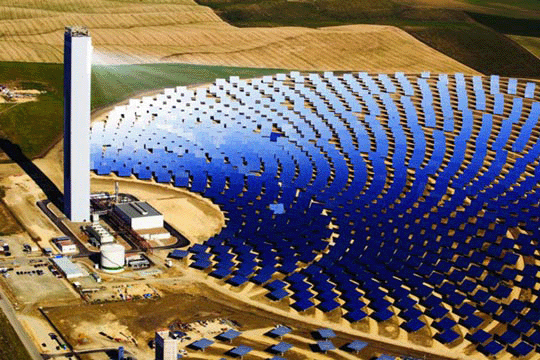
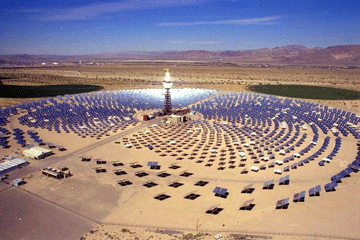
And his government has promised to throw in an extra $110 million to support a solar tower and storage facility in Port Augusta. Once that technology gets established, with its ability to provide 24-7 power, then the game will surely be up for baseload fossil fuels.
Indeed, this was one of the big themes of the Large Scale Solar 2017 conference being co-hosted by RenewEconomy and Informa in Sydney this week. The long expected and sudden boom in large-scale solar is about to change the energy landscape in this country forever, particularly as storage comes on board as well.
Gloria Chan, the head of large-scale solar for the Clean Energy Finance Corporation, talked of a “changing paradigm” from baseload and peaking fossil fuel plants, to a “smart grid” based around solar and wind, with the gaps being filled by “dispatchable” renewables and storage……
The CEFC’s Chan said the CEFC technology roadmap includes pumped hydro and batteries, along with synchronous condensers and other technologies; “dispatchable” renewables such as solar thermal, geothermal hydrogen and biomass.
Other technologies include transmission upgrades and “behind the meter solutions” – the solar and storage and virtual power plants, and demand management highlighted by Zibelman in the past week.
What is so astonishing about the plethora of opportunities is the refusal of the incumbents and other vested interests to see them.
Their regulatory capture of many of the country’s key institutions seems to be complete as well, but could be challenged by the likes of Zibelman and chief scientist Alan Finkel.
Indeed, a survey released this week by Sven Teske, from the Institute of Sustainable Futures in Sydney, found that 71 per cent of international energy experts thought that 100 per cent renewable energy was obtainable and realistic. To be sure, the responses ranged from the “progressive” to the “conservative” – who simply didn’t believe it could be done.
As the head of China’s state grid has noted, this is not a technology issue, but a cultural one.
And perhaps it is that which causes the media to struggle to move forward, and lazily repeat the mischievous myth-making of the fossil fuel incumbents. Jones’s comments on Q&A are a case in point. Perhaps mainstream media is waiting for the right signals from the mainstream parties. The CEFC’s Chan said the CEFC technology roadmap includes pumped hydro and batteries, along with synchronous condensers and other technologies; “dispatchable” renewables such as solar thermal, geothermal hydrogen and biomass.
Other technologies include transmission upgrades and “behind the meter solutions” – the solar and storage and virtual power plants, and demand management highlighted by Zibelman in the past week.
What is so astonishing about the plethora of opportunities is the refusal of the incumbents and other vested interests to see them.
Their regulatory capture of many of the country’s key institutions seems to be complete as well, but could be challenged by the likes of Zibelman and chief scientist Alan Finkel.
Indeed, a survey released this week by Sven Teske, from the Institute of Sustainable Futures in Sydney, found that 71 per cent of international energy experts thought that 100 per cent renewable energy was obtainable and realistic. To be sure, the responses ranged from the “progressive” to the “conservative” – who simply didn’t believe it could be done.
As the head of China’s state grid has noted, this is not a technology issue, but a cultural one.
And perhaps it is that which causes the media to struggle to move forward, and lazily repeat the mischievous myth-making of the fossil fuel incumbents. Jones’s comments on Q&A are a case in point. Perhaps mainstream media is waiting for the right signals from the mainstream parties. http://reneweconomy.com.au/get-used-to-it-were-switching-from-baseload-to-a-smart-grid-96298/
April 7, 2017
Posted by Christina Macpherson |
AUSTRALIA - NATIONAL, energy |
Leave a comment
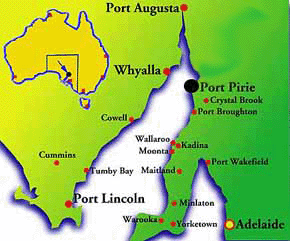 Port Augusta mayor Sam Johnson ‘absolutely ecstatic’ solar power plant will be finally funded Adam Langenberg, Political reporter, Sunday Mail (SA) April 2, 2017
 THE city at the centre of South Australia’s power crisis is “buzzing” after a highly anticipated plan to build a 100MW solar thermal plant took one huge leap closer to reality.
Excited locals say the promise of a $110 million concessional loan to proponents is “absolutely huge” and  transformative for the city, while project backers say the State Government must award its power supply contract to provide certainty.
Mayor Sam Johnson said he was “absolutely ecstatic” the project was a step closer but he took a shot at the Federal Government for only delivering on its promise as part of a deal with Senator Xenophon to support its company tax cut package.
“There was certainly a buzz around town because it’s no secret we’ve had a few bad shots in the arm in the last 18 months,’’ Mr Johnson said.
“We’re looking for that positivity and we know we can deliver the next chapter.”
Senator Xenophon said Prime Minister Malcolm Turnbull had assured him the project “was a goer” and welcomed the Government’s clear commitment to solar thermal generation at Port Augusta. “It will transform the town and be a beacon of hope. It will also change the way we look at energy, by providing virtual baseload with a molten salt storage,” Senator Xenophon said. “I just want it to happen. I’m happy to work with the Prime Minister………
..Repower Port Augusta Dan Spencer reiterated both proponents, SolarReserve and Solarstor, needed to clinch an electricity supply deal with the State Government before progressing further.
“It puts the ball right in Jay’s (Premier Weatherill) court,” Mr Spencer said.
“They’ve got the guarantee of the federal loan so they can lock it in now by providing the power contract.”
Energy Minister Tom Koutsantonis said applications for the electricity contract were being assessed and the Government had “numerous policies in place to support a potential solar thermal plant.”http://www.adelaidenow.com.au/news/south-australia/port-augusta-mayor-sam-johnson-absolutely-ecstatic-solar-power-plant-will-be-finally-funded/news-story/55acc17df92d7f9cef77b6548aae488c
April 3, 2017
Posted by Christina Macpherson |
solar, South Australia, storage |
Leave a comment
 Power games: The quick fix and unanswered questions on electricity, The Age Adam Morton 2 Apr 17,
Let’s assume that at some point in February next year it will reach 45 degrees in south-east Australia.
Let’s assume it will be more than 43 degrees for three days running. Let’s assume you are unlucky and the temperature tops 40 degrees for a week or more……..
As the climate control kicks in, home solar systems are also firing up. At the turn of the decade, rooftop solar panels were a novelty. Now, more than 1.5 million households have them. They provide some relief for the stretched electricity grid.
And the grid needs all the relief it can get. Like most of us, electricity infrastructure performs less well when it is hot. This applies to the ageing equipment in creaking old coal plants and gas-fired turbines. Some break down as the temperature rises. It also applies to solar photovoltaic panels, some of which lose nearly a fifth of their capacity as the temperature goes past 40……..
the extraordinary weather conditions means the annual threat of bushfire – which could knock out transmission lines and possibly affect generators – remains constant………
The scenario above is the picture today, but it will almost certainly have changed again by next summer. The energy industry has been acting as though on fast-forward over the past fortnight, and shows no sign of slowing down.
The Clean Energy Council says there is more than $5.5 billion worth of renewable energy projects under construction this year. On Thursday, Lyon Solar added plans for a $1 billion solar and battery plant in South Australia’s Riverland to be in place by next summer. Billed as the biggest of its type in the world, it includes a 330 megawatt solar farm and 100 megawatt battery system with four hours’ storage – enough, proponents say, to potentially make concerns about South Australia and Victoria’s supply redundant.
This is independent of the Weatherill government’s quick tender for Australia’s first large-scale battery system that could – if Tesla mogul Elon Musk is to be believed – be built in 100 days. It is one of a number of steps planned by the South Australian government. Less headline grabbing, but possibly just as important, is that Premier Jay Weatherill has assured the public there will be 200 megawatts of emergency back-up in place. Almost certainly, it will be met by bringing in cheap, reliable and emissions-intensive diesel generators. This was the path Tasmania took when its hydro dams were running low and the Basslink cable to Victoria was broken last year. It might seem antiquated, but works.
The Victorian government has also promised a battery tender, aiming to have 50 megawatts – enough to power a couple of regional cities for four hours – before Christmas. Another 50 is expected to follow in 2018……..
The ignored opportunity
Perhaps because it has no champion among industry or regulators, the potentially significant scope to quickly reduce electricity demand through smarter use of technology remains little explored.
A paper released last week by the awkwardly named Energy Efficiency Certificate Creators Association makes the case for the savings possible by cutting waste.
Victoria has been a leader in this area with an energy efficiency scheme that, until the Coalition walked away before the last election, had bipartisan support. Ric Brazzale, managing director of Green Energy Markets, estimates the cleaner lights and appliances it helped install last year alone reduced demand by about 120 megawatts – the equivalent of a small power plant.
Advocates want incentives for businesses to reduce production when necessary and to upgrade substandard equipment – think boilers, airconditioners, fridges and insulation. At a household level, the call is for greater support to install better whitegoods and battery packs.
Small steps can make a significant difference. Replacing old lights with LEDs, for example, can cut electricity consumption from that device by up to 80 per cent.
Unanswered questions
Better demand management will help, but it won’t avoid the need for more generation. The big, unaddressed question is what will the response be when the next large coal power plant closes – and the next one after that, and so on.
Australia has 23 remaining coal generators. As the federal government acknowledges, several more may shut over the next decade. According to modelling for the Climate Change Authority, all would need to be gone and replaced by cleaner technology by 2035 if Australia is to play its part under the Paris deal to keep global warming below 2 degrees.
That notional deadline rarely gets a mention in public debate, but a campaign is in full flight for a bipartisan national energy and climate policy to set the pace for the transition to cleaner plants. Businesses are worried that ageing coal plants will otherwise continue to shut abruptly – Hazelwood’s closure was announced just five months out – without there being time to build replacements. The federal government has rejected their preferred model, an emissions intensity scheme, and as has offered no alternative.
Reviews into electricity security (by chief scientist Alan Finkel) and climate policy (by the Environment Department) are under way, but the government is fundamentally divided on the need to do anything. It is hard to see where it lands.
Nationally, the only significant large-scale policy designed to drive energy investment beyond this decade is Victoria’s ambitious and contested renewable energy target, which aims to build enough wind and solar farms to deliver 40 per cent of the state’s electricity needs by 2025. (The ACT has also a renewable target, but in other states the goals are purely aspirational.)
The Andrews government has not said what it thinks the rapid growth in clean energy means for the Latrobe Valley’s three remaining coal plants – Yallourn, Loy Yang A and Loy Yang B. The state opposition plans to abolish the renewable target if it wins power next year, but it hasn’t said what, if anything, it would do in its place. It has hinted it may subsidise coal plants to keep them open.
Meanwhile, anyone hoping for an answer on what will keep the lights on in the longer term is left waiting. http://www.theage.com.au/business/energy/power-games-the-quick-fix-and-unanswered-questions-on-electricity-20170327-gv7w01.html
April 3, 2017
Posted by Christina Macpherson |
AUSTRALIA - NATIONAL, energy |
Leave a comment