Solar power battery storage would solve SA’s electricity problems, company says, ABC News, By Claire Campbell, 21 Feb 17, The company behind a $100-million solar plant with battery storage says its project could solve South Australia’s energy woes as the Federal Government announces a $445,000 investment into a pumped hydro-station for the state.
South Australia’s power supply has been scrutinised since the state was plunged into darkness last September, and was forced to “load shed” during a recent heatwave.
South Australian-based renewable energy company Zen Energy is working to build a $100-million solar power plant with 100 megawatts of battery storage in the region.
Chairman Professor Ross Garnaut said the battery would “solve most” of the state’s energy problems and if increased by a further 50MW it would solve “all” energy issues.
“The blackouts of the past year would not have happened if this was in place,” he said.
“We think that it can make a major contribution both to grid stability and also to provide a buffer for when peak demand for power exceeds supply from other sources.”…… http://www.abc.net.au/news/2017-02-21/solar-power-battery-storage-could-have-prevented-sa-blackout/8290304
February 22, 2017
Posted by Christina Macpherson |
South Australia, storage |
Leave a comment
 Josh Frydenberg flags changes to allow CEFC to invest in carbon capture and storage, ABC News, AM By Eliza Borrello, 20 Feb 17, Federal Energy Minister Josh Frydenberg has revealed the Government is considering lifting a ban on allowing the Clean Energy Finance Corporation (CEFC) to invest in carbon capture and storage……At the moment the CEFC, the Government’s green bank, is not allowed to invest in it.
But amid the Coalition’s renewed support for coal-fired power, Mr Frydenberg said that could change…..
Shadow Energy Minister Mark Butler said it would require the kind of legislation Labor would strongly oppose. “This would be an outrageous act of vandalism against a successful financing mechanism for renewable energy, for energy efficiency projects and for genuine low-carbon technology,” he said.”It’s no real surprise, I guess, because the Liberal Party has never really supported the CEFC. “It tried to abolish it for three years and now seems committed to making it a finance mechanism for the coal industry, which is unable to attract finance from the private sector.”
Government interested in low-emission coal-fired plants Mr Frydenberg said he was also interested in investment in high-efficiency, low-emission coal-fired plants.
Currently they are not green enough for the CEFC to invest in, but Mr Frydenberg has flagged changing the rules. “The Government could issue a new mandate to the CEFC which would then inform its guidelines and would make possible an investment in a high-efficiency low-emission power plant,” he said……
But Mr Butler said the market was not interested in the kind of plants Mr Frydenberg was suggesting.
“It doesn’t reflect the reality in the electricity industry. No-one in the industry is talking about the reality of building new coal-fired power stations,” he said. http://www.abc.net.au/news/2017-02-20/government-interested-in-carbon-capture-tech-frydenberg-says/8284682
February 20, 2017
Posted by Christina Macpherson |
AUSTRALIA - NATIONAL, energy, politics |
Leave a comment
The number of high-priced events in Queensland so far this year are 40 (yes, forty) times more common than in renewables-strong South Australia. Did we hear a peep of protest from the Coalition about this? No.
There is no doubt that more renewables, and more competition, will reduce that pricing power. That is a given.
But the Coalition and many in the mainstream media simply don’t want to know. They have barely reported on the high-priced events in Queensland and NSW, or on the real cause of those events in South Australia.
They don’t want to know: politics and ideology are at play.
 High energy prices? Blame fossil fuel generators, not renewables, REneweconomy, By Giles Parkinson on 8 February 2017 It seems that you can ask the Coalition government a question about pretty much anything – plunging polls, Donald Trump, Cory Bernardi or even the weather – and the answer will always be the same: “We’re focused on electricity prices.”
Great. But what exactly is the Coalition doing about it? On the evidence to date, not a whole lot, apart from blaming renewables for soaring wholesale electricity costs and promoting something called “clean coal,” despite all the evidence pointing to the fact that coal generation it is not very clean, and not cheap.
They are chasing the wrong target. Australia has experienced some extraordinary high wholesale electricity prices this summer, and most of these price surges have come in states with little large-scale wind or solar.
It is the activities of the fossil fuel generators that are to blame. This is about competition, or the lack of it, and the fossil fuel generators have been going to extraordinary lengths to get rid of competition.
The Australian Energy Regulator has been investigating more than half a dozen “high priced” events, as it is required to do when prices jump above $5,000/MWh. Some of the reports it has already completed make astonishing reading. Continue reading →
February 10, 2017
Posted by Christina Macpherson |
AUSTRALIA - NATIONAL, energy, Queensland |
1 Comment
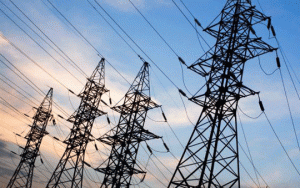 SA power woes to spread nation-wide, starting with Victoria, Australian Energy Council warns, ABC News 9 Feb 17 By Claire Campbell The Federal Government needs to take urgent action to improve its energy policies before the rest of Australia falls victim to the type of large-scale blackouts experienced in South Australia, the Australian Energy Council has warned.
About 90,000 South Australian homes and businesses were blacked out Wednesday when the Australian Energy Market Operator (AEMO) issued a load-shedding order to avoid potential damage to the network equipment due to supply deficiency.
It asked for more power generators to be switched on but did not receive “sufficient bids” and said it did not have enough time to turn on the second unit at Pelican Point. AEC chief executive officer Matthew Warren said there was no shortage of electrons and available power, but it was not dispatched when required.
He said the entire nation’s system needed upgrading quickly because energy reliability was not just a state issue…….
AEMO has warned that load-shedding is possible in New South Wales on Friday. http://www.abc.net.au/news/2017-02-09/sa-power-woes-to-spread-through-rest-of-australia-aec-warns/8257032
February 10, 2017
Posted by Christina Macpherson |
AUSTRALIA - NATIONAL, energy, New South Wales |
Leave a comment
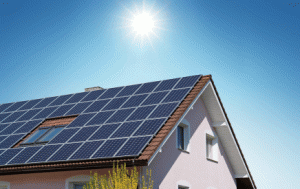 Powershop reveals cash for renewable projects from customers who paid more https://www.theguardian.com/environment/2017/feb/09/powershop-reveals-cash-for-renewable-projects-from-customers-who-paid-more
Energy retailer raised $100,000 from customers, which will be given out as grants to community-owned energy projects, Guardian, Michael Slezak, 9 Feb 17, Amid fresh attacks on renewable energy targets from the federal government and large energy retailer ERM Power, smaller electricity retailer Powershop has raised $100,000 from its customers to be given out as grants to 10 community-owned projects around the country.
Three months ago Powershop launched the Your Community Energy initiative, where they gave customers the opportunity to pay higher rates, which it said would then be distributed to renewable energy projects that were community-owned.
Powershop aimed to raise $20,000 by the end of 2016 but, as of February 2017, it had raised $100,000.
One project – rooftop solar on the Centre for Education and Research in Environmental Strategies (Ceres) centre in Melbourne – has already received $10,000 from the initiative and used that to complete their 15 KW solar installation.
A spokeswoman for Ceres, Judy Glick, said the installation would save the community group $2,000 each year and reduce their yearly emissions by almost 16 tonnes of CO2. “Ceres is on a mission to achieve zero emissions by 2025,” she said.
Five other projects were also announced as recipients of a share of the money. Continue reading →
February 10, 2017
Posted by Christina Macpherson |
AUSTRALIA - NATIONAL, solar, Victoria |
Leave a comment
Carmichael mine jobs need ’21 times the subsidies’ of renewables, says lobby group
Federal funding for Adani project amounts to $683,060 a job, compared with $32,191 a worker in Queensland’s clean energy sector, 350.org says, Guardian, Joshua Robertson, 8 Feb 17, Clean energy projects in Queensland are already on track to create more employment than Australia’s largest proposed coalmine, which if funded federally would cost taxpayers 21 times more per job, according to new study.
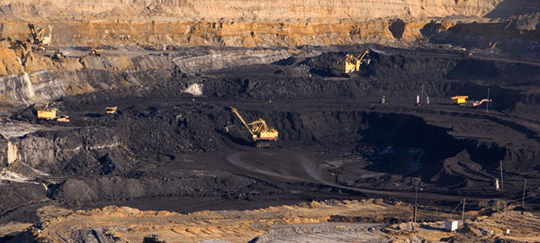
Federal government agencies are investing $71.4m in seven solar farms and a windfarm in Queensland, which are set to deliver a total of 2,218 jobs, according to analysis by climate advocacy group 350.org.
Adani’s proposed Carmichael coal project in central Queensland, which has obtained conditional approval for a $1bn federal infrastructure loan, is predicted to deliver 1,464 jobs.
The level of federal subsidy for Adani would amount to $683,060 a job, compared with $32,191 a worker in Queensland’s clean energy sector.
The Queensland government has accused the federal government of misrepresenting key data while talking up coal in an ideological attack on renewable energy. Continue reading →
February 10, 2017
Posted by Christina Macpherson |
AUSTRALIA - NATIONAL, energy, politics, Queensland |
Leave a comment
 Solar battery rebate scheme pushed by Greens in WA election pitch, ABC News , 9 Feb 17 By Laura Gartry More than 100,000 WA households could be entirely powered by their own solar energy using battery storage within five years under a 50 per cent tax rebate proposed by the Greens.
In one of first major election commitments by the party, Upper House candidate Tim Clifford said the cost of battery units were currently out of reach for a lot of people.
The Greens’ proposed rebate would allow individuals to get up to half the cost of their storage system covered to a maximum of $5,000 in the first year and tapering off to $1,500 in five years.
The $290 million scheme would also provide a $5,000 upfront grant to install solar for families earning less than $80,000. Households with solar panels in WA are looking to batteries as a way to offset the sharp fall in rebates Synergy pays them for their electricity.
It is hoped the scheme would kick-start the industry and drive down the cost of units and power bills.
Energy Minister Mike Nahan said a possible battery subsidy was discussed, but would not be implemented by the Government…..
Mr Clifford said up to 3,000 WA businesses could also benefit, allowing their battery storage assets to be depreciated over three years rather than 15, which could pay off their battery storage unit within 10 years.
The scheme would be co-funded from the removal of federal fossil fuel and mining subsidies……http://www.abc.net.au/news/2017-02-08/solar-rebates-mooted-by-greens-wa-election/8252706
February 10, 2017
Posted by Christina Macpherson |
energy, politics, Western Australia |
Leave a comment
 Is Malcolm Turnbull’s priority really just keeping the lights on?, Guardian, Kristina Keneally, 6 Feb 17 It seems Turnbull is basing his core political agenda for 2017 on a rare weather event. It’s a textbook definition of being buffeted by events rather than shaping them Imagine a severe thunderstorm had not hit South Australia last September and caused a state-wide blackout. What on earth would the Turnbull government have to talk about?
The day after the South Australian storm, the energy minister, Josh Frydenberg, nominated “energy security” as the government’s number one priority.
Last week at the National Press Club, Malcolm Turnbull said that this year his government would prioritise energy security and storage.
The Turnbull government is basing its core political agenda for 2017 on a once-in-50-years weather event. This must be the textbook definition of a government buffeted by events rather than shaping them.
Let’s set aside – for a moment – the happenstance nature of the Turnbull government’s top policy priority and instead consider the relevance of its pitch to voters. What does energy security even mean? When was the last time you used that phrase in conversation? Does it have something to do with defence? Is it keeping our power plants safe from attack?
And if that is the Turnbull government’s priority, well, that’s pathetic. So much for innovation, agility, jobs and growth, and budget repair. The Turnbull government is flat out making sure our fridges are still running and we can still charge our mobile phones. They have no ambition or time for anything greater.
But the biggest joke of all is that Turnbull can’t even manage to pretend for more than a week that energy security is his number one priority. Last night Turnbull told Channel Nine’s Laurie Oakes that “what I set out is our agenda for this year and what we’re going to deal with is energy prices”.
Energy security and energy prices. Yeah, they are not the same thing. Continue reading →
February 8, 2017
Posted by Christina Macpherson |
AUSTRALIA - NATIONAL, energy, politics |
Leave a comment
Turnbull’s over-riding ambition is to last at least one day longer as prime minister than Abbott. That means that he will remain beholden to the right, who are ready to push the self-destruct button at any moment in the fervent belief that they can win power, if not immediately then after a single term of Labor.
Like Trump, Turnbull’s energy policy is based on “alternative facts”http://reneweconomy.com.au/like-trump-turnbulls-energy-policy-is-based-on-alternative-facts-25100/ By Giles Parkinson on 7 February 2017 The first few weeks of the Trump administration have been extraordinary, and quite frightening – not just because of the incompetence of a president who appears to be little more than a self-obsessed idiot, but by the actions of the dangerous ideologues at the helm of the world’s biggest economy and military power.
There have been shocks across the policy spectrum, but probably none more so than in climate and clean energy, where Trump has promised to throw the baby out with the bathwater, quit the Paris deal, disband or dismember environmental regulations, “re-invent” coal, stop renewables and build more gas 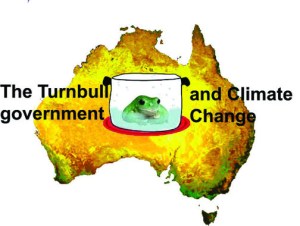 pipelines.
It might sound stone-cold crazy to many people in Australia, but it should be familiar: There is little that Trump and his regime is doing on climate and clean energy that has not already achieved, or attempted, by the current Coalition government in Canberra. Continue reading →
February 8, 2017
Posted by Christina Macpherson |
AUSTRALIA - NATIONAL, climate change - global warming, energy, politics |
Leave a comment
“If the same sequence of events happened today the system black would not occur,” Marxsen told the audience, according to one source.
This is an important concession from AEMO. It suggests that South Australia, even with around 40 per cent wind energy and a further 6 per cent from rooftop solar, is not at risk of a system-wide shut-down that affected the state late last year.
AEMO says wind farm changes mean SA blackout won’t be repeated http://reneweconomy.com.au/aemo-says-wind-farm-changes-mean-sa-blackout-wont-repeated-43631/ By Giles Parkinson on 6 February 2017
The Australian Energy Market Operator says it is confident that adjustments made to wind farm software means there is no risk of the South Australia blackout being repeated in the future.
AEMO chairman Tony Marxsen told more than 100 energy experts at a presentation under the auspices of the Electrical Energy Society of Australia last week that the “system black” event in South Australia in September – which has set off a huge debate about renewable energy across the country – would not be repeated. Continue reading →
February 8, 2017
Posted by Christina Macpherson |
South Australia, wind |
Leave a comment
No new coal-fired power stations planned for Queensland, Australian Financial Review, by Mark Ludlow, 7 Feb 17 The Palaszczuk Labor government said it had no plans to back any new coal-fired power stations in Queensland, despite the Turnbull government planning to use the $5 billion Northern Australia Infrastructure Fund to help bankroll new base-load power in the state’s far north.
Energy Minister Mark Bailey – who is attempting to transform the state’s power mix from 7 per cent to 50 per cent renewables in the next 13 years – said new “clean coal” power stations were too expensive and there was more than enough wind, solar and hydro projects about to come online in the state.
“There is simply no need for new coal-fired base load generation in North Queensland,” Mr Bailey said.
“With the start of a large scale renewable industry under the Palaszczuk government, North Queensland is getting its own power stations, with twenty-first century producing affordable, clean energy.”
It comes as Mr Bailey has written to federal Energy Minister Josh Frydenberg to accuse him of using flawed modelling to criticise the state Labor governments and their ambitious renewable energy targets.
These include Queensland (50 per cent by 2030), South Australia (50 per cent by 2025), Victoria (40 per cent by 2025) and the ACT (100 per cent by 2020).
In the letter, obtained by The Australian Financial Review, Mr Bailey questioned the $27 billion figure Mr Frydenberg has repeatedly claimed would be the cost of the state renewable programs, asking since late last year to publicly release the modelling to back up the figure.
“I am disappointed by the lack of detail provided in your response in which you simply outlined some of the data sources used in your department’s analysis,” Mr Bailey said in the letter.
“As a consequence, your response leaves me no clearer as to how the capital cost estimate of $27 billion was calculated. It confirms my concerns, however, about your use of this figure which even with limited visibility of your modelling is clearly flawed.”
Mr Bailey said the Turnbull government was continuing to “demonise renewable energy” and undermine Queensland’s consumer confidence by attacking the state renewable targets. He said the state was committed to moving away from fossil fuels, with more than 680 megawatts of new renewable projects, worth $1.5 billion, in the pipeline.
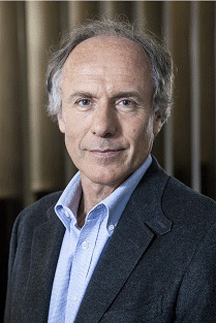
Last week Chief Scientist Alan Finkel – who is conducting a review for the Turnbull government on energy security – said taxpayer money should not be used to subsidise high-efficiency, low-emission coal plants, such as those used in Japan………
Meanwhile, the Clean Energy Regulator has warned electricity retailers that they have until the deadline of February 14 to meet their obligations under the Renewable Energy Target. It follows ERM Power, one of Australia’s largest electricity retailers, choosing to pay a $123 million penalty rather than their RET liabilities.
“Paying a shortfall charge does not support generation to meet the 2020 target [of 23.5 per cent],” the Clean Energy Regulator said. “The intentional failure to surrender certificates will be viewed as a failure to comply with the spirit of the law and an undermining of the objectives and integrity of the scheme.” http://www.afr.com/news/politics/no-new-coalfired-power-stations-planned-for-queensland-20170206-gu69z8#ixzz4Y4ELrTUX
February 8, 2017
Posted by Christina Macpherson |
energy, Queensland |
Leave a comment
Shell plans Australian solar plants that can switch to gas The Anglo-Dutch oil giant is looking to invest in Australian solar plants that can switch to gas when needed. THE AUSTRALIAN, MATT CHAMBERS, 4 Feb 17
Anglo-Dutch oil giant Shell is looking to invest in Australian solar plants that can switch to gas when needed to deliver baseload power supply as debate rages over renewable energy security in the wake of South Australia’s crippling power outages.
Shell, which is Australia’s biggest LNG exporter and one of the world’s largest oil companies, has revealed that Australia was one of three global locations, along with Oman and Brunei, where it was studying pairing renewable energy with gas, after last year flagging “new energies” would be a potential major source of growth for the fossil fuel company beyond 2020.
“We believe we are in the middle of an energy transition that is unstoppable and we want to be in the vanguard of that,” Shell’s global chief Ben van Beurden said after the company’s fourth-quarter earnings release in Britain on Thursday.
He said renewables alone would not be enough to provide the world with cleaner power.
“An integrated offering of gas and renewables, which cannot only deal with interruptibility and everything else of renewables but also give that second leg that a growing economy needs, is a sensible offering,” Mr van Beurden said.
Chief financial officer Simon Henry confirmed Australia was one of the regions where combined gas and renewables were being studied……..
Shell’s plan, to develop economically viable renewable power stations where a gas switch could be flicked when needed, could reduce the need for both coal-baseload power and expensive gas-only peaking plants…….
While Shell’s renewables focus has been on wind farms so far —,it won a bid in December to build a 700MW wind farm off the coast of Holland — it is understood Shell is investigating solar power, paired with gas, in Australia……. http://www.theaustralian.com.au/business/mining-energy/shell-plans-australian-solar-plants-that-can-switch-to-gas/news-story/1ea4416426893074645c45215d3781ea
February 3, 2017
Posted by Christina Macpherson |
AUSTRALIA - NATIONAL, energy |
Leave a comment
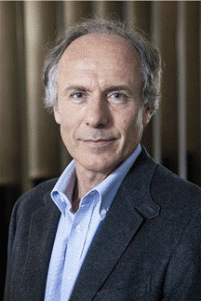 Eight reasons why Dr Finkel is great news for Australia’s energy future http://reneweconomy.com.au/eight-reasons-why-dr-finkel-is-great-news-for-australias-energy-future-70270/ By Valdis Dunis on 1 February 2017
Our electricity grid looks likely to progress more systematically to a cleaner more secure future thanks to Australia’s Chief Scientist Dr Alan Finkel being brought in – to lead the analysis and policy recommendations. For those who could not make Tuesday night’s 2.5 hour session in Adelaide with him, here are some of the key comments made by him and his team:
1. Dr Finkel and SA’s Chief Scientist Leanna Read both see the grid becoming 100% renewable powered as the end point. Continue reading →
February 3, 2017
Posted by Christina Macpherson |
AUSTRALIA - NATIONAL, energy, politics |
Leave a comment
 SA in ‘pivotal position’ to harness sun and wind to stabilise our energy system, says expert. Tory Shepherd, Political Editor, The Advertiser,February 2, 2017 A SUPERGRID connecting South Australia to the west and the east to harness and transport sun and wind could stabilise our energy system, one of the nation’s top experts says.
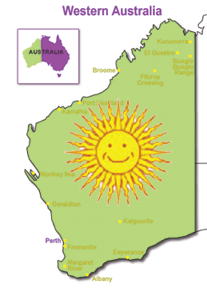
And because the sun is shining in Western Australia after it has gone dark in SA, and its rays hit SA when it is still dark in WA, supply and demand would be evened out.
Professor Andrew Blakers from the Australian National University is working on supergrids and ideas for energy storage in SA. He said there were no financial figures yet, but that SA was in a “pivotal position”.
“An HVDC (high-voltage, direct-current) cable across the desert west to Perth would stabilise the SA system and allow time-shifting … WA is two or three hours behind,” he said. “That would reduce the storage.
“The idea would be you run west. There’s great sun and wind all the way from the head of (Spencer) Gulf to Perth. You’d pick up wind and solar farms along the way.”
The interconnector could then be connected to a new interconnector to the east coast, an option currently under discussion.
Prof Blakers, a professor of engineering, is also talking to the State Government about energy storage through pumped hydro. He says the technology – where water is pumped up to a small reservoir when energy is cheap then released when demand is high – could see SA powered by renewables alone.
Federal opposition energy spokesman Mark Butler has described pumped hydro as one of a number of “exciting” technologies that could transform the market. “There’s a really exciting race on between different technologies that are all being supported at different stages here in Australia and all around the world,” he said.
State Energy Minister Tom Koutsantonis said any extra interconnector would need approval, but that the Government was in favour of the east coast leg.
“The State Government believes a new interconnector to New South Wales would put downward pressure on prices and improve grid security, while at the same time allowing more renewables to be exported to the east coast,” he said……..http://www.adelaidenow.com.au/news/south-australia/sa-in-pivotal-position-to-harness-sun-and-wind-to-stabilise-our-energy-system-says-expert/news-story/4fcf455f7e6f4883eeed3a93f7283319
February 3, 2017
Posted by Christina Macpherson |
energy, South Australia |
Leave a comment
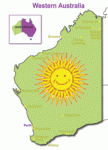 West Australians embrace solar panels at record rate http://www.abc.net.au/news/2017-01-31/solar-power-embraced-by-west-australians-at-record-rate/8227194 By Kathryn Diss WA households and businesses are installing solar panels at a record rate, with installations up 33 per cent last year, driven by rising power prices and the falling cost of the technology, new research has found.
The data, compiled by solar industry consultancy SunWiz, also revealed ten of the nation’s top 20 solar-adopting suburbs were in WA, with Wanneroo, Mandurah and Armadale leading the way.
Sunwiz managing director Warwick Johnston said two factors were driving the uptake in WA.
“We’re seeing solar prices have come down to levels they’ve never been before — prices in Perth are at their lowest compared to the eastern states — and we’re also seeing the electricity price rises really kicking in in Western Australia”, he said.
“In Perth electricity prices started climbing again and [are] expected to do so for a number of years, so I think that’s in people’s minds, in people’s consciousness when they’re thinking about solar power.
“Those factors are really making solar something people are interested in.”
The huge uptake in solar panels during 2016 provided a boon for solar installers across the state.
Solargain WA sales manager James Baverstock has been selling solar panels since 2008 but 2016 was his best year yet, with unprecedented sales during the last three months of the year.
“Towards the end of 2016 we saw record numbers — we were 80 per cent up compared to the same time during the previous year,” he said.
“The average size of the system has also gone up, we’ve seen that go up a kilowatt to a kilowatt and a half. That’s been a steady increase and [it has] certainly accelerated a little bit more recently.
Leading change
The research came as more than 40 interest groups joined forces in WA to call for action on climate change. Headed by doctors, farmers and church groups, the coalition wants the government to commit to an ambitious renewable energy target of 100 per cent by 2030.
General practitioner Richard Yin spoke on behalf of the coalition and said a shift towards renewable energy was essential. “We understand the target is ambitious but it’s been modelled as being possible and it’s been modelled in such a way we believe it can achieved,” he said.
“Everything has a cost. To not proceed down this line has an effect on our climate, to not proceed has a health impact, the combustion from coal kills many thousands of people in Australia each year and the estimated cost is about $2.6 billion in terms of our health cost.” Former WA doctor and surgeon Kingsley Faulkner is also behind the movement.
He now chairs Doctors for the Environment and said climate change was having a big impact on public health.
“In medicine we have a real responsibility to not only treat individual patients but to be involved with public health matters, and climate change and other environmental challenges are amongst the biggest of those matters,” he said.
Increasing use of solar panels has come at a time when, according to the state’s economic watchdog, households are increasingly struggling to pay their power bills on time.
February 1, 2017
Posted by Christina Macpherson |
solar, Western Australia |
Leave a comment





 Antinuclear