 Early skirmishes point to a war over renewable energy lasting well into 2017, The Age, Peter Hannam, 15 Jan 17 “……Trenches are now being dug for what looms as a political battle that will probably last through 2017. On one side lie the Turnbull government, fossil fuel suppliers and right-wing pundits, who say the priority has to be affordable and reliable power.
 On the other, Labor and the Greens and clean-energy backers who argue ageing coal-fired power stations need to prepare for an orderly if not accelerated exit to meet Australia’s commitments agreed in the Paris climate treaty.
Josh Frydenberg, environment and energy minister, ended holidays early on Thursday to rail against states for curbing unconventional gas exploration, which also feeds into higher  electricity prices. That’s especially true in SA where gas provides all the power that’s not from wind or the sun.
He took particular aim at Queensland, where the Labor government under  Annastacia Palaszczuk is aiming for a 50 per cent share of renewable by 2030, up from 4.4 per cent in 2015………
Frydenberg’s Labor counterpart, Mark Butler, though, says the Coalition’s energy policy was “being dictated by the hard right of the party with the likes of Tony Abbott and Cory Bernardi”.
“The culture-war element starts to blind people to pretty clear policy,” he says, noting three-quarters of Australia’s fleet of power stations were operating beyond the end of their design life and needed to be replaced.
“The Turnbull government leaves a policy vacuum at the federal level, the states will fill the void,” he says.
Federal Labor remains committed to a 50 per cent renewable share by 2030, he said, noting the Turnbull government has no target beyond 2020 nor is a target among the terms of reference for its 2017 climate policy review. NSW Labor shares the party’s national goal……
Abbott, as if on cue, weighed into the renewables debate on Saturday……
What is certain is that energy bills are on the rise – although the causes are highly debated…….
Bruce Mountain, an energy economist with CME Australia, says rising energy prices will prompt more people to add solar panels and also batteries as prices continue to tumble – much faster than regulators predict.
Tesla’s new 13.5-kilowatt-hour Powerwall 2, costing about $8800 before installation, already offers a lower battery price than AEMO had predicted for 2040, he says
An average household in Adelaide, where power prices have doubled in the past eight years to be among the highest in Australia, would now be better off with panels and storage.
While panels alone typically slash demand for electricity from the grid by a third, adding a battery will reduce grid purchases by about 95 per cent, he said.
‘Existential threat’
Dylan McConnell, a research fellow at the Melbourne Energy Institute, notes AEMO is predicting 15.5 gigawatts of coal-fired power plants will be shut by 2030. That’s about half of such stations and equivalent to 10 Hazelwoods.
Importantly, AEMO is betting 12GW of new gas-fired power will come on stream “assuming no alternative technologies come to fruition”, Mr McConnell said.
However, the open-cycle gas plants that can provide peaking power to complement variable suppliers such as wind and solar farms “face an existential threat from batteries”, he said……..
Without clear signals, investors won’t have the confidence to invest the billions needed to bring new, more efficient capacity online.
RET challenges
Bloomberg New Energy Finance underscored the scale of the challenge even meeting the 2020 Renewable Energy Target of supplying 33,000 gigawatt-hours from clean energy annually from 2020.
Last year, investment in large scale renewables under the RET bounced back from a meagre $US10 million in 2014 and 2015 after the Abbott government’s review of the sector threw it into a panic. In 2016, it recovered to $US1.1 billion ($1.45 billion).
“However it is still well below the $US2.9 billion per annum now needed to satisfy the notional 20 per cent target by 2020,” Bloomberg said.
Greens energy spokesman Adam Bandt says the Coalition will be tempted to stir up fears of rising electricity prices “in the hope that they can repeat 2013”, when Tony Abbott swept to power in part because of the carbon tax issue.
“They’ll try to beat the electricity bill drums but the prices are going up on their watch,” he says……… http://www.theage.com.au/environment/climate-change/early-skirmishes-point-to-a-war-over-renewable-energy-lasting-well-into-2017-20170111-gtpsd9.html
January 15, 2017
Posted by Christina Macpherson |
AUSTRALIA - NATIONAL, energy, politics, solar, storage |
Leave a comment
Funding boost for renewable sector to prepare ACT for green future http://www.canberratimes.com.au/act-news/funding-boost-for-renewable-sector-to-prepare-act-for-green-future-20170110-gtp8vm.html Clare Sibthorp 11 Jan 17
The ACT government hopes a funding boost to the local renewable sector will take the territory one step closer to a green future.
Two new grant programs launched by Climate Change and Sustainability Minister Shane Rattenbury aim to shape the ACT as an export-oriented hub for renewable energy innovation and investment.
The new Direct Grants Stream will provide grants of more than $30,000 to businesses developing renewable technologies.
The Innovation Connect Renewables Stream will feed extra cash into the ACT government’s existing Innovation Connect grants program, allocating $120,000 to the development of innovative products and services in the renewable sector in 2017.
Mr Rattenbury said the programs would be financed from the $12 million industry-funded Renewable Energy Innovation Fund.
He said the ACT was on track to be fully powered by renewables by 2020. “The grants announced today are designed to grow the renewable energy industry, help organisations take the next step in commercialising their technology and reduce deployment costs of renewable energy and energy storage,” he said.
Jobs growth in the ACT renewable energy sector in the past six years was 12 times faster than the national average, a report into the territory government’s action on climate change revealed.
The Minister’s Report into Climate Change and Greenhouse Gas Reduction also showed the rate of job growth in the ACT’s renewables sector was six times higher than any other state and territory, as the government invested $12 million into a renewable energy industry development strategy.
January 12, 2017
Posted by Christina Macpherson |
ACT, business, energy, politics |
Leave a comment

East Timor villages lit up by solar from Australian not-for-profit http://www.pv-tech.org/news/east-timor-villages-lit-up-by-australian-not-for-profit By Tom Kenning Jan 12, 2017
An Australia-based not-for-profit, the Alternative Technology Association (ATA), has installed hundreds of household solar lighting systems across 12 villages in East Timor.
The two-year project was completed in partnership with two local partners, CNFP and Natiles, and with funding from the Google Impact Challenge 2014, four East Timor Friendship Groups and public donations.
After pilot projects in 2015, now 607 solar systems have been installed in villages in the districts of Aileau, Viqueque and Baucau, affecting 4,000 people.
In each village, Natiles liaised with the community, providing training to a management committee and helping it set up its own maintenance fund, while CNEFP trained 30 local technicians to install, maintain and repair the systems. Participating villagers pay a US$10 installation fee, followed by a monthly subscription of US$2, which will be held by the management committee to fund ongoing maintenance and repairs.
This monthly payment is less than the cost of candles and kerosene for a month, said the ATA.
Lighting was installed inside and outside the front of each house, and each household also received a USB-rechargeable torch on a wristband. The systems are designed to be easy to fix and tamper-proof.
The solar systems allow villagers to charge mobile phones via the USB port and to work or study in the evenings.
The ATA has worked closely with the East Timor Government and the United Nations Development Program on the future of the country’s renewable energy rollout since 35% of Timorese households still have no access to the grid.
January 12, 2017
Posted by Christina Macpherson |
AUSTRALIA - NATIONAL, solar |
Leave a comment
 Sunny Brisbane rooftops well placed to capitalise on solar power, experts say, ABC 6 Jan 17, PM By Katherine Gregory Brisbane has the potential to capitalise on solar power’s more competitive pricing, according to experts.
New research by the not-for-profit solar energy company Australian PV Institute and the University of New South Wales has revealed solar panels in Brisbane’s CBD could generate significant savings.
“We’ve done this stocktake of the solar potential of Brisbane’s CBD and from that we’ve worked out that Brisbane could install 188 megawatts of solar on the rooftops of the CBD and produce enough power to meet 11 per cent of demand of the CBD,” the Institute’s chair Renate Egan said.
“This could be done with upfront investment of about $200 million and would payback in electricity repayments $30 million a year.”
To conduct the stocktake the institute used its new Solar Potential Map, which calculates how much electricity can be generated from any particular roof in Brisbane’s CBD.
Ms Egan said it had found close to 50 per cent of roofs could have solar panels.
“We’ve started with Brisbane CBD because Brisbane and Queensland are really proactive around solar,” she said.
“Queensland has got the largest update of solar in Australia, with 1.6 gigawatts of solar installed in Brisbane [and] in Queensland, and they have a target of getting to three gigawatts by 2020.”
Ms Egan said the institute had also engaged with the Queensland Government about it providing the initial upfront investment to install the panels on government buildings such as Suncorp Stadium and the Queensland Performing Arts Centre (QPAC).
“Anything that helps achieve our renewable energy target of 50 per cent by 2030 is being considered,” a spokesman for Queensland’s Energy Minister Mark Bailey said in a statement.
 ‘Like trying to develop an alpine skiing industry in Queensland’
But the Federal Minister for Northern Australia, Matt Canavan, said Queensland’s renewable energy target was mad.
“It’s like trying to develop an alpine skiing industry in Queensland, it’s about as realistic as that,” he said.
“We don’t have the same renewable resources as say South Australia.
“It would cost an enormous amount of money to build in Queensland and put at risk huge amounts of jobs, particularly in the power sector.
“You’ve got a Labor state government more interested in the philosophy and ideology of power rather than the practicality and reality of it and providing jobs and a decent cost of living for people.”……http://www.abc.net.au/news/2017-01-05/brisbane-well-placed-to-capitalise-on-solar-energy/8164436
January 7, 2017
Posted by Christina Macpherson |
AUSTRALIA - NATIONAL, Queensland, solar |
Leave a comment
Solar targets: ‘We’re already halfway there’ says Energy Minister Mark Bailey, Brisbane Times, Tony Moore , 5 Dec 16 The Queensland Government says it is halfway towards one section of its 2020 target of generating 3000 megawatts of solar power from Queensland rooftops by 2020.
“November’s peak of almost 16MW of solar generation capacity installed represents a 33 per cent increase on the year-to-date monthly average,” Energy Minister Mark Bailey said on December 19.
“The four-month period from August to November included four of the five best months during 2016 for the number rooftop solar installations in Queensland.”
Fairfax Media on Tuesday reported calls by University of New South Wales researchers for Brisbane to make better use of the roofs to collect solar energy.
The researchers will arrive in Brisbane on Friday to demonstrate that by putting solar panels on public buildings such as Suncorp Stadium, QPAC and Roma Street Station enough energy could be collected to power 1200 homes.
Senior researcher Anna Bruce wants to talk to Queensland’s Energy Supply Department and to Brisbane City Council about the potential of using extra roof space to collect solar power.
The research team believes it is possible to “generate 241 gigawatt hours of energy per year,” from photo-voltaic cells which could collect a potential 188 megawatts.
Generating 3000 megawatts from Queensland rooftops is one of the Queensland government’s renewable energy objectives; as well as establishing “a credible pathway for having 50 per cent renewable energy generation by 2030”.
That is contained in its solar energy policy, which can be read here.………http://www.brisbanetimes.com.au/queensland/solar-targets-were-already-halfway-there-says-energy-minister-mark-bailey-20170103-gtlg7a.html
January 6, 2017
Posted by Christina Macpherson |
Queensland, solar |
Leave a comment
Dennis Matthews, 1 Jan 17 Australia’s Chief Scientist, Alan Finkel, has recently drawn attention to a problem in adopting new energy technology.
When home owners consider installing rooftop photovoltaic (PV) electricity generators they are faced with up-front costs.
By comparison, electricity supplied through the grid by large scale electricity generators is provided at no up-front cost to the consumer. The consumer eventually pays the generators’ up-front costs (plus interest) through quarterly bills over a period of several years.
The solution to the problem has been known for several decades – provide a level playing field by having PV up-front costs financed by either an electricity service provider or government with the costs plus interest being recovered over time through the usual quarterly bill.
Such a simple arrangement would not only make rooftop PV competitive (including for rental properties) with grid electricity but would also make energy conservation measures, such as double glazing, more competitive.
January 1, 2017
Posted by Christina Macpherson |
solar, South Australia |
Leave a comment
 Solar switch for one of Australia’s biggest companies funded by community http://www.abc.net.au/news/2016-12-22/wesfarmers-wa-company-switches-to-solar-on-community-investment/8143048 By Ursula Malone Mum and dad investors are using their savings to fund a half-a-million-dollar solar energy project at the Wesfarmers-owned Blackwoods distribution depot at Canning Vale in Western Australia.
Blackwood is the country’s largest distributor of industrial and safety supplies and its Canning Vale depot will have 630 solar panels installed on its roof in the New Year. “Wesfarmers is an enormous company but it is also Australia’s largest private employer so there is an enormous connection [with the community] already,” said Wesfarmers sustainability lead Patrick Heagney.
“We have an internal target to reduce our greenhouse gas emissions, so this is something we’re very proud of.”
The 200-kilowatt system will supply a quarter of the business’s electricity needs.
Mr Heagney said it was the biggest single solar installation in the Wesfarmers group, and the first funded by community investors.
Investors expecting solid returns The community funding model for solar projects was developed by solar innovator Huon Hoogesteger and Emeritus Professor of Economics at University of Technology Sydney, Warren Yeates. “Within 48 hours we had fully subscribed investors for that particular installation,” said Mr Hoogesteger. Continue reading →
December 23, 2016
Posted by Christina Macpherson |
solar, Western Australia |
Leave a comment
India announces plan to step away from coal, casting doubt on approved Queensland Adani mine http://www.abc.net.au/news/2016-12-19/india’s-plan-to-step-away-from-coal-casts-doubt-on-adani-mine/8131240
By Stephen Long India has released a new power plan promoting a dramatic increase in renewable energy and raising doubts about the Indian-owned Adani Group’s massive coal mine in Queensland.
Key points:
- The plan says no need for additional coal fired energy capacity in next decade
- Six-fold rise in energy from renewable sources key part of national electricity plan
- Josh Frydenberg said the Adani mine had to go ahead because India desperately needed it for energy
The new national electricity plan says India will not need any additional coal-fired energy capacity in the next decade.
India’s Energy Minister Piyush Goyal alluded to a renewables pivot when he spoke to Four Corners last year.
“I hope in the years to come we can see an explosion of renewable energy on the back of cheaper storage,” Mr Goyal said.
Media player: “Space” to play, “M” to mute, “left” and “right” to seek.
AUDIO: Listen to Stephen Long’s story (AM)
Tim Buckley from the Institute for Energy Economics and Financial Analytics told AM the development was bad news for the Australian coal industry.
“They [India] say that they have 50 gigawatts of coal-fired power plants under construction already, so it’s far better to complete those than write them off as stranded assets,” he said.
“But no new coal-fired plants in India in the next decade.”
Mr Buckley said the plan had left the Adani proposal “totally stranded”.
“It is a white elephant, and it is six years past it’s use by date,” he said………
However, Adani rejects Mr Buckley’s argument, saying it needs to coal for itself.
“What happens to the market has no implication for Adani because we are supplying our own power stations with our own coal,” an Adani spokesman told the ABC.
Plans to fund billion-dollar railway to mineDespite these doubts, the Australian Government plans to give a $1 billion subsidised loan to Adani to build a railway to the planned mine.
When the then Minister for Resources Josh Frydenberg approved the Adani mine in north Queensland 14 months ago, he argued it had to go ahead because India desperately needed it for energy.
“I think there is a strong moral case here, it will help lift hundreds and millions of people out of energy poverty, not just in India but right across the world,” Mr Frydenberg said.
Mr Buckley said the International Energy Agency (IEA) had forecast that hundreds of gigawatts of new coal-fired power plants would be built in India in the next few decades.
“The Indian Energy Ministry is saying that is absolutely wrong,” he said.
“He instead articulates a plan that involves building 215 gigawatts of renewable energy, building another 20 gigawatts of hydro, building five gigawatts of nuclear, building a bit more gas, and dramatically elevating the importance of energy efficiency and grid efficiency in order to diversify India rapidly away from coal.”
December 21, 2016
Posted by Christina Macpherson |
energy, Queensland |
Leave a comment
 Solar cooling systems take heat out of summer’s hottest days https://www.theguardian.com/sustainable-business/2016/dec/20/solar-cooling-systems-take-heat-out-of-summers-hottest-days
A few Australian businesses are exploiting the searing heat of summer to create purpose-designed solar cooling systems whose benefits extend far beyond electricity savings, Guardian, Dyani Lewis, 20 December 16,
As Australia settles in for another long hot summer, the demand for air-conditioning is set to surge. In fact, with the World Meteorological Organisation stating that 2016 is likely to be the hottest year on record, it’s no surprise an estimated 1.6bn new air conditioners are likely to be installed globally by 2050.
Powering all these units will be a challenge, especially on summer’s hottest days. In Australia, peak demand days can drive electricity usage to almost double and upgrading infrastructure to meet the increased demand can cost more than four times what each additional air-conditioning unit costs.
Yet an emerging sector of the solar industry is turning the searing heat of summer into cooling by using solar heat or electricity. For those developing the technology, the benefits of solar cooling are obvious: the days when cooling is needed the most are also the days when solar works best.
Currently, such systems are still the exception. “It hasn’t got into the mainstream yet,” says Ken Guthrie, who chairs the International
Energy Agency’s Solar Heating and Cooling Program.
Nevertheless, several solar cooling technologies are making their way to market. While off-the-shelf systems for most are still years away, a handful of businesses have already opted for purpose-designed solar cooling systems, which experts hope will convince others to follow their lead.
Echuca regional hospital in rural Victoria was one of the first to take the leap into solar cooling. In 2010, with support from Sustainability Victoria, the hospital designed and installed a solar heat–driven absorption chiller with engineering firm WSP consultants.
A 300 sq m roof-mounted evacuated tube solar field feeds hot water to a 500 kW chiller that was set to save the hospital $60,000 on energy bills and reduce greenhouse gas emissions by around 1,400 tonnes of carbon dioxide equivalent per year.
The system was not designed to run entirely off solar (a gas-fired boiler takes up the slack on hot days), but “we have had days where we run 100% solar” for both cooling and hot water, says Echuca regional health executive project manager Mark Hooper.
The benefits of solar were clear enough that a larger 1,500 kW chiller, connected to a field of trough-shaped solar collectors that track the sun during the day, was installed during the hospital’s recent expansion and redevelopment. This second chiller started operating in November and an analysis of the resulting energy and emissions savings will be assessed in conjunction with CSIRO.
Meanwhile, Stockland Wendouree shopping centre in Ballarat, Victoria, is trialling a CSIRO-designed solar cooling system with funding from the Australian Renewable Energy Agency (Arena). Trough-shaped metal collectors on the centre’s rooftop collect solar heat that is used to dry out a desiccant matrix (much like the silica gel sachets in your shoebox) that dehumidifies air brought in from outside. The hot, dry air is then directed to an indirect evaporative cooler, which delivers cool, dry air into the shopping centre.
The yearlong trial is still under way and hasn’t yet seen a full summer to calculate energy savings, but “it’s going very well,” says CSIRO’s Stephen White. The system is 50% more efficient than an earlier iteration of the design – an important improvement given many buildings don’t have the sprawling rooftop spaces of a shopping centre to mount large solar collector arrays.
With photovoltaic cells more affordable than ever, cooling systems that run off solar electricity are already commercially available. But solar thermal systems could still find a place in the market, according to Guthrie, especially for larger commercial buildings. “There’s no single solution,” he says.
Like any solar technology, solar cooling doesn’t work 24/7. Storing the solar energy collected during the day for use overnight is possible. Stockland’s system uses thermal oil storage, for example, and Echuca regional hospital has insulated its firewater tanks to store chilled water. But there are also efforts to store heat or cooling from one season to the next using underground storage tanks.
Whichever systems a building adopts, White says the benefits of solar cooling extend beyond electricity savings. “It’s not just about the cents per kilowatt hour avoided, but it’s also about the value of the asset itself,” he says.
For Hooper, the motivation was even simpler: “We did it to ensure that our children have a future.”
December 21, 2016
Posted by Christina Macpherson |
solar, Victoria |
Leave a comment
 Some analysts kid themselves about future of solar + storage, REneweconomy, By Giles Parkinson on 19 December 2016
It is an analysis by investment bank CLSA – partly informed by Frontier Economics, the consultancy behind the other notable analyses we reported on last week, here and here – and argues why rooftop solar and battery storage will never take off in Australia and why no one in their right mind would ever leave the grid. Or even install solar modules.
We wouldn’t normally bother with it, but it got some serious air-time in the AFR, and in other Fairfax media, and may just be cited by others.
So it’s worth looking at and pointing out that it is based on some extraordinary assumptions – not just about the cost of solar and storage, but also about the way people would use the technology.
Let’s take its assumptions on going off-grid for instance. It cites as an example an energy hungry, four-bedroom house, the sort of consumer that would likely be the last to choose to go off grid.
No matter. It assumes that such households would want to use all of their appliances at the same time (the oven, the microwave, the dishwasher, the washing machine, the iron, the kettle, the air-con, the drier, the TV, and every light in the house as well as laptops) and would therefore need 19kW of continuous power to supply all that. [good table here on original]
This, concludes analyst Baden Moore, would require 3 Tesla Powerwall 2 batteries or three Redflow ZCells, just to manage two hours of that demand – not to mention the 3-7 days of backup. Just the cost of meeting this peak, he says, would be prohibitive and cost more than $50,000 for the battery storage alone.
There are myriad problems with this calculation. The first is that many houses simply can’t download that amount of power anyway even from the coal-powered grid. In Victoria, for instance, new households have a “capacity” limit of around 10kW.
And then there is something called the “diversity factor,” which, as SolarQuip’s Glen Morris – a leading authority on solar and storage – explains, means it is almost impossible to reach such peak demand at the same time.
One appliance might go for a few seconds at maximum demand then ease off. “I’ve got 10kW (of maximum demand) just in my kitchen but I’ve never been able to turn them on all at the same time and trip the 5kW inverter,” says Morris, who lives off grid.
If a household was going to consider going off grid, would they choose to pay more than $50,000 for batteries that would not be needed most of the time, or would they pay $1,000 or less for smart controls to ensure that most of these appliances are used in off-peak?
The other issue is the sort of thinking that the CLSA report represents. It’s the same dumb attitude – based on visions of soaring peak demand – that was used to over-build and gold plate the country’s electricity network, such that Australian consumers are now paying through the teeth for their grid supply; the very cost that is making rooftop solar and battery storage so attractive to consumers.
But Moore doesn’t seem to see a problem here. He argues that the grid has been built and paid for, and that the energy networks should use any means possible to recover their costs.
“The Australian Energy Markets Commission (AEMC), the key regulator of Australian energy markets, highlights the networks will be allowed to vary the price of grid connection to ensure the cost of capital on the network is recovered,” Moore writes.
“On this basis, the cost of the network will be recovered from all consumers regardless of their usage of battery and solar energy.”
Even the networks know how crazy this attitude is. In the report they prepared with the CSIRO, and in their advice to the Finkel report, they say that millions of households will be driven, economically, to take up solar and storage.
And unless the industry gets its act together and offers them a decent and competitive service, then many will choose to leave the grid, leaving the economics of the industry in a complete mess.
Part of the problem is what Moore and Frontier Economics are comparing the price of solar and storage to. Instead of the full grid price, Moore and Frontier compare solar and storage to the retail and wholesale component of people’s bills. But then they come up with some extraordinary estimates of those prices……
[good charts on original] ….The CLSA report even highlight an analysis on South Australia’s recent blackout by Russell Skelton, a former head of the two biggest coal generators in NSW. Needless to say, Skelton says the high level of wind energy was at fault for the blackout and will cause similar problems elsewhere.
This is in direct contrast to the AEMO report, which said that the nature of wind energy had nothing to do with the outage, and of the Finkel review, which pointed out there are plenty of technology alternatives to coal and gas to ensure grid security and reliability as renewables grow.
It also contradicts the CSIRO and the network owners, who see no problem incorporating more than 90 per cent wind and solar over time, and more than 80 per cent in South Australia in the same time frame that other states are aiming for 50 per cent.
CLSA’s principal point out of all this is to argue that the incumbent utilities are in the box seat when it comes to (slowly) migrating the energy system from black to green.
It is true that these utilities, and the networks, wield enormous influence at political and regulatory level on policies. But simply wishing away the cost competitiveness of new technologies is no strategy to protect the incumbents, or the consumer. http://reneweconomy.com.au/analysts-kid-future-solar-storage-33799/
December 21, 2016
Posted by Christina Macpherson |
AUSTRALIA - NATIONAL, solar, storage |
Leave a comment
 Dennis Matthews, 18 Dec 16 , 1 DECEMBER 2016.
The “separation event” was the disconnection of the Heywood interconnector into South Australia.
The following uses the same headings as the AEMO preliminary report.
1. Overview
A short-circuit in a Victorian 500 kV (kilovolt), alternating current (AC) transmission line connected to the Heywood Victorian-SA interconnector resulted in the SA electricity network being disconnected from the Heywood interconnector.
At the time of the “incident” the Victorian electricity network was highly vulnerable to disruption. One of the two circuits served by the Heywood interconnector had been taken out of operation for maintenance. To make matters worse, one of the circuits supplying the Alcoa aluminium smelter at Portland was also out of service. Like all aluminium smelters, the Portland smelter had a very heavy electricity demand (about 480 MW).
The vulnerability of the Victorian electricity network meant that the SA network was also vulnerable to an abrupt loss of 230 MW. Nevertheless, no measures had been put in place to immediately replace power supply from Victoria in the event of disconnection from the Haywood interconnector. As with the SA state-wide blackout two months earlier, there was more than sufficient generating capacity available in SA but it was not on standby.
A short circuit in the remaining transmission line in Victoria to the Heywood interconnector resulted in SA and the Portland smelter being disconnected and the shutdown of two wind farms in Victoria.
The “incident” in Victoria, together with inadequate contingency plans resulted in the loss of 230 MW to SA, BHP’s Olympic Dam project losing 100 of its 170 MW for 3 hours, Portland smelter being disconnected for 4½ hours and disconnection of two wind farms (Portland generating 3MW, and Macarthur generating 4MW) in Victoria.
2. Pre-event Conditions
“Immediately prior to the incident there were two planned outages.”
Use of terms such as “incident” and “event” is reminiscent of the nuclear industry’s avoidance of terms such as “failure” , “accident”, and “meltdown”.
“Planned outage” refers to deliberate disconnection of parts of the system for maintenance or repairs. Such deliberate disconnections should be permitted only if they do not expose the system to serious disruption and only if there is sufficient backup in case of a fault developing in the remaining parts of the system. For SA no backup was put on standby in the case of SA being disconnected to the Heywood interconnector.
One of the “outages” referred to was that one half of the Heywood supply to SA (a 500 kV busbar) was out of service. This left SA and Victoria vulnerable to a fault developing in the remaining half of the Heywood supply. The other “outage” was the Heywood to Portland 500 kV transmission line servicing the Alcoa aluminium smelter.
Both outages were given permission by the Australian Energy Market Operator (AEMO).
These two decisions left the aluminium smelter vulnerable to a fault developing in the remaining half of the Heywood transmission line in Victoria. There was no backup plan for maintaining supply to the smelter in this contingency.
At the time, SA was importing about 240 MW from Heywood in Victoria.
3. Event
“A single phase to earth fault occurred on the Morabool-Tarrone 500 kV transmission line causing the line to trip out of service.” In other words, there was a short circuit in the only remaining transmission line in Victoria to the Heywood interconnector.
“It is believed that the line tripped as a normal response to this type of fault”. The short circuit caused the transmission line to Heywood to be disconnected (trip).
The short circuit was caused by the breaking of an electrical cable. The reason for the cable breaking was not known to the Australian Energy Market Operator (AEMO).
The “trip” of the transmission line left the Portland smelter still connected to SA, the power flow reversed so that instead of 240 MW into SA from Victoria there was 480 MW from SA to Victoria to supply the Portland smelter. A control scheme then disconnected the smelter from SA.
5 Operation of SA when Islanded
Islanded means that SA was on its own as far as power supply was concerned, in particular, it means that it was not receiving power from Victoria. In fact, SA was still receiving about 220 MW through the high voltage, direct current (DC), Victoria-SA, Murraylink interconnector.
December 19, 2016
Posted by Christina Macpherson |
AUSTRALIA - NATIONAL, energy, South Australia, spinbuster, Victoria |
1 Comment
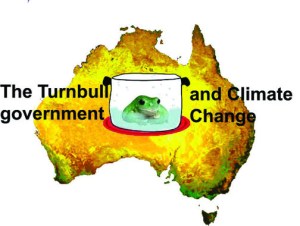 Why Coal Is Not Our Future, Skeptical Science 15 December 2016 by Riduna
Coal Problems
Australian Prime Minister, Malcolm Turnbull, has repeatedly asserted that coal will remain in use for electricity generation for ‘many, many decades to come’. He argues that moving to renewable energy would reduce production and use of coal resulting in unacceptable loss of mining and transport jobs, particularly in rural areas. However, the threat of larger job losses did not stop his predecessor from withdrawing subsidies for the car industry, resulting in its closure nationwide – action supported by the present Prime Minister.
Recently, Energy Minister Friedenberg asked Australia’s Chief Scientist, Dr Finkel, to prepare a Discussion Paper on electricity security during the transition to renewable energy. The Paper, presented to the Prime Minister and Premiers on 9 December, 2016 recommended that an energy intensity scheme be applied to the electricity generating sector. This would see the highest emitters leave electricity generation and promote orderly replacement of coal by gas and, increasingly, renewable energy generators.
The Paper reported that existing policies lacked clarity and certainty for investors and would not achieve Australia’s commitment to reduce greenhouse gas emission by 26-28% below 2005 levels by 2030, given under the Paris Agreement. Even before recipients of the paper had time to consider it, the Prime Minister rejected its main conclusions.
In declaring coal Australia’s present and future energy source, Turnbull has chosen to ignore the dangers of coal production and use to public health or, more accurately, public death. Clear evidence shows that coal mining in Australia not only causes respiratory problems through inhalation of airborne particles but that this results in the incurable ‘black lung disease’ resulting in a slow and painful death. Its combustion in power stations results in emissions which increase the incidence and severity of health problems among populations living up to 100 km away.
As the Prime Minister knows, coal has to compete with renewable clean energy sources, particularly solar and wind. It’s a no brainer of course. Continue reading →
December 16, 2016
Posted by Christina Macpherson |
AUSTRALIA - NATIONAL, energy |
1 Comment
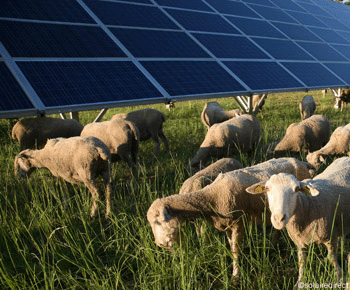
ACT solar farm announces new tender ….. for sheep, REneweconomy By Sophie Vorrath on 16 December 2016
The owners of the Mugga Lane Solar Park in the ACT are looking for one more addition to their almost complete 13MW power station – and it’s not battery storage.
Maoneng Group, who started building the solar farm in March after winning a tender in the ACT government’s first large-scale renewables reverse auction, has this week launched its own, rather unusual, tender – for a flock of sheep. The company is seeking expressions of interest for a farmer or community group to graze 100-150 head of sheep within the Mugga Lane Solar Park – an area of around 46 hectares at the intersection of Mugga Lane and Monaro Highway in the ACT.
“Applicants must maintain the livestock inclusive of drenching, crutching, shearing, veterinarian costs and portable pens,” the tender says, adding that “weathers or non-lambing ewes are preferred.”
The owners of the solar park, which began generating power in mid-November, will provide and maintain fencing, two water troughs and a small holding paddock with all-weather accessibility.
Maoneng’s Shaun Curran said the deal, which would be a quid pro quo “cost neutral” affair, would provide a local farmer or community group with free and secure grazing, while for the Solar Farm, it would provide free lawn mowing and reduce the site’s fire risk…….
Curran also noted that sheep, while preferred, were possibly not the only livestock option.
“There was a large mob of kangaroos on site when it was first being developed,” he said. “So they could work too. They’re similar to sheep; not too destructive. They don’t want to rub up against the panels.”…… http://reneweconomy.com.au/act-solar-farm-announces-new-tender-sheep-19044/
December 16, 2016
Posted by Christina Macpherson |
ACT, solar |
Leave a comment
 Dennis Matthews, December 2016 BLACK SYSTEM, SOUTH AUSTRALIA, 28 SEPTEMBER 2016.
3rd Preliminary Report, December 2016 Australian Energy Market Operator (AEMO)
Introduction
The “Black System” referred to by AEMO is what is more commonly known as the South Australian state-wide blackout. AEMO also refers to it as “the event”. The AEMO report contains considerable technical jargon and use of acronyms. Constant referral to a list of terms and abbreviations at the beginning of the report is necessary.
AEMO Executive Summary
According to the executive summary, the SA blackout was “initiated by the loss of three transmission lines involving a sequence of faults in quick succession”. These electricity transmission lines are the high voltage power lines that feed into the low voltage distribution system that services homes and many small to medium businesses.
The damaged transmission lines were in the mid-north of SA.
The sequence of faults led to many wind turbine electricity generators in the mid-north initially trying to continue to generate. Within 7 seconds, these initial attempts to “ride through” the problems caused by transmission line damage were followed by wind turbines deliberately shutting down (tripping), or decreasing their output, in order to protect them from serious damage. This caused a decrease of power generation by about 460 megawatts (MW). Prior to the transmission line damage, the total generated grid power available to SA was about 1830 MW. Domestic, off-grid, solar photovoltaic power was about 50 MW.
Although it seems reasonable that wind turbines should have an ability to shut down to protect against serious damage, according to the report “AEMO was not aware of the protective feature of these generating units”. Consequently, AEMO had not taken steps to replace the lost power in such a situation.
The loss of about 460 MW of generating capacity resulted in an attempt to import extra power through the Heywood, high voltage, alternating current (AC), connector with Victoria. Such connectors between states are essential for the operating of an electricity market. Without interconnectors there would be no National Electricity Market (NEM). Continue reading →
December 16, 2016
Posted by Christina Macpherson |
energy, South Australia |
1 Comment
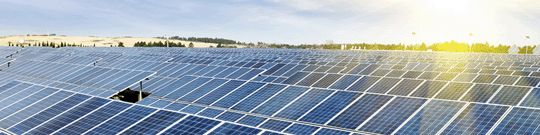 Queensland’s largest solar farm plugs into the grid a month early The 20 megawatt plant in Barcaldine is one of first in the country to be funded by Australian Renewable Energy Agency, Guardian, Joshua Robertson, 14 Dec 16, Queensland’s largest operating solar farm has plugged into the national electricity grid and is set to generate enough power for almost 10,000 households by the end of 2016.
The Barcaldine remote community solar farm, in the state’s central west outback, connected to the national electricity market on Wednesday, more than a month ahead of schedule.
The early delivery of the 20 megawatt plant, one of the first in the country to be funded by the Australian Renewable Energy Agency, was evidence of the growing speed and proficiency of big solar developers, said Arena’s chief executive, Ivor Frischknecht.
It is to be followed by a dozen new large-scale solar farms to be built across Australia by the end of 2017, which would ramp up national solar capacity to enough power for 150,000 average homes.
Those plants – six in Queensland, five in New South Wales and one in Western Australia – would be the fruits of an Arena funding program expected to “unlock almost $1bn in commercial investment and boost regional economies”, Frischknecht said.
The Barcaldine plant developer, Elecnor – one of a number of Spanish companies invested in Australian solar – is a transnational corporation with interests from gas and rail to aerospace. Elecnor was backed by $22.8m in funding commitments by Arena and $20m in loans from the federal government’s “green bank”, the Clean Energy Finance Corporation.
Barcaldine’s mayor, Rob Chandler said the project, which features 78,000 solar panels, had “enthusiastic supporters” in a local community that saw “the great benefits it can bring to outback communities like ours”.
“If it’s one thing we have a lot of it’s sun so it’s great to see it being harnessed to power the electricity grid.”
Frischknecht said: “As well as generating clean energy, the project is demonstrating how project developers can monetise network benefits and ultimately how solar farms can improve network efficiency and reliability at the edge of the grid.”…… https://www.theguardian.com/environment/2016/dec/14/queenslands-largest-solar-farm-plugs-into-the-grid-a-month-early
December 16, 2016
Posted by Christina Macpherson |
solar, South Australia |
Leave a comment
 Early skirmishes point to a war over renewable energy lasting well into 2017, The Age, Peter Hannam, 15 Jan 17 “……Trenches are now being dug for what looms as a political battle that will probably last through 2017. On one side lie the Turnbull government, fossil fuel suppliers and right-wing pundits, who say the priority has to be affordable and reliable power.







 Antinuclear