South Australia: Electricity market’s unstoppable move away from coal-fired “base-load generation”
 South Australia signalling the death of base-load generation, REneweconomy,By Giles Parkinson on 8 August 2016 Tuesday marks the three-month anniversary of the closure of the last coal-fired “base-load generator” in the South Australia electricity market, and despite the best efforts of many in the Coalition and the Murdoch media, there is nothing to suggest that other states will not follow suit, in time.
The fossil fuel industry predicted – and possibly hoped for – “armageddon” from the closure of the last coal plant. But all it got was a big jump in wholesale electricity prices, caused not by renewable energy, as federal and local energy ministers have made clear, but by the soaring cost of gas and constraints on the interconnecter.
If anything, the events of the last few weeks have reinforced the point that the electricity market is in the early stages of an unstoppable transition. Coal-fired plants will soon be a thing of the past, and the role of gas-fired generators may all diminish as battery storage and other renewables take more central roles.
The announcement by AGL on Friday of its plans – supported by the South Australian government and the Australian Renewable Energy Agency – for an array of 1,000 batteries in homes and businesses to create a “virtual power plant” to address demand peaks and grid stability, is a foretaste of what is to come.
Indeed, South Australia’s experiment – as premier Jay Weatherill has described it – in pursuing the world’ highest level of wind and solar generation is rapidly evolving into a whole bunch of world-leading projects.
These include AGL’s (described the world’s biggest virtual power plant), South Australia Power Networks’ commitment to a second “world leading” battery storage project that will likely reduce the need for grid investment, and various proposals for large-scale solar with storage (from SolarReserve,Lyon Infrastructure and others) and the creation of suburban and remote town micro-grids that will reduce the need for centralised power and distribution.
The withdrawal of base-load coal generation from the South Australian grid has sparked predictions of economic collapse and soaring prices, but these have simply replicated what used to happen when the state relied entirely on gas for the balance on power, even before the arrival of wind and solar. Continue reading
Clean Energy Finance Corporation helps North Melbourne Football Club go solar
 Join in the solar chorus, says council, as North Melbourne gets on the ball http://www.theage.com.au/victoria/join-in-the-solar-chorus-says-council-as-north-melbourne-gets-on-the-ball-20160807-gqmtz2.html, Clay Lucas
Councillor Arron Wood can understand why more businesses don’t put solar panels on their roof.
It’s not because they don’t want to save money. And it’s not because they don’t want to do the right thing. “The biggest barrier to wider uptake [of solar power] is the complexity of going through the process,” says Cr Wood, the chairman of Melbourne City Council’s environment committee.
Which is why, he says, opening North Melbourne Football Club’s new solar panel bank – 800 panels set across the club’s roof and that of the neighbouring council-run recreation centre – is a major breakthrough.
“There’s this sense that footy speaks to all parts of life in Melbourne, so partnering with … North Melbourne footy club might drive others to think ‘Maybe this is something we can do’,” he says.
The panels on the club’s roof will produce enough electricity per year to run 70 average Melbourne homes. North Melbourne’s chief executive Carl Dilena said the club expected to cut its energy use by almost a quarter as a result of installing the solar panels.
But as many Melbourne home owners know, solar does not always come cheap, at least initially. The system cost almost half a million dollars to install, and was partly financed by the council, via the Clean Energy Finance Corporation. The club contributed about $67,000 of the funding, with the rest coming from the city council.
It is the first partnership the council has undertaken with an outside party – all other installations it has done have been on council-owned building rooftops.
The council is working with Sustainability Victoria to find businesses interested in reducing either emissions or energy bills that have previously considered going solar.
“The driver for a lot of businesses isn’t saving the environment, it’s to save dollars and that’s completely fine,” says Cr Wood.
Western Australian farmers see solar off-grid savings opportunity
 Solar could be game changer for rural communities going off the grid, ABC News By Kathryn Diss , 7 Aug 16 For decades, farmers in Western Australia’s south have put up with the most unreliable electricity supply in the state, now they are about to find out if they can live off-grid, surviving on solar power instead.
Key points:
- Farmers in Western Australia are investigating using stand-alone solar power systems
- Solar battery technology is making this more easily achieved, and the State Government will pay for it
- Power-supply to south west WA has been unreliable, a problem in other regional areas
Ros and Bernie Giles are part of a handful of farming families giving the technology a crack after living through years of frustration at their farm in West River, 500 kilometres south of Perth.
“Summer is our worst time, we seem to have more fluctuations then,” Ms Giles said……
Power problems span farmland across nation
WA’s south west grid spans more than 250,000 square kilometres, an area the size of the United Kingdom, yet it only services a 50th of the population, making it unreliable and expensive to maintain.
But the power problems faced by the people of West River are hardly unique.
Matthew Warren heads up the Australian Energy Council, which formed earlier this year to respond to the world’s rapidly changing energy market.
He said most edge-of-grid communities around the nation suffered the same problems……….
Renewable energy reaches tipping point
The move by WA’s Liberal-National Government to invest in the technology is seen as a step towards a greener future.
It is not just environmental goals driving the innovation but the financial realities of providing an expensive poles and wires network versus the improving economics of renewables……..http://www.abc.net.au/news/2016-08-06/solar-could-be-game-changer-for-rural-communities-on-grid-edge/7681398
World’s largest ‘virtual power plant’- 1000 battery systems for solar energy in Adelaide
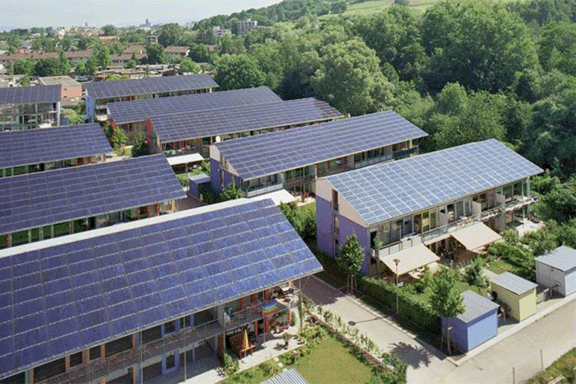 Adelaide charges ahead with world’s largest ‘virtual power plant’ AGL project to roll out 1,000 battery systems to homes and businesses will operate like a 5MW plant, and optimise energy produced from solar panels, Guardian, Michael Slezak, 5 Aug 16, Adelaide will be home to the world’s largest “virtual power plant” – AGL is rolling out 1,000 battery systems to homes and businesses, with backing from the Australian Renewable Energy Agency (Arena).
AGL and Arena say the project will improve network security and dampen a volatile wholesale electricity price in South Australia. However, an energy expert says that at the current size, the system will have a minimal impact on network security or wholesale prices, but might pose a challenge to the revenues of companies that own the poles and wires.
Offered to homes and businesses with solar systems, the $20m AGL project, backed with $5m from Arena, will operate like a 5MW peaking power plant, providing power to homes and businesses during periods at optimal times.
The chief executive of AGL, Andy Vesey, told Guardian Australia: “The beauty of the project is it’s being done over 1,000 batteries, and that’s how we deliver an aggregate benefit to the grid itself.
“But for the consumer, it will have the value of the battery. And it’s being priced at a way that a good investment decision could be made. We’re viewing that the average savings for someone who has rooftop solar right now would be $500 a year. It’s really a way of optimising the energy produced out of their solar panel.”
The system will cost $3,500, and AGL estimates it will take about seven years for solar customers to recover the costs.
Arena’s chief executive, Ivor Frischknecht, said the project would boost grid stability, reduce power price volatility and support the expansion of renewable energy……..
As a demonstration of something that could be bigger, McConnell said one of the biggest impacts of the business model could be on how the networks recover the costs of the poles and wires.
About half the cost of a home energy bill is linked to the network’s cost recovery of its poles and wires. McConnell said that meant a lot of the money being saved by consumers was actually done by avoiding paying the network costs. And that’s what AGL is relying on for its business model.
But this “virtual power plant” isn’t moving people off the grid. Instead, it’s relying on the grid, while avoiding the charges the distributors use to pay for the grid…….https://www.theguardian.com/environment/2016/aug/05/adelaide-charges-ahead-with-worlds-largest-virtual-power-plant
Combination of solar and wind, with smart analytics and “big data” could cause electricity costs to plummet
Could big data soon make renewable energy storage free?, Independent Australia 2 August 2016, A new report explores the democratising of renewable energies through the advancement of “big data”.RenewEconomy‘s Giles Parkinson reports.
GLOBAL investment bank Citi is predicting that the combination of near zero-variable cost energy sources such as solar and wind, along with smart analytics and “big data”, may deliver what the nuclear industry promised nearly half a century ago — free energy……
Citi is not the only research institution making such forecasts but it is in sharp contrast to the general public discussion in Australia, which is dominated by those who insist that the old centralised energy system – slow, inefficient and expensive – will not and cannot be replaced by new technologies.
South Australia is now the focus of that debate, and the push-back against wind and solar by conservatives and, of course, vested interests, seeking to protect their sunk assets is striking.
But Australia is already well down the path to this transformation, given its high level of rooftop solar and the fact that it is considered to be the world-leading market for household battery storage and smart software. Continue reading
Melbourne’s first Tesla-town to be built in mega Alphington development
The Age, Simon Johanson, 2 Aug 16, The first stage of the massive 2500-dwelling, mixed-use commercial redevelopment of the former Amcor paper mill site in Fairfield will be built with 60 homes fitted with Tesla battery packs, inverters and solar panels. The full-line energy installation will not be an optional extra for home buyers but a standard inclusion in all three- to five-bedroom homes, Glenvill development director Travers Nuttall said…….http://www.theage.com.au/business/property/melbournes-first-teslatown-to-be-built-in-mega-alphington-development-20160729-gqgr0w.html
Australia’s potentially powerful political constituency – solar power home-owners
Regardless of what the industry’s lobbyists and media barrackers say, renewables are cutting the cost of power and making it more reliable….
The next big threat to the old business model, however, is storage
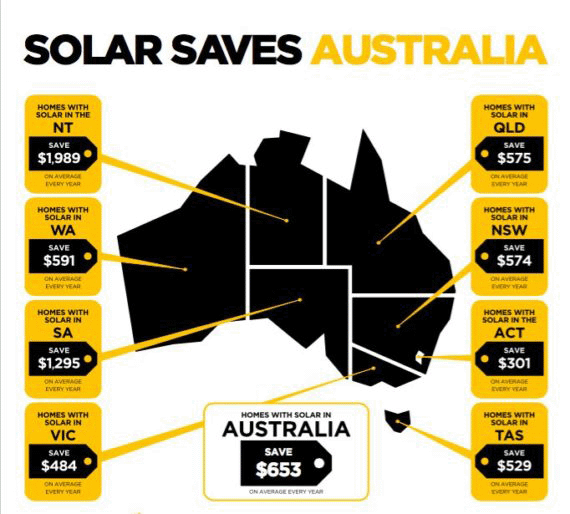
According to figures compiled by the environment group Solar Citizens before the recent election, just 2352 of the 90,000-odd voters in Frydenberg’s affluent inner Melbourne electorate of Kooyong had solar panels on their roofs.
That placed Kooyong 132nd of 150 federal electorates for rooftop solar. Kooyong is typical of what Solar Citizens found in their study of rooftop solar. More affluent electorates tend to have lower take-up rates……
out in the ’burbs, and in the rural and regional areas, rooftop solar is big. The seat of Dawson, for example, based on Mackay in North Queensland, has more than 10 times as many houses with rooftop solar as Frydenberg’s electorate. Yet voters there just returned George Christensen, a climate change denier who sits on the extreme right wing of the Nationals. Ipswich, home town of Pauline Hanson, has even more solar panels up.
Dickson in Brisbane, held by another arch-conservative, Peter Dutton, has more than 35,000 solar roofs, and the eighth-highest penetration of solar in the country. And the number one electorate for rooftop solar is the huge rural South Australian seat of Grey. There, according to Solar Citizens, some 41,000 constituents have invested $140 million to install more than 80,000 kilowatts of solar, resulting in an annual abatement of 54,000 tonnes of the main greenhouse gas, carbon dioxide. The seat is held by Rowan Ramsey for the Liberals, although he was given a nasty scare from the Nick Xenophon Team at the election. Continue reading
Cutback in solar payments: smart meters might help
 From solar boom to bill shock: Australians face loss of rooftop payments
About 275,000 people across the country will have their solar energy payments reduced by up to 80% over the next six months, Guardian, Michael Slezak 31 July 16 “……. more than 275,000 people across Australia who will see the subsidised payments they receive for their solar energy disappear over the next six months, replaced with rates up to 80% lower.
The solar boom in Australia, which has led to 1.5m households generating their own electricity from the sun, was accelerated by subsidised payments for people who sell solar-generated electricity back to the grid.
In some cases, like Shaw’s, solar customers were able to receive more than twice the money for the electricity they put in the grid, compared with what they paid for electricity they took out of it.
But for a lot of homes and businesses, those schemes are coming to an end over the next six months and, if they’re not prepared, they will be heading towards some serious bill shock.
Customers in New South Wales, who got the most generous rate, will be in for the biggest hit and will need to do the most to adapt to the changes…….
While about 150,000 homes and business will be kicked off these schemes in NSW on 1 January 2017, the party is ending for about 130,000 customers inVictoria and South Australia too.
(Others are on schemes that will continue for years to come. So if people are confused about their own feed-in tariffs, they should ask their retailer what’s happening with them.)…….
Smart meters
The issue of what kind of meter to get is a minefield right now, with different issues affecting consumers depending on where they are, and options are changing rapidly.
One thing that can help anyone make the most of their solar electricity is a smart meter, says Claire O’Rourke, national director of Solar Citizens, a group that lobbies on behalf of solar customers.
A smart meter can be read remotely, and can tell when the most power is being drawn, helping maximise the benefits. They can also open up services such as time-of-use tariffs, providing savings for people who avoid using energy during periods of high demand.
“You’re probably better off with a smart meter but they do have an increased cost,” says O’Rourke.
Some retailers are offering discounts for smart meters in return for fixed-term contracts. “It is really in the interest of consumers to shop around,” she says.
For many people right now a smart meter could be overkill. The smart meter will either be paid upfront, or in the case of free meters offered by retailers, will be paid for through increased tariffs, says Moyse. Whether the meter will allow consumers to recoup that cost is unclear.
For people outside NSW, the lowest-cost option is to keep their current meter, at least until it’s clear a smart meter is worth it. Outside NSW, the current meter will work fine on the new deals.
Unfortunately, for most people on the NSW solar bonus scheme, their meters will need to be replaced……..
the loss of generous feed-in tariffs is driving interest in battery storage, says Chris Cooper, chief executive of Suncrowd, a company using group purchasing power to get cheaper prices for batteries.
“It’s a bit of a trigger point for people to look at new technology,” Cooper says. So far Suncrowd has run its first round in Newcastle, and had about 200 homes join together and buy batteries at discount rates.
He says lots of the customers who have been approaching Suncrowd have been people coming off the NSW solar bonus scheme. Having a battery added to an existing solar system can significantly increase “solar self-sufficiency”, Cooper says, a measure of how much the customer relies on solar rather than electricity from the grid. “With an appropriately sized battery you can boost it from 20% to about 60 or 70% self-sufficiency,” he says. Cooper says Suncrowd is building an online tool to help people calculate their solar self-sufficiency and have been showing it to people at events they’ve been holding. “People are really motivated by seeing the numbers go up,” he says…….https://www.theguardian.com/environment/2016/jul/31/australia-residents-solar-rooftop-lose-payments
Electricity industry in a panic about renewable energy’s success
Disruptive power, The Age, Richard Denniss , 29 July 16 The Productivity Commission is  criticising the Trans Pacific Partnership, the head of the Australian Competition and Consumer Commission is criticising privatisation, and the electricity industry is worried that competition from renewables might deliver lower prices to consumers. What on earth is happening to the Neo-liberal “agenda”?
We are witnessing a watershed moment in Australia’s economic and political debate. The grand narrative of “market good-government bad” is dead. Killed by the rent seekers and vested interests that couldn’t resist overselling the benefits to the same consumers and taxpayers they were busy gouging.
The mining industry can’t help asking for taxpayers to subsidise their rail lines…….
It’s hard to maintain the argument that government spending is bad for the economy when even the Institute of Public Affairs supports taxpayer funding for dams and coal railway lines in far northern Australia…….
The PC, which now refers to so-called “free trade agreements” as “preferential trade agreements”, recently said that the TPP includes provisions of “questionable benefit” to Australia. It was once heresy to suggest that a document called a ”free trade agreement” could do anything other than facilitate trade, but now the Lefties at the PC are encourage us to scrutinise the detail. Rules matter…….
the banks, the mining companies and the media moguls that shouted the loudest about “free markets” have always spent up big on lobbyists to ensure they got the rules they wanted. But now the cat is out of the bag. …….
As more and more batteries are installed in homes and businesses the peak load on the transmission network will be reduced, meaning that we will be able to save billions of dollars on line upgrades within and between towns and cities. Should that windfall accrue to those with an obligation to maintain the network, to the people who install the batteries, or be shared in some way? Rules matter……..
South Australia has cheaper electricity today than it had in 2007. There were no black outs during the so-called “crisis” and the vast majority of residential and industrial customers who are on long-term contracts didn’t even notice the five-minute surges in the wholesale spot price. When the interconnector upgrade is complete, and if a new interconnector with NSW is built, not only will SA be able to rely on more power from other states when the wind is calm, but SA will be able to export a lot more cheap energy when the wind does what it usually does in SA which is blow hard.
The fear that SA may soon be an even bigger exporter of cheap wind power is what is behind the recent “debate”. Their best chance to protect their profits is to ensure that the “market regulations” restrict the growth prospects for their main competitors. Rules matter. After years of getting the rules they wanted by arguing that they simply wanted “free markets” Australian rent seekers are now forced to win public debates about why we should give them the rules they want. It’s not going well for them.
Richard Denniss is the chief economist for The Australia Institute. http://www.theage.com.au/comment/disruptive-power-20160728-gqgazk.html
Desperate coal industry sponsors attacks on wind farms
 Coal is behind the attacks on wind turbines. It’s fighting for its life, The Age, Peter Martin, 27 July 16
First they were supposed to be destroying birds, then sleep. Now wind turbines are being blamed for destroying the Australian electricity market and pushing prices as high as $14,000 per megawatt hour.
As Victoria gives the green light for a massive $650 million wind farm with up to 104 turbines at Dundonnell, 200 kilometres west of Melbourne, and with talk of more wind farms in NSW a Liberal senator has been calling for a moratorium on new turbines until the Productivity Commission examines what they are doing to prices.
“There should be no further subsidies paid for an intermittent and unreliable power source that can be seen as as proven failure,” Senator Chris Back is quoted as saying, in an apparent attempt to prejudge the inquiry he is calling for.
On the face of it, it’s an odd idea: that adding a new and very cheap source of power should push up prices (wind turbines cost next to nothing to operate). And for the record, it’s not true. South Australia has more wind turbines than any other state. They supply more than one-third of its power. Yet a graph prepared by the Australian National University’s Hugh Saddler shows that South Australia’s average electricity price was much higher when they only provided 10 per cent.
The complaint is about spot prices, those instant short-lived prices the big industrial users have to pay if they haven’t insured against sudden movements, as a lot have not………
With fewer coal-fired plants, and with wind plants scattered throughout the nation, the system has the potential to work surprisingly well. Energy analyst David Leitch points out that in South Australia most of the wind turbines fire up at the same time, but if they were also placed in northern NSW and Tasmania (where the wind blows at very different times) each would fill the other’s gaps.
South Australia and Tasmania overlap only 10 per cent of the time. At other times, the gap would be filled by storage: either batteries or water storage as wind power pumps water up to the top of mountains while the wind’s abundant and lets it drop through hydro plants when it’s not.
Wind needn’t be a problem, regardless of what you’ve been told. But it does leave very little role for coal, which supplies base load power for which a wind-dominated system would have little use.
With fewer coal-fired plants, and with wind plants scattered throughout the nation, the system has the potential to work surprisingly well. Energy analyst David Leitch points out that in South Australia most of the wind turbines fire up at the same time, but if they were also placed in northern NSW and Tasmania (where the wind blows at very different times) each would fill the other’s gaps.
South Australia and Tasmania overlap only 10 per cent of the time. At other times, the gap would be filled by storage: either batteries or water storage as wind power pumps water up to the top of mountains while the wind’s abundant and lets it drop through hydro plants when it’s not.
Wind needn’t be a problem, regardless of what you’ve been told. But it does leave very little role for coal, which supplies base load power for which a wind-dominated system would have little use. http://linkis.com/www.theage.com.au/co/1H46Y
Renewables not to blame for South Australia’s electricity papers – says Energy Minister Josh Frydenberg
Frydenberg says renewables not to blame for South Australia energy “crisis”, REneweconomy By Giles Parkinson on 28 July 2016 Josh Frydenberg, the minister newly elevated to the combined energy and environment portfolio, says that renewable energy was not to blame for the recent energy “crisis” in South Australia, although he did deliver some mixed messages about how the government proposes to move forward.
Frydenberg delivered a series of interviews on Wednesday, the first since he was appointed to the new position in a reshuffle by the re-elected Turnbull government, and this included a “chat” with ABC personality Annabel Crabb at a dinner function at the Clean Energy Summit.
Asked about the recent electricity spikes in South Australia, Frydenberg said it was a “complex picture” that included a reduced capacity on the inter-connector, a cold snap that spiked demand, a big shift in gas prices, and the “intermittency issue about wind and solar.”
But he also noted that in 2008, as RenewEconomy has reported, the price of wholesale electricity in South Australia peaked above $5,000/MWh more than 50 times. That was before wind and solar were in that state, he said, and noted there had only been three such peaks so far this year.
“People have to understand that this volatility is not a new thing. It was back there in 2008 …. so to say that (this price spike) is the fault of renewables is not an accurate assessment,” Frydenberg said, to the applause of the audience of around 400 people.
This, however, was not how The Australian interpreted events, who attributed Frydenberg’s comments about the crises in South Australia and Tasmania as a “wake-up” call about the problems created by wind and solar.
Tasmania, it should be remembered, suffered the highest wholesale prices in Australia last financial year because its electricity supply was restricted by the loss of the Basslink cable and much of its hydro capacity due to drought. Most analysts say it was its lack of investment in wind and solar that forced it to rely heavily on expensive back-up gas and diesel…….
Frydenberg appeared well briefed, non-confrontational, and recognised the growing role of technologies such as wind, solar and battery storage whose costs had fallen quickly and would continue to do so. He also appeared to be listening, people said.
The role of coal, Frydenberg accepted, is declining, and the transition to clean energy is inevitable. But he was reluctant to put any time frames on the inevitable move to zero emissions technology, apart from saying that a shift to 100 per cent renewable energy was not going to happen overnight.
But while his comments were soothing for an industry just regaining its confidence after being battered and bruised by the first term of the Abbott-Turnbull government and the key policy decisions of Frydenberg’s good friend, the previous environment minister Greg Hunt, his next moves will be scrutinised intensely.
There is great concern about a push by the incumbent energy industry, such as the Energy Supply Council to force state governments to abandon their individual state targets, a move that will be strongly resisted by South Australia, Victoria, Queensland and the ACT……..http://reneweconomy.com.au/2016/frydenberg-says-renewables-not-to-blame-for-south-australia-energy-crisis-75546
Wind and solar are NOT responsible for the doubling of wholesale energy prices in South Australia
South Australia’s ‘absurd’ electricity prices: renewables are not to blame, Guardian
Tristan Edis, 28 July 16
Wind and solar are not responsible for the doubling of wholesale energy prices in SA – that’s just part of the spin that says renewables are expensive. Reading many of the newspapers over the past few weeks you’d think South Australia had become a horrible case study in the dangers of too much renewable energy……
Politicians are now responding, with Liberal Senator Chris Back calling for a ban on new wind farms until after a review by the Productivity Commission. Meanwhile Senator Nick Xenophon’s party are backing a Senate inquiry.
Yet everyone has missed the main cause of a doubling in SA power price rises – a doubling in gas prices.
What makes it all especially worrying is the blame attributed to renewable energy appears to have originated from a public relations campaign initiated by the lobby group for the big power generators………
wholesale market data suggests renewable energy has actually been depressing power prices, not increasing them. In the months before and after the Northern Coal Power Station was taken off-line, South Australia’s wind farms, without exception, bid their entire available output into the market for a price less than a single dollar. Meanwhile rooftop solar doesn’t even bid into the market, with its output just reducing the demand for generators that do bid into the wholesale market.
This is not to suggest renewable energy imposes no costs. It is certainly true that wind and solar require a subsidy, but its cost is distributed equally across all electricity consumption around the nation via the federal RenewableEnergy Target scheme. It isn’t allocated to states depending on how many wind farms or solar panels they have installed.
The idea that renewables are to blame for the doubling in South Australian wholesale prices is an idea the Australian Energy Council, which represents big power companies, have been pushing since late last year. This campaign has sought to paint South Australia as an “accidental experiment” in the dangers of too much renewable energy.
If you scratch the surface they actually acknowledge renewable energy is depressing wholesale power prices. But they claim it pushes prices so low that, rather strangely, it is apparently increasing prices……..
It was only with the addition of wind and solar to the existing mix of coal plus the interconnector that gas could be driven down to less than a third of the electricity market. This acted to substantially shield SA from power price rises, not induce them.
So it is LNG plants, not wind and solar, that are responsible for South Australia’s “absurd” electricity prices. https://www.theguardian.com/commentisfree/2016/jul/27/south-australias-absurd-electricity-prices-renewables-are-not-to-blame
Large-scale solar the next wave of renewable energy
Jul 27 2016. The federal government has allocated more than $600 million to help large-scale solar projects get off the ground, as utility solar photovoltaic projects become the next wave of renewable energy to be embedded into the national electricity market…...(subscribers only)
http://www.afr.com/news/politics/largescale-solar-the-next-wave-of-renewable-energy-20160727-gqeo4k
Queensland’s Mt Emerald wind farm – construction to start in December
Construction Mt Emerald wind farm expected to start in December The Cairns Post July 28, 2016 CONSTRUCTION on the Tablelands’ Mt Emerald wind farm is expected to start in December, following the selection of preferred contractors for the $360 million project.
Developer Ratch Australia has awarded its wind farm contract to Dutch manufacturers Vestas and the Sydney-based Downer Group.
Vestas and Downer will share responsibility for the entire 180MW project, including supply and construction of more than 50 turbines, a substation, cabling to the grid, civil and electrical works, and wind monitoring equipment.
The announcement follows Ergon Energy’s decision to purchase all of the electricity generated by the wind farm through to the end of 2030……..http://www.cairnspost.com.au/news/cairns/construction-mt-emerald-wind-farm-expected-to-start-in-december/news-story/09b600f1c8d9b6e2a4eb929d34b27768
Tough new guidelines for New South Wales wind farms
Tilting against windmills? Industry doubts NSW support for wind farms, SMH, Peter Hannam, 28 July 16 New wind farm guidelines are expected to impose tough requirements on developers to limit their visual impact in a move that proponents say will put NSW at a disadvantage to other states.
The proposed guidelines, requiring developers to prepare visual impact assessments according to the height of turbines, were disclosed by the planning department to a select group of prospective wind energy developers on the sidelines of a two-day clean energy summit in Sydney on Thursday. Continue reading
1 This month

of the week – Australians for War Powers Reform (AWPR)
To see nuclear-related stories in greater depth and intensity
 Antinuclear