Australia must adapt to changes in global energy sector, or fail economically
Changes in the global energy sector as well as in the global climate are underway, whether Australian policymakers like it or not, and Australia must adapt.
Opportunities beyond the Australian Energy White Paper, Nautilus Institute by Samantha Mella and Geoff James 8 June 2015
I. INTRODUCTION
Samantha Mella and Geoff James write “The (Australian Energy) White Paper’s framework of competition, productivity and investment provides a good platform for discussion, but a number of important issues are not addressed. These include the development of Australia’s abundant renewable energy resources, the consideration of carbon constraints, the growth in renewable energy investment overseas compared to a decline in Australia, and the potential impacts of the fossil fuel divestment movement.”
“Australia’s future prosperity is [best] served by the development of a vital, healthy renewable energy sector that competes alongside fossil fuels in a fair and open energy market.”
POLICY FORUM BY SAMANTHA MELLA AND GEOFF JAMES
Opportunities beyond the Australian Energy White Paper
Australia’s Energy White Paper released in April focused on the development of fossil fuels in Australia’s domestic and export energy markets. The paper has been well received by the mineral and resources sector and some industry groups, while others have expressed dismay in its treatment of Australia’s energy and environmental future.[1] [2] Continue reading
Mount Alexander Shire, Victoria, launches MASH (Mount Alexander Solar Homes)
Further information on MASH 2 can be viewed here.
 SunEdison Australia Powering MASH 2 Solar Initiative http://www.energymatters.com.au/renewable-news/sunedison-mash-solar-em4862/ June 9, 2015Castlemaine-based non profit group Hub Foundation has sparked a second solar revolution in Mount Alexander Shire in Victoria, Australia; in partnership with SunEdison.
Hub Foundation’s largest project so far has been MASH (Mount Alexander Solar Homes). The community solar bulk-buy program has already achieved 225 new solar PV rooftops in the area – half of all solar power systems installed in Mount Alexander Shire last year.
During the first stage of MASH, 3,000 panels were installed in total. 24% of homes in the Shire are now saving on power costs with a solar rooftop; making it equal second among Victoria’s shires. But perhaps the Shire may boost its ranking very soon, while helping even more residents to save on energy bills and reduce their CO2 emissions.
For those who missed out on the first stage of MASH, MASH 2 was launched on the 4th of June by Mayor of Mount Alexander Shire, Cr Christine Henderson. Continue reading
Power from sunshine and seawater – applicable to Australia
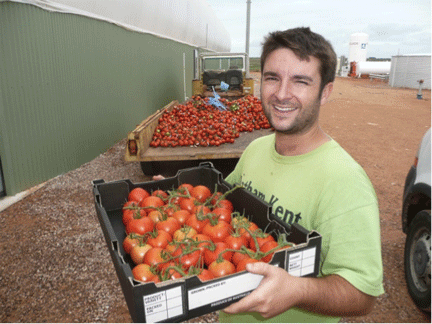 The Sundrop Farms project is moving ahead, and has won substantial financial support from the global venture capital firm KKR in addition to its earlier support from the Clean Energy Finance Corporation, as well as a contract to supply fresh produce to supermarket chain Coles over the next ten years.
The Abu Dhabi project is even more ambitious and is called “seawater farming”.
Could Australia do the same? Australia is a country with vast arid areas, copious quantities of seawater and sunshine – all the ingredients needed for a similar solar biofuel and food project.
It has a national air carrier in Qantas that has already experimented with various kinds of aviation biofuels. It has a national R&D organization in CSIRO that could organize such a project.
Desert farms could power flight with sunshine and seawater, The Conversation, John Mathews Professor of Strategic Management, Macquarie Graduate School of Management at Macquarie University, 9 June 15 “…….what if you could grow biofuels on land nobody wants, using just seawater and sunlight, and produce food at the same time?
That’s just what a new project in Abu Dhabi is seeking to do. TheIntegrated Seawater Energy and Agriculture System, or ISEAS, will grow sustainable food and aviation fuel in the desert, using seawater and sunshine, in a way that is eminently transferable to similar arid regions around the world.
The project was announced in January 2015 and is now under construction……..
Energy, water and food problems frequently compound each other, each making the others more difficult to resolve.
Examples abound: think of wasteful irrigation coming up against water limits and threatening reductions in food production. But there are some projects that turn the issue around and bring water, energy and food issues into positive relations, each strengthening the others. Continue reading
Cut price loans by NAB for solar and energy efficiency program s
 NAB to offer discounted energy efficiency, solar loans, Climate Spectator JOHN CONROY 9 JUN, The National Australia Bank will offer cut-price equipment loans to small and medium-sized businesses investing in energy efficiency and renewable power equipment as part of a $120m funding program backed by the Clean Energy Finance Corporation.
The agreement to fund energy-saving equipment or renewables generation will see NAB offer a rate 70 basis points below its standard equipment finance rate.
Finance will be offered through NAB, and will be across a diverse range of pre-approved assets including cars, irrigation systems, solar PV, building upgrades, lighting upgrades, processing line improvements and refrigeration……..http://www.businessspectator.com.au/news/2015/6/9/policy-politics/nab-offer-discounted-energy-efficiency-solar-loans
Bundaberg – Queensland’s solar capital.
 Solar power: Queensland city Bundaberg has more solar energy systems installed than any other place DARYL PASSMORE THE SUNDAY MAIL (QLD) JUNE 07, 2015
Bundaberg now has a new claim to fame — as Queensland’s solar capital. The subtropical city has more rooftop photovoltaic solar energy systems installed than any other city or town in the state.
Data from the Clean Energy Regulator reveals that 9400 houses with the postcode 4670 — which includes Bundaberg and Bargara — now have solar systems with a combined output capacity of more than 28 megawatts. “There’s huge demand,’’ Bundaberg Solar managing director Ashley Clark said.
More than 330 days of sunshine a year makes the central Queensland city a perfect place for solar power. “I would put it down to the fact that this is an area with a lot more retirees who are a bit more cautious about where their money goes,’’ Mr Clark said.
It is a trait Bundaberg shares with Hervey Bay and Caloundra, which fill the second and third spots on the list. Mr Clark said demand was now so strong that residents were having trouble getting approval from Ergon to connect to the electricity network….
- The regional feed-in tariff is now 6.5¢ , while householders in the Energex area have to negotiate a rate with power companies. The Palaszczuk Government says a new Queensland Productivity Commission will set a fair feed-in rate……
Australian Greens Senator for Queensland Larissa Waters said the state’s residents were collectively saving $214 million on electricity bills a year by embracing solar.
Queensland leads the country with 433,770 of the 1,393,526 solar installations nationwide. A quarter of houses in the state now have rooftop solar panels. Queensland Energy Minister Mark Bailey says the state has a target of one million homes having rooftop solar panels by 2020. http://www.couriermail.com.au/news/queensland/solar-power-queensland-city-bundaberg-has-more-solar-energy-systems-installed-than-any-other-place/story-fnn8dlfs-1227386107531
Yackandandah – small Victorian town with a big renewable energy future
Yackandandah’s small steps to a big renewable future, http://www.theage.com.au/national/yackandandahs-small-steps-to-a-big-renewable-future-20150605-ghfj1l Michael Green The old brick-veneer community centre in Yackandandah has been transformed.
“We’ve had some really cold days this week,” says Ali Pockley, the centre’s manager. “But you come in here and it’s just toasty. It was hopelessly inefficient up until the retrofit, no doubt about that.”
With the help of a state government grant, local tradies installed a large solar photovoltaic system, insulation, double-glazing, shading and efficient air conditioners for heating and cooling. Electricity bills have plunged by three-quarters.
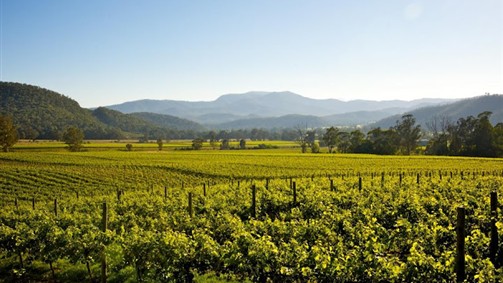
Pockley launched the retrofit of the community centre together with an even bigger initiative: Totally Renewable Yackandandah. A group of residents are aiming for the north-eastern Victorian town to produce more electricity than it uses, by 2022. They began working on their scheme twelve months ago, and already the number of solar households in the town has jumped. Now, one in every three houses has solar power, more than double the national average.
Matthew Charles-Jones, from Totally Renewable Yackandandah, says they’re surveying residents and working on their grand plan, with the help of a local council grant. In the meantime, new solar panels, like those on the Men’s Shed, will make it easier to reach the target.
Yackandandah is one of four Australian towns plotting to become 100 per cent renewable, along with Newstead, in central Victoria, and Byron Bay and Uralla in northern NSW. Newstead was recently awarded a $200,000 grant from the state government to develop its plan. Continue reading
House of Representatives passes draft laws on Renewable Energy Target
 Draft laws on renewable energy targets pass through lower house 9 News 3 June 15 Draft laws on a bipartisan renewable energy target have passed the lower house despite the concerns of two government MPs.
Nationals MP Keith Pitt broke ranks during debate on the legislation, which pares back the target from 41,000 gigawatt hours to 33,000,
………However, his vote was not formally counted among those in opposition, with only independents Bob Katter and Andrew Wilkie voting against the bill.
Liberal Craig Kelly questioned the efficacy of solar panels, saying such an investment would simply be “pissed up against the window”.
He ridiculed how building 2000 new wind turbines would reduce the impact of climate change……..
The government included the burning of wood waste as a renewable source of fuel in the legislation, to much consternation from Labor, which wants it removed and omitted from any future laws on the target.
The opposition argues that what is considered wood waste is not just timber offcuts, bark and branches but also the whole of any tree not harvested………
Read more at http://www.9news.com.au/national/2015/06/03/02/36/draft-renewable-energy-laws-pass-through-lower-house#HlQSdZTUvSdZvczq.99
South Australia the renewable energy leader- and now with battery storage!

 Plans for Australia’s first non-hydro renewable storage project move forward http://reneweconomy.com.au/2015/plans-for-australias-first-non-hydro-renewable-storage-project-move-forward-52911 By Giles Parkinson on 4 June 2015 The potential site for what will be the first large-scale, non-hydro storage project for renewable energy in Australia has identified three possible sites in South Australia, and received more than 40 different storage proposals and ideas. The project – known as Energy Storage for Commercial Renewable Integration South Australia (ESCRI-SA) – is a ground breaking project for Australia because it will be first and biggest of its type.
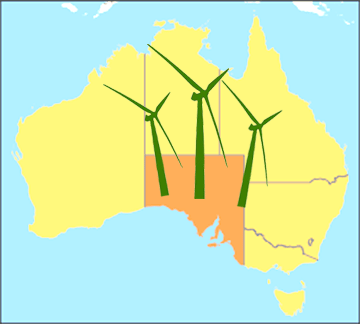 South Australia has already reached 40 per cent generation from variable renewable energy sources such as wind (33 per cent) and solar (7 per cent). It is one of the highest penetrations of variable renewables in modern industrial economies.
Up to now, that share of wind and solar has been relatively easily accommodated, but as this share grow, battery storage will be required as yet more coal-fired generators are retired, and even the need for gas plant diminishes.
The storage will be needed to soak up excess generation (such as wind at night-time or solar during the day) to be stored for use at peak time. It will also be used to provide ancillary services such as frequency – a critical component of the grid. In Germany, battery storage is being used for the same purpose.
Paul Ebert, from Worley Parsons who is leading the project lead funded by the Australian Renewable Energy Agency and with support from AGL Energy, and transmission group ElectraNet says the storage is likely to be located in one of three locations – near Port Lincoln on the Eyre Peninsula, near the Monash sub station on the Yorke Peninsula, or the Dalrymple sub-station in the river land area of the state. Continue reading
Queensland’s Millmerran solar farm to go ahead – biggest in Australia?
Millmerran solar farm plans move ahead despite disappointment over lower Renewable Energy Target http://www.abc.net.au/news/2015-06-04/solar-firm-pushes-ahead-with-plans-for-big-darling/6520796 By Fidelis Rego, 4 June 15 A solar company says it is disappointing the Federal Government wants to reduce the Renewable Energy Target (RET) but it is still forging ahead with plans for a solar farm on the Darling Downs in southern Queensland.
The Government and Opposition have agreed to reduce the amount of power produced from renewable energy sources to 33,000 gigawatt hours by 2020.
Angus Gemmel from Solar Choice said it had not jeopardised its plans to build what could be the country’s biggest solar farm at Millmerran.
He said construction was expected to begin later next year.
“It’ll certainly have an impact, it is sad to see Australia is the first country to go backwards on a renewable energy target rather than forwards, so I guess it’s with a mixture of disappointment but also relief that we can finally get some first major stages underway,” he said.
“We’re still very confident that even in the medium to longer term this project will be built.
“We’re at an excellent site with optimal conditions for large-scale solar farming long-term and once our first stage is in the ground that’s going to make it so much easier and cost-effective to make stages two and three and subsequent away as well.”
Australian electricity utilities to supply battery energy storage
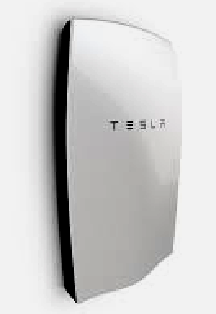 Australian Utilities Cozy Up to Home Storage: ‘If We Don’t Respond, Someone Else Will’ Three Australian power companies are set to offer Panasonic’s residential battery systems. Greentech Grid Jason Deign June 5, 2015
Australian utilities are moving to combat the threat of revenue loss from residential energy storage by opting to supply batteries themselves. Three companies — Red Energy, Ergon Energy and ActewAGL — announced trials offering Panasonic battery systems.
“Our customers are already showing interest in this technology, and if we don’t respond to what our customers want, someone else will,” said ActewAGL CEO Michael Costello.
The Australian Capital Territory utility, which already has more than 15,000 residential installations in its catchment area, expects to start offering the systems this October.
“The trial will validate batteries as a product offering in the Canberra environment and evaluate the product functionality,” Costello said.
He confirmed ActewAGL had been working with Panasonic for two years “on how to make a trial of battery energy storage in Canberra a reality.”
Panasonic, which last year won the contract to supply Tesla’s Gigafactory in the U.S., is said to be keen on using utilities and retailers as a channel to the residential market, rather than selling direct to homeowners…….http://www.greentechmedia.com/articles/read/australian-utilities-cozy-up-to-energy-storage
Renewable energy storage to be sold to Australia’s electricity utilities
Panasonic To Sell Energy Storage To Australian Utilities http://cleantechnica.com/2015/06/04/panasonic-sell-energy-storage-australian-utilities/June 4th, 2015 by Jake Richardson Panasonic will start to sell energy storage solutions to Australian power companies like Red Energy and ActewAGL this October, according to recent reports. Like Tesla’s energy storage products, built around Panasonic cells, they are lithium-ion batteries. Panasonic energy storage solutions will be available in New Zealand as well.
“Power companies in Australia are faced with dropping sales as the installation of solar panels expand and yet they still need to maintain the grids. We have been exploring ways to work together to benefit both users and retailers of electricity,” explained Katsufumi Miyamato, a Panasonic manager.
Australia reportedly has over one million homes with solar panels. It seems the adding of more solar panels has created much greater interest in energy storage, which is only natural. Additionally, having the ability to store electricity generated by solar panels for the times when sunlight isn’t available makes solar power much more attractive.
In fact, Kane Thornton, CEO of the Clean Energy Council estimated that there are about 1,000-2,000 battery storage systems currently in Australia. The largest power producer in Australia, AGL Energy Ltd., announced recently it would be offering a 6 kilowatt-hour battery storage system for homes sometime fairly soon. Continue reading
Renewable energy chemicals can be exported to Australia’s energy customers
Any form of renewable electricity can be used in electrolysis, including wind and solar. Research around the world and in Australia continues to aim at reducing the costs of electrolysis………
The possible future scale of producing renewable energy chemicals in Australia is enormous. To imagine it one can mentally sum up all the investments that have made in Australia in coal, in liquefied natural gas (LNG), and that will be made in renewable energy to meet our own domestic energy needs, and more.
Hundreds of billions of dollars indeed. At MEI, we think it is time to start planning how Australia can competitively meet the future renewable energy needs of our traditional energy customers.
Meeting the future needs of Australia’s energy customers with renewable energy chemicals, Climate Spectator TIM FORCEY 4 JUN, “…… One day those fossil fuel exports and imports will cease as Japan and South Korea continue to improve their energy productivity and expand their use of renewable energy. Some of that will be home-grown – renewable energy that Japan and South Korea can make for themselves. Already Japan is building impressive large-scale solar photovoltaic facilities out over the sea.
However, these man-made solar islands illustrate the physical and economic limits Japan and South Korea face while recognising they will need to rely partly on renewable energy imports. But imports from where? Preferred will be imports from countries that have extensive renewable energy resources that can be harvested and transported at reasonable cost, that are politically stable, and that have long histories as reliable energy suppliers. In other words, countries like Australia.
But how can renewable energy be exported 8000km from Australia to northeast Asia? Continue reading
Offgrid solar power an economic winner for Western Australian farming family
 WA farming family opts for solar power battery system over costly grid connection, ABC News By Kathryn Diss 3 June 15 When Katherine Naughton’s family moved to a farm in Northam, north-east of Perth, it was going to cost them up to $60,000 to connect their house to the power grid.
But for just two thirds of that cost they have been able to install a solar power storage system, harnessing all of their electrical needs from the sun.”Not having that $400 bill every three months is just fantastic,” Ms Naughton said.
Perth-based company Solar Balance designed the system with Chinese battery manufacturer BYD.The batteries charge from rooftop solar panels during the day and store the energy for use when the sun goes down.
And unlike connecting to the grid, it is an investment that pays for itself. “With the cost of power going up, it’s quite scary how much it keeps going up by every single year, and you don’t know how much it’s going to be in the next five years,” Ms Naughton said. “So if we can go solar then we don’t have to worry about that bill.”
Battery storage an affordable option
With the entry of new players it will put downward pressure on battery costs which is going to be good for everyone over time because it will become more and more affordable. – Rod Hayes
The power revolution may be taking place slowly, just one household at a time, but the industry believes that is set to change………..
Curtin University’s Sustainability Policy Institute’s Jemma Green said the power grid will become less relevant.
“The grid will have a place but it will become more of a back up system as electricity prices go up even further and the price of solar and batteries decline further, the economics of grid defection are going to stack up sooner.
“This is going to have an impact on the utilisation of the grid and therefore the revenue that the government currently derives from using it.
“I think the grid and the business models of the utilities, that is the generators and the poles and wires will need to evolve to deal with this changing energy system which is effectively a centralised and decentralised energy model,” Ms Green said.
Bosche, LG and Samsung have also indicated they plan to enter the market. http://www.abc.net.au/news/2015-06-03/farming-family-opts-for-solar-power-battery-system/6519960
2014 Clean Energy Australia Report released
 Clean Energy Australia Report 2014 Released http://www.energymatters.com.au/renewable-news/clean-energy-australia-em4854/ June 4, 2015 2014 was a difficult year for renewable energy in Australia with the grim reaper looming over the RET for much of it – but it wasn’t without its bright spots.
Clean Energy Australia Report 2014 states more than 230,000 households and businesses installed either solar power systems or solar hot water last year.
While this may be down on previous years; the average size of each system installed continued to increase (nudging 4.5kW on average), thanks to the plummeting cost of solar panels, other components and increased competition.
More businesses are switching on to solar savings and by the end of 2014, 15,000 commercial enterprises across Australia had installed solar panels; collectively saving more than $64 million on their power bills.
All up, 823.42 MW capacity of residential and commercial solar installs up to 100kW occurred during 2014.
Only two large-scale solar power stations were commissioned in 2014, totaling 23.5 MW. However, 5 new plants with a collective capacity of 258.275 MW were under construction at the end of last year.
The majority of the 16 wind farms under construction in 2014 were on hold by the end of the year due to policy uncertainty. Three wind farms with a combined capacity of 566.7 megawatts were completed in 2014; Snowtown II in South Australia, Gullen Range in New South Wales and Mount Mercer in Victoria. Five wind farms remained in progress early this year and five and are expected to be completed in 2015.
By the end of 2014, there were 71 wind farms Australia-wide, consisting of 1,866 wind turbines in total and with a collective output capacity of 3807MW.
Overall, 13.47 per cent of Australia’s electricity came from renewables last year, enough to power 4.5 million average homes . While dropping from 2013 (14.76 per cent), this was mainly due to reduced rainfall in hydro catchments.
There was a huge difference in renewables use between the states – around 95 per cent of the electricity consumed in Tasmania came from renewables last year (primarily hydro) and approximately 40 per cent of South Australia’s power (primarily wind power). The next best was Western Australia at 13 per cent.
While investment in new large-scale renewable energy fell 88 per cent in 2014 compared to the year before due to policy uncertainty, with bipartisan backed legislation now being considered by Parliament, the CEC says the outlook for the sector is looking more positive.
The Clean Energy Australia 2014 Report was produced with the support of the Australian Renewable Energy Agency and can be downloaded here (PDF).
Home energy storage is bringing solar power to the people
What is certain is that the electricity equation will look very different in a few short years, and it looks like, for the first time in many years, that ordinary consumers will hold a bit more of the power
How home energy storage is going to change the way we think about power, Adelaide Now, CAMERON ENGLAND SUNDAY MAIL (SA) MAY 31, 2015 WHEN Elon Musk launched the Tesla Power Wall earlier this month, it was done in true Silicon Valley style.
The charismatic chief executive enters stage right, sans tie, and makes a pronouncement that his new product will change the world — cue rapturous applause from the audience and because this is the United States, whooping.
The thing about Musk’s pronouncement is that it’s most likely true.
It might not necessarily be his company — critics are divided as to whether Tesla will be the market leader it’s portraying itself as — but home and business energy storage is soon to change the way energy utilities, homes and governments think about power……..
Batteries allow homes and especially businesses to employ “peak shaving” — if power prices spike, flick over to using your own solar power and save money, or if the grid power is cheap, suck it out and sell it back later at a higher price.
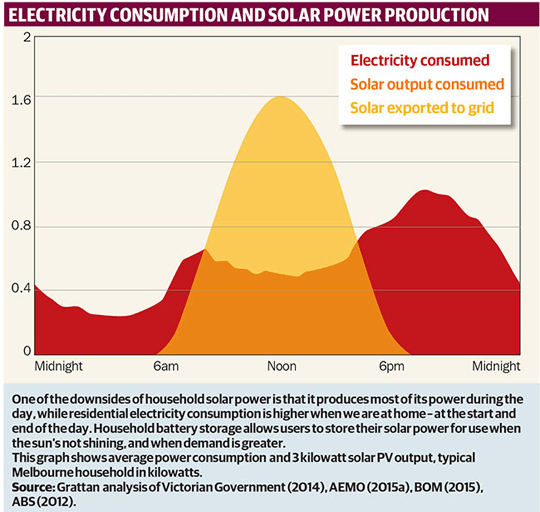
Or simply save up the solar power your rooftop panels produce during the day for use in the evening, when your demand might be higher……..
Tesla Power builds on the Tesla Motors technology — relatively standard lithium ion batteries with smart software to help them interact with the grid. The initial interest has been huge. The company recently reported early orders of 50,000 to 60,000 batteries, or as Musk put it, “It’s like crazy off-the-hook”.
Effectively the company is sold out until the middle of next year and its huge new factory will not be big enough to keep up with demand.
At $US3000 for the battery and $US7000 installed with solar panels (US prices) the system makes it economic for houses to become much less dependent on grid power.
UBS estimates that in Australia, the system would pay itself back in six years.
But Tesla is not the only game in town — although it almost certainly has the best PR machine. Continue reading
1 This month

of the week – Australians for War Powers Reform (AWPR)
To see nuclear-related stories in greater depth and intensity
 Antinuclear