Forget nuclear, Australia is on fast lane to 100pc renewables
by Andrew Blakers | Apr 11, 2025 https://michaelwest.com.au/forget-nuclear-australia-is-on-fast-lane-to-100pc-renewables-solar/
Gas is the talk of the town, while nuclear is not, but a massive increase in solar power generation capacity has already put Australia on the fast track to a 100% renewable energy future. Solar cell engineer
Andrew Blakers explains.
An academic living in cold Canberra retired his gas heaters a few years ago and installed electric heat pumps for space and water heating. His gas bill went to zero. He also bought an electric vehicle, so his petrol bill went to zero.
He then installed rooftop solar panels that export enough solar electricity to the grid to pay for electricity imports at night, so his electricity bill also went to zero. That Canberra academic will get his money back from these energy investments in about eight years.
I am that academic.
Solar energy is causing the fastest energy change in history. Along with support from wind energy, it offers unlimited, cheap, clean and reliable energy forever.
With energy storage effectively a problem solved, the required raw materials impossible to exhaust — despite some misconceptions in the community — and an Australian transition gathering pace,
“solar and wind are becoming a superhighway to a future of 100 percent renewable energy.“
While the technological arguments for solar and wind power are compelling, it’s clear renewables have to overcome obstacles.
One is the division over the impact of the rollout of renewable energy infrastructure. It has divided affected communities across the country and needs to be addressed. Generous compensation and effective education about large regional economic opportunities are good ways forward.
There is also the political debate about what form Australia’s energy transition should take.
Solar surge
Yet, beyond those issues, solar offers unlimited energy for billions of years and provides the cheapest energy in history with zero greenhouse gases, zero smog and zero water consumption.
That explains why solar energy generation is growing tenfold each decade and, with support from wind, dominates global power station construction markets, while global nuclear electricity generation has been static for 30 years and is largely irrelevant.
In 2024, twice as much new solar generation capacity — about 560 gigawatts — was added compared with all other systems put together. Wind, hydro, coal, gas and nuclear added up to about 280 gigawatts.
There will be more global solar generation capacity in 2030 than everything else combined, assuming current growth rates continue. Solar generation will pass wind and nuclear generation this year and should catch coal generation around 2031.
About 37 percent of Australia’s electricity already comes from solar and wind, with an additional 6 percent from hydroelectric power stations that were built decades ago.
“More solar energy is generated per person in Australia than in any other country.”
Solar is by far the best method of removing fossil fuels, which cause three-quarters of global greenhouse gas emissions, from the economy.
In Australia, 99 percent of new generation capacity installed since 2015 has been solar and wind, and it is all private money. The energy market is saying very clearly that solar and wind have won the energy race and energy policies are consistent with reaching the government target of 82 percent renewable electricity by 2030.
Solar on the roof coupled with energy storage in a hot water tank, an EV battery and a home battery allows a family to ride through interruptions to gas, petrol and electricity supply and that energy resilience can apply at domestic, city, state and national levels.
Managing the balance
Balancing high levels of solar and wind energy to avoid supply interruptions is straightforward at low cost using off-the-shelf technology available from vast production lines. New transmission brings new solar and wind power into the cities and also smooths out the vagaries of local weather by transmitting solar and wind electricity to where it is needed.
For example, if it is raining in Victoria and sunny in New South Wales, then electricity can be transmitted south. Storage comprises batteries for short-term storage of a few hours and pumped hydro energy storage for hours to days.
“Together, batteries and pumped hydro solve the energy storage issues.“
Pumped hydro energy storage provides about 95 percent of global energy storage. It typically comprises two reservoirs located a few kilometres apart and with an altitude difference of between 500 and 1,000 metres.
On sunny or windy days, renewable sources like solar or wind power are used to pump water into the uphill reservoir, and during the night, the water flows back downhill through the turbine to recover the stored energy.
The same water can go up and down between the reservoirs for 100 years. Global potential pumped hydro energy storage is equivalent to two trillion electric vehicle batteries.
Australia has about 300 times more pumped hydro energy storage potential than needed to support 100 percent renewable electricity. It already has three pumped hydro systems, with two more under construction.
Globally, the world has more than 820,000 potential pumped hydro sites, which is about 200 times more than we need to support a 100 percent renewable energy system.
When eventually complete, Snowy 2.0 will provide 85 percent of energy storage in the national energy market at a cost 10 times lower than equivalent batteries and with a lifetime that is five times longer.
Myths and misconceptions
There are those — often vested interests — who throw up arguments against solar energy, regardless of what the facts say about its merits.
Here are a few:
- It takes up valuable farmland. Most of the area in solar and wind farms remains in use for agriculture. The area withdrawn from agriculture to generate all our energy from solar and wind is very small, equating to about the size of a large living room per person.
- The rural landscape can’t fit in any more solar and wind farms. Heat maps developed by researchers at the Australian National University show the vast number of good locations for solar and wind farms.
- Renewable infrastructure is a blight on the landscape. Hosts of solar and wind farms (and their neighbours) are generously compensated, while hosts of transmission lines are paid more than $200,000 per km. All the solar farms, wind farms, transmission and pumped hydro are in regional areas, which means that vast amounts of money and employment are flowing into regional areas. Solar farms are usually invisible from other properties. Open-cut roads, buildings, open-cut coal mines and gas fields are also visible in the landscape. People in cities have a far more cluttered view from their windows than rural people.
- We will run out of critical minerals. No critical minerals are required, only substitutable minerals. Solar panels require silicon for the solar cells, glass, plastic and conductors, which are made from extremely abundant materials.
- We will drown in solar panel waste. The amount of solar panel waste generated when all energy (not just electricity) comes from solar amounts to about 16 kg per person per year (mostly glass). Panel waste is a small and solvable problem.
The Coalition MP who tried to stop the solar farm that will help save thousands of local jobs

What is clear is that if the LNP had its way, and was in a position to deliver on its ideological infatuation with coal and nuclear, old energy paradigms and its obsession with “baseload”, then the smelters and the refineries would not survive beyond the end of the decade.
Giles Parkinson, Mar 16, 2025, https://reneweconomy.com.au/the-coalition-mp-who-tried-to-stop-the-solar-farm-that-will-help-save-thousands-of-local-jobs/
If you ever need an example of the idiocy and the ignorance behind the Coalition and LNP campaign against renewable energy in Australia, a good place to start would be the federal MP for Flynn, Colin Boyce.
The LNP member has staged a relentless campaign against renewables, and the proposed Smoky Creek solar project in his electorate in particular. Boyce has argued that they are “reckless”, and he has amplified numerous scare campaigns about heat islands and toxic runoffs, and even homelessness that these projects allegedly cause.
Just a few weeks ago, Boyce argued that wind and solar could not possibly provide the necessary power for the biggest employer in his own electorate, and the biggest energy consumer in the state, the Boyne Island smelter.
“The Gladstone community and the Boyne smelter rely heavily on reliable, predictable and affordable power. The reality of wind and solar output, for anyone enjoying their air-conditioning in this current heat, is that it cannot provide any of this,” Boyce wrote on his web page on January 22.
“It is not a 24-hour baseload solution. It isn’t always windy and it’s certainly not that sunny after 7pm.” Nuclear, Boyce suggested, is the only solution to replace coal fired power.
How wrong, how ill-informed, and how irresponsible can a local MP be?
Last week, Rio Tinto – the owner of the Boyne Island aluminium smelter and the Yarwun and Queensland Alumina refineries that together employ more than 3,000 people in Gladstone alone – announced the future of these assets will be secured, precisely because they have been able to sign deals for wind, solar and battery storage.
Rio Tinto last week signed 20-year off take deal with the 600 MW Smoky Creek solar farm and its huge 600 MW, 2,400 MWh DC coupled battery, adding to the previously announced contracts with the 1.4 GW Bungaban wind project and the 1.2 GW Upper Calliope solar project.
“These agreements are integral to repowering our Gladstone aluminium operations with affordable, reliable and lower carbon energy for decades to come,” said the head of Rio Tinto Australia Kellie Parker.
“For the first time, we have integrated crucial battery storage in our efforts to make the Boyne aluminium smelter globally cost-competitive, as traditional energy sources become more expensive.”
Rio Tinto says the deal with the Smoky Creek solar and battery means the company now has contracts in place for 80 per cent of its bulk energy needs in Gladstone, and 30 per cent of its “firming” requirements. But it is confident, given the plunging cost of battery storage technologies, that this gap can be readily addressed.
What is clear is that if the LNP had its way, and was in a position to deliver on its ideological infatuation with coal and nuclear, old energy paradigms and its obsession with “baseload”, then the smelters and the refineries would not survive beyond the end of the decade.
Coal fired generation is now too costly and the local coal generators are getting old, the alumina and aluminium products must compete in a world that demands low emission supplies, and nuclear is too far away – and way too expensive – to help.
Boyce’s argument against Smoky Creek is a taste of the nonsense, lies and deliberate misinformation peddled by the LNP, the Murdoch media, conservative “think-tanks” and nuclear boosters and then recycled back through frightened and ill-informed constitutents.
Boyce’s arguments against the Smoky Creek project included claims about “run -off” from solar farms affecting the barrier reef, of destroyed farming land, of businesses lost, and homelessness.
He has warned of “heat islands” (a disproved nonsense) and in 2023 wrote to the regulator warning that his constituents were “lying awake at night, concerned about the radiation and heat energy will affect their herds, their families, and their health.”
Boyce has long campaigned against Smoky Creek, standing up in Queensland state parliament in May, 2021, as the then member for Callide, complaining that the project would only employ five people on a full time basis. He didn’t consider the thousands of jobs that could be saved by the project going ahead.
That speech to parliament – you can watch the video here – was delivered less than five hours after the Callide coal generator, experienced a devastating explosion that very nearly caused a state-wide blackout, and might have were it not for the intervention of big batteries that the Coalition still dismisses as useless.
But Boyce, without a hint of irony, declared that the Callide explosion “reiterates the fact that we need baseload power.”
The biggest employer in his electorate, and the biggest consumer of energy in Australia, begs to differ. Perhaps it’s time that Boyce and his LNP colleagues listen to what they have and other experts have to say.
Giles Parkinson is founder and editor of Renew Economy, and of its sister sites One Step Off The Grid and the EV-focused The Driven. He is the co-host of the weekly Energy Insiders Podcast. Giles has been a journalist for more than 40 years and is a former deputy editor of the Australian Financial Review. You can find him on LinkedIn and on Twitter.
Grazing sheep among solar panels could produce higher quality wool, study finds
Sophie Vorrath, Nov 1, 2024,
https://reneweconomy.com.au/grazing-sheep-among-solar-panels-could-produce-higher-quality-wool-study-finds/
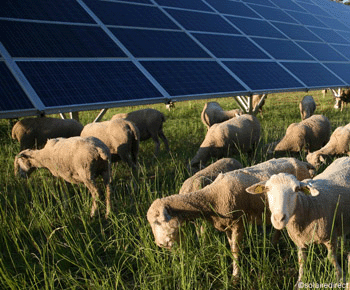
The co-location of solar farming with sheep grazing does not have a negative affect on wool production and could even improve the quality of the wool produced, a new study has found.
The study is based on the results of a second round of wool testing at the Wellington solar farm, south east of Dubbo in New South Wales, which has shared its site with 1,700 merino sheep for the past three years.
Legend has it that the decision to graze sheep at the solar farm came about when an employee of Lightsource bp, the owner of the Wellington project, complained to a local, sixth-generation wool farmer about the hassle and cost of mowing the solar farm six times a year.
According to Tony Inder, who heads up the Allendale Merino Stud, the effect on his sheep has been a lot better than he thought it would be – he says the wool quality they are producing has “increased significantly.”
But Lightsource bp – which is now wholly owned by the oil and gas giant BP, after completing the acquisition of the remaining 50.03% interest – has used the opportunity to gather some formal data.
The study, conducted by EMM Consulting with support from Elders Rural Services, compares two groups of merino sheep – one group grazed in a regular paddock and the other at the Wellington solar farm.
The latest findings show grazing sheep among solar panels does no harm to wool production, even in the case of pre-existing high-quality standards. And it says that some parameters even indicate an improvement in wool quality, although conclusive benefits require further long-term measurement.
Lightsource bp says that while the study at the Wellington solar farm is ongoing, it is another indication that solar farms can exist side-by-side with sheep farming, for the benefit of both enterprises.
“These results are very encouraging and highlight the potential for solar farms to complement agricultural practices,” says Emilien Simonot, Lightsource bp’s head of agrivoltaics.
“By integrating sheep farming with solar energy production, we can achieve dual benefits of sustainable energy together with agricultural output.” . By co-locating grazing with renewable energy, land can remain in agricultural use, offering farmers additional revenue while contributing to cleaner energy for the planet.
“Finding ways for agriculture and clean energy to work together is crucial for a more sustainable future,” says Brendan Clarke, interim head o environmental planning Australia and NZ at Lightsource bp.
“The promising results from this study indicate that we are on the right path, and working closely with farmers to grow our knowledge in this area is paramount.”
As for the sheep, Inder says they “just do really well” when grazing among the Wellington solar farm panels.
“I like to say that panel sheep are happy sheep.”
Sophie is editor of One Step Off The Grid and deputy editor of its sister site, Renew Economy. She is the co-host of the Solar Insiders Podcast. Sophie has been writing about clean energy for more than a decade.
The nuclear and renewable myths that mainstream media can’t be bothered challenging

Mark Diesendorf, Jul 4, 2024, https://reneweconomy.com.au/the-nuclear-and-renewable-myths-that-mainstream-media-cant-be-bothered-challenging/
Nuclear energy proponents are attempting to discredit renewable energy and promote nuclear energy and fossil gas in its place. This article refutes several myths they are disseminating that are receiving little or no challenge in the mainstream media.
Myth: Renewables cannot supply 100% electricity
Denmark, South Australia and Scotland already obtain 88, 74 and 62 per cent of their respective annual electricity generations from renewables, mostly wind. Scotland actually supplies 113 per cent of its electricity consumption from renewables; the difference between its generation and consumption is exported by transmission line.
All three jurisdictions have achieved this with relatively small amounts of hydroelectricity, zero in South Australia. Given the political will, all three could reach 100% net renewables generation by 2030, as indeed two northern states of Germany have already done. The ‘net’ means that they trade some electricity with neighbours but on average will be at 100% renewables.
Computer simulations by several research groups – using real hourly wind, solar and demand data spanning several years – show that the Australian electricity system could be run entirely on renewable energy, with the main contributions coming from solar and wind. System reliability for 100% renewables will be maintained by a combination of storage, building excess generating capacity for wind and solar (which is cheap), key transmission links, and demand management encouraged by transparent pricing.
Storage to fill infrequent troughs in generation from the variable renewable sources will comprise existing hydro, pumped hydro (mostly small-scale and off-river), and batteries. Geographic dispersion of renewables will also assist managing the variability of wind and solar. For the possibility of rare, extended periods of Dunkelflaute (literally ‘dark doldrums’), gas turbines with stores of biofuels or green hydrogen could be kept in reserve as insurance.
Myth: Gas can fill the gap until nuclear is constructed
As a fuel for electricity generation, fossil gas in eastern Australia is many times more expensive per kilowatt-hour than coal. It is only used for fuelling gas turbines for meeting the peaks in demand and helping to fill troughs. For this purpose, it contributes about 5% of Australia’s annual electricity generation. But, as storage expands, fossil gas will become redundant in the electricity system.
The fact that baseload gas-fired electricity continues temporarily in Western Australia and South Australia is the result of peculiar histories that will not be repeated. Unlike the eastern states, WA has a Domestic Gas Reservation Policy that insulates customers from the high export prices of gas.
However, most new gas supplies would have to come from high-cost unconventional sources. South Australia’s ancient, struggling, baseload, gas-fired power station, Torrens Island, produces expensive electricity. It will be closed in 2026 and replaced with renewables and batteries.
Myth: Nuclear energy can co-exist with large contributions from renewables
This myth has two refutations:
- Nuclear is too inflexible in operation to be a good partner for variable wind and solar. Its very high capital cost necessitates running it constantly, not just during periods of low sun or wind. Its output can only be ramped up and down slowly, and it’s expensive to do that.
- On current growth trends of renewables, there will be no room for nuclear energy in South Australia, Victoria or NSW. The 2022 shares of renewables in total electricity generation in each of these states were 74%, 37% and 33% respectively.
Rapid growth from these levels is likely. It’s already too late for nuclear in SA. Provided the growth of renewables is not deliberately suppressed in NSW and Victoria, these states too could reach 100% renewables before the first nuclear power station comes online.
As transportation and combustion heating will be electrified, demand for electricity could double by 2050. This might offer generating space for nuclear in the 2040s in Queensland (23% renewables in 2022) and Western Australia (20% renewables in 2022). However, the cost barrier would remain.
Myth: There is insufficient land for wind and solar
The claim by nuclear proponents that wind and solar have “vast land footprints” is misleading. Although a wind farm can span a large area, its turbines, access road and substation occupy a tiny fraction of that area, typically about 2%.
Most wind farms are built on land that was previously cleared for agriculture and are compatible with all forms of agriculture. Off-shore wind occupies no land.
Solar farms are increasingly being built sufficiently high off the ground to allow sheep to graze beneath them, providing welcome shade. This practice, known as agrivoltaics, provides additional farm revenue, which is especially valuable during droughts. Rooftop solar occupies no land.
Myth: The longer lifetime of nuclear reactors hasn’t been taken into account
The levelised cost of energy method – used by CSIRO, AEMO, Lazard and others – is the standard way of comparing electricity generation technologies that perform similar functions.
It permits the comparison of coal, nuclear and firmed renewables. It takes account automatically of the different lifetimes of different technologies.
Myth: We need baseload power stations
The recent claim that nuclear energy is not very expensive “when we consider value” is just a variant of the old, discredited claim that we need baseload power stations, i.e. those that operate 24/7 at maximum power output for most of the time.
The renewable system, including storage, delivers the same reliability, and hence the same value, as the traditional system based on a mix of baseload and peak-load power stations.
When a nuclear power reactor breaks down, it can be useless for weeks or months. For a conventional large reactor rated at 1000 to 1600 megawatts, the impact of breakdown on electricity supply can be disastrous.
Big nuclear needs big back-up, which is expensive. Small modular reactors do not exist––not one is commercially available or likely to be in the foreseeable future.
Concluding remarks
We do not need expensive, dangerous nuclear power, or expensive, polluting fossil gas. A nuclear scenario would inevitably involve the irrational suppression of renewables.
The ban on nuclear power should be maintained because nuclear never competes in a so-called ‘free market’. Renewables – solar, wind and existing hydro – together with energy efficiency, can supply all Australia’s electricity.
Mark Diesendorf is Honorary Associate Professor at the Environment & Society Group in the School of Humanities & Languages and Faculty of Arts, Design & Architecture at UNSW. First published in Pearls and Irritations. Republished with permission of the author.
Is rooftop solar a fatal flaw in the Coalition’s grand nuclear plans?

Unlike nuclear, solar is also extraordinarily cheap, at least up-front, and large-scale projects can be delivered for comparative peanuts — and with blinding speed.
There are now almost 4 million homes spread across the country with solar installations, and the electricity they generate accounted for about 12 per cent of Australia’s needs last year.
It’s a constituency that politicians would tackle at their peril.
By energy reporter Daniel Mercer, https://www.abc.net.au/news/2024-06-24/rooftop-solar-potentially-lethal-flaw-in-coalition-nuclear-plans/104008864—
Earlier this year, the Coalition made a curious, significant move.
David Littleproud, the leader of the National Party, broke cover and wholeheartedly threw his support behind rooftop solar and household batteries.
The Nationals, he said, were not against renewable energy, only large-scale projects such as wind farms and transmission lines that were “tearing up the environment”.
Quite the opposite — the National Party wanted as many Australian households to get solar and batteries as would have them.
The pitch, which was quickly backed by opposition leader Peter Dutton, evidently had a few purposes.
For starters, it clearly distinguished the opposition from the Labor government, whose plan to decarbonise the power system rests largely on big-ticket renewable energy and transmission items.
In one fell swoop, the Coalition was able to say it was pro-renewable energy while being able to attack the government’s own green plans as environmentally and economically dangerous.
What’s more, the shift was a clear nod — or a sop, depending on who you ask — to the enormous and growing political clout of Australia’s solar-owning class.
Lastly, as both Mr Littleproud and Mr Dutton have repeatedly since pointed out, rooftop solar was an ideal complement for the central plank of the Coalition’s energy plans — nuclear.
Dangers in the detail?
The thinking behind that pivot has been on full display in recent days after the Coalition finally unveiled the major details of its energy policy for the upcoming federal election.
Under the plans, Australia would get seven nuclear power plants by the middle of the century — five large-scale ones across New South Wales, Queensland and Victoria and two small ones across South Australia and Western Australia.
No longer would the renewable emphasis be on scores of new wind and solar farms in regional areas and the high-voltage power lines needed to plug them into the grid.
It would instead be directed towards people’s rooftops, “an environment that you can’t destroy”, according to Mr Littleproud.
But hiding behind this veil of logic from the Coalition, energy experts reckon, is a potentially fatal flaw.
Solar power and nuclear power don’t play nicely together.
“That’s another untested and questionable part of this whole strategy,” said Dylan McConnell, a senior researcher and energy analyst at the University of NSW.
“What happens if we look into a system that is largely dominated by … a significant proportion of … behind-the-meter solar?
“People are going to continue to install rooftop solar and, in fact, the Coalition is supportive of that.
At the heart of this tension are the differing — and some argue incompatible — characteristics of nuclear and solar power.
On the one hand, nuclear reactors are the quintessential base-load generators that can — and want to — run at or near full capacity all the time.
Not only are they well-suited to the task technically, nuclear plants also have an economic imperative to operate flat-out given their monumental development costs.
These development costs are typically exacerbated by very long lead times — lead times subject to significant blowouts — in which debts are incurred and eye-watering amounts of interest can accrue.
The hare and the tortoise
Paying off those debts is paramount for the owner of a nuclear plant.
Failure to do so can be financially ruinous.
And the way to do that is to produce and sell as much electricity as is technically possible.
By contrast, solar power — specifically from photovoltaic cells typical of suburban rooftops — are the archetypal source of variable renewable energy.
They produce the most power when the sun is shining during the day, none when it’s not, and their output can be highly variable depending on the conditions.
Unlike nuclear, solar is also extraordinarily cheap, at least up-front, and large-scale projects can be delivered for comparative peanuts — and with blinding speed.
For a household, the cost of a 10-kilowatt system — an installation capable of meeting much of an average customer’s needs — can be done for a few thousand dollars.
In other words, if nuclear power is the proverbial tortoise, solar is the hare.
None of which is to dismiss the technical and economic challenges that solar presents, namely, how to back it up when it’s not producing — a very big task indeed.
But there is another crucial way in which solar and nuclear — or any base-load power such as coal, for that matter — clash.
Solar generation, by its very nature, peaks in the middle of the day.
As ever-more Australians install seemingly ever-more solar panels on their roofs, that peak in solar output is becoming truly epic in its proportions.
Rooftop solar is a beast
or example, there are times in South Australia when rooftop solar alone can account for more than the entire demand for electricity in the state.
To ensure South Australia’s electricity system doesn’t blow up, virtually all other generators have to pare back their output to a bare minimum or switch off entirely.
And even then, South Australia’s surplus rooftop solar generation has to be exported to other states or wasted.
Rooftop solar can do this because it’s largely uncontrolled and flows simply by dint of the sun shining.
It was partly for this reason that South Australia’s only base-load coal plant retired in 2016.
Of course, there are many more times when rooftop solar provides precisely 0 per cent of South Australia’s power needs.
But it all goes to illustrate the very real challenges that base-load nuclear would face, and the very real trends that are unlikely to grind to a halt between now and 2035, by when the Coalition hopes to have the first of its nuclear reactors up and running.
A quick glance at the numbers will tell you all you need to know about the popularity — and power — of rooftop solar in Australia.
There are now almost 4 million homes spread across the country with solar installations, and the electricity they generate accounted for about 12 per cent of Australia’s needs last year.
Bruce Mountain, the director of the Victoria Energy Policy Centre, summed it up this way: “Rooftop solar has few opponents.”
“It’s the one thing that keeps on growing despite the impasse at a national level,” Professor Mountain said.
“And I think there’s much more to go to realise the potential for that, most notably on factory roofs.”
Something has to give
Professor Mountain said “I’m kind of open to the idea of nuclear”, noting that it was being taken seriously by many other developed countries seeking to decarbonise their electricity supply.
He also pointed out that Australia’s development of large-scale renewable energy projects and, particularly, the transmission lines needed to support them, had hardly been a glowing success to date.
In any case, Professor Mountain suggested the fact the Coalition was proposing to own and operate any nuclear power stations was an acknowledgement that there was no commercial case for the technology in Australia.
On that point, Dr McConnell from the University of NSW agreed.
Dr McConnell said the economic obstacles in front of nuclear in Australia were enormous, and a big one was rooftop solar.
He said that in the almost inevitable event that nuclear and solar power clashed, something would have to give.
“The way you might achieve that in a system with lots of rooftop solar is by curtailing [switching off] rooftop solar,” Dr McConnell said.
“And that may not be politically popular either.”
Robert Barr, a power industry veteran and a member of the lobby group Nuclear for Climate, did not shy away from the potential for future tensions, noting that coal was already getting squeezed out of the system by solar.
But Dr Barr said any clash could be easily managed through a combination of price signals that encouraged householders to use more of their solar power and export less, and new reactor technology that could ramp up and down more effectively.
You could probably drop down from 100 per cent down comfortably to like 60 per cent output and on a daily basis,” Dr Barr said of new nuclear technology.
Ultimately, however, Dr Barr argued it may need to be households with solar panels that gave way to nuclear energy for the greater benefit of the electricity system.
Don’t mention the solar wars
Right now, he said, renewable energy was benefiting from taxpayer-funded subsidies that allowed wind and solar projects to make money even when the price of power was below $0.
These subsidies applied to both utility-scale projects and rooftop solar panels, through the large- and small-scale green energy targets introduced by the Rudd Labor government.
They effectively allow such projects to sell their electricity for less than zero — up to a point — and still be in the money.
In the future, Dr Barr said, those subsidies would no longer exist and renewable energy projects would start to be penalised each time the price of electricity went negative.
“I think what will happen is that nuclear will just tend to push out solar,” he said.
“There’ll be an incentive for customers to back off.
“And I think it wouldn’t be that difficult to build control systems to stop export of power at the domestic level.
“It’d be difficult for all the existing ones but for new ones, it just might require a little bit of smarts in them to achieve that particular end — it can be managed.”
Much like the Coalition’s grand policy pitch, those comments might be considered bold given the political heft wielded by millions of solar households.
Last decade, politicians of all stripes got into all manner of trouble when they tried to wind back subsidies known as feed-in-tariffs, which paid customers for their surplus solar power generation.
Solar households, egged on by the industry, mobilised, went on the attack and in many cases forced governments to bend to their will.
And that was at a time when the number of households with solar was a fraction of what it is now.
It’s a constituency that politicians would tackle at their peril.
Farmers who graze sheep under solar panels say it improves productivity. So why don’t we do it more?
Guardian, by Aston Brown, 14 June 24
Allowing livestock to graze under renewable developments gives farmers a separate income stream, but solar developers have been slow to catch on.As a flock of about 2,000 sheep graze between rows of solar panels, grazier Tony Inder wonders what all the fuss is about. “I’m not going to suggest it’s everyone’s cup of tea,” he says. “But as far as sheep grazing goes, solar is really good.”
Inder is talking about concerns over the encroachment of prime agricultural land by ever-expanding solar and windfarms, a well-trodden talking point for the loudest opponents to Australia’s energy transition.
But on Inder’s New South Wales property, a solar farm has increased wool production. It is a symbiotic relationship that the director of the National Renewables in Agriculture Conference, Karin Stark, wants to see replicated across as many solar farms as possible as Australia’s energy grid transitions away from fossil fuels.
“It’s all about farm diversification,” Stark says. “At the moment a lot of us farmers are reliant on when it’s going to rain, having solar and wind provides this secondary income.”
In exchange, the panels provide shelter for the sheep, encourage healthier pasture growth under the shade of the panels and create “drip lines” from condensation rolling off the face of the panels.
“We had strips of green grass right through the drought,” Dubbo sheep grazier Tom Warren says. Warren has seen a 15% rise in wool production due to a solar farm installed on his property more than seven years ago.
Despite these success stories, a 2023 Agrivoltaic Resource Centre report authored by Stark found that solar grazing is under utilised in Australia because developers, despite saying they intend to host livestock, make few planning adjustments to ensure that happens……………………………………………………………………………….
According to an analysis by the Clean Energy Council, less than 0.027% of land used for agriculture production would be needed to power the east coast states with solar projects – far less than the one-third of all prime agricultural land that the rightwing thinktank the Institute of Public Affairs has claimed will be “taken over” by renewables. That argument, which has been heavily refuted by experts, has been taken up by the National party, whose leader, David Littleproud, said regional Australia had reached saturation point with renewable energy developments.
Queensland grazier and the chair of the Future Farmers Network, Caitlin McConnel, has sold electricity to the grid from a dozen custom-built solar arrays on her farm’s cattle pastures for more than a decade.
“Trial and error” and years of modifications have made them structurally sound around cattle and financially viable in the long-term, she says.
“As far as I know, we are the only farm to do solar with cattle,” McConnel says. “It’s good land, so why would we just lock it up just for solar panels?” https://www.theguardian.com/australia-news/article/2024/jun/13/farmers-who-graze-sheep-under-solar-panels-say-it-improves-productivity-so-why-dont-we-do-it-more
‘Cottage industry’: Gurus say nuclear no match for solar energy

Professor Green described nuclear as “pie in the sky” – including the small modular reactor technologies that have enthused the British government and the opposition in Australia as countries race to transition to green energy.
Hans van Leeuwen https://www.afr.com/companies/energy/cottage-industry-gurus-say-nuclear-no-match-for-solar-energy-20231013-p5ebxp
Hans van Leeuwen covers British and European politics, economics and business from London. He has worked as a reporter, editor and policy adviser in Sydney, Canberra, Hanoi and London. Connect with Hans on Twitter. Email Hans at hans.vanleeuwen@afr.com
London | The debate on nuclear power is a distraction from solar, which is about to tip into exponential growth that will sweep aside all other energy sources, say Australia’s much-garlanded pair of leading solar inventors.
Andrew Blakers and Martin Green, often dubbed the “fathers of photovoltaics”, described nuclear energy as “a cottage industry”, with no chance of reaching economies of scale in any useful timeframe.
Solar, though, “is going to take over energy it is in a way that will be utterly astonishing for most people”, Professor Blakers said.
“It is going to do it as fast as we went from film photography to digital photography. In the space of 20 years, basically we’re going to flip from solar being a few per cent to solar being everything but a few per cent. It really is the fastest energy change in all of history by a large margin,” he said.
The two men were in London to collect the latest in a string of prizes for their work on PERC solar photovoltaic technology, which has brought down the cost of solar panels by 80 per cent in the past decade.
At Buckingham Palace on Thursday (Friday AEDT), the King awarded them and their colleagues Aihua Wang and Jianhua Zhao with the Queen Elizabeth Prize for Engineering.
Professor Green described nuclear as “pie in the sky” – including the small modular reactor technologies that have enthused the British government and the opposition in Australia as countries race to transition to green energy.
“They are going to have a few prototypes up by 2030, but it really needs the economy of volume to get the prices down to where they’re projecting,” he said. “So you need to be selling hundreds of these things, not just a few sample ones.”
He also said that the history of power generation had been about reducing costs by making things bigger. “It’s going against historical trend, I think, imagining that you can do things cheaply by making a lot of [smaller ones].”
Professor Blakers said nuclear was simply not in the net-zero race. “This year, it looks like the world will do about 500 gigawatts of solar and wind – maybe 400 gigawatts of solar, 100 gigawatts of wind. Hydro will do about 20 gigawatts, nuclear will do approximately one, gas and coal maybe 50,” he said.
“Solar has been growing at 20 per cent a year for a long time. If it continues to grow at this level, we will completely decarbonise the world by the early 2040s. This is how fast it’s happening. It’s so cheap compared with anything else.”
Nuclear, meanwhile, had not increased its capacity in the past 13 years, he said, adding no more than a gigawatt a year.
“You cannot grow an industry from one to multi-thousand gigawatts, which is what you’d need per year, in any reasonable timeframe. It’s impossible unless you put it on a war footing,” he said.
“You just don’t have enough engineers, scientists, raw materials, the factories, the factories to build the factories, the factories to build the factories to build the factories – it just doesn’t happen.”
Grids: the big hurdle
Both men were convinced that battery technologies and costs would continue to fall, driving increasingly rapid growth. The one big obstacle in Australia was transmission.
“Basically, you need a lot of new transmission to bring the new solar and wind into cities. And we’re not building it,” Professor Blakers said.
“Transmission only becomes important once you get up to 30, 40 per cent solar-wind. We’re currently 33 per cent solar-wind, and we will be 75 per cent by 2030. We don’t have a transmission problem yet. But in two years’ time, we’ll have a major one, and everyone can see that.”
He said initiatives to increase compensation to land owners should overcome the remaining community resistance.
Professor Green said the growth of solar energy use would not unseat China’s dominance of the supply chain for solar panels.
“Solar is basically going to demolish the market for coal and gas. And the geopolitical question is whether India, Europe and the US would tolerate having 80 or 90 per cent of the global solar industry coming out of China,” he said.
“It’s very hard to see other countries competing with China. The momentum they’ve got.”
He said India might become a major manufacturer, but its industry’s development would not be as co-ordinated and co-operative as China’s had been.
China, though, would have to address the demand of its customers for higher environmental and social standards – creating an opportunity for Australia to become a player in providing green-friendly metallurgical-grade silicon.
Big batteries and solar push new boundaries on the grid
The rapid evolution of Australia’s energy system continues apace as the
mild weather of spring and new production benchmarks give voice to the new
capacity that has been added over the past 12 months. As noted earlier this
week, spring is the season for new records because of the good conditions
and moderate demand.
In South Australia on Sunday, solar set a new record
of 120 per cent of local demand in the state (the excess was exported to
Victoria) and on Wednesday and Thursday it was the turn of wind and battery
storage. Wind hit a peak of 141.4 per cent of local demand at 4.35am on
Thursday morning. That wasn’t a record in itself, but the big share of
wind and later solar during the daytime was accompanied by a record amount
of activity from the state’s growing fleet of big batteries.
Renew Economy 14th Sept 2023
Not nuclear, but wind and solar still cheapest – CSIRO

By Peter Roberts https://www.aumanufacturing.com.au/not-nuclear-but-wind-and-solar-still-cheapest-csiro 18 July 23
There is a huge amount of hype around new energy sources to replace fossil fuels and none more so than the phenomenon of small modular nuclear reactors (SMR).
But the hype remains just that according to the latest GenCost 2022–23 study released today by CSIRO and Australian Energy Market Operator.
While SMRs are likely cheaper to build that traditional large nuclear power stations, renewable power from onshore wind turbines and solar PV are increasingly important as the cheapest sources of new energy generation capacity according to the report.
This holds true whether the costs of integration into the grid are taken into account, or not.
Each year the two bodies work with industry to give an updated cost estimate for large-scale electricity generation in Australia, and each year wind and solar come out on top
The 2022-23 report found that onshore wind and solar PV are ‘the lowest cost generation technology by a significant margin’, despite cost increases averaging 20 per cent for new-build electricity generation in Australia.
Offshore wind is higher cost but competitive with other alternative low emission generation technologies.
CSIRO Chief Energy Economist Paul Graham said: “Innovation in electricity generation technology is a global effort that’s strongly linked to climate change policy ambitions.
“Technology costs are one piece of the puzzle, providing critical input to electricity sector analysis.
“To limit emissions, our energy system must evolve and become more diverse.”
GenCost said the next lowest cost flexible technology in 2023 is gas generation with carbon capture and storage, but only if it could be financed at a rate that does not include climate policy risk.
Fossil fuels were more expensive and faced hurdles such as government legislation and net zero targets, and historically high energy costs.
GenCost said that with SMRs, ‘achieving the lower end of the nuclear SMR range (of cost estimates) requires that SMR is deployed globally in large enough capacity to bring down costs available to Australia’.
As for SMRs, none of this should not be surprising as even the International Atomic Energy Agency does not claim nuclear power is cheaper.
The agency claims only that SMRs, advanced nuclear reactors that have a power capacity of up to 300 MW(e) per unit or about one-third of typical sizes, provide cheaper power than traditional large nuclear stations.
Their advantage over traditional nuclear is linked to the nature of their design – small and modular.
According to the IAEA more than 70 commercial SMR designs are being developed around the world.
The IAEA says on its website: “Though SMRs have lower upfront capital cost per unit, their economic competitiveness is still to be proven in practice once they are deployed.”
.
Australia continues to lead the world for solar installations.
Rooftop solar took a hit in 2021 with the industry growing a third less than expected thanks to lockdowns and supply chain disruptions, despite still showing strong growth overall. More than 3m households and small businesses across the country now have solar panel systems installed, with the milestone reached in November. According to registration data provided by solar consultancy company SunWiz, 3.24GW of new solar capacity was added across the country last year, representing 10% growth on the previous year.
These figures include small rooftop systems of less than 100MW registered by homeowners and small businesses, and do not include large, industrial-scale solar installations. Queensland now has the most installed capacity, with 4,483MW, closely followed by New South Wales (4,256MW) and Victoria (3,839MW). Australia continues to lead the world for solar installations with a total installed capacity of just under 17GW.
nationwide.
Guardian 19th Jan 2022
Solar, storage to take over from Ranger uranium mine
|
Solar, storage to take over from Australian uranium mine https://www.pv-magazine.com/2021/02/17/solar-storage-to-take-over-from-australian-uranium-mine/https://www.pv-magazine.com/2021/02/17/solar-storage-to-take-over-from-australian-uranium-mine/https://www.pv-magazine.com/2021/02/17/solar-storage-to-take-over-from-australian-uranium-mine/
The Ranger Uranium Mine ceased production in Australia’s Kakadu National Park in January, following years of financial losses. Now, as part of a multimillion dollar rejuvenation of the park, there are plans to develop a solar and battery storage hybrid project near the town of Jabiru. FEBRUARY 17, 2021 BLAKE MATICH From pv magazine Australia Distributed energy producer EDL will build, own and operate a hybrid microgrid in the remote mining town of Jabiru, in Australia’s Northern Territory. Working with the Northern Territory government, EDL’s Jabiru Hybrid Renewable Project will help the community transition from its recent history as a uranium mining town to a new future as a tourist destination in the heart of the World Heritage-listed Kakadu National Park. Jabiru is held in native title by the Mirarr people. The town, as it is recognized today, has only existed since 1982, when it was established as a living community for the nearby Ranger Uranium Mine. The project, which integrates 3.9 MW of solar generation and a 3 MW/5 MWh battery with 4.5 MW of diesel generation, is in line with broader efforts to rejuvenate Kakadu. It will also be EDL’s 100th site since it began 30 years ago with the development of the Pine Creek Power Station on the other side of the national park. “Once completed, our hybrid renewable power station will provide Jabiru with at least 50% renewable energy over the long term, without compromising power quality or reliability,” said EDL CEO James Harman. The Ranger Uranium Mine is owned by Energy Resources Australia, a subsidiary of Rio Tinto. It was once one of the most productive uranium mines in the world. However, the mine ceased production on Jan. 8, after years of losses primarily attributed to the market slump following the 2011 Fukushima nuclear disaster. According to the Katherine Times, Kakadu is set to undergo a $276 million upgrade as part of a plan to rejuvenate tourism to the home of the world’s oldest living culture. Federal Environment Minister Sussan Ley told the newspaper that “the park’s traditional owners want to see culturally appropriate tourism grow and we will work with them to achieve that outcome.” EDL will begin construction on the project in the months ahead. It expects the hybrid system to be generating energy by early 2022. |
|
South Australia’s global milestone -100 per cent of energy demand met by solar panels alone
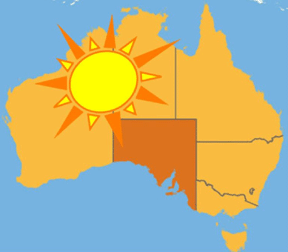 ABC 25th Oct 2020, South Australia’s renewable energy boom has achieved a global milestone. The state once known for not having enough power has become the first major ABC 25th Oct 2020, South Australia’s renewable energy boom has achieved a global milestone. The state once known for not having enough power has become the first majorjurisdiction in the world to be powered entirely by solar energy. For just over an hour on Sunday, October 11, 100 per cent of energy demand was met by solar panels alone. “This is truly a phenomenon in the global energy landscape,” Australian Energy Market Operator (AEMO) chief executive Audrey Zibelman said. https://www.abc.net.au/news/2020-10-25/all-sa-power-from-solar-for-first-time/12810366 |
|
|
Coalition to divert renewable energy funding away from wind and solar
|
Coalition to divert renewable energy funding away from wind and solar
Scott Morrison says solar and wind are commercially viable and do not need subsidies from the $1.43bn funding, Guardian, Katharine Murphy and Adam Morton, Thu 17 Sep 2020 The Morrison government will continue to fund Australia’s renewable energy agency to the tune of $1.43bn over a decade but overhaul its mandate so there will be less investment in solar and wind, and more focus on investment in hydrogen, carbon capture and storage, microgrids and energy efficiency.The baseline funding for the Australian Renewable Energy Agency (Arena) will be supplemented by a transfer of funds from the government’s emissions reduction fund and a new grants program worth $193.4m – but that represents a funding cut to the agency which was established by the Gillard government in 2011. The significant overhaul will be unveiled by Scott Morrison on Thursday ahead of the government outlining its next steps in the technology roadmap, which is the government’s emissions reduction strategy. The energy minister, Angus Taylor, is expected to unveil the government’s inaugural low emissions technology statement during a speech at the National Press Club early next week…….. The Morrison government will continue to fund Australia’s renewable energy agency to the tune of $1.43bn over a decade but overhaul its mandate so there will be less investment in solar and wind, and more focus on investment in hydrogen, carbon capture and storage, microgrids and energy efficiency……… The government will also continue to plough more taxpayer funds into carbon capture and storage through a $50m fund, while $70.2m will be allocated for an export hydrogen hub. ……. The overhaul of Arena follows the government outlining first steps in its much vaunted “gas-led recovery” from the economic shock caused by the coronavirus. Morrison on Tuesday pointed to new commitments in the October budget, including funding of $52.9m to unlock more gas supply and boost transport infrastructure. As well as flagging that the government would back the construction of a new gas-fired power station in the Hunter Valley if the energy company AGL failed to replace Liddell, Morrison held open the option of taxpayer underwriting for priority gas projects, streamlining approvals or creating special purpose vehicles for new investment. While Morrison and Taylor have been muscling up about the importance of new generation to replace Liddell, the government’s proposition has not been backed by a taskforce report commissioned to assess the impact of its closure. Morrison said this week the government had estimated 1,000 megawatts of new dispatchable electricity generation capacity would be needed to replace Liddell, which owner AGL has announced will close in early 2023. But the taskforce does not find that 1,000MW of additional dispatchable electricity would be needed. It listed a range of energy committed and probable projects that it found would be “more than sufficient” to maintain a high level of power grid reliability as Liddell shut.https://www.theguardian.com/australia-news/2020/sep/17/coalition-to-divert-renewable-energy-funding-away-from-wind-and-solar |
|
Forget toilet paper, consumers are panic buying solar
 Byron Bay’s Smart Energy is seeing an unprecedented surge in sales and enquiries of solar and home storage as consumers look to shore themselves up in uncertain times. pv magazine,
Byron Bay’s Smart Energy is seeing a record sales quarter after an unprecedented 41% increase in sales and a 400% increase in battery enquiries over the last two weeks as panicking consumers look to protect themselves in times of uncertainty.
In uncertain times people rush to certainties. It is said that the only certainties are death and taxes, but what about pasta, toilet paper and solar PV? We certainly need to eat, to use the toilet, and just as certainly as the tax bill comes, so too does the electricity bill, so why not do whatever we can to lessen the impact?
When other industries and businesses are shrinking and self-isolating, Smart Energy is taking on additional resources and looking for ways to support local communities and installers as the solar and battery retailer enjoys an unprecedented surge for its products.
In a statement, Elliot Hayes, co-founder and managing director of Smart Energy said that there are many contributing factors to the growth, the main two being consumers seeking out greener purchases following the recent natural disasters in Australia and economic downturn, and consumers looking to future-proof their homes.
And why wouldn’t consumers look to future-proof their homes with solar PV and an energy storage system?……..
The solar industry in Australia expected to take quite a hit from the Coronavirus outbreak considering most panels in the market come from China, where the virus originated. Of course, many in the industry are doing it tough, but BloombergNEF reports that the production of PV components in China is already resuming, and whilst shortages may exist in the short-term, China is expected to meet its export demand before its domestic market. https://www.pv-magazine-australia.com/2020/03/19/forget-toilet-paper-consumers-are-panic-buying-solar-pv/?fbclid=IwAR3wceEHrP9MVgguwPW4092RhgYZ4GVNt7iM4abDe4XpTXOJfPf33ThqrkU
Australia’s future as a renewable energy superpower
|
Australia has a real future as a renewables superpower, https://www.canberratimes.com.au/story/6587200/australia-has-a-real-future-as-a-renewables-superpower/?cs=14246Tristan Edis, 19 19 Jan 2020, Amid almost daily complaints from industry about skyrocketing electricity costs, out dropped an announcement recently so counter to the dominant news flow that it seemed beyond belief. Yet there it was in the business pages: Australian software billionaire Mike Cannon-Brookes and iron ore billionaire Andrew “Twiggy” Forrest have a plan to supply a fifth of Singapore’s electricity needs – all of it from solar power – via a 3750-kilometre underwater cable from the Northern Territory. The proposed solar farm, near Tennant Creek, would be the world’s biggest by a comfortable margin. It would stretch as far as the eye can see, across an area equal to more than 20,000 soccer fields.Despite Cannon-Brookes’s self-deprecating description of the project as “batshit insane”, it could actually make technical and economic sense. And it’s not the only mega-renewable energy project being pursued by credible Australian companies with the aim of powering the many hundreds of millions of people living to the north of us. Continue reading |
1 This month

of the week – Australians for War Powers Reform (AWPR)
To see nuclear-related stories in greater depth and intensity
 Antinuclear