BHP’s plan to take yet more water for huge copper-uranium mine
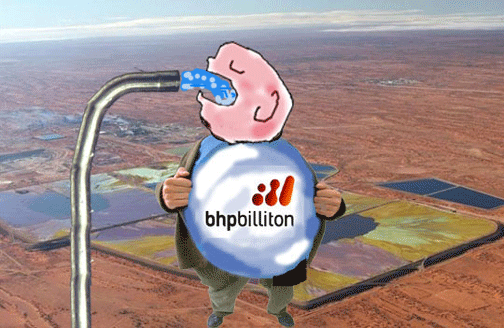
https://www.melbournefoe.org.au/olympic_dam_uranium_mine_expansion1219
The federal government is inviting public comment on BHP’s proposed expansion of the Olympic Dam copper-uranium mine (ODM) until Tues. 10 Dec 2019.
BHP plans to increase extraction of precious Great Artesian Basin water to an average 50 million litres per day for the next 25 years, with likely serious adverse impacts on the unique and fragile Mound Springs ‒ which are listed as an Endangered Ecological Community and are of significant cultural importance to Aboriginal people.
Please make a brief submission to the Federal Minister for Environment. You can use our pro-forma submission and just add your name (and you can add any additional comments you like).
More information:
- Short briefing papers on the proposed Olympic Dam expansion are posted at https://nuclear.foe.org.au/olympic-dam/.
- See esp. the “Preconditions to Protect Mound Springs in Olympic Dam Expansion EIS Guidelines“.
- Detailed BHP information: See the BHP Referral at http://epbcnotices.environment.gov.au/publicnoticesreferrals/ and scroll down to Referral Number 2019/8570, dated 27 Nov. in chronological listing, or Search (use the tab “Filter by Referral Number’) for 2019/8570.
Public opinion: for the first time, Environment is Australians’top concern
 Environment is prime worry for the first time: poll, The Age Matt Wade Environment is prime worry for the first time: poll, The Age Matt Wade
December 2, 2019 The environment has for the first time surpassed healthcare, cost of living and the economy to be the number one concern for Australians.
The Ipsos Issues Monitor,which asks a representative sample of Australians to select the three top issues facing the nation, found 32.1 per cent rated the state of the environment among their biggest worries in November – the highest share in the decade-long history of the survey. The result follows devastating spring bushfires in NSW and Queensland and worsening drought conditions in many regional areas. These events have been widely attributed to climate change caused by global warming. The survey shows anxiety about the state of the environment has risen steadily since the middle of the decade…. https://www.theage.com.au/national/environment-is-prime-worry-for-the-first-time-poll-20191201-p53fu5.html |
|
|
The nuclear industry – an unsustainable water-guzzler
Ethics of Nuclear Energy Abu-Dayyeh (P.hD) Amman – H.K. of Jordan Ayoub101@hotmail.com E_case Society (President) www.energyjo.com [Extract]
“…….4- Sustainability
Environmental Ethics is perceived as the practical dimension of ethics concerning environmental issues. It is also conceived by some as an “education for sustainability”, and “an important vehicle to transmit values, to change attitudes and to motivate commitment” (40). Therefore, sustainability is a crucial element in our moral decision over the choice of energy.
The new technologies in shale-gas extraction are expected to extend the life-time of gas reserves worldwide many folds the life span predicted for oil reserves, which are unlikely to last more than 40 years. On the other hand, uranium reserves of high concentrations (above 1000 ppm) mainly exist in Canada and Australia (41), as can be seen in Figure 2: [on original]
Therefore, considering the present consumption of uranium U3O8 per year, which stands at around 70,000 tonnes, the world reserves of around 3.5 million tonnes will not last more than 50 years. A report published in the International Journal of Green Energy in 2007 suggests that if a nuclear renaissance is expected soon, according to the myth of a nuclear renaissance which the nuclear lobbies and the IAEA are trying to promote, the uranium reserves will only be sufficient to keep the world’s nuclear reactors functioning for only 16.5 years (42). In another words, most of the reactors that are proposed now for future investment would practically be out of enriched fuel soon after they are commissioned.
The other choice out of this impasse would be to acquire fuel from reprocessing of depleted fuel and from the plutonium of nuclear warheads that has been neutralized after the cold-war. However, this industry is extremely complicated, risky and it’s environmental impact is highly controversial; two reprocessing plants had already been shut down after Fukushima, one in Japan; the Rokkasho Reprocessing Program; which economical feasibility has already been questioned by Sakurai Yoshiko and Inose Naoki. A governmental committee estimated the cost of reprocessing existing nuclear waste in Japan at 18.8 trillion yen (43); around 200 Billion US$; the second facility shut down was in the UK at Sellafield.
After the Japanese disaster at Fukushima on March 11, 2011 the maximum world capacity of fuel reprocessing at the present time has become around 20% of the total depleted fuel produced all around the world, thus causing a serious set-back; not only for providing a new source of fuel, but also to depositing depleted fuels at lower radioactive level and less segregating radioactive isotopes.
We can thus conclude that fission-fuel technology is not a sustainable source of energy for the future……
Even if the depletion of uranium is postponed much further, it remains an unsustainable source of energy per excellence, particularly if water, energy and CO2 emissions are taken into consideration as shown in Figure 3.
If we take the Olympic Uranium Project as an example we can see that more than 3402 KL of water is needed for each tonne of U3O8 mined, this number is more than doubled at the Beverley Mines. If we add the amount of water needed for all the by-products, such as enrichment of fuel, cooling the reactors, etc. we can say that huge amounts of water are consumed in the overall process. The poorer the grade of uranium ore is the more water is needed. The Australian Olympic and Beverly mines ore grade are around 640-1800 ppm, so we can postulate the much larger amount of clean water are needed for poorer quality, at 200 ppm or even less!
Each tonne also consumes more than 1700 GJ of energy and can emit more than 320 tonnes of CO2 for each tonne U3O8 produced. [table on original]……”
The Murray Darling water crisis and what governments must do to fix this
|
Fish kills and undrinkable water: here’s what to expect for the Murray Darling this summer, The Conversation, Jamie Pittock
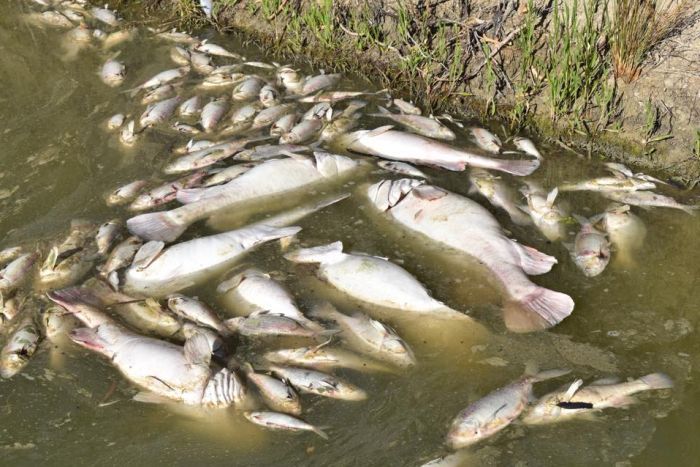
Professor, Fenner School of Environment & Society, Australian National University, November 27, 2019 A grim summer is likely for the rivers of the Murray-Darling Basin and the people, flora and fauna that rely on it. Having worked for sustainable management of these rivers for decades, I fear the coming months will be among the worst in history for Australia’s most important river system.The 34 months from January 2017 to October 2019 were the driest on record in the basin. Low water inflows have led to dam levels lower than those seen in the devastating Millennium drought. No relief is in sight. The Bureau of Meteorology is forecasting drier-than-average conditions for the second half of November and December. Across the summer, rainfall is also projected to be below average. So let’s take a look at what this summer will likely bring for the Murray Darling Basin – on which our economy, food security and well-being depend. Not a pretty pictureAs the river system continues to dry up and tributaries stop flowing, the damaging effect on people and the environment will accelerate. Mass fish kills of the kind we saw last summer are again likely as water in rivers, waterholes and lakes declines in quality and evaporates. Three million Australians depend on the basin’s rivers for their water and livelihoods. Adelaide can use its desalination plants and Canberra has enough stored water for now. But other towns and cities in the basin risk running out of water. Governments were warned well before the drought to better secure water supplies through infrastructure and other measures. But the response was inadequate. Some towns such as Armidale in New South Wales have been preparing to truck water to homes, at great expense. Water costs will likely increase to pay for infrastructure such as pumps and pipelines. The shortages will particularly affect Indigenous communities, pastoralists who need water for domestic use and livestock, irrigation farmers and tourism business on the rivers………. How to fix thisGovernments must assume that climate-induced drought conditions in the basin are the new normal, and plan for it. Action should include:
Investing in these adaptation actions now would provide jobs during the drought and prepare Australia for a much drier future in the Murray-Darling Basin. https://theconversation.com/fish-kills-and-undrinkable-water-heres-what-to-expect-for-the-murray-darling-this-summer-126940 |
|
Australia’s ‘permanently wet’ rainforests now burning for the first time

Bushfires devastate rare and enchanting wildlife as ‘permanently wet’ forests burn for first time ABC, RN BY ANN ARNOLD 27 NOV 19 The rainforests along the spine of the Great Dividing Range, between the Hunter River and southern Queensland, are remnants of Gondwana, the ancient supercontinent that broke up about 180 million years ago.
“Listening to the dawn chorus in these forests is literally an acoustic window back in time,” ecologist Mark Graham tells RN’s Saturday Extra.
“It’s like listening to what the world sounded like in the time of the dinosaurs.”
The forests are mountaintop islands that have been “permanently wet” for tens of millions of years.
But now, these forests are being burnt for the first time.
“We are seeing fire going into these areas where fire is simply not meant to go,” says Mr Graham, a fire specialist with the Nature Conservation Council.
Most of the focus of Australia’s catastrophic fires has been on people and property — with the exception of koalas, which have come to symbolise the non-human costs.
Beyond the koalas are many rare and fascinating creatures whose lives and homes have been destroyed, or remain threatened.
“The fauna in these landscapes requires permanently wet conditions, and many of the fauna species in these landscapes simply have no tolerance to fire,” Mr Graham says.
The most ancient birds on the planet
The songbirds that live in these ancient wet forests have always lived there…….
One reason the north coast of New South Wales is a global biodiversity hotspot is it has the most species of eucalypts in the world, and the best areas of Antarctic Beech forest.
“These forests are recognised globally for their outstanding universal values because they are essentially the oldest forests remaining on the planet,” Mr Graham says.
The tree hollows host many fauna species, for shelter and breeding. The hollows take centuries to develop to full size. They can’t be replaced.
“You have to wait 200 to 400 years until they develop again,” Mr Graham says.
One of two nature conservation areas he privately owns, and manages for their natural values, has been almost obliterated by fire.
He wants to present only the facts, and avoid fuelling a media and political circus around the fires……https://mobile.abc.net.au/news/2019-11-27/bushfires-devastate-ancient-forests-and-rare-wildlife/11733956
Launch of Australia’s National Environmental Defenders Office
 National Environmental Defenders Office launches https://www.lawyersweekly.com.au/sme-law/26968-national-environmental-defenders-office-launches, By Jerome D, oraisamy|21 November 2019 The new EDO will have offices in Adelaide, Brisbane, Cairns, Canberra, Darwin, Hobart, Perth and Sydney, with all state and territory EDOs finalising their merger process over the coming months.
Launched yesterday, the national Environmental Defenders Office will “take high-impact enforcement cases to the courts to make sure the public interest is upheld, and our communities are properly protected by our environmental laws”, it said in a statement.
In explaining why the former environmental legal centres were now coming together under one roof, EDO CEO David Morris said that the environmental problems facing Australia are not bound by our state and territory borders.
“The Murray-Darling crisis spans four jurisdictions. Our iconic koalas are dying right up and down the east coast. Climate change doesn’t stop at any border,” he said.
“Now more than ever, national leadership is required to protect Australia’s natural and cultural heritage. That’s where the new national EDO steps in.”
Moreover, the merger will see us the new EDO become the “largest public interest environmental law centre in the Australia-Pacific region”, Mr Morris told Lawyers Weekly.
“With that additional scale comes opportunities to play a bigger role empowering communities and protecting places. We see big opportunities to increase our presence in the Pacific and to better serve local communities in remote parts of Australia, including northern Australia,” he said.
“Increasingly communities across northern Australia are seeking legal assistance in respect of gas developments and we intend to ensure that our expert lawyers are available to assist them.” Merging also allows the EDO, Mr Morris added, to address the “problems of scale” identified by the Productivity Commission in its Access to Justice Arrangements report.
“That is, we’re able to centralise much of the offices’ administrative, financial and communications work freeing up our legal staff to provide better services to the community. The opportunity is that as a much bigger organisation we can play a bigger role at a national level on national issues, but at the same we’re committed to maintaining and strengthening connections to grass roots communities,” he said.
Another challenge and opportunity I expect will be big issues for us in the next twelve months will be coming to grips with what it means to be a distributed national team across a large area and multiple time-zones and multiple jurisdictions. We’ve got some tools and we’ve got some resourcing to improve our legal technology, rolling that out and implementing it will be crucial to the merger’s success.”
Australia is one of the “most naturally beautiful and biologically diverse places on Earth”, EDO’s statement continued, “but our environment is in decline”.
“There are more than 1,700 threatened species in Australia, we have lost more animals to extinction than any other country in the world. And while the Australian community expects robust accountability and oversight when it comes to environmental protection, trust in government processes and institutions has eroded to an all-time low.
Mr Morris said: “Regulations are regularly not enacted or enforced. Governments have cut resources to departments that are supposed to monitor breaches of environment law.”
“Companies routinely and intentionally breach state and federal environment laws. The problem is systemic and widespread because there is no clear legal deterrent.
“As a merged, national organisation we can share expertise, more closely scrutinise projects and address the widespread culture of non-compliance with environment laws.”
Survey showed environment and climate to be Australian children’s top concerns
|
Environmental issues and climate change are Australian children’s top concerns, https://www.sbs.com.au/news/environmental-issues-and-climate-change-are-australian-children-s-top-concerns The environment has topped the list of concerns of Australians aged between 10 and 16 as children fight for a bigger say.
BY ROSEMARY BOLGER 21 Nov 19,The environment is the greatest concern for Australian children aged between 10 and 16, a national survey has found.
The results of the Unicef survey, released on Wednesday to mark World Children’s Day, showed 28 per cent of respondents named treatment of the environment as the most pressing issue for the world. The issue, which encompassed water and other forms of pollution, climate change and extinction rates, was also the number one concern when asked to consider what needed to be improved in their own lives, their local area and Australia. Unicef Australia’s young ambassador Josh Brittain said views on the environment tended to become bleaker as children got older. “You could track how their optimism falters as they get older,” he said. The 20-year-old said children and young people were asked to name the first thing that popped into their head when they thought of the environment. “As we were talking to younger kids they’d say things like animals, plants, turtles and as we talked to older kids, maybe around year 6 or 7, they’d say things like littering or sustainability,” he said. “And as we got to the later years like 11 or 12 exclusively like death destruction, hopelessness.” The 602 children and young people in Australia surveyed for the report strongly rejected the notion their views were manipulated or a regurgitation of their parents or teachers’ ideas. Eighty-five per cent said that they solidly held their own views, with 37 per cent saying adults encourage them to think for themselves. But Mr Brittain said many felt their views on issues like climate change were not taken seriously, particularly by political leaders, reflected in the massive climate strikes in Australia led by young people in September. “We needed to be included in the decision making because nobody is more invested than we are. This idea that young people are not capable of coming up with solutions or we do come up are just products of their parents … is an absolute fantasy,” he said. Unicef Australia director Nicole Breeze said the survey results reinforced the need for a national youth peak body to be funded to provide a channel for children and young people to directly influence policies that matter to them. “They are feeling frustrated by the political process and many of them are seeing that their last resort or only option is to step more into this strike mode,” Ms Breeze said. Unicef has conducted similar surveys in other countries. “What we do see is the level of disengagement and worry about the political level of engagement is very high in Australia in contrast to countries like Canada and elsewhere,” she said. Despite their concerns, the majority of children and young people said they enjoyed growing up in Australia. |
|
Visionary Leaders Symposium: ‘Our planet is our patient.’
 Visionary Leaders Symposium: ‘Our planet is our patient.’ http://publichealthnewswire.org/?p=physicians-for-social-responsibility-visionary-leaders-symposium#.XdARGW8_6rw.twitter by Louise Dettman on 11/8/2019 Nearly 200 organizations representing medical, health care and public and environmental health professionals, including APHA, have so far endorsed the 2019 U.S. Call to Action on Climate Change, Health and Equity: A Policy Agenda.It challenges government, business, civil society and the health sector to recognize climate change as a public health emergency and to act now for climate, health and equity.
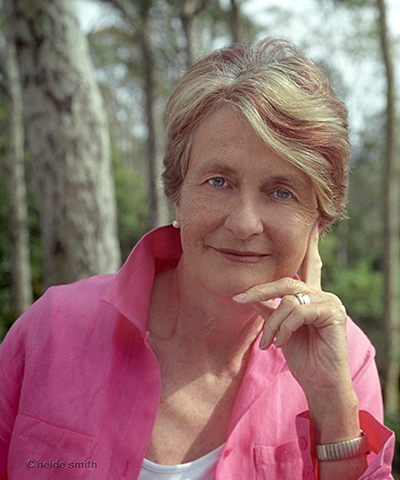
“Being health professionals, it’s important for us to realize that our planet is our patient, and it’s in the intensive care unit. We’re doctors to a dying planet and we have a job to do,” said Helen Caldicott, MD, keynote speaker at yesterday’s Physicians for Social Responsibility Visionary Leaders Symposium in Washington, D.C.
A PSR founder and former president, anti-nuclear activist, author and pediatrician from Australia, Caldicott has spent her life educating world leaders and the public about the medical hazards of the nuclear age. She urged those gathered at the Ronald Reagan Building for the symposium to “stop being polite and speak the truth loudly and clearly” about the need for action on climate change. As one of the drafters of the U.S. Call to Action, PSR is using it to mobilize and give voice to more health professionals.
It advocates for policies that promote a just transition to clean, safe renewable energy and energy efficiency; sustainable food production and diets; clean water; active transportation; and green cities. Such policies can lower climate pollution, reduce the incidence of communicable and non-communicable disease, improve mental health and realize significant cost savings in health care.
“I’m not being radical. I’m being a physician,” Caldicott said as she stressed the urgency of the situation; challenged attendees to question the role of politicians, corporations and the military in the production of greenhouse gases; and told everyone to contact members of Congress. “If you don’t use your democracy, they’ll swoop in and use it for you — for their own political and financial gain,” she said.
The U.S. Call to Action urges the health sector itself to reduce greenhouse gas emissions and — as a trusted voice — to effectively communicate the health threats of climate change and the health benefits of climate action. The symposium focused specifically on the role of women in the climate, health and equity movement and the importance of economic justice for the most vulnerable communities.
Heidi Hutner, PhD, a filmmaker, writer and professor at Stony Brook University, moderated an expert panel of women advocates discussing the health hazards of and solutions to nuclear power and climate change. Hutner opened the program with a trailer of her upcoming documentary about the women of Three Mile Island and, along with the other participants, questioned nuclear power as the answer for a just transition to clean energy.
Following the symposium, at the 2019 Visionary Leadership Awards, PSR presented Caldicott with a Lifetime Achievement Award for her work. It also recognized other individuals and organizations for their efforts in advancing nuclear weapons abolition and addressing environmental risks to human health, including the consequences of climate change.
Rio Tinto drives ERA rehabilitation of Ranger uranium mine
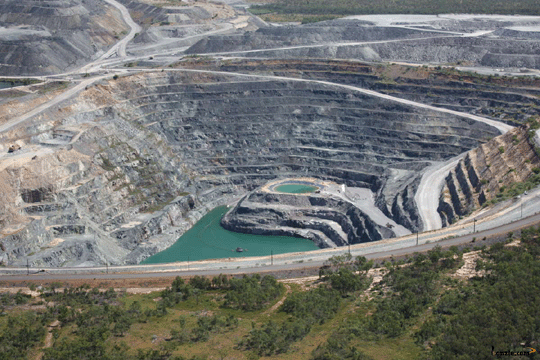 Rio Tinto drives ERA rehabilitation of Ranger, https://www.australianmining.com.au/news/rio-tinto-drives-era-rehabilitation-of-ranger/
The company has announced an offer of new fully paid ordinary shares to raise the rehabilitation funds, with support from majority owner Rio Tinto.
As ERA’s largest shareholder, Rio Tinto is subscribing to its full entitlement of approximately $326 million.
ERA is not able to secure third-party underwriting support, therefore Rio Tinto is also acting as the underwriter to ensure ERA secures the funds it needs.Rio Tinto energy and minerals group executive Bold Baatar said it was committed to ensuring ERA’s position to fund the rehabilitation.
“We take mine closure very seriously and ensuring ERA is able to fund the closure and rehabilitation of the Ranger project area, through participating in this entitlement offer, is a priority,” Baatar said.
The shares will be offered to all eligible shareholders for $0.15 per share, representing a 38 per cent discount to the $0.24 per share 10-day volume weighted average price (VWAP).
After the increase in the rehabilitation provision in 2018, ERA found it did not have sufficient existing cash resources or expected future cash flows to fulfil the Ranger rehabilitation.
ERA believes it will have an achievable plan for the Ranger rehabilitation with the completion of this entitlement officer.
As per the obligation with the Commonwealth and Northern Territory governments and the Traditional Owners, ERA will return the Ranger project area to an environment similar to the nearby Kakadu National Park.
Under its mining approval terms, ERA must end mining and processing at Ranger by January 2021 and finish final rehabilitation by January 2026.
ERA is not expected to generate any direct financial return from the Ranger rehabilitation expenditure.
Australia’s over-exploited water supply – an issue being ignored
|
Although Australia is a land often devastated by drought, if you live in the city, it’s very unlikely that you’ll turn on the tap and find no water comes out.Even during the Millennium Drought nearly a decade ago, we avoided coming close to a Cape Town-style ‘Day Zero’. And given about 70 per cent of Australians live in major cities, it’s easy to forget just how good most of us have it. Whether it’s for cooking, drinking or bathing, we don’t have to collect water from a well, or pump it ourselves, or worry about it being dirty or unsafe. The sources of our water supplies are out of sight, out of mind. But it hasn’t always been that way — and we need to stop and think about where it comes from. If we don’t, we risk being unprepared for when the next prolonged drought comes around. ‘Liquid sausage meat’ It’s important to note that not all Australians have access to safe drinking water: spare a thought, for example, for remote Indigenous communities, or for the people trucking drinking water to small drought-stricken towns…….. [The author gives a history of Australia’s water sources, water use, and restrictions] We have to start thinking about our waterMore than a decade has passed since those tough restrictions on household water use. As our cities grow and the climate changes, it’s no longer reasonable to wash our hands of the water question. For our hotter and drier cities of the future, building more dams won’t be the answer. Seawater desalination plants aren’t without their problems: desal is energy-intensive and its salty brine is damaging to the local marine environment. Although some cities like Perth are making headway with wastewater recycling, the cheapest and easiest option for all of us is to change our water behaviour, and to better live within our means. Relying on technology alone is not the answer. The development of urban water supplies and sanitation over the past century or so has brought incredible benefits to our lives, while technology and infrastructure allows us to consume that water in the blink of an eye. According to the Australian Bureau of Statistics, households in the Northern Territory (349kL) and Western Australia (241kL) use the most water each year, while Victoria (166kL) and Tasmania (147kL) use the least. Climate, soils and pricing all play a role here, but these statistics suggest that some cities have much thirstier habits than others. Thinking more carefully about where our water comes from — and at what cost — is vital to making sense of living in Australian cities now and in the future. Dr Ruth Morgan is an environmental historian at Monash University, and an ABC Top 5 humanities scholar for 2019.https://www.abc.net.au/news/2019-11-11/changing-australian-water-attitudes-for-conservation/11647258 |
|

Australia’s Environment Is The Enemy – Sussan Ley faithful to Scott Morrison’s priority
 Sussan Ley’s environmental law circus, Independent Australia By Sue Arnold | 5 November 2019 Vulnerable species like the koala – and the environment in general – are the losers, while developers reign supreme in Environment Minister Sussan Ley’s environmental law “review”. Sue Arnold reports.
In July, Sussan Ley sent out a statement indicating that as Minister for the Environment, she would
… commence a ten-year statutory review of the [Environment Protection and Conservation] Act by October this year. And it is the right time to have a conversation about the best ways we can ensure strong environmental and biodiversity protection measures that encourage people to work together in supporting the environment.
All Australians will have a chance to share their ideas as part of the next statutory review of the EPBC Act, due to commence by October 2019.
Exactly why Ley waited another three months before commencing the review is unclear. In a follow-up press release, she announced that former competition regulator Professor Graeme Samuel would head the year-long review, ‘to tackle green tape and deliver greater certainty to business, farmers and conservation groups‘.
Missing from Ley’s pronouncements are key issues relevant to one of the most critical problems — self-referral by developers. Under the current scenario, a developer whose project is likely to destroy or severely impact koala habitat makes the decision whether or not to “refer“ the development to the Federal government as a matter of national environmental significance (MNES), under the provisions of the EPBC Act 1999.
As the koala is listed as “vulnerable” under the EPBC, the referral should never have been reduced to the responsibility of a developer — referral to the Federal government should have been made a mandatory requirement.
A referral is designated as a “controlled action” if the result of a scorecard available from the Government’s ‘EPBC Act referral guidelines for the vulnerable koala’ reaches a certain level. Then the project is assessed by the Federal Department of the Environment and Energy and the minister makes the decision whether to approve the project. Documents relevant to the project are published on the EPBC referral list website and open to public comment — including environmental impact assessments paid for by the developer.
Once the project is approved, a “koala management plan” (KMP) must be provided by the developer before the project commences. However, this is where the proverbial hits the fan as there is no requirement for any public comment, nor any access to the plan.
One of the most important koala management plans has been on Sussan Ley’s desk since July. This is the Lendlease plan for southwest Sydney koalas at their Mt Gilead, now renamed “FigTree Hill” urban project for 1700 residences. This is a project mired in controversy and public outrage because of the risks to the largest expanding healthy koala colony in the Sydney Basin.
IA has been following up this issue with the only section of the Department of the Environment and Energy (DEE) that responds in a timely manner — the Communications and Engagement Branch Media (CEBM) team. ……….
The bottom line to this Monty Python circus is not only the Lendlease koala plan of management which is being withheld, but any developer who has self-referred has no requirement by the environment minister to publish the plan other than “on the developer’s website”.
Given that this would require a large staff to check the multiple developer projects impacting koala habitat throughout Queensland and New South Wales on a daily basis, a new definition of “mission impossible” arises.
Essentially, any koala management plan may be approved. There are no published standards or requirements — much less compliance or monitoring.
A review by some of Australia’s leading ecologists sums up the catastrophic situation facing koala survival.
Some 85 per cent of land-based threatened species experienced habitat loss. The iconic koala was among the worst affected. More than 90 per cent of habitat loss was not referred or submitted for assessment, despite a requirement to do so under Commonwealth environment laws.
Our research indicates the legislation has comprehensively failed to safeguard Australia’s globally significant natural values, and must urgently be reformed and enforced.
Sussan Ley’s priorities in a review of the EPBC Act reflect those of the Prime Minister: the environment is the enemy. https://independentaustralia.net/politics/politics-display/sussan-leys-environmental-law-circus,13279
A NATIONAL APPROACH TO A NATIONAL RIVER SYSTEM
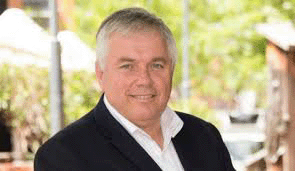 Senator Rex Patrick 3 Nov 19, I’m sick and tired of the NSW Government threatening to pull out of the Murray-Darling Basin Plan every time they get upset about something happening on the river.
It’s been threatened at least 4 times since February 2018, when the Senate was debating whether or not to allow an extra 70GL of extraction from the Norther Basin (Centre Alliance voted against extra extraction).
NSW pulling out of the Basin Plan would not be in its own interests. There are a number of significant NSW river projects that are or will be funded by the Basin Plan, but won’t be if NSW were to pull out.
The Murray-Darling is a national river that needs to be managed accordingly. If NSW took its bat and ball home, there would be little choice but for the Federal Government to take control, either using existing Commonwealth powers or by supporting a constitutional amendment handing powers to the Federal Parliament. Centre Alliance already has a Constitutional Alteration Bill before the Parliament that seeks to do this.
NSW Nationals MPs have cried wolf on pulling out of the plan so often now that it’s becoming meaningless. They would be better off focussing their efforts on reigning in over-extraction, but that would involve acting in the national interest, not in the Nationals’ interests.
240 conservation scientists call on Australian government to strengthen environmental protection laws
Letter by 240 leading scientists calls on Scott Morrison to stem extinction crisis, More than 240 conservation scientists sign open letter warning PM that 17 Australian native species face extinction in next 20 years. Guardian, Adam Morton Environment editor @adamlmorton, Mon 28 Oct 2019 More than 240 conservation scientists have called on Scott Morrison to drop his opposition to stronger environment laws and seize a “once-in-a-decade opportunity” to fix a system that is failing to stem a worsening extinction crisis.
With the federal government due to this week announce a 10-yearly legislated review of the Environmental Protection and Biodiversity Conservation (EPBC) Act, the scientists have signed an open letter to the prime minister urging him to increase spending and back laws to help protect the natural world from further destruction.
The letter says three native species have become extinct in the past decade and another 17 could follow in the next 20 years. More than 1,800 Australian plants and animals are formally listed as threatened with extinction, but the scientists say this is an underestimate.
“Our current laws are failing because they are too weak, have inadequate review and approval processes, and are not overseen by an effective compliance regime,” the scientists say.
“Since they were established (in 1999), 7.7m hectares of threatened species habitat has been destroyed. That’s an area larger than Tasmania. Meanwhile, the number of extinctions continue to climb, while new threats emerge and spread unchecked.”
Environmental law was a point of difference at this year’s election, with Morrison pledging to limit “green tape” that he said cost jobs while Labor promised a new environment act and a federal environment protection authority.
Lesley Hughes, a distinguished professor of biology at Macquarie University, member of the Wentworth Group of Concerned Scientists and a signatory to the letter, said environmental protections had been consistently wound back over the past decade, most often by conservative governments.
She said it was having a significant impact, pointing to the 2016 state-of-the-environment report that found Australia was facing multiple environment changes and lacked a national policy that established a clear vision for the protection and sustainable management of the country’s natural heritage.
She also cited a WWF assessment that ranked eastern Australia as one of the world’s top 11 deforestation hotspots. Australia was the only developed country on the list.
“It’s a very grim picture,” Hughes said. “This letter is a pre-emptive strike to say this is an opportunity to do it better, this is not an opportunity to weaken and dilute the existing weak laws.”
Morrison’s pledge not to increase environmental laws came as a United Nations global assessment found biodiversity was declining at an unprecedented rate, with one million species across the globe at risk of extinction and human populations in jeopardy if the trajectory was not reversed.
The environment minister, Sussan Ley, said the review of the EPBC Act was an independent process that would encourage submissions from a wide variety of perspectives……. https://www.theguardian.com/environment/2019/oct/28/toughen-environmental-laws-to-stem-extinction-crisis-scientists-tell-morrison
Radioactive liquids in Olympic Dam waste pools are killing native birds
Olympic Dam Alert: BHP propose a major new Evaporation Pond 6 for radioactive acid liquor wastes that will continue deaths of hundreds of birds each year
The federal government are inviting comments on BHP’s “Olympic Dam Evaporation Pond 6 EPBC Act Referral 2019/8526” (scroll down to Date of Notice 21/10/2019).
Public submissions are only open until cob Monday 4th Nov 2019, see info on how to do so at end of this e-mail.
Please consider making a brief submission, key Recommendations are provided below, along with a Background Briefing Paper and a feature press article “BHP vs Birds”.
For info see “Migratory Birds at Risk of Mortality if BHP Continues Use of Evaporation Ponds” a 3 page Briefing written by David Noonan for the ACF, Friends of the Earth and Conservation SA (30 June 2019), at https://nuclear.foe.org.au/wp-content/uploads/ODM-Migratory-Birds-BHP-Evaporation-Ponds.pdf
see “BIRDS VS BHP: Evaporation ponds at BHP’s Olympic Dam mine are killing hundreds of birds” article in The Advertiser 10 July 2019
Barkindji people have title to Darling River area – but their river is dying, killed by drought, and whiteys’mismanagement
Indigenous community say they’ve lost their culture to water mismanagement, SBS, This is the final part in a series of reports from communities along NSW’s Darling River that have been impacted by water mismanagement and drought. BY ANEETA BHOLE 18 Oct 19, An Aboriginal community in rural NSW fears their culture may be lost, as dry conditions and low river flows threaten the future of the Darling River.
The Barkindji people have lived, hunted and passed down their oral history on the banks of the Darling for more than 40,000 years.
Now the river is drying up due to over-extraction by irrigation upstream and drought.
The community’s fears surfaced at a recent corroboree in the small town of Wilcannia, which was once a thriving Murray-Darling River port.
The Yaama Ngunna Barka corroboree had been travelling to towns along the river from Walgett to Menindee. The corroboree have been travelling to towns in outback New South Wales in a bid to raise awareness about the plight of the Darling river.
‘Dead water’
Lilliana Bennett can still recall her grandmother talking about taking the family down the riverbank to fish and hunt for goanna. The river was a place of safety and community for her family.
“It’s a place they go to relax, to tell stories,” she told SBS News.
“For me, it’s been really devastating, I mean we went down and camped by the river where there’s still a bit of water around and it just doesn’t have the same feeling, it’s dead water.”…….
With water levels at an all-time low and the drought continuing to ravage the region, native animals have also started to disappear from the river banks. Many with spiritual significance. …….
The Barkindji community fought for Native Title of the land – covering 128,000 square kilometres — from Wentworth at the Victorian border to near Wanaaring in the state’s north-west, including Broken Hill, Wilcannia, Menindee, Pooncarie and Dareton.
They started the claim in 1997 and won two decades later, but many have said without water flowing in the river they feel robbed. …….
Case for change
Last month, the National Resources Commission (NRC) released an independent report looking into the water-sharing plan of the Barwon-Darling River system.
The system takes in the the Barwon River, from upstream of Mungindi at the confluence of the Macintyre and Weir rivers, to where the Barwon meets the Culgoa River.
At this point the river channel becomes the Darling River and the Barwon–Darling system extends downstream to the Menindee Lakes.
It found that provisions that allow increased access to low flows resulted in poor ecological and social outcomes downstream of Bourke, including the town of Wilcannia where part of the Barkindji community live.
The NRC has made 17 recommendations, including one which has called for stricter regulation of when irrigators, including cotton farmers, can pump water from the river………. HTTPS://WWW.SBS.COM.AU/NEWS/INDIGENOUS-COMMUNITY-SAY-THEY-VE-LOST-THEIR-CULTURE-TO-WATER-MISMANAGEMENT
1 This month
17 October, Free Public Talk on Nuclear Issues in South Australia
David Noonan will speak on public interest concerns over the new Roxby Downs Indenture Act 2026 on BHP copper-uranium mining and ore processing in SA, and on how AUKUS may face SA with a High-Level nuclear waste agenda.
Dr Jim Green will discuss international developments in the field of nuclear power including ‘small modular reactors’ and Generation 4 ‘advanced’ nuclear reactor concepts.


Help Aunty Sue Protect Her Land and Sacred Sites From Destructive Rocket Testing.
.

Australians deserve the truth
about
AUKUS – https://aukuspublicinquiry.com/

PETITION – To: Prime Minister Anthony Albanese and the Australian Labor Government

of the week – Australians for War Powers Reform (AWPR)
To see nuclear-related stories in greater depth and intensity

