A third of Australia’s spectacled flying fox population wiped out by extreme heat waves
Extreme heat wipes out almost one third of Australia’s spectacled flying fox population, ABC Far North , 20 Dec 18, By Sharnie Kim and Adam Stephen An extreme heatwave in far north Queensland last month is estimated to have killed more than 23,000 spectacled flying foxes, equating to almost one third of the species in Australia.
The deaths were from colonies in the Cairns area where the mercury soared above 42 degrees Celsius two days in a row, breaking the city’s previous record temperature for November by five degrees.
Ecologist, Dr Justin Welbergen from the Hawkesbury Institute for the Environment (Western Sydney University) is collating the numbers of bat deaths and said it was the second-largest mass die-off of flying foxes recorded in Australia and the first time it had happened to this species.
“These are certainly very serious wildlife die-off events and they occur at almost biblical scales,” he said……..https://www.abc.net.au/news/2018-12-19/heat-wipes-out-one-third-of-flying-fox-species/10632940
Bushfire threat to vital koala habitat
 Salamander Bay bushfire threatens homes, vital koala habitat in Port Stephens, ABC 11 Dec 18 An entire koala population in Port Stephens could be wiped out after a fire devastated their habitat near Port Stephens, an animal rescue group fears.
An estimated 16 hectares of the Mambo Wetlands, north of Newcastle, was scorched on Monday night, according to Port Stephens Koalas.
The reserve is about 40 per cent of the vital koala habitat.
The blaze broke out near the Salamander Bay shopping centre about 6:30pm and dozens of firefighters spent the night backburning to protect homes.
It burnt away more than 80 hectares of swampy scrub, which made access difficult for fire crews.
The fire flared up to a watch and act level at 3:00am, but weather conditions eased in the early hours and the blaze was brought under control.
Carers from the rescue group today surveyed the damage and fielded calls about stranded and injured wildlife.
Simone Aurino, senior carer at Port Stephens Koalas, said the reserve was one of the most important areas in the Tomaree Peninsula.
“It has a viable breeding population and its central to all the other habitats,” she said.
“It’s a really, really essential habitat.”
Ms Aurino said the blaze would lead to significant flow-on effects which may not be known for some time.
“It has the potential to wipe out the population in this area, it’s really quite devastating,” she said.
“The habitat’s been changed, so the animals are going to move…….https://www.abc.net.au/news/2018-12-11/bushfire-threatens-vital-koala-habitat-in-port-stephens/10605160
Release of Federal Inquiry Report into community contamination from toxic chemicals
| On Monday December 3rd a cross-party Parliamentary Inquiry will release its report into the Defence Department’s management into PFAS contamination in and around Defence bases. To date 90 sites and communities in every single state and territory of Australia have been contaminated by this toxic and banned chemical which was used in firefighting foams and has leaked into the environment. |
| A seven-year study of 69,000 US residents by an independent panel of scientists concluded these body of chemicals were connected to developmental issues in infants and children, increased cancer risk, high cholesterol levels, hormone disruption and lowered immunity.
For years contaminated communities were kept in the dark about their homes being contaminated. For the last four years they have fought tirelessly for their own Government to take responsibility for compensation and clean-up of their polluted properties. The Inquiry report will detail physical, emotional and financial toll living in a contaminated community has created along with listing recommendations. Contaminated communities are tired of years of inaction and false claims. “To date, the Australian Government is a world leader in managing PFAS contamination.” Letter from the Department of Prime Minister and Cabinet to Williamtown residents. March 2018 Fact– More than 170 countries have signed a treaty which ban PFAS related chemicals – Australia refuses to. Fact– PFAS is not only still leaking off Defence bases, airports and industrial sites all around Australia in States such as Queensland it’s still in use at over 200 sites. Fact – Defence and the Government continues to refuse to provide blood testing for residents at a number of contaminated sites. It will not release collated blood testing results from other sites. Fact:– Contaminated communities are told not to drink water or eat food from their properties but the Government is dismissive of the international research detailing the health risks of PFAS. Fact – The Inquiry hearings saw both the Defence Department admit they would welcome a third party stepping in to better manage the PFAS contamination and the Federal Government unable to point to who was coordinating the national response to it handling it. |
Labor’s Environment Action Network (Lean) determined that a Shorten Labor government must overhaul federal environment laws
 Labor to face pressure on environment policies after embarrassing stuff-up, Guardian, Katharine Murphy Political editor@murpharoo, 19 Nov 2018 Party members vow to step up push for national environment protection authority at ALP conference Labor’s Environment Action Network (Lean) has warned the ALP it will not give up on securing a significant overhaul of federal environment laws in the first term of a Shorten government, and a national environment protection authority to police the framework, despite an embarrassing process stuff-up with the draft policy platform.
A draft policy platform signed off by the ALP national executive and circulated to conference delegates last month suggested both policy commitments and a national environment commission would be adopted by the party’s national conference in December – but the shadow environment minister, Tony Burke, has now put the brakes on.
Burke has written to the party’s national secretary, Noah Carroll, arguing the initiatives were not signed off by the national policy forum in September, and the specific commitments were included in the draft platform in error.
Labor’s Environment Action Network (Lean) has warned the ALP it will not give up on securing a significant overhaul of federal environment laws in the first term of a Shorten government, and a national environment protection authority to police the framework, despite an embarrassing process stuff-up with the draft policy platform…….https://www.theguardian.com/australia-news/2018/nov/19/labor-to-face-pressure-on-environment-policies-after-embarrassing-stuff-up
Chifley Research Centre calls for a new and independent Australian environmental protection framework
Labor to face pressure on environment policies after embarrassing stuff-up, Guardian, Katharine Murphy Political editor, 19 Nov 2018 “………Environmental approvals are always a sensitive and divisive political issue, but the internal pressure to strengthen the framework from grassroots ALP members in the run-up to the national conference will be fuelled by a new report from the Labor thinktank, the Chifley Research Centre, to be published on Monday.
The new report, prepared in conjunction with Lean, calls for a new legislative framework to replace the Environment Protection and Biodiversity Conservation Act “in order to enshrine federal government leadership in issues of national and international environmental importance”.
The Chifley report also calls for the creation of a national environment commission. Chifley’s executive director, Brett Gale, said the commission would have an independent institutional structure and be “responsible for a new development approvals process that would get rid of the current system with its long delays and lack of clarity around development approvals”.
“It would provide open and transparent approvals to set guidelines, thus delivering better outcomes for the environment, communities and business,” Gale says.
He says the commission would have a policy focus, conduct Productivity Commission-style inquiries into major environmental issues, and be an advocate for the environment in the national debate.
The Chifley report says community confidence in the environmental protection framework will be enhanced if an independent regulatory agency led commonwealth development approvals “aided by greater clarity of expectations and design of the approvals process at the outset”……….https://www.theguardian.com/australia-news/2018/nov/19/labor-to-face-pressure-on-environment-policies-after-embarrassing-stuff-up
Federal government’s water gift to Adani exposed
Green Left, Margaret Gleeson, 15 Nov 18 The Environmental Defenders Office Queensland said new documents raise fresh questions about why the water impacts of Adani’s huge North Galilee Water Scheme will not be assessed under federal laws.
“Queensland is suffering through a severe drought. Despite this, state environment minister Melissa Price decided in September not to apply the “water trigger” assessment on Adani’s proposal to extract river water for up to 60 years, expand a dam and build a pipeline to transport the water to its mine.
This was despite federal environment law dictating that coalmines that are likely to have a significant impact on water resources must undergo a full environmental assessment.
On November 7, the Environmental Defenders Office Queensland (EDO Qld) said that new documents released under a Freedom of Information request raised fresh questions about why the water impacts of Adani’s huge North Galilee Water Scheme — its pipeline from the Suttor River in Queensland to its Carmichael mine site — will not be assessed under federal laws.
The ABC reported that it had seen documents showing that the federal environment department ruled against water experts from the Department of Agriculture and Water who recommended applying the water trigger to Adani’s plan to pump 12 billion litres of river water to the Carmichael mine. …
“Community groups have questioned why the project’s impacts to water resources will not be assessed under the “water trigger”. The documents received by Lock the Gate confirm the community’s concerns.
A submission from the Department of Agriculture and Water Resources advised that the North Galilee Water Scheme could “have a significant impact(s) on a water resource, in relation to coal seam gas development and large coal development, protected under the EPBC Act”.
A submission from Geoscience Australia also called into question Adani’s own referral documents to the federal government, indicating the company failed to consider groundwater dependent ecosystems, despite there being a large number in the affected area.
EDO Qld principal solicitor Sean Ryan said the contents of the documents were “concerning”.
“These new documents raise serious questions as to why the water impacts of this project are not being thoroughly assessed under federal laws,” Ryan said. … ”
ReadMuchMuchMore at the #GreenLeft Source: www.greenleft.org.au/content/federal-government-water-gift-adani-exposed
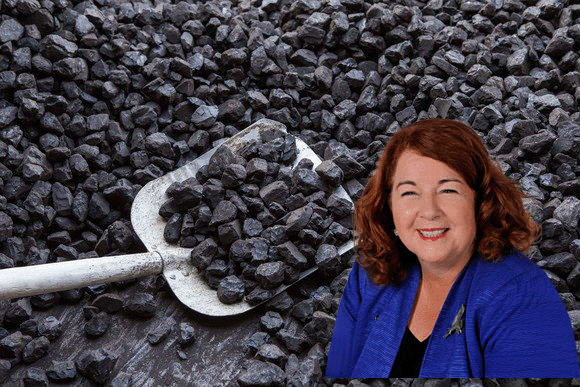
Call to Melissa Price, Minister For Coal, (sorry, I meant Environment) to explain why Adani project is OK about water
|
Adani water project bypasses full environmental impact assessment against advice,
Key points:
Documents obtained under Freedom of Information (FOI) and provided to the ABC by activist group Lock the Gate Alliance showed the Department of Agriculture and Water Resources wrote to the Environment Department suggesting the project could activate what is known as the “water trigger”……… Action will ‘clearly have an impact on water resources’The principal solicitor at the Queensland Environmental Defenders Office, Sean Ryan, said the Environment Department should explain how it came to its decision to not require a full environmental assessment. “It is concerning when these significant environmental laws are not applied to an action that clearly will have a significant impact on water resources,” he said. Carmel Flint from the Lock the Gate Alliance said she was astounded by the situation. “We were really shocked to see that these documents had given some pretty clear advice to the department that there was a serious risk to water resources and that they ignored that and pushed thorough the Adani project without requiring an environmental impact assessment,” she said. “So it just raises real questions about what’s going on inside government. “We’ve got a department who has this key role of looking after water and agriculture basically raising this concern, saying they consider there would be a significant impact on water resources, and they’ve effectively been overruled. “That’s just not good enough.”………. Ms Flint is calling on Environment Minister Melissa Price to act. “We’re really calling for the Minister now to urgently step in and reverse the decision and require a proper environmental impact assessment and fully apply the water trigger,” she said. “We’d also really like to know how it was that this advice came to be ignored by the Department for Environment.”………https://www.abc.net.au/news/2018-11-07/adani-water-project-bypassed-full-assessment-against-advice/10457670 |
|
Traditional Owners launch campaign challenging Origin Energy over NT fracking consents
to challenge Origin Energy over claims it has consent for controversial gas fracking plans
across some of the Northern Territory’s most pristine
landscapes, waterways and iconic tourism regions.
‘Traditional Owners, the Protect Country Alliance and supporters will address
a press conference prior to the AGM, coinciding with the launch of a national campaign
calling on Origin to drop plans to frack the Northern Territory. …
‘Stuart Nuggett [TraditionalOwner] has travelled from the remote township of Elliott
to attend the AGM on behalf of his community, a region at the heart of Origin’s fracking permit acreage:
‘“Our communities haven’t been given enough information about what Origin is planning for our region.
We are worried about the risks fracking brings.
I have concerns over what the impact could be on water. Water is life.
I want the company to listen to our concerns and act on them.”
‘May August is an Alawa grandmother and Traditional Owner
for land under the Origin exploration permits:
‘“We don’t want fracking to start in our area because we have seen
the damage Origin and other companies have done elsewhere in Australia. … ‘
What can we expect of Australia’s new Environment Minister?
 It looks like being Melissa Price – who seems to have a good background in environment, and even believes in climate change! On the other hand, she previously worked for Crossland Resources, (they may or may not be connected to Crossland Uranium Resources).
WA regional MP Melissa Price set to be new federal environment minister , WA Today By Nathan Hondros, 26 August 2018 Western Australian MP Melissa Price will be promoted to the environment portfolio as part of Prime Minister Scott Morrison’s Cabinet shake up.
Ms Price, who represents the North West seat of Durack – the largest single member electorate in the world, assisted former environment minister Josh Frydenberg in the role and is understood to have supported Mr Morrison for the Liberal party leadership……..
Ms Price was a lawyer before entering parliament, working as general counsel for CBH Group and Crosslands Resources Ltd.
As assistant environment minister, Ms Price has been responsible for climate adaptation and resilience, biodiversity, chemicals, waste, air quality and ozone policy, and was the director of Australia’s national parks. https://www.watoday.com.au/politics/western-australia/wa-regional-mp-melissa-price-set-to-be-new-federal-environment-minister-20180826-p4zzuh.html
The punishing effect on Australia’s environment by rapid population boom
 Environment the biggest loser as Australia’s population hits 25 million https://independentaustralia.net/politics/politics-display/environment-the-biggest-loser-as-australias-population-hits-25-million,11748 Michael Bayliss
Australia’s population growth has several disadvantages, one of the main ones being environmentalimpact, writes Michael Bayliss.
AUSTRALIA IS ON THE CUSP of a major demographic milestone. Our population will reach 25 million by mid-August this year.
We were never expected to reach this “milestone” so soon. In 1999, then Minister for Immigration Philip Ruddock said that there was no need for a population policy as the nation was on course to reach 23 million “by the middle of next century”. Not only have we surpassed 23 million, but we are now heading to reach 40 million by 2050.
The consequences of rapid population growth are many. Housing security, job security, traffic congestion and infrastructure are all concerns increasingly felt by many Australians feeling the pressures of growth. It has been reported that population has become a primary political issue among voters this year.
Another casualty of population growth is Australia’s natural environment. If we agree it is impossible to have a healthy economy on a dead planet, then we should be paying more attention to the impacts of growth in our national backyard.
Australia’s population ballooned quicker than any other developed country on the planet from 1990 to 2017, during which time we have grown by 50%. At the same time, Australia is leading the developed world in terms of rapid land clearance. This is no coincidence.
Australia’s leading ecologists agree growth is a major driver of species loss and degradation of habitats in our country. Successive State of the Environment Reports (at both national and state level) have recorded ongoing deterioration of all environmental indicators; increasing population density, urbanisation and settlement patterns have all been cited as leading causes of this deterioration.
The koala and emu, both Australian icons, are fast becoming the poster animals of the victims of urban sprawl and the clearance of native habitat. It is no coincidence that their habitats overlap with the areas of most rapid urban expansion, for example the peri-urban areas around Sydney and Brisbane. It is anticipated that the continual urban expansion in NSW and Queensland will result in a crash of wild koala populations within several decades. We won’t solve this problem by putting solar panels on the new housing estates or hybrid cars on our roads. Endless urban growth corridors will wreck native habitats, regardless of how “green” these new developments are — and most new suburbs are anything but green.
If the impact on other species is not a strong enough motivator for change, perhaps we should consider the impacts of growth for future generations. Take Melbourne, Australia’s fastest growing capital city, for example. Continued urban sprawl will reduce the city’s food bowl capacitysignificantly — from 40% now to around 18% by 2050.
Last year, our emissions grew by 1.5%, whilst the population grew by almost the same amount. The figures speak for themselves. If we grow by the size of a new Canberra every year, our emissions will go up regardless of how innovative we are or how many plastic bags we no longer use.
This highlights the many difficulties for rapidly growing nations such as Australia to meet their responsibilities under the Paris Agreement. For example, to meet the agreement, Australia will need to reduce national emissions by 30% over the next three decades. Adding an extra 50% to our population over the period will make this monumental task even more difficult to achieve and likely to mask any gains achieved in fuel and energy efficiency over the same period.
The “creeping normalcy” of both densification (more apartment blocks) and urban sprawl are easy to overlook against our busy pace of life. At 1.5% per annum, population increase can appear gradual against the rapid rate of change in our world. But the changes over a decade leave a tangible and permanent legacy on our landscape. The remaining strands of forest and open space on the urban fringe will be swallowed by housing estates while productive farmland is converted into roads and concrete. The hasty planning and development that accompanies rapid population growth locks future generations into high carbon living.
t is often asked as to what is Australia’s optimum population size. Whilst this can be difficult to quantify, most of us can agree that Australia cannot grow at 1.5% per annum indefinitely — the laws of physics do not allow for exponential growth on a finite space.
The idea that Australia is a continent of empty plains and that we can solve the problem by moving inland does hold up to scrutiny. Australia is the world’s second driest continent and our only major river system, the Murray-Darling basin, has a fraction of the water flow compared with other major river systems, such as the Mississippi. We are also one of the least fertile continents on earth, with only 6% of our land area arable, mostly around our capital cities and on the coast. It is these very areas that are being encroached on by urban development. It is not viable to densify much of Australia and to suggest so makes almost as much sense as developing Antarctica.
It is critical that as a nation we can move beyond the assumption that we need to keep growing for growth’s sake. It is necessary that we reduce and level off our carbon emissions, the rate in which we destroy our ecosystem and native habitats and the rate in which we concrete over our food bowls. This requires a transition to a post-growth economy, where our per capita consumption andour population remain stable. Only then can any improvements to technology and efficiency have any lasting impact.
Restoring Kakadu to its former glory (now that uranium mining is finished)
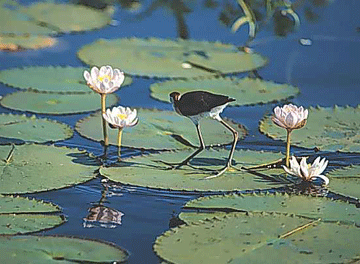
Kakadu at a crossroads: Traditional owners welcome call to restore park to its former glory http://www.abc.net.au/news/2018-06-29/kakadu-at-a-crossroads:-traditional-owners-tourism/9921510 By Felicity James
Water wars: A new front in the fight against Adani
‘In April Adani applied to the federal Department of Environment and Energy
to expand a dam by 450% and build a pipeline for its Carmichael coalmine,
without an assessment under national environment laws.
‘The project, North Galilee Water Scheme, involves expanding an existing
2.2 billion-litre dam to 10 billion litres and building associated infrastructure,
including 110 kilometres of pipeline to transport water
from the Suttor River and Burdekin Basin. The aim is to supply at least
12.5 gigalitres of fresh water to the Carmichael coalmine and
other mines in the Galilee Basin in central Queensland. …
‘In its application, Adani said the water trigger applies only to
projects associated with extraction. …
‘“It’s an incredibly narrow reading of the EPBC Act,” said
Australian Conservation Foundation Stop Adani campaigner Christian Slattery.
“Clearly it’s a project connected with coalmining.”
‘“If this interpretation is accepted by the minister it further demonstrates
the weaknesses of the EPBC Act and the need for a new generation of environmental laws.”
‘Labor’s environment spokesperson Tony Burke said the government should ensure
a thorough and rigorous environmental assessment is conducted:
“Adani cannot evade the scrutiny of the expert independent scientific committee,
and the minister for the environment should not be facilitating an opportunity for Adani
to avoid scientific scrutiny on its use of water.
‘“The more I look at this [Carmichael] project and the way the company has dealt with
different layers of government the more sceptical I have become.”
‘Lock the Gate Alliance campaign coordinator Carmel Flint said the proposal came
when “most of central Queensland is in drought” and the effects on other water users
and the environment must be considered.
‘“Adani is apparently trying to sneak through approval for a massive water scheme
without a full environmental assessment … in our view that’s an activity
which is absolutely required to go through the water trigger,” she said. …
‘Adani’s claims in the application, in relation to consultation with local Traditional Owners
and its track record on adherence to environmental regulations, are spurious at best. …
‘It makes no mention that its dodgy Indigenous Land Use Agreement (ILUA)
is subject to legal challenge. …
‘The Wentworth Group of Concerned Scientists told the Productivity Commission review
that mining exemptions make it difficult to measure the cumulative
impacts of water extraction,
“placing entire groundwater and interconnected surface water systems at risk”. …
‘Environmental Defenders Office Queensland chief executive Jo Bragg said
the community was not given an opportunity to object to the granting of Adani’s water licence.
‘She said the commission’s findings added to pressure on federal Labor
to revoke Adani’s environmental approvals if it wins power.’
Read more of Margaret‘s comprehensive, well-researched & groundbreaking article,
www.greenleft.org.au/content/water-wars-new-front-fight-against-adani
Australian Medical Association urges fixing the uranium-polluted water supplies to remote communities
Filtering out heavy metals years away, despite high uranium detected in water, ABC News , By Bridget Brennan, Isabella Higgins and Stephanie Zillman, -20 June 18
The Northern Territory Government has downplayed concern following the ABC’s revelation that drinking water has been high in uranium in three Aboriginal communities for a decade — even as the Power and Water Corporation said a plan to filter heavy metals was still years away.
Key points:
- Earlier this week ABC revealed at least three Central Australian communities have uranium levels in drinking water that exceed health guidelines
- The NT Health Minister has now responded, saying the NT Health Department and Power and Water were working together on the issue
- But medical professionals said the situation was “unacceptable”
The response came as the Australian Medical Association urged the water supplies be fixed, with Aboriginal health organisations describing the situation as “unacceptable”.
On Tuesday, ABC’s 7.30 revealed the central desert communities of Laramba, Wilora and Willowra supplied bore water with elevated levels of uranium.
Data from the Power and Water Corporation showed Laramba’s water supply contained uranium at higher than 0.04 milligrams per litre (mg/L).
Australian Drinking Water Guidelines outline those levels should not exceed 0.017 mg/L — and the corporation agreed that several communities are drinking water above the national guidelines.
Yet the Power and Water Corporation said a plan to filter out elevated levels of heavy metals like uranium from drinking water in some Central Australian communities is still years away……….
Doctors said fixing the supply should be a priority.
“Contaminants which do make the drinking water unsafe to drink above the guidelines as stipulated, should be treated as a health priority,” AMA president Dr Tony Bartone said.
“All governments — of either jurisdiction — need to ensure that all Australians have access to potable drinking water.”
Dr Bartone said the AMA wanted safe drinking water levels to be part of the Closing the Gap targets, which are currently undergoing a review after 10 years of limited progress.
“Access to safe drinking water is a prerequisite for good health,” he said.
“You can’t really set aspirational targets for health without really pinning the strategy to the building blocks around good health — the social determinants of health.”
John Paterson, chief executive of the Aboriginal Medical Services Alliance Northern Territory, said an independent review was needed “as soon as possible”.
“Governments need to respond to this, we need the experts out there to explain how much contamination is in the water and what solutions have been provided,” he said.
Rod Little, co-chair of National Congress of Australia’s First Peoples, said he was shocked to hear of uranium levels not meeting health guidelines in Aboriginal communities. http://www.abc.net.au/news/2018-06-20/high-uranium-detected-in-central-australian-bore-water/9891522
Monte Bello Islands remain a nuclear radiation risk
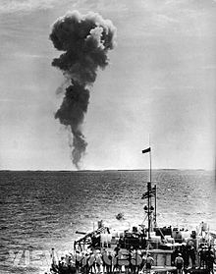 Montebello Islands are a nuclear radiation risk, but boaters and campers flout the rules, ABC North West WA By Susan Standen , 17 June 18
Labor prepared to strengthen environmental protections, as grass roots members demand
 Labor considers tougher environmental laws as branches call for new agency
Tony Burke says Labor isn’t afraid to strengthen laws as grassroots campaign calls for more proactive protections, Guardian, Katharine Murphy Political editor@murpharoo17 May 2018
1 This month

of the week – Australians for War Powers Reform (AWPR)
To see nuclear-related stories in greater depth and intensity
 Antinuclear