Radioactive waste dumped in Kakadu National Park
Toxic waste dump in Kakadu, Northern Territory News , NIGEL ADLAM, March 13th, 2010
THE equivalent of six Olympic-size swimming pools of radioactive soil and mining equipment has been buried in Kakadu National Park.Parks Australia said it was not nuclear waste and the level of radioactivity was low.
The soil and equipment had been stored in shipping containers.
It has now been put in containers with a structural life of 1000 years and buried four metres down.
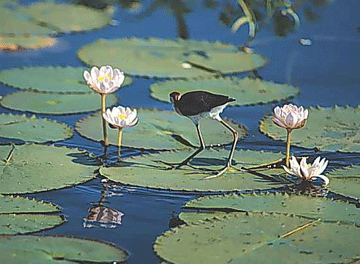
BHP’s Yeelirrie uranium mining poses riskes to groundwater, and to biodiversity
the report had “glazed over” a lot of the research into the mine’s
potential environmental impact…”There’s potential for leakages and spills … there is a great concern for contamination of water.”

BHP uranium report unveils risks, MICHAEL BENNETT, The West Australian February 27, 2010,
BHP Billiton documents have revealed the company’s proposed $17 billion Yeelirrie uranium mine could threaten vulnerable animal species previously found in the area. Continue reading
Uranium mining’s damage to the Australian environment
The impact of nuclear testing on the Australian environment | Blog About All 16 Feb 2010 “.……..In the case of Rum Jungle, the pollution of the surrounding environment was quite severe with run off from the tailing damns causing extensive damage in the East Finniss river for several kilometres away from the sight of the mine. Continue reading
Highly radioactive leaking water continues from Ranger uranium mine
The Office of the Supervising Scientist is the environmental regulator of the Ranger uranium mine, which is owned by Energy Resources of Australia. Continue reading
Roxby Downs, Ranger – who’ll clean up, who’ll pay?
Relevant to the proposed BHP Roxby new open pit and to the Ranger expansion – will they leave nothing but waste and cleanup bills (comment from David Noonan)
Call to levy mining firms for green fund KIM MACDONALD, The West Australian January 26, 2010,
Former scientist of the year Jorg Imberger has called for a five per cent levy on mining companies to pay for social and environmental programs, amid revelations only a fifth of export sales money stays in WA. Continue reading
Uranium mining’s threat to beautiful Australian animal
BHP Billiton’s plan to dig the world’s biggest uranium mining hole at Olympic Dam aspparently, (they say) requires them to have a desalination plant at Point lowly, Spencer Gulf , South Australia.
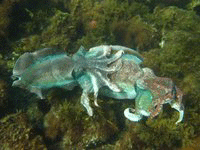 This will mean the extinction of Australia’s uniquely beautiful Sepia apama Giant Australian Cuttlefish. (photo by Helen Crawford from http://groups.google.com/group/point-lowly-action
by aussiecuttlefish -14 Jan 2010 – excerpt from comment on this site at Uranium and the giant cuttlefish « Antinuclear “…..The Giant Australian Cuttlefish is iconic to Australia, but more so it is endemic to the 8 kilometre section of coastline that has the most ideal conditions for placement of egg-sacs – the next generation. Continue reading
Dangers of radioactive uranium mill tailings
Potential hazards from uranium mill tailings League of individuals for the environment 11 Jan 2010
1994, Feb. 14 Olympic Dam, Roxby Downs, South Australia WMC Ltd. leakage of tailings dam during 2 years or more release of up to 5 million m3 of contaminated water into subsoil ?
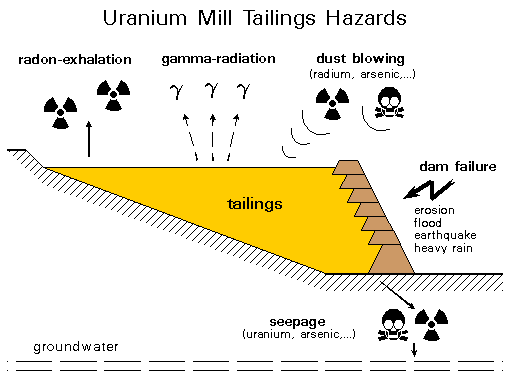 Radionuclides contained in uranium tailings emit 20 to 100 times as much gamma-radiation as natural background levels on deposit surfaces. Gamma radiation levels decrease rapidly with distance from the pile.The radium-226 in tailings continuously decays to the radioactive gas radon-222, the decay products of which can cause lung cancer. Some of this radon escapes from the interior of the pile. Radon releases are a major hazard that continues after uranium mines are shut down….. Continue reading
Uranium and the giant cuttlefish
 Have you ever seen the giant cuttlefish? It is the most beautiful animal, of magically changing colours, and ballet-like gracious movement. It is unique to a special part of Spencer Gulf, where the delicate salt balance in the water provides its specialised habitat, the only one in the world.
Some people might think that to stand up for the Giant Cuttlefish, against the Giant BHP BIlliton’s plan for Olumpic Dam uranium mine, – that this is a petty argument, about some odd, unimportant little creature.
Well, think again. Australia’s giant cuttlefish is a special, unique, and iconic toAustralia as is the kangaroo or the koala. It’s a sad time when Australians let the short-term greed of a big corporation destroy our precious environmental heritage.
South Australian govt will put BHP Billiton’s welfare ahead of environment?
 “Is the Premier saying that no matter what environmental impact there may be, he is giving BHP the go-ahead to put the desal plant there?”
BHP insists Point lowley best for desalination plant Adelaide Now SARAH MARTIN
January 08, 2010
BHP Billiton says building its proposed desalination plant anywhere but Point Lowly on the Spencer Gulf would cost “hundreds of millions” more dollars.
The desal plant’s location has divided the State Government and the Opposition, with the latter calling for BHP to investigate an alternative site on the West Coast beyond Ceduna.
Labor member for Giles, Lyn Breuer, also wants the plant built elsewhere, saying the risk to the giant cuttlefish population in the gulf is too great. Continue reading
Can uranium mines be operated safely?
Uranium Mining: Australia and Globally League of Individuals for the Environment, Inc , Gavin M. Mudd 7 Jan 2010 “………………..The most recent experience of Australia’s operating uranium mines demonstrates the challenges involved in uranium mining, which are distinct and unique. There have been numerous incidents at the now closed Nabarlek mine and the operating Ranger, Olympic Dam, and Beverley projects. Continue reading
After years of denial, NSW govt quietly demolishing radioactive home
Radioactive waterfront home to be razed Sydney Morning Herald BEN CUBBY ENVIRONMENTDecember 28, 2009 NEW plans to clean up the site of a former uranium smelter in Hunters Hill mean a four-storey waterfront mansion the NSW Government has repeatedly declared safe will be demolished. Continue reading
Coalition ignores nuclear problems: water, cost, dangers
Thirsty energy
ABC News 4 Dec 09 Scott Ludlam says there are issues with where the nuclear power plants would be sited. Continue reading
Uranium miner squanders Australia’s precious water – for FREE!
 South Australia: Olympic Dam mine BHP Billiton 30 Oct 09 Watch Western Mining Corporation first developed the Olympic Dam (Roxby Downs) Uranium Mine in 1983, despite strong and sustained opposition from Kokatha and Arabunna Traditional Owners and environmentalists. BHP Billiton purchased the underground Olympic Dam mine in 2005.
In May 2009 BHP Billiton released an Environmental Impact Statement detailing plans to turn Olympic Dam into a massive open pit mine. With this expansion uranium production is expected to increase from 4,000 tonnes to 19,000 tonnes per year and copper production from 200,000 to 750,000 tonnes a year. Continue reading
Uranium water contamination in Kakadu National Park
Probe into uranium mine leak continues ABC News Oct 20, 2009 The Commonwealth supervising scientist of the Ranger uranium mine at Kakadu National Park says investigations are continuing into water contamination at the site. Continue reading
Time to learn from desert knowledge of aboriginal people
New insight into heritage of desert Aboriginal people Stock Journal 17/10/2009 A UNIQUE report written in both in the Alyawarr Aboriginal language and English marks a new milestone in Australia’s efforts to perpetuate the deep knowledge and cultural heritage of desert Aboriginal people. Continue reading
1 This month


Help Aunty Sue Protect Her Land and Sacred Sites From Destructive Rocket Testing.
.

Australians deserve the truth
about
AUKUS – https://aukuspublicinquiry.com/

PETITION – To: Prime Minister Anthony Albanese and the Australian Labor Government

of the week – Australians for War Powers Reform (AWPR)
To see nuclear-related stories in greater depth and intensity

