Legal challenge about Adani’s planned water use for giant coal mine
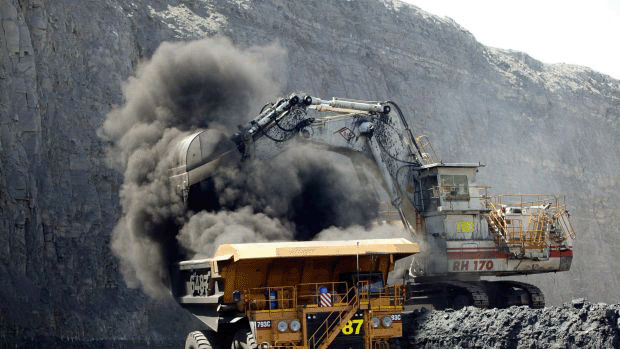 Morrison government faces legal challenge over Adani pipeline plan, Brisbane Times, Peter Hannam, March 16, 2020 The Morrison government’s failure to activate the so-called “water trigger” when assessing the proposed Adani coal mine in Queensland will be challenged in the Federal Court.
Lawyers acting for the Australian Conservation Foundation will test the government’s decision not to refer Adani’s North Galilee Water Scheme, a pipeline supplying the mine, for a thorough assessment as intended by the law.
The water trigger, introduced by the Rudd-Gillard government in mid-2013, was meant to require the government to assess the impact on water of all large coal mines and coal seam gas developments.
However, the government treated Adani’s plan to draw 12.5 billion litres a year from the Suttor River in central Queensland as a pipeline that was not a “large coal mining development”, nor did it involve one.
Similarly, it viewed the pipeline proponent, Adani Infrastructure Pty Ltd, as “a different legal entity” from the coal mine proponent, Adani Mining Pty Ltd.
The foundation plans to test both reasons for the failure not to activate the water trigger in court, arguing that the government made an error in law by ignoring infrastructure that was critical for the coal mine to proceed.
Tony Windsor, the former independent MP who was a key architect of the trigger, said reliable long-term access to clean water was “vital for regional communities and demands that we sustainably manage our rivers and aquifers”.
“Allowing companies to split up mining projects and assess them in isolation makes a nonsense of the process,” he said. “You don’t see much looking at just one piece of the jigsaw – you need to look at the whole puzzle.”……..https://www.brisbanetimes.com.au/environment/sustainability/morrison-government-faces-legal-challenge-over-adani-pipeline-plan-20200316-p54an6.html?ref=rss&utm_medium=rss&utm_source=rss_feed
A nuclear waste dump for Eyre Peninsula conflicts with the Strategic Plan for the Eyre Peninsula Natural Resources Management Region – 2017-2027
Susan Craig shared a No Nuclear Waste Dump Anywhere in South Australia
The Kimba nuclear waste dump will take a huge toll on the Murray River’s water
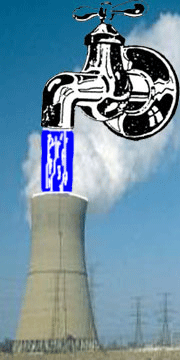 Annette Ellen Skipworth No Nuclear Waste Dump Anywhere in South Australia, 25 Feb 20
I spent some time as a remote road contractor and I learnt a little bit about roads and site works.
To take the weight of the truck load, a road has to be compacted to gain the strength to take the semi plus the load on the tray.
From asking questions and scouring internet sites, I have found out, the casks containing the high grade nuclear waste.. excuse me ..the intermediate nuclear waste are very very heavy.
It wasn’t advisable to use water that is very salty.. it rises to the top and makes the road slippery.
As Kimba’s only water supply comes from the precious Murray River, and the local underground water is salty and unusable.. where is the water needed coming from?
Risk that Environment Protection and Biodiversity Conservation (EPBC) Act could be changed to promote nuclear power

K-A Garlick at Nuclear Free WA, 12 Feb 20
The Environment Protection and Biodiversity Conservation (EPBC) Act is currently under review and will look at how the Act has been operating, and any changes needed for Australia to support ecologically sustainable development into the future.
Currently, under the EPBC Act, nuclear power is banned and the ‘nuclear action’ triggers uranium mining and milling projects to be Federally assessed. This should remain.
There is a real threat that the EPBC Act could change to remove the ban on nuclear power and the ‘nuclear actions’ trigger, so that this dirty industry can push forward. We urge you and your organisation to make a submission to keep the ban on nuclear power and the ‘nuclear action’ triggers.
Don’t nuke the climate is a great new website with a ton of information to use for your submission including last years no nuclear power statement by a broad coalition of faith, union, environmental, Aboriginal and public health groups, representing millions of Australians, that clearly outlines our energy future is renewable, not radioactive. Click here to read the statement.
Submissions are due 17 April 2020. You can send submissions via email to epbcreview@environment.gov.au Or via post to: EPBC Act Review Secretariat Department of the Environment and Energy GPO Box 787 CANBERRA ACT 2601. Please complete and submit this cover page with your submission. All submissions that include this cover sheet will be considered by the review. For more information on the EPBC Act and submissions, click here.
Australia’s extreme bushfires – forests might not recover
 Wildfires have spread dramatically—and some forests may not recover. An explosion in the frequency and extent of wildfires worldwide is hindering recovery even in ecosystems that rely on natural blazes to survive. https://www.nationalgeographic.com/science/2020/01/extreme-wildfires-reshaping-forests-worldwide-recovery-australia-climate/
|
BY JOHN PICKRELL, JANUARY 30, 2020, Pungent and damp, the so-called tall, wet forests of southeastern Australia are home to the tallest flowering plants on Earth. Eucalyptus regnans, the Latin name of the mountain ash, means “ruler of the gum trees”—which is fitting, given these giants can reach more than 300 feet high.
Many of Australia’s gum trees, particularly those in drier forest types, are famously able to tolerate fire, throwing out new buds and shoots within weeks of being engulfed in flames. But even these tenacious species have their limits. Old-growth forests of the mountain ash and a related species, the alpine ash, are among the gum trees that are less tolerant of intense blazes. In the state of Victoria, these trees had already been severely depleted by logging and land clearing. Now, the bushfires that have burned more than 26 million acres of eastern Australia in recent months are putting the forests at even greater risk. Some of the forests razed this year have experienced four bushfires in the past 25 years, meaning they’ve had no chance to recover, says David Lindenmayer, an ecologist at the Australian National University in Canberra. “They should be burning no more than every 75 to 125 years, so that’s just an extraordinary change to fire regimes,” he says. “Mountain ash need to be about 15 to 30 years old before they can produce viable amounts of seed to replace themselves following fire.” The loss of these dominant trees is a significant problem, since they provide vital habitat for threatened animal species such as the sooty owl, the giant burrowing frog, and a fluffy arboreal marsupial called the greater glider. (Also find out how Australia’s fires can create big problems for freshwater supplies.) |
|
Names of 34 environmentalists and conservationists who received Australia Day Awards
 Australia Day Honours, Maelor Himbury, 27 Jan 2020
Congratulations to the following people who received honours for contributions to the environment and/or conservation. (Apologies to any I may have missed)
Raymond Louis Specht, St Lucia QLD
Elaine Cafferty Carbines, Grovedale VIC
Graham John Faichney, Mosman NSW
David Ronald Leece, Beecroft NSW
Grant Donald Hunt, Isle of Capri QLD
Roderick Tucker Wells, Flagstaff Hill SA
Dedee Daryl Woodside, Umina Beach NSW
Graeme Leonard Worboys, Gilmore ACT
Maree Rosalie Byrne, Bowral NSW
Judith Anne Charnaud, Warriewood NSW
Fred Conway, QLD
Elizabeth Corke, VIC
Daryl James Akers, Melton South VIC
Eulalie Perry Brewster, Inverloch VIC
Raymond Brown, Bulli NSW
Leif Robert Cocks, Willagee WA
Brian Stuart Blythe, Portsea VIC
Marie Ann Ficcara, Cronulla NSW
Peter John Forster, Anglesea VIC
Sherryl Maree Garbutt, Brunswick VIC
Mary Julia Hutton, Stirling WA
William David Incoll, Monbulk VIC
Bronwen Jean Keichery, Subiaco WA
Gregory John Keichery, Subiaco WA
Diana Betty Laube, Tiatukia SA
Sarah Jane Lloyd, Birralee TAS
Peter Phillip Gash, Lady Elliott Island QLD
Lloyd Alwyn Nielsen, Mount Molloy QLD
Catherine Marie-Claire Oelrichs, Coopers Shoot NSW
Margaret Owen, Wembley WA
Carl John Rayner, Anglesea VIC
John Stanisic, Albany Creek QLD
Beverley Jean Weaver, Nundah QLD
Bruce Anthony Wilson, Seacliff Park SA
Australia’s billion of animal deaths – conservationists must not give up

|
Conservation scientists are grieving after the bushfires – but we must
not give up, The Conversation, January 21, 2020 Stephen Garnett,
Professor of Conservation and Sustainable Livelihoods, Charles Darwin
John Woinarski, Professor (conservation biology), Charles Darwin University,
Sarah Legge, Professor, Australian National University
That a billion animals may die as a result of this summer’s fires has horrified the world. For many conservation biologists and managers, however, the unprecedented extent and ferocity of the fires has incinerated much more than koalas and their kin.The scale of the destruction has challenged what is fundamentally an optimistic worldview held by conservationists: that with sufficient time, love and money, every species threatened by Australia’s 250 years of colonial transformation cannot just be saved from extinction, but can flourish once again. The nation’s silent, apocalyptic firescapes have left many conservation biologists grieving – for the animals, the species, their optimism, and for some, lifetimes of diligent work. So many of us are wondering: have lives spent furthering conservation been wasted? Should we give up on conservation work, when destructioncan be wrought on the environment at such unprecedented scales? The answer is, simply, no. Acknowledge the grief Federal government figures released on Monday showed more than half of the area occupied by about 115 threatened species has been affected by fire. Some of these species will now be at significantly greater threat of extinction. They include the long-footed potoroo, Kangaroo Island’s glossy black-cockatoo and the East Lynne midge orchid………. 1.action is an effective therapy for grief. There is plenty to do: assess the extent of damage, find and nurture the unburned fragments, and feed the survivors. The official recovery response has been swift. Victoria, New South Wales and now the Commonwealth have all issued clear statements about what’s happened and how they’re responding. The determination and unity among government agencies, researchers and conservation groups has been remarkable……. |
|
The impact of bushfires on drinking water, rivers and fish
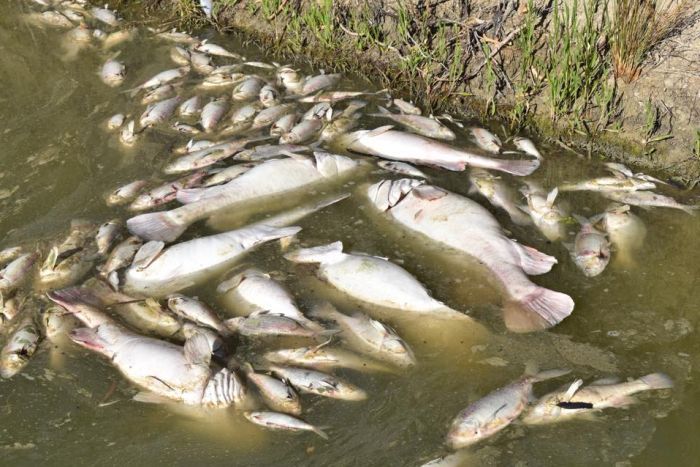 Our drinking water, rivers and fish will all feel the impact of bushfires, experts warn, ABC Science, By Jo Khan, 9 Jan 2020, Our drinking water, rivers and fish will all feel the impact of bushfires, experts warn, ABC Science, By Jo Khan, 9 Jan 2020,
When it rains after bushfires, the consequences stretch way beyond temporary relief for those on the front line — and scientists are warning of potentially dire impacts on our waterways.
They say the aftermath of the current fires could bring devastation to freshwater animals and plants, as well as drinking water catchments. This is because, while it may or may not help firefighters themselves, rain inevitably washes the ash and eroded soil from burnt forests into rivers and streams, shifting the bushfire impact to our crucial freshwater ecosystems. Waterways can also suffer immediately in a fire just from the temperature increase, according to Ross Thompson from the University of Canberra. “In one of the streams we worked on in Victoria, the Black Saturday fire got so hot that the stream boiled,” Professor Thompson said. Even if water doesn’t boil (which effectively sterilises it), many animals can’t withstand the sudden increase in temperature, and die. But it’s the longer term effects that have scientists really worried. Rain washes ash into waterwaysRain events after bushfires can transfer huge amounts of ash, burnt material, soil and dead animals into our rivers and lakes. There will be an increase in nutrients because there’s lots of phosphorous and nitrogen in ash,” said Professor Thompson, a freshwater ecologist who has studied water catchments after the 2003 fires in the ACT and the 2009 Black Saturday fires in Victoria. “You also see more sediment because trees are falling down and the river banks are getting knocked around.” As the water fills up with fine sediment and foreign, nutrient-rich material, the water quality can drop very quickly — and stay that way for a long time. “We’re still seeing higher sediment loads coming out of the Cotter River catchment and those fires were more than a decade ago,” Professor Thompson said. Freshwater animals lose oxygenAs soon as a fire has passed and the ash settles on rivers and lakes, bacteria in the water will start consuming the carbon in that ash. In the process of breaking down the carbon, the bacteria will also consume the dissolved oxygen in the water. The more carbon, the more oxygen will be taken out of the system. And most animals and plants can’t survive in such a low-oxygen environment, as was seen in the Murray Darling Basin last summer. “The the risk is we will see big fish kill events even in some of the larger rivers,” Professor Thompson said. “Even if the fires didn’t burn immediately adjacent to the river.” Changes in the turbidity, or amount of sediment in the water, is another factor that can threaten aquatic species. “We see a loss of a lot of invertebrates that rely on really stony streams, because the sediment and ash smothers the rocks and it changes the habitat.” Rescuing fish from ‘water like licorice’………..Drinking water quality affectedChanges to the insects and other invertebrates in an ecosystem, along with the influx of nutrients from the ash, can result in the growth of cyanobacteria — commonly known as blue-green algae (but it’s not actually algae). Cyanobacteria produce chemicals which may cause a range of water quality problems, starting with poor taste and odour, according to Stuart Khan, an urban water management expert at the University of New South Wales………. “Of more concern is that cyanobacteria can produce chemicals that are really quite toxic,” Professor Khan said. https://www.abc.net.au/news/science/2020-01-09/freshwater-ecosystems-water-catchment-bushfire-impact/11850826?pfmredir=ms |
|
|
In water-scarce Australia, cooling water for nuclear power would become an impossible burden
In summary, in a hot dry continent like Australia, providing cooling water for a nuclear power plant would prove a huge cost and distortion to the water industry.
|
Nuclear cost and water consumption – The elephants in the control room, Open Forum, Peter Farley | December 20, 2019 “…..Cooling Water
A key issue with nuclear plants is cooling. Because of the cost of shutdowns and the degradation of materials by irradiation, the plants are designed to run at lower peak temperatures (260-320 C) than coal (500-670 C), gas turbines (1,300-1430C) or internal combustion plants (2,000 C). The thermal efficiency of a plant is directly related to the difference between the peak temperature and the cooling medium – what is termed Carnot efficiency. Lower temperature means lower efficiency, as less of the heat energy is converted into work and more is removed by the cooling system. So for a given amount of electrical energy delivered, more cooling is required in a nuclear plant. Furthermore the warmer the cooling water or air the more coolant is required. Thus the Barrakah plants require 100 tonnes of Gulf seawater per second for each generator. In higher latitudes with seawater temperatures in the range of 2-12C, water requirements can still be 40-60 tonnes per second per GW. Just to put that in perspective Melbourne Water supplies 15-20 tonnes per second to the entire Metropolitan area of almost 5 million people. Even so, the water temperature is raised by 7-10C which is enough to kill any fish larvae unfortunate enough to be sucked into the cooling intakes. It is enough to change the local environment for all sea life, so finding a suitabable site is very difficult. There are currently no nuclear plants operating using warm seawater for cooling although Barrakah is soon to be commissioned. The problem there is not just the temperature but the accelerated rates of corrosion and biofouling which will mean the heat exchangers need to be larger, pumping losses will be higher and maintenance bills higher still. Perhaps the area near Portland in Victoria might work, but then the 500kV line would have to be triplicated to carry away the power, further adding to the cost. Plants at the edges of the grid have a whole lot of other issues so a South Australian plant would be extremely difficult to integrate. On land in very cold climates, a small number of air cooled plants have been built but the offset is that about 5% of the output of the power plant is used to run the fans. However in warm climates it is virtually impossible to run an air cooled nuclear power plant. It would require in the order of 450-500 tonnes of air per second to be moved over the heat exchangers per GW of electrical output. At typical air velocities for cooling fans that would have a fan area of 75,000 square meters or if each fan was the cross section of a shipping container, 17,000 fans. It is enough to change the local environment for all sea life, so finding a suitable site is very difficult. There are currently no nuclear plants operating using warm seawater for cooling although Barrakah is soon to be commissioned. The problem there is not just the temperature but the accelerated rates of corrosion and biofouling which will mean the heat exchangers need to be larger, pumping losses will be higher and maintenance bills higher still. Perhaps the area near Portland in Victoria might work, but then the 500kV line would have to be triplicated to carry away the power, further adding to the cost. Plants at the edges of the grid have a whole lot of other issues so a South Australian plant would be extremely difficult to integrate. On land in very cold climates, a small number of air cooled plants have been built but the offset is that about 5% of the output of the power plant is used to run the fans. However in warm climates it is virtually impossible to run an air cooled nuclear power plant. It would require in the order of 450-500 tonnes of air per second to be moved over the heat exchangers per GW of electrical output. At typical air velocities for cooling fans that would have a fan area of 75,000 square meters or if each fan was the cross section of a shipping container, 17,000 fans. In other cases straight through cooling is used from large rivers or lakes. The Murray at the South Australian border is often down to 9 GL/day or even less. 9 Gl/day is about 105 tonnes/second, and so a single unit nuclear power plant located on the Murray would often need the entire flow to cool it, while heating the water by 8-12 C. This is obviously an environmentally impossible situation. That is why cooling towers are the most common cooling method because they are the most efficient. Evaporating water carries away much more heat than liquid flows. In typical Australian conditions the nuclear plant would evaporate between 20 and 24 GL per year per GW so a two unit 2.2 GW plant like Plant Vogtle currently under construction in the US would need 44-50 GL/ year. That is more than the 4.7 GW of coal in the Latrobe Valley and almost 30% more than the entire demand served by Barwon Water which includes 320,000 people and all their business homes, parks and gardens. At current spot prices for irrigation water that would be an additional cost of $50m per year. In summary, in a hot dry continent like Australia, providing cooling water for a nuclear power plant would prove a huge cost and distortion to the water industry. There are many other issue with nuclear power, including a lack of flexibility, large and long duration backup requirements for refueling and outages and large spinning reserve requirements, but these can be explored at another time…….https://www.openforum.com.au/nuclear-cost-and-water-consumption-the-elephants-in-the-control-room/?fbclid=IwAR2M3NxMjfrDJNWTG9tatKSARHGUKWVcG_CE-bSW5wtnAbwhGnYxd1ElugU |
|
While ignorant tunnel-visioned politicians kowtow to irrigators, the Murray River system faces death
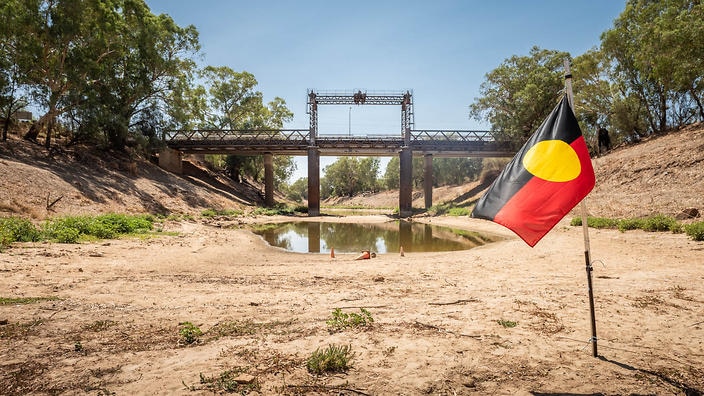
Water wars: will politics destroy the Murray-Darling Basin plan – and the river system itself?
Drought is not the only threat to the river system: the plan to save it is in doubt as states spar over the best way forward, Guardian, Anne Davies
The basin states – Queensland, New South Wales, Victoria and South Australia – as well as the federal government, are due to meet on Tuesday in Brisbane amid threats from the NSW Nationals that it will walk away from the plan unless major changes are made.
“We simply can no longer stand by the Murray-Darling Basin plan in its current form, the plan needs to work for us, not against us,” NSW Nationals’ leader John Barilaro warned last week.
“NSW is being crippled by the worst drought on record and our future is at risk. The plan should be flexible, adaptive and needs to produce good environmental outcomes for this state.”
NSW has already flagged that it will be asking to be relieved of its remaining contributions towards the environmental water target – it has committed to saving a further 450GL – while Victoria is balking at meeting its commitments as well.
There have also been calls from various ministers to end environmental flows during the drought and to instead allocate more water for agriculture. In particular is unhappiness from NSW at the amount of water stored in the lower lakes in South Australia. That will be fiercely resisted by SA. Continue reading
Scott Morrison, comfy in his Morrison bubble, trashes Environment Department
 Morrison torches Environment Department, Independent Australia, By Stephen Saunders | 15 December 2019, For a time, Arts and Environment were in the same federal department. Both functions have taken a hit, in Scott Morrison’s Christmas departmental reshuffle.
Australia’s first federal Environment Department debuted 1971. The function has carried forward to this day, under varying departmental banners. Since 1993, “Environment” (or “Sustainability, Environment”) has always been the leading item in a departmental title.
Not any more. “Busting” congestion, blindsiding the public service, Morrison has reversed recent history. The Environment function of the previous Environment and Energy Department goes into the Agriculture Department. It’s never been parked there before. The Industry Department mops up most of Energy and Climate.
Apparent wins there, for fossil fuels and land conversion. And never mind the fire and smoke. Brand-new Environment chief David Fredericks has been recycled as Industry chief…….
With endless growth running the show, the Department has won battles and lost wars. Our first State of the Environment report surfaced in 1986. When you decode the polite language of the scientific committees, successive reports reveal steady decline up to 2016.
It’s simplistic to say, but the Department has prospered more under Labor……
In his [Morrison’s] inflated opinion, ministers can always be relied on to “set the policy direction” correctly. As they surround themselves with increasingly docile public service chiefs.
On top of all this, he cashiers the Environment Department. And puts Energy and Climate under Industry. His religion and ideology seem to be clobbering reason and science.
Labor’s bulldog adherence to Big Coal and Big Australia undermines their credibility to oppose environmental overreach. Still, Morrison’s arrogance might come back to bite him.
Over its first 30 or 40 years, the Federal Environment Department attracted a keen cadre of officials, whose commitment and knowledge could be turned to disparate environmental issues at short political notice. They had notable successes and signal failures. But their relationships with ministers held more nuance than the feudal deference that Morrison now demands.
You can’t throw the switch, to recharge independent and vigorous environment policy advice at a moment’s notice. Rationally speaking, we need those skills, more than ever.
Weather, rain and fire are visibly different, within our own short lifetimes. Environment and growth problems have never been more obvious. The environment has returned to the public consciousness bigtime.
The “bubble” isn’t around Canberra. It’s around Morrison himself. Sure, the weakened Environment and Climate bureaus will have to answer, to him and his ministers. The physical environment may not be so obliging. https://independentaustralia.net/environment/environment-display/morrison-torches-environment-department,13415
A foreign corporation gets 89 BILLION litres of Australia’s water, as drought worsens
|
Water restrictions for you, an endless supply for them: How a foreign corporate giant is snapping up 89 BILLION litres of Australia’s H20 as the country suffers its worst drought ever
By ALISHA ROUSE FOR DAILY MAIL AUSTRALIA DAILY MAIL UK 12 December 2019 |A multi-billion dollar Singaporean food company is selling 89,000 megalitres of Australian water to a Canadian pension fund. The mega sale of Australian permanent water rights comes as the country is crippled by one of the worst droughts in its history. On Tuesday, NSW brought in a complete ban on hoses as part of the toughest water restrictions implemented for more than a decade. But no such problem existed for food and agriculture giant Olam International, which sold the 89billion litres of permanent water rights for an astonishing $490 million. The company sold it to an entity associated with the Public Sector Pension Investment Board, one of Canada’s largest pension investment managers, according to Straits Times. It will use the water to irrigate almond trees, in a business venture likely to draw criticism over foreign ownership of farms and water. The water rights are in the lower Murray-Darling Basin. The chairman of the Victorian Farmers Federation’s water council, Richard Anderson, told the Sydney Morning Herald: ‘Really, all you’ve got is a change of ownership, it (the water) has gone from a Singapore-owned company to a Canadian pension fund……. Water restrictions in Sydney, the Blue Mountains and Illawarra were upgraded to level two as dam levels in the region sank to just 45 per cent capacity, the lowest levels since the Millennium Drought took hold in 2003….. The Bureau of Meteorology has predicted a hot-than-usual summer, with no forecast for significant rain. The sale is understood to be giving Olam a ‘one-time pre-tax capital gain of about $311 million’, the paper reported. The agreement is for 25 years, with the option to renew for another 25. In March, the government released its foreign ownership of water entitlement register, showing that investors from China and the US had the largest stake in Australia’s foreign-owned water entitlements. It showed that one in 10 water entitlements is foreign owned. A water entitlement is the right to an ongoing share of water, which can be sold by irrigators, companies or investors. Acting as a property right, it gives access to an exclusive share of water from a water resource. This is different to a water allocation, which is the right to access a volume of water for use or trade. https://www.dailymail.co.uk/news/article-7780983/Foreign-company-sells-89-billion-litres-Australian-water-rights-490m-drought.html?fbclid=IwAR3wKbYP6OnXTEPhNoZiDeQ2Oj1o6uMzWUmkQSOgMxYjkZn6i0cJFj60Zo4&fbclid=IwAR3oHKAi9vQG4MctY4LMYNppX-pbY88hw0Zj4ACzypNTB_WI9nTtkc710bc |
|
Victoria’s chemical waste scandal
 The man who made a toxic waste disaster, Greed, lax oversight and poor regulation allowed one man to distort the national market for toxic waste disposal and create an environmental catastrophe.The Age, By Chris Vedelago, Sumeyya Ilanbey and Cameron Houston, DECEMBER 8, 2019 August 2012, former truck driver and sandblaster Graham Leslie White bought a 567-hectare block of useless scrubland outside the tiny western Victorian town of Kaniva, nearly five hours from his home and businesses in Melbourne.He began by building a road, designed to support the weight of heavy vehicles, into the desolate patch. Later, White bulldozed a network of tracks deep into the interior of the property that dead-ended in oddly shaped clearings of rough, red earth. The man who made a toxic waste disaster, Greed, lax oversight and poor regulation allowed one man to distort the national market for toxic waste disposal and create an environmental catastrophe.The Age, By Chris Vedelago, Sumeyya Ilanbey and Cameron Houston, DECEMBER 8, 2019 August 2012, former truck driver and sandblaster Graham Leslie White bought a 567-hectare block of useless scrubland outside the tiny western Victorian town of Kaniva, nearly five hours from his home and businesses in Melbourne.He began by building a road, designed to support the weight of heavy vehicles, into the desolate patch. Later, White bulldozed a network of tracks deep into the interior of the property that dead-ended in oddly shaped clearings of rough, red earth.
White claimed it was a quad-biking course for his children, an answer that satisfied the curiosity of the council officer. But five years on, we know the truth. Covered by a thin layer of topsoil were the pits that White had dug and that he was filling with toxic waste — millions of litres of chemicals and tonnes of asbestos-contaminated products brought by the truckload. The Kaniva property was the final destination for an illegal dumping syndicate whose operations grew so large they distorted the national market in toxic waste disposal. Victoria’s Environment Protection Authority — relying on a paper-based tracking system and a lax inspection regime — was blindsided by this dark market that threatened public safety and the welfare of emergency services personnel. By the time the scheme was accidentally exposed in 2018, White and his associates at Bradbury Industrial Services had illicitly buried or stockpiled an estimated 50 million litres of highly flammable solvents and other toxic materials. The failure to arrest this operation also laid the groundwork that sparked two of Melbourne’s worst-ever industrial fires. The value propositionSome time after 2013, White made an informal arrangement with waste recycling and remediation company, Bradbury. Their pitch to the producers and owners of toxic waste was simple — we can do it cheaper. Industry sources who declined to be identified for fear of retribution by their employers say the waste industry operates on thin margins. The syndicate offered to dispose of products at up to half the cost of competitors. Sometimes they offered to transport chemicals from the factory door for free. An investigation by The Age has revealed that manufacturers, chemical companies, waste processors, and paint, automotive and cleaning businesses across the eastern states quickly signed up. …… https://www.theage.com.au/national/victoria/the-man-who-made-a-toxic-waste-disaster-20191205-p53h1x.html |
|
Peter Garrett urges Labor to reconnect with environmental movement, warns ‘true believers are dying’
|
Peter Garrett urges Labor to reconnect with environmental movement, warns ‘true believers are dying’, Brisbane Times, By Rob Harris
December 7, 2019, Midnight Oil frontman and environmental campaigner Peter Garrett has urged Labor to stare down the “self interest” within its ranks and commit to ambitious plans to avoid the “catastrophe” of climate change.
Warning that the suburbs of western Sydney and Melbourne are being “crucified on the altar of inaction” and regional and rural communities were “hostage to climate damage”, the former Labor minister said the party’s true believers are “dying out” and a younger generation of voters will be “more radical and less forgiving” if it fails to act. Speaking to Labor’s Environmental Action Network on Saturday night, Mr Garrett took direct aim at former colleague Joel Fitzgibbon and “some in the CFMEU”, who he accused of deliberately undermining the party and “not committed to the challenge” of reducing emissions. “The natural world is under siege. The threat we face is literally existential,” Mr Garrett told the gathering of about 100 people at the Keg and Brew Hotel in Sydney’s Surry Hills. “We are surrounded by fires, force-fed by a super hot spring. Our cities and towns are blanketed with smoke and the sun has gone out, it’s hard to breathe.” Labor has engaged in a fierce internal debate since its shock election loss on May 18 with Mr Fitzgibbon, the agriculture and resources spokesman, arguing the ALP should offer “a political and policy settlement” on climate policy to make a 28 per cent reduction in emissions the target by 2030. Opposition Leader Anthony Albanese has signalled Labor’s future climate policy platform will be focused on jobs in the low-emissions energy sector. Mr Garrett said progressive politics must realise the world was “witnessing a tectonic shift” in the climate and its faith was waning in established institutions. “Our times do not call for ‘business as usual’ politics,” Mr Garrett said. Labor must face down self-interest and sectional interest, whether from some in business, or some in the CFMEU, or from individual members who eschew reality and are not committed to the challenge, and indeed in the case of the shadow minister for Agriculture and Resources Joel Fitzgibbon, deliberately undermine the party whilst still holding their position.” …….. https://www.brisbanetimes.com.au/politics/federal/peter-garrett-urges-labor-to-reconnect-with-environmental-movement-warns-true-believers-are-dying-20191206-p53hqe.htm |
|
Environment is downgraded, as Morrison merges government departments
Concerns for environment as Morrison merges government departments Newsline, 5 Dec 19, “……. Farmers for Climate Action spokesperson Verity Morgan-Schmidt said strong environmental policy was essential to make the agriculture sector sustainable.
“We’re failing to address climate change, which is the biggest threat to agriculture, and the concern in this merger is that ecological outcomes will be overlooked,” Ms Morgan-Schmidt said.
……. Farmers for Climate Action spokesperson Verity Morgan-Schmidt said strong environmental policy was essential to make the agriculture sector sustainable.
“We’re failing to address climate change, which is the biggest threat to agriculture, and the concern in this merger is that ecological outcomes will be overlooked,” Ms Morgan-Schmidt said.
……. Infrastructure, transport, regional development, communications and the arts will also come together in another massive new department.
Education, skills and employment will be merged in a move welcomed by vocational education advocates…….. https://www.newsline.com.au/2019/12/05/concerns-for-environment-as-morrison-merges-government-departments/
1 This month
17 October, Free Public Talk on Nuclear Issues in South Australia
David Noonan will speak on public interest concerns over the new Roxby Downs Indenture Act 2026 on BHP copper-uranium mining and ore processing in SA, and on how AUKUS may face SA with a High-Level nuclear waste agenda.
Dr Jim Green will discuss international developments in the field of nuclear power including ‘small modular reactors’ and Generation 4 ‘advanced’ nuclear reactor concepts.


Help Aunty Sue Protect Her Land and Sacred Sites From Destructive Rocket Testing.
.

Australians deserve the truth
about
AUKUS – https://aukuspublicinquiry.com/

PETITION – To: Prime Minister Anthony Albanese and the Australian Labor Government

of the week – Australians for War Powers Reform (AWPR)
To see nuclear-related stories in greater depth and intensity

