A public health challenge to Australia’s use of medical ionising radiation
 We’ve known about the risks of radiation for some time, but these three studies quantify the risks. Essentially, they show that relatively low doses of ionising radiation, previously considered ‘safe’ can translate into excess cancer cases.
We believe that these findings call for a change in imaging practice. First, ionising radiation should be a consideration for the referring doctor when deciding whether a patient needs a scan (and if so, what type). Second, imaging techniques and machines that reduce ionising radiation doses should always be used. Finally, government funding models must be reviewed to ensure there are no inappropriate incentives towards a radiating scan.
For example, in Australia, if a young patient presents to a GP with low back pain and the GP orders a scan, Medicare would fund a CT scan but not a magnetic resonance imaging (MRI), even though this may be a safer alternative in terms of radiation.
The body of evidence is growing. We need to start translating evidence into practice
 The risks of ionising radiation: three new studies and their impact on imaging in sports medicine http://www.clinicalsportsmedicine.com/the-risks-of-ionising-radiation-three-new-studies-and-their-impact-on-imaging-in-sports-medicine-jessica-orchard-and-john-orchard~ Jessica Orchard and John Orchard 2 July 13, In 2012, two major studies were published about the risks of ionising radiation from imaging. Pearce and colleagues’ study in The Lancet examined the excess risk of leukaemia and brain tumours for children and adolescents exposed to computed tomography (CT) scans. They found that children exposed to cumulative doses of 50mGy (3-5 CTs) may have triple the risk of leukaemia, and doses of 60mGy may have almost triple the risk of brain tumours.[1] In addition, the Pijpe and colleagues’ GEN-RAD-RISK paper in theBMJ[2] study showed that women such as Angelina Joliewho carry a specific mutation associated with breast cancer (BRCA1/2), and who were exposed to diagnostic radiation before the age of thirty, had almost twice the risk of breast cancer (with a dose-response pattern). This study involved lower doses, which we have previously considered fairly ‘safe’ (e.g. 4mGy from a single mammogram or shoulder X-ray).
On the basis of these studies, we wrote a blog post and started writing an editorial for theBritish Journal of Sports Medicine. While we were in the final stages of preparing the editorial,[3] a third study was published. The Matthews et al Australian data linkage study,[4] with an enormous cohort (11 million) showed that the adjusted overall cancer incidence for young people exposed to a CT scan was twenty-four percent greater than for those who were not exposed.
That is, one in every 1800 scans resulted in an excess cancer case. As the mean follow up time was only 9.5 years (relatively short in relation to the time taken to develop cancer), this suggests the true lifetime risk may be much higher. We await with interest the relative risk in older people to see whether the risks for the young also apply to those in middle age. Continue reading
Australia’s hidden atomic health and death toll
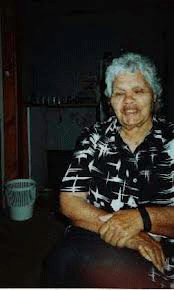 A powerful manuscript entitled “The Black Mist and its Aftermath — Oral Histories by Lallie Lennon” (2010) was submitted to the South Australian and federal governments as well as to the International Atomic Energy Agency
Now aged in her 80s, Lallie has never had her health issues properly investigated, much less received any compensation. She continues to suffer from the beta burn-related skin condition to this day.
Professor Sir Ernest Titterton, the duplicitous architect of nuclear testing in Australia, typified the official contempt for survivors when he dismissed the Black Mist event as a “scare campaign”.
More recently, the ultra-right wing Herald Sun columnist Andrew Bolt has repeated this line.
Australian atomic massacre still ignored http://www.greenleft.org.au/node/54394, June 29, 2013 By David T. Rowlands Nearly 60 years have passed since Totem 1, a British nuclear test in the Australian desert, was recklessly conducted in unfavourable meteorological conditions.
Nuclear testing of any sort, even in the most “controlled” of circumstances, is inherently abusive, a crime against the environment and humanity for countless generations to come. Yet the effects of Totem 1 were particularly bad, even by the warped standards of the era.
The mushroom cloud did not behave in the way it was supposed to. Instead of rising uniformly, part of it spread laterally, causing fallout to roll menacingly at ground level over a remote yet still populated corner of South Australia, sowing injury, illness and death in its wake.
The number of casualties is unknown because the secretive and unaccountable nuclear establishment has always declined to investigate the full impact of its own criminal negligence. But it has been suggested by investigators that perhaps 50 short-term Aboriginal fatalities resulted.
In addition to those who died, many others were exposed to harmful levels of radiation. The long-term health effects on these individuals have never been charted — but anecdotal reports of high cancer rates and horrendous birth defects in isolated “downwinder” communities have circulated.
At the time of the tests, it was well known by authorities that communities of Aboriginal people were close by. Yet the official attitude was that the concerns of a “handful of natives” could not be allowed to interfere with the “interests” of the British Commonwealth. Continue reading
Australian study shows increase in cancer among children who had CT scans
CT Scans May Increase Cancer Risk in Children, Adolescents http://www.medscape.com/viewarticle/804715 Larry Hand May 23, 2013 Children and adolescents who undergo computed tomography (CT) scans may be at greater risk of developing cancer compared with individuals who do not, according to a study published online May 21 in the British Medical Journal. However, the absolute risk for all cancers is relatively low.John D. Mathews, MBBS, MD, PhD, DSc Hon, DMedSc Hon, professor of epidemiology at the School of Population and Global Health, University of Melbourne, Carlton, Victoria, Australia, and colleagues analyzed the records of children and adolescents aged 0 to 19 years who were included in the Australian Medicare database between January 1, 1985, and December 31, 2005. They followed the study population through electronic linkage to the Australian Cancer Database and the National Death Index through December 31, 2007. Continue reading
Western Australia’s asbestos town – a prelude to uranium towns?
WA GOVERNMENT TO MOVE LAST RESIDENTS FROM ASBESTOS TOWN ABC Radio National 3 April 2013 By:Catherine Van Extel The West Australian Government is looking to move a group of residents who continue to live in the deadly asbestos mining town of Wittenoom, in the Pilbara region of Western Australia. But while there are moves to finally clean up the toxic site, many continue to face the legacy of their time spent growing up in or visiting the notorious town.

The 1990 Midnight Oil song ‘Blue Sky Mine’ was inspired by Wittenoom and its deadly mining industry. It’s estimated that more than 20,000 people lived at Wittenoom before the mine closed in 1966.
Asbestos-related diseases have killed more than 2000 former workers and family members of Wittenoom, a death toll that continues to rise.
In 2007, the state government withdrew Wittenoom’s town status—disconnecting services like water and electricity—but a small group of residents stayed. Now the government wants them out in order to remediate the contaminated site. Continue reading
The fluoride issue and why it is important
 The anti nuclear movement is a very broad collection of scientists, doctors, and ordinary concerned citizens. The main focus of concern for many of us is the scientifically proven fact that ionising radiation damages cells, bringing about genetic mutations, embryonic deformities and cancer
I really deplore the way in which anti fluoride campaigners often want to connect up the two campaigns.
Fluoridation of water is the most proven public health measure, effective in protecting teeth, and without side effects. In areas where fluoride is naturally present in high proportions, people have strong teeth, but they may have a mottled appearance, and that’s all.
Yet in Australia, especially in some rural areas in Victoria, the anti fluoride mob have for decades been on the bandwagon – claiming all sorts of preposterous ill effects from fluoride. This campaign was rampant back in the 1970s , led by right wing extremist Eric Butler, with his “League of Rights”
The anti nuclear movement has a strong scientific basis. and no connection with right wing conspiracy groups.
Fluoride cuts tooth decay for all age groups, University of Adelaide study finds http://www.adelaidenow.com.au/news/south-australia/fluoride-cuts-tooth-decay-for-all-age-groups-university-of-adelaide-study-finds/story-e6frea83-1226590762881HealthReporter Jordanna Schriever
adelaidenow March 05, 2013
- Tory Shepherd: When anti-scientists attack fluoride http://www.adelaidenow.com.au/news/opinion/tory-shepherd-when-anti-scientists-go-on-the-attack/story-fn34ojzj-1226590190515
- Something toxic in MP Ann Bressington’s fluoride claim FLUORIDE cuts tooth decay in adults of all ages, a University of Adelaide-led international study has found. http://www.adelaidenow.com.au/news/opinion/something-toxic-in-mp-ann-bressingtons-fluoride-claim/story-fn34ojzj-1226587983885
- The world-first population-level study has uncovered the strongest evidence for adding fluoride to water.Director of the university’s Australian Research Centre for Population Oral Health, Professor Kaye Roberts-Thomson, said the results added to already established evidence that fluoride in drinking water benefits the dental health of children.
- “By looking right across the Australian population, we now have good evidence that fluoride in drinking water is effective in preventing tooth decay in adults,” Prof Roberts-Thomson said.The study looked at data from a random sample of 3800 Australians aged 15 and over.”We’ve known for some time that fluoridated drinking water can prevent tooth decay in children, but this is the first time that research has conclusively shown this in an adult population.”
- The researchers found adults with more than a 75 per cent lifetime exposure to water fluoridation have up to a 30 per cent reduction in tooth decay compared with those with less than 25 per cent lifetime exposure.”Those people who have had longer exposure to fluoride in water obviously will have the greater benefit. However, and this is an important aspect of the study, even those people who were born before water fluoridation existed have since received some benefit in their lifetimes,” Prof Roberts-Thomson said.
A warning that electromagnetic radiation, also, may be a cancer causer,
The World Health Organisation’s International Agency for Research on Cancer has classified radiofrequency electromagnetic fields as “possibly carcinogenic to humans”.
Parents urged to limit children’s use of mobiles, cordless phone under new health warningshttp://www.adelaidenow.com.au/technology/parents-urged-to-limit-childrens-use-of-mobiles-cordless-phone-under-new-health-warnings/story-fn7bfu22-1226589473040 Natasha Bita, National Social Editor March 03, 2013 PARENTS should limit kids’ use of mobile and cordless phones, Australia’s radiation watchdog recommends in new health advice.
The Federal Government’s Australian Radiation Protection and Nuclear Safety Agency (ARPANSA) also suggests that baby monitors be kept a metre away from cots, to minimise any electromagnetic emissions.
“Due to the lack of scientific evidence on mobile and cordless phone use by children, ARPANSA recommends that parents encourage their children to limit their exposure,” the agency states in its first “fact sheet” for consumers to reduce exposure from wireless devices including mobile phones.Doctors yesterday agreed with the regulator’s advice, in light of children’s fixation with tablets and smartphones.
Nearly one in four of Australia’s nine-year-olds and at least 75 per cent of high school students own a mobile phone, the latest Australian Bureau of Statistics data shows.
Australian Medical Association president Steve Hambleton said that while the health risks were low, it was best that children did not hold mobile phones directly to their ears.
“With children’s growing brains, you do want to reduce exposure,” he said.”Even putting your thumb between your ear and the phone can reduce radiation.” Continue reading
For 75% of breast cancer patients, genetics is not a factor. Environmental causes look more likely
This is a very important research finding. For decades, Australian women have been fed stories on how breast cancer is probably genetically caused. Each women is advised to look into the cancer background of her family. OK. Still a good idea.
So the cancer is supposed to be initiated from inside us. But how about environmental causes? How about the chemical bath in which we all swim? In food additives, in chemical sprays on fruit and vegetables. And how about ionising radiation – some from (often necessary) medical radiation, some from France’s Pacific atomic bomb testing 1960 to 1996?
We’re always being urged to donate to breast cancer research. How about some research into environmental causes of breast cancer?
 Genetics not a factor in three-quarters of breast cancer cases Herald Sun, Susie O’Brien, 16 Feb 13, FAMILY history plays no role in breast cancer in three out of four women, a shock new Victorian survey has revealed.
Analysis of the breast screens of almost 20,000 women over two decades shows 72 per cent of women who got breast cancer had no family history of the disease.
The findings contradict the popular belief that genetics plays a key role in determining which one in nine women will get breast cancer….. http://www.heraldsun.com.au/news/victoria/genetics-not-a-factor-in-three-quarters-of-breast-cancer-cases/story-e6frf7kx-1226579439609
UV radiation and potentially fatal lip cancer
 In Australia there are an estimated 900 cases of lip cancer diagnosed
each year, with 20 deaths. This type of cancer is known to be more
common in men than women.
Be smart under the sun
http://au.news.yahoo.com/thewest/lifestyle/a/-/article/16027587/be-smart-under-the-sun/
PETA RASDIEN, The West Australian January 30, 2013 A lifetime spent in
the sun – 42 years as a pool builder – came back to haunt Arnold
Vervenne. Now the 56-year-old is hoping his run-in with lip cancer
will serve as a timely warning for others. Continue reading
Another reminder about ultra violet radiation and skin cancer
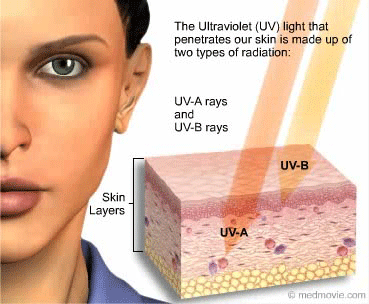 Sunscreen, skin cancer and the Australian summer, The Conversation, 23 Jan 13, With the long, hot Australian summer comes the imperative to manage the country’s enormous skin cancer risk.Along with the growing raw numbers (11,545 skin cancer cases diagnosed in 2009) and rates of melanoma, the numbers of non-melanoma skin cancers (NMSC) are going off the charts. Men are disproportionately affected, with one in 14 blokes diagnosed with melanoma before the age of 85, compared with one in 23 women.
Two months ago the Medical Journal of Australia reported the total number of NMSC treatments increased from 412,493 in 1997 to 767,347 in 2010, and the authors estimated the number of treatments would increase to 938,991 by 2015.
The costs estimate – which I understand doesn’t include the patient’s out-of-pocket expenses – was over half a billion dollars in 2010. This is an enormous health burden unique to Australia and our friends across the Tasman…..
The Nambour study conducted in South East Queensland in the early 1990s found the use of sunscreen (then the old SPF15+) reduced the risk of squamous cell carcinomas (the second most common non-melanoma skin cancer) by 12% andmelanoma by about half.
So, as we get closer to seeing SPF50+ sunscreen land on the shelves of our local shops remember the famous all-encompassing 1998 life advice speech of disputed origins“Wear sunscreen” – and heed the advice. It’s still a good tip.
Here are a few other simple sunscreen tips:
- Sunscreen shouldn’t be used as the first and last defence against the sun. Don’t forget the other “S”s – Slip on a Shirt, Slap on a Hat, Seek some shade and Slide on your sunnies….. http://theconversation.edu.au/sunscreen-skin-cancer-and-the-australian-summer-11633
Sydney to cop very high UV radiation
Extreme UV radiation levels warning, Hills News, Jan. 11, 2013 NOT
only is Sydney suffering from a heatwave, the area is also
experiencing extreme ultraviolet (UV) radiation levels which can be
damaging to people’s skin.
UV levels for Friday, January 11 were recorded by the Bureau of
Meteorology at an extreme level of 13. While on Saturday, January
12, temperatures are said to reach 42 degrees Celsius with a UV rating
of 12.
Regional manager for western Sydney at the Cancer Council, Rory
Alcock, said UV levels past three could damage skin.
‘‘The UV Index starts from a low level of one to two,’’ Mr Alcock said.
‘‘A level of over three can be strong enough to damage your skin.
‘‘Australia has among the highest ratings of skin cancer. ‘‘Two in
three people will develop skin cancer before the age of 70.’’
For the best protection against UV rays, Mr Alcock recommends a
combination of sun protection
measures……http://www.hillsnews.com.au/story/1230027/extreme-uv-radiation-levels-warning/?cs=12
Scary facts on Australians, UV radiation, and skin cancer
“Forgetting to cover up is simply scary when you think about the 115
South Australians who die from melanoma skin cancer every year.”
but each time you burn, the UV
radiation causes damage to the DNA in your skin and as you get older
your body’s ability to kill those damaged cells is scaled back.”
Skin cancer message not getting through Health reporter Jordanna
Schriever Adelaide Now, The Advertiser January 09, 2013 SOUTH
Australians are being sloppy when it comes to avoiding sunburn.
SA Health latest figures to the end of November show 33 people were
treated in hospital for sunburn and 17 for sunstroke.
Of the total, 11 were children and, in all but one case, the children
were admitted because of sunburn.
Cancer Council SA chief executive Brenda Wilson said she was deeply
concerned by any sunburn-related hospital admissions because of the
avoidable, long-term health consequences. Continue reading
Damage to eyes from ultraviolet radiation
 UV Eye Safety to Avoid Sunburn of the Eyes,
https://www.tranquileyes.net.au/2012/12/uv-eye-safety/
23 Dc 12,
We protect our skin with
sunscreen, but what about our eyes? Most of us are aware of the
dangerous effects ultraviolet (UV) rays have on our skin, but few of
us realize the danger imposed on our eyes. UV radiation, whether from
natural sunlight or artificial UV rays, can damage the eye’s surface
tissues as well as the cornea and lens. UV radiation can burn the
front surface of the eye, much like a sunburn on the skin. Continue reading
We’ve been conned into working harder and longer – consumerism!
One analysis at the University of Melbourne sought to discover the reasons why people are increasingly compelled to work more than 50 hours a week.
The correct answer was consumerism. It was the “work-and-spend” trap, an endless cycle characterised by the desire for higher living standards, linked with greater levels of debt that can only be managed by working longer and harder.
 A frenzy of consumerism http://www.theage.com.au/small-business/blogs/work-in-progress/a-frenzy-of-consumerism-20121207-2ayut.html#ixzz2EgEa2wIK The Age, December 7, 2012 James Adonis There was something quite tragic about .. the Black Friday stampedes in the US, the likes of which are bound to be repeated here in Australia on Boxing Day. It’s tasteless consumerism to the max, turning ordinary people into ravenous and mindless shoppers, with flow-on effects in the workplace.
But first, let’s go back to 1929. In an article written for Nation’s Business magazine, Charles Kettering – a director of General Motors Research – opined on the need for companies to keep consumers dissatisfied. The moment people are happy with what they have, “almost immediately hard times would be upon us”, he wrote.
And so it is that marketers persevere with advertising to convince us we’re not sexy enough, popular enough, smart enough, or (whatever) enough, unless we purchase what they’re selling. Continue reading
Ultraviolet radiation – skin cancer a greater danger than insufficient Vitamin D
Monday’s medical myth: we’re not getting enough sun heconversation.edu.au/mondays-medical-myth-were-not-getting-enough-sun-10205 12 November 2012 Myths abound about UV radiation and its effect on our health. We hear that sun-protection has triggered an epidemic of vitamin D deficiency; being tanned protects you from sunburn; a tan looks healthy; and “old” skin doesn’t need to be protected from the sun like “young” skin does.
Myth, myth, myth, myth.
What is beyond doubt is that Australia is the world’s skin cancer capital , yet skin cancer is the most preventable of all common cancer types. Continue reading
Cancer in Australia’s soldier witnesses of Monte Bello atomic bomb tests
 AUDIO: Atom bomb veterans mark anniversary (PM)
Atom bomb veterans remember life-changing blast ABC News Radio 4 Oct 12, PM By Brendan  Trembath Sixty years since Britain tested its first atom bomb in Australia, those who witnessed the blast – many who now have cancer – have reunited to talk about how it changed their lives. The veterans are still seeking an apology from the Federal Government and appropriate health care for them and their children.
Official records say those serving on the HMAS Murchison on October 3, 1952, were 70 miles away when Britain successfully detonated an atomic bomb on the Monte Bello islands, off the coast of the Pilbara in Western Australia.
But to this day, many who were there say they were much closer.
Michael Rowe was on board the ship and remembers the moment the bomb went off.
“We were told to face east, which we did, and then we were told we could turn around and face west and we saw the first British atom bomb go off,” he said…… “We were clothed to protect ourselves in a pair of shorts and sandals. That’s all,” he said.
Mr Rowe is also among those who say they were much closer to ground zero than what is officially recorded and he has photos which he says proves it. “There’s been big arguments over the years about how far away the Murchison was from the actual bomb site, but I had a little tiny camera that I had hidden down inside my shorts and I took a photograph of that bomb going off, a very clear photograph of the bomb going off,” he said.
“All the records show that we were 70 miles away and there was no way in the world you could’ve taken this photograph from 70 miles.”
Mr Rowe says he and others onboard the ship think they were about 12 to 15 nautical miles east of the blast site. I’ve had a great life. Done lots of things, been lots of places but I always seem to have something wrong with me and it was only on September 19 that I was diagnosed with multiple cancers, terminal cancers. He is one of the 23 known surviving national servicemen from HMAS Murchison.
But like many who were there that day, Mr Rowe now has cancer. “I’ve had a great life. Done lots of things, been lots of places but I always seem to have something wrong with me and it was only on September 19 that I was diagnosed with multiple cancers, terminal cancers,” he said.
Fellow crew member Ken Palmer was not well enough to attend the lunch but his wife Robyn came in his place.
“He has secondaries from thyroid cancer as a result of the blast. They were exposed to the radiation, but he’s doing well, yes, he’s doing well,” she said….. http://www.abc.net.au/news/2012-10-03/atom-bomb-veterans-remember-blast-that-changed-lives/4294276
1 This month

of the week – Australians for War Powers Reform (AWPR)
To see nuclear-related stories in greater depth and intensity
 Antinuclear