The torture that awaits Julian Assange in the US.
 From the frying pan into the fire. The torture that awaits Julian Assange in the US.https://www.thecanary.co/uk/analysis/2020/05/10/from-the-frying-pan-into-the-fire-the-torture-that-awaits-julian-assange-in-the-us/
Tom Coburg 10th May 2020 WikiLeaks founder Julian Assange is currently held in Belmarsh prison awaiting hearings that could see him extradited to the US to face prosecution for alleged espionage-related offences.
Award-winning US journalist Chris Hedges described the torture that would await Assange in the US prison system, adding “they will attempt to psychologically destroy him”. If extradited, Assange would likely be detained in accordance with ‘Special Administrative Measures’ (SAMs). One report equates this to a regime of sensory deprivation and social isolation that may amount to torture.
Journalists speak out
US journalist Chris Hedges spoke about the treatment Assange is likely to receive in the US. He argues that the US authorities will “psychologically destroy him” and that conditions imposed could see him turned into a ‘zombie’ to face life without parole:
Australian journalist John Pilger agrees:
If Julian is extradited to the US, a darkness awaits him. He’ll be subjected to a prison regime called special administrative measures… He will be placed in a cage in the bowels of a supermax prison, a hellhole. He will be cut off from all contact with the rest of humanity.
From the frying pan…
Assange is already in a precarious position, alongside all other UK prisoners. Belmarsh is a high-security Category A facility and, as with all other prisons in the UK, inmates there are at risk to infection from coronavirus (Covid-19).
On 28 April, the BBC reported that there were “1,783 “possible/probable” cases of coronavirus – on top of 304 confirmed infections across jails in England and Wales”. Also that there were “75 different “custodial institutions”, with 35 inmates treated in hospital and 15 deaths”.
Vaughan Smith, who stood bail for Assange, reported that the virus was “ripping through” Belmarsh:
We know of two Covid-19 deaths in Belmarsh so far, though the Department of Justice have admitted to only one death. Julian told me that there have been more and that the virus is ripping through the prison.
Assange has a known chronic lung condition, which could lead to death should he become infected with coronavirus. Assange’s lawyers requested he is released on bail to avoid succumbing to the virus, but that request was rejected.
As for the psychological effects of segregation, a European Committee for the Prevention of Torture and Inhuman or Degrading Treatment or Punishment report argued that it can “can have an extremely damaging effect on the mental, somatic and social health of those concerned”.
…and into the fire
It’s likely that Assange will be placed under SAMs if he is extradited to the US. The Darkest Corner, a report authored by the Allard K. Lowenstein International Human Rights Clinic and The Center for Constitutional Rights, describes how SAMs work.
In its summary, the report explains that:
SAMs are the darkest corner of the U.S. federal prison system, combining the brutality and isolation of maximum security units with additional restrictions that deny individuals almost any connection to the human world. Those restrictions include gag orders on prisoners, their family members, and their attorneys, effectively shielding this extreme use of government power from public view.
It continues:
SAMs deny prisoners the narrow avenues of indirect communication – through sink drains or air vents – available to prisoners in solitary confinement. They prohibit social contact with anyone except for a few immediate family members, and heavily regulate even those contacts. And they further prohibit prisoners from connecting to the social world via current media and news, limiting prisoners’ access to information to outdated, government-approved materials. Even a prisoner’s communications with his lawyer – which are supposed to be protected by attorney-client privilege – can be subject to monitoring by the FBI.
It ominously adds that: “Many prisoners remain under these conditions indefinitely, for years or in some cases even decades”. Moreover, these conditions can be used as a weapon to force a prisoner to plead guilty:
In numerous cases, the Attorney General recommends lifting SAMs after the defendant pleads guilty. This practice erodes defendants’ presumption of innocence and serves as a tool to coerce them into cooperating with the government and pleading guilty.
The report provides further details on how SAMs incorporate sensory deprivation and social isolation measures that “may amount to torture”. Also, it argues that the SAMs regime contravenes both US and international laws.
ECHR article 3
Should the UK courts agree to extradite Assange, he could face months, if not decades, of psychological torture. However, Article 3 of the European Court of Human Rights states clearly: “No one shall be subjected to torture or to inhuman or degrading treatment or punishment”. Under that article, the US extradition request should be rejected by the UK courts.
For a publisher to be subjected to such a nightmare scenario would be intolerable.
Bushfire Survivors for Climate Action taking legal action against NSW Environment Protection Authority
  ‘Kick them into action’: Fire group takes EPA to court over climate, SMH, By Peter Hannam, April 20, 2020 Lisa Roberts spent 25 years building a native plant business that was as sustainable as they come, with off-grid solar power and water harvesting, only to see it go up in flames in the recent bushfires.Her home and nursery in Wandella in southern NSW reduced to rubble, Ms Roberts fled to Canberra, powerless to act as fires threatened another venture in nearby Pialligo. Living in the smoke-choked capital also damaged her vocal cords, which have still not recovered. ‘Kick them into action’: Fire group takes EPA to court over climate, SMH, By Peter Hannam, April 20, 2020 Lisa Roberts spent 25 years building a native plant business that was as sustainable as they come, with off-grid solar power and water harvesting, only to see it go up in flames in the recent bushfires.Her home and nursery in Wandella in southern NSW reduced to rubble, Ms Roberts fled to Canberra, powerless to act as fires threatened another venture in nearby Pialligo. Living in the smoke-choked capital also damaged her vocal cords, which have still not recovered.
“A part of me totally rages at the world for its totally inadequate response to climate change,” Ms Roberts said. “Everybody’s safety is at risk.” That anger is being now channelled into a legal challenge against the NSW Environment Protection Authority. Bushfire Survivors for Climate Action, of which Ms Roberts is a member, began the suit last week with the NSW Environmental Defenders Office “to kick [the EPA] into action”, she said. EDO chief executive David Morris said the case, in the Land and Environment Court, would seek to force the EPA, which does not have a climate policy, to use its powers to keep communities safe from the increasingly severe impacts of a warming world. Mr Morris said the EPA was chosen as a test case among similar agencies nationally in part because of a section of the Protection of the Environment Operations Act 1997. That section requires the agency to “develop environmental quality objectives, guidelines and policies to ensure environment protection”. “It’s an opportunity for the EPA to recognise they have a legal obligation to take action,” he said. “They should have a policy and a plan to address the greatest threat to the environment.”…….. https://www.smh.com.au/environment/climate-change/kick-them-into-action-fire-group-takes-epa-to-court-over-climate-20200418-p54kzl.html
|
|
13 Australian peak Non Government Organisations seek stronger Environmental Law on Nuclear Issues

Joint ENGO Submission on Nuclear Issues as they Relate to the Environmental Protection & Biodiversity Conservation Act Review 2020
This submission is made on behalf of the following national and state peak environment groups:
-
- Australian Conservation Foundation,
- Australian Nuclear Free Alliance,
- Friends of the Earth Australia,
- Greenpeace Australia Pacific,
- Mineral Policy Institute,
- The Wilderness Society,
- Arid Lands Environment Centre,
- Environment Centre NT,
- Environment Victoria,
- Conservation Council SA,
- Conservation Council WA,
- Nature Conservation Council NSW and Queensland Conservation Council.
This submission outlines the importance of retaining s140A of the EPBC Act which prohibits nuclear power; the retention of uranium exploration and mining in the definition of a Nuclear Action and the inclusion of Nuclear Actions as a Matter of National Environmental Significance (MNES).
This submission is made in consideration of the broader objects and principles of the Act and is based on evidence from recent inquiries into both nuclear power and uranium mining. There is clear evidence that nuclear activities can have a significant environmental and public health risk and, in many cases, irreversible impacts, and this is consistent with the current dedicated legislative prohibitions for both nuclear power and scrutiny for uranium mining.
While the current Act does not include a prohibition on uranium mining we strongly advocate that there be a national ban on uranium mining consistent with state legal or policy prohibitions in New South Wales, Queensland, Tasmania, Victoria and West Australia Written by Mia Pepper, Jim Green, Dave Sweeney, David Noonan & Annica Schoo.
Summary of Recommendations
Uranium:
• that uranium mining and milling be included in s140A prohibitions as nuclear actions that the Minister must not approve, on the basis that the nuclear industry has failed to successfully remediate any uranium mine in Australia and has impacts inconsistent with the objects and principles of the EPBC Act.
• if the above recommendation is not adopted that uranium mining and milling remains within the definition of a ‘nuclear action’ and that nuclear actions continue to be listed as MNES and the protected matters continue to be listed as the ‘environment’ and so be subject to full environmental assessment at the state level
• DAWE to initiate an inquiry into the human and environmental impacts of uranium mining, as advised by the UN Secretary General following the Fukushima nuclear disaster, noting that Australian uranium was present in each of the Fukushima Daiichi reactors at the time of multiple reactor meltdowns
. • regulatory reform for existing operating mines • that the review committee recommend DAWE prioritise the rehabilitation of abandoned uranium mines and processing facilities, exploration sites and uranium mines that have been in care and maintenance for more than two years.
Nuclear Power:
• the retention of s140A of the EPBC Act 1999 which states “No approval for certain nuclear installations: The Minister must not approve an action consisting of or involving the construction or operation of any of the following nuclear installations: (a) a nuclear fuel fabrication plant; (b) a nuclear power plant; (c) an enrichment plant; (d) a reprocessing facility.”
Other Matters:
• a National Environmental Protection Authority be established
• the effectiveness of assessment bilateral agreements be reviewed, and approval bilateral agreements are not pursued
• legislate requirements for mine closure, address activities that are used to avoid mine closure and to work with states and territories to remediate existing legacy mine sites
• there be established internal process for DAWE to pursue the listing of newly identified species by referring to the Threatened Species Scientific Committee
• that the principles of free, prior and informed consent become a mandatory operational principle within the EPBC Act along with a governance mechanism to operationalise this principle……… . https://dont-nuke-the-climate.org.au/wp-content/uploads/2020/04/Joint_Sub_EPBC_Nukes_FINAL.pdf
Legal challenge about Adani’s planned water use for giant coal mine
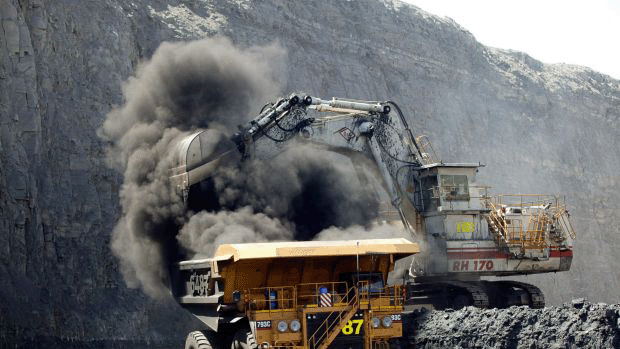 Morrison government faces legal challenge over Adani pipeline plan, Brisbane Times, Peter Hannam, March 16, 2020 The Morrison government’s failure to activate the so-called “water trigger” when assessing the proposed Adani coal mine in Queensland will be challenged in the Federal Court.
Lawyers acting for the Australian Conservation Foundation will test the government’s decision not to refer Adani’s North Galilee Water Scheme, a pipeline supplying the mine, for a thorough assessment as intended by the law.
The water trigger, introduced by the Rudd-Gillard government in mid-2013, was meant to require the government to assess the impact on water of all large coal mines and coal seam gas developments.
However, the government treated Adani’s plan to draw 12.5 billion litres a year from the Suttor River in central Queensland as a pipeline that was not a “large coal mining development”, nor did it involve one.
Similarly, it viewed the pipeline proponent, Adani Infrastructure Pty Ltd, as “a different legal entity” from the coal mine proponent, Adani Mining Pty Ltd.
The foundation plans to test both reasons for the failure not to activate the water trigger in court, arguing that the government made an error in law by ignoring infrastructure that was critical for the coal mine to proceed.
Tony Windsor, the former independent MP who was a key architect of the trigger, said reliable long-term access to clean water was “vital for regional communities and demands that we sustainably manage our rivers and aquifers”.
“Allowing companies to split up mining projects and assess them in isolation makes a nonsense of the process,” he said. “You don’t see much looking at just one piece of the jigsaw – you need to look at the whole puzzle.”……..https://www.brisbanetimes.com.au/environment/sustainability/morrison-government-faces-legal-challenge-over-adani-pipeline-plan-20200316-p54an6.html?ref=rss&utm_medium=rss&utm_source=rss_feed
Court dismisses Aboriginal group’s appeal to stop the Kimba nuclear waste dump
Court rules against bid to stop nuke dump,https://www.transcontinental.com.au/story/6677900/court-rules-against-bid-to-stop-nuke-dump/?cs=9397&fbclid=IwAR25qIOzDiqg20vLhGNb5YS9iUwZJX39yQ3yV5iM_5U86kKJaMUTasN3Slc, Tim Dornin , MARCH 13 2020 -Native title holders on South Australia’s Eyre Peninsula have lost a court bid in their continuing fight to stop the federal government establishing a nuclear waste dump near Kimba.
The government recently named a site on a farming property as the location for the dump which will take Australia’s low to medium-level nuclear waste material.
But the Barngarla Determination Aboriginal Corporation, the native title holders of the region, argued that their 200-strong community had been unfairly excluded from the ballot on their basis of the Aborginality.
They appealed to the Full Court of the Federal Court against a single judge’s decision to uphold the District Council of Kimba’s earlier move.
But the full court dismissed their appeal on Friday.
“It is not correct to say that BDAC’s members were excluded from the ballot,” the court ruled.
“Membership of BDAC was not a characteristic that disqualified any person from the franchise. Rather, the effect of the resolutions was that possession of native title rights and interests was not included among the various qualifying criteria.”
The court found the original decision by a single judge was correct in that it concluded that anyone who fulfilled one of 14 criteria could take part in the vote, irrespective of a person’s race.
“Similarly, the classes of persons who were excluded from the franchise included persons who were Aboriginal and persons who were not,” the appeal judges said.
In his argument, counsel for the Barngarla, Daniel O’Gorman SC, had told the court that their request to take part in the ballot should have been granted.
“This was a ballot of the community, the Kimba community. They are the native title holders of the land surrounding the sites in question,” he said.
“Therefore, we submit, they clearly had an interest in the ballot, they clearly had an interest in the dump and whether it goes ahead or not.
“Their mere standing as native title holders, warranted them being included as part of the community.”
The ballot ultimately returned about 62 per cent support for the dump, which then Resources Minister Matt Canavan accepted as broad community backing.
Those still opposed to the dump going ahead include some locals, environmental groups as well as indigenous communities.
Legislation to allow construction of the waste facility is before the federal parliament.
The underpinning laws allow for acquisition of land for the facility as well as a $20 million payment for the community to help establish and maintain the site, which is expected to operate for at least 100 years. AT TOP https://www.transcontinental.com.au/story/6677900/court-rules-against-bid-to-stop-nuke-dump/?cs=9397&fbclid=IwAR25qIOzDiqg20vLhGNb5YS9iUwZJX39yQ3yV5iM_5U86kKJaMUTasN3Slc
Barngarla Aboriginal people take legal action against Australian govt’s planned Kimba nuclear waste dump
 Indigenous group fights on to stop SA dump https://www.9news.com.au/national/indigenous-group-fights-on-to-stop-sa-dump/d72f3453-28e8-4182-a9bb-6c9390098bf6?fbclid=IwAR3l91JVzBoJhkIhnf49 Feb 21, 2020 Native title holders on South Australia’s Eyre Peninsula are continuing their court fight to stop the federal government establishing a nuclear waste dump near Kimba. Indigenous group fights on to stop SA dump https://www.9news.com.au/national/indigenous-group-fights-on-to-stop-sa-dump/d72f3453-28e8-4182-a9bb-6c9390098bf6?fbclid=IwAR3l91JVzBoJhkIhnf49 Feb 21, 2020 Native title holders on South Australia’s Eyre Peninsula are continuing their court fight to stop the federal government establishing a nuclear waste dump near Kimba.
The government recently named a site on a local station as the location for the dump which will take Australia’s low to medium level nuclear waste material.
The government’s decision was informed in part by a ballot of local residents which supported the proposal.
But it’s that ballot that the Barngarla people are fighting in new Federal Court action.
They’re appealing against a court judgment last year that the council had not acted wrongly in excluding about 200 native title holders from the vote.
Counsel for the Barngarla, Daniel O’Gorman SC, told the court on Friday that their request to take part in the ballot should have been granted.
“They, therefore, are part of the community,” he said.
“This was a ballot of the community, the Kimba community. They are the native title holders of the land surrounding the sites in question.
“Therefore, we submit, they clearly had an interest in the ballot, they clearly had an interest in the dump and whether it goes ahead or not.
“Their mere standing as native title holders, warranted them being included as part of the community.”
The ballot ultimately returned about 62 per cent support for the dump, which then Resources Minister Matt Canavan accepted as broad community backing.
Those still opposed to the dump going ahead include some locals, environmental groups as well as indigenous communities.
Earlier this month, legislation to allow construction of the waste facility was introduced to federal parliament.
The underpinning laws allow for acquisition of land for the facility as well as a $20 million payment for the community to help establish and maintain the site which is expected to operate for at least 100 years.
The Federal Court’s ruling on the Barngarla appeal is expected to be handed down on a date to be fixed.
|
|
|
Immoral and illegal spying on Julian Assange and his lawyers – MP Andrew Wilkie calls on Australian government to act.
 Wilkie says Assange extradition efforts should be dropped after US spying revelations, https://www.theage.com.au/politics/federal/wilkie-says-assange-extradition-efforts-should-be-dropped-after-us-spying-revelations-20200223-p543j3.html, By Rob Harris, February 24, 2020 The revelation Julian Assange’s confidential conversations with his Australian lawyers were secretly recorded should force the British courts to throw out attempts to extradite him to the United States, independent MP Andrew Wilkie says.Mr Wilkie has again called on Prime Minister Scott Morrison to lobby the British government to reject the United States attempts to extradite Australian-born WikiLeaks founder who faces several espionage charges over the publication of hundreds of thousands of confidential government documents. Wilkie says Assange extradition efforts should be dropped after US spying revelations, https://www.theage.com.au/politics/federal/wilkie-says-assange-extradition-efforts-should-be-dropped-after-us-spying-revelations-20200223-p543j3.html, By Rob Harris, February 24, 2020 The revelation Julian Assange’s confidential conversations with his Australian lawyers were secretly recorded should force the British courts to throw out attempts to extradite him to the United States, independent MP Andrew Wilkie says.Mr Wilkie has again called on Prime Minister Scott Morrison to lobby the British government to reject the United States attempts to extradite Australian-born WikiLeaks founder who faces several espionage charges over the publication of hundreds of thousands of confidential government documents.
A Spanish private security company is under investigation over allegations it spied on Mr Assange while he was living at the Ecuadorian embassy, passing on hundreds of hours of recordings and other surveillance to American intelligence, according to former workers at the Spanish company. The ABC reported on Sunday that Mr Assange’s Australian lawyers, including prominent QC Geoffrey Robertson, were also among those spied on in “Operation Hotel”. Mr Wilkie, who met with Mr Assange as part of Australian parliamentary delegation in London last week, told The Sydney Morning Herald and The Age the actions were “immoral and illegal”. “It alone should be the basis for the extradition to be dropped this week,” Mr Wilkie said. “If the court doesn’t drop the proceedings in light of these allegations, a question mark hangs over the court’s neutrality. It just adds to the injustice that’s being experienced by Julian”. The ABC reported the covert surveillance was uncovered through a public investigation into the Spanish company, UC Global, contracted by the Ecuadorian government to provide security at the embassy. WikiLeaks Spanish lawyer, Aitor Martinez, told the ABC it came to light after Mr Assange was arrested, when former UC Global employees provided a large file of material.
Hundreds of supporters of Julian Assange marched through London on Saturday to pressure the British government into refusing to extradite the WikiLeaks founder to the United States to face spying charges. Famous backers, including Pink Floyd’s Roger Waters, Pretenders singer Chrissie Hynde and fashion designer Vivienne Westwood joined the crowd protesting the US espionage charges against the founder of the secret-spilling website. He will again face an extradition hearing on Monday night (Australian time) relating to US criminal charges against him for his role in the WikiLeaks releases of classified US government material. WikiLeaks adviser Jennifer Robinson, one of the Australian lawyers caught in the spying operation, said the federal government had not done enough to protect Mr Assange. “His Australian lawyers — all of us Australian citizens — have [also] had our rights as lawyers and our ability to give him a proper defence superseded by the US and potentially the UK government,” she told the ABC. “This is something that the Australian government ought to be taking very seriously and ought to be raising, both with the UK and with the United States. It is time the Australian government stands up for this Australian citizen and stops his extradition.” A spokesman for the Department of Foreign Affairs and Trade said the Australian government had discussed Julian Assange’s circumstances with partners, including as recently as during the UK Foreign Secretary Dominic Raab’s visit. “In the past 12 months, we have sought relevant assurances on multiple occasions from the UK,” the spokesman said. |
|
How will Julian Assange’s extradition case proceed in court?
 Julian Assange’s extradition case is finally heading to Julian Assange’s extradition case is finally heading to  court – here’s what to expect more https://www.sbs.com.au/news/julian-assange-s-extradition-case-is-finally-heading-to-court-here-s-what-to-expe court – here’s what to expect more https://www.sbs.com.au/news/julian-assange-s-extradition-case-is-finally-heading-to-court-here-s-what-to-expeFebruary 24, 2020 Holly CullenAdjunct professor, University of Western AustraliaThe extradition hearing to decide whether to send Julian Assange to the United States to be tried for publishing classified military documents on Wikileaks is expected to finally begin today in London. Assange is charged with 17 counts under the Espionage Act, involving receipt, obtaining and disclosing national security information. He has also been charged with one count of conspiracy to assist Chelsea Manning to crack a US Department of Defense password to enable her to access classified information. Assange has been in Belmarsh prison since his arrest in April 2019. He had been in solitary confinement in a prison medical unit, but was recently moved into a less isolated section of the prison due to concerns about his mental health. From May to September of last year, Assange served a sentence for bail absconding, but since then has been waiting for the extradition hearing. How will the process play out? Continue reading |
Adani about to receive criminal conviction over false documents
 Adani agrees to plead guilty to giving ‘false or misleading documents to an administering authority’, may be fined up to $3m
Key points:
- The company’s Australian arm, Adani Mining Pty Ltd, is listed for sentencing in the Brisbane Magistrates Court
- It belatedly declared clearing land on its mine site after environmentalists complained to the government
- The company says it has been prosecuted for an “an administrative error”
Adani has agreed to plead guilty to giving “false or misleading documents to an administering authority”, according to the court file and sources familiar with the case.
The company’s Australian arm, Adani Mining Pty Ltd, is listed for sentencing today in the Brisbane Magistrates Court.
It faces a fine of up to $3 million if convicted under the Environmental Protection Act.
According to notes in the court file made by Magistrate Stephen Courtney and seen by the ABC, the matter is “to be [a] plea of guilty”.
In court papers, the Department of Environment and Science (DES) says Adani filed its annual return in March 2018 with a graph declaring it cleared no land on the Carmichael mine site, north-west of Clermont, in 2017-18.
The DES alleged it became aware of the offence six months later. It alleged Adani “knew or ought reasonably to have known [the document] was false or misleading” because it had planned and carried out land clearing before and during the reporting period.
On September 6, 2018, conservation group Coast and Country raised land clearing allegations with the State Government, citing satellite imagery.
State and federal environment department officials then inspected the site within days……..https://www.abc.net.au/news/2020-02-06/adani-to-plead-guilty-court-qld/11932640
Six legal arguments against the extradition of Julian Assange to America
Six legal arguments show why the US extradition of Julian Assange should be denied https://www.thecanary.co/uk/analysis/2020/01/25/six-legal-arguments-show-why-the-us-extradition-of-julian-assange-should-be-denied/ Tom Coburg 25th January 2020 The first of two articles examining Julian Assange’s upcoming extradition trial.
There are at least six legal reasons why the extradition request by the US against WikiLeaks founder Julian Assange should be dismissed by the UK courts. The main extradition hearing is scheduled to commence 24 February 2020, with district judge Vanessa Baraitser presiding. The evidence to support Assange is compelling.
1. Client-lawyer confidentiality breached
2. The initial charge is flawed
1. Client-lawyer confidentiality breached
3. Initial charge relies on co-operation from Manning
4. Additional charges raised by the US are political
5. US legal precedent argues that Assange’s work is protected by the US Constitution
6. Threats of violence against Assange mean he’s unable to receive a fair trial
1. Client-lawyer confidentiality breached Continue reading
Traditional Aboriginal owners will not give up fight against planned WA uranium mine, despite legal loss
 Traditional Owners lose another fight against planned WA uranium mine, https://www.sbs.com.au/nitv/nitv-news/article/2019/08/01/traditional-owners-lose-another-fight-against-planned-wa-uranium-mine?fbclid=IwAR3fZ4v8xEAU1sPLXNPznPMbbgTM0YSa97czCEvMfQacuYNB2XTsWaOhUgo 1 Aug 19, Environmental approval for Cameco’s Yeelirrie uranium mine proposal in WA still stands after another appeal by Traditional Owners failed. Traditional Owners and the Conservation Council of WA have lost their fight against a proposed uranium mine that the Environmental Protection Authority refused to back, saying risks to subterranean fauna in the project area were too great.Former state environment minister Albert Jacob approved Cameco’s Yeelirrie mine plan in January 2017, just 16 days before the pre-election caretaker mode began. Traditional Owners lose another fight against planned WA uranium mine, https://www.sbs.com.au/nitv/nitv-news/article/2019/08/01/traditional-owners-lose-another-fight-against-planned-wa-uranium-mine?fbclid=IwAR3fZ4v8xEAU1sPLXNPznPMbbgTM0YSa97czCEvMfQacuYNB2XTsWaOhUgo 1 Aug 19, Environmental approval for Cameco’s Yeelirrie uranium mine proposal in WA still stands after another appeal by Traditional Owners failed. Traditional Owners and the Conservation Council of WA have lost their fight against a proposed uranium mine that the Environmental Protection Authority refused to back, saying risks to subterranean fauna in the project area were too great.Former state environment minister Albert Jacob approved Cameco’s Yeelirrie mine plan in January 2017, just 16 days before the pre-election caretaker mode began.
Together with members of the Tjiwarl native title group, CCWA challenged the approval in the Supreme Court but lost, and on Wednesday had their the Court of Appeal challenge dismissed. Traditional Owner Vicki Abdullah said the native title group was disappointed, but taking the case to court had exposed problems with WA’s environmental laws. “We won’t give up – our country is too important. We will continue to fight for Yeelirrie and to change the laws, ” Ms Abdullah said. CCWA director Piers Verstegen said the judgment was appalling and demonstrated WA’s environmental laws urgently needed to be strengthened. “This case has confirmed our worst fears – that it is legally admissible for a minister to sign off on a project against the advice of the EPA and in the knowledge that it would cause the extinction of multiple species, ” he said. “We will consider options for further appeal of this decision. “The mining company can expect a long, expensive process if they want to continue pursuing plans to mine uranium at Yeelirrie.” |
|
Launch of Australia’s National Environmental Defenders Office
National Environmental Defenders Office launches https://www.lawyersweekly.com.au/sme-law/26968-national-environmental-defenders-office-launches, By Jerome D, oraisamy|21 November 2019 The new EDO will have offices in Adelaide, Brisbane, Cairns, Canberra, Darwin, Hobart, Perth and Sydney, with all state and territory EDOs finalising their merger process over the coming months.
Launched yesterday, the national Environmental Defenders Office will “take high-impact enforcement cases to the courts to make sure the public interest is upheld, and our communities are properly protected by our environmental laws”, it said in a statement.
In explaining why the former environmental legal centres were now coming together under one roof, EDO CEO David Morris said that the environmental problems facing Australia are not bound by our state and territory borders.
“The Murray-Darling crisis spans four jurisdictions. Our iconic koalas are dying right up and down the east coast. Climate change doesn’t stop at any border,” he said.
“Now more than ever, national leadership is required to protect Australia’s natural and cultural heritage. That’s where the new national EDO steps in.”
Moreover, the merger will see us the new EDO become the “largest public interest environmental law centre in the Australia-Pacific region”, Mr Morris told Lawyers Weekly.
“With that additional scale comes opportunities to play a bigger role empowering communities and protecting places. We see big opportunities to increase our presence in the Pacific and to better serve local communities in remote parts of Australia, including northern Australia,” he said.
“Increasingly communities across northern Australia are seeking legal assistance in respect of gas developments and we intend to ensure that our expert lawyers are available to assist them.” Merging also allows the EDO, Mr Morris added, to address the “problems of scale” identified by the Productivity Commission in its Access to Justice Arrangements report.
“That is, we’re able to centralise much of the offices’ administrative, financial and communications work freeing up our legal staff to provide better services to the community. The opportunity is that as a much bigger organisation we can play a bigger role at a national level on national issues, but at the same we’re committed to maintaining and strengthening connections to grass roots communities,” he said.
Another challenge and opportunity I expect will be big issues for us in the next twelve months will be coming to grips with what it means to be a distributed national team across a large area and multiple time-zones and multiple jurisdictions. We’ve got some tools and we’ve got some resourcing to improve our legal technology, rolling that out and implementing it will be crucial to the merger’s success.”
Australia is one of the “most naturally beautiful and biologically diverse places on Earth”, EDO’s statement continued, “but our environment is in decline”.
“There are more than 1,700 threatened species in Australia, we have lost more animals to extinction than any other country in the world. And while the Australian community expects robust accountability and oversight when it comes to environmental protection, trust in government processes and institutions has eroded to an all-time low.
Mr Morris said: “Regulations are regularly not enacted or enforced. Governments have cut resources to departments that are supposed to monitor breaches of environment law.”
“Companies routinely and intentionally breach state and federal environment laws. The problem is systemic and widespread because there is no clear legal deterrent.
“As a merged, national organisation we can share expertise, more closely scrutinise projects and address the widespread culture of non-compliance with environment laws.”
Journalists beware! Australia now a surveillance state
 Australia now a surveillance state with journalists as POIs under ASIO Act, Michael West.com, by John Stapleton — 21 November 2019 Will future historians see the Abbott/Turnbull/Morrison era as the period of governance when totalitarian instincts were unleashed? The targeting of journalists is just the beginning of a much greater disaster, writes journalist and author, John Stapleton. Australia now a surveillance state with journalists as POIs under ASIO Act, Michael West.com, by John Stapleton — 21 November 2019 Will future historians see the Abbott/Turnbull/Morrison era as the period of governance when totalitarian instincts were unleashed? The targeting of journalists is just the beginning of a much greater disaster, writes journalist and author, John Stapleton.
The #RighttoKnow movement barely touches on the intensity of media manipulation by the conservatives since they regained power in 2013; from blocking popular Facebook sites to harassing little-read authors like me. Imagine you’re writing something critical of the government. You know there are cameras in your home, a keylogger on your computer – every keystroke is observed or recorded. And then you hear cries of derision from a neighbouring house. I experienced this while completing the third and final book in a series on Australian life, Dark Dark Policing. The first two, Terror in Australia: Workers’ Paradise Lost and Hideout in the Apocalypse, may not have set the bestseller lists alight, but that is not the point. My lifetime in journalism never prepared me for so much abusive surveillance. My epiphany came post-retirement. Returning from years in Asia, I was jarred by the dilapidated state of Australia in contrast to the dynamic societies I had been in. And so began my work on a book initially titled Workers’ Paradise Lost. But it was impossible to ignore the biggest story of the day, terror, with the then Prime Minister, Tony Abbott, abandoning good government in favour of terrifying the population, pounding on about “the death cult” at every opportunity. This was despite repeated warnings from terror-messaging experts that his terminology was counterproductive, actually attracting recruits to Islamic State……. Among the most egregious laws passed by the Abbott and Turnbull governments were Journalist Information Warrants, issued entirely in secret. Journalists are not informed if a warrant is taken out against them and face jail if they publicise the fact. The laws have become so strict that journalists cannot write about security operations, or even surveillance of their reporting, without the risk of prison. I chose to use novelistic techniques. …….. The tranches of anti-journalist legislation introduced jail terms of up to ten years for journalists who disclose what are known as SIOs, Secret Intelligence Operations. Who decides what an SIO is? ASIO does…… The point is, the public narrative – thereby, the nation’s culture – is being controlled: from barely read authors like me, to the mainstream media, to Facebook warriors. Suppress dissent and you foment revolution. Thanks to the blizzard of poorly drafted legislation that the Liberals introduced to exploit the fear of terror, we now live in a country where, as the Inspector-General of Intelligence and Security recently pointed out, you can be jailed for five years for breaching orders you didn’t know existed; where children as young as ten can be incarcerated without charge. It doesn’t take the gift of prophecy to know that future historians will see the Abbott/Turnbull/Morrison era as the worst period of governance in Australia’s history, when totalitarian instincts were unleashed. The targeting of journalists is just the beginning of a much greater disaster. https://www.michaelwest.com.au/australia-the-surveillance-state-with-journalists-now-pois-under-the-asio-act/ |
|
Journalism’s future in crisis – the case of Julian Assange
JOHN PILGER: Assange’s case will define the future of free journalism, https://independentaustralia.net/life/life-display/john-pilger-assanges-case-will-define-the-future-of-free-journalism,13324 By John Pilger | 18 November 2019 John Pilger describes the disturbing scene inside a London courtroom last week when the WikiLeaks publisher, Julian Assange, appeared at the start of a landmark extradition case that will define the future of free journalism.
Her face was a progression of sneers and imperious indifference; she addressed Julian Assange with an arrogance that reminded me of a magistrate presiding over apartheid South Africa’s Race Classification Board. When Julian struggled to speak, he couldn’t get words out, even stumbling over his name and date of birth.
When he spoke truth and when his barrister spoke, Baraister contrived boredom; when the prosecuting barrister spoke, she was attentive. She had nothing to do; it was demonstrably preordained. In the table in front of us were a handful of American officials, whose directions to the prosecutor were carried by his — back and forth this young woman went, delivering instructions.
Her knee in the groin was to announce that the next court hearing would be at remote Woolwich, which adjoins Belmarsh Prison and has few seats for the public. This will ensure isolation and be as close to a secret trial as it’s possible to get. Did this happen in the home of the Magna Carta? Yes, but who knew?
Who will then dare to expose anything of importance, let alone the high crimes of the West? Who will dare publish ‘Collateral Murder’? Who will dare tell the public that democracy, such as it is, has been subverted by a corporate authoritarianism from which fascism draws its strength?
Once there were spaces, gaps, boltholes, in mainstream journalism in which mavericks, who are the best journalists, could work. These are long closed now. The hope is the samizdat on the internet, where fine disobedient journalism is still practised.
The greater hope is that a judge or even judges in Britain’s court of appeal, the High Court, will rediscover justice and set him free. In the meantime, it’s our responsibility to fight in ways we know but which now require more than a modicum of Julian Assange’s courage.
A travesty of justice- extradition process of Julian Assange
|
Julian Assange’s Extradition Process Is ‘A Charade’, The Real News Network, November 5, 2019
Interview Transcript
GREG WILPERT: Julian Assange recently lost a court bid to have his upcoming February 2020 extradition hearing postponed. The hearing about the postponement took place on October 21, and according to observers who were present, he could barely speak in coherent sentences. Reacting to the hearing, UN Human Rights Rapporteur Nils Melzer warned last Friday that Assange continues to show symptoms of psychological torture. Melzer had visited Assange in May when he conducted an extensive review of his physical and psychological condition. In his statement on Friday, Melzer said, “Despite the medical urgency of my first appeal, and the seriousness of the alleged violations, the U.K. has not undertaken any measures of investigation, prevention, and redress required under international law.” In addition to the concerns about Assange’s treatment at Belmarsh Prison outside of London, many have also raised concerns about the impartiality of the proceedings against him. Assange was jailed last April when the Ecuadorian Embassy, where he had been given political asylum, allowed the police to arrest him. He then received a 50-week sentence for having skipped jail in 2012. The Trump Administration has since then requested Assange’s extradition on 17 charges of espionage for which he could receive a 170-year prison sentence in the United States. Joining me now to discuss the latest developments in the case of Julian Assange is John Pilger. He has been observing the Assange case very closely and was present at the October 21 court hearing…… John Pilger – “…..His physical condition has changed dramatically. He’s lost about 15 kilos in weight. To see him in court struggling to say his name, and his date of birth, was really very moving. I’ve seen that when I visited Julian in Belmarsh Prison where he struggles at first, and then collects himself. I’m always impressed by the sheer resilience of the man, because as Melzer says, absolutely nothing has been done to change the conditions imposed on him by the prison regime. Nothing has been done by the British authorities.
This was almost underlined by the contemptuous way that this court hearing recently was conducted by this judge, by this magistrate. There was a sense among all of us who were there that the whole charade, and it seemed a charade, was preordained. You had sitting in front of us, on a long table, four Americans who were from the U.S. Embassy here in London, and one of the prosecution team was scurrying backwards and forwards to get instructions from them. The judge could see this, and she allowed it. It was just absolutely outrageous.
When Julian did try to speak, and to say that basically he was being denied the very tools with which to prepare his case, he was denied the right to call his American lawyer. He was denied the right to have any kind of word process or laptop. He was denied certain documents. As he said, “I’m even denied my own writings,” as he called it. That is, his own notes and manuscripts. This hasn’t changed at all, and of course the effect of that on his morale, to say the least, has been very significant, and that showed in the court.
Greg Wilpert – ” ….district judge, Vanessa Baraitser, and one of the things that she did was completely dismiss Assange’s request for determination whether the extradition proceedings are even legal. That is, he cites according to U.K. law, “Extradition shall not be granted if the offense for which extradition is requested is a political offense”
JOHN PILGER quotes Julian’s lawyer Gareth Peirce – “….under law, it’s not a matter of opinion. They are political. All but one of the charges concocted in Virginia are based on the 1917 Espionage Act, which was a political piece of legislation used to chase off the conscientious objectors during the first World War.
It’s political. There is no charge. There is no basis, no foundation, for allowing these extradition proceedings to go forward, and almost perversely the judge seemed to, if not acknowledged that in her contempt for the proceedings. Whenever Julian Assange spoke, she feigned a disinterest, a boredom, and whenever his lawyers spoke, the same thing. Whenever the prosecutor spoke, she was attentive. The theatrics of this hearing were quite remarkable. I’ve never seen anything like it. Then very hurriedly, when Julian Assange’s lawyer requested a delay in when the case actually starts from February, they said, “We’re not going to be ready in February,” and she dismissed that out of hand.Not only that, she said that the extradition case would be held in a court that is in fact adjoining Belmarsh prison. It’s almost part of the prison. It’s a long way out of London.
So you have, if not a secret trial, but a trial in which, or an extradition hearing in which very few seats are available to the public. It’s a very difficult place to get to. So every obstacle has been put in the way of Assange getting a fair hearing. And I can only repeat, this is a publisher and a journalist convicted of nothing, charged with nothing in Britain, whose only crime is journalism. That may sound like a slogan, but it’s true. They want him for exposing the kind of outrageous war crimes, Iraq, Afghanistan, that journalists are supposed to do. “
GREG WILPERT: “…….How do you explain this lack of concern among the media and human rights groups for Assange’s situation?
JOHN PILGER: Because so many human rights groups are deeply political, Amnesty International never made Chelsea Manning a prisoner of conscience. A really disgraceful thing. Chelsea Manning, who was effectively tortured in prison, and they haven’t, as you say, they haven’t elevated Julian’s case. Why? Well, they’re an extension. They’re an extension of an establishment that is now almost systematically coming down on any form of real dissent. In the last five, six years, the last gaps, the last bolt holes, the last spaces in the mainstream media for journalists, from average journalists for the likes Assange, not only Assange, for the likes of people like even myself and others, have closed. The mainstream media, certainly in Britain, always held open those spaces. They’ve closed, and there is generally I would think a fear, right throughout the media, a fear about opposing the state on something like the Assange case. You see the way the whole obsession with Russia has consumed the media with so many nonsensical stories. The hostility, the animosity towards Julian. My own theory is that his work shamed so many journalists. He does what journalists ought to have done, and don’t do any more. He’s done the job of a journalist. That can only explain it. I mean when you take a newspaper like The Guardian, which published originally the WikiLeaks revelations about Iraq and Afghanistan, they turned on Julian Assange in the most vicious way.
They exploited him for one thing. A number of their journalists did extremely well with their books, and Hollywood scripts, and so on, but they turned on him personally. It was one of the most unedifying sights I think I’ve ever seen in journalism. The same thing happened in the New York Times. Again, I can only surmise the reason for that. It’s that he shames them. We have a desert of journalism at the moment. There are a few who still do their jobs; who still stand up against establishment power; who still are not frightened. But there’re so few now, and Julian Assange is totally fearless in that. He knew that he was going to run into a great deal of trouble with the state in Britain, the state in the United States–but he went ahead anyway. That’s a true journalist…… https://therealnews.com/stories/julian-assange-extradition-process-charade
|
|
1 This month
7 April – WEBINAR – Australia and the Doomsday Clock – Preventing nuclear war through NoFirstUse and other policies
Online | Tuesday April 7, 4:00-5:30pm, Australian Eastern Time / 8:00-9:30am Central Europe Time
– Access the registration link
15 April – Zoom –Nuclear Power is Not the Solution
Apr 15, 2026 01:00 AM in Canberra, Melbourne, Sydney

Join the International Physicians for the Prevention of Nuclear War (IPPNW) on Tuesday, April 14th for a timely webinar exploring the risks associated with nuclear power and challenging the myth that it offers a simple, safe, carbon-free solution to the climate crisis

21 April Webinar: No Nuclear Weapons in Australia
Start: 2026-04-21 18:00:00 UTC Canberra, Melbourne, Sydney (GMT+10:00)
End: 2026-04-21 19:30:00 UTC Canberra, Melbourne, Sydney (GMT+10:00)
Event Type: Virtual
A virtual link will be communicated before the event.
Host Contact Info: australia@icanw.org

of the week – Australians for War Powers Reform (AWPR)
To see nuclear-related stories in greater depth and intensity
 Antinuclear