Julian Assange exposed “a very serious pattern of actual war crimes”
Speaking on the significance of the WikiLeaks releases, Ellsberg said, “It was clear to me that these revelations, like the Pentagon papers, had the capability of informing the public that they had been seriously misled about the nature of the [Iraq and Afghan] war[s], the progress of the war, the likelihood that it would be ended successfully or at all, and that this was information of the highest importance to the American public.”
Characterising the wars that WikiLeaks exposed, Ellsberg explained, “The Iraq war was clearly recognisable, even to a layman, as a crime against the peace, as an aggressive war.”
|
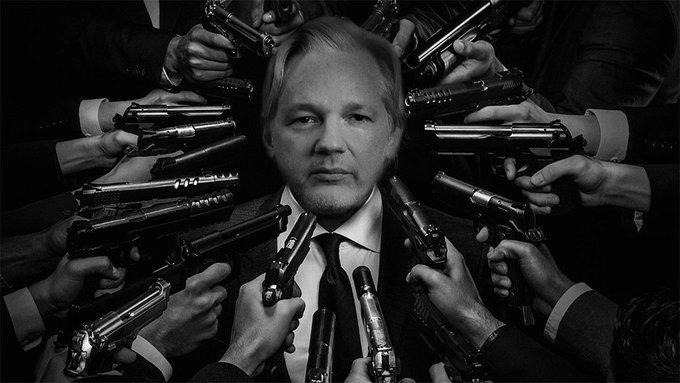
Assange exposed “a very serious pattern of actual war crimes,” Daniel Ellsberg tells extradition hearing https://www.wsws.org/en/articles/2020/09/17/ells-s17.html, By Thomas Scripps, 17 September 2020Daniel Ellsberg gave powerful testimony to the Julian Assange extradition hearing yesterday, speaking via videolink to London’s Old Bailey. Ellsberg’s release of the top-secret Pentagon Papers in 1971 exposed the US government’s lies and criminality in the Vietnam War. “[T]he Afghan war was immediately recognisable as what might be called ‘Vietnam-istan.’ It was a rerun of the Vietnam war despite the great differences in terrain, in religion, in language … [T]he basic nature of the war, as basically an invasion and occupation of a foreign country against the wishes of most of its inhabitants, was the same. And that meant the prospects were essentially the same, which were for an endless stalemate which we’ve now experienced in Afghanistan for 19 years. And it might have gone on that long in Vietnam had not truths that the government was trying to withhold been made public.” Referring to the brutality of these occupations which the WikiLeaks releases uncovered, Ellsberg said, “I saw for the first time in virtually forty years … since the Pentagon papers, the release of a sufficient quantity of documentation to make patterns of decision making [in the war] very evident, to show that there were policies at work and not merely aberrant incidents.” He drew special attention to how the documents had exposed “a very serious pattern of actual war crimes. … In the Afghan case the reports of torture and of assassination and death squads were clearly describing war crimes. I would have, by the way, been astonished to see such reports in Secret level communications [as opposed to Top Secret] in 1971 or 1964 in the Pentagon. They would have been much higher in classification. What these reports revealed was that in the intervening years, in the Iraq War and the Afghan War, torture had become so normalised, and death squads and assassination, that reports of them could be trusted to a network at the Secret level available to … people with low-level clearances.” Ellsberg said of the Iraq “Collateral Murder” video, “We were watching somebody pursue with his machine gun an unarmed man, wounded, crawling for safety. … I was very glad that the American public was confronted with this reality of our war.” Speaking on the significance of the WikiLeaks releases, Ellsberg said, “It was clear to me that these revelations, like the Pentagon papers, had the capability of informing the public that they had been seriously misled about the nature of the [Iraq and Afghan] war[s], the progress of the war, the likelihood that it would be ended successfully or at all, and that this was information of the highest importance to the American public.” Characterising the wars that WikiLeaks exposed, Ellsberg explained, “The Iraq war was clearly recognisable, even to a layman, as a crime against the peace, as an aggressive war.” Continue reading |
Following the UK court hearing on the extradition of Julian Assange
 Your Man in the Public Gallery – Assange Hearing Day 8, Craig Murray September 10, 2020 The great question after yesterday’s hearing was whether prosecution counsel James Lewis QC would continue to charge at defence witnesses like a deranged berserker (spoiler – he would), and more importantly, why?
QC’s representing governments usually seek to radiate calm control, and treat defence arguments as almost beneath their notice, certainly as no conceivable threat to the majestic thinking of the state. Lewis instead resembled a starving terrier kept away from a prime sausage by a steel fence whose manufacture and appearance was far beyond his comprehension.
Perhaps he has toothache.
PROFESSOR PAUL ROGERS
The first defence witness this morning was Professor Paul Rogers, Emeritus Professor of Peace Studies at the University of Bradford. He has written 9 books on the War on Terror, and has been for 15 years responsible for MOD contracts on training of armed forces in law and ethics of conflict. Rogers appeared by videolink from Bradford.
Prof Rogers’ full witness statement is here.
Edward Fitzgerald QC asked Prof Rogers whether Julian Assange’s views are political (this goes to article 4 in the UK/US extradition treaty against political extradition). Prof Rogers replied that “Assange is very clearly a person of strong political opinions.”
Fitzgerald then asked Prof Rogers to expound on the significance of the revelations from Chelsea Manning on Afghanistan. Prof Rogers responded that in 2001 there had been a very strong commitment in the United States to going to war in Afghanistan and Iraq. Easy initial military victories led to a feeling the nation had “got back on track”. George W Bush’s first state of the union address had the atmosphere of a victory rally. But Wikileaks’ revelations in the leaked war logs reinforced the view of some analysts that this was not a true picture, that the war in Afghanistan had gone wrong from the start. It contradicted the government line that Afghanistan was a success. Similarly the Wikileaks evidence published in 2011 had confirmed very strongly that the Iraq War had gone badly wrong, when the US official narrative had been one of success.
Wikileaks had for example proven from the war logs that there were a minimum of 15,000 more civilian deaths than had been reckoned by Iraq Body Count. These Wikileaks exposures of the failures of these wars had contributed in large part to a much greater subsequent reluctance of western powers to go to war at an early stage.
Fitzgerald said that para 8 of Rogers’ report suggests that Assange was motivated by his political views and referenced his speech to the United Nations. Was his intention to influence political actions by the USA?
Rogers replied yes. Assange had stated that he was not against the USA and there were good people in the USA who held differing views. He plainly hoped to influence US policy. Rogers also referenced the statement by Mairead Maguire in nominating Julian for the Nobel Peace Prize:
Julian Assange and his colleagues in Wikileaks have shown on numerous occasions that they are one of the last outlets of true democracy and their work for our freedom and speech. Their work for true peace by making public our governments’ actions at home and abroad has enlightened us to their atrocities carried out in the name of so-called democracy around the world.
Rogers stated that Assange had a clear and coherent political philosophy. He had set it out in particular in the campaign of the Wikileaks Party for a Senate seat in Australia. It was based on human rights and a belief in transparency and accountability of organisations. It was essentially libertarian in nature. It embraced not just government transparency, but also transparency in corporations, trade unions and NGOs. It amounted to a very clear political philosophy. Assange adopted a clear political stance that did not align with conventional party politics but incorporated coherent beliefs that had attracted growing support in recent years.
Fitzgerald asked how this related to the Trump administration. Rogers said that Trump was a threat to Wikileaks because he comes from a position of quite extreme hostility to transparency and accountability in his administration. Fitzgerald suggested the incoming Trump administration had demonstrated this hostility to Assange and desire to prosecute. Rogers replied that yes, the hostility had been evidenced in a series of statements right across the senior members of the Trump administration. It was motivated by Trump’s characterisation of any adverse information as “fake news”.
Fitzgerald asked whether the motivation for the current prosecution was criminal or political? Rogers replied “the latter”. This was a part of the atypical behaviour of the Trump administration; it prosecutes on political motivation. They see openness as a particular threat to this administration. This also related to Trump’s obsessive dislike of his predecessor. His administration would prosecute Assange precisely because Obama did not prosecute Assange. Also the incoming Trump administration had been extremely annoyed by the commutation of Chelsea Manning’s sentence, a decision they had no power to revoke. For that the prosecution of Assange could be vicarious revenge.
Several senior administration members had advocated extremely long jail sentences for Assange and some had even mooted the death penalty, although Rogers realised that was technically impossible through this process.
Fitzgerald asked whether Assange’s political opinions were of a type protected by the Refugee Convention. Rogers replied yes. Persecution for political opinion is a solid reason to ask for refugee status. Assange’s actions are motivated by his political stance. Finally Fitzgerald then asked whether Rogers saw political significance in the fact that Assange was not prosecuted under Obama. Rogers replied yes, he did. This case is plainly affected by fundamental political motivation emanating from Trump himself.
James Lewis QC then rose to cross-examine for the prosecution. His first question was “what is a political opinion?” Rogers replied that a political opinion takes a particular stance on the political process and does so openly. It relates to the governance of communities, from nations down to smaller units………. https://www.craigmurray.org.uk/?fbclid=IwAR1SSVvRVbh8_y-5pargeR-U2E6JHQDcGUq_752VyejbktpjIbMY-g-MdnA
A legal win for Adani, against climate activist Ben Pennings
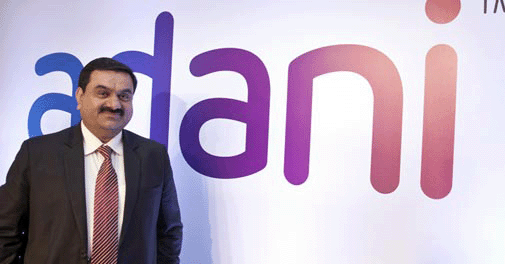 Adani granted injunction to stop activist Ben Pennings using ‘confidential material’ABC 11 Sept 20, Mining giant Adani has been granted an injunction ordering an activist to stop using “confidential material” it claims is frustrating the development of its mine and rail network in the Galilee Basin.
Key points:
- The legal action is against Brisbane activist Ben Pennings
- Mr Pennings is accused of demanding contractors to cease working with Adani
- Justice Martin found the “Stop Adani” movement had caused at least three contractors to withdraw
Adani launched legal action in the Supreme Court in Brisbane against activist Ben Pennings, claiming he had continually demanded contractors who had agreements with the mining company to terminate or withdraw from negotiations.
Adani also argued Mr Pennings would encourage others to provide confidential information to an ongoing campaign —The Galilee Blockade — concerning plans and operations at the site.
Today’s order comes after Adani twice failed to secure a search order to seize evidence from Mr Penning’s home.
Activist accused of ‘intimidation and conspiracy’
Outside court, Mr Pennings said he would respect the court’s injunction but was “very concerned” about ongoing civil action in which Adani accused Mr Pennings of a “breach of confidence, inducing breach of contract, intimidation and conspiracy”.
“I have a family at home, kids, a kid with a disability,” Mr Pennings said.
“If Adani is successful with their civil action, I’ll have to sell my house, and that’s really difficult for my family, but Adani seem determined to hurt me.
“I don’t believe I should have to sell my suburban family home in Aspley to make an Indian multi-billionaire even richer.
“The ‘Stop Adani’ movement is massive. I’m just one passionate person. They really can’t sue all of us.”………. https://www.abc.net.au/news/2020-09-11/adani-granted-court-injunction-ben-pennings-galilee-basin/12654486
Professor Paul Rogers – a witness explaining how Julian Assange is to be extradited for POLITICAL REASONS
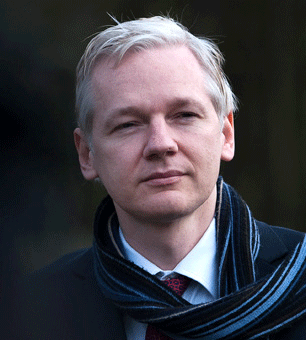 Julian Assange clearly political, says extradition trial witness, https://www.theaustralian.com.au/world/julian-assange-clearly-political-says-extradition-trial-witness/news-story/735ef7d40551d52f4f7f12d9d6c318d7 JACQUELIN MAGNAY, FOREIGN CORRESPONDENT@jacquelinmagnay, THE TIMES, SEPTEMBER 10, 2020
Julian Assange’s nomination for the Senate during the 2013 federal election campaign and the establishment of the WikiLeaks political party the year before “clearly shows’’ the WikiLeaks founder has a political view and a libertarian standpoint, a witness has told the Old Bailey.
Professor Paul Rogers, the emeritus professor of peace studies at Bradford University, was called as a witness by Assange’s team to persuade the judge that Assange is being targeted for political means, and thus an extradition to the US should not be permitted under the Anglo-US extradition treaty.
In day three of the court hearing where Assange, 49, is objecting to extradition to the US, Professor Rogers said in written testimony that Assange’s expressed views, opinions and activities demonstrate very clearly “political opinions”. He cited how Assange had formed the political party to contest the Australian general election and “central of this is his view to put far greater attention to human rights’’.
He added: “The clash of those opinions with those of successive US administrations, but in particular the present administration which has moved to prosecute him for publications made almost a decade ago, suggest that he is regarded primarily as a political opponent who must experience the full wrath of government, even with suggestions of punishment by death made by senior officials including the current President.’’
But US prosecutor James Lewis QC said: “Assistant US Attorney Gordon D. Kromberg explicitly refutes that this is a political prosecution but rather an evidence-based prosecution.’’
In documents to the court, the prosecution says the investigation into Assange had been ongoing before the Trump administration came into office.
“Assange’s arguments are contradicted by judicial findings, made in the US District Court of the District of Columbia, that the investigation into the unauthorised disclosure of classified information on the WikiLeaks website remained ongoing when the present administration came into office,” the prosecution says.
Mr Lewis added: “If this was a political prosecution, wouldn’t you expect him to be prosecuted for publishing the collateral murder video?’’https://www.theaustralian.com.au/world/julian-assange-clearly-political-says-extradition-trial-witness/news-story/735ef7d40551d52f4f7f12d9d6c318d7
He said Assange was being extradited to face charges relating to complicity in illegal acts to obtain or receive voluminous databases of classified information, his agreement and attempt to obtain classified information through computer hacking; and publishing certain classified documents that contained the unredacted names of innocent people who risked their safety and freedom to provide information to the United States and its allies, including local Afghans and Iraqis, journalists, religious leaders, human rights advocates, and political dissidents from repressive regimes.
Professor Rogers told the court the motivation of Assange and WikiLeaks was to achieve greater transparency and was political. The trial continues.
INJUSTICE at work? The extradition trial of Julian Assange
|
UK: Assange extradition hearing will be a key test for UK and US justice https://www.amnesty.org/en/latest/news/2020/09/uk-assange-extradition-hearing-will-be-a-key-test-for-uk-and-us-justice/?fbclid=IwAR2HY0lPIxV4m0h3u7ikxEmtaJ0m5YxUITtTgqmVViX03L6qsd40vHEwq2Y 4 September 2020 US authorities must drop all charges against Julian Assange relating to his publishing activities, and UK authorities must reject the related US extradition request, said Amnesty International ahead of Julian Assange’s extradition hearing which resumes on Monday and is expected to last several weeks. The hearing will decide on the Trump administration’s request for Julian Assange’s extradition to the US, where he faces a sentence of up to 175 years for publishing materials that document possible war crimes committed by the US military. “This hearing is the latest worrying salvo in a full-scale assault on the right to freedom of expression. If Julian Assange is prosecuted it could have a chilling effect on media freedom, leading publishers and journalists to self-censor in fear of retaliation,” said Amnesty International’s Europe Director, Nils Muižnieks. “If Julian Assange is extradited it will have far reaching human rights implications, setting a chilling precedent for the protection of those who publish classified information in the public interest.” The US extradition request is based on charges that stem directly from the publication of classified documents as part of Assange’s journalistic work with Wikileaks. Publishing such information is a cornerstone of media freedom and the public’s right to access public interest information, and must be protected rather than criminalized. In the US, Julian Assange could face trial on 18 charges, 17 of them under the Espionage Act; and one under the Computer Fraud and Abuse Act. He would also face a real risk of serious human rights violations including detention conditions that could amount to torture or other ill-treatment, including prolonged solitary confinement. Julian Assange is the first publisher to face charges under the Espionage Act. The fact that Assange was the target of a negative public campaign by US officials at the highest levels undermines his right to be presumed innocent and puts him at risk of an unfair trial. “The UK must abide by its obligations under international human rights law, which forbid the transfer of individuals to another country where they would face serious human rights violations,” said Nils Muižnieks. The case will begin at the Old Bailey, London, on the morning (9.30am UK time) of 7 September. Stefan Simanowitz will be outside the court with an Amnesty International spokesperson. Follow @StefSimanowitz for updates and analysis Amnesty will have trial observers monitoring remotely the entire series of hearings. During the first week, Sebastian Elgueta (@sebelgueta), a UK based barrister, will be monitoring. Background: Amnesty International also has concerns with regard to Julian Assange’s physical and mental well-being, particularly with the spread of COVID-19. Conditions in UK prisons and detention centres are substandard. It is imperative that health and safety protocols are put in place to reduce the risk of COVID-19 infection, while ensuring that prisoners’ and detainees’ rights are protected. Bail or release should be considered for any detainee or prisoner who has serious underlying health conditions and is particularly at risk of infection. See Amnesty International’s statement on prison conditions for Assange here |
|
A student is suing the government over the financial risks of climate change
 ‘A wake-up call’: why this student is suing the government over the financial risks of climate change, The
  Conversation
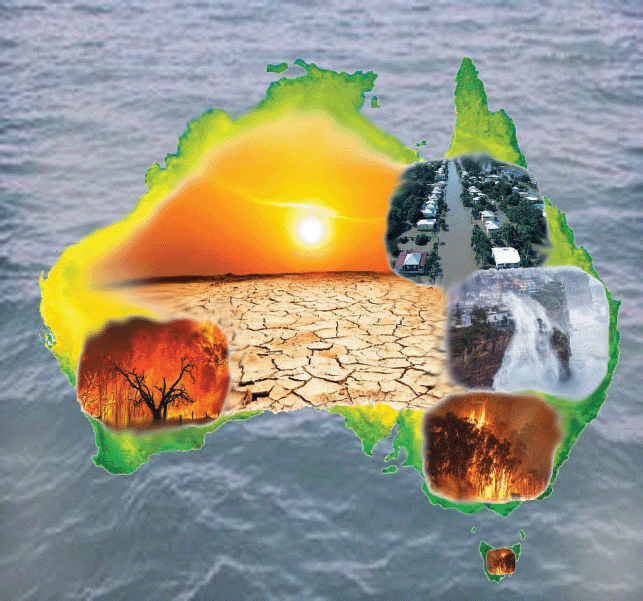
July 27, 2020 Jacqueline Peel Professor of Environmental and Climate Law, University of Melbourne, Rebekkah Markey-Towler, Research assistant, University of MelbourneAs the world warms, the value of “safe” investments might be at risk from inadequate climate change policies. This prospect is raised by a world-first climate change case, filed in the federal court last week.
Katta O’Donnell – a 23-year-old law student from Melbourne – is suing the Australian government for failing to disclose climate change risks to investors in Australia’s sovereign bonds.
Sovereign bonds involve loans of money from investors to governments for a set period at a fixed interest rate. They’re usually thought to be the safest form of investment. For example, many Australians are invested in sovereign bonds through their superannuation funds.
But as climate change presents major risks to our economy as well as the environment, O’Donnell’s claim is a wake-up call to the government that it can no longer bury its head in the sand when it comes to this vulnerability.
O’Donnell’s arguments
O’Donnell argues Australia’s poor climate policies – ranked among the lowest in the industrialised world – put the economy at risk from climate change. She says climate-related risks should be properly disclosed in information documents to sovereign bond investors.
O’Donnell’s claim alleges that by failing to disclose this information, the federal government breaches its legal duty. It alleges the government has engaged in misleading and deceptive conduct, and government officials breached their duty of care and diligence.
This is a standard similar to that owed by Australian company directors. Analysis from leading barristers indicates that directors who fail to consider climate risks could be found liable for breaching their duty of care and diligence.
O’Donnell argues government officials providing information to investors in sovereign bonds should meet the same benchmark.
Climate change as a financial risk….… https://theconversation.com/a-wake-up-call-why-this-student-is-suing-the-government-over-the-financial-risks-of-climate-change-143359
Remote community loses their court fight to get uranium-free drinking water
Key points:
- The tribunal ruled drinking water uranium levels were not the housing department’s responsibility
- The residents were seeking compensation over the contamination and also tap filters to bring their water in line with guidelines
- The tribunal has called for further submissions relating to claims about housing conditions and repairs
Data compiled by the NT’s Power and Water Corporation had shown there were 0.046 milligrams of uranium per litre (mg/L) in the town’s water supply — close to three times the level recommended in national guidelines.
According to Australia’s national guideline, published by the National Health and Medical Council, uranium levels in drinking water should not exceed 0.017 milligrams per litre.
Residents of Laramba, north-west of Alice Springs, lodged a legal case against the landlord, which in this case is the NT’s Department of Housing.
The case was submitted to the NT Civil and Administrative Tribunal (NCAT) in November last year, highlighting problems with not only residents’ drinking water but also housing repairs and conditions in the town.
Residents sought compensation over the uranium contamination and also asked for a filter system on at least one tap in their household kitchens to bring uranium levels in line within Australia’s drinking water guidelines.
But in the NTCAT’s ruling against the residents, the tribunal member Mark O’Reilly said the uranium in the water was not the responsibility of the landlord.
“In my view the landlord’s obligation for habitability is limited to the premises themselves,” the decision read…….
Appeal of NTCAT decision ‘likely’
Daniel Kelly, lawyer assisting for Australian Lawyers for Remote Aboriginal Rights said the result was disappointing and an appeal was likely.
“We’re in the process of speaking to our clients, but our view is — and the views that we’ve been able to garner from our clients are — that we should seek to have this decision reviewed,” Mr Kelly said.
“The decision leaves the question well who is responsible? Because these people have been exposed to uranium in the drinking water for over 10 years.”
“The Department of Housing is doing nothing about it, Power and Water is doing nothing about it and the Northern Territory Government is doing nothing about it.”
In a statement to the ABC, the NT Department of Housing said it would not be providing comment as proceedings were ongoing.
In relation to the rest of the Laramba case, involving housing conditions and repairs, the tribunal has called for further submissions. https://www.abc.net.au/news/2020-07-14/nt-community-laramba-lose-legal-battle-over-uranium-in-water/12454206?fbclid=IwAR2Vb6AHk4MlypQI-_s8MMuWSLFCVQOViknD4nXc52RY4-i5NyA767hOHYk
Court action in India against Adani – allegations of ‘coercion, fraud and undue influence’
Adani power plant and coal plans threatened by land owner court action, ABC News, By Stephen Long, 11 July 20
The case filed with the court accuses Adani and its agents of using “coercion, fraud [and] undue influence” to illegally exclude thousands of people affected by the development from a required social impact assessment.
The claimants allege that a key meeting was full of labourers “from far away” who were paid to attend a crucial public hearing about the development and — in conjunction with local police — used brutal force to keep villagers opposed to Adani’s project out.
“Thousands of people gathered to go into the venue site but they were prevented both by the police, who were acting as agents of private company Adani Power Limited, as well as by their security guards,” the writ filed with the court alleges.
“The situation was so bad that the police lathi [baton] charged the affected families. When they tried to attend the public hearing were beaten mercilessly.”
Residents challenge land acquisition
The court case also challenges the forced takeover of land for the development by the State Government on behalf of Adani.
Under Indian law, a government can only acquire land for a private company if the project is for “public purpose”.
The claimants argue the project does not meet the definition of “public purpose” under the law.
Part of their argument is that the power plant will have few local benefits, since the electricity will all be exported and the coal used to generate the power will all be imported — largely from Australia.
“It is crystal clear from the various documents of Adani Power Limited that the power which shall be generated from this private project shall be exported to Bangladesh [while] the coal shall be imported from Australia … to Dharma Port and transported to the project covering a distance of around 700km causing immense pollution in transportation.
“Thus, there is not even a semblance of public interest.”….
The irony is that Jharkhand is a resource-rich state, accounting for more than 40 per cent of the mineral resources of India, and the Adani power project is situated amid some of the richest coal deposits in the nation.
Adani’s own Jitpur coal mine is just kilometres away from the project site; when the plant was first proposed five years ago, this was to be the source of the coal.
But those plans rapidly changed, apparently because under Indian law domestic coal cannot be used for thermal power projects that will export electricity to another country.
So, Adani now appears set to transport imported coal vast distances, at extraordinary expense, into a state that is home to the biggest coal reserves in India…….
‘Land is indispensable to a Santhal’
The patriarch of the Adani business empire, Gautam Adani, is one of the richest men in India, while many of the villagers affected by the Godda power project are from the other end of the wealth spectrum.
Some are from the lowest castes in the Hindu religion and others are from an Indigenous tribal group known as the Santhal.
Archaeologists estimate that the Santhal have been in eastern India for up to 65,000 years. Like Aboriginal Australians, they have an ancient and spiritual connection to the land that has long been recognised in legislation.
“Land is indispensable to a Santhal,” a local villager explained to the independent Indian filmmaker who shared her interviews with the ABC.
“It is an intrinsic part of culture. The Santhal tribe and their land are like two sides of one coin. If land exists, Santhal exists, but if the land is taken away it just means they will be totally wiped out.”
The Santhal have a practice of burying their dead in the fields they sow, which become sacred to them.
One of them says: “We belong here, this is our ancestral land. We are buried on our land. We have no problem dying on our land but we will not give it away.”
Santhal land rights have previously been protected under a long-standing law which prohibited industrial development on their farming lands, but the laws have recently been watered down…….
those fighting the project face a race against time; the High Court case, and a separate environmental challenge before India’s National Green Tribunal — scheduled for hearings in early August — will be of no consequence if construction reaches a point where the development becomes a fait accompli.
Curiously, geopolitics is working in favour of the project’s opponents.
Adani has contracts with a Chinese firm for equipment purchases and engineering work on the power plant.
With a border conflict taking India and China close to war, Adani is facing political pressure to terminate the deal, which could further delay or even jeopardise the project. https://www.abc.net.au/news/2020-07-10/adani-godda-power-plant-threatened-by-land-owner-court-action/12439624
Julian Assange’s father in tireless fight to free his son, calls on Scott Morrison to help Australian citizen Julian
Assange’s father calls extradition process ‘disgrace’ https://telanganatoday.com/assanges-father-calls-extradition-process-disgrace?fbclid=IwAR1a7bQ0W_Xcgc9EIeGaAHVP7Zmm2cM6nNV65ZXtkhCwNUlarqIYTJVw6xo1 July 20, The 80-year-old is organizing public events in Australia despite the ongoing coronavirus pandemic and hopes to travel to London in August to support Assange during his extradition trial.
Sydney: WikiLeaks founder Julian Assange’s father, John Shipton, is fighting tirelessly for the release and return of his son, who is facing an extradition trial in London for publishing classified information, a process he described as abuse.
“We maintain that the extradition request is a fraud in the English court… It’s a fraud in the English legal system, it’s a case of abuse of process, it is a disgrace,” Shipton, who travelled from Melbourne to Sydney to campaign for his son’s release, told Efe news in an interview.
The 80-year-old is organizing public events in Australia despite the ongoing coronavirus pandemic and hopes to travel to London in August to support Assange during his extradition trial which, he says, is being carried out under “dire” circumstances.
In May 2019, the UN Special Rapporteur on Torture, Nils Melzer, said, after visiting Assange in the Belmarsh prison along with two medical experts, that he showed “all symptoms typical for prolonged exposure to psychological torture, including extreme stress, chronic anxiety and intense psychological trauma”.
Assange has spent almost a decade in confinement, first under house arrest in a British town and then at the Ecuadorian embassy in London between 2012 until 2019, when Ecuador withdrew his political asylum status.
Shipton has urged the Australian government to mediate with the UK administration for the release of his son, who is wanted in the US on 18 charges of espionage and computer intrusion, for which he could be sentenced to prison for up to 175 years.
“I believe the government can, if it wishes to, assist us in bringing Julian home. I believe that (it) is very simple for the Prime Minister (Scott Morrison) to pick up the phone and ring (his UK counterpart) Boris Johnson and say Julian Assange is an Australian citizen in dire circumstances.
“This will resolve this immediately and that’s easily possible,” he told Efe news during the interview.
USA adds a new indictment to its charges against Julian Assange
WikiLeaks founder Assange faces new indictment in US, By ERIC TUCKER, 29 June 20, WASHINGTON (AP) — WikiLeaks founder Julian Assange sought to recruit hackers at conferences in Europe and Asia who could provide his anti-secrecy website with classified information, and conspired with members of hacking organizations, according to a new Justice Department indictment announced Wednesday.The superseding indictment does not contain additional charges beyond the 18 counts the Justice Department unsealed last year. But prosecutors say it underscores Assange’s efforts to procure and release classified information, allegations that form the basis of criminal charges he already faces.
Beyond recruiting hackers at conferences, the indictment accuses Assange of conspiring with members of hacking groups known as LulzSec and Anonymous. He also worked with a 17-year-old hacker who gave him information stolen from a bank and directed the teenager to steal additional material, including audio recordings of high-ranking government officials, prosecutors say.
Assange’s lawyer, Barry Pollack, said in a statement that “the government’s relentless pursuit of Julian Assange poses a grave threat to journalists everywhere and to the public’s right to know.”
“While today’s superseding indictment is yet another chapter in the U.S. Government’s effort to persuade the public that its pursuit of Julian Assange is based on something other than his publication of newsworthy truthful information,” he added, “the indictment continues to charge him with violating the Espionage Act based on WikiLeaks publications exposing war crimes committed by the U.S. Government.”
Assange was arrested last year after being evicted from the Ecuadorian Embassy in London, where he had sought refuge to avoid being sent to Sweden over allegations of rape and sexual assault, and is at the center of an extradition tussle over whether he should be sent to the United States.
The Justice Department has already charged him with conspiring with former U.S. Army intelligence analyst Chelsea Manning in one of the largest compromises of classified information in U.S. history by working together to crack a password to a government computer.
Prosecutors say the WikiLeaks founder damaged national security by publishing hundreds of thousands of classified documents, including diplomatic cables and military files on the wars in Iraq and Afghanistan, that harmed the U.S. and its allies and aided its adversaries.
Assange maintains he was acting as a journalist entitled to First Amendment protection. His lawyers have argued the U.S. charges of espionage and computer misuse were politically motivated and an abuse of power.
Assange generated substantial attention during the 2016 presidential election, and in investigations that followed, after WikiLeaks published stolen Democratic emails that U.S. authorities say were hacked by Russian military intelligence officials. An investigation by special counsel Robert Mueller revealed how Trump campaign associates eagerly anticipated the email disclosures. One Trump ally, Roger Stone, was found guilty last year of lying about his efforts to gain inside information about the emails. Assange, however, was never charged in Mueller’s Russia investigation.
The allegations in the new indictment center on conferences, in locations including the Netherlands and Malaysia in 2009, at which prosecutors say he and a WikiLeaks associate sought to recruit hackers who could locate classified information, including material on a “Most Wanted Leaks” list posted on WikiLeaks’ website.
According to the new indictment, he told would-be recruits that unless they were a member of the U.S. military, they faced no legal liability for stealing classified information and giving it to WikiLeaks “because ‘TOP SECRET’ meant nothing as a matter of law.”
At one conference in Malaysia, called the “Hack in the Box Security Conference,” Assange told the audience, “I was a famous teenage hacker in Australia, and I’ve been reading generals’ emails since I was 17.”
Assange faces new indictment in US
|
WikiLeaks founder Assange faces new indictment in US, https://apnews.com/218d39782d70c434533b8faa033eb45e By ERIC TUCKER, 26 June 20 WASHINGTON (AP) — WikiLeaks founder Julian Assange sought to recruit hackers at conferences in Europe and Asia who could provide his anti-secrecy website with classified information, and conspired with members of hacking organizations, according to a new Justice Department indictment announced Wednesday. The superseding indictment does not contain additional charges beyond the 18 counts the Justice Department unsealed last year. But prosecutors say it underscores Assange’s efforts to procure and release classified information, allegations that form the basis of criminal charges he already faces. Beyond recruiting hackers at conferences, the indictment accuses Assange of conspiring with members of hacking groups known as LulzSec and Anonymous. He also worked with a 17-year-old hacker who gave him information stolen from a bank and directed the teenager to steal additional material, including audio recordings of high-ranking government officials, prosecutors say. Assange’s lawyer, Barry Pollack, said in a statement that “the government’s relentless pursuit of Julian Assange poses a grave threat to journalists everywhere and to the public’s right to know.” “While today’s superseding indictment is yet another chapter in the U.S. Government’s effort to persuade the public that its pursuit of Julian Assange is based on something other than his publication of newsworthy truthful information,” he added, “the indictment continues to charge him with violating the Espionage Act based on WikiLeaks publications exposing war crimes committed by the U.S. Government.” Assange was arrested last year after being evicted from the Ecuadorian Embassy in London, where he had sought refuge to avoid being sent to Sweden over allegations of rape and sexual assault, and is at the center of an extradition tussle over whether he should be sent to the United States. The Justice Department has already charged him with conspiring with former U.S. Army intelligence analyst Chelsea Manning in one of the largest compromises of classified information in U.S. history by working together to crack a password to a government computer. Prosecutors say the WikiLeaks founder damaged national security by publishing hundreds of thousands of classified documents, including diplomatic cables and military files on the wars in Iraq and Afghanistan, that harmed the U.S. and its allies and aided its adversaries. Assange maintains he was acting as a journalist entitled to First Amendment protection. His lawyers have argued the U.S. charges of espionage and computer misuse were politically motivated and an abuse of power. Assange generated substantial attention during the 2016 presidential election, and in investigations that followed, after WikiLeaks published stolen Democratic emails that U.S. authorities say were hacked by Russian military intelligence officials. An investigation by special counsel Robert Mueller revealed how Trump campaign associates eagerly anticipated the email disclosures. One Trump ally, Roger Stone, was found guilty last year of lying about his efforts to gain inside information about the emails. Assange, however, was never charged in Mueller’s Russia investigation. The allegations in the new indictment center on conferences, in locations including the Netherlands and Malaysia in 2009, at which prosecutors say he and a WikiLeaks associate sought to recruit hackers who could locate classified information, including material on a “Most Wanted Leaks” list posted on WikiLeaks’ website. According to the new indictment, he told would-be recruits that unless they were a member of the U.S. military, they faced no legal liability for stealing classified information and giving it to WikiLeaks “because ‘TOP SECRET’ meant nothing as a matter of law.” At one conference in Malaysia, called the “Hack in the Box Security Conference,” Assange told the audience, “I was a famous teenage hacker in Australia, and I’ve been reading generals’ emails since I was 17.” |
|
Julian Assange’s fiancé calls on the Australian government to secure his freedom
|
Julian Assange’s fiancé calls on the Australian government to secure his freedom, https://www.wsws.org/en/articles/2020/06/22/assa-j22.html, By Oscar Grenfell, 22 June 2020Stella Morris, the fiancé of Julian Assange and mother of his two young children, issued a powerful call last night for the Australian government to secure the WikiLeaks founder’s freedom and prevent his extradition to the US, where he faces life imprisonment for exposing American war crimes.
Morris was featured on Channel Nine’s “60 Minutes” program. The 24-minute segment provided an objective account of Assange’s decade-long arbitrary detention, first in Ecuador’s London embassy where he was a political refugee, and since April 2019 in the maximum-security Belmarsh Prison. The program, presented by Tara Brown, was the first substantive examination of Assange’s plight by the Australian media since the coronavirus pandemic began. Despite the fact that he is an Australian journalist being persecuted by the most powerful governments in the world for his publishing activities, corporate media outlets have maintained an effective D-notice on Assange for more than three months. This has dovetailed with the refusal of the Australian government, the Labor opposition and all of the official parties to defend the WikiLeaks founder. Morris warned that Assange’s incarceration in Belmarsh, which she noted has been dubbed the “UK’s Guantanamo Bay,” is exacerbating physical and psychological health issues stemming from his protracted persecution. “He’s very unwell and I’m very concerned for his ability to survive this,” she said. “Now he’s in the UK’s worst prison. It’s a high-security prison. One in five prisoners are murderers. He shouldn’t be there. He’s not a criminal, he’s not a dangerous person, he’s a gentle intellectual thinker and a journalist. Those people are not the people who belong in prison.” Morris stated that she was “very worried” about Assange’s circumstances. She has been unable to visit him since February, as a result of coronavirus lockdown measures. Despite widespread infections throughout the British penitentiary system, including in Belmarsh, and Assange’s vulnerability to the virus as a result of a chronic lung condition, he has been refused bail. “If you’re separated from your family and you’re alone in a tiny, dark room for 23-hours a day, with no control over your surroundings, I think people can imagine what that is like,” Morris said. Brown stated that in such circumstances, “most people would probably go mad.” Morris responded: “I think any person would get very severely depressed and he is very depressed.” “60 Minutes” showed Morris and her two young children speaking with Assange on the phone. The older of the two asked Assange when he was coming home. Morris, a 37-year-old lawyer, recounted the circumstances of her relationship with Assange. They had grown close when she was working on his legal cases after he had successfully sought political asylum in the Ecuadorian embassy. When the couple’s two children were born in 2017 and 2018, the new Ecuadorian government had initiated closer relations with the US and was increasingly hostile to Assange. UC Global, a Spanish firm contracted to manage the embassy’s security, was surveilling every aspect of Assange’s life and was passing the the material gathered to the US Central Intelligence Agency. When she fell pregnant, Morris informed Assange by writing the news on a piece of paper. They were fearful that any conversation about their personal life would be picked up by the audio recording devices placed throughout the embassy by UC Global. Morris sought to hide her pregnancies from the embassy staff and after the children were born, a friend of Assange pretended to be their father and brought them to the embassy. “The real issue was I thought that our family would be targeted by the same people that were trying to harm Julian,” Morris stated. The program featured news clips of senior US government figures denouncing Assange in hysterical terms and calling for him to be silenced. Morris noted that UC Global had considered stealing the diaper of one of her children to confirm his paternity, and had even discussed plans to kill Assange or allow American agents to kidnap him. Morris commented that it would be difficult for many people to appreciate the lawlessness that had characterised Assange’s persecution. “There’s incredible criminality that has been going on in order to gather information about Julian’s lawyers, and his family, and journalists who were visiting him,” she said. “I’ve been in a permanent state of fear for years and now it’s slowly playing out.” Significantly, the politically-motivated character of Swedish sexual misconduct allegations against Assange was made clear in the program. The allegations were concocted by that country’s police and judiciary, in the midst of a frenzied US campaign against WikiLeaks’ exposure of war crimes in Iraq and Afghanistan. Brown noted that Assange had never been charged with a crime in Sweden, and that the Swedish investigation had been dropped. Australian independent parliamentarian Andrew Wilkie pointed out that documents had shown that the British government used the allegations to enforce Assange’s arbitrary detention in the Ecuadorian embassy. The British authorities had been aware that the Swedish claims were a smokescreen for plans to dispatch Assange to his US persecutors. The program concluded with an appeal from Morris to the Australian government. She said: “I want people to understand that we’re being punished as a family. It’s not just Julian in the prison. The kids are being deprived of their father. I need Julian and he needs me.” Morris declared: “I’d like to ask [Australian Prime Minister] Scott Morrison to do everything he can to get Julian back to his family. If Australia doesn’t step in I’m very fearful this wrong won’t be righted. It’s a nightmare.” Tellingly, Brown stated that Morrison, Foreign Minister Marise Payne and Christian Porter refused to be interviewed. This was in line with the ten-year collaboration of Australian governments in the US-led vendetta against Assange. Beginning with the Greens-backed Labor government of Julia Gillard, they have rejected calls to defend the WikiLeaks’ founder, instead participating in the campaign against him. The official hostility to Assange is bound up with the Australian ruling elite’s unconditional support for the US military alliance and all of American imperialism’s illegal wars and military preparations and dovetails with a domestic assault on democratic rights, including attacks on press freedom and laws increasing punishments for whistleblowers. It is facilitated by the refusal of the Greens, the pseudo-left groups and the unions to mount any campaign for Assange’s rights. This underscores the fact that the fight for Assange’s freedom and for the defence of all civil liberties requires the mobilisation of the working class. The international protests over recent weeks against police violence have demonstrated the objective basis for building such a movement. |
|
Desmond Menz – Constitutional problems in Nuclear Waste Bill – could lead to High Court case?

why ultimately was South Australia the only state to contain the final three sites?
A tiny community poll seems to have informed the final decision, and contradicts the Minister’s stated position of “broad community support”. Just 0.037% of the voting public in SA have had a say.
why did South Australia become the only state to be chosen for the nuclear waste site, knowing that a Citizens Jury in 2016 had rejected a major nuclear waste storage industry in South Australia following the outcomes of the Nuclear Fuel Cycle Royal Commission? The Citizens Jury was substantially more representative of the views of the people of SA, in comparison with the very small poll of the eligible residents of the District Council of Kimba..
former Minister Canavan’s snap decision? The decision on site selection was announced on Saturday morning 1 February 2020, and by the afternoon Senator Canavan had resigned
Desmond Menz SUBMISSION TO ECONOMICS LEGISLATION COMMITTEE OF THE
AUSTRALIAN PARLIAMENT ON THE National Radioactive Waste Management Amendment (Site Specification, Community Fund and Other Measures) Bill 2020 Submission 13
In September 2019 ….I raised critical concerns about the validity of the National Radioactive Waste Management Act 2012 (NRWM Act) in relation to the Australian Constitution, and also the lawfulness of the process about site selection. I also raised concerns about breaches of South Australian law. It seems that my concerns were either ignored or dismissed. I again raise these critical matters for the attention of the Economics Legislation Committee. If they are not responded to, then it would not be too much a stretch of the imagination to have them resolved in a higher court of law, quite possibly the High Court of Australia. In my view, the Economics Legislation Committee should not make any decision on the Amendment Bill until all issues I have countenanced have been resolved.
Main Concerns
1.It is contended that inconsistency between the federal National Radioactive Waste Management Act 2012 (NRWM Act) and the South Australian Nuclear Waste Storage (Prohibition) Act 2000 (NWSP Act) (and other similar state/territory laws), has been manufactured by the Australian Parliament. This is a serious issue, and one that not even the Senate Standing Committee for the Scrutiny of Bills has acknowledged. It is incomprehensible why this matter was not addressed way back in 2010 during the establishment of the NRWM Act.
It is also contended that there are Constitutional matters that need to be resolved to affirm the safety of the federal law, including the Amendment Bill, because at the moment there are sufficient concerns relating to inconsistency between federal and state laws to inhibit the lawful and constitutional passage of the Amendment Bill. [here he gives an example from a previous High Court case]……… Continue reading
Injustice of UK court process regarding Julian Assange. Assange too sick to attend
2. In addition to other ongoing health concerns, Assange faces the serious risk of exposure to Covid in Belmarsh prison, and has been advised that even going to the video room to take part in hearings is unsafe. This is another reason he should be immediately released.
3. Assange’s lawyers have long complained they have had insufficient access to him in prison. Under lockdown conditions, they have had no access to him at all. They have repeatedly flagged that this lack of access seriously impacts their ability to prepare his defence.
4. One of the next steps agreed today is that psychiatric reports on Assange from the prosecution and defence will be due to the court on 31 July. Remember that UN Special Rapporteur @NilsMelzer has expressed alarm many times that Assange shows symptoms of psychological torture.
5. It is a welcome step that the continuation of the full extradition hearing was adjourned, as lockdown conditions present clear barriers to open justice – but 7 September may not be late enough to make a meaningful difference. Also the court is still struggling to find a venue.
6. It remains extremely frustrating that the court does not adequately accommodate NGO observers. I have never experienced so much difficulty accessing a trial in any country as at Woolwich Crown Court in February, and the teleconference option we now have is far from sufficient.
7. The press are also facing severe restrictions. Only 6 journalists have been allowed to attend in person the past 2 hearings, with others limited to the awful phone line. This case is of high public interest and a better solution must be found before the full hearing resumes.
8. Assange’s next callover hearing has been scheduled for 29 June at 10 am. We urge the court to find workable solutions to enable his safe attendance and ensure the press and observers are able to properly monitor proceedings. /END
The push to weaken Australia’s law regulating the uranium industry, in the review of Environmental Protection and Biodiversity Conservation (EPBC) Act

Uranium, extinction, expedited approvals and extreme risks: the need for stronger environmental laws, https://www.onlineopinion.com.au/view.asp?article=20887
| By Mia Pepper – 14 May 2020 |
This year a Review Committee is examining the cornerstone of Australia’s environmental laws – the Environmental Protection and Biodiversity Conservation (EPBC) Act 1999. This review comes hot on the heels of three inquiries into nuclear power driven by conservative politicians and pressure from the nuclear lobby. This cohort are pushing for the removal of laws banning nuclear power, a push the current federal government has already ruled out.
They are also pushing to weaken regulatory requirements for uranium mine assessments through the EPBC Act. There is currently no national prohibition on uranium mining, but prohibitions exist in Victoria, NSW, Queensland, WA, Tasmania and Victoria. SA and the NT have a long and contested history of supplying uranium to fuel nuclear power plants overseas. Uranium from SA and the NT fuelled the Fukushima reactor during the 2011 meltdowns, fires and explosions ‒ a discomforting legacy given that there was ample evidence long before the Fukushima disaster of corruption and inadequate safety standards in Japan’s nuclear industry.
Following the Fukushima disaster the UN Secretary General advised that Australia have “an in-depth assessment of the net cost impact of the impacts of mining fissionable material on local communities and ecosystems.” No such assessment has been carried out. Worse still, the appointment of a former uranium mining company executive to the EPBC Review Committee suggests that there may be some support within the government for a weakening of uranium mining regulations rather than the necessary strengthening.
The reality of uranium mining in Australia has been one of leaks, spills, accidents, license breaches and a failure to rehabilitate. Of the 15 uranium mines that have operated, just two are still mining (Olympic Dam and Beverley Four Mile), one is preparing for closure (Ranger), another is preparing for a second round of rehabilitation failing previous attempts (Rum Jungle), three are on life support in extended care and maintenance; and the remaining sites are all contaminated and require ongoing monitoring and maintenance at the expense of taxpayers.
That track-record strongly suggests the need for greater scrutiny and a strengthening not a weakening of regulations. Proposed changes by the nuclear industry include changing the definition of ‘nuclear actions’ in the EPBC Act to remove the “mining and milling” of uranium. The impact of this would reduce requirements for whole-of-environment assessments for uranium projects and reduce federal oversight. Existing processes desperately need improvement given recent failures around transparency, upholding principles and objects of environmental laws, political influence in decision making, expedited process and unfounded exemptions.
The Ranger uranium mine in the tropical NT, owned by Rio Tinto and operated by ERA, will begin rehabilitation in 2021, a project set to cost in excess of $1 billion. There are ongoing concerns about the funding and adequacy of the proposed rehabilitation. Meeting the regulatory requirement to secure radioactive wastes and other toxins from the environment for 10,000 years is inherently difficult, not least because there is a long history of routine, daily leakage of large volumes of contaminated liquid.
Not far from Ranger, the government-owned Rum Jungle mine has been leaking radioactive and acidic materials into the East Branch of the Finniss River since it was closed in 1971. The NT government has released new plans to remediate the site which is likely to cost in excess of $300 million, but there is still no commitment from the NT or Federal governments to fund this important work.
The legacy threats from uranium mines are unlike the threats from other mines and a repeated failure to contain this waste suggests that mining uranium should be banned, or at the very least have the strictest possible regulations.
There are many other examples of industry and regulatory failure. At the former uranium mine at Radium Hill in SA, the tailings dam was shoddily constructed and was not capped when the mine closed. The Port Pirie uranium treatment plant in SA is still contaminated over 50 years after its closure. SA regulators failed to detect a mining exploration company’s dumping of low-level radioactive waste in the Arkaroola Wilderness Sanctuary. At the Beverley Four Mile in-situ leach uranium mine in SA, contaminated wastewater is routinely dumped in groundwater ‒ a process permitted by regulators who should know better.
In yet another regulatory failure, BHP’s proposal for a new tailing’s facility at its Olympic Dam copper/uranium mine in SA has been fast-tracked without requirements for federal approval. The decision not to assess the new tailings dam came after the Australian National Committee on Large Dams gave three existing tailings dams at Olympic Dam a risk ranking of ‘extreme’ – this ranking is given to tailings facilities that if failed would cause the death of over 100 people. The independent review of tailings followed the Samarco tailings disaster in Brazil, a joint venture project between BHP and Vale, which killed 19 people. The new proposed tailings should be assessed to determine the risk and likelihood of failure; instead, the facility has been fast-tracked avoiding scrutiny under the EPBC Act.
Cameco’s proposed Yeelirrie mine in WA provides another example of unseemly haste and unseemly exemptions. The WA EPA recommended that Yeelirrie not be approved because of the likelihood the mine would cause multiple species extinctions. Despite this recommendation the former State Environment Minister approved the mine weeks before losing his seat and the Liberal party lost Government in the 2017 WA election. In a similar scenario, the mine was given federal approval on the eve of announcing the 2019 federal election. That federal approval followed direct lobbying of Ministers and the Department and resulted in a set of conditions that no longer require the company to prove the mine won’t cause species extinction.
A 2003 report by the federal Senate References and Legislation Committee found “a pattern of underperformance and non-compliance” in the uranium mining industry and it concluded that changes were necessary “in order to protect the environment and its inhabitants from serious or irreversible damage”. The same could be said now. Subsequent reviews of uranium mining regulations in Queensland, WA and Canada identify unique risks with uranium mining and calls for improved and increased regulations that meet those specific challenges and risks.
The push from the industry to weaken regulations should be wholeheartedly rejected and instead the EPBC Committee could consider advice from former UN Secretary General to hold an “in-depth” assessment of the uranium sector and its impacts.
1 This month
7 April – WEBINAR – Australia and the Doomsday Clock – Preventing nuclear war through NoFirstUse and other policies
Online | Tuesday April 7, 4:00-5:30pm, Australian Eastern Time / 8:00-9:30am Central Europe Time
– Access the registration link
15 April – Zoom –Nuclear Power is Not the Solution
Apr 15, 2026 01:00 AM in Canberra, Melbourne, Sydney

Join the International Physicians for the Prevention of Nuclear War (IPPNW) on Tuesday, April 14th for a timely webinar exploring the risks associated with nuclear power and challenging the myth that it offers a simple, safe, carbon-free solution to the climate crisis

21 April Webinar: No Nuclear Weapons in Australia
Start: 2026-04-21 18:00:00 UTC Canberra, Melbourne, Sydney (GMT+10:00)
End: 2026-04-21 19:30:00 UTC Canberra, Melbourne, Sydney (GMT+10:00)
Event Type: Virtual
A virtual link will be communicated before the event.
Host Contact Info: australia@icanw.org

of the week – Australians for War Powers Reform (AWPR)
To see nuclear-related stories in greater depth and intensity
 Antinuclear