Nuclear dump to be built on Defence land

14 March, 2023, Judy Skatssoon
The government has confirmed it will build a high level nuclear dump to deal with waste from its nuclear powered submarine program but says the location is yet to be decided.
Dealing with high level waste on Australian soil is part of the $368 billion AUKUS deal announced on Tuesday, which will see Australia build and operate eight nuclear powered submarines over the next 30 years.
Defence Minister Richard Marles said during a press conference on Tuesday that a purpose-built facility will have to be built to deal with waste generated by the submarines.
He admitted the government is yet to decide where the dump will be located but said it would be ‘quite some time’ before that bridge is crossed.
“There will be a process that we will determine within the next 12 months for how the site will be identified,” Mr Marles said.
“That’s to say we won’t identify the facility in twelve months’ time, but we will set up a process within the next twelve months for how that will be identified. But we’ve got time. We’ve got time to get this right, we’ve got time to identify the facility.”
30-year timeframe for decisions
It would be about 30 years before the first of the nuclear reactors that will power the subs will have to be disposed of, he said.
“So that is the timeframe. We will, in the course of the next year, announce a process by which that site will be identified. We’re not about to identify right now. And there is plenty of time in which to identify.”
He declined to say whether South Australia, where the SSN-AUKUS submarines will be built, or WA, which will eventually be home to the nuclear powered fleet, would be the site of a dump.
However, he indicated it will be on Defence land.
“We are committing to the fact that it will happen on Defence land, be it current Defence land or future Defence land,” the minister said.
He told the ABC the location would need to be remote from populations and geologically stable.
“We’re actually blessed with large parts of the country where that’s possible,” he said.
Spent nuclear reactors
Spent nuclear reactors will produce the highest level of nuclear waste, but this won’t need to be disposed of until after 2050, he said.
The first of those will be from the Virginia Class submarines being procured from the US, which will start operating in the early 2030s, Mr Marles said.
“It’s a significant undertaking to deal with the reactors at the end of their life, and this will require a purpose built facility in order to do that,” he said.
“So that people are clear, we’re talking about the first reactor needing to be dealt with in the 2050s, so this is a long way into the future.
“But we need to be planning for that, and what we’ve made clear today is that within the year we will announce a process by which that place will be identified – so we won’t identify the place in a year, but we’ll announce the process for that and what that facility would look like.”
Mr Marles did not answer questions about how many kilos of highly enriched uranium would need to be disposed of, telling the ABC that information was classified.
Australia was focused on dealing only with it’s own nuclear waste, and not that of its AUKUS partners the US and UK, the minister said.
Chinese official asks if Australia’s Aukus nuclear submarines intended for ‘sightseeing’
Multiple sources present confirm the remark was made, but it is unclear if it was made sarcastically
Daniel Hurst, Guardian, 17 Mar 23,
“……… The comment was made during a briefing held by the Department of Foreign Affairs and Trade on Wednesday at which dozens of representatives from other diplomatic missions were also present.
It is believed to have been made in the context of Beijing’s longstanding claims that the Aukus deal is a breach of either the letter or spirit of the Nuclear Non-Proliferation Treaty (NPT).
One source said a Chinese official at the briefing said words to the effect of: “What are these boats for? Sightseeing?”…….. The Chinese embassy has been contacted for a response.
The Australian government declined to comment………………………….
Australia, the US and the UK argue the NPT regime expressly allows for the transfer of naval nuclear propulsion technology, although they acknowledge this is the first time such a transfer has been made from a nuclear weapons state to a non-nuclear weapons country.
The Aukus partners say they are committed to negotiating a rigorous verification and safeguards package with the International Atomic Energy Agency to set the strongest possible precedent.
China, however, has argued such transfers should only be for peaceful uses.
China – a nuclear weapons state – has put nuclear non-proliferation concerns at the centre of its international campaign against Aukus, knowing that these issues have resonance in south-east Asia and the Pacific.
A Chinese foreign ministry spokesperson said this week that the Aukus countries were trying to “coerce the IAEA secretariat into making safeguards exemption arrangements, which would seriously undermine the authority of the body”…………………………………… more https://www.theguardian.com/world/2023/mar/16/chinese-official-asks-if-australias-aukus-nuclear-submarines-intended-for-sightseeing
AUKUS subs deal binds us to a country that can change its mind on whim
Clinton Fernandes, Academic and former intelligence officer, SMH 18 Mar 23
The AUKUS $368 billion submarine deal announced this week sets Australia on a trajectory from which it will be very difficult to depart.
The deal, in which Australia purchases submarines from the US and UK, means that those countries’ future is now intertwined with ours for decades. The danger is that our defence force winds up as a component of the US armed forces rather than a sovereign force.
The key word here is interoperability: to operate inside the strategy of a superpower by contributing a well-chosen, niche capability to augment the larger force. AUKUS means that the Australian Defence Force will be interoperable, even interchangeable, with US and British forces.
………………. A sub-imperial consciousness is intrinsic to Australian conceptions of security and identity, and remains at the heart of AUKUS, taking precedence over other goals such as defence self-reliance and cost.
Interoperability under AUKUS means that the submarines will be co-built with Britain, based on a British design, using American nuclear propulsion technology, combat systems and weapons……………………………………
Long-term interoperability with the US Navy implies long-term political alignment with the US. Australia has placed a very big bet on two unknowns: that the US’s internal political stability and the US-led global order will endure into the 2070s. We don’t get to vote in US elections, however, and it is obvious that in recent years it has developed a sharply polarised domestic landscape and the prospect of democratic erosion. Australia must take out some form of political insurance in the event we find ourselves tied structurally to an illiberal, unreliable power that changes its stance from one administration to another – something radically different to the America we have long been used to.
Insisting on parliamentary authorisation before military deployments (other than when we’re attacked and must respond in self-defence) is a good way to preserve Australian sovereignty.
….. But wars of choice and other overseas military deployments are an entirely different matter, as other US allies including Norway, Germany and the Netherlands recognise. The Australian parliament and people must remain in control, especially because of the geopolitical traps that lie in wait.
Submarine operations are arguably the most dangerous military operations of all, even in peacetime. Their margin for error is extremely small. A small fire, a flood, or a gas leak can have tragic consequences when you’re 200 metres underwater. Submarines are out of radio contact for extended periods of time. Their commanding officers are uniquely vulnerable to incidents that escalate quickly and seriously because they may be unable to seek guidance and direction from ashore. The diplomatic fallout and geopolitical consequences that result from such incidents can be grave.
“Sovereignty” isn’t just about operational control of a boat but about its principal purpose: in the case of AUKUS, that means fitting into the US combat force aimed at China…………..
Nor can we take for granted the US-led global order persisting into the 2070s. We are at the threshold of an emerging multipolar world order, one very different to the immediate aftermath of World War II, as well as to the US-led unipolar order after the Soviet Union dissolved itself. Our elected representatives must preserve genuine Australian sovereignty and ensure we are not automatically and irreversibly hitched to US objectives far into the future. https://www.smh.com.au/national/aukus-subs-deal-binds-us-to-a-country-that-can-change-its-mind-on-whim-20230316-p5cskq.html
Transparent oceans? Technologies for detection of nuclear submarines will still be all too successful by 2050

Transparent Oceans? The Coming SSBN Counter-Detection Task May Be Insuperable
ANU National Security College https://nsc.crawford.anu.edu.au/publication/16666/transparent-oceans-coming-ssbn-counter-detection-task-may-be-insuperable
Abstract:
A first principles analysis of new technologies and the detection of nuclear-powered ballistic missile submarines (SSBNs).
Authors: Roger Bradbury, Scott Bainbridge, Katherine Daniell, Anne-Marie Grisogono, Ehsan Nabavi, Andrew Stuchbery, Thomas Vacca, Scott Vella and Elizabeth Williams.
This report considers the problem of disruptive changes in the technologies for detection of SSBNs and how they intersect with the growing or continued reliance on submarines for retaliatory nuclear capability. In simple terms, this report answers the question: Will future science and technology make the oceans transparent? It takes a scientific perspective and considers the science and technology issues bearing on ocean sensing and the detection of submarines as anomalies in the water column. This report utilises a time horizon spanning to the 2050s, as the next generation of nuclear-armed submarines will be deployed through the 2030s and beyond. Its analysis identified broad areas of future science and technology – rather than specific ‘hot’ areas of the moment – that might have an impact on submarine detection as well as on counter-detection.
This report makes two strong findings:
- Favourable geographies that the West took advantage of in the Atlantic during the Cold War, and more recently in the Pacific in its strategic rivalry with China, will not have the same salience in the 2050s as during the Cold War.
- The evolution of counter-detection technologies will not have the same salience in the 2050s as it did in earlier times. As a result, by the 2050s, this assessment shows, progress in counter-detection will only reduce the probability of detection from very likely to likely.
Publication file:
 Transparent Oceans? The Coming SSBN Counter-Detection Task May Be Insuperable
Because the U.S. says so – $368 Billion for nuclear subs!
Prime Minister Anthony Albanese has just committed Australia to spending $368 billion on second-hand US Virginia Class submarines, and a follow on build of eight next generation British AUKUS nuclear submarines. It’s a strategic blunder. The Story: https://michaelwest.com.au/i-just-wan… Patreon: https://www.patreon.com/TheWestReport Merch: https://lonelykidsclub.com/new/michae… Facebook: https://www.facebook.com/michaelwest…. Insta: https://www.instagram.com/michaelwest…
Paul Keating savages AUKUS nuclear submarine deal as Labor’s worst since conscription in World War 1

ABC, By political correspondent Brett Worthington. 15 Mar 23,
Former prime minister Paul Keating has taken aim at Australia’s AUKUS nuclear-powered submarine deal with the United States and the United Kingdom, calling it the “worst international decision” by a Labor government since conscription in World War I.
Key points:
- The AUKUS deal will see Australia spend up to $368 billion to acquire nuclear-powered submarines
- Mr Keating has dubbed it one of the worst deals in history
- He insists Australia should draw closer to China than to the United States and the United Kingdom
The former Labor leader also offered a scathing assessment of the government’s most senior politicians, including Prime Minister Anthony Albanese, Defence Minister Richard Marles, and Foreign Affairs Minister Penny Wong, dubbing Mr Marles and Senator Wong “seriously unwise ministers”.
“This week, Anthony Albanese screwed into place the last shackle in the long chain the United States has laid out to contain China,” Mr Keating said in a written statement issued before he addressed the National Press Club on Wednesday.
“No mealy-mouthed talk of ‘stabilisation’ in our China relationship or resort to softer or polite language will disguise from the Chinese the extent and intent of our commitment to United States’s strategic hegemony in East Asia with all its deadly portents.
“History will be the judge of this project in the end. But I want my name clearly recorded among those who say it is a mistake. Who believes that, despite its enormous cost, it does not offer a solution to the challenge of great power competition in the region or to the security of the Australian people and its continent.”
Mr Keating has been critical of the AUKUS defence pact since it was first struck between the three nations 18 months ago.
Mr Albanese met with US President Joe Biden and UK Prime Minister Rishi Sunak in California earlier this week, where they finalised a deal for Australia to buy and build nuclear-powered submarines, costing up to $368 billion over three decades.
Australia will eventually build British-designed nuclear-powered submarines with American combat systems.
Before that happens, Australia will buy at least three US nuclear-powered submarines early next decade — boats that might be second-hand and need US Congressional approval.
The Coalition has endorsed the deal.
“For $360 billion, we’re going to get eight submarines. It must be the worst deal in all history,” Mr Keating said………………………………
Mr Keating dismissed China’s growing military as posing a threat to Australia.
“Let me say this: China has not threatened us,” he said.
Mr Keating, who said he spoke for both Labor politicians and grassroots members who felt they could not speak out, said nothing short of a Chinese naval fleet heading for Australia should be considered a threat.
“We wouldn’t need submarines to sink an armada, an armada of Chinese boats and troop ships,” he told the press club. “We’d just do it with planes and missiles.”……………….. https://www.abc.net.au/news/2023-03-15/paul-keating-anthony-albanese-penny-wong-aukus-nuclear-china/102098142
‘Send it to Woomera’: Premier McGowan cold on nuclear waste being stored in Western Australia
SMH, Hamish Hastie, With Paul Sakkal. March 16, 2023
Western Australia has nominated defence force land in the Woomera prohibited area in South Australia as the best location to store dangerous radioactive waste from Australia’s nuclear submarines.
The premier’s comments add to the growing headache the Albanese government faces over what to do with the spent nuclear reactors from the AUKUS deal submarines once the vessels begin producing them from the mid-2050s.
On Wednesday the leaders of Victoria, Queensland and South Australia all signalled they did not want a nuclear waste facility in their state.
When asked whether he would be happy with a nuclear waste facility set up in WA after a press conference alongside Defence Minister Richard Marles in Perth on Thursday McGowan responded: “no”.
Woomera is a large swath of defence land in the north west of South Australia used as a long-range weapons testing area, including for nuclear weapons, after the second world war.
……………………………. Marles said the government would begin a process to pick a site for the waste within the year and revealed he had “a chat” with McGowan about the issue. But he said it was still early days.
…………… On Wednesday South Australian Premier Peter Malinauskas told ABC Radio the waste should be sorted somewhere safe but that didn’t mean it had to be in South Australia……………………
A spokeswoman for Queensland Premier Annastacia Palaszczuk said under no circumstances would the state become a dumping ground for nuclear waste.
WA has a nuclear waste dumping facility in the Goldfields that stores waste with low-level radioactivity including discarded medical imaging machines.
McGowan said this low-level waste was completely different to the radioactivity from spent nuclear reactors from submarines. https://www.smh.com.au/national/send-it-to-woomera-mcgowan-cold-on-nuclear-waste-being-stored-in-wa-20230316-p5csps.html—
Life on a nuclear submarine takes its toll
Do you have what it takes to operate a nuclear submarine?
With nuclear reactors on board there is twice the amount of maintenance compared to diesel-powered submarines and a distinctly different knowledge base.
AFR, Matthew Cranston, 15 Mar 23
Deep in the dark, silent waters of the Pacific and the Atlantic oceans, veteran US nuclear submariners Nirav Patel, Joshua Besser and Brent Sadler have endured what no Australian has yet but soon will – months on end under the sea.
Patel spent four months without surfacing, while Besser and Sadler spent three months. They were in one of the ultra-quiet nuclear submarines operated by the US Navy, which can create its own oxygen and desalinated water, only resurfacing for food.
That ability to spend months under the ocean is one of the biggest advantages of nuclear submarines compared to Australia’s fleet of diesel submarines, which need to resurface frequently to replenish oxygen and battery power.
But living for months under the sea takes its toll. “There is only a finite amount of happiness on board,” Patel says.
“It’s an office without windows, constantly. So if you can stay occupied, you don’t think about it,” he says, noting that daily fire, flooding, weapons and nuclear reactor drills help with focus………………………..
For Joshua Besser, who spent a decade on board nuclear-powered submarines and is now a senior director of nitrogen supply chains at explosives company Dyno Nobel, submarines are for young people.
“It’s definitely a young sailor’s game. The operational tempo is gruelling and deployments are long and arduous,” he says.
………………… A typical operational cycle consists of a six month “work up” where everyone becomes proficient in all watch stations and each department becomes certified in the mission parameters. This is followed by a six months or more deployment to achieve the intended mission. Finally, there is a six-month recovery, repair and maintenance period, he says.
Through all this, chemical amines, used to control the atmosphere, fill the fibres of the submariners’ uniforms worn throughout shifts and while eating their 30-minute meals.
They are only free from them when they take their two-minute showers, their six hours of sleep every two days, or during the extremely rare event of an ocean swim.
“Underway – you can’t tell the smell. When you come home and get off the ship, you can smell the hydraulic fluid, amine and other chemicals impregnated in your clothing and skin.”
Besser says that the level of danger on submarines with nuclear power poses far greater levels of risk than on a conventional submarine. “There are drills on every aspect that could go wrong”, and that creates a much tighter culture with the crew.
…………………. “For nuclear submarines versus diesel conventional subs – there is no comparison regarding sustained speed, electrical power and for advanced sonar systems,” Patel says pointing out yet another difference.
“They truly are hunter/killers.” https://www.afr.com/world/north-america/do-you-have-what-it-takes-to-operate-a-nuclear-submarine-20230214-p5ck9k
Susanne Godden – submission to Senate – the principle of “First do no harm”means – don’t produce toxic nuclear waste.

I urge you to leave the ban in
place.
First do no harm”.
There is no safe way to dispose of radioactive waste material as it remains radioactive for up to 100,000 years!
nuclear power is dangerous, expensive and will be too slow to make the
massive rapid changes necessary to deal with the heating climate emergency.
By Susanne Godden 12 December 2022
I am a concerned citizen from Western Australia, writing in defence of the existing ban on
nuclear power in Australia.
The reasons for my current view are:
“First do no harm”.
o There is no safe way to dispose of radioactive waste material as it remains radioactive for up to 100,000 years! The idea of barrels under the ocean, which must corrode after (at most) decades, is laughable. The only attempt at burial deep underground in America failed, with low-level radiationaffec ting people above ground.
o There is an unacceptable risk of accident on-site or during transfer from mine
to port.
o There is an assumption that Australia has lots of remote vacant land to mine uranium from, build nuclear plants on and dispose of unwanted waste, but this fails to consider indigenous people who live on country and retain deep spiritual ties to their ancestral homeland.
o We have limited ability to track nuclear materials. They could be used to make weapons in other countries that may not be our allies. Let’s aim for peace.
o Any nuclear facility could make Australia a military target.
o Please consider the legacies of Hiroshima & Nagasaki 1945, Three Mile Island
1979, Chernobyl 1986 and Fukushima 2011.
Renewable energy is faster and cheaper
o According to global scientists it is necessary to reduce greenhouse gas
emissions urgently to prevent climate catastrophe.
o Nuclear power infrastructure would take decades to create.
o We have vast quantities of sun and wind to tap into, NOW.
o It does not make sense to start changing our laws to allow nuclear power,
then spend decades building infrastructure, when there is a cheaper and
faster alternative available. The small modular reactors that have been
suggested are not commercially available.
o Workers in the coal and gas industries can be transitioned to renewable
energy jobs for the future; they don’t need jobs in a nuclear industry which
would cause more problems overall.
Unpopular
o Nuclear power is unpopular with most Australians.
In summary, nuclear power is dangerous, expensive and will be too slow to make the
massive rapid changes necessary to deal with the heating climate emergency.
I understand there is currently an energy crisis due to the war in Ukraine and increasing
energy prices, especially on the east coast of Australia, but I urge you to leave the ban in
place. Instead, we can reserve some energy supplies for locals once existing contracts end
and invest in renewable energy backed by battery technology. energy https://www.aph.gov.au/Parliamentary_Business/Committees/Senate/Environment_and_Communications/Nuclearprohibitions/Submissions
Nuclear is the ‘most expensive form of electricity available to humans’: Plibersek
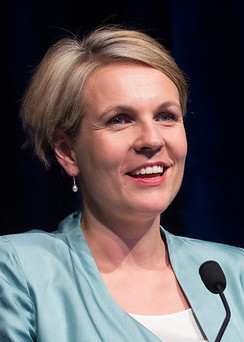
Environment Minister Tanya Plibersek says nuclear energy is the most expensive form of electricity “available to humans”.
“It would take years, potentially decades, to have a domestic nuclear energy arrangement,” Ms Plibersek told Sky News Australia.
“I don’t think anybody wants to live next door to a nuclear reactor.”
Australia hasn’t figured out low-level nuclear waste storage yet – let alone high-level waste from submarines.
The Conversation, Ian Lowe, Emeritus Professor, School of Science, Griffith University, March 15, 2023
.”……………. nuclear submarines mean nuclear waste. And for decades, Australia has failed to find a suitable place for the long-term storage of our small quantities of low and intermediate level nuclear waste from medical isotopes and the Lucas Heights research reactor.
With this deal, we have committed ourselves to managing highly radioactive reactor waste when these submarines are decommissioned – and guarding it, given the fuel for these submarines is weapons-grade uranium.
Where will it be stored? The government says it will be on defence land, making the most likely site Woomera in South Australia.
What nuclear waste will we have to deal with?
Under this deal, Australia will not manufacture nuclear reactors. The US and later the UK will give Australia “complete, welded power units” which do not require refuelling over the lifetime of the submarine.
In this, we’re following the US model, where each submarine is powered by a reactor with fuel built in. When nuclear subs are decommissioned, the reactor is pulled out as a complete unit and treated as waste.
An official fact sheet about this deal states Australia “has committed to managing all radioactive waste generated through its nuclear-powered submarine program, including spent nuclear fuel, in Australia”.
What does this waste look like? When Virginia-class submarines are decommissioned, you have to pull out the “small” reactor and dispose of it. Small, in this context, is relative. It’s small compared to nuclear power plants. But it weighs over 100 tonnes, and contains around 200 kilograms of highly enriched uranium, which is nuclear weapons-grade material.
So, when our first three subs are at the end of their lives – which, according to defence minister Richard Marles, will be in about 30 years time – we will have 600kg of so-called “spent fuel” and potentially tonnes of irradiated material from the reactor and its protective walls. Because the fuel is weapons-grade material, it will need military-scale security.
Australia has no long-term storage facility
There’s one line in the fact sheet which stands out. The UK and US “will assist Australia in developing this capability, leveraging Australia’s decades of safely and securely managing radioactive waste domestically”.
This statement glosses over the tense history of our efforts to manage our much less dangerous radioactive waste.
For decades, the Australian government has been trying to find a single site for disposal of low-level radioactive waste. …………………………………..
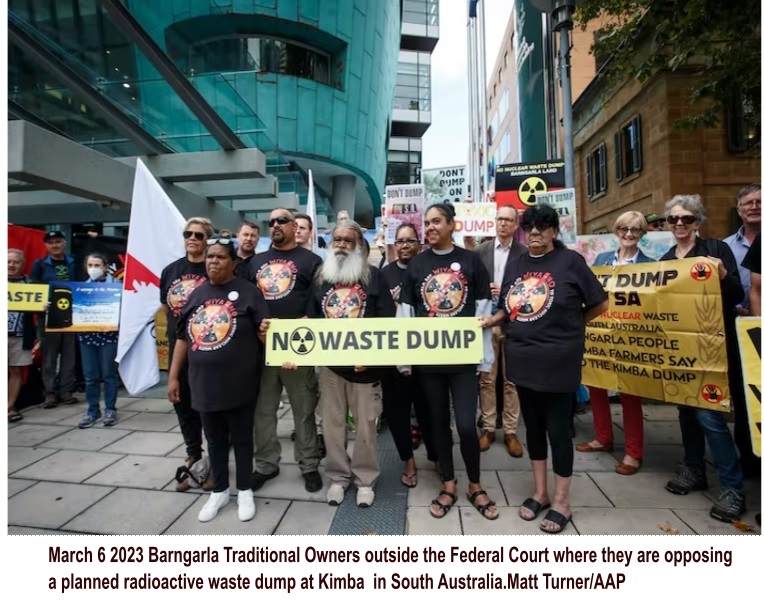
The most recent plans to locate a dump at Kimba, on South Australia’s Eyre Peninsula is still bogged down in the legal system due to opposition by local communities and First Nations groups.
And we’re still dithering about what to do with the intermediate level waste produced by the OPAL research reactor at Lucas Heights in Sydney. At present, spent fuel is sent to France for reprocessing while nuclear waste is now being returned to Australia, where it is held in a temporary store near the reactor.
This waste needs to be permanently isolated from ecosystems and human society, given it will take tens of thousands of years for the radiation to decay to safe levels.
Our allies have not figured out long-term waste storage either
But while Sweden and Finland are building secure storage systems in stable rock layers 500 metres underground, neither the UK nor the US have moved beyond temporary storage.
UK efforts to manage waste from decommissioned nuclear submarines is still at the community consultation stage. At present, high-level waste from sub reactors is removed and taken to Sellafield, a long-established nuclear site near the border with Scotland. But each submarine still holds around one tonne of intermediate level waste, which, according to the UK government, has to be temporarily stored until a long-term underground storage facility is built some time after 2040.
In the US, spent fuel and intermediate waste from nuclear submarines is still in temporary storage. ………. nuclear waste from their military and civilian reactors is just piling up with no long-term solution in sight. Successive administrations have kicked the can down the road, assuring the public a permanent geological disposal site will be developed some time in the future.
This should be concerning. To manage the waste from our proposed nuclear submarines properly, we’ll have to develop systems and sites which do not currently exist in Australia.
In 2016, South Australia’s Royal Commission on nuclear fuel suggested Australia’s geological stability and large areas of unpopulated land would position us well to act as a permanent place to store the world’s nuclear waste.
This hasn’t come to pass in any form. An almost intractable problem is that any proposed site will be on the traditional land of a First Nations group. Every site suggested to date has been opposed by its Traditional Owners.
What if we send the high-level waste overseas for processing and bring it back as less dangerous intermediate waste? It’s possible, given it’s what we already do with waste from the OPAL reactor. But that still leaves us with the same problem: where do you permanently store this waste. That’s one we haven’t solved in the 70 years since Australia first entered the nuclear age with our original HIFAR reactor at Lucas Heights. https://theconversation.com/australia-hasnt-figured-out-low-level-nuclear-waste-storage-yet-let-alone-high-level-waste-from-submarines-201781
Are these wildly expensive nuclear-powered submarines really in Australia’s best interests?
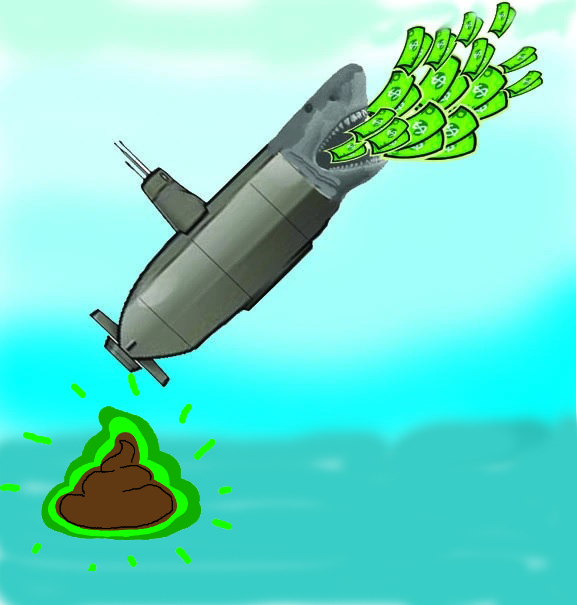
The Monthly, By Rachel Withers 15 Mar 23, As is often the case in politics, the ABC comedy Utopia skewered the situation years ago. In an episode in which the government decided to spend a mind-boggling amount on defence, the gathered strategists would not specify why, and agreed only to nod along when Tony deduced that China was the target, our trade routes were what needed protecting, and that China was our largest trading partner.
“So under this scenario, we’re spending close to $30 billion a year to protect our trade with China… from China,” Tony surmised. In the case of the AUKUS deal, it’s quite clear that China is who we are looking to counter. But it’s still not entirely clear why we are sinking $368 billion into submarines that will, as The Betoota Advocate quips, “halt China’s invasion by 14 hours”. Is it really in Australia’s strategic interests to be poking the dragon, permanently aligning ourselves with the US against a power we could never actually defend ourselves against? Is China really enough of a threat to us that we need to spend $368 billion? Are these wildly expensive nuclear subs necessary, or prudent? Shouldn’t we, I dunno, talk about this a little more before signing away our collective future?
Doubts are continuing to swirl around AUKUS, not least because, as the ABC’s Matt Bevan observes, Australia is “buying stuff to protect us from China, using essentially all the money we get from exporting stuff to China” (“to protect ourselves from missiles made from our raw materials,” added Alan Kohler)……………………………..
Turnbull wasn’t the only former PM refusing to be swept up in the excitement. Former Labor leader and major AUKUS critic Paul Keating did not hold back at the National Press Club today, labelling it the “worst international decision” by his party since Billy Hughes tried to introduce conscription, with several kicks at Penny Wong and Richard Marles, and some vicious comments about the UK and US leaders for good measure.
………………………….. Other experts, meanwhile, have blasted the fact that the AUKUS deal directly benefits the US and the UK governments while Australia takes the main strategic risk; others reckon that our massive subs outlay would be better spent closer to home. “A more sensible approach might be for the AUKUS partners to negotiate with China on an arms control agreement to cap the number of regional nuclear submarines and avoid a hugely expensive arms race for all concerned,” wrote Clive Williams, a former military intelligence officer in the army and a visiting fellow at the ANU’s Strategic and Defence Studies Centre. It’s not that far off The Shovel’s suggestion, which is that we “just pay China $300 billion not to invade”, saving $68 billion.
…………. the fact is, as Curran writes today, “the Morrison and Albanese governments have never fully explained the strategic assessments underpinning AUKUS”. There are serious questions to be asked of this $368 billion deal, including why Scott Morrison, the father of AUKUS, decided to embark on it, and whether it really is in our best interests to pursue. It’s not quite spending $30 billion a year to protect our trade with China from China, as Utopia put it. But we’re certainly going to be spending billions each year to send a message to China, and it remains unclear what exactly that message will be…………………… https://www.themonthly.com.au/the-politics/rachel-withers/2023/03/15/fleeting-interest?utm_medium=email&utm_campaign=The%20Politics%20%20Wednesday%2015%20March%202023&utm_content=The%20Politics%20%20Wednesday%2015%20March%202023%20CID_7e05b98afe6f957b579379e85c950a53&utm_source=EDM&utm_term=Read%20on%20free&cid=7e05b98afe6f957b579379e85c950a53
$200billion nuclear submarine deal could cost the average Australian taxpayer about $13,000.
A $200billion nuclear submarine deal could cost the average Australian
taxpayer about $13,000. This is effectively the equivalent of every
Australian buying a new small car – an astonishing outlay on just a handful
of boats. But experts say the deal – despite the extraordinary price tag –
could be worth every cent.
Daily Mail 13th March 2023
I just want a Ferrari, sorry, a nuclear submarine, no matter the cost
by Rex Patrick | Mar 14, 2023 more https://michaelwest.com.au/i-just-want-a-nuclear-submarine-no-matter-the-cost-aukus/
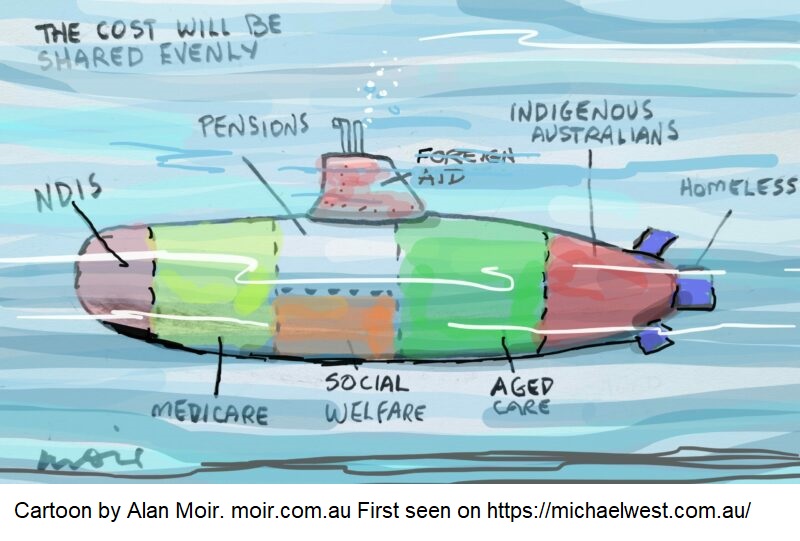
Prime Minister Anthony Albanese has just committed Australia to spending $368 billion on somewhere between three and five second-hand US Virginia Class submarines, and a follow on build of eight next generation British AUKUS nuclear submarines. It’s a strategic blunder, writes former submariner Rex Patrick, and it’s not even going to happen the way the PM has suggested.
I just want a Ferrari. All my mates tell me they’re great cars. Never mind that, financially, I’m already struggling to keep up with the house repayments and, over time, the wife and kids are going to have to miss out on some of life’s niceties and even essentials; no orthodontic treatment to straighten my daughter’s teeth, no tutor to assist my son through extension maths and the wife won’t be able to afford to go back to uni to get her masters.
But I’ll look good cruising down Jetty Road at Glenelg in my shiny red machine. Now, just between you and me, the Ferrari’s not so good for going off-road or towing the family caravan, but hey, otherwise it is a great car.
Nuclear capability
Coming back from my Ferrari dream, it’s true that nuclear submarines are good. I know, because I’ve spent time at sea on them.
There’s nothing like taking the submarine down to 200 metres and turning up the power on the reactor to get to 30 knots, and then staying there, knowing you have almost unlimited power. It allows you to deploy great distances, arriving quickly. That’s important for the power projecting nations that sit as permanent members of the United Nations Security Council; China, France, Russia, the UK and the US all have nuclear submarines.
Our first priority is supposed to be defence of Australia, and our Defence Force should be configured for that, first and foremost. Even those who think we must automatically join the US in a war against China need to understand US strategy and what Australia’s role would likely be.
China depends on imports for 72% of its oil consumption, and the overwhelming majority of China’s oil imports must pass through maritime chokepoints over which the United States has significant influence. China’s dependency is complicated by the fact an overwhelming portion of its energy imports come from its west. 43% of its oil is sourced in the Persian Gulf, 25% from the Gulf of Aden and Africa and 9% from the Americas, with the overwhelming majority of that passing through the Malacca Straits. Security of supply would be a significant weak point in any conflict China finds itself involved in with the US.
In time of conflict the United States Navy, perhaps in conjunction with European or other regional coalition partners, could secure the Straits of Hormuz. India, part of the Quad, could assist with operations from the Persian Gulf through to the Andaman Seas.
Indonesia, Malaysia and, particularly, Singapore would exercise control over the Malacca Straits with Indonesia and Australia jointly responsible for shutting down Chinese oil carriage through Sunda and Lombok (and up through Makassar Straits). With these routes controlled, the only remaining option for China would be to re-direct shipping around Southern Australia.
Australian submarines are not needed in the South China Sea. The US will rely on Japan’s 20 submarines, South Korea’s 23, and Vietnam’s six, and Malaysia’s two and Singapore’s six. Our submarines have a role to play in shutting down the Sunda and Lombok Straits, or Chinese ships passing through Australian waters. This is a role that can be carried out by far less expensive conventional submarines.
The pros and cons of going nuclear
Of course, it’s true to say that it’s handy to have a reactor when you are detected by enemy anti-submarine forces. Speed can be a very useful asset.
The flip side is that smaller conventional submarines are better performers in littoral waters where they can silently lie in wait, lay mines or covertly deploy Special Forces.
Unsustainable price
The purported cost of this program is “up to” $368 billion dollars. That’s an incredible amount of money to spend, and particularly on a single capability.
Australia has $970 billion dollars in gross debt. It will rise to a trillion dollars next financial year. Albanese says that out Defence budget will increase to 2.5% of GDP. That’s an extra $10 billion per annum, on top of a structural deficit of $50 billion a year, already rising to $70 billion.
With Stage 3 tax cuts set to kick in next year, and revenue from coal and gas exports likely to decrease, it hard to work out how AUKUS will be paid for, other than by spending cuts.
Nation building spin
The Government has started to offset concerns about the spend and placate the punter by saying that this is a nation building project. But this is just spin.
Yes, shipbuilding creates trade jobs which can be utilised in a range of different industries other than defence. The same is true for the electronic engineers and software engineers that work on submarine combat systems.
But as for where a lot of workforce investment will take place, it will be in nuclear technology. This investment will not translate into benefits for the Australian economy, because there are no plans for us to have a civil nuclear industry. Even if Australia were to take a decision to go there, the US will not grant the nuclear technology release or transfer approval.
Any investment in a nuclear workforce will be a sunk Defence cost.
Dismantling of our sovereign submarine build capability
We will see an Australian flagged submarine in our waters in the early 2030’s. At that time we will start decommissioning Collins Class submarines and the workforce in Adelaide, who carry out full cycle dockings and life of type extension. That activity will stop, and 700 jobs will go.
The Government tells us that we will start building next generation SSN AUKUS submarines in 2040. But they are wrong. Once the Adelaide workforce is disbanded, we won’t rebuild a submarine build workforce. We will just buy an AUKUS submarine from the UK, or perhaps more US Virginia class boats instead.
Opportunity cost
There is a real tension building to our north. We need to have a Defence Force that can deter and, if that fails, fight.
This multi-billion dollar program will come at a great opportunity cost. What significant other capabilities do we miss out on as we fund this program? In that respect there is tragedy in the way we are moving forward.
Will it happen?
We’ve seen our future submarine go from an Australian “Son of Collins” under Rudd, to a Japanese submarine under Abbot, to a French submarine under Turnbull, to a US and UK submarine under Morrison and Albanese. The reality is that as Governments change moving forward, and that includes in the US and UK, the program will change again. And that’s not to mention significant changes that could take place in our geo-strategic circumstances.
In 2040, when we are purportedly going to start building an AUKUS submarine here in Australia, Anthony Albanese will be 77. You and I will be reading the second edition of his political memoirs, picked up from the discount bin at the front of the local bookstore. There’ll be a different program underway.
I’d love a new Ferrari, but I’d have to pay for it, so it just won’t happen. Unconstrained by the need to pay for it themselves, the Prime Minister, supported by a few Admirals, just wants nuclear submarines.
Australian Strategic Policy Institute among the group of crooked “Think Tanks” funded by weapons companies in order to promote war
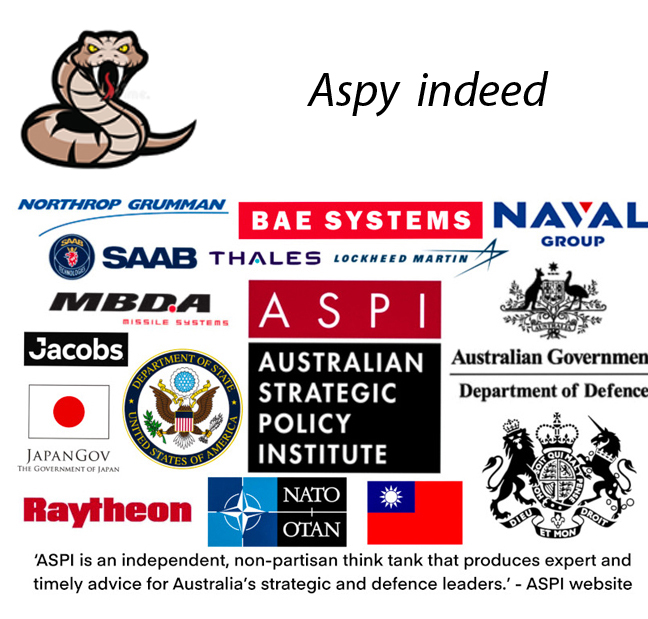
SIX WAR MONGERING THINK TANKS AND THE MILITARY CONTRACTORS THAT FUND THEM

By Amanda Yee, Orinoco Tribune., March 12, 2023 https://popularresistance.org/six-war-mongering-think-tanks-and-the-military-contractors-that-fund-them/
From producing reports and analysis for U.S. policy-makers, to enlisting representatives to write op-eds in corporate media, to providing talking heads for corporate media to interview and give quotes, think tanks play a fundamental role in shaping both U.S. foreign policy and public perception around that foreign policy. Leaders at top think tanks like the Atlantic Council and Hudson Institute have even been called upon to set focus priorities for the House Intelligence Committee. However, one look at the funding sources of the most influential think tanks reveals whose interests they really serve: that of the U.S. military and its defense contractors.
This ecosystem of overlapping networks of government institutions, think tanks, and defense contractors is where U.S. foreign policy is derived, and a revolving door exists among these three sectors. For example, before Biden-appointed head of the Pentagon Lloyd Austin took his current position, he sat on the Board of Directors at Raytheon. Before Austin’s appointment, current defense policy advisor Michèle Flournoy was also in the running for the position. Flournoy sat on the board of Booz Allen Hamilton, another major Pentagon defense contractor. These same defense contractors also work together with think tanks like the Center for Strategic and International Studies to organize conferences attended by national security officials.
On top of all this, since the end of the Cold War, intelligence analysis by the CIA and NSA has increasingly been contracted out to these same defense companies like BAE Systems and Lockheed Martin, among others — a major conflict of interest. In other words, these corporations are in the position to produce intelligence reports which raise the alarm on U.S. “enemy” nations so they can sell more military equipment!

And of course these are the same defense companies that donate hundreds of thousands of dollars each year to think tanks. Given all this, is it any wonder the U.S. government is simultaneously flooding billions of dollars of weaponry into an unwinnable proxy war in Ukraine while escalating a Cold War into a potential military confrontation with China?
The funding to these policy institutes steers the U.S. foreign policy agenda. To give you a scope of how these contributions determine national security priorities, listed below are six of some of the most influential foreign policy think tanks, along with how much in contributions they’ve received from “defense” companies in the last year.
All funding information for these policy institutes was gathered from the most recent annual report that was available online. Also note that this list is compiled from those that make this information publicly available — many think tanks, such as the hawkish American Enterprise Institute, do not release donation sources publicly.
1 – Center for Strategic and International Studies
According to their 2020 annual report
$500,000+: Northrop Grumman Corporation
$200,000-$499,999: General Atomics (energy and defense corporation that manufactures Predator drones for the CIA), Lockheed Martin, SAIC (provides information technology services to U.S. military)
$100,000-$199,999: Bechtel, Boeing, Cummins (provides engines and generators for military equipment), General Dynamics, Hitachi (provides defense technology), Hanwha Group (South Korean aerospace and defense company), Huntington Ingalls Industries, Inc. (largest military shipbuilding company in the United States), Mitsubishi Corporation, Nippon Telegraph and Telephone Corporation (provides intelligence and information technology services to U.S. military), Qualcomm, Inc. (semiconductor company that produces microchips for the U.S. military), Raytheon, Samsung (provides security technology to the U.S. military), SK Group (defense technology company)
$65,000-$99,999: Hyundai Motor (produces weapons systems), Oracle
$35,000-$64,999: BAE Systems
2 – Center for a New American Security
From fiscal year 2021-2022
$500,000+: Northrop Grumman Corporation
$250,000-$499,999: Lockheed Martin
$100,000-$249,000: Huntington Ingalls Industries, Neal Blue (Chairman and CEO of General Atomics), Qualcomm, Inc., Raytheon, Boeing.
$50,000-$99,000: BAE Systems, Booz Allen Hamilton, Intel Corporation (provides aerospace and defense technology), Elbit Systems of America (aerospace and defense company), General Dynamics, Palantir Technologies
3 – Hudson Institute
According to their 2021 annual report
$100,000+: General Atomics, Linden Blue (co-owner and Vice Chairman of General Atomics), Neal Blue, Lockheed Martin, Northrop Grumman.
$50,000-$99,000: BAE Systems, Boeing, Mitsubishi Heavy Industries
The Comprehensive Crisis in the US and the Revolutionary Way Forward
4 – Atlantic Council
According to their 2021 annual report
$250,000-$499,000: Airbus, Neal Blue, SAAB (provides defense equipment)
$100,000-$249,000: Lockheed Martin, Raytheon
$50,000-$99,000: SAIC
5 – International Institute for Strategic Studies
Based in London. From fiscal year 2021-2022
£100,000+: Airbus, BAE Systems, Boeing, General Atomics, Lockheed Martin, Raytheon, Rolls Royce (provides military airplane engines)
£25,000-£99,999: Northrop Grumman Aerospace Systems, Northrop Grumman Corporation
6 – Australian Strategic Policy Institute
Note: ASPI has been one of the primary purveyors of the “Uyghur genocide” narrative
From their 2021-2022 annual report
$186,800: Thales Australia (aerospace and defense corporation)
$100,181: Boeing Australia
$75,927: Lockheed Martin
$20,000: Omni Executive (aerospace and defense corporation)
$27,272: SAAB Australia
1 This month

of the week – Australians for War Powers Reform (AWPR)
To see nuclear-related stories in greater depth and intensity
 Antinuclear