The consequences of a war between the US and China” – Kevin Rudd
The Hon. Kevin Rudd, president and CEO of Asia Society, served as Australia’s 26th Prime Minister from 2007 to 2010, then as Foreign Minister from 2010 to 2012, before returning as Prime Minister in 2013. He discusses major topics of his new book, “The Avoidable War: The Dangers of a Catastrophic Conflict between the US and Xi Jinping’s China” Rudd graduated from the Australian National University with honors in Chinese studies, and is fluent in Mandarin. He also studied at the National Taiwan Normal University in Taipei.
Australia ‘Punctures’ US-UK Nuclear Submarine Proposal Under AUKUS; Says Hi-Tech Arms Better Than Nuke Subs.

Eurasia Times. By Parth Satam, July 11, 2022
Australia’s new Defense Minister Richard Marles’ recent comment about “hi-tech arms” being “more important” than “nuclear submarines” while being in the US to meet his counterpart, Secretary of Defense Llyod Austin, presents a grim future for the Australia-United Kingdom-United States (AUKUS) pact.
This comes amidst Prime Minister Anthony Albanese’s government’s outreach to China, deployment and technical shortcomings with the USS Virginia-class nuclear submarines, and; oversight of the International Atomic Energy (IAEA) regarding the use of nuclear propulsion material some of the dampeners staring at Canberra.
Sky News Australia reported that this was Marles’ first since assuming office, making the statement a significant signal.
The AUKUS deal was announced on September 15 last year under then Prime Minister Scott Morrison in a secret agreement with Washington and London that envisages Australia acquiring at least eight nuclear submarines.
………… the deal’s biggest drawback is the monetary, operational, and technical challenges more than the political repercussions.
Nuclear Submarines Overrated?
The first submarine, which is probably a version of the US Virginia class attack, will not be operationally available until the early 2040s and the last vessel by 2060.
The extended timeline that will leave the Royal Australian Navy without serious undersea capability calls for a stopgap interim arrangement. It could be an improved version of the Swedish-origin Collins-class ship to bridge the looming capability gap.
The Virginia class has been afflicted with maintenance problems and, over the last 33 years, has only performed 15 six-monthly deployments. Conventionally powered submarines are now commonly equipped with air-independent propulsion (AIP), which makes them quieter than nuclear submarines.
The latter must keep their reactor cooling pumps going and use noisy giant meshing gears between the steam turbines and propellers.
Nuclear submarines can also be detected by their constant release of hot water by leaving wakes on the surface when running at high speeds. A section of naval strategists within the US has been making a case for a return to diesel-electric or AIP-powered boats, given the technological improvements that have enhanced their speed, submerged endurance, and diving depths.
Diesel-electrics and AIP SSKs like the Swedish Gotland class or the Indian Navy’s Russian origin Kilo-class have also ‘sank’ US carriers often in exercises. Worse, the nuclear propulsion of the Virginia-class is not suitable in the littoral, shallow waters of the South and East China Seas…..
Naval bases in the first island chain around China like Guam, Subic Bay, Singapore, and Okinawa already provide proximity making attributes like range and endurance irrelevant, making conventional submarines more suited for the task.
The cost of the project also dwarfs Australia’s financial wherewithal. Australia’s defense budget this financial year stood at $48.6 billion.
But the upgraded USS Virginia-class boat that the AUKUS pact promises would be $3.5 billion per unit alone. This doesn’t include the highly sophisticated infrastructure required to maintain the fleet, which will entail additional expenses and having to rely on UK and US support until the facilities are functioning.
While former Australian Prime Minister Scott Morrison had announced that the submarines would be built within the country, the construction of advanced nuclear-powered submarines involves steep learning curves, experience, and transfer of technology costs.
Morrison had announced that the hulls would be fabricated in Australia and then sent to the US to install nuclear propulsion and other components. Only time will tell what will be the order book at overburdened US shipyards like the General Dynamics Electric Boat then.
Nuclear Proliferation Safeguards
Lastly, possible run-ins with the International Atomic Energy Agency (IAEA), the UN’s nuclear watchdog, will likely trigger different diplomatic hurdles. The IAEA prohibits the transfer of fissile material for nuclear purposes, preventing the use of nuclear fuel from Australia’s civil nuclear power plants from diverting it for the nuclear submarines.
Australia may be exempted under Paragraph 14 of the standard pact with the IAEA that allows the transfer of nuclear material for “non-prescribed military activity” like nuclear weapons or explosive nuclear material. But that raises a question of a different standard for Iran, whose IAEA-approved civil nuclear program is heavily monitored and safeguarded.
When the new Australian Foreign Minister Penny Wong has to assure IAEA chief Rafael Grossi about Canberra’s “total commitment” to nuclear non-proliferation, it portends tough nuclear diplomacy. Australia is a signatory of the Nuclear Non-Proliferation Treaty (NPT) and the South Pacific Nuclear Free Zone Treaty (SPNFZT) https://eurasiantimes.com/australia-punctures-us-uk-nuclear-submarine-proposal-under-aukus/
China Reaffirms Support for ASEAN’s Nuclear Weapon-Free Zone
https://jakartaglobe.id/news/china-reaffirms-support-for-aseans-nuclear-weaponfree-zone BY :JAYANTY NADA SHOFA. JULY 11, 2022
Jakarta. China recently pledged to take its ties with ASEAN to greater heights, among others, by backing the Southeast Asian bloc’s nuclear-weapon-free treaty.
China reaffirmed its readiness to ink the protocol to the treaty when its senior diplomat Wang Yi visited the ASEAN Secretariat in Jakarta on Monday.
“We will continue to support ASEAN’s efforts in building a nuclear-weapon-free zone and reaffirm that China is ready to sign the protocol to the Treaty of Southeast Asia Nuclear-Weapon-Free Zone at any time,” Wang Yi said at the ASEAN Secretariat.
According to Wang Yi, over the past years, China has made several historic milestones in its ties with ASEAN, among others, in regard to the country’s support to help keep the Southeast Asian region free of nuclear arms.
“[China was] the first to publicly express its willingness to sign the protocol to the Southeast Asia nuclear-weapon-free zone,” Chinese Foreign Minister Wang Yi said.
In 1995, the ten ASEAN member states, including Indonesia, agreed to a nuclear weapons moratorium treaty known as the Bangkok Treaty.
The protocol for this treaty is open for signature by the five nuclear-weapon states recognized by the Non-Proliferation Treaty, namely China, France, the UK, the US, and Russia.
The protocol obliges its signatories not to use or threaten to use nuclear weapons within the zone or against any state party to the treaty. To date, none of the nuclear-weapon states has penned the protocol.
Chinese President Xi Jinping has pledged to sign the protocol as early as possible. Xi Jinping made this commitment at last year’s China-ASEAN Special Summit, which marked the 30th anniversary of dialogue relations between the two sides.
Labor must reverse Morrison’s submarine bungle to protect nation
https://independentaustralia.net/politics/politics-display/labor-must-reverse-morrisons-submarine-bungle-to-serve-nation,16546 By Alan Austin | 11 July 2022,

There is a niche in the global submarine industry that Australia is well-placed to occupy, reports Alan Austin.
IT WOULD BE a bold move which only a visionary and courageous government could accomplish. Australia has the chance now to reimagine its status as a global naval manufacturer and exporter. The challenge is to build a smaller, faster, stealthier, stronger submarine than its rivals, which requires fewer crew and is cheaper to build and operate.
This can be achieved with a scaled-down version of one of the best submarines ever designed: the Collins class. Where was this built? In South Australia in the 1990s.
This “daughter-of-Collins”, as former Prime Minister Paul Keating dubbed it, offers multiple gains. It will replace the current ageing Collins class more quickly than other options, it will give Australia’s navy boats fit for purpose, it will generate export income and build a springboard for expansion into other high-tech manufacturing. It’s a win-win.
Australia lost its car manufacturing industry during the disastrous Tony Abbott period. Australia’s military procurement suffered badly throughout the later Coalition years due to ineptitude, lack of enterprise and corruption. New submarine construction will restore Australia’s heavy industry capability and recover – eventually – the treasure lost with all those Coalition failures.
The boat for middle-power countries
None of the submarines considered by the previous incompetent Coalition Government is right for Australia.
These were:
- Japan’s Soryu class diesel-electric, 84 meters long, speed of 20 knots submerged, 65 crew. The Abbott Government announced in 2014 that it was buying these but did not proceed;
- France’s Barracuda class nuclear attack submarine, 99.5 meters, speed of 25 knots, 60 crew. The Turnbull Government contracted to buy twelve in 2015. The Morrison Government welched on that deal in 2021, costing Australia its international reputation as an honourable trading partner, compromising Australia’s medium-term security, and losing taxpayers around five billion borrowed dollars with nothing to show for it;
- American Virginia class nuclear-powered fast-attack submarine, 115 metres, speed of 25 knots, 135 crew. Designed in the 1990s, first delivered in 2008;
- Britain’s Astute class, nuclear-powered attack submarine, 97 metres, speed of 30 knots, 98 crew. Designed in the 1990s, first launched in 2007.
Other options include Sweden’s Blekinge class diesel-electric, 66 metres; Germany’s U-36, diesel-electric, 57 meters; and India’s Kalvari class diesel-electric, 67.5 metres.
These compare with the current Australian Collins class, which is 77 metres, speed of 20 knots, crew 42, including six officers.
Assessing Australia’s needs
The new Australian sub should be around 60 metres, diesel-electric, speed 30 knots and operable with a crew of four officers and 25 sailors. This is based on the following needs:
- Given regional stability is steadily improving, Australia can ensure its defence with smarter decisions, more advanced technology, better regional collaboration and much lower expenditure;
- Australia’s immediate neighbours are Papua New Guinea, Timor-Leste, New Zealand, Indonesia and Malaysia. Nuclear submarines are not needed to patrol these waters and cannot access New Zealand ports under laws unlikely to change. Malaysia and Indonesia also have serious misgivings;
- The concept that Australia, population 26 million, could deploy nuclear attack class vessels in the South China Sea or beyond to engage militarily with China, population 1,439 million, is ludicrous. This seems to be the underpinning of the previous Government’s failed endeavours.
- The risk of China attacking Taiwan is limited. Even if it does, Australia has no treaties with Taiwan, and will not be involved;
- The risk of buying American nuclear submarines is that they will be operated and controlled by Americans and effectively just add to the U.S. fleet.
Historical precedent
Building the six Collins class submarines in Australia was an extraordinarily ambitious project. The challenge was to build faster, stealthier and more lethal boats than its successful predecessor, the Oberon class.
Prime Minister Bob Hawke delegated this task to Treasurer Paul Keating and Defence Minister Kim Beasley.
Keating recalled recently that “Kim always had the admiral’s hat on. I had the money and the guns”.
Construction began in 1990 and encountered multiple engineering problems, all of which were eventually overcome. The first boat was delivered in 1996, the sixth in 2003. These will now serve until the mid-2030s.
Military analysts Asianometry recently assessed them as:
‘… very capable, up to par with anything the United States has to offer … The Collins was a triumph.’
Australia can do this
ASC, the government-owned shipbuilders based in Osborne, South Australia, built the Collins vessels and has continual experience maintaining them. It has also successfully delivered three Hobart class destroyers and other vessels.
Home-built submarines superior to Collins are now possible because of advances since the 1990s in metallurgy, engine design, sonar technology and batteries. Weapons systems are also more compact.
Importantly, Australia is one of two major lithium mining countries. Lithium-ion batteries have double the storage capacity of lead-acid batteries. Australia becoming the world’s leading lithium battery producer will be a highly-profitable spin-off.
Can new Defence Minister Richard Marles pull this off? As Deputy PM, he had the choice of portfolios and chose defence. He has put his hand up. Let’s see what he delivers when he dons his admiral’s hat.
South Australia’s enthusiasm
The project has passionate support from the State Government.
Welcoming new Defence Minister Richard Marles to South Australia last week, Premier Peter Malinauskas said:
What the Deputy Prime Minister has been able to see firsthand today is the extraordinary capability that South Australia offers when it comes to shipbuilding. This has been something that is now in our blood here in South Australia. We are the home of the Collins-class submarine. We built the AWDs. We now see firsthand the work in terms of the delivery of the Hunter class.
What should we call this new class of submarines built in Australia? One option is to honour the last of the Coalition defence ministers, whose incompetence has inadvertently gifted the new Government with this shot at greatness.
So why not the Boofhead class? Or in honour of Keating, who remains an inspirational visionary in this area, maybe the Scumbag class?
Perhaps, to recognise the recent historic change of government, the Toto class? Or if the incoming Government succeeds with this ambitious project, as it should, then why not simply the Albo class?
Slow, expensive and no good for 1.5° target: CSIRO crushes Coalition nuclear fantasy.

CSIRO says nuclear is too slow, too expensive, and its best prospects for a significant share of global generation are in weak climate targets. The post Slow, expensive and no good for 1.5° target: CSIRO crushes Coalition nuclear fantasy appeared first on RenewEconomy.
Slow, expensive and no good for 1.5° target: CSIRO crushes Coalition nuclear fantasy — RenewEconomy
Australia’s leading scientific research organisation, the CSIRO, has delivered a damming blow against the renewed push by the federal Coalition for nuclear power, saying it is expensive, and too slow to make a significant contribution to any serious climate targets.
The latest version of the CSIRO’s important GenCost report still ranks nuclear as the most expensive of existing technologies, and at least double or up to five times the cost of “firmed” wind and solar, including storage and transmission costs.
It has long been accepted that existing large scale nuclear is way too expensive and too inflexible to play any role in Australia’s future grid, but the pro-nuclear lobby has been pushing the idea of Small Modular Reactors, and has been putting intense pressure on the CSIRO to embrace it.
This argument has been taken up with vigour by the federal Coalition, which has responded to its electoral defeat by appointing a pro-nuclear advocate as energy spokesman, and intensifying its campaign against wind and solar that its members have described as “dole bludgers.”
The latest CSIRO GenCost report – which says that wind, solar and storage is clearly the cheapest option in Australia – points out that the intense pressure it received to lower its cost estimates for nuclear comes almost exclusively from ambitious vendors, and their proxies, who have nothing to show for their claims.
There are no SMRs in operation, and none are expected until 2029 at the earliest. CSIRO economist Paul Graham, the lead author of the report, says until the first SMRs are deployed it is not possible to find good evidence about the claims of the industry.
It is interesting to note that in the latest GenCost report, CSIRO notes that only one formal submission was received on nuclear, which argued that the cost estimates of nuclear SMR should be lower.
“Vendors seeking to encourage the uptake of a new technology have proposed theoretical cost estimates, but these cannot be verified until proven through a deployed project,” it says.
But perhaps the most damming part of the CSIRO report are what it says about the role of various technologies in differing climate scenarios.
It shows that the weaker the climate target, the greater the share of nuclear power. If countries are serious about achieving 1.5°C target, or even below 2°C, then nuclear is simply too slow to play a significant role, and its share of global generation falls significantly.
Graham puts it this way. If nuclear is to prosper, it will need huge licks of government support, and a significant carbon price. But if the world is aiming for the Paris climate targets and is willing to spend money to get there, then other technologies – mostly wind, solar and storage – will fill that gap.
“(Nuclear) needs some climate policy ambition,” Graham told RenewEconomy. “But if there’s too much climate policy ambition the other technologies run away with the cost reductions and nuclear can’t catch up.
“If it looks like we have to reduce emissions much faster, then it’s just too slow to contribute to that.”
This graph [on original] illustrates the point. Nuclear (in purple) has a share of around 10-12 per cent of global generation in the “current policies” scenario out to 2030. But this share diminishes out to 2050 in all three scenarios, and particularly those that seek to minimise average global warming.
The current policies scenario represents average global warming of around 2.6°C, while the Global NZE (net zero emissions) by 2050 aims for 1.5°C and the Global NZE post 2050 assumes around 1.7°C.
“Forget nuclear and simplify electrification:” The message from energy experts.

“ in Australia, because we’re blessed with the world’s best wind and solar resources, I just don’t see that nuclear will ever compete,”
in Australia, wind and solar can still outcompete new-build coal, gas and nuclear.
”our future will be powered by renewables supported by energy storage,”
”We need options for consumers to reduce demand and be rewarded for doing so. We need incentives to shift demand to periods of lower demand, smart meters and internet controls.”
‘Forget nuclear and simplify electrification’ is the message form Australian energy experts for next steps in decarbonisation push. “
“Forget nuclear and simplify electrification:” The message from energy experts — RenewEconomy 11 July 22,
Australia has an opportunity to seize the competitive advantage in a future, decarbonised global energy system, but experts warn that governments must do more to simplify the process for households and businesses to go electric.
A research brief prepared by Australian energy experts and published by the Australian Academy of Technological Sciences & Engineering (ATSE) has called for an acceleration of the deployment of renewable energy, arguing the technologies needed to decarbonise Australia’s energy system are already available.
Australia has the technologies to avoid a future crisis, but we must act now to lay the foundation of a truly modern energy system,” the former head of engineering and system design at the Australian Energy Market Operator, Alex Wonhas, said at the launch of the report.
While the research report suggests that Australia will need a diversity of new energy technologies to play a role in a future decarbonised energy system, experts say there should be a greater focus on the electrification of energy use to reduce Australia’s dependence on fossil fuels.
Professor Renate Egan, the CEO of UNSW Energy Institute, says there are minimal technical barriers to the electrification of energy use. However, Australian consumers need greater policy support and more information to confidently choose electric replacements.
“I don’t think we have barriers so much as we lack information and incentives,” Egan said.
If we can have a coordinated effort around it, it should be possible to have all new homes electrified rather than having gas delivered. It would be better not to be making investments in gas infrastructure now in homes.
“There are a million pieces of small infrastructure that need to be replaced over the next ten years, and we should start right now … every decision you make from now needs to be to electrify.”
Electrification of energy use, which involves the replacement of appliances like gas stoves, hot water systems and petrol-fuelled cars replaced with electric alternatives – has been touted as a means of cutting both emissions and energy costs because they can be powered with renewable electricity.
Former Chair of Natural Hazards Research Australia, Katherine Woodthorpe, echoed the view that the natural need to replace appliances provides an opportunity to phase energy consumption away from fossil fuels through electrification.
“Every time you buy a new appliance, buy the electric version. Ditto cars and other parts of your infrastructure at home and at work,”
“Every time you make that decision, you buy electric… it’s about making those decisions on a daily basis.”
Head of the Battery Storage and Grid Integration Program at the Australian National University, professor Lachlan Blackhall, told the briefing policymakers should support households and businesses to make the switch to electric appliances by working to simplify the process.
“It’s important to acknowledge that householders and communities are being asked to do a very significant amount of heavy lifting to support the energy transition,” Blackhall said.
“But it can be quite complicated for them.”
“The reason we’re seeing solar being deployed at such scale is it’s now a relatively simple proposition. You walk into your friendly local solar installer, and you can buy a solar system, and we understand how to install it at scale.
“So we really need that same experience when it comes to new technologies in people’s homes,” Blackhall added.
Former managing director of Ausgrid, George Maltabarow, told the briefing that the electrification of Australia’s energy use would require system planners to manage the changing dynamics in the electricity system – but that the technology needed to do so already exists.
“The transition away from fossil fuels will require electrifying everything. The good news is we have all the technologies available. We now need the frameworks to manage the investment,” Maltabarow said.
“We need options for consumers to reduce demand and be rewarded for doing so. We need incentives to shift demand to periods of lower demand, smart meters and internet controls.”
“Now, does that mean consumers have to stand by monitors to figure out ‘what am I going to do to reduce and manage my demand?’ – The answer is no because set-and-forget software is available now. It can be tailored to the circumstances of individual households, and consumers can relax about having that available.”
Maltabarow added that while nuclear could play a role in decarbonising energy systems in a global context, it was unlikely that current technologies would be able to compete on cost.
“Certainly overseas, [nuclear] is going to be much more of a part of the solution. My own view is that in Australia, because we’re blessed with the world’s best wind and solar resources, I just don’t see that nuclear will ever compete,” Maltabarow said.
“I’m not saying that nuclear is not an appropriate decarbonisation technology. I simply can’t see it being competitive in the Australian context.”
The CSIRO released the latest iteration of its GenCost assessment, comparing the effective cost of new electricity projects in Australia, which again confirmed that firmed wind and solar can still outcompete new-build coal, gas and nuclear.
“If you look at that report, it consistently highlights that in the Australian context, nuclear will be significantly more expensive than the kind of roadmap laid out in the ISP, which largely is that our future will be powered by renewables supported by energy storage,” Blackhall added.
Why Australia’s Labor government refuses to defend Julian Assange

WSWS Oscar Grenfell@Oscar_Grenfell, 6 July 22, When the Labor Party scraped into office following the May 21 federal election, some supporters of Julian Assange voiced hopes that the new government would defend the WikiLeaks publisher because he is an Australian journalist and citizen undergoing persecution abroad.
The crudest and most thoughtless expression of these hopes came in the form of an update to a petition demanding that the Australian government act to free Assange. Over the course of almost three years, the petition has been signed by more than 730,000 people, and has served as an important focal point for the latent, mass support that exists for Assange.
But on July 4, the petition’s founder declared that it was no longer necessary to issue any demands on the Australian government. The sole evidence provided was that Labor Prime Minister Anthony Albanese had purportedly signed the petition, and that some members of the government have hinted that it may engage in “quiet diplomacy” on behalf of Assange. “Now that we confirm that the Prime Minister of Australia is one of us and together with all of our collective 731,000 Signatories to this petition we will together move forward with direct representations to the responsible Public Officers in both the USA and Britain,” the update declared.
It was necessary to “understand that the Australian Government does have a right to negotiate the matter of freedom of Julian Assange in the best way they see to secure his freedom… We do not intend to work against any action being taken in different ways by any individual Signatory”—i.e., Albanese.
“[W]e will move forward in a peaceful, harmonious and inclusive manner,” the update declared, that is with regards to the Labor government.
To be blunt, such statements are exercises in wilful delusion. Since forming government, Labor has not issued anything that even could be described as weasel-words in support of Assange. Its attitude towards the WikiLeaks publisher is barely concealed hostility.
The greatest mistake defenders of Assange could make would be to allow a right-wing pro-war Labor government to lead them around by the nose. Such a course would serve to demobilise the mass backing that Assange has among workers and young people, and create the political conditions required for Labor to bury his plight and ensure that extradition from Britain to the US proceeds without hindrance.
The petition update promoted the latest comments on Assange by a member of the government. In an Australian Broadcasting Corporation “Law Report” radio program on June 28, Labor’s Attorney-General Mark Dreyfus again stated that the Assange case had “gone on for too long.” It was this comment that was highlighted on the petition.
But what, of substance, did Dreyfus actually say?
Introducing the subject of Assange, midway through the interview, the host noted warnings that the attempted US prosecution of Assange would set a dangerous precedent of US law being imposed globally.
Assange, an Australian citizen, is facing prosecution in the US, for documents he published while in Europe, exposing American war crimes in Iraq and Afghanistan. Citing Assange legal advisor Greg Barns, the interviewer asked if Dreyfus was troubled by this attempt to extend the reach of American legislation to an Australian citizen with no legal connection to the US?
The attorney-general brushed the question aside. “The United States has long legislated in an extra-territorial way and I think that all other countries have understood that for a long time,” he said. In other words, the US government can do what it likes.
Dreyfus continued: “It is not open to the Australian government to directly interfere with either the jailing of Mr Assange in the United Kingdom or the extradition request that has been made by the United States.”
As with all other Labor ministers, Dreyfus presented Assange’s imprisonment and threatened extradition as a bona fide, lawful procedure. But Assange’s detention, in a maximum-security British prison, without conviction, has been denounced by outgoing United Nations Rapporteur Nils Melzer as state torture.
The US extradition effort is akin to a pseudo-legal lynching. Assange is to be imprisoned, for 175 years, under the draconian Espionage Act, for publishing true information revealing the illegal actions of the American government. Such an operation recalls dissidents being hurled into a dungeon cell, with the key thrown away, during medieval times.
Credible allegations are now on the public record, moreover, that the Trump administration and the CIA discussed kidnapping or assassinating Assange in 2017, before filing an indictment and an extradition request.
Dreyfus again made reference to the possibility of diplomatic representations on Assange’s behalf.
In a highly revealing exchange, the interviewer noted: “The government has said it would like to see this matter brought to an end, but hasn’t exactly said how it would prefer it to come to an end.” Would the government seek to have the charges against Assange dropped in the United States? she asked. “I am not going to canvas what will be the resolution of this case,” Dreyfus replied.
In other words, the attorney-general’s vague statements are worthless. Why would anyone believe that a government minister, who will not even state publicly that the charges against Assange should be dropped, would be fighting for his freedom behind closed doors?
Dreyfus’ vague references to “representations” are like a bone to a hungry dog, meant to placate Assange’s supporters, as is the cloak and dagger operation of Albanese possibly signing the petition.
The real position of Labor has been spelled out by two of its most prominent leaders, Foreign Minister Penny Wong and Defence Minister Richard Marles.
Marles stated last month: “This is a matter for the United Kingdom. Like any Australian citizen facing legal proceedings abroad, he will be provided consular assistance.”
The position is identical to that of the previous Liberal-National Coalition government. Consular support means monitoring the extradition case and the decline of Assange’s health. It is the antithesis of a diplomatic and political intervention to free Assange.
For his part, Albanese has sought to dodge the issue of Assange for the past six weeks. He refuses to mention the WikiLeaks founder’s name, even when directly questioned about the topic. The only passionate comments he has made on the case were in an angry denunciation of Twitter users calling on the Labor government to take action.
It is hardly a mystery why Labor refuses to defend Assange.
The primary focus of the new government has been a foreign policy blitz, orchestrated in the closest of collaboration with the Biden administration, which is seeking Assange’s extradition.
Wong and Albanese have been on one foreign visit after another, seeking to shore-up US dominance in the Indo-Pacific, and to further American imperialism’s confrontation with China, which threatens nuclear war.
The highpoint came last week, when Albanese attended the NATO summit in Madrid. There, he gave full support to a new NATO doctrine, which labels Russia and China as threats and calls on member states to prepare “for high-intensity, multi-domain warfighting against nuclear-armed peer-competitors.”
The persecution of Assange is retribution for his exposure of past war crimes. But it is also a preparation for new, and even greater crimes, associated with these US-led plans for what is nothing short of a global war. The aim is to intimidate the mass anti-war sentiment that exists among workers and young people, and to establish a precedent for further frame-ups and victimisations. The Labor government is fully committed to Washington’s war measures, so it is hostile to Assange. ………………………… https://www.wsws.org/en/articles/2022/07/07/isae-j07.html?fbclid=IwAR0KI1GXMtRjNi5gMnnDCcCiFsGuXMVqQKQcD1XNx2edJay1aEwTdLlSzmI
Jacinda Ardern says New Zealand’s no-nuclear line on AUKUS subs met with ‘understanding and appreciation’ in Australia

ABC NEWS, 7 July 22, New Zealand Prime Minister Jacinda Ardern has reaffirmed her country’s long-standing policy of not allowing nuclear-powered vessels in its waters, saying the rule was well understood in Australia.
Key points:
- Jacinda Ardern says New Zealand will continue to take a “strong, principled position” on its nuclear-free zone
- New Zealand banned ships with nuclear weapons and nuclear-powered vessels in its waters in 1987
- Ms Ardern says New Zealand’s defence policy would remain focused on the Pacific
Asked by 7.30 host Sarah Ferguson if there were “any circumstances” in which an Australian nuclear-propelled submarine might dock in a New Zealand port in the future, Ms Ardern said the policy was set.
“But, actually, you know, I’ve only ever encountered understanding and appreciation of that position,” she said.
“We’ve taken a strong, principled position and we’ll continue to do so. That doesn’t change the relationship we have with Australia or their understanding of our position.”
Ms Ardern has been in Australia this week for her second meeting with Prime Minister Anthony Albanese as well as meetings with state premiers………………………………….
A question of neutrality
Ms Ardern was also asked about a recent security pact struck between Solomon Islands and China, which some analysts warn could provide a pretext for the basing of Chinese troops or vessels in the Pacific Island nation.
The Solomon Islands government has repeatedly ruled out a military base.
…….. “We believe that escalation in our region and a militarisation in our region is not necessary, not called for, and not wanted. So we’re very clear on that.”
Asked if New Zealand would join Australia in increasing its defence capability in response to China’s military expansion, Ms Ardern said it was up to Australia to explain its own rationale for its defence strategy.
New Zealand’s defence policy would remain “Pacific-focused”, she said………………..
“It is not for New Zealand, or Australia, to dictate the relationships that Pacific Island neighbours have with others.”
She said China pursuing closer ties with Pacific Island nations was not a new phenomenon and that Solomon Islands had been on a “trajectory” of closer links with Beijing over a “number of years”. https://www.abc.net.au/news/2022-07-07/jacinda-ardern-new-zealand-nuclear-policy-met-with-understanding/101216094
Liberal National Party, led by Dutton and Littleproud vote on support for Queensland nuclear plants

LNP vote on support for Qld nuclear plants, Marty Silk July 8, 2022,
Liberal National Party members are set to vote on whether to make it easier for nuclear power plants to be built in Queensland.
The party will use its annual convention in Brisbane this weekend to decide on motions that could come to define its climate change and energy policies at the next state and federal elections.
They include a call to commit to net zero emissions by 2050 ahead of the 2024 state election and to repeal any law preventing the construction of a nuclear power plant in Queensland.
“So that it authorises the construction or operation of the following nuclear installations: a nuclear fuel fabrication plant; a nuclear power plant; an enrichment plant; and a reprocessing facility,” the motion put forward by three LNP branches says.
Other motions call for an end of government subsidies for renewable energy and for domestic coal, oil, gas and uranium reserves.
The LNP motions could be decisive in determining the federal coalition’s energy policies as both the Liberal and National leaders – Peter Dutton and David Littleproud – are members.
Mr Littleproud last month wrote to Prime Minister Anthony Albanese urging him to consider small-scale nuclear plants to reduce emissions and improve reliability.
Formed in a merger of the two parties 14 years ago, the LNP currently holds more seats in Queensland than the coalition does in any other state.
The Queensland party’s three-day annual convention starts in Brisbane on Friday will begin charting a course for its return to power.
Opposition Leader David Crisafulli is hoping to lead the LNP to victory in two years’ time against what will then be a nine-year-old Labor government.
Federal Opposition Leader Mr Dutton is on leave and will miss the convention, but his deputy Mr Littleproud will speak on Saturday………………………………
There are also motions to water down land clearing laws and to oppose any increase of national park areas in Queensland…………………………
Albanese’s extreme language against China is out of place now, and against Labor tradition
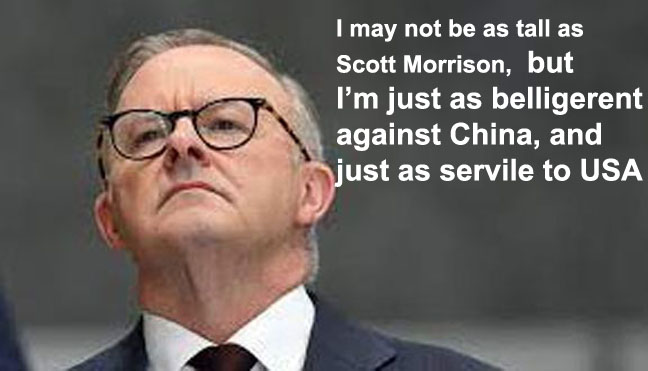
Even the hawkish former defence Minister Peter Dutton told National Press Club that he did not believe China wanted to occupy Australia. Why then do both sides of politics go out of their way to make an enemy of China. It is a recklessly provocative policy that could cause many Australians to die unnecessarily.
Albanese blasted China for not condemning Russia’s invasion of Ukraine but exempted India which did the same.
China has not been in major war since 1950. Nor has it killed anyone in the South China Sea or near Taiwan, where it is accused of behaving more aggressively. All major countries accept Taiwan is part of China.
What is Anthony Albanese up to! https://johnmenadue.com/what-is-anthony-albanese-up-to/ By Brian Toohey. Jul 6, 2022
Anthony Albanese has shown during his recent trip to Europe that he is a prime minister addicted to hyperbole and oblivious to how countries can change in unexpected ways.
He told NATO leaders China aimed to become the most powerful nation in the world and its strengthening relations with Moscow “posed a risk to all democratic nations”. It’s most unlikely all democratic countries will be at risk. For a start, Russia will be in no condition to go to war with any other country after its abhorrent decision to invade Ukraine. It could be bogged down for years in a guerrilla war. China faces a growing number of countries, including those in NATO, which are committed to containing its military and economic growth.
Albanese said in Europe that China is trying to “build up alliances to undermine what has historically been the Western Alliance in places like the Indo Pacific”. Historically, however, most Asian countries, including India and China, have been there a lot longer than the Western intruders are likely to last. The US may be the exceptional state. It annexed Hawaii in 1898 and made it an American state in 1959. But there is a plausible chance America will not remain a democracy in coming years. While nothing is certain, China may become a democracy sometime after a discredited President Xi is deposed or dies. If so, it is entirely feasible the public may elect a majority Communist government led by a moderate reformist. No one knows. Alternatively, the US may become an autocratic state with a feral Supreme Court while China remains an autocratic state with an unpopular and futile determination to achieve “Zero Covid”.
The story of other members of the Western alliance is one of momentous change. Britain took Hong Kong by force in 1842 as a base for peddling opium produced in India by the British East India Company. India won its independence from Britain in 1947 and Hong Kong was handed back to China in 1977. France had a cumulative 100 years as the colonial power in Indochina until booted out by the Viet Minh in 1953. However, it retained its colonial possessions in the Pacific Islands. Albanese told President Macron in Paris that France was an Indo Pacific power which could help contain China’s “growing ambitions” in the region.
Albanese told President Macron in Paris that France was an Indo Pacific power which could help contain China’s “growing ambitions” in the region.
Albanese blasted China for not condemning Russia’s invasion of Ukraine but exempted India which did the same. Labor’s Defence Minister Richard Marles earlier warmly praised India and said it is “central to Australia’s worldview and defence planning”. It also has a Hindu supremacist government that actively discriminates against Islamic members of the population.
While in Europe, Albanese falsely claimed that Australia always obeys the international rules. If it had, it would not have helped the US and the UK invade Iraq. The invasion killed or seriously injured large numbers of people and rendered even more homeless. It also allowed terrorist groups to operate in Iraq when none were present under Saddam Hussein. Albanese’s misleading assertion dishonours Labor’s leader at the time, Simon Crean, who opposed the invasion as a breach of the rules forbidding the use of military aggression in international relations.
Albanese caught the attention of his European audience when he complained that China had “economically coerced” Australia. A fuller picture would have acknowledged Australia officially took more than 100 anti-dumping complaints against China, despite usually frowning on such measures as potentially harming free trade. China eventually retaliated with tariffs and anti-dumping measures on some Australian exports to China. Albanese gives no sign that he understands China is not the only one who should back off.
China has not been in major war since 1950. Nor has it killed anyone in the South China Sea or near Taiwan, where it is accused of behaving more aggressively. All major countries accept Taiwan is part of China. Some of China’s opponents, including senior US Republican politicians, seem intent on goading it into using military force against Taiwan. Fortunately, Taiwanese leaders seem to understand that the island will not be attacked unless they declare independence. China could make this less likely by granting Taiwan a genuine status as autonomous region. One reason China won’t grant independence is this would make the island a convenient base to stage attacks against the mainland. Nevertheless, an experienced observer Geoff Raby says China won’t attack the island as this would involve the killing fellow ethnic Han Chinese which would be highly unpopular.
China makes claims to territorial waters in the South China Sea that other littoral countries also claim. The Pentagon acknowledges China withdrew six land claims to settle borders disputes. If it wants to be more accommodating, China could settle some of the extreme territorial sea claims that were originally made by the Communist Party’s political opponent, the Nationalist Party, before 1949. Taiwan also makes these claims. Ideally, China Sea could follow the Antarctic example and offer to turn South China Sea into a demilitarised zone beyond the 12 nautical mile offshore line.
There is no dispute that China is building up its armed forces. But its spending is no match for the US which is spends as much as the next nine countries together, including China. China has good reason to respond to a US military build up. In 2009, the US announced it had developed an Air/Sea Battle Plan for a war with China, to destroy much of its air and naval forces and blockade all its ports and maritime routes. The details have changed, but in 2011 the US also adopted a “pivot” to the Pacific with goal of deploying 60 per cent of its forces there. It is also actively engaged in building new bases on Pacific islands within striking distance of China while the Albanese government loudly opposes any hint that China might try to build naval base in the Pacific, or even in nearby Cambodia. US and Australian forces also constantly undertake surveillance missions close to China.
In these circumstances, it is vital to try to ease tensions on all sides to avoid what would be a terrible war. In the past, Labor would be among those urging support for new arms control agreements and expanding all channels for the potential combatants to talk. Ben Chifley, Bert Evatt, Gough Whitlam, Bill Hayden, Gareth Evans and Paul Keating all made significant efforts to actively promote peace. Anthony Albanese is supporting a large arms buildup, which is not the same thing.
Well before Albanese’s European trip, he stressed the Labor government would support the Coalition’s new security pact between Australia, the UK and the US (AUKUS). No one has given a convincing explanation for why we need AUKUS on top of the Australian New Zealand US (ANZUS) security treaty signed back in 1951.
The UK adds nothing of value. In 1968 the then Labour Prime Minister Harold Wilson announced that Britain would withdraw its military bases from “East of Aden”. This was a good policy reflecting the fact that Britain no longer ruled the waves. Wilson also refused to send British troops to the Vietnam war, partly because the country couldn’t afford it. Yet Britain retained its “special relationship” with the US. A subsequent government restored a military base in the Middle East, but now Boris Johnson, a disastrous prime minister, has given British military forces a role in confronting China in the Asia-Pacific.
Although the text of AUKUS has not been released, it states the US and UK are prepared to sell nuclear submarines to Australia. They would’ve done that without AUKUS. They would also have done so for other countries such as Japan, South Korea, Vietnam and Singapore, but they see more advantages in writing operating modern conventionally powered ones. NATO members without nuclear subs could buy them, but don’t because it doesn’t make military or financial sense. Yet Labor still wants buy eight nuclear subs, almost certainly from the US, so it can fire cruise missiles from nuclear submarines operating far from Australia into China. This is an extremely bad idea on both strategic and cost grounds. It will only provoke China which çan fire more missiles into Australia than Australia can fire into it. We could do more to defend Australia from closer to home with a mix of weapons at a much lower cost. Moreover when our nuclear submarine fires the first missile into China it will be detected and almost certainly sunk.
Plausible estimates put the cost of eight US nuclear submarines at $171 billion. (This is from a government that says it can’t afford to increase the miserable level of the New Start Allowance.) The risks of buying nuclear are on the upside, particularly as Australia wants to build them here.
The first submarine, probably a version of the US Virginia class attack ones, will not be operationally available until the early 2040s and the last by 2060. A leading US defence analyst Winslow Wheeler cautions that the Virginia class has maintenance problems and is not available for much of the time. He says that over 33 years they have only performed 15 six monthly deployments.
The former Senator Rex Patrick, an ex-submariner, says that conventionally powered submarines are now commonly equipped with air independent propulsion (AIP), which makes them quieter than nuclear submarines which have to keep their reactor cooling pumps going and use noisy big meshing gears between the steam turbines and propellers. Others point out that nuclear subs can be detected by their constant release of hot water; by leaving wakes on the surface when run at high speeds and by blue green lasers that will penetrate water by 2040.
Patrick says that figures given to the parliament show Australia could buy 20 modern off-the-shelf conventional submarines for $30 billion – not $171 billion for nuclear submarines that don’t meet our requirements.
Another downside of buying nuclear subs is that we would have to meet our obligations to declare any fissile material under our control to the International Atomic Energy Agency which acts on behalf of the Nuclear non-Proliferation Treaty (NPT). However, the US will refuse to give us the required information about the highly enriched, weapons grade uranium in the reactors.
A further problem is that several Pacific Island leaders don’t want Australia to buy nuclear submarines. Nor, as Foreign Minister Penny Wong discovered on her recent visit to Malaysia, do its leaders.
Australian public opinion does not unambiguously support Labor’s strategy. The latest Lowy Institute’s annual poll shows over 51 per cent believe Australia should remain neutral in a military conflict between China and the US.
Even the hawkish former defence Minister Peter Dutton told National Press Club that he did not believe China wanted to occupy Australia. Why then do both sides of politics go out of their way to make an enemy of China. It is a recklessly provocative policy that could cause many Australians to die unnecessarily.
Scientist sheds doubt on the viability of Australia’s planned Kimba nuclear waste dump.
Peter Remta 7 July 22, This is the comment by the scientific expert who has been responsible for Australia’s only two nuclear waste management facilities and is often asked by ARPANSA for advice .
There was an oblique reference to aerodynamic surveys in the characterisation reports by AECOM.
I have no idea why they would be doing this now.
This is the kind of survey that would be undertaken prior to selecting a site to identify prospective geology and avoid areas of commercial mineralisation that would be sterilised by siting a radioactive repository. It smacks to me of someone with a bottomless budget to spend or be lost.
As a consultant advising a client on site evaluations on a regular basis, I do my best to minimise the extent of work done to only that which is required and will provide important supporting information, as such survey work is costly.
A good comparison is Deep Isolation from California which apparently has raised USD$35 million but most overseas experts regard its technology as old hat and not really workable and above all not safe
+
AUKUS submarines: Beasts of nuclear proliferation
The AUKUS security partnership, announced last September by Australia, the United States and Britain, has muddied the pool of non-proliferation.
The precedent of permitting Australia to be the only non-nuclear weapons state with HEU-propelled technology is also seismic on another level.
For one thing, Article III of the NPT exempts naval reactors from nuclear safeguards, which threatens a pillar of the non-proliferation regime — limiting the production and use of highly enriched uranium (HEU) which can be used, in turn, to make nuclear weapons.
There will be nothing stopping China and Russia doing what the United States and Britain promise to do: proliferate naval reactor technology and long-range missiles with a nuclear capability.
https://www.greenleft.org.au/content/aukus-submarines-beasts-nuclear-proliferation Binoy Kampamrk, July 6, 2022, Issue 1352,
When faced with the option of acquiring nuclear technology, states have rarely refused. Since the splitting of the atom and the deployment of atomic weapons in war, the acquisition of a nuclear capacity has been a dream. Those who did acquire it, in turn, tried to restrict others from joining what has become, over the years, an exclusive club.
Members of this club engage in elaborate ceremonial claims that their nuclear weapons inventory will eventually be emptied. Non-nuclear weapons states allied to such powers go along with appearances, taking comfort that nuclear weapons states will offer them an umbrella of security.
This hypocrisy underlines such arrangements as the Treaty on the Non-Proliferation of Nuclear Weapons (NPT).
Central to the document is the discouragement of non-nuclear weapons states from weaponising nuclear technology, as long as members of the nuclear club pursue “good-faith” disarmament negotiations. While it is true to say that the NPT probably prevented a speedier, less infectious spread of the nuclear virus, it remains a constipated regime of imperfections that has only delayed proliferation.
Most tellingly of all, most non-nuclear weapon states have complied with their undertakings whereas nuclear weapons states have not: they have disregarded serious multilateral nuclear disarmament. Nor do they have an incentive to alter current arrangements, given that any changes to the NPT can only take place with the unanimous support of the three treaty depositories: Russia, Britain and the United States.
The NPT supporters pour scorn on alternative approaches to nuclear weapons, such as the Treaty on the Prohibition of Nuclear Weapons (TPNW), which held its first meeting of state parties in Vienna from June 21—23.
While the Anthony Albanese government sent Susan Templeman MP to the meeting as an observer, Canberra has remained consistently opposed to the TPNW as a threat to the accepted disarmament and NPT framework. Dated and spurious concepts, such as extended nuclear deterrence and the interoperability of Australian and US military systems, tend to be common justifications.
The AUKUS security partnership, announced last September by Australia, the United States and Britain, has muddied the pool of non-proliferation.
A central component of the agreement is a promise to share nuclear propulsion technology with Australia, thereby enabling it to acquire eight nuclear submarines, to supposedly be built in Adelaide.
While much of this is wishful thinking — Australia has no expertise in the field and will have to rely on expertise from the other two — the glaring problem with AUKUS is what it does to non-proliferation arrangements.
While former Prime Minister Scott Morrison said the agreement would comply with Australia’s own non-proliferation commitments, such confidence is misplaced.
For one thing, Article III of the NPT exempts naval reactors from nuclear safeguards, which threatens a pillar of the non-proliferation regime — limiting the production and use of highly enriched uranium (HEU) which can be used, in turn, to make nuclear weapons.
Non-proliferation experts have not been enthusiastic with the promised new Royal Australian Navy submarines. Daryl G Kimball, director of the Arms Control Association, noted the salient difference between deepening defence cooperation with allies on the one hand and proliferating “sensitive HEU nuclear propulsion tech in contravention of US and global nonpro principles”.
Hans Kristensen, director of the Nuclear Information Project at the Federation of American Scientists, greeted AUKUS with gloom when it was announced. Its provisions on nuclear technology would “further intensify the arms race in the region and the dynamics that fuel military competition”.
The International Atomic Energy Agency’s (IAEA) Director General Rafael Mariano Grossi is visiting Australia to discuss safeguards of nuclear material used for naval propulsion.
This is nothing short of problematic, given that IAEA inspectors are unable to inspect such material for extended periods of time when the vessel is at sea. Grossi described this process as “quite complex”, although he wants Australia to commit to non-proliferation alongside the acquisition of nuclear technology.
“There is a period of 18 months which was given by the three partners — the United States, United Kingdom and Australia — to define how the project is going to be implemented but, already we have started this interaction, this joint work of technical levels so that we can reconcile both things.”
Prior to Grossi’s visit, Foreign Minister Penny Wong reiterated Australia’s “longstanding” support of the “IAEA’s mission to harness the peaceful use of nuclear technology in areas like medicine, industrial processes and environmental monitoring, as well as upholding the international nuclear non-proliferation regime”.
The world Wong described is distinctly pre-AUKUS. Despite promises of “open and transparent engagement with the IAEA on nuclear safeguards”, the whinnying horse of proliferation has bolted from the stable. Assurances to avoid the future development of nuclear weapons capability in Australia or a national nuclear fuel cycle also ring hollow.
The precedent of permitting Australia to be the only non-nuclear weapons state with HEU-propelled technology is also seismic on another level.
There will be nothing stopping China and Russia doing what the United States and Britain promise to do: proliferate naval reactor technology and long-range missiles with a nuclear capability. [Dr Binoy Kampmark lectures at RMIT University.]
Kimba nuclear waste dump – phase 3 in progress, but the Australian Radioactive Waste Agency (ARWA) has not completed phase 2 !
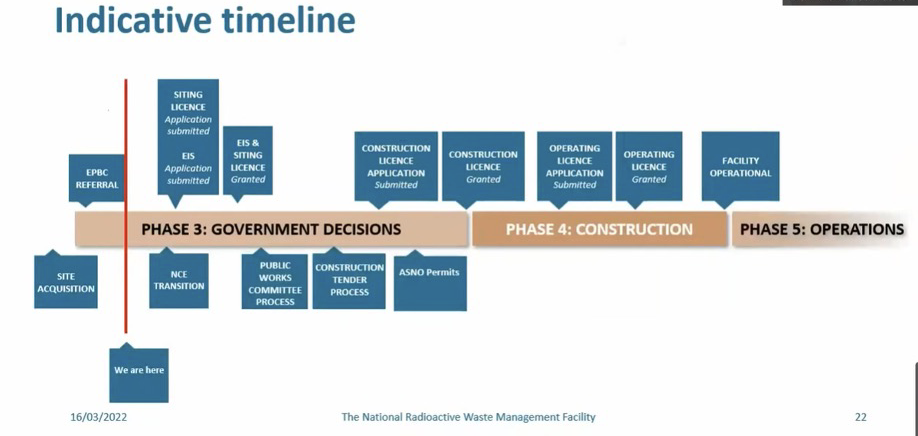
Peter Remta. Timeline for development of Kimba facility 6 July 22.
Out of interest this is the timeline produced by the Australian Radioactive Waste Agency (ARWA) showing where the progress of the Kimba nuclear waste facility development was as at 16 March 2022.
From this timeline it appears that the government is already into phase 3 of the Kimba development but this is completely false as it has still not completed phase 2 in accordance with the prescriptions of its official nomination guidelines issued in November 2016 and titled Radioactive Waste Management Land Nomination Guidelines.
Time to speak up: water apartheid is Australia’s dirty secret
Canberra Times By Erin O’Donnell, Kirsty Howey, July 4 2022
Imagine, in Australia, having to buy bottled water just so you can have clean water to drink. Imagine in 2022, in Australia, Aboriginal communities still have to do that, because they don’t have access to safe drinking water supplies.
While the 2022 NAIDOC week theme is get up, stand up, and show up, that’s an instruction for all of us.
All Australians need to get up, stand up, show up and speak up about this national shame.
In the Northern Territory, drinking water in remote communities regularly breaches guidelines for uranium, and heavy metals. It makes people sick. In Western Australia, the Auditor-General found 24 communities still require the government to truck in bottled water, as local supplies contain harmful contaminants, including uranium. In Queensland, remote, largely Indigenous, townships have faced ongoing water quality issues. Further south, NSW communities also struggled with water quality during the recent drought, and a 2022 study found towns and communities with higher Aboriginal populations and lower income levels were less likely to have access to free sources of filtered water within the community.
In the NT, predominantly white towns such as Darwin, Alice Springs and Katherine have a regulated and safe drinking water supply, but in Indigenous communities drinking water supply is unregulated, with many residents needing to resort to buying bottled water. And far from being an unavoidable consequence of life in remote communities, this is the result of ongoing failure by successive NT governments to plug gaps in water regulation.
………………………………………… The new Labor government’s commitment to restoring a National Water Commission must end water apartheid in Australia. The commission cannot come too soon for northern Australia, where this disaster is unfolding. https://www.canberratimes.com.au/story/7804335/time-to-speak-up-water-apartheid-is-australias-dirty-secret/
Julian Assange’s 51st birthday.
 | |||
|
Alan William Preston 2 July 22, 1174 days in solitary confinement in London’s Belmarsh prison for having published evidence of the American military’s deliberate breaching of the Geneva Conventions during their illegal occupation of Iraq during which their personnel recorded 61,000 civilian deaths caused by their activities.
This is only a small corner of the truth he was shining the light on.
No further investigations or prosecutions for these war crimes have ever been pursued. Now the U.K. government is scrambling to disconnect itself from the European Court of Human Rights.
The U.N. had deemed that Julian Asssange had the right to publish this material and that his imprisonment is arbitrary and that the conditions equate to psychologicial torture and is ‘intimidation and reprisal’ being inflicted by the states that stand implicated by the evidence received and published.
We need to set the terms of reference for a Royal Commission of Inquiry into the dysfunction in all the checks and balances that have allowed this travesty of injustice to occur.
1 This month
7 April – WEBINAR – Australia and the Doomsday Clock – Preventing nuclear war through NoFirstUse and other policies
Online | Tuesday April 7, 4:00-5:30pm, Australian Eastern Time / 8:00-9:30am Central Europe Time
– Access the registration link
15 April – Zoom –Nuclear Power is Not the Solution
Apr 15, 2026 01:00 AM in Canberra, Melbourne, Sydney

Join the International Physicians for the Prevention of Nuclear War (IPPNW) on Tuesday, April 14th for a timely webinar exploring the risks associated with nuclear power and challenging the myth that it offers a simple, safe, carbon-free solution to the climate crisis

21 April Webinar: No Nuclear Weapons in Australia
Start: 2026-04-21 18:00:00 UTC Canberra, Melbourne, Sydney (GMT+10:00)
End: 2026-04-21 19:30:00 UTC Canberra, Melbourne, Sydney (GMT+10:00)
Event Type: Virtual
A virtual link will be communicated before the event.
Host Contact Info: australia@icanw.org

of the week – Australians for War Powers Reform (AWPR)
To see nuclear-related stories in greater depth and intensity
 Antinuclear