Opposition to nuclear waste transport through the port of Whyalla, South Australia
Push for nuclear port no-no, Whyalla News, Louis Mayfield 21
A Whyalla resident passionate about the issue of nuclear waste storage has called for the Whyalla City Council to move a motion against transporting nuclear waste through the steel city’s port.
Andrew Williams, who has written to the Whyalla News on the issue in the past, delivered a presentation to council during their meeting on Monday.
Mr Williams said the federal government intended to override state laws in order to transport nuclear waste through South Australia, with the Whyalla Port being a “target port” for transportation.
“The federal government have said they will ensure appropriate consultation where there is significant public interest,” he said.
It is necessary for more public interest, especially in Whyalla as Department of Industry reports name the Whyalla Port to take shipments of nuclear fuel wastes.”
Mr Williams further outlined his concerns around storing intermediate level nuclear waste (ILW) at a Nuclear Radioactive Waste Management Facility (NRWMF) at the Napandee site near Kimba.
“The intermediate level waste consists of reprocessed spent fuel rods and reactor waste and some legacy waste which must be kept contained and secure from the environment for 10,000 years,” he said.
“Storage will require double handling of ILW which is not world’s best practice. The issue has been presented as a local economic development opportunity rather than a National Dump which will affect many generations to come.”………https://www.whyallanewsonline.com.au/story/7351332/?fbclid=IwAR1Wk-SzqygZroJ14ZA2g4_VmixtphFkTOFKKzTMnJxlHIcxiMQAwotNN4Y
Port at Cape Hardy could be the entrance place for radioactive waste transport to Kimba, South Australia.
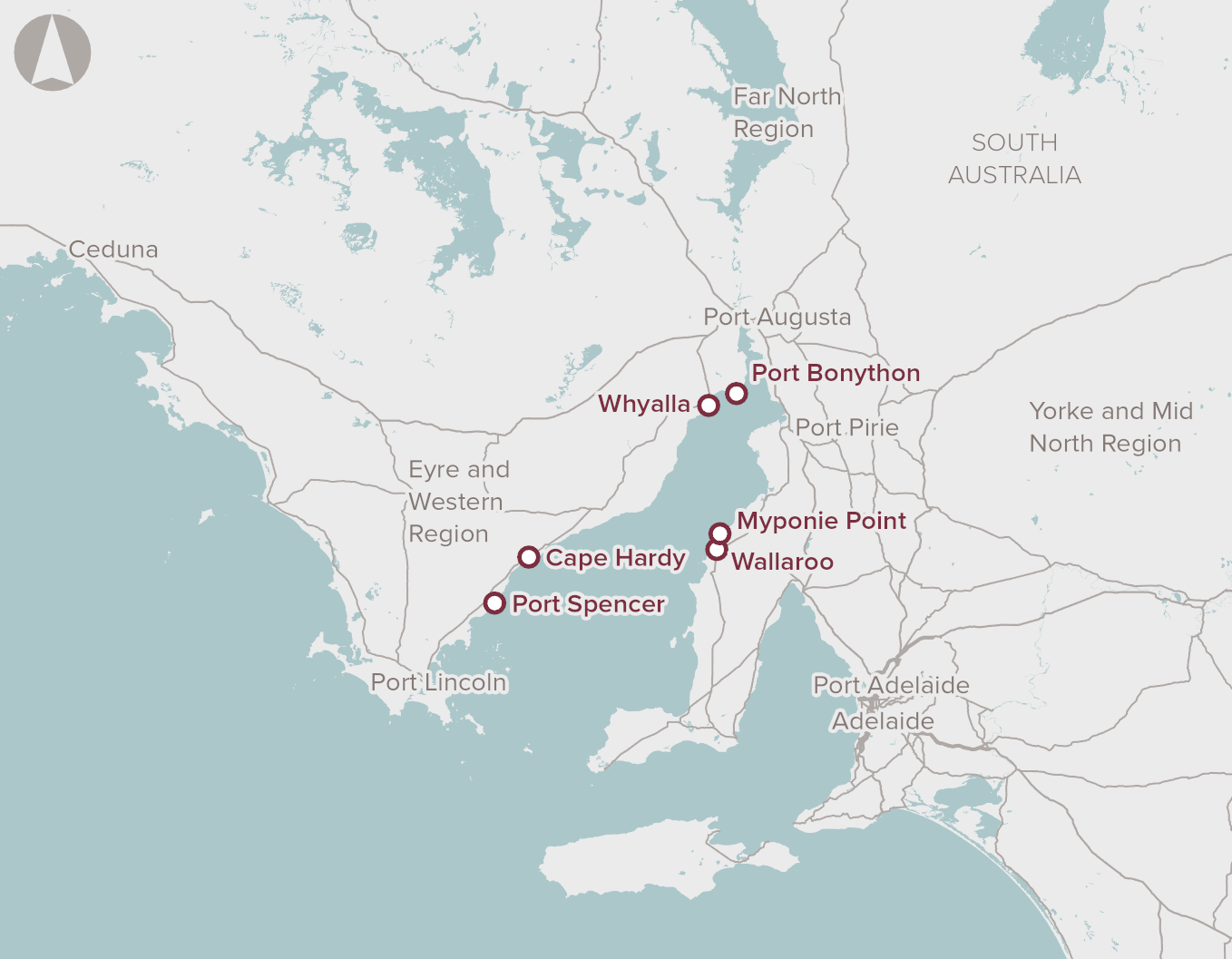
Paul Waldon . Fight to Stop a nuclear waste dump in South Australia, 22 July 21, Fear of Whyalla as a port for receiving ANSTO’s radioactive waste has strongly been suggested recently. Mr Paterson responded to Sarah Hanson-Young’s question by saying that residents of a port town would be consulted before any such plan.
However I for one don’t believe Whyalla is on the cards, I believe the chosen port would likely be Port Hardy.
The Sentient Group (incorporated in the Caymen Islands) is the parent entity of Iron Road Limited. Iron Road put forward a plan to develop Port Hardy as a export terminal. So why would there be two deep water ports to service one region. Yes, there is only 78 kilometers from Iron Roads mining site at Warramboo and Kimba the proposed site for ANSTO’s radioactive waste.
So is there anything in it for the mining industry??? I don’t know, but it has been claimed that Iron Road is the states biggest mining operation outside Olympic Dam.
Moreover, in May 2017 when the Department of Industry, Innovation and Science proposal to burden an unwilling community in South Australia with their radioactive waste was just heating up Iron Road Limited became the beneficiary of a 21 year mining lease for magnetite mining and mineral processing. Which had 127 compliance conditions flagged.
But wait there’s more, the federal government also announced a 25 million dollar grant commitment to support development of Iron Roads Cape Hardy port precinct.
I’m not implying that Iron Road and the government are in bed together, but wouldn’t it make sense that while lanthanides are leaving a port the government would allow actinides to enter. more https://www.facebook.com/groups/344452605899556
Australian cities not prepared for the coming heatwaves- poor urban planning
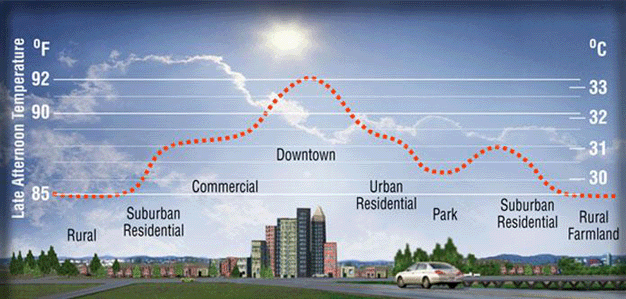
The heat is coming and we are not prepared for it.
It is not just that large houses on small blocks leave no room for trees,….. The little space left between them provides no room for recreation and serve to increase heat, with side-passages often home to air-conditioning systems that spew heated air across dividing fences.
When he looks at new developments on the fringes of Australian cities, Pfautsch says residents have been abandoned to wholly predictable heat extremes caused by global warming but exacerbated by poor planning regulation.
We’re ending up with dark-roofed, back-to-back, nose-to-front, housing suburbs on the outskirts of Melbourne. And if you add dark, asphalt and concrete surfaces you’re going to get really hot suburbs,”
Why a killer US heatwave points to a stifling future for our cities. Brisbane Times, By Nick O’Malley and Miki Perkins, July 17, 2021 It was the hellish evening temperatures that finally caused the authorities to start busing the homeless into heat shelters where they had access to fans, air-conditioning and water.
Three hours from sundown last Saturday the temperature in Las Vegas peaked at 47.2 degrees, equalling a record set in 2017. By dawn, the temperature had bottomed out at a stifling 34 degrees and begun to rise again.
One person was treated for burns after walking on a pavement and the homeless were bussed from an outdoor shelter to indoor cooling centres in response.
West of the city at Furnace Creek in Death Valley a temperature of 54.4 degrees was recorded. Experts are still checking the reading and debating over whether this was the hottest temperature ever recorded on earth.
In the town of Lytton in British Columbia, a Canadian heat record was set at the end of last month when the temperature hit 49.6 degrees and lingered up there over three days. Authorities attributed hundreds of deaths across the region to the heat, even before wildfire arrived and burnt most of the village to the ground, killing two more.
Before the flames approached one local, Lorna Fandrich, told the New York Times that she’d noticed green leaves dropping off the trees, apparently unable to tolerate the heat. On the coast to the west, millions of mussels and oysters cooked and died in superheated shallow waters.
From his home outside Sacramento Ken Pimlott, the recently retired head of Cal Fire, the agency responsible for fighting wildfires across the state of California, watched on with dread. The height of the northern fire season, he noted, has not even arrived yet.
These temperatures, Pimlott told The Sydney Morning Herald and The Age, are no longer outliers, but spikes in a new normal in a world not prepared to manage them.
The temperatures have already extended the North American fire season, causing exhaustion among crews who can’t get enough rest from the fire lines and difficulties in keeping up with maintenance demands on equipment. Aircraft once shared with nations like Australia were under greater demand as fire seasons overlapped, he said.
Pimlott’s dread was shared in Australia.
Dr Sebastian Pfautsch, a specialist on urban heat at Western Sydney University, says though Australian attention has drifted from the terrible summer of 2019 and 2020, he fears for the future of residents of some suburbs in Sydney and Melbourne.
The heat is coming, he says, and we are not prepared for it.
Stephen Livesley is an associate professor in forest sciences at the University of Melbourne, and an expert on the benefits of urban forests. “It’s possible we’re going to end up with large neighbourhoods which people in 20 or 30 years’ time will simply avoid,” he says.
This concern is not misjudged, says Professor Christian Jakob, a Monash University atmospheric scientist.
His analysis of the heatwave that struck North America shows that it originated with an unremarkable rainshower on the other side of the Pacific Ocean, not far from Japan.
The shower caused an atmospheric disturbance that in turn created what scientists call a Rossby wave, which was guided towards North America by the jet stream, amplifying as it travelled before breaking upon the shores of the Pacific Northwest.
There the wave caused a high-pressure system. As Jakob explains, air heats under pressure. On the ground, temperatures soared. What caused the temperatures to reach such extremes, though, and what made the system linger long enough to cause such misery and destruction beneath it, cannot yet be explained by science says Jakob.
Until better computer models are created all we can know is that as the climate heats due to global warming such heatwaves will in some areas increase in intensity and duration.
Areas particularly prone to the phenomenon include northern Europe, North America and south-eastern Australia, he says
On the day that Penrith became for a time the hottest place on earth, with temperatures hitting 48.9 degrees on January 4 last year, Keith Heggart’s air conditioner conked out by midday. The manual said it sometimes did that in extreme heat and recommended hosing it down, but due to bushfires water use was banned. Heggart and his young family closed windows against the smoke and the blinds against the sun and sheltered in the living room where a fan pushed around the hot air.
Watching the news from America these past few weeks, Heggart has fretted about the summers to come. His street in Penrith is older than others and there is some shade, some gaps between the houses, but when he looks at the new developments nearby, he despairs.
“There are no trees, there is no shade,” he says. “You could reach out your window and touch the house next door.
When he looks at new developments on the fringes of Australian cities, Pfautsch says residents have been abandoned to wholly predictable heat extremes caused by global warming but exacerbated by poor planning regulation.
Council areas such as Blacktown, Penrith and Campbelltown in Sydney and suburbs like Wollert, Mernda and Mickleham in Melbourne are compelled to absorb growing populations by state governments, but are failing to impose proper planning regulations. Strapped for cash, they have allowed property developers to shape the built environment, he says.
…….. It is not just that large houses on small blocks leave no room for trees, Pfautsch says. The little space left between them provides no room for recreation and serve to increase heat, with side-passages often home to air-conditioning systems that spew heated air across dividing fences.
But Pfautsch sees other wilful mistakes. Unshaded black roads absorb heat during the day only to radiate it at night, extending the heat of day into the evening. This contributes to the urban heat island effect.
Roofs, exterior walls and even driveways created by developers in currently fashionable dark shades serve to exacerbate the impact, he says.
But, according to Pfautsch, the problems begin even before the new suburbs are laid out, when developers clear new sites of all existing trees, ponds and watercourses to maximise space and save on construction costs.
What greenspace remains is often not connected to homes by shaded foot or bike paths.
“It is inhumane to expect people to live like this in the temperatures we anticipate,” he says. “I can’t say it more strongly than that.”………….
Overall, Melbourne lost 0.3 per cent of its canopy between 2014 and 2018. Almost 2000 hectares of trees were cut from the east and south-east, mostly at residential properties……….
We’re ending up with dark-roofed, back-to-back, nose-to-front, housing suburbs on the outskirts of Melbourne. And if you add dark, asphalt and concrete surfaces you’re going to get really hot suburbs,” he says. “When you have high-temperature events intersecting with urban heat islands, you have really, really high temperatures.”
According to Pfautsch, even a concerted effort to increase tree coverage in the suburbs most prone to the heat-island effect will only have limited impact in the years to come………
All this raises thorny questions of environmental and climate justice, Livesley says, as the suburbs most affected are often the most affordable.
“We are pushing some of the most vulnerable people in our society into these low tree, low services environments, with poor public transport infrastructure.”…………
In Mildura, a town near the border in north-west Victoria, temperatures have increased in line with worldwide heating trends. Between 1998-99 and 2018-19 the number of days each year where the temperature went above 35 degrees increased by about 20 days, and the number of heatwaves rose from six to nine.
For residents living in public housing – who faced huge bureaucratic hurdles to having air conditioners installed – recent summers have been a nightmare,………..
not only should we be tackling climate change, we should be totally re-imagining how we build our suburbs. https://www.brisbanetimes.com.au/environment/climate-change/why-a-killer-us-heatwave-points-to-a-stifling-future-for-our-cities-20210716-p58ae9.html
Let the Australian nuclear spin begin – in earnest

‘‘until we can have the nuclear [power] discussion then carbon farming will play an important role.’‘ Michael McCormack of the Nationals Party , The Age , 18/7/21
You can bet your boots that Michael Mc Cormack knows about as much about nuclear power as a kindergarten kid does.
He is supposed to be an enemy of Nationals leader Barnaby Joyce, but on nuclear opinion, and nuclear knowledge, they’re in lockstep.
I was meaning to leave until Ausgust, this very NOW story of the renewed nuclear spin in Australia. I just couldn’t let this one pass – as Mc Cormack just slipped this in to a story that purports to be all about supporting agriculture and carbon farming.
US and Allies’ military machine – out of Afghanistan (where it’s needed) and into the Pacific – against its new enemy – The Great Barrier Reef

War games on despite pandemic, threat to Great Barrier Reef https://www.greenleft.org.au/content/war-games-despite-pandemic-threat-great-barrier-reef, Kerry SmithJuly 16, 2021 Lurking off the coast of China’s eastern seaboard now are three United States aircraft carrier battle groups (each with about 30 support vessels).
They will be joined by a British aircraft carrier group and Australian and Canadian warships as part of biennial military exercises, which start on July 18 and last until the end of the month.
Talisman Sabre 2021 (TS21) will involve a US expeditionary strike group from the USS America, the amphibious assault ship based at Sasebo Naval Base in Japan, and 17,000 Australian, US and foreign troops in combined land, sea and air war exercises.
According to Stars and Stripes, for the first time, there will be live-fire training: the US Army will fire a Patriot missile defense system from Shoalwater Bay in Queensland at a pair of drone targets on July 16.
This is within the Great Barrier Reef Marine Park and other environmentally and culturally significant areas.
The war games will also take place in Darwin in the Northern Territory and Evans Head, New South Wales.
All are thousands of kilometres away from their home base, and provocatively close to the new declared enemy — China.
Forces from Canada, Japan, New Zealand and the Republic of Korea will take part and Australia-based personnel from India, Indonesia, France and Germany will observe.
Meanwhile, the ABC’s “defence correspondent” hyperventilated on July 14 that a solitary Chinese military ship, outside Australian territorial waters, poses a threat to national security.
The Independent and Peaceful Australia Network (IPAN) is concerned about both the war games and its impact on environmentally and culturally significant sites.
“TS21 will involve amphibious assaults, movement of heavy vehicles, use of live ammunition as well as the use of U.S. nuclear-powered and nuclear-weapon capable vessels,” IPAN spokesperson Annette Brownlie said.
“These activities are incompatible with the protection of the environment and, in particular, the Great Barrier Reef.
“During Talisman Sabre 2013, the US jettisoned four unarmed bombs on the Great Barrier Reef when they had difficulty dropping them on their intended target, Townshend Island,” Brownlie said.
The objective of Talisman Sabre is to further integrate the Australian military with the US — now ranked among the world’s worst polluters.
IPAN said the ADF did not engage in a Public Environment Report process for TS21 and has yet to release an environmental assessment for the areas in which TS21 will take place.
However, the Department of Defence did produce an environmental awareness video for visiting troops that promotes the military use of the Great Barrier Reef. The video reminds troops to consider the reef and not to litter.
“Talisman Sabre is a threat to the reef and to the environment. Putting out a video is a completely inadequate response,” Brownlie said.
This comes as federal environment minister Sussan Ley is lobbying to keep the Great Barrier Reef off the United Nations Educational, Scientific and Cultural Organization World Heritage Committee’s “in danger” list.
Despite a global pandemic, about 1800 foreign military personnel have arrived in Darwin to participate.
Australia’s weapons lobby drumming up fear of nuclear attack by China, against all logic

Those in Australia beating the “drums of war” point to Taiwan as the flashpoint for the next major global conflict. To what end does a first strike on Australia achieve China’s goals in relation to Taiwan?
War with China: zero logic yet the weapons lobby has 42% of Australians believing it Michael West Media, by Marcus Reubenstein | Jul 16, 2021 Incredibly, a survey finds 42% of Australians believe China will attack Australia, this despite exports to China surging 36% over in the last six months, and despite there being no logical rationale for war with China, or an attack by China. Marcus Reubenstein analyses the ludicrous position of Australia’s China hawks and the mainstream media pushing their agendas.
“Cry ‘Havoc!’ and let slip the dogs of war.”
William Shakespeare, Julius Caesar Act 3, Scene 1
China is a rapidly growing economic power, seeking to exert considerable influence in its region and beyond. And like every great power it is a bully which tries to entice, cajole or intimidate other nations into adopting its view of the world.
How is this such a difficult concept for Australians to embrace?
Since Federation we’ve tied our fortunes to two great powers, the declining British Empire then the rising, and rising even more, US global hegemony……….
Who is threatening whom?
A new report from the Australia Institute begins with the following words:

“In April this year, Australians were warned by no less an expert than the former Minister for Defence, Christopher Pyne, that they may need to engage in a ‘kinetic’ war with China in the next five to ten years.”
Perhaps, in the realm of China policy, ‘no lesser expert’ better describes his authority on the subject.
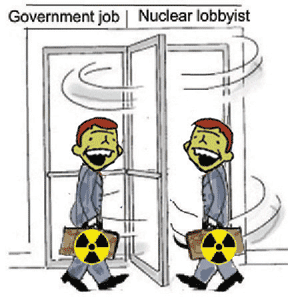
The same Pyne, famously discussed his role as a defence industry consultant with EY whilst he was a sitting member of the Federal Cabinet, a matter which prompted a Senate investigation.
He still works for EY, sits on the board of defence contractor XTEC, is Chair of the Advisory Board of another defence contractor NIOA, and in June last year Arawa Capital announced him as Chair of its Advisory Board and Investment Committee for a fund investing in weapons systems.
In heralding that appointment Arawa specifically referred to the, still unsubstantiated, Scott Morrison announcement of a malicious cyber attack by an unnamed “state-based” actor. Arawa trumpeted Pyne has “unrivalled knowledge of the cyber, intelligence and national security landscape.”
With Pyne on board, Arawa said it “anticipates closing out the initial $50mil capital raising swiftly.” It transpired there was a swift “closing out”, ASIC records show six months later Arawa Capital Pty Ltd was deregistered as a company.
According to research from Michael West Media’s “Revolving Doors” series, Pyne’s numerous board memberships and consultancies put him in direct, or indirect, contact with more than a dozen weapons makers and contractors.
Clearly, talking up a war with China is of no financial benefit to these companies.
Why would China attack Australia?
Should Australia go to war with China in defence of Taiwan? is the title of the Australia Institute report and 42% of its six hundred respondents think China is poised to attack Australia.
How and why?
Those in Australia beating the “drums of war” point to Taiwan as the flashpoint for the next major global conflict. To what end does a first strike on Australia achieve China’s goals in relation to Taiwan?
If Australia has something China wants, it is many times cheaper and easier to buy it than to send your army half way around the world to steal it.
China’s current leadership is presiding over a great deal more diplomatic disasters than triumphs but, if nothing else, the Chinese are pragmatic.
Australia’s rabid China hawks will no doubt dismiss such assessments, saying China doesn’t need to deploy military assets it would simply launch a nuclear strike on a target—which they ignore is home to 1.2 million ethnically Chinese people.
My counter argument?
The policy wonks in Washington, who made you their lapdogs, didn’t throw you a bone because they thought you were smart, they threw you the bone because they knew you were dumb enough to catch it!
This survey’s inconvenient truth
The same number of respondents were polled in Taiwan and only a few more (49 percent) expressed fears of an attack from the mainland. Bear in mind the Taiwanese are of the same Han ethnicity as the majority of Chinese, who moved over from the mainland in the 1680s; the PRC has never given up its claim to what was once part of China; and the island sits just 161 kilometres off the coast of China.
That four in ten Australians should think Beijing—a mere 9,000 kilometres from Canberra—is gearing up for invasion is staggering.
Report author Allan Behm noted, “Given Australia and Taiwan’s historical and geographical differences, it is astounding that Australians could be more fearful than Taiwan in anticipating an attack from China.”
This anticipation is undoubtedly fuelled by Australia’s China hawks, all with close ties to US-funded research groups and patronage from US weapons makers.
However, they should not be too smug in thinking their “drums of war” are resonating.
73 percent of Australians regard the United States as an aggressive nation, while only six in ten Australians believe the US would come to our aid in the event of war with China.
Given Australia has followed the United States into 100 percent of its wars, that Australians would only rate America a 60 percent chance of leaping to our defence is a sobering statistic.
Totally at odds with Prime Minister Morrison and Foreign Minister Maris Payne’s unquestioned support of the US antagonism towards China, 75 percent of Australians think it is in our interests that China and the US “work together towards world peace”. Of concern to the spin merchants inside the government an even higher number of coalition supporters, 79 percent, think peace with China is a good idea.
Despite the US, and Morrison’s, rhetoric of Taiwan being a like-minded democracy of shared values, 76 percent of Taiwanese rate America as an aggressor. Should the US come to Taiwan’s aid in a war with China, only 18 percent of Taiwanese people think they would win.
How reliable are drummers?
By any sensible strategic logic, the dogs of war should remain in their box. Let the drums of war continue to drum up business for the China threat industry and their death-merchant patrons. …..
Liberal-led committee raises concerns about Morrison government’s charity crackdown
Liberal-led committee raises concerns about Morrison government’s charity crackdown, Concetta Fierravanti-Wells fears the regulations could curb political protest and freedom of speech Guardian Daniel Hurst, 16 July 21, A Coalition-chaired committee has raised concerns about the Morrison government’s crackdown on charities suggesting the new regulations could curb certain types of political protests and freedom of speech.
In a newly released letter, the conservative Liberal senator Concetta Fierravanti-Wells also says the government has been too vague in explaining what sorts of offences could lead to charities being deregistered.
An alliance of more than 30 charities welcomed the intervention, with Tim Costello saying it sends “a clear signal that these laws are unprecedented and an unjustified regulatory overreach”.
Late last month, the government said it would press ahead with new regulations to expand the types of offences for which charities could be deregistered, prompting the sector to raise fears the crackdown could silence their advocacy work.
Under the changes, which the government says will reinforce trust and confidence in the sector, the regulator would be empowered to investigate charities engaging in or promoting serious unlawful acts of trespass, vandalism, theft or assault and threatening behaviour.
This will apply regardless of whether they are classified as an indictable offence or the less serious category of summary offences under state and territory laws.
Charities will be prohibited from using their resources – including social media accounts – to “actively promote” others to engage in unlawful activities.
Fierravanti-Wells has written to the assistant treasurer, Michael Sukkar, seeking a response to a range of concerns, including the potential effect on the implied freedom of political communication in Australia.
Fierravanti-Wells is chair of the parliamentary committee that monitors how ministers are making use of their powers to issue regulations.
In her letter to Sukkar on behalf of the committee (PDF), she says while the government has provided some examples of the type of offences to which the rules may apply, “it is unclear what the full scope of the offences may be”.
The government has not provided enough detail about the charities commissioner’s discretionary powers, why they are needed, and any safeguards – even though that information “is important to enable charities to clearly understand their obligations”.
“The committee concerns are particularly amplified noting that the discretionary powers to be exercised by the commissioner may relate to the determination of whether a criminal law has been breached,” Fierravanti-Wells writes.
Similarly, she says, the government has not provided information about whether the measure “may limit registered entities’ implied freedom of political communication, by preventing them from engaging in, or supporting certain activities”.
“This may include limiting their ability to engage in, or support, certain types of political protest,” she writes, without making any assessment as to whether the regulations are constitutional.
Fierravanti-Wells asks Sukkar to explain by 28 July “how the instrument is compliant with the implied freedom of political communication, and whether the explanatory statement can be amended to include this analysis”.
Costello, the chair of the Community Council for Australia and former chief of World Vision Australia, said it was “heartening to see that this important committee shares the concerns of charities from across the sector, which have formed a broad alliance to condemn these egregious regulations”.
“Giving the charity commissioner power to shutter a charity for a minor offence by a member is the equivalent of the electoral commissioner having discretion to deregister the Liberal party because a party member damages someone’s lawn when putting up a sign,” Costello said in a statement on Friday.
Dr Cassandra Goldie, the head of the Australian Council of Social Service, said a healthy democracy was “one where communities and their charities are free to speak up and act in the interests of the people they represent and serve”………… https://www.theguardian.com/australia-news/2021/jul/17/liberal-led-committee-raises-concerns-about-morrison-governments-charity-crackdown
Military exercises put the Great Barrier Reef in danger
 | |||
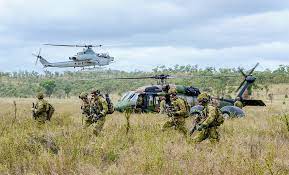
15 July 2021, The Independent and Peaceful Australia Network is greatly concerned about the impact of current warfare exercises on environmentally and culturally significant sites, such as the Great Barrier Reef.
Talisman Sabre 2021 (TS21) is currently taking place in Australia and will see 17,000 Australian, U.S. and foreign troops engaging in combined land, sea and air manoeuvres.
Exercises as part of TS21 will take place along the Queensland and New South Wales coastline, within the Great Barrier Reef Marine Park as well as other environmentally and culturally significant areas.
TS21 will involve amphibious assaults, movement of heavy vehicles, use of live ammunition as well as the use of U.S. nuclear-powered and nuclear-weapon capable vessels. These activities are incompatible with the protection of the environment and in particular the Great Barrier Reef.
This year, the ADF did not engage in a Public Environment Report process for TS21 and has not publicly released an environmental assessment for the areas in which TS21 will take place.
However, the Department of Defence did produce an environmental awareness video for visiting troops that promotes the military use of the Great Barrier Reef. The video reminds troops to consider the reef and not to litter.
Annette Brownlie, Chairperson of the Independent and Peaceful Australia Network: “Talisman Sabre is a threat to the reef and to the environment. Just putting out a video is a completely inadequate response to the active environmental management required to protect the vulnerable reef. Particularly as environment minister, Sussan Ley, is on an international lobbying campaign to keep the Great Barrier Reef off the UNESCO World Heritage Committee ‘in danger’ list.”
“The objective of Talisman Sabre is to integrate the Australian military further into the U.S. military, which is ranked among the world’s worst polluters and is the world’s greatest organisational consumer of oil.”
“Let us not forget that during Talisman Sabre in 2013, the U.S. jettisoned four unarmed bombs on the Great Barrier Reef when they had difficulty dropping them on their intended target, Townshend Island.”
Annette Brownlie, Chairperson of the Independent and Peaceful Australia Network: “Talisman Sabre is a threat to the reef and to the environment. Just putting out a video is a completely inadequate response to the active environmental management required to protect the vulnerable reef. Particularly as environment minister, Sussan Ley, is on an international lobbying campaign to keep the Great Barrier Reef off the UNESCO World Heritage Committee ‘in danger’ list.”
“The objective of Talisman Sabre is to integrate the Australian military further into the U.S. military, which is ranked among the world’s worst polluters and is the world’s greatest organisational consumer of oil.”
“Let us not forget that during Talisman Sabre in 2013, the U.S. jettisoned four unarmed bombs on the Great Barrier Reef when they had difficulty dropping them on their intended target, Townshend Island.” IPAN Media Liaison: 0428 973 324 or ipan.australia@gmail.com
British court ruling heightens danger of Assange extradition to the US
British court ruling heightens danger of Assange extradition to the US, WSWS, Oscar Grenfell, 12 July 21, Last week’s ruling by the British High Court allowing prosecutors to appeal an earlier judgment blocking Julian Assange’s extradition, poses the very real danger that the WikiLeaks publisher will be dispatched to his American persecutors in the not-too-distant future.
The ruling is a microcosm of the Assange case as a whole. As they have for the past decade, the British courts have thrown aside the WikiLeaks founder’s legal and democratic rights. They have granted a US appeal that is both duplicitous and irregular under conditions in which the entire attempt by the American state to prosecute Assange has been exposed as an illegal frame-up.
The US appeal is a damning refutation of those, including among Assange’s own supporters, who have peddled dangerous illusions that the US administration of President Joe Biden may drop the prosecution if a sufficient number of moral pleas are addressed to the new occupant of the White House.
The appeal was first issued in the dying days of the Trump administration but it was continued, honed and argued for by Biden’s Justice Department. Assange remains in London’s maximum-security Belmarsh Prison and faces the prospect of lifetime incarceration in the US because Biden is determined to press ahead with the prosecution of a journalist and publisher for exposing American war crimes, human rights violations and illegal spying operations.
That is because the Assange prosecution is viewed as a crucial precedent by the imperialist powers for the suppression of dissent and anti-war opposition amid a ratcheting up of the preparations for military conflict, including the Biden administration’s threats and provocations against China, and the first signs of a resurgence of working-class struggle.
The appeal also confirms the warnings made by the World Socialist Web Site about January’s British District Court decision that barred extradition.
Judge Vanessa Baraitser accepted all the substantive arguments of the US prosecutors, including their right to try a publisher under the Espionage Act. Her ruling, prohibiting extradition, was framed in the narrowest terms. Its purpose was to defuse a groundswell of opposition to the prospect of Assange’s extradition and to provide the US with ample scope for appeal.
Baraitser ruled that extradition would be “oppressive.” Assange’s compromised health and the conditions of his imprisonment in the US would likely result in his suicide.
The deliberate consequence of that judgment was that there was only a legal sliver between Assange and extradition.
The US has exploited this with its appeal claiming that the conditions of imprisonment would not be so oppressive. It has proposed worthless assurances that Assange would not be held under Special Administrative Measures (SAM), regulations that impose almost total isolation on a prisoner, and that he could serve out his sentence in Australia.
The extradition hearing had heard harrowing testimony about the dire psychological consequences of SAMs and conditions at the supermax ADX Florence prison where they are frequently imposed.
The US arguments, accepted as a legitimate basis of appeal by the British court, were demolished by Stella Moris, Assange’s partner and an international human rights lawyer.
In a statement issued on Friday, Moris wrote: “Reports about US undertakings are grossly misleading. On any given day 80,000 prisoners in US prisons are held in solitary confinement. Only a handful are in ADX/under special administrative measures. ADX is just one of dozens of self-described supermax prisons in the United States. The US government also says it may change its mind if the head of the CIA advises it to do so once Julian Assange is held in US custody.
“With regard to the supposed concession of allowing Julian to serve jail time in Australia, it was always his right to request a prisoner transfer to Australia to finish serving his sentence because he is an Australian. It is no concession at all. There are existing agreements between the US and Australian authorities. What is crucial to understand is that prisoner transfers are eligible only after all appeals have been exhausted. For the case to reach the US Supreme Court could easily take a decade, even two.
“What the US is proposing is a formula to keep Julian in prison effectively for the rest of his life. The only assurance that would be acceptable would be for the Biden Administration to drop this shameful case altogether, once and for all. He should not be in prison for a single day, not in the UK, not in the United States, not in Australia—because journalism is not a crime.”
As Moris noted, the US appeal itself reserved the “right” to impose SAMs once Assange is on US soil. Testimony at the extradition hearing, including from a former US prison warden, established that the imposition of SAMs is essentially extra-judicial, often being introduced at the say-so of the intelligence agencies, and with no genuine means of appeal.
“What the US is proposing is a formula to keep Julian in prison effectively for the rest of his life. The only assurance that would be acceptable would be for the Biden Administration to drop this shameful case altogether, once and for all. He should not be in prison for a single day, not in the UK, not in the United States, not in Australia—because journalism is not a crime.”
As Moris noted, the US appeal itself reserved the “right” to impose SAMs once Assange is on US soil. Testimony at the extradition hearing, including from a former US prison warden, established that the imposition of SAMs is essentially extra-judicial, often being introduced at the say-so of the intelligence agencies, and with no genuine means of appeal.
The hearings, moreover, heard evidence of a case in which similar assurances were immediately thrown out the door once extradition was secured……………
Thordarson has now admitted, however, that almost all his testimony consisted of lies proffered in exchange for immunity from US prosecution. The American government thus submitted a false indictment to the British courts……….https://www.wsws.org/en/articles/2021/07/12/assa-j12.html?pk_campaign=assange-newsletter&pk_kwd=wsws
South Australian law demands an Inquiry into the Federal government’s nuclear waste storage plan

Robyn Wood, 10 July 21 The SOUTH AUSTRALIA NUCLEAR WASTE STORAGE FACILITY (PROHIBITION) ACT 2000, Section 14 states:If a licence, exemption or other authority to construct or operate a nuclear waste storage facility in this State is granted under a law of the Commonwealth, the Environment, Resources and Development Committee of Parliament must inquire into, consider and report on the likely impact of that facility on the environment and socio-economic wellbeing of this State.
https://www.legislation.sa.gov.au/LZ/C/A/NUCLEAR%20WASTE%20STORAGE%20FACILITY%20(PROHIBITION)%20ACT%202000.aspx?fbclid=IwAR0jBfTQuytzlMroTWvPAkMXZraWTDPbKfYim5rrdgPl95UtR3eBSuvIOv4
Australian Members of Parliament from right and left parties call on US President Biden to drop charges against Julian Assange,
Australian MPs call on US President Biden to drop charges against Assange, https://www.smh.com.au/politics/federal/australian-mps-call-on-us-president-biden-to-drop-charges-against-assange-20210629-p585a1.html By Rob Harris, June 30, 2021 Former security analyst turned federal Labor MP Peter Khalil has joined a group of Australian politicians directly lobbying the United States to drop an appeal over a British court’s ruling against the extradition of the WikiLeaks co-founder Julian Assange.
In a video message to US President Joe Biden released on Wednesday evening Australian time, 11 federal MPs from across the political spectrum have also appealed to Washington to drop its espionage charges against the Australian citizen and for the British government to allow him to return home.
Before entering politics Mr Khalil, the member for the Victorian seat of Wills, was director of National Security Policy of the Coalition Provisional Authority in Iraq. As a national security adviser to former prime minister Kevin Rudd, he was personally named in diplomatic cables sent to Washington by the US Embassy, which were later released by Wikileaks.
While he has previously criticised Mr Assange’s actions in helping obtain and leak classified information on the wars in Afghanistan and Iraq, Mr Khalil said the case was “not just about one individual”.
“In an era where rising authoritarian regimes are denying and attacking freedom of the press, such as the shut down of Hong Kong’s Apple Daily by the Chinese Community Party, it is more important than ever that when it comes to condemning the denial of press freedom the rhetoric of liberal democracies is actually matched with substantive actions to protect the right of journalists and the media to do their work freely to hold governments to account,” Mr Khalil said.
He said while the Obama administration had clearly chosen not to indict Mr Assange because it would set a damming precedent against journalistic practice and behaviour, the Trump administration aggressively pursued the case.
“Therein lies the problem. These charges are so broad-based that if successful they would go well beyond this individual case – they would impact investigative journalism and open up prosecutions of countless media doing this journalism, they would have a chilling effect on all journalists reporting on national security and foreign affairs matters,” he said.
The 49-year-old Mr Assange has been in Belmarsh Prison since April 2019 trying to avoid extradition to the US to face charges on multiple counts of conspiring with and directing others, from 2009 to 2019, to illegally obtain and release US secrets.
In doing so he aided and abetted hacking, illegally exposed confidential US sources to danger and used the information to damage the US, according to the charges. If convicted on all counts he faces a prison sentence of up to 175 years.
In 2012 Mr Assange sought asylum at the Ecuadorean embassy to avoid extradition to Sweden on a rape allegation that he denied. An investigation into the 2010 rape allegation has since been dropped by Swedish prosecutors.
He was awarded a Walkley award, Australian journalism’s highest honour, in 2011 for a “most outstanding contribution to journalism” for his “brave, determined and independent stand for freedom of speech and transparency”.
In March this year Nationals MP George Christensen, Independent Andrew Wilkie and Labor’s Julian Hill personally met with the US embassy’s charge d’affaires, Michael Goldman, arguing that Mr Assange should be allowed to return home.
A 24-member parliamentary group established to support Mr Assange’s bid to return home contains members from all major parties, including now Deputy Prime Minister Barnaby Joyce.
Prime Minister Scott Morrison said in January Mr Assange would be allowed to return to Australia if all charges were dropped. He said consular support had consistently been offered to Mr Assange, but made clear the government were “not parties to those set of proceedings”.
.
U.S. government offers meaningless assurances on Julian Assange’s well-being, as it gets right to appeal on UK court ruling against his extradition

UK High Court grants US government right to appeal on Assange extradition, World Socialist Website, Laura Tiernan7 July 2021 Stella Moris, the partner of imprisoned WikiLeaks publisher Julian Assange, spoke outside Britain’s High Court yesterday warning he is “still at risk of extradition” after a judge decided the US government can appeal an earlier court ruling that blocked his extradition on health grounds.
The judge also ruled that Assange must remain in prison until the appeal is heard, effectively extending his incarceration for at least many more months.The ruling underscores the Biden administration’s determination to ensure Assange’s removal to the US. According to a report in the Wall Street Journal, based on excerpts of the judge’s ruling supplied by the UK Crown Prosecution Service, the US government offered “assurances” that Assange would not be imprisoned in oppressive conditions and could be permitted to serve any sentence in Australia.Such assurances are meaningless. Once Assange is in US custody, those pledges will be cast aside. The Wall Street Journal reported: “The US said it reserved the right to impose special measures on Mr. Assange, or hold him in a Supermax jail, if ‘he were to do something subsequent to the offering of these assurances’ that meets the test for applying them.”
Assange has been denied bail and remains detained in London’s Belmarsh Prison despite a January decision by District Court Judge Vanessa Baraitser denying his extradition to the US. Assange faces trumped-up charges under the Espionage Act over his exposure of war crimes, illegal mass surveillance and torture by the US and its allies. He has been held captive in the UK for a decade.
Baraitser ruled January 4 that Assange’s extradition to a US federal prison would be “oppressive” because of his compromised mental health and risk of suicide. The US Department of Justice (DoJ) under President Donald Trump immediately appealed Baraitser’s decision. Two days later, Trump mounted a fascist coup attempt in Washington D.C. The Democrats under Joseph Biden and Kamala Harris have seamlessly continued US imperialism’s political vendetta against Assange.The WikiLeaks publisher is being held in violation of his First Amendment rights to free speech and freedom of the press and in breach of international human rights law.
Britain’s High Court has reportedly granted a right of appeal to the US on three grounds. The court will decide whether Baraitser applied the Extradition Act correctly; whether sufficient advance notice was given of the court’s decision, and whether “assurances” by the US over mitigating the risk of suicide were properly considered.A date for the appeal hearing has not been announced, but it will likely take place after the courts’ summer recess. This leaves Assange imprisoned at Belmarsh indefinitely in conditions long condemned by doctors and human rights lawyers as “psychological torture.”
In a letter sent yesterday to Biden and US Attorney General Merrick Garland by Doctors for Assange, 250 doctors from 35 countries demanded the dropping of all charges against the WikiLeaks publisher. They denounced his ongoing imprisonment due to the US appeal as “amounting to cruel, inhuman and degrading treatment in the UK.”……….. https://www.wsws.org/en/articles/2021/07/08/gnkp-j08.html?pk_campaign=assange-newsletter&pk_kwd=wsws
U.S. proposals about extradition of Julian Assange are designed to keep him in prison for life
Assange fiancee rejects US proposals over possible extradition
Stella Moris says measures intended to keep her partner ‘in prison effectively for the rest of his life’, https://www.theguardian.com/media/2021/jul/08/julian-assange-fiancee-rejects-us-proposals-over-possible-extradition Ben Quinn@BenQuinn75, Thu 8 Jul 2021
US assurances that Julian Assange would not be held under the strictest maximum-security conditions if extradited from the UK have been rejected by his fiancee, who described them as a formula to keep him in prison for the rest of his life.
Details of the proposals made to British authorities emerged after permission was granted this week to appeal against January’s ruling that the Wikileaks co-founder cannot be extradited on mental health grounds.
They include assurances that Assange, if convicted in relation to charges of alleged espionage and hacking, would be allowed to serve any jail time in his native Australia.
The package contains a particular assurance that Assange would not be subject to “special administrative measures” (SAMs) in US custody or imprisoned at the “supermax” prison in Florence, Colorado, procedures reserved for high-security prisoners. The assurances were subject to change if he were to “do something” subsequently that met the US test for the imposition of the high-security measures.
Details were contained in excerpts of the UK court ruling granting limited permission to appeal, which were released by the Crown Prosecution Service.
In January, the district judge Vanessa Baraitser ruled Assange could not be extradited because of concerns over his mental health and risk of suicide in a US prison.
Stella Moris, Assange’s fiancee, described reports about US undertakings as “grossly misleading”, adding that 80,000 prisoners in US prisons were held in solitary confinement on any given day and only a handful were held in the conditions specifically mentioned in the proposals.
“The US government also says it may change its mind if the head of the CIA advises it to do so once Julian Assange is held in US custody,” she added.
In relation to him serving jail time in Australia, she said that it had always been his right to request a prison transfer to finish serving his sentence.
“What is crucial to understand is that prisoner transfers are eligible only after all appeals have been exhausted. For the case to reach the US supreme court could easily take a decade, even two.
“What the US is proposing is a formula to keep Julian in prison effectively for the rest of his life.”
Nick Vamos, a partner at the Peters & Peters law firm and a former head of extradition at the Crown Prosecution Service, said it was “highly unusual” for the US Department of Justice to offer broader assurances to a foreign court on prisoner treatment upfront. In fact, he said it had previously refused to do so in terrorism cases.
“It’s not unusual in extradition, but it is for the Americans to give this type of assurances because their previous approach over many years has been to say, ‘the US legal system is a fair one and our prison system is capable of dealing with people with all kinds of conditions,’” he said.
While a date has yet to be set for a high court hearing in relation to the US appeal, Vamos suggested things could move “quite quickly”.
While the ruling earlier this year had gone in Assange’s favour, he added: “The difficulty he and his legal team now have is that, if the court says we are denying extradition because we are concerned about his treatment, we are worried that a, b or c might happen, and the requesting state then provides an assurance which says, ‘under no circumstance will that ever happen’, then it defeats the objection.
“There’s also a longstanding history of our courts accepting the assurances from requesting states. The question is: ‘Does the assurance address it in fact or can it be undermined by suggesting that it is not quite as good as it appears or that they will dishonour it anyway?’”
Key witness in Julian Assange case admits to lies in indictment
A major witness in the United States’ Department of Justice case against Julian Assange has admitted to fabricating key accusations in the indictment against the Wikileaks founder. STUNDIN, Bjartmar Oddur Þeyr Alexanderssonbjartmar@stundin.is, Gunnar Hrafn Jónssonritstjorn@stundin.is 26 June 21,
A major witness in the United States’ Department of Justice case against Julian Assange has admitted to fabricating key accusations in the indictment against the Wikileaks founder. The witness, who has a documented history with sociopathy and has received several convictions for sexual abuse of minors and wide-ranging financial fraud, made the admission in a newly published interview in Stundin where he also confessed to having continued his crime spree whilst working with the Department of Justice and FBI and receiving a promise of immunity from prosecution.
The man in question, Sigurdur Ingi Thordarson, was recruited by US authorities to build a case against Assange after misleading them to believe he was previously a close associate of his. In fact he had volunteered on a limited basis to raise money for Wikileaks in 2010 but was found to have used that opportunity to embezzle more than $50,000 from the organization. Julian Assange was visiting Thordarson’s home country of Iceland around this time due to his work with Icelandic media and members of parliament in preparing the Icelandic Modern Media Initiative, a press freedom project that produced a parliamentary resolution supporting whistleblowers and investigative journalism.
The United States is currently seeking Assange’s extradition from the United Kingdom in order to try him for espionage relating to the release of leaked classified documents. If convicted, he could face up to 175 years in prison. The indictment has sparked fears for press freedoms in the United States and beyond and prompted strong statements in support of Assange from Amnesty International, Reporters without borders, the editorial staff of the Washington Post and many others.
US officials presented an updated version of an indictment against him to a Magistrate court in London last summer. The veracity of the information contained therein is now directly contradicted by the main witness, whose testimony it is based on.
No instruction from Assange
The court documents refer to Mr Thordarson simply as “Teenager” (a reference to his youthful appearance rather than true age, he is 28 years old) and Iceland as “NATO Country 1” but make no real effort to hide the identity of either. They purport to show that Assange instructed Thordarson to commit computer intrusions or hacking in Iceland.
The aim of this addition to the indictment was apparently to shore up and support the conspiracy charge against Assange in relation to his interactions with Chelsea Manning. Those occurred around the same time he resided in Iceland and the authors of the indictment felt they could strengthen their case by alleging he was involved in illegal activity there as well. This activity was said to include attempts to hack into the computers of members of parliament and record their conversations.
In fact, Thordarson now admits to Stundin that Assange never asked him to hack or access phone recordings of MPs. His new claim is that he had in fact received some files from a third party who claimed to have recorded MPs and had offered to share them with Assange without having any idea what they actually contained. He claims he never checked the contents of the files or even if they contained audio recordings as his third party source suggested. He further admits the claim, that Assange had instructed or asked him to access computers in order to find any such recordings, is false.
Nonetheless, the tactics employed by US officials appear to have been successful as can be gleaned from the ruling of Magistrate Court Judge Vanessa Baraitser on January 4th of this year. Although she ruled against extradition, she did so purely on humanitarian grounds relating to Assange’s health concerns, suicide risk and the conditions he would face in confinement in US prisons. With regards to the actual accusations made in the indictment Baraitser sided with the arguments of the American legal team, including citing the specific samples from Iceland which are now seriously called into question.
Other misleading elements can be found in the indictment, and later reflected in the Magistrate’s judgement, based on Thordarson’s now admitted lies. One is a reference to Icelandic bank documents. The Magistrate court judgement reads: “It is alleged that Mr. Assange and Teenager failed a joint attempt to decrypt a file stolen from a “NATO country 1” bank”………..
On the FBI radar
Thordarson’s rogue acts were not limited to communications of that nature as he also admits to Stundin that he set up avenues of communication with journalists and had media pay for lavish trips abroad where he mispresented himself as an official representative of WikiLeaks………………………. https://stundin.is/grein/13627/key-witness-in-assange-case-admits-to-lies-in-indictment/
Barngarla Determination Aboriginal Corporation (BDAC) will take legal action against nuclear dump plan if Resources Minister Keith Pitt names Napandee as the site
Barngarla will pursue judicial review if Napandee site named. https://www.portlincolntimes.com.au/story/7330119/barngarla-may-seek-legal-review/?fbclid=IwAR28Hj_22In6jE2Vd3s7ZrWBtOe0nHJxbyqdKk_xXF6hXv8Z-TNbEtBu5CEMembers of the Barngarla Determination Aboriginal Corporation (BDAC) have said the outcome of the nuclear waste amendment bill was the result they were hoping for.
The National Radioactive Waste Management Amendment (Site Specification, Community Fund and Other Measures) Bill 2020 was passed by the Australian Parliament on June 22.
The BDAC had previously raised concerns about the absence of a judicial review process by naming the Napandee site in the proposed legislation.
“The government sought to change the law to remove our democratic right to judicial review of their actions so that no court could ever assess what had been done,” they said in a previous statement.
However BDAC chair Jason Bilney said the bi-partisan support the bill received in parliament was what they were looking for, as changes were made to the bill to reinstate the ability to pursue a judicial review of the site selection process.
The bill was initially tabled in parliament in February 2020 with the intention to name the Napandee site near Kimba within the legislation.
Now federal resources minister Keith Pitt will be required to name the host site through ministerial decision, which will allow for a potential judicial review of the site selection process in future.
Mr Pitt is also not bound to name one of the three sites currently shortlisted.
Mr Bilney said it had been a “long, hard battle” for 15 months, and that he and others were in Canberra that week as the bill went through.
“It’s a good outcome for the Barngarla people, but also all Australians because it affects all Australians,” he said.
The BDAC have stated since the passing of the bill that if there is a declaration of the Napandee site, the BDAC will seek a judicial review.
“The Barngarla and farmers worked together and the senate did not agree to pass any bill which removed judicial review,” they said.
“We had certain demands, which amounted to removing site specification in the bill and removing Schedule 1.
“The government gave in to these demands and effectively amended their own bill to reflect what Barngarla, Labor and the cross bench had said we required.
“So, we have no issues with the new bill, as it is the bill that we demanded occur.
“Namely, it preserves judicial review.
“In simple terms, we won this battle in parliament and we are very grateful for Labor and the cross bench, including senator Hanson’s One Nation, the Greens, and senator Patrick.”
We even had the Explanatory Memorandum further amended to make it clear that the Minister was not limited to just the three sites in the Table and that the Table was purely a historical record.
1 This month.
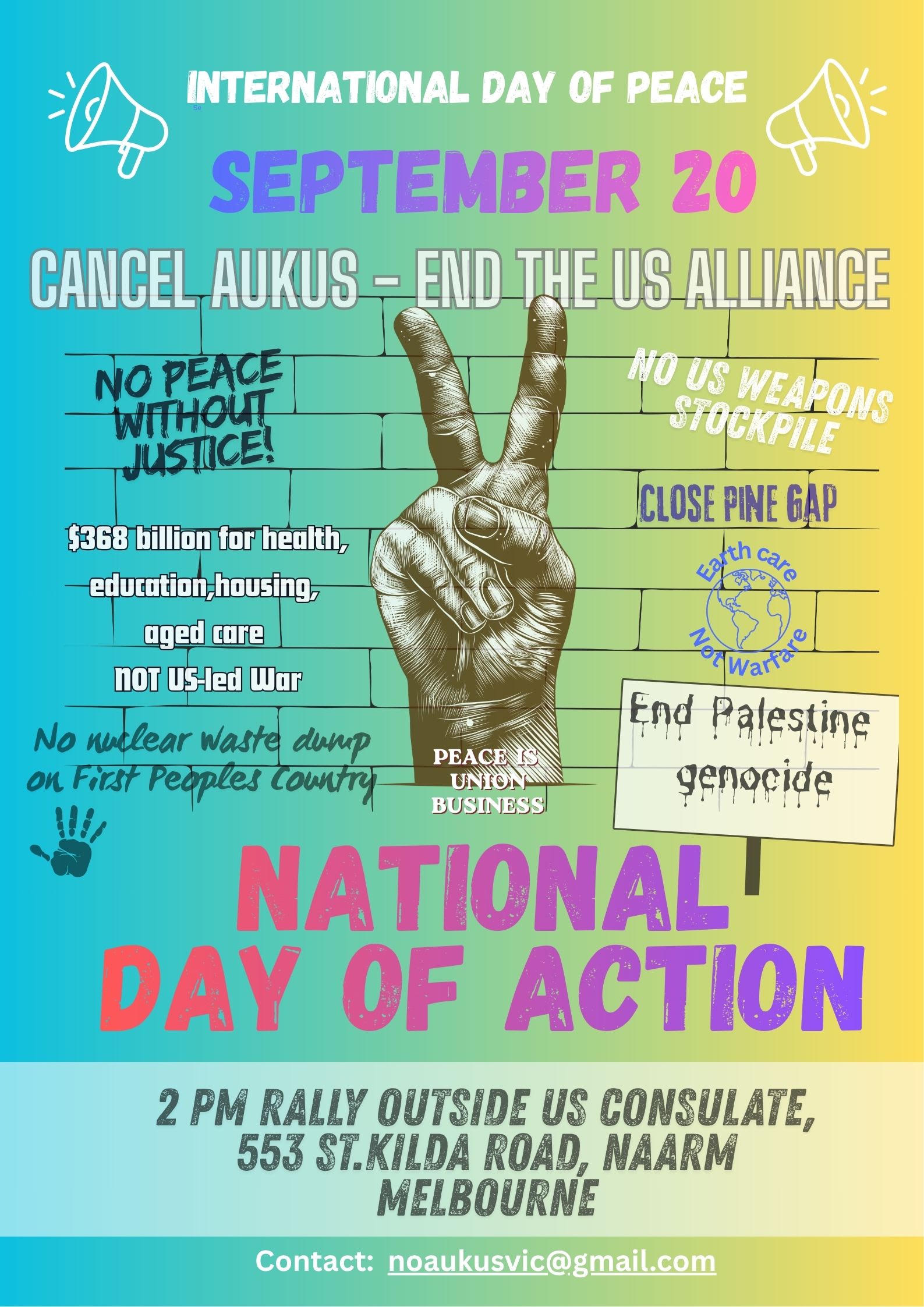
20 September –National Day of Action in Melbourne on the International Day of Peace

Help Aunty Sue Protect Her Land and Sacred Sites From Destructive Rocket Testing.
.

Australians deserve the truth
about
AUKUS – https://aukuspublicinquiry.com/

PETITION – To: Prime Minister Anthony Albanese and the Australian Labor Government

of the week – Australians for War Powers Reform (AWPR)
To see nuclear-related stories in greater depth and intensity
 Antinuclear