Many people, both inside and outside Kimba, want a judicial review of the government’s nuclear waste dump decision
Commenting on the opinion piece: They have let it come: now build it InDaily
I respect the right of Sean Edwards to express his opinion. However, he makes a number of factual errors which should be corrected.
I will address one: ‘The people of Kimba don’t want judicial review’.
I personally know people from Kimba who do want judicial review.
Furthermore, many outside the Kimba region want judicial review, hence the widespread objection to the proposed amendment. – Andrew Williams https://indaily.com.au/opinion/reader-contributions/2021/03/01/your-views-on-vaccination-sa-nuclear-dump-jobseeker-reviews-and-more/
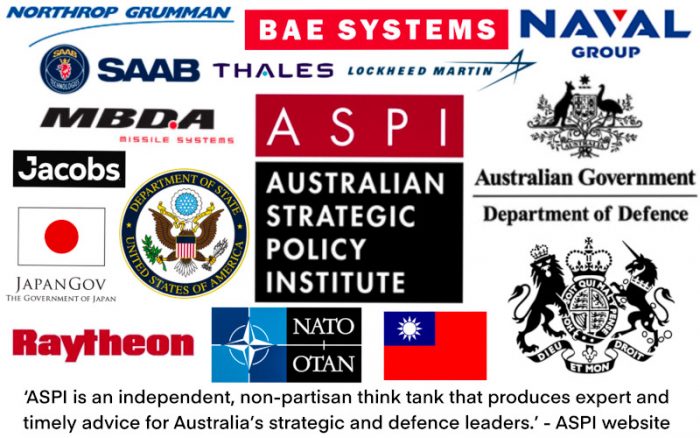
Australian Strategic Policy Institute – a stooge for weapons industries and China-haters
|
Independent” think-tank ASPI behind push for more defence spending rakes in advisory fees, Michael West Media, 1 Mar 21, by Marcus Reubenstein | Jul 1, 2020 Funded by the Department of Defence, the Australia Strategic Policy Institute collects millions more as it drives the “China threat” narrative. As Marcus Reubenstein reports, while ASPI is the media’s go-to experts for public comment, ASPI is remarkably coy about revealing all its funding sources.
On the day the Prime Minister Scott Morrison announced a $270 billion defence spending plan, the Department of Defence paid the Australian Strategic Policy Institute (ASPI) a $214,500 contract for “management advisory services”. Exactly one year ago today, it was awarded a similar “management advisory services” contract for the considerably larger amount of $614,536. ASPI has pushed hard for boosts to defence spending, in particular an upgrade of Australia’s missile capabilities. The Government says it will spend $800 million on the US-made AGM-158C Long Range Anti Ship Missile, manufactured by Lockheed Martin, which gave ASPI $135,909 in sponsorship funds in 2018-19. Go-to think tank on ChinaThe Australian Strategic Policy Institute is the “go to” think tank for the mainstream media seeking an “independent voice” to make sense of troubled times with China. Its analysts are knowledgeable and articulate, always forthcoming with research pointing to the strategic threat of China. However, it is less forthcoming about the funders of its research, although it is an open secret that foreign governments and multi-billion-dollar weapons makers are generous supporters. What is not widely known is the extent to which taxpayers are propping it up, through dozens of small contracts not listed in its annual reports. Last year, these contracts amounted to more than $2 million and were signed by the chiefs of a small group of government departments which, say ASPI’s critics, have vested interests in promoting China as Australia’s No. 1 strategic threat. On China’s radarTwo weeks ago, ASPI was again thrust into the international limelight after China’s foreign ministry directly named it as the source of claims by Prime Minister Scott Morrison that Australia was the victim of a sustained cyber security attack. Morrison did not name China but, ASPI’s executive director, Peter Jennings did. He told journalists it was a “95%” likelihood that China was behind the alleged attacks. Critics, including former foreign ministers, ambassadors and senior figures within the defence establishment, contend that ASPI is an anti-China lobby that has hoodwinked the media into believing it is independent. Labor Senator Kim Carr, who is pursuing ASPI through a Senate committee, argues it’s a conflicted government-funded body that lacks transparency, particularly in the way it reports who funds its research. It is an Australian government organisation, a Commonwealth company, and they’ve been at the centre of Sinophobia. This is what happened in the Cold War, you set up a front and create a world view that’s unchallengeable. Then you de-legitimize anyone who argues for engagement with China. Ironically, engagement with China remains official government policy”. Disguised defence largesseThe Howard Government set up ASPI in 2001 as an independent think tank that would challenge a supposed culture of stagnated thinking, weighed down by the defence bureaucracy. Its main funding was an annual grant from the Defence Department but over the past decade it has developed more and more revenue streams — and no obligation to reveal exactly who pays it what. Defence remains its biggest benefactor. Before the federal election, the Morrison Government not only increased this funding by more than 13%, it locked in a guaranteed $20 million until 2023. This largesse does not include one-off payments for sponsorship and commissioned reports. In its annual reports, ASPI declares the $4 million annual Defence grant but opaquely refers to this as “core funding”. According to Department of Finance figures, in 2018-19 it received an additional $1,363,002.84 in funding from Defence, which was not publicly declared. According to answers it provided to a Senate Estimates committee in February, ASPI collected $1,158,581.63 (pre-GST) in funding from Defence without clearly declaring the source of those funds. ASPI didn’t explain the discrepancy between its two reported figures. Shrinking support?In its annual report, ASPI splits income into two sources: “Defence funding” and “Sale of goods and rendering of services”. It also produced a gloomy graph [on original] showing how “core” funding had withered away from 100% of its income to a moderate 43%. However, the graph doesn’t take into account its numerous government tenders and contracts that have delivered a financial windfall. In the past five years the value of its government contracts has increased by more than 300%. (second graph on original] Figures from the Department of Finance’s procurement website AusTender show ASPI was awarded $2,133,716.62 in contracts between July 2019 and June 2020. ASPI records all these government payments in its annual reports but muddies the waters by consolidating them with sponsorships and other commercial revenue. ASPI has received 37 government contracts in the past two years. See below [on original] or click here for easier viewing………. Major backersASPI has received funding from the governments of Britain, Japan and Taiwan as well as NATO. Among its corporate supporters are global weapons makers Thales, BAE Systems, Raytheon, SAAB, Northrop Grumman, MDBA Missile Systems and Naval Group. Yet their contribution of over $330,000 last year is dwarfed by that of a handful of government departments and agencies. Disclosures to the Senate revealed that ASPI had at least 56 sources of income in 2018-19 which it categorised as either sponsorships or commissioned income. Critics might accuse ASPI of having a narrow world view, but its views are financially supported by a very broad base of benefactors. Michael West Editor’s Note: This is a special investigation by APAC News, Michael West Media and Pearls & Irritations https://www.michaelwest.com.au/independent-think-tank-aspi-behind-push-for-more-defence-spending-rakes-in-advisory-fees/ |
|
A new motley crew of Australian politicians form “Friends of Nuclear”

Reporter Rosie Lewis, writing in THE AUSTRALIAN (25/12/21) recorded, with that paper’s usual pro nuclear joy and delight, that 21 Australian politicians have signed up to this group. They named only 9 of these MPs, a motley crew indeed, of minor party members, and 5 Labor Party ones.
It gets confusing, as Labor has a clear policy of prohibiting nuclear technology, ( excluding the Lucas Heights Opal reactor). But then, sabotage of Labor policies is not a new thing for Joel Fitzgibbon. He opposes Labor’s climate policy (which is strange, as nuclear’s big push is about purporting to combat climate change)
However, you can bet that the remaining 12 ‘nuclear friends’ would be Liberals and Nationals.
Meanwhile, the 9 mentioned have an odd assortment of views on energy – some support renewable energy, some oppose. There’s some scepticism on climate change, where you’d expect nuclear being touted as the solution. And Pauline Hanson is on record as opposing the nuclear lobby’s plan for a nuclear waste dump at Kimba, South Australia.
“Dr Gillespie and Senator Gallacher said their priority was on educating other MPs — particularly within Labor — about nuclear energy.” “We can introduce the best scientific minds into our parliamentary friendship group and bring them to Canberra.”
Of course, those “best scientific minds” will come from “Australia’s Nuclear Science and Technology Organisation and other government and industry bodies” which function primarily as nuclear promoters, anyway. I don’t think they’ll be inviting Dr Helen Caldicott, Dr Jim Green, or Dave Sweeney fron the Australian Conservation Foundation.
Australian government obsessed with preventing legal appeals against its nuclear waste dump plan
Commenting on the opinion piece: They have let it come: now build it , In Daily Dave Sweeney, Australian Conservation Foundation InDaily 25 Feb 21
Sean Edwards’ defence of the federal governments push for a hotly-contested national radioactive waste facility near Kimba on the Eyre Peninsula fails to recognise that the deeply flawed plan has once more hit the rough.
Mr Edwards speaks of respect, but there is nothing respectful in the governments new legislation seeking to remove people’s rights to legally appeal or challenge the plan.
Access to a day in court is a fundamental democratic right, and the governments obsession with removing this should sound alarm bells in the wider community, just as it has in the Senate where the planned law was again deferred this week after it failed to garner broad political support.
The plan shirks the hard questions about responsible long-term radioactive waste management in favour of a sub-optimal short-term political ‘fix’.
The waste comes from the Lucas Heights reactor in Sydney. There is a growing call that it should stay at this secure federal site until there is a credible pathway for its long-term management. Moving it to an area in regional South Australia where there are far fewer management assets and resources is both unnecessary and irresponsible.
This is not a decision about on which hill to put a mobile tower. Deciding on Australia’s first purpose-built national radioactive waste facility requires much more evidence, effort and evaluation than has occurred to date.
If radioactive waste lasted as long as our politicians it would hardly be a problem. But it doesn’t. This is Australia’s most serious radioactive waste and some of it needs to be isolated from people and the environment for 10,000 years.
Our nation needs a credible, evidence-based approach to the long-term management of radioactive waste.
Sadly, neither Minister Pitt’s plan nor Mr Edward’s assurances deliver this. It is time the current approach was scrapped and the federal government got serious about advancing responsible waste management. – https://indaily.com.au/opinion/reader-contributions/2021/02/26/your-views-on-nuclear-waste-submarines-and-jobseeker/
Legislation banning nuclear power in Australia should be retained

Murdoch papers and Murdoch’s Sky News have ramped up their campaign to have nuclear laws repealed, and far-right Coalition MPs and former MPs are along for the ride. The post Legislation banning nuclear power in Australia should be retained appeared first on RenewEconomy.
Legislation banning nuclear power in Australia should be retained — RenewEconomy
State parliaments in NSW and Victoria have completed nuclear inquiries over the past two years but the governments of both states have no intention of repealing laws banning nuclear power.
The Morrison government established an inquiry into nuclear power in 2019 but made it clear that the federal ban would be retained regardless of the findings of the inquiry.
Nevertheless, supporters continue to campaign for the repeal of federal and state laws banning nuclear power. The Murdoch papers and Murdoch’s Sky News have ramped up their campaign to have those laws repealed.
Far-right Coalition MPs and former MPs are along for the ride.
And a tangled web of far-right conspiracists and fossil fuel interests: for example a recent article promoting nuclear power in Australia was written by a Policy Associate at the impressive-sounding Institute for Energy Research — the impressive-sounding, Koch-founded, fossil fuel-funded Institute for Energy Research.
There’s conflict within the Coalition, as demonstrated by the unwillingness of the federal and NSW Coalition governments to repeal legal bans, and submissions opposing nuclear power to the federal inquiry from the SA and Tasmanian conservative governments as well as the Queensland Liberal-National Party.
Coalition Senator Matt Canavan is at war with himself, previously noting that nuclear power would increase power bills but now supporting taxpayer funding for nuclear power through the Clean Energy Finance Corporation.
Yes, it’s entertaining watching the Coalition at war with itself over an energy source that has well and truly priced itself out of the energy debate and has instead found a home in the culture wars.
Former PM Malcolm Turnbull describes nuclear power as the “loopy current fad … which is the current weapon of mass distraction for the backbench”.
But there’s a serious side to the problem.
Firstly, the promotion of nuclear power muddies the energy debate and helps to delay the transition from fossil fuels to renewables. Economist Prof. John Quiggin notes that, in practice, support for nuclear power in Australia is support for coal.
Secondly, politicians who are silly enough to promote nuclear power over cheaper renewables would probably be silly enough to gift billions of dollars of taxpayer subsidies to nuclear companies.
And not all of these MPs are fringe figures like Craig Kelly — some have real clout such as NSW Deputy Premier John Barilaro, former Deputy Prime Minister Barnaby Joyce, and former PM Tony Abbott (who thinks the Coalition should promote nuclear power to “create a contest” with unions, GetUp, the Greens, the ALP and the “green left“.
There are plenty of recent examples demonstrating how badly nuclear power projects can go wrong.
All of the recent projects in the US and western Europe have cost about A$20 billion per reactor and all of them are at least A$10 billion over budget and many years behind schedule.
Multi-billion-dollar taxpayer and ratepayer subsidies for these failed projects have been ever-expanding. It would be naïve to expect a better outcome — in other words, a non-disastrous outcome — in Australia given our lack of experience and expertise.
Thirdly, culture wars based on lies and conspiracy theories can escalate beyond anyone’s wildest imagination, as we see with the MAGA movement in the US.
There has to be push-back against irrational ideologues lest they become dangerous irrational ideologues.
The rest of this article summarises the reasons to oppose nuclear power in Australia and to keep legal bans in place. This summary comes with the caveat that rational arguments won’t shift the culture warriors; a cult deprogrammer might shift them, but not rational arguments.
Nonetheless, the rest of the population needs to be inoculated against the misinformation of the ideologues. Continue reading
Australian government’s nuclear waste plans unacceptable – Dr Margaret Beavis
 Long-term impact of quick nuclear dump fix https://indaily.com.au/opinion/2021/02/23/long-term-impact-of-quick-nuclear-dump-fix/Legislation to set up a national nuclear waste storage site on South Australia’s Eyre Peninsula is being debated by federal parliament. Margaret Beavis argues that both the site selection process and storage plans for long-lived intermediate nuclear waste are unacceptable. Long-term impact of quick nuclear dump fix https://indaily.com.au/opinion/2021/02/23/long-term-impact-of-quick-nuclear-dump-fix/Legislation to set up a national nuclear waste storage site on South Australia’s Eyre Peninsula is being debated by federal parliament. Margaret Beavis argues that both the site selection process and storage plans for long-lived intermediate nuclear waste are unacceptable.
Today, the government is planning a Senate vote to lock in moving highly radioactive nuclear waste to Kimba. This bill will deny any judicial oversight or review, despite major flaws in the proposal. However there is no rush to find a home for Australia’s nuclear waste. The federal nuclear regulator, ARPANSA, has been crystal clear; the nuclear waste at the ANSTO Lucas Heights reactor can stay there safely for decades. Claims that moving the waste is urgently needed to continue nuclear medicine in Australia are patently false. As a GP, I use nuclear medicine and ongoing access is necessary. Other arguments that we need to consolidate nuclear waste at one site are misleading, given hospitals will be handling waste for as long as there is nuclear medicine. Hospitals currently manage their own nuclear medicine wastes on a ‘delay and decay’ basis on site; after use in a patient, the waste very rapidly loses its radioactivity. After a few months the vast majority is safe enough to go to a normal rubbish tip. There will always be multiple sites. Many South Australians would be unaware that this proposed “temporary storage” of nuclear waste in Kimba is a second-rate cheap solution. World’s best practice requires deep geological disposal, which costs a lot more. Countries such as Finland have spent over 40 years researching locations and properly involving communities. They are only now building a deep geological repository, at a cost of over A$5 billion In contrast, the Kimba plan will cost shift onto future generations, who will be left to do the job properly at great expense. Indeed, whilst the government promises to move the waste yet again some decades hence, there are no plans whatsoever for proper longer-term disposal. It is highly likely to end up stranded at Kimba and a significant liability for South Australians. In addition to the dodgy storage proposal, there are many other flaws. The big ones include: four years of a misleading government marketing campaign, a deciding vote using a biased sample of residents and a complete disregard of profound opposition by the Traditional Owners. The site selection process has been poor. The community has endured several years of very one-sided marketing, and remains deeply divided on the issue. Low-level waste has been the major focus thoughout, yet the elephant in the room is the intermediate waste that is radioactive for over 10,000 years. The community vote was based on town boundaries, which biased the sample towards businesses who may profit from the facility. It excluded farmers who are closer to the site than the township. At the alternative Hawker site last year, a much less biased vote with a 50 km radius was used, and the waste was clearly rejected. This current proposal also rides rough shod over the clear opposition of the traditional owners. In April 2020 the Federal Parliament’s own Joint Committee on Human Rights found the National Radioactive Waste Management Act does not sufficiently protect the Barngarla’s rights and interests. The Federal Government admits its proposed legislation will deny farmers, Traditional Owners and other interested parties a right to a judicial review. Indeed, the legislation is designed to do just that. This bill locks in a second-rate process for a second-rate facility that will be a major future liability for South Australians. Highly radioactive intermediate level nuclear waste is going to be with us for a very, very long time. There is plenty of time to do it right. We need a proper disposal plan, not moving the waste unnecessarily to a temporary store and leaving it for our kids to pay for. This waste is highly radioactive for millennia. If this legislation passes, it will come back and haunt South Australians for generations to come. Margaret Beavis is a GP and vice president of the Medical Association for Prevention of War. |
|
Assange’s partner exposes ongoing denial of his legal and democratic rights,
 Assange’s partner exposes ongoing denial of his legal and democratic rights, https://www.wsws.org/en/articles/2021/02/22/assa-f22.html?pk_campaign=assange-newsletter&pk_kwd=wsws, Oscar Grenfell, 21 February 2021 In an online post last week, Stella Moris, the partner of Julian Assange and mother of his two young children, outlined the ongoing denial of the WikiLeaks founder’s fundamental legal and democratic rights, even after a British Magistrates’ Court ruled early last month against his extradition to the United States. Assange’s partner exposes ongoing denial of his legal and democratic rights, https://www.wsws.org/en/articles/2021/02/22/assa-f22.html?pk_campaign=assange-newsletter&pk_kwd=wsws, Oscar Grenfell, 21 February 2021 In an online post last week, Stella Moris, the partner of Julian Assange and mother of his two young children, outlined the ongoing denial of the WikiLeaks founder’s fundamental legal and democratic rights, even after a British Magistrates’ Court ruled early last month against his extradition to the United States.
Moris provided a succinct summary of the issues of democratic principle at stake, in the US attempt to prosecute Assange for lawful publishing activities that exposed war crimes, and updated his supporters on the current stage of the legal campaign to secure his freedom. The January 4 verdict, forbidding extradition, had “taken into account” the “extensive medical evidence” presented during last year’s trial, Moris explained. Assange’s dispatch to the US had been blocked on the grounds that it would be “oppressive.” His health issues, including serious depression, and the brutal character of the US prison system, meant there would be a great risk of Assange taking his own life if he were extradited. The US immediately responded, in the final days of the administration of President Donald Trump, by formally signalling an appeal. Trump’s Democratic Party successor, President Joe Biden, in his first weeks in office, rejected calls by civil liberties and press freedom organisations for the US Department of Justice to drop its pursuit of Assange, demonstrating the bipartisan character of the persecution. The High Court will decide after March 29 whether prosecutors, acting on behalf of the US state, will be permitted to proceed with their appeal. Moris stated that the next stage for the defence was to submit a response to the US grounds of appeal. She then reviewed the anti-democratic implications of Judge Vanessa Baraitser’s January 4 ruling. It had denied Assange’s extradition on health grounds, but “did not side with him on the wider public interest arguments.” Baraitser had upheld virtually all of the prosecution’s substantive arguments, effectively green-lighting future attempts by governments to prosecute journalists and publishers for exposing material that they deem to be “classified” and of “national security” significance, regardless of the public interest of what is exposed. Continue reading |
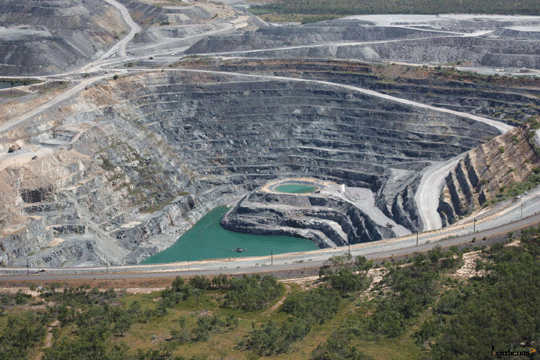
The remediation of Ranger uranium mine: will it really restore the environment?
Traditional owners were given land rights in return for their support for the Ranger mine, and Kakadu National Park was born. ……. the land will finally be returned to the traditional owners… the question is, in what state? ……… we could find the site an eroding heap of substandard scrub.
As part of cleaning up the mine site, contaminated buildings and equipment will be buried in one of the mine’s enormous pits.
We’ve been told that burying the equipment and the contaminated material in the mine site is out of step with global best practice in the mining industry.
|
Kakadu in crisis, ABC 22 Feb 2021, Crisis in Kakadu: The turmoil threatening Australia’s biggest national park
“It’s gone downhill. No one basically trusts anybody, no one respects each other anymore. That’s how bad it is here.” Traditional owner Kakadu is one of the great natural wonders of the world. The stunning landscape, teeming with wildlife, is a major tourist destination with scores of Instagram friendly sites. For tourism operators it is an iconic symbol of what Australia has to offer. “It’s one of the most special places in Australia. It’s for so long been one of the reasons why people visit Australia and for Australians, one of their must do life experiences.” Tourism industry representative Despite its beauty, there is trouble inside Australia’s biggest national park. This World Heritage listed site is in crisis. “It’s an absolute mess because the institutions responsible for fixing it up aren’t doing their job.” Traditional owner On Monday Four Corners investigates accusations of mismanagement and neglect which have fuelled a bitter dispute between the park’s traditional owners and the authority that runs the park. |
National Farmers Federation want govt to support renewable energy (not coal or nuclear)
released on Tuesday, the NFF makes the call for renewable energy to be part
of new investment to address the $3.8bn annual shortfall in infrastructure
in regional Australia. The paper, which makes no mention of coal or nuclear
energy supporting jobs in the regions, comes as the Nationals push for the
Clean Energy Finance Corporation to invest in those technologies.
Kimba radioactive trash Bill stagnates in the Senate, as Right-wing media extols nuclear power
Resources Minister Keith Pitt and Australia’s nuclear schills must be getting a bit desperate. The National Radioactive Waste Management Amendment (Site Specification, Community Fund and Other Measures) Bill 2020 keeps on not getting itself discussed in the Senate.
This could be because (a) it’s likely to be defeated, or (b) if passed, there will be a successful court action opposing it, or (c) the plan would not meet the required international safety standards.
I’m betting on (d) – the Senators just don’t know wotthell to do about it.
Meanwhile Australia’s the prevailing media, the Murdochracy,and commercial media is in a frenzy, in their anxiety about Australia’s huge need to embrace nuclear technology.
Why we need to flick the switch and embrace nuclear power -THE AUSTRALIAN 23 February
Wise warning to Australian government to withdraw embarrassing Nuclear Waste Dump Bill

 Peter Remta, 21 Feb 21, to Senator Slade Brockman
I am aware that the Waste Management Amendment (Site Specification, Community Fund and Other Measures) Bill 2020 has been listed in the Senate’s order of business for Tuesday 23 February but with respect suggest that this a completely futile exercise on the part of your government and the responsible minister
The bill will not be passed because of the unwavering opposition by the crossbench and any preceding debate could be extremely embarrassing for your government because of the untoward and disingenuous information previously put out by Pitt and his department and its agencies being raised by the opposing senators
If Pitt then falls back on the existing legislation he will be subject to administrative and judicial and now because of the High Court decision earlier this month in the New Acland Coal case(1) will be completely stopped with his proposals if the opposing community at Kimba start their legal action since their situation is one real and not just apprehend bias as in that case
Should that litigation ensue then practically all written material held by the government in all its guises will be fully disclosed through the litigation procedure of discovery
From my limited personal knowledge of some of that material it will prove extremely embarrassing and your government will not be able to claim any privilege to prevent its disclosure
This is the view of several senior lawyers including some retired superior court judges but ask the attorney should you have any doubts
Perhaps the most pertinent aspect of the whole situation is the proposal for Kimba will in any event fail to get any of the necessary licences as ARPANSA is already being criticised for not carrying out its proper regulatory functions with respect to ANSTO and as a result the licence applications will be subject to an overseas peer review which will completely remove the licensing process from your government and its agencies
In any case ANSTO is already under a cloud due to its dismal performance and awkward responses at the Senate estimates hearing on 29 October 2020 which will I understand be subject to further extensive questioning and explanations
Please bear in mind that I was the source of the information for the questioning senators and the further questions to be asked due to the complete inadequacy of the responses by ANSTO to the notified questions(2)
I therefore suggest that you and Dean Smith as the government whips withdraw the bill before it becomes a further embarrassment to your government in a possible election year
With kind regards
Peter Remta
(1). Oakey Coal Action Alliance Inv v. New Acland Coal Pty Ltd & Ors
High Court Case No.B34/2020
(2). SENATE ECONOMICS LEGISLATION COMMITTEE Estimates
Hansard THURSDAY 29 OCTOBER 2020
Senator Abetz pages 11 to 13 and Senator Carr pages 5 to 11
News Corpse fervently promoting nuclear power to Australia
 From THE AUSTRALIAN, 17 Feb 21, ‘‘Think of the deaths that could have been avoided, since installing solar panels and wind turbines is a surprisingly dangerous exercise. The death toll from solar power per unit of energy supplied is more than five times as high as the death toll from nuclear, according to estimates from Cambridge House in Canada. By the same measure, nuclear power is 1000 times safer than coal and 400 times safer than natural gas. Yet still Albanese persists with the lame excuse that nuclear power is too dangerous to consider.”
 Cambridge House doesn’t seem like a credible source for deaths in different power sources.
Maybe not the most reliable source of info, journalist at The Australian.
Some excellent scientists did, in fact, do meticulous studies, and documented illnesses,deaths, birth defects resulting from the Chernobyl disaster. The Russian government happily collaborated with the West in a successful campaign to discredit those scientists. Most notably Alexey V. Yablokov – https://en.wikipedia.org/wiki/Chernobyl:_Consequences_of_the_Catastrophe_for_People_and_the_Environment
Queensland neeeds job-supplying, clean, renewable energy, NOT antiquated nuclear power

“What regional Queensland needs is an Australian government that is united on growing manufacturing and delivering cleaner, cheaper, energy.
“Not a Government that is tearing itself apart and proposing antiquated solutions.”
LNP comes clean on plans for Queensland nuclear power, https://statements.qld.gov.au/statements/91502 18 February, 2021
The LNP’s latest thought bubble on energy policy has again exposed the rifts in the coalition party room, Energy, Renewables and Hydrogen Minister Mick de Brenni said today.
Mr de Brenni said the LNP’s latest announcement to bring nuclear energy to Queensland would not be welcome by the public.
“Queenslanders have emphatically rejected nuclear power time and time again and today’s revelation flies in the face of every State and Territory’s nuclear ban,” the Minister said.
“Inner city Liberals are pushing renewables, Nationals are nuclear and the result is the lack of a coherent national energy policy.
“Manufacturing and resources companies are investing in cheaper, cleaner energy to grow jobs in Queensland by investing in renewables, not old fashioned, dangerous options.
“Queensland’s renewable energy zones have been flooded with enough interest to create 60,000 megawatts of extra clean energy, which could create up to 57,000 jobs in construction alone, let alone the influx of load intensive manufacturing jobs…
“This ongoing investment in large-scale renewable energy is only happening because of Queensland’s very clear energy policy.
“What regional Queensland needs is an Australian government that is united on growing manufacturing and delivering cleaner, cheaper, energy.
“Not a Government that is tearing itself apart and proposing antiquated solutions.”
Mr de Brenni said the Queensland Opposition Leader should immediately reject the calls and ask his party for a coherent energy policy.
“He should call his Queensland federal colleagues today to put an end to calls to bring nuclear energy to Queensland,” Mr de Brenni said.
“Any decision to overturn the Australian ban on nuclear by the LNP has the potential to kill off Queensland’s chance to onshore manufacturing and the Palaszczuk Government’s plans to develop a clean, renewable hydrogen sector and thousands of renewable jobs.”
“Queensland’s renewable energy zones have been flooded with enough interest to create 60,000 megawatts of extra clean energy, which could create up to 57,000 jobs in construction alone, let alone the influx of load intensive manufacturing jobs.
“And we have the youngest fleet of coal-fired power stations.
“This ongoing investment in large-scale renewable energy is only happening because of Queensland’s very clear energy policy.
“What regional Queensland needs is an Australian government that is united on growing manufacturing and delivering cleaner, cheaper, energy.
“Not a Government that is tearing itself apart and proposing antiquated solutions.”
Mr de Brenni said the Queensland Opposition Leader should immediately reject the calls and ask his party for a coherent energy policy.
“He should call his Queensland federal colleagues today to put an end to calls to bring nuclear energy to Queensland,” Mr de Brenni said.
“Any decision to overturn the Australian ban on nuclear by the LNP has the potential to kill off Queensland’s chance to onshore manufacturing and the Palaszczuk Government’s plans to develop a clean, renewable hydrogen sector and thousands of renewable jobs.” Media contact: Rosie Gilbert 0466 834 330
Nationals add nuclear enthusiasm to the government’s energy bill
 Nationals’ nuclear flare-up on energy bill https://au.news.yahoo.com/nuclear-ideal-cutting-emissions-joyce-222058648.html?guccounter=1&guce_referrer=aHR0cHM6Ly9uZXdzLmdvb2dsZS5jb20v&guce_referrer_sig=AQAAAG3X514QPdgktFOrKbKPrnzoSz6joD3PVpI6uSj2DBv3oIZTOIzUDZWnifcsw_SXXPYtt3h1orA3QYlShoI_rlgBn5o675_PqDys5-xmgpGOEFmBJ1ooQWfTzK9RMofsPeZk-CfshnVXybppn5h7kGhpqKtNAaeAVwv0YCeavNKn, Thu, 18 February 2021, The Nationals have gone nuclear on energy policy, flagging another amendment to their own government’s plans.
The government wants the bill to pass parliament next week so a raft of projects go ahead.
Former Nationals leader turned backbencher Barnaby Joyce has already wedged his colleagues by introducing an amendment which would allow the Clean Energy Finance Corporation to invest in coal-fired power stations.
Now the Nationals Senate team wants the green bank to invest in nuclear power as well as carbon capture and storage.
The five Nationals senators led by Bridget McKenzie and Matt Canavan fronted a media conference promoting their plan.
“We compete against the world with one hand behind our back while other nations avail themselves of cutting edge, low emissions technologies,” Senator McKenzie said.
There is a longstanding moratorium on nuclear energy generation which has been maintained by both Labor and coalition governments.
The coal and nuclear-pushing Nationals are putting renewed pressure on current leader Michael McCormack.
By introducing amendments to the government’s own bill they are forcing their colleagues to either vote for or against the original plan.
Treasurer Josh Frydenberg said Mr McCormack has been a resilient leader, having already batted off an attempt from Mr Joyce to snatch back the party’s top job.
Mr Frydenberg said the Nationals and Liberals had so far worked effectively on energy under the current leaders.
“It’s a pretty complex area, as I know,” he told reporters in Canberra.
“If I took off my jacket I could show you the scars from being the energy minister.”
Mr Frydenberg was the minister behind the previous coalition government’s National Energy Guarantee, which played a role in Malcolm Turnbull’s downfall as prime minister.
Mr Joyce claims small modular nuclear reactors are ideal to replace decommissioned coal-fired power stations and reduce emissions.
“Nuclear reactors can do it,” he told reporters in Canberra.
“Why not, if you want zero emissions.”
Opposition Leader Anthony Albanese said nuclear energy in Australia doesn’t stack up.
“What we are witnessing here is just a part of the chaos that is the coalition when it comes to energy policy,” he said.
The Nationals argue the $1 billion grid reliability fund to be run out of the CEFC should support small nuclear energy projects and get involved in developing the technology.
The Australian Conservation Foundation says there’s nothing clean about nuclear, coal or gas.
“Nuclear is not a credible climate response and has been repeatedly rejected by the market and the community,” ACF spokesman Dave Sweeney said.
Australia a renewables leader – or the Saudi Arabia of nuclear energy”

Northern Territory Senator Dr Sam McMahon says she is “delighted” her push for nuclear has been backed, after the Nationals announced new amendments to a bill in favour of nuclear energy and carbon capture and storage.
Nationals Senators, led by Matt Canavan and Bridget McKenzie have announced a raft of amendments to the Clean Energy Finance Corporation (CEFC) bill to invest in nuclear power.
Senator McMahon says the drafted legislation supports her long-established calls to unlock nuclear energy…..
The Northern Territory, with our abundance of Uranium and potential nuclear fuel Thorium, should be the Saudi Arabia of nuclear energy.
But political activist group Get Up’s national director Paul Oosting says that as Australia forges ahead with solutions to the climate crisis, such as solar technology, the push for nuclear could delay climate action.
“Nuclear power is dangerous, unnecessary and colossally expensive. It would take more than a decade to build a nuclear reactor in Australia and cost billions. It’s the ultimate climate action delay tactic,” Mr Oosting said.
“Australia has an opportunity to position itself as a world leader in renewables. It’s critical this pivotal moment in our history not be squandered on obsolete and failing technologies that will lock in irreparable climate damage.”
Mr Oosting said he was concerned the clean energy corporation could become a “slush fund” for the coal, gas, and nuclear industry, and cautioned politicians from backing the bill.
“When Taylor’s Bill comes before Parliament, politicians who accept the seriousness of the climate crisis we face – of all parties and none – must act to ensure coal, gas, and nuclear are excluded from any definition of ‘low emissions technology’, the return-on-investment requirement is kept, and the independence of the CEFC board is maintained,” he said………….he said…………. https://www.hepburnadvocate.com.au/story/7134825/the-nt-should-be-the-saudi-arabia-of-nuclear-energy-senator-mcmahon/
1 This month.
20 September –National Day of Action in Melbourne on the International Day of Peace


Help Aunty Sue Protect Her Land and Sacred Sites From Destructive Rocket Testing.
.

Australians deserve the truth
about
AUKUS – https://aukuspublicinquiry.com/


PETITION – To: Prime Minister Anthony Albanese and the Australian Labor Government

of the week – Australians for War Powers Reform (AWPR)
To see nuclear-related stories in greater depth and intensity
 Antinuclear