Federal energy and emissions reduction minister Angus Taylor wants to include dirty energy in Clean Energy Finance Corporation
Renew Economy 18th Feb 2021, The Morrison government is set for a fight from within over proposed changes to the Clean Energy Finance Corporation, with a growing number of
Nationals looking to lift restrictions on investments in unproven fossil fuel technologies and nuclear energy projects.
Federal energy and emissions reduction minister Angus Taylor has introduced legislation to establish a new $1 billion Grid Reliability Fund to be administered by the Clean Energy
Finance Corporation, that the government wants to use to underwrite new gas and storage projects, which would require re-defining gas as a ‘low emissions technology’.
The Clean Energy Finance Corporation is restricted to only investing in ‘low emissions technologies’, and is explicitly prohibited from investing in nuclear energy technologies and carbon capture and storage projects.
https://reneweconomy.com.au/nationals-push-nuclear-in-new-attempt-to-highjack-cefc-changes/
Nothing clean about nuclear, coal or gas – Australian Conservation Foundation
 The Australian Conservation Foundation has urged parliamentarians not to undermine Australia’s successful clean energy bank by changing its mandate to invest in dirty, dangerous energy options like gas, coal and nuclear.
The government’s Clean Energy Finance Corporation Amendment (Grid Reliability Fund) Bill, which would give Energy Minister Angus Taylor power to direct the CEFC to invest in technologies that are not renewable and make investments that would not generate a financial return, is listed for debate today in the House of Representatives.
Some government MPs and Senators want the CEFC to be able to fund coal and nuclear.
“Undermining the popular and successful Clean Energy Finance Corporation would be a massive own goal,” said ACF campaigner Dave Sweeney.
“Talking up nuclear and new coal-fired power plants is a dangerous distraction from facing up to Australia’s very real energy challenges and choices.
“There is nothing clean about the fuel behind the Fukushima and Chernobyl disasters, which produces waste that remains radioactive for tens of thousands of years.
“There is no such thing as clean coal and the CEFC wouldn’t be considered a trusted investment partner if it was expected to invest in this outdated, dirty technology.
“Despite the urgent need to cut climate pollution – which is why the CEFC was established – no country in the world is choosing to set up a nuclear industry from scratch.
“When it comes to climate action, nuclear power is a dead end. The reactors that exist are expensive and risky; the promised new reactors don’t exist. Nuclear is not a credible climate response and has been repeatedly rejected by the market and the community.
“To spruik nuclear as the world approaches the tenth anniversary of the Fukushima disaster is an act of wilful blindness and political convenience – a fission fig leaf for politicians stuck in a previous century.
“Australia’s energy future is renewable, not radioactive.”
ACF is proud to have come up with the idea of a Clean Energy Finance Corporation in a 2010 report, Funding the transition to a clean economy.
Australian Liberal National Coalition enthusiastic for nuclear power
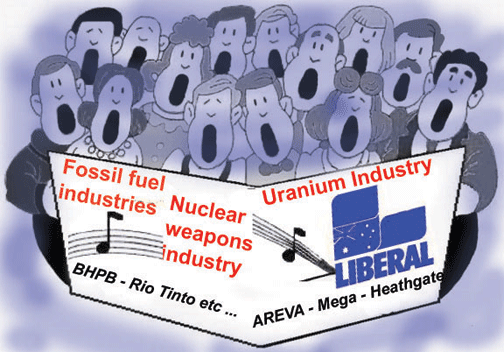
Coalition MPs in drive for nuclear energy, THE AUSTRALIAN, 17 Feb 21, Nationals senators have drafted legislation allowing the Clean Energy Finance Corporation to invest in nuclear power as two-thirds of Coalition MPs backed lifting the ban on the controversial fuel source.
The block of five Nationals senators, led by Bridget McKenzie and Matt Canavan, will move an amendment to legislation establishing a $1bn arm at the green bank to allow it to invest in nuclear generators, high-energy, low-emissions (HELE), coal-fired power stations and carbon capture and storage technology.
The Nationals’ move comes as a survey of 71 Coalition backbenchers conducted by The Australian revealed that 48 were in favour of lifting the longstanding prohibition on nuclear power in the EPBC act.
Liberal MPs Andrew Laming, John Alexander and Gerard Rennick are among backbenchers who want Scott Morrison to take a repeal of the nuclear ban to the upcoming election ……
The new amendment proposed by the Nationals would go further than Mr Joyce’s push by ensuring the CEFC — established by the Gillard government in 2012 to invest in green energy initiatives — could help kick-start nuclear projects as well as new clean coal plants……..
Out of the 71 Coalition backbenchers surveyed by The Australian, only Queensland senator Paul Scarr was opposed to changing the nuclear prohibition enshrined in the EPBC Act, citing a lack of community support “at this stage”. A further 22 backbenchers were undecided or did not respond to questions.
Other supporters of lifting the ban on nuclear generation, including Trent Zimmerman, Ted O’Brien and Rowan Ramsey, believe the government should not move ahead with legalising the energy source while the proposal is bitterly opposed by Labor.
In-principle support for lifting the nuclear prohibition is prevalent by members in every faction of the Coalition, which has been divided over climate change action since Tony Abbott became prime minister in 2013.
City-based Liberal MPs ……. including Jason Falinski, Tim Wilson, Katie Allen, Andrew Bragg and Dave Sharma — argue that nuclear should be an option in a technology-agnostic approach …..
The Prime Minister has signalled he will not move ahead with legalising nuclear energy unless there is bipartisan support with Labor. MPs told The Australian Mr Morrison was unlikely to pursue a policy change on the issue in this term of parliament. However, small modular nuclear reactors were included as a potential technology in the federal government’s technology investment roadmap discussion paper………..
Mr Tim Wilson attacked Labor and the Greens as nuclear science deniers. …….
Many government MPs acknowledge the power source is not currently competitive on price, but say investment decisions should be a matter for private companies and lifting the nuclear ban would encourage technological advancement..
Other Liberal MPs in favour of lifting the prohibition are: Warren Entsch, Russell Broadbent, James Stevens, Ian Goodenough, Rick Wilson, David Fawcett, Concetta Fierravanti-Wells, Sarah Henderson, Hollie Hughes, James McGrath, Jim Molan, Julian Simmonds, Bert van Manen, Ben Small, Dean Smith, David Van, Terry Young and James Paterson.
Nationals MPs who want the energy source legalised include Anne Webster, Damian Drum, Perin Davey, Llew O’Brien, Sam McMahon, Susan McDonald and Ken O’Dowd.
Boothby MP Nicolle Flint has previously publicly backed nuclear power.
Mediation continuing over rehabilitation of Range uranium mine
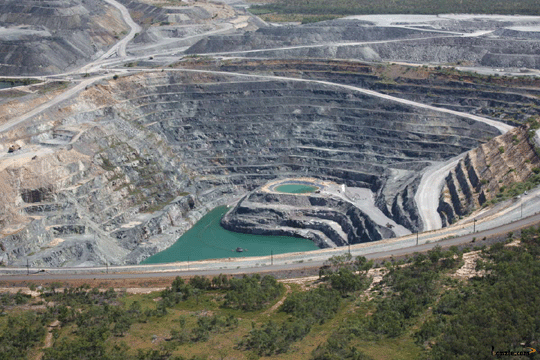 Mediation continues behind closed doors, but the case is a clear reminder that commitments are not set in stone and that clean-up funding for even the most environmentally destructive projects is not guaranteed.
While national and/or state law jurisdictions regulate specific requirements for closure and associated financial assurance, which also determine the period of rehabilitation, it is essential that members of the mining community are aware of applicable law and regulation in all jurisdictions of operation……….
“In the context of price volatility, investment shifts and now Covid-19, many major companies have been mothballing operations and selling mines to juniors, smaller and/or less resourced companies around the world. The most notable may be Blair Athol coal mine in Queensland, sold for $1 in 2016.”
The socio-economic and financial arrangements for closure agreements are especially important in order to avoid dumping the costs on taxpayers and society .
How long should a miner commit to oversight? https://www.mining-technology.com/news/mining-rio-tinto/ Yoana Cholteeva11 February 2021
A subsidiary of Rio Tinto is currently in mediation with the Australian Government over continuing commitments to scientific monitoring of the Ranger mine. We examine the dispute and take a look at some positive examples of land remediation.
Land rehabilitation as part of mining oversight is an essential process where the land in a mining area is returned to some degree of its former state. Recently, a new dispute over the rehabilitation of the Ranger Uranium Mine in the Northern Territory of Australia, owned by a Rio Tinto subsidiary, once again reignited the debate over how long a miner should maintain oversight once operations have stopped.
Rio Tinto’s oversight dilemma
‘Clean Coal’ – ridiculed by experts, as just a marketing scam
 ‘Clean coal’ is nothing but a marketing scam: Energy experts, New Daily, Cait Kelly, Reporter 17 Feb 21, The Nationals’ pitch for taxpayers to invest in ‘clean coal’ is nothing but a marketing scam designed to make Australians feel better about burning carbon emissions, leading energy experts say.
It comes as the Morrison government pushes key changes to Australia’s Clean Energy Finance Corporation that would allow the green bank to invest in fossil fuel projects, and give Energy Minister Angus Taylor the power to control which investments receive funding.
Mr Taylor’s proposed bill would undo laws that stop the corporation from investing in fossil fuels and loss-making projects.
But outspoken backbencher Barnaby Joyce served up an amendment to allow for investment in clean coal, blindsiding the government and derailing the passage of the bill through Parliament on Wednesday.
Debate on the legislation started in the House of Representatives on Monday and the push was on to get ‘clean coal’ a spot at the investment table.…….
On Wednesday, Nationals Senate leader Bridget McKenzie backed Mr Joyce’s amendment intended to allow for new investment in “high efficiency, low emissions” coal-fired power.
Doctors also joined the chorus of voices warning the changes would negatively affect environment targets, saying our love of fossil fuels is already killing 5700 Australians each year, and will continue to do so until we phase it out.
Clean coal ‘doesn’t exist’
Richie Merzian, the climate and energy program director with the Australia Institute, said ‘clean coal’ was nothing more than spin.
“Clean coal doesn’t exist. That’s the first thing,” Mr Merzian told The New Daily.
“Over the last 15 years, Australian governments have invested $1.3 billion into making clean coal work.
“There isn’t a single commercial clean coal, carbon capture storage power plant in Australia. And there are hardly any overseas – you can count them on one hand.”
Australia has only one carbon capture and storage gas plant. It’s currently leaking emissions into the atmosphere, because it doesn’t work.
The Gorgon gas project in WA received $60 million in federal funding but did not start storing emissions until 2019, three years after productions started.
Recently, it has been leaking high levels of emissions out into the atmosphere because its pressure management system is broken.
“It’s still not fully operational,” Mr Merzian said.
“The level of the emissions released in the atmosphere are about the same as Australia’s annual domestic emissions of flights.
“It’s been a massive failure.”
All it boiled down to was a marketing tool, he said……… https://thenewdaily.com.au/news/2021/02/17/clean-coal-scam/
Solar, storage to take over from Ranger uranium mine
|
Solar, storage to take over from Australian uranium mine https://www.pv-magazine.com/2021/02/17/solar-storage-to-take-over-from-australian-uranium-mine/https://www.pv-magazine.com/2021/02/17/solar-storage-to-take-over-from-australian-uranium-mine/https://www.pv-magazine.com/2021/02/17/solar-storage-to-take-over-from-australian-uranium-mine/
The Ranger Uranium Mine ceased production in Australia’s Kakadu National Park in January, following years of financial losses. Now, as part of a multimillion dollar rejuvenation of the park, there are plans to develop a solar and battery storage hybrid project near the town of Jabiru. FEBRUARY 17, 2021 BLAKE MATICH From pv magazine Australia Distributed energy producer EDL will build, own and operate a hybrid microgrid in the remote mining town of Jabiru, in Australia’s Northern Territory. Working with the Northern Territory government, EDL’s Jabiru Hybrid Renewable Project will help the community transition from its recent history as a uranium mining town to a new future as a tourist destination in the heart of the World Heritage-listed Kakadu National Park. Jabiru is held in native title by the Mirarr people. The town, as it is recognized today, has only existed since 1982, when it was established as a living community for the nearby Ranger Uranium Mine. The project, which integrates 3.9 MW of solar generation and a 3 MW/5 MWh battery with 4.5 MW of diesel generation, is in line with broader efforts to rejuvenate Kakadu. It will also be EDL’s 100th site since it began 30 years ago with the development of the Pine Creek Power Station on the other side of the national park. “Once completed, our hybrid renewable power station will provide Jabiru with at least 50% renewable energy over the long term, without compromising power quality or reliability,” said EDL CEO James Harman. The Ranger Uranium Mine is owned by Energy Resources Australia, a subsidiary of Rio Tinto. It was once one of the most productive uranium mines in the world. However, the mine ceased production on Jan. 8, after years of losses primarily attributed to the market slump following the 2011 Fukushima nuclear disaster. According to the Katherine Times, Kakadu is set to undergo a $276 million upgrade as part of a plan to rejuvenate tourism to the home of the world’s oldest living culture. Federal Environment Minister Sussan Ley told the newspaper that “the park’s traditional owners want to see culturally appropriate tourism grow and we will work with them to achieve that outcome.” EDL will begin construction on the project in the months ahead. It expects the hybrid system to be generating energy by early 2022. |
|
Australian Government could face an unwinnable legal case if Senate passes the Kimba Nuclear Waste Dump Bill

sources outside of the government.
5. The government has been notified in writing that its concept for one national centralised facility has been badly planned and not anywhere as safe as claimed – in fact the government and its entities have been asked to withdraw their claims and express the concerns of the holders and the contractors but have refused to do so.
Refuting claims about the ”medical necessity” for Kimba Nuclear Waste Dump
 It is Absolute nonsense that the facility at Kimba is critical to nuclear medicine.
In what specific and fully explained way is the Kimba facility critical?
Nuclear medicine requirements in Australia are already being catered for adequately under present conditions and if additions are necessary they can be achieved without Kimba.
How can the consolidation be achieved since the federal government has no legal rights or control over the waste held at the various locations throughout Australia?
Department of Industry Science Energy and Resources but is now head of the recently established Australian Radioactive Waste Agency (ARWA)
Australian government’s brazen duplicity concerning Julian Assange
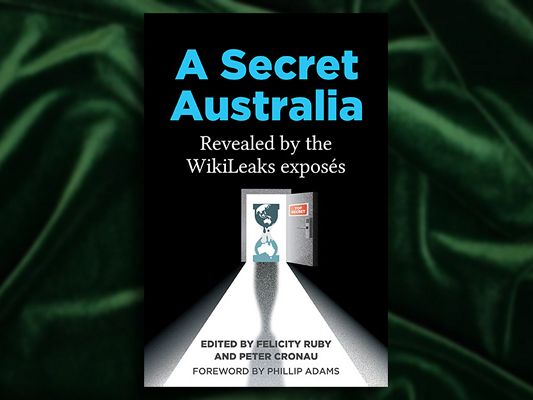 What Assange and WikiLeaks said about Australia, https://www.smh.com.au/culture/books/what-assange-and-wikileaks-said-about-australia-20210129-p56xyo.html
By Jessie Tu February 4, 2021 He has been called “truth-telling hero”, “evil and perverted traitor”, “heroic, trickster, mythical – reviled”. Robert Manne called him the “most consequential Australian of the present time”. The new US President has called him a “high-tech terrorist”.
The protean narratives of Julian Assange, who will be 50 in July, have been brewing since 2010, when his website published “The Afghan War Diaries”, “Iraq War Logs” and “Collateral Murder”, a video showing the US military killing two Reuters employees in Iraq.
December marked 10 years since Assange has been “arbitrarily detained” in Britain, according to Felicity Ruby and Peter Cronau in their introduction to A Secret Australia – a collection of 18 essays that survey the impact WikiLeaks has had on Australia’s media landscape and the consequences of our government’s attraction towards America’s intelligence and military empire.
The potpourri of authors and thinkers includes Julian Burnside, Antony Loewenstein, Scott Ludlam and Helen Razer, who critique “the powers opposed to openness and transparency” and examine the evidence, “not the likelihoods, the probabilities, the suspicions, and assumptions” around the “subversive, technology-based publishing house”.
WikiLeaks invented a “pioneering model of journalism” – one that embodied the “contemporary spirit of resistance to imperial power”, says Richard Tanter, from the school of political and social sciences at the University of Melbourne. It brought renewed debates on free speech, digital encryption and questions around the management and protection of whistleblowers who risk their lives to expose covert, deceitful actions by governments.
The documents exposed the “brazen duplicity” of the Australian government towards its citizens and presented “off-stage alliance management conversations”, Tanter writes. They invited the layperson into the green room of the performance that is politics and international diplomacy.
WikiLeaks unmasked reports that showed governments recommending media strategies to deceive the public, demonstrating their unethically utilitarian approach to international diplomacy and governance and “enlightened the public on the dark corners of wars”, writes journalist and author Antony Loewenstein.
Assange is still in a cell at London’s Belmarsh Prison, facing an appeal by the United States in its bid to extradite him to face charges for the 2010 publications. He is continuing to be “denied adequate medical care” and “denied emergency bail in light of the COVID-19″, says Lissa Johnson, a clinical psychologist and writer for New Matilda – one of the few Australian publications that have paid genuine attention to the WikiLeaks saga.
In Australia, there’s been a “striking absence of a solid debate on WikiLeaks in the mainstream public discourse”, according to Benedetta Brevini, a journalist and media activist who insists that our concerning “lack of a thorough and sustained debate” is incomprehensible. Loewenstein calls Australia’s lack of journalistic solidarity with Assange “deeply shameful”. He says we have an “anodyne media environment” – perhaps not unsurprising, considering our highly concentrated media market, one of the most severe in the world.
The standout essays come from Guy Rundle and Helen Razer – whose amusing voice cuts through the somewhat parched tenor of cold academic-speak that lightly threads through the other essays. Her addition is a breath of fresh air in the middle of a chain of same-same arguments.
The most useful essay is Rundle’s take on the historical basis for WikiLeaks. He surveys the swirling currents of Australian history that led to its founding, identifying WikiLeaks as a continuation of political activist Albert Langer’s resistance to capital.
“We need a whole new organisation of how recent Australian history is told,” Rundle concludes, seconding Lissa Johnson’s opinion that we demand citizens who “cut across the acquiescence and consent, remove the deadbolt on the torture chamber door, turn down the music and expose what is going on inside”. This collection of polemics, though at times repetitive, takes us closer to a future where these demands no longer seem beyond reality.
Press freedom hangs on the fate of Julian Assange
 Sabine von Törne 14 Feb 21,
 Biden administration presses for Julian Assange to be extradited to USA
Biden administration files appeal pressing for Assange extradition, Yahoo News, Sat, 13 February 2021 The administration of US President Joe Biden has appealed a British judge’s ruling against the extradition of WikiLeaks founder Julian Assange, a Justice Department official said Friday.
A brief filed late Thursday declared Washington’s desire to have Assange stand trial on espionage and hacking-related charges over WikiLeaks’ publication of hundreds of thousands of US military and diplomatic documents beginning in 2009.
The Justice Department had until Friday to register its stance on Judge Vanessa Baraitser’s January 4 ruling that Assange suffered mental health problems that would raise the risk of suicide if he were sent to the United States for trial.
“Yes, we filed an appeal and we are continuing to pursue extradition,” Justice Department spokesman Marc Raimondi told AFP.
After Baraitser’s decision, which did not question the legal grounds for the US extradition request, Donald Trump’s administration moved to appeal.
But Biden’s stance was not clear, and he was pressured by rights groups to drop the case, which raises sensitive transparency and media freedom issues.
After WikiLeaks began publishing US secrets in 2009, then-president Barack Obama, whose vice president was Biden, declined to pursue the case.
Assange said WikiLeaks was no different than other media constitutionally protected to publish such materials.
Prosecuting him, too, could mean also prosecuting powerful US news organizations for publishing similar material — legal fights the government would likely lose.
But under Trump, whose 2016 election was helped by WikiLeaks publishing Russian-stolen materials damaging to his rival Hillary Clinton — the Justice Department built a national security case against Assange.
In 2019 the native Australian was charged under the US Espionage Act and computer crimes laws with multiple counts of conspiring with and directing others, from 2009 to 2019, to illegally obtain and release US secrets……….
Assange has remained under detention by British authorities pending the appeal.
Earlier this week 24 organizations, including Human Rights Watch, Amnesty International USA and Reporters Without Borders, urged Biden to drop the case.
“Journalists at major news publications regularly speak with sources, ask for clarification or more documentation, and receive and publish documents the government considers secret,” they said in an open letter.
“In our view, such a precedent in this case could effectively criminalize these common journalistic practices.”
Assange’s fiancée Stella Moris said in a statement that Baraitser’s January decision that Assange was a high risk for suicide and that US prison facilities were not safe remained a strong reason to deny extradition.
Baraitser “was given clear advice by medical experts that ordering him to stand trial in the US would put his life at risk,” she said.
“Any assurances given by the Department of Justice about trial procedures or the prison regime that Julian might face in the US are not only irrelevant but meaningless because the US has a long history of breaking commitments to extraditing countries,” she said https://au.news.yahoo.com/biden-administration-files-appeal-assange-171637702.html
In its rush for Kimba nuclear dump, Australian government tries to remove rights to legal recourse
|
Jodie van Deventer’s recent comment clearly identifies “our obligation as a society to dispose of our waste responsibly”. Sadly this much needed responsibility is missing from the federal governments stalled push to advance a national radioactive waste site near Kimba on the Eyre Peninsula. Right now, the federal government is seeking to change the rules and remove fundamental democratic rights and protections by denying concerned and affected citizens a day in court. The right to independent legal recourse is a fundamental principle of our democracy. It should not be lightly jettisoned, especially on an issue with such significant implications and impacts as radioactive waste. Despite multiple requests, Barngarla Native Title holders were explicitly excluded from the consultations and remain actively opposed to the planned waste facility. To further remove their rights – and the rights of others – is unfair, unnecessary and unjustified. This is not simply a low-level waste facility. Many state and national civil society groups, Aboriginal and professional groups, the SA Upper House, state Labor and unions share concerns and oppose the government’s approach. A key concern is that it will not result in credible long term management, especially of intermediate level waste. The right to independent legal recourse is a fundamental principle of our democracy. It should not be lightly jettisoned, especially on an issue with such significant implications and impacts as radioactive waste. Despite multiple requests, Barngarla Native Title holders were explicitly excluded from the consultations and remain actively opposed to the planned waste facility. To further remove their rights – and the rights of others – is unfair, unnecessary and unjustified. This is not simply a low-level waste facility. Many state and national civil society groups, Aboriginal and professional groups, the SA Upper House, state Labor and unions share concerns and oppose the government’s approach. A key concern is that it will not result in credible long term management, especially of intermediate level waste. The right to independent legal recourse is a fundamental principle of our democracy. It should not be lightly jettisoned, especially on an issue with such significant implications and impacts as radioactive waste. |
|

Retain Gosford’s nuclear free zone status.
 Keep the Coast nuclear free, https://coastcommunitynews.com.au/central-coast/news/2021/02/keep-the-coast-nuclear-free/ Donna Carey, Narara Ecovillage, Narara Keep the Coast nuclear free, https://coastcommunitynews.com.au/central-coast/news/2021/02/keep-the-coast-nuclear-free/ Donna Carey, Narara Ecovillage, NararaFEBRUARY 12, 2021 I am passionately in favour of retaining Gosford’s nuclear free zone status. No one who I have engaged with, in person or on social media, is in favour of this being rescinded. Opening up Central Coast Council like this would allow the use, storage of or transportation through the LGA of nuclear weapons, waste or material for the first time since 1984. I am strongly opposed to this action being facilitated. It also paves the way for small-scale nuclear facilities on the Central Coast. In addition, it is on the public record that Taylor Martin MLC is in favour of small-scale nuclear reactors to generate electricity. The rationale for this proposal is that “the handling and mining of radioactive materials is now highly regulated at a State and Federal level” and “any public concern regarding nuclear-related activities is best dealt at the State and Federal level”. However, this is not completely correct, and legislation is slowly changing. In 2019, a NSW Upper House inquiry into the Uranium Mining and Nuclear Facilities (Prohibitions) Repeal Bill 2019 recommended repealing the original bill in its entirety. Uranium exploration is also already permitted under current legislation; its mining just currently is not. There is no certainty that “there are no known uranium deposits on the Central Coast” (Item 4.1, Attachment 3, Council agenda, Feb 8). As you are aware, the former Wyong Shire Council had a similar nuclear free zone policy, which was revoked in April, 2014, and “policies from the former Gosford City and Wyong Shire Councils still apply in their respective former Local Government Areas, until a new policy is adopted for the Central Coast Council region” (https://www.centralcoast.nsw.gov.au/council/forms-and-publications/policies). My first preference would be for the nuclear free zone to be extended back into the previous Wyong LGA. If our Council’s “financial crisis” is your main order of business in your role as Administrator, Mr Dick Persson, I urge you to focus on this being the main issue at hand. I also thought that you said that it was not your role to go back over previous decisions. Please resist allowing your professional integrity to be compromised by the Council’s Environment and Planning department, which will pave the way for future nuclear power generation, uranium mining, and/or the storage of nuclear waste on the beautiful Central Coast. |
|
|
Mount Isa City Council supports nuclear weapons ban
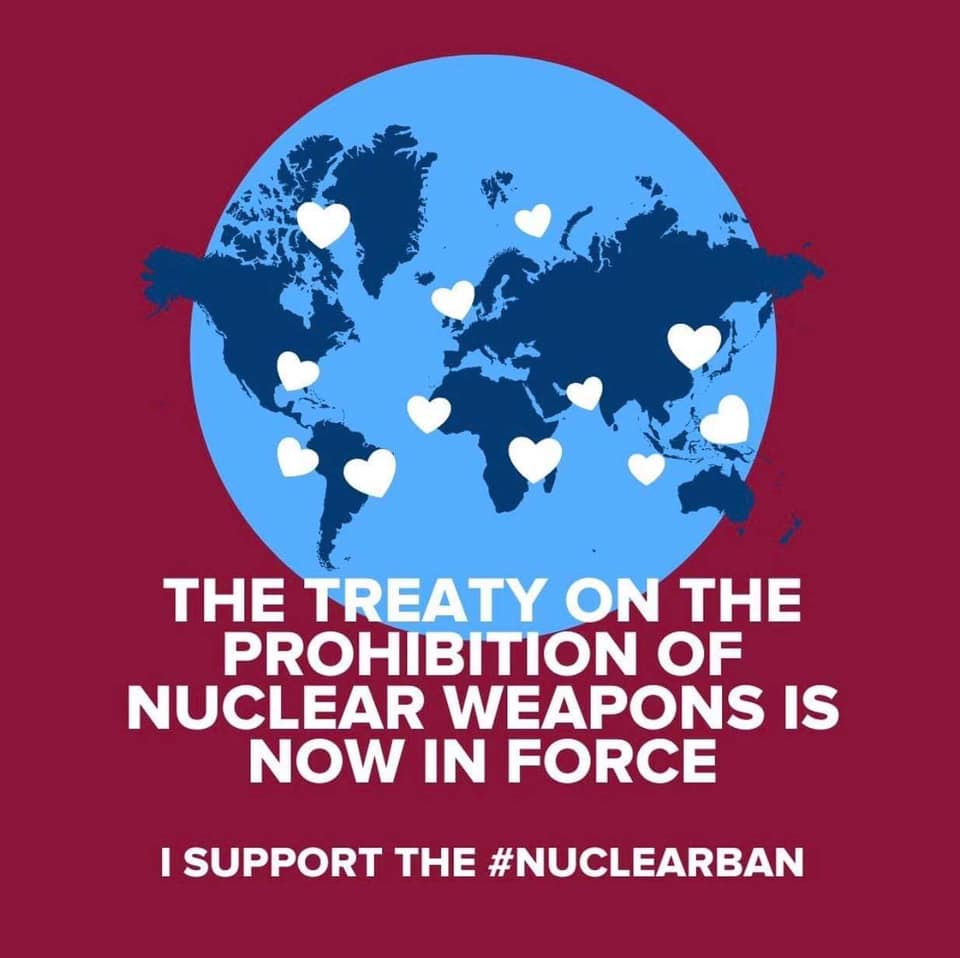 Mount Isa City Council supports nuclear weapons ban, Derek Barry, 10 Feb 21,
French nuclear attack submarine visted Australia, then on to patrol the South China Sea
|
French Nuclear Attack Boat Patrolled South China Sea https://news.usni.org/2021/02/10/french-nuclear-attack-boat-patrolled-south-china-sea By: Xavier Vavasseur, February 10, 2021 A French Navy Rubis-class nuclear-powered submarine (SSN) patrolled the South China Sea, the French minister of armed forces announced in a series of tweets.
French armed forces minister Florence Parly called the patrol “a striking proof of the capacity of our French Navy to deploy far and for a long time in connection with our Australian, American and Japanese strategic partners.” On Monday night, Parly shed some light on the current deployment of Rubis-class SSN FS Emeraude (S604) to the Pacific region. In a series of messages on Twitter, she said: “Since September, a nuclear attack submarine (SSN Émeraude) and a support vessel (BSAM Seine) have sailed up to 15,000 km from the coasts of mainland France in the Indian Ocean and the Pacific. This extraordinary patrol has just completed a passage in the South China Sea. A striking proof of the capacity of our French Navy to deploy far and for a long time in connection with our Australian, American and Japanese strategic partners. Why such a mission? To enrich our knowledge of this area and to affirm that international law is the only rule that is valid, whatever the sea in which we sail. Nation of the Indo-Pacific (~ 2 million inhabitants), France has the 2nd largest exclusive economic zone in the world (11 million km2 of which 9 are in the Indo-Pacific). We intend to protect our sovereignty and our interests.” Naval News first reported about Emeraude’s mission to the Pacific when it stopped over in Australia. The submarine then visited the U.S. naval base in Guam and participated in an anti-submarine warfare (ASW) exercise with the U.S. Navy and JMSDF. Following an exercise with the Indonesian Navy Emeraude will likely be joining the French carrier strike group which is set to depart this week for the Indian Ocean and Persian Gulf region. |
|
1 This month.
20 September –National Day of Action in Melbourne on the International Day of Peace


Help Aunty Sue Protect Her Land and Sacred Sites From Destructive Rocket Testing.
.

Australians deserve the truth
about
AUKUS – https://aukuspublicinquiry.com/


PETITION – To: Prime Minister Anthony Albanese and the Australian Labor Government

of the week – Australians for War Powers Reform (AWPR)
To see nuclear-related stories in greater depth and intensity
 Antinuclear