Morrison government’s devastating cuts to Environmental research and teaching
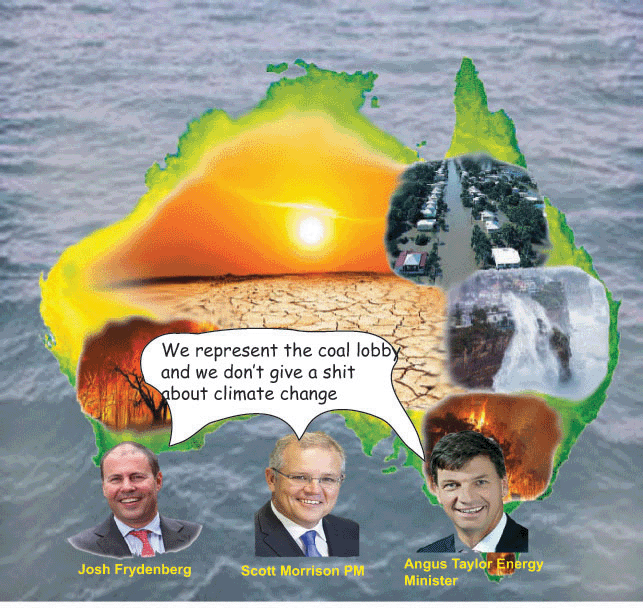 ‘Devastating’: The Morrison government cuts uni funding for environment courses by almost 30%, The Conversation, Dianne Gleeson, Professor, Science, University of Canberra, Ian Clark, Associate professor, University of South Australia, Stuart Parsons, Professor, Queensland University of Technology, 14 Oct 20,
 - agriculture, to address threats as diverse as water quality in the Great Barrier Reef, better retention of nitrogen fertilisers in soils and adaptation to climate change
- mining, for advice on site planning and restoration to ensure minimal environmental harm during and after the mine’s operation
- water management in rivers and wetlands, to respond to climate change and higher demand from growing populations…….
We need environmental experts
Australia’s recent, brutal experience with bushfires and drought shows just how badly we need world-class environmental expertise. As climate change grows ever worse, these experts will be critical in steering us through these challenges.
What’s more, the COVID-19 pandemic – linked to land clearing and more human-wildlife interaction – shows just what can happen under poor environmental management.
Australia is uniquely vulnerable to climate change, and in 2019, recorded its worst-ever environmental conditions. These university funding cuts affect the people with the answers to our pressing environmental problems – they are a blow to the future of all Australians.
Read more: A major scorecard gives the health of Australia’s environment less than 1 out of 10 https://theconversation.com/devastating-the-morrison-government-cuts-uni-funding-for-environment-courses-by-almost-30-147852
Australia a leader in the worst sense – biodiversity loss and risk of ecosystem collapse

Fifth of countries at risk of ecosystem collapse, analysis finds https://www.theguardian.com/environment/2020/oct/12/fifth-of-nations-at-risk-of-ecosystem-collapse-analysis-finds
Trillions of dollars of GDP depend on biodiversity, according to Swiss Re report, Damian Carrington Environment editor @dpcarrington, Mon 12 Oct 2020 .One-fifth of the world’s countries are at risk of their ecosystems collapsing because of the destruction of wildlife and their habitats, according to an analysis by the insurance firm Swiss Re.
Natural “services” such as food, clean water and air, and flood protection have already been damaged by human activity.
More than half of global GDP – $42tn (£32tn) – depends on high-functioning biodiversity, according to the report, but the risk of tipping points is growing.
Countries including Australia, Israel and South Africa rank near the top of Swiss Re’s index of risk to biodiversity and ecosystem services, with India, Spain and Belgium also highlighted. Countries with fragile ecosystems and large farming sectors, such as Pakistan and Nigeria, are also flagged up.
Countries including Brazil and Indonesia had large areas of intact ecosystems but had a strong economic dependence on natural resources, which showed the importance of protecting their wild places, Swiss Re said.
“A staggering fifth of countries globally are at risk of their ecosystems collapsing due to a decline in biodiversity and related beneficial services,” said Swiss Re, one of the world’s biggest reinsurers and a linchpin of the global insurance industry.
“If the ecosystem service decline goes on [in countries at risk], you would see then scarcities unfolding even more strongly, up to tipping points,” said Oliver Schelske, lead author of the research.
Jeffrey Bohn, Swiss Re’s chief research officer, said: “This is the first index to our knowledge that pulls together indicators of biodiversity and ecosystems to cross-compare around the world, and then specifically link back to the economies of those locations.”
The index was designed to help insurers assess ecosystem risks when setting premiums for businesses but Bohn said it could have a wider use as it “allows businesses and governments to factor biodiversity and ecosystems into their economic decision-making”.
The UN revealed in September that the world’s governments failed to meet a single target to stem biodiversity losses in the last decade, while leading scientists warned in 2019 that humans were in jeopardy from the accelerating decline of the Earth’s natural life-support systems. More than 60 national leaders recently pledged to end the destruction.
The Swiss Re index is built on 10 key ecosystem services identified by the world’s scientists and uses scientific data to map the state of these services at a resolution of one square kilometre across the world’s land. The services include provision of clean water and air, food, timber, pollination, fertile soil, erosion control, and coastal protection, as well as a measure of habitat intactness.
Those countries with more than 30% of their area found to have fragile ecosystems were deemed to be at risk of those ecosystems collapsing. Just one in seven countries had intact ecosystems covering more than 30% of their country area.
Among the G20 leading economies, South Africa and Australia were seen as being most at risk, with China 7th, the US 9th and the UK 16th.
Alexander Pfaff, a professor of public policy, economics and environment at Duke University in the US, said: “Societies, from local to global, can do much better when we not only acknowledge the importance of contributions from nature – as this index is doing – but also take that into account in our actions, private and public.”
Pfaff said it was important to note that the economic impacts of the degradation of nature began well before ecosystem collapse, adding: “Naming a problem may well be half the solution, [but] the other half is taking action.”
Swiss Re said developing and developed countries were at risk from biodiversity loss. Water scarcity, for example, could damage manufacturing sectors, properties and supply chains.
Bohn said about 75% of global assets were not insured, partly because of insufficient data. He said the index could help quantify risks such as crops losses and flooding.
Michelle Fahy blows open the disgraceful collusion between Australian politicians and weapons industries
|
Sweeping policy changes by the Coalition, including bringing the military industry into the centre of defence planning and a 2018 strategy to catapult Australia into the world’s top 10 of weapons exporting nations, created a business bonanza in the military industry. The Turnbull government allocated $195 billion towards upgrading Australia’s military capability (since increased to $270 billion). Extraordinary amounts of money. When combined with the fundamental undeclared, and undealt with, conflicts of interest that have now become routine in Australia’s defence sector, the potential for corruption has increased markedly. Conflicts of interest have become entrenched because of the close integration of military industry interests with government policy. Corporate influence on government policy has been cultivated for years by a phenomenon at which the arms trade excels: the revolving door. This is how the revolving door works. Defence-related politicians and public officials and military personnel are regularly offered high-level, high-paying positions with weapons companies upon retirement. This provides a strong incentive for those in public service, with an eye to their future, to seek the best interests of these companies. Military industry executives in turn are welcomed into government as experts, consultants and employees. Legalised corruption of democracy? Corruption is defined as “the abuse of entrusted power for private gain, be it grand, petty, or political corruption” in the 2019 Australian research report, Governing for Integrity. The report says ‘undue influence’ is a marker for corruption, and that undue influence and the ‘revolving door’ are two key problems “eroding public confidence in parliamentarians and ministers, and weakening the fundamentals of democracy”. Take the case of former defence minister Christopher Pyne, who discussed his future with EY Defence while still in parliament, then nine days after leaving politics accepted a position with them. Pyne now also runs his own lobbying firm, lectures as an ‘industry professor’ at the University of South Australia, and is chair of the advisory board and investment committee of a new investment fund promoting high returns via investment in selected defence and cyber stocks. Pyne’s post-politics career made a mockery of the ministerial standards and lobbying rules and led to a senate inquiry, which included former foreign minister Julie Bishop, who only months after leaving parliament joined the board of multinational aid contractor Palladium. The revolving door yet again exposed the parliament’s unwillingness to manage risk factors for corruption, further eroding public confidence in the integrity of our political system. As noted by Transparency International Australia in its submission to the senate inquiry, it is quite the “culture of cosiness”. Although a particularly egregious case, Pyne isn’t the only former defence minister to have used the revolving door. The Liberals’ Peter Reith left his ministerial desk and popped up a few days later at Tenix, then Australia’s largest defence contractor. EY also secured the services of Labor’s Kim Beazley within a year of his political departure, along with former Labor defence minister Stephen Smith. Beazley joined the board of Lockheed Martin in between his public roles as US Ambassador and WA Governor. (The job description and the budget of the WA Governor has been expanded to enable Beazley to advocate for defence industry.) After a three-year association with EY, Smith has recently accepted directorships with cyber security companies ArchTIS and Sapien Cyber. Meanwhile, former Liberal David Johnston is being paid $3,000 a day for up to 180 days a year as the federal government’s chief weapons industry advocate, while sitting on the board of Saab Technologies (a significant contractor to the Defence Department). Brendan Nelson, a former Liberal party leader, defence minister and director of the Australian War Memorial, is now with Boeing (a multibillion-dollar contractor to Defence). Nelson’s move to Boeing was announced in January 2020, just a few weeks after his departure from the war memorial, a tenure that caused controversy given Nelson’s pursuit of sponsorship from arms manufacturers. (In Nelson’s final appearance at senate estimates in October 2019 he highlighted Boeing’s $1 million sponsorship of the memorial.) Nelson also raised eyebrows in March 2019 when his entry on the foreign influence transparency register revealed he had been on Thales Australia’s “advisory board” since March 2015. Thales is a global top 10 arms manufacturer, a multibillion-dollar contractor to Defence, and a sponsor of the war memorial. Then veterans affairs minister Michael Ronaldson approved Nelson’s extracurricular activity while noting the potential for conflict of interest. Nelson countered public concerns by saying he donated the fees he received to the war memorial. Current minister Linda Reynolds was briefly employed by missile-maker Raytheon in between military and political jobs in her pre-senate career. Politicians attract almost all the attention for using revolving door, but they aren’t the only ones using it. Privileged accessConsider the appointment to the Thales Australia board of former ASIO boss Duncan Lewis in February 2020, just five months after he left ASIO. The appointment attracted almost no attention. While the Sydney Morning Herald noted the appointment, no hard questions were asked and no analysis provided of Lewis’s swift move into an industry over which he had had oversight. Lewis had spent five years as ASIO’s Director-General, his final public role in a long career of public service that spanned the military (commander of special forces), the departments of the prime minister and cabinet and defence, as well as diplomatic roles (including as Australia’s ambassador to NATO)……… Weapons CEO moves into public serviceThe revolving door also ushers former weapons industry executives into public sector roles. Jim McDowell is a good example. After 17 years with BAE, the world’s sixth largest weapons-maker, including 10 years as chief executive of BAE Systems Australia, McDowell returned to Australia in December 2013 from his post in Saudia Arabia as the company’s chief executive and was immediately appointed to the board of the Australian Nuclear Science and Technology Organisation. He became ANSTO’s chair in August 2014. For the next four years while with ANSTO he also undertook numerous influential consulting roles with the Defence Department. (More details here.)…….. McDowell was chancellor of the University of South Australia (which has close links with military industry) and was on the board of numerous companies in the military industrial sector …… Part 2: There’s been plenty of talk about enhancing military capability but nothing about enhancing defence’s anti-corruption practices . https://www.michaelwest.com.au/culture-of-cosiness-colossal-conflicts-of-interest-in-defence-spending-blitz/ |
|

Litigation: a promising new way to address Australia’s climate inaction
The pandemic lays bare a truth leaders consistently ignore: in the end, nature reigns supreme.
It ought to be worth noting that last month was Earth’s hottest September over the 140-year global temperature record, or that this year is in record territory even without an El Nino, or that warming over the past 12 months was just 0.2C below the internationally agreed “safe” limit……
The sad fact is that new temperature records have next to no impact in a world that has become hardened against climate shocks, a situation encouraged by an unholy coalition of political and corporate interests which over many decades have worked hard to obscure the true story.
As a nation, we ought to be up in arms about the Morrison government’s plans to ramp up methane extraction, based on the false claim that generating power by burning natural gas is somehow clean energy. But we’re not. It seems that in a pandemic you don’t question and don’t argue.
The pandemic is bad and generally getting worse getting worse as countries battle with competing health and economic demands. But at least, on the whole, governments recognise that COVID-19 constitutes an emergency and that urgent measures are needed to counter it.
What they don’t see is that the pandemic emergency sits within a bigger emergency. For all its devastation – and we should never downplay its impact on lives and livelihoods – in the long run we know it will end. That cannot be said about the all-enveloping catastrophe of climate change………
Litigation and divestment are two potent legal and financial levers that hold much promise. A case brought this year against the federal government promises to pull both of them.
Katta O’Donnell, a 23-year-old La Trobe University law student, grew up in Victoria’s central highlands. She experienced the impact of long-term drought on that landscape, and twice in 11 years saw it devastated by unstoppable wildfire. Last year, inspired by a lecture by Australian climate law specialist David Barnden, she decided it was time to act.
With Barnden’s help, O’Donnell filed a federal court claim alleging that the Australian government was breaching its legal duty and misleading sovereign bond investors by failing to disclose climate-driven financial risks, such as stranded fossil fuel assets and worsening environmental conditions.
In identifying a material risk to the market in government bonds everywhere, her action attracted attention globally, including in business circles in Europe and the United States alert to any sign of future financial loss.
Australia’s troubled environment, she told me last week, puts it on the front line of the climate crisis. Coral bleaching threatens Great Barrier Reef tourism, drought is lowering our capacity to grow food, and last summer’s bushfires will cost us upwards of $100 billion. Such tangible threats prompted Sweden to sell its Australian bonds last November.
The pandemic is telling us that fiscal and monetary controls, budgets and banks and all the rest of our economic constructs and artifices can’t hide the fact that it is nature, above all, that determines wealth, or its absence. We should all take that message to heart and welcome O’Donnell’s initiative as a long-overdue wakeup call. http://southwind.com.au/2020/10/13/on-trial-australias-dismal-climate-record/
Assange extradition case could esrablish a dangerous legal precedent

Crumbling Case Against Assange Shows Weakness of “Hacking” Charges Related to Whistleblowing
The charge against Assange is about establishing legal precedent to charge publishers with conspiring with their sources, something that so far the U.S. government has failed to do because of the First Amendment.
Five years later, in 2018, the Trump Administration indicted Assange anyway. But, rather than charging him with espionage for publishing classified information, they charged him with a computer crime, later adding 17 counts of espionage in a superseding May 2019 indictment.
The computer charges claimed that, in 2010, Assange conspired with his source, Chelsea Manning, to crack an account on a Windows computer in her military base, and that the “primary purpose of the conspiracy was to facilitate Manning’s acquisition and transmission of classified information.” The account enabled internet file transfers using a protocol known as FTP.
New testimony from the third week of Assange’s extradition trial makes it increasingly clear that this hacking charge is incredibly flimsy. The alleged hacking not only didn’t happen, according to expert testimony at Manning’s court martial hearing in 2013 and again at Assange’s extradition trial last week, but it also couldn’t have happened.
The new testimony, reported earlier this week by investigative news site Shadowproof, also shows that Manning already had authorized access to, and the ability to exfiltrate, all of the documents that she was accused of leaking — without receiving any technical help from WikiLeaks. …….
the charge is not actually about hacking — it’s about establishing legal precedent to charge publishers with conspiring with their sources, something that so far the U.S. government has failed to do because of the First Amendment………
Whether or not you believe Assange is a journalist is beside the point. The New York Times just published groundbreaking revelations from two decades of Donald Trump’s taxes showing obscene tax avoidance, massive fraud, and hundreds of millions of dollars of debt.
Trump would like nothing more than to charge the New York Times itself, and individual journalists that reported that story, with felonies for conspiring with their source. This is why the precedent in Assange’s case is so important: If Assange loses, the Justice Department will have established new legal tactics with which to go after publishers for conspiring with their sources. https://portside.org/2020-10-10/crumbling-case-against-assange-shows-weakness-hacking-charges-related-whistleblowing
Kimba’s potential water problem, if radioactive waste dump goes ahead
 Paul Waldon Fight to Stop a Nuclear Waste Dump in South Australia 12 Oct 20, Know Your Environment.
As Julian Assange faces extradition to USA, global press freedom is endangered
|
Assange Faces Extradition for Exposing US War Crimes, BY Marjorie Cohn, Truthout, October 11, 2020 Three weeks of testimony in Julian Assange’s extradition hearing in London underscored WikiLeaks’s extraordinary revelation of U.S. war crimes in Iraq, Afghanistan and Guantánamo Bay. But the Trump administration is seeking to extradite Assange to the United States to stand trial for charges under the Espionage Act that could cause him to spend 175 years in prison.
Assange founded WikiLeaks during the Bush administration’s “war on terror,” which was used as a pretext to start two illegal wars and carry out a widespread program of torture and abuse of prisoners at Guantánamo and the CIA black sites. On October 8, 2011, Assange told a Stop the War Coalition rally in London’s Trafalgar Square, “If wars can be started by lies, peace can be started by truth.” In 2010 and 2011, WikiLeaks published classified material that Army intelligence analyst Chelsea Manning had provided to the organization. Manning was prosecuted, convicted and sentenced to 35 years in prison for leaking the documents. As he left office, Barack Obama commuted her sentence to the seven years she had already served. That commutation provoked “tremendous anger” in the Trump administration and drew Trump’s attention to Assange, Eric Lewis testified. Lewis, chairman of the board of Reprieve U.S. and lawyer for Guantánamo and Afghan detainees, called this “a politically motivated prosecution.” The files that WikiLeaks published contained 90,000 reports about the war in Afghanistan, including the Afghan War Logs, which documented a greater number of civilian casualties by coalition forces than the U.S. military had reported. In addition, WikiLeaks published nearly 400,000 field reports about the Iraq War, more than 15,000 unreported deaths of Iraqi civilians, and the systematic murder, torture and rape by the Iraqi army and authorities that were ignored by U.S. forces. WikiLeaks also published the Guantánamo Files, 779 secret reports constituting evidence of the U.S. government’s abuse of approximately 800 men and boys, ages 14 to 89. That abuse violated the Geneva Conventions and the Convention Against Torture and Other Cruel, Inhuman or Degrading Treatment or Punishment. Perhaps the most notorious release by WikiLeaks was the 2007 “Collateral Murder” video, which depicts a U.S. Army Apache helicopter target and fire on unarmed civilians in Baghdad. At least 18 civilians were killed, including two Reuters reporters and a man who came to rescue the wounded. Two children were injured. A U.S. Army tank drove over one of the bodies, cutting it in half. The video contained evidence of three separate war crimes prohibited by the Geneva Conventions and the U.S. Army Field Manual. As they are firing on the civilians, U.S. gunmen can be heard saying, “Look at those dead bastards.” In his written testimony, investigative journalist Nicky Hager drew a parallel between the Collateral Murder video and the television image of George Floyd screaming “I can’t breathe.” Assange Cannot Be Extradited for a Political OffenseThe 2003 U.S.-U.K. Extradition Treaty forbids extradition for a political offense. Although the treaty doesn’t define “political offense,” it generally includes espionage, treason, sedition and crimes against state power. Trump is asking the U.K. to extradite Assange for exposing war crimes. This is a classic political offense. Assange is charged under the Espionage Act and espionage constitutes a political offense as well……….. Assange’s Prosecution Violates Freedom of PressWhile the Obama administration declined to file criminal charges against Assange for fear of setting a dangerous precedent, Team Trump demonstrated no such forbearance. By charging Assange under the Espionage Act, Trump is making him a poster boy for its full court press against the media, which he calls “the enemy of the people.” Assange’s prosecution would send an ominous message to all journalists: report the unvarnished truth at your peril. No media outlet or journalist has ever been prosecuted under the Espionage Act for publishing truthful information, which is protected First Amendment activity. Journalists are permitted to publish material that was illegally obtained by a third person and is a matter of public concern. The U.S. government has never prosecuted a journalist or newspaper for publishing classified information, an essential tool of journalism. Information-gathering, reporting and disclosure fit the classic definition of activity protected by the First Amendment’s guarantee of freedom of the press. There is no distinction between what WikiLeaks did and what The New York Times, Der Spiegel, Le Monde, El País and The Guardian did as well. They all published articles based on documents WikiLeaks released. This is the reason Obama administration — which prosecuted an enormous number of whistleblowers — considered, but refrained from, indicting Assange. ……… WikiLeaks Didn’t Endanger Informants and Saved LivesAlthough the U.S. government claims that Assange endangered informants named in the published documents, John Goetz, an investigative reporter who worked for Germany’s Der Spiegel, testified that Assange took pains to ensure that the names of U.S. informants in Iraq and Afghanistan were redacted to protect their identities. …….. Moreover, WikiLeaks’s revelations actually saved lives. After WikiLeaks published evidence of Iraqi torture centers the U.S. had established, the Iraqi government refused Obama’s request to extend immunity to U.S. soldiers who commit criminal and civil offenses there. As a result, Obama had to withdraw U.S. troops from Iraq. WikiLeaks also revealed evidence of wrongdoing by other countries besides the United States. The organization uncovered Russian surveillance, published exposés of Bashar al-Assad in Syria, and some say WikiLeaks’s exposure of corruption in Tunisia and torture in Egypt helped catalyze the Arab Spring………… Assange’s Prosecution Will Chill JournalismOstensibly to get around allegations that it is prosecuting Assange for conducting journalism, the Trump administration is trying to paint him as a hacker by accusing him of conspiring with Manning to break into a government computer to steal government documents, in violation of the Computer Fraud and Abuse Act. But, as Patrick Eller, a digital forensic expert, testified, the attempted cracking of the password hash was not technologically possible in 2010, when the conversation between Assange and Manning occurred. Even if it were feasible, the purpose would not have been to conceal Manning’s identity and it would not have given Manning any increased access to government databases. The prosecution of Assange would set a disturbing example for journalists and media outlets that publish information critical of the government. Team Trump singled out Assange to deter journalists from publishing material that criticizes U.S. policy. If Assange is extradited to the United States and convicted of the charges against him, it would chill journalists from reporting the facts for fear they could be indicted under the Espionage Act………. When she set the November 16 date for the defense to submit closing arguments, Judge Vanessa Baraitser asked the defense how the U.S. presidential election would affect its case and declared that her decision on extradition would come after that election, stating, “That’s one of the factors going into my decision.” Kristinn Hrafnsson, editor-in-chief of WikiLeaks, said that the judge “acknowledged what has been clear since even before the first indictment against Julian Assange was unsealed — that this is a politically motivated prosecution.” Baraitser, who has granted extradition in 96 percent of the cases that have come before her, plans to issue her ruling on January 4. If she grants extradition, there will be several levels of appeals, including to the European Court of Human Rights. The stakes could not be higher. https://truthout.org/articles/assange-faces-extradition-for-exposing-us-war-crimes/?eType=EmailBlastContent&eId=614ce999-9844-4d61-a600-169db0c99052 |
Murdoch media monopoly – an ‘arrogant cancer on our democracy’
 Australia’s high concentration of media ownership is eroding its democracy, getting in the way of critical action on issues like climate change and limiting what stories get told, media experts have warned. Australia’s high concentration of media ownership is eroding its democracy, getting in the way of critical action on issues like climate change and limiting what stories get told, media experts have warned.
The warning comes as former prime minister Kevin Rudd called for a royal commission into media concentration on Saturday, launching a petition to Parliament that amassed thousands of signatures within hours of going live. Australia’s media landscape is dominated by two players – Nine Entertainment, which owns the The Age and The Sydney Morning Herald mastheads among others, and News Corp, owned by former Australian Rupert Murdoch, which controls between 60 and 70 per cent of the metropolitan market. Mr Rudd decried the sheer concentration of the Murdoch empire, and pointed to News Corp mastheads’ support for the Liberal Party in the past 18 elections. Murdoch has become a cancer, an arrogant cancer, on our democracy,” Mr Rudd said. “I’m calling on the Parliament to establish a royal commission into the abuse of media monopoly in Australia, and particularly by the Murdoch media, to make recommendations to maximise media diversity ownership for the future lifeblood of our democratic system.” Mr Rudd has had a long-running feud with News Corp, which used its mastheads to hound him during his tenure as prime minister. A petition to Parliament is essentially a request for action, but it does not mean the sitting government has to implement its requests…….. Mr Murdoch’s influential newspapers and television stations have been widely criticised for spreading misinformation about climate change during Australia’s out-of-control bushfires. The Australian has repeatedly argued that this year’s fires are no worse than those of the past – a claim that scientists have dismissed as untrue…….. “We see story after story in the Murdoch papers saying there is no such thing as climate change, then that arsonists were responsible. “There’s never any apology or correcting the record.” News Corp has also been pursuing Victorian Premier Daniel Andrews over the issue of the state’s coronavirus lockdowns, she said. “Every story in The Australian is about ‘Dictator Dan’, it would be like the NZ publications going after ‘General Jacinda’, but there the coverage has been more considered,” Dr Price said. Her dream royal commission on media ownership would also focus on tabloid commentators and the ways in which they target and bully individuals they dislike. “I want a royal commission into the stream of columnists who should have to make amends for their fact-less columns,” Dr Price said………. Dr Muller said the Murdoch influence was not just apparent in Australia. “If you look at the two democracies in the most trouble, the UK and the US, in both the Murdoch empire is dominant and has been an active player in preferring right-wing governments,” he said. “When you have power like that which is not accountable you impair your democracy.”…….. https://thenewdaily.com.au/news/politics/2020/10/11/kevin-rudd-murdoch-royal-commission/ |
|
Queensland election – all about climate, coal, and minority parties
 ‘Queensland paradox’ pushes coal and climate to centre stage of election campaign, Guardian, Ben Smee @BenSmee, Sat 10 Oct 2020
 As Labor and the LNP try to woo regional and metro voters with at-times contradictory messages, minor parties thrive
On Sunday in Clermont – in the dusty heart of Queensland – the coal fanatic Liberal National party senator Matt Canavan and the mining magnate Clive Palmer will hold a rally, mocking the convoy of climate protesters who made a somewhat unwelcome voyage north last year.
Three days earlier, almost 1,000km away in Brisbane’s trendy western suburbs, the Greens announced state election plans to provide free school meals, funded by a $55bn increase to mining royalties.
Somewhere in between lies what the University of Queensland political scientist Glenn Kefford calls “the Queensland paradox” – the challenge for major parties to woo voters in both Toowong and Townsville with different, sometimes contradictory, messages.
“The state might appear a certain way to outsiders but it’s really interesting and diverse,” Kefford says.
As Labor and the LNP attempt to “walk both sides of the street”, divisive issues including coalmining and climate change have again been pushed to the forefront of the campaign………
Avoiding the third rail
Of course, it’s impossible to talk about Queensland, coal, climate and the election without mentioning the third rail of that debate: Adani.
On the eve of the election, Labor sought to neutralise a potential campaign problem by signing a long-delayed royalties deal for Adani’s under-construction Carmichael coalmine.
Polling released this week shows Labor extending its dominance over the LNP in greater Brisbane. The party also hopes to pick up seats on the Gold Coast and the southern Sunshine Coast.
Of most concern to Labor strategists are the party’s regional seats, including the working-class regional cities of Townsville, Mackay, Rockhampton and Gladstone, where voters swung fiercely towards the Coalition at the 2019 federal election.
The premier, Annastacia Palaszczuk, began her hi-vis “jobs, jobs and more jobs” campaign by hopping across north Queensland, pushing a pro-mining message.
Kefford said Labor appeared to be attempting to address failures from last year’s federal election campaign in north and central Queensland by running messaging tailored to suit local campaigns in regional areas……….
‘Frankenstein majority’
Queensland politics has become known for its embrace of minor parties,………
“There’s a good chance of [a hung parliament], there’s no doubt,” Kefford said. “The major parties, they have to rationalise what they’re doing and be strategic about their messaging. They can’t be everything to everyone.” https://www.theguardian.com/australia-news/2020/oct/10/queensland-paradox-pushes-coal-and-climate-to-centre-stage-of-election-campaign
Net zero emissions target for Australia could launch $63bn investment boom
|
Net zero emissions target for Australia could launch $63bn investment boom, Guardian, Lisa Cox, 12 Oct 20,
Modelling shows moving towards a net zero emissions economy would unlock financial prospects in sectors including renewables and manufacturing Australia could unlock an investment boom of $63bn over the next five years if it aligns its climate policies with a target of net zero emissions by 2050, according to new economic modelling. The analysis, by the Investor Group on Climate Change (IGCC), finds the investment opportunity created by an orderly transition to a net zero emissions economy would reach hundreds of billions of dollars by 2050 across sectors including renewable energy, manufacturing, carbon sequestration and transport. However, if the country keeps to its current targets and climate policies, investment worth $43bn would be lost over the next five years, growing to $250bn by 2050. The Investor Group on Climate Change represents investors in Australia and New Zealand who are focused on the effect of the climate crisis on the financial value of investments. Among its membership are institutional investors with funds under management worth more than $2 trillion. The organisation commissioned the consultancy Energetics to examine the domestic investment opportunities that would arise from an orderly transition to net zero emissions by 2050. The report finds a net zero scenario would unlock $63bn in investment over the next five years, including $15bn in manufacturing, $6bn in transport infrastructure such as charging stations, and $3bn in domestic green hydrogen production, as companies and governments moved towards the stronger emissions goal. ………. “What it shows is that the investment opportunities extend well beyond just the renewables industry,” said Erwin Jackson, the IGCC’s director of policy. “Renewables are the backbone of the transition but there are massive opportunities in other sectors such as manufacturing, restoring the land, and electrification of transport.” The report, which targets governments, companies, investors and financial regulators, says its estimates are conservative because they do not factor in the export potential of industries such as clean hydrogen. It argues that if governments set stable policy, and companies and investors collaborate to align their decisions with the goals of the Paris agreement, then billions of dollars over the short and long term could support the jobs and wealth of millions of Australians, particularly in regional areas. The Morrison government has refused to commit Australia to a net zero emissions target and has focused its climate policy on a new technology roadmap covering hydrogen, energy storage, “low carbon” steel and aluminium, carbon capture and storage, and soil carbon……… John Connor, the chief executive of the Carbon Market Institute, said the reality Australia faced was its economy was running “below capacity and it needs a new direction”. He said clean technologies like renewable energy and transport represented significant opportunities for Australia in a post-carbon world and the country’s vast land mass, with landscapes in need of regeneration, gave it a competitive advantage in carbon sequestration. “We can either coast off the cliff into the hothouse of economic and climate disaster, or we can turn a corner towards an orderly transition and the opportunities that are there,” Connor said. https://www.theguardian.com/australia-news/2020/oct/12/net-zero-emissions-target-for-australia-could-launch-63bn-investment-boom |
|
Australian government’s controversial Nuclear Waste Bill delayed – not yet debated in Senate
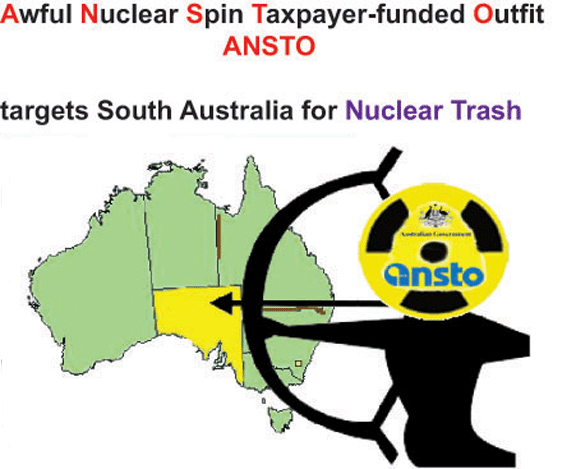 10 Oct 20, The dump legislation didn’t make it on to the Senate floor for debate and voting …
I think the government just ran out of time, they didn’t withdraw the Bill
So over the next week Non Government Organisations, and farmers and Traditional Owner s will be discussing how best to use the next month
Clean-up for Ranger uranium mine. Rum Jungle mine still a polluted mess
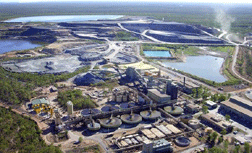 It’s costing a fortune but the Ranger uranium mine is gradually being cleaned up, Canberra Times, Chris McLennan 6 Oct 20 It’s costing a fortune but the Ranger uranium mine is gradually being cleaned up, Canberra Times, Chris McLennan 6 Oct 20
Over the years many people questioned the decision to allow uranium to be mined inside one of Australia’s most famous and largest national parks – Kakadu. But in 1980 that’s exactly what happened, an open-cut mine surrounded by a park famed for its natural beauty made even more famous by the hugely popular Paul Hogan movie, Crocodile Dundee. Now the uranium is gone, dug out and sent off to nuclear power stations around the world and Australia’s longest continually operated uranium mine is almost done.
Nuclear power is making way for renewable energy. Uranium has been mined at Ranger for more than three decades, producing in excess of 130,000 tonnes of uranium oxide. The mine is being closed, Jabiru – the town built to service to the mine workers, is in the process of being handed over to Traditional Owners and the mining company is being closely watched as it delivers on its promise to clean up the site. Cleaning up uranium mines is not something the Northern Territory does well – there is still a huge environmental mess at Rum Jungle closer to Darwin.
That uranium mine is a legacy of the Cold War. Australia’s first large scale uranium mine was dug at Rum Jungle on behalf of our “Allies” in the UK and USA to fuel their nuclear weapon programs in the 1950s. Now water fills that vast open cut, a lake as locals call it, and another attempt is going to have to be made to cap the radioactive tailings left behind, the first attempt, supposed to last a century, failed after 20 years. Energy Resources Australia, a subsidiary of Rio Tinto, says it has spent more than $642 million in the past eight years on rehabilitation of the mountains of tailings complicated by a lake created from a vast flooded pit………. This story It’s costing a fortune but the NT’s uranium mine is being cleaned up, gradually first appeared on Katherine Times. https://www.canberratimes.com.au/story/6955634/its-costing-a-fortune-but-the-nts-uranium-mine-is-being-cleaned-up-gradually/?cs=14231 |
|
Adnyamathanha Traditional Lands Association gets $millions from uranium mining: need for Royal Commission into Native Title
 South Australia’s premier will be formally asked to launch a royal commission into native title, Transcontinental, Greg Mayfield, 10 Oct 20, South Australia’s premier will be formally asked to launch a royal commission into native title, Transcontinental, Greg Mayfield, 10 Oct 20,
Indigenous leaders will make a last-ditch formal attempt to persuade the South Australian government to order a royal commission into Native Title and Aboriginal corporations. Premier Steven Marshall has agreed to see the group, led by Mark Koolmatrie, in Adelaide on Friday, October 16, to hear their case as outlined by a Senior Counsel. Sources say Mr Marshall may agree to the plea, but the verdict is unknown at this stage.
The submission comes after the Canberra-based Office of the Registrar of Indigenous Corporations put two Port Augusta-based Aboriginal corporations into special administration this year. It also follows demands by an action group for access to financial records of the Adnyamathanha Traditional Lands Association, based at Port Augusta and which is one of the groups under administration.
The association receives millions of dollars in royalties from the Beverley uranium mine in the outback. Indigenous leaders say problems with Native Title corporations exist around the nation. They have called also for a federal royal commission. …… “The message is that there are concerns at the way things are happening. “There is a better way of doing business. We want to find out about what ’empowerment’ really means. “We want to see the financial records of the Adnyamathanha association.”…….. Aboriginal Reform Group of South Australia and Adnyamathanha elder Charlie Jackson, of Port Augusta, said some members were appointed as directors of corporations without knowing their rights and responsibilities. “If you don’t know your role as a board member, that is going to cause conflict for you and for the organisation,” he said. “We want the government to instigate a royal commission into Native Title and Aboriginal corporations throughout SA. “There are major problems in these organisations.” The newspaper is seeking comment from the Premier’s office. https://www.transcontinental.com.au/story/6962338/sa-premier-to-look-at-indigenous-inquiry-plea/ |
|
China’s dramatic plan for switch to renewables – a warning to Australia’s fossil-fuel economy
 China just stunned the world with its step-up on climate action – and the implications for Australia may be huge, The Conversation, October 8, 2020, Hao Tan, Associate professor, University of Newcastle, Elizabeth Thurbon, Scientia Fellow and Associate Professor in International Relations / International Political Economy, UNSW, John Mathews, Professor Emeritus, Macquarie Business School, Macquarie University, Sung-Young Kim, Senior Lecturer in International Relations, Discipline of Politics & International Relations, Macquarie School of Social Sciences, Macquarie University China just stunned the world with its step-up on climate action – and the implications for Australia may be huge, The Conversation, October 8, 2020, Hao Tan, Associate professor, University of Newcastle, Elizabeth Thurbon, Scientia Fellow and Associate Professor in International Relations / International Political Economy, UNSW, John Mathews, Professor Emeritus, Macquarie Business School, Macquarie University, Sung-Young Kim, Senior Lecturer in International Relations, Discipline of Politics & International Relations, Macquarie School of Social Sciences, Macquarie University
|
|
Australia needs a permanent war crimes investigation unit
At the conclusion of Justice Paul Brereton’s Afghanistan inquiry we know there will be more referrals to the Australian Federal Police for criminal investigation of war crimes allegations.
We know so far that Brereton’s inquiry has investigated more than 55 incidents of alleged unlawful killings and cruel treatment of Afghan civilians and captured combatants. We know that the AFP is investigating at least three incidents, and it has been put on notice to prepare for more.
Our legal centre was established to push Australia to undertake more investigations and prosecutions into international crimes and to contribute to the global effort to end the impunity enjoyed by perpetrators of these crimes. It has been saying for some time that the AFP needs specialist training, skills, and resources to undertake such investigations. Experience shows that authorities often find the challenges involved in investigating and prosecuting crimes committed extraterritorially daunting, and consequently choose not to prioritise these cases………….
Rawan Arraf is principal lawyer and director of the Australian Centre for International Justice, a legal centre that has been working with survivor and victims’ communities on criminal complaints to the Australian Federal Police. https://www.theage.com.au/politics/federal/australia-needs-a-permanent-war-crimes-investigation-unit-20201005-p562a2.html
1 This month.
20 September –National Day of Action in Melbourne on the International Day of Peace


Help Aunty Sue Protect Her Land and Sacred Sites From Destructive Rocket Testing.
.

Australians deserve the truth
about
AUKUS – https://aukuspublicinquiry.com/


PETITION – To: Prime Minister Anthony Albanese and the Australian Labor Government

of the week – Australians for War Powers Reform (AWPR)
To see nuclear-related stories in greater depth and intensity
 Antinuclear