Notes on Barry Wakelin, speaking to the Senate Inquiry on Napandee nuclear waste dump plan
A student is suing the government over the financial risks of climate change
 ‘A wake-up call’: why this student is suing the government over the financial risks of climate change, The
  Conversation
July 27, 2020 Jacqueline Peel Professor of Environmental and Climate Law, University of Melbourne, Rebekkah Markey-Towler, Research assistant, University of MelbourneAs the world warms, the value of “safe” investments might be at risk from inadequate climate change policies. This prospect is raised by a world-first climate change case, filed in the federal court last week.
Katta O’Donnell – a 23-year-old law student from Melbourne – is suing the Australian government for failing to disclose climate change risks to investors in Australia’s sovereign bonds.
Sovereign bonds involve loans of money from investors to governments for a set period at a fixed interest rate. They’re usually thought to be the safest form of investment. For example, many Australians are invested in sovereign bonds through their superannuation funds.
But as climate change presents major risks to our economy as well as the environment, O’Donnell’s claim is a wake-up call to the government that it can no longer bury its head in the sand when it comes to this vulnerability.
O’Donnell’s arguments
O’Donnell argues Australia’s poor climate policies – ranked among the lowest in the industrialised world – put the economy at risk from climate change. She says climate-related risks should be properly disclosed in information documents to sovereign bond investors.
O’Donnell’s claim alleges that by failing to disclose this information, the federal government breaches its legal duty. It alleges the government has engaged in misleading and deceptive conduct, and government officials breached their duty of care and diligence.
This is a standard similar to that owed by Australian company directors. Analysis from leading barristers indicates that directors who fail to consider climate risks could be found liable for breaching their duty of care and diligence.
O’Donnell argues government officials providing information to investors in sovereign bonds should meet the same benchmark.
Climate change as a financial risk….… https://theconversation.com/a-wake-up-call-why-this-student-is-suing-the-government-over-the-financial-risks-of-climate-change-143359
Today -public Australian Senate hearings on Kimba nuclear waste plan and changed federal laws

the next Senate hearing into the proposed Kimba radioactive waste plan and the changed federal laws to facilitate this is taking place today.
Try listening -follow the link at this site https://www.aph.gov.au/news_and_events/watch_parliament
Today’s session will hear from supporters of the planned facility as well as critics, including the MUA/Unions SA’s Jamie Newlyn, former federal member Barry Wakelin and myself/ACF.
Details of the program are below and info on how to access the event is available at:
11.00 am Wesley and Lisa Schmidt (Submission 75) 11.30 am Mr Barry Wakelin (Submission 46) 12.00 pm Mr Jeff Baldock (Submission 42) 12.45 pm Australian Conservation Foundation (Submission 97) 1.15 pm Maritime Union of Australia (Submission 19) 1.45 pm Adjournment
Spinbusting the extraordinarily inept nuclear waste media release from 3 Australian MPs.
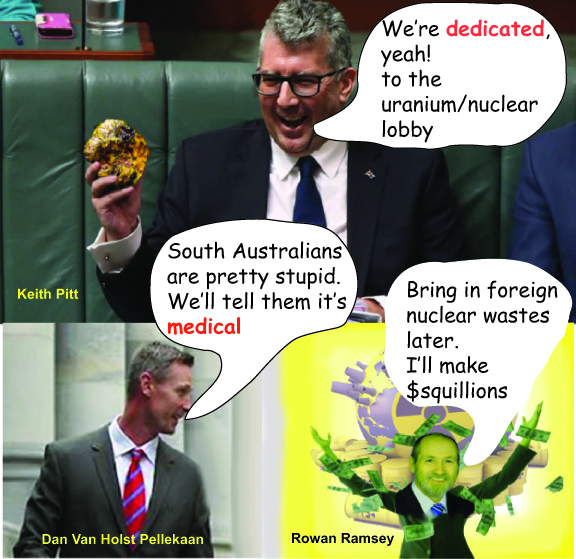
27 July 20, On 20th July, MPs Keith Pitt, Rowan Ramsey and Dan van Holst Pellekaan issued a joint media release, which announced the establishment of a new agency in Adelaide to manage Australia’s nuclear waste. The agency was to start that same day (even though they would be advertising for staff and a CEO) . It was obviously written in a hurry, and raised amazement among those who follow the ongoing drama of the Australian government’s attempt to impose a nuclear waste dump on a rural region. Amazement at the questions that remain unanswered.
Peter Remta critiques the statement, and raises some of those embarrassing questions:
The joint media release is inconsistent within itself and with other previous reports and is surely an embarrassment to the two ministers while confirming the long-held partiality of the local member , Rowan Ramsey.
It is badly composed with meaningless statements and lacks any precise reasons and explanations for what should be the creation of a major and nationally important organisation
The establishment by other countries of entities with similar objectives (even though it is hard to ascertain what they are in the case of this new Australian agency) has invariably involved lengthy and detailed planning including the views and suggestions of various members of the community together with commercial interests and other government agencies.
A most pertinent example is the Reset Initiative of the United States of America as to the management of its nuclear waste which was undertaken by the well known Stanford and George Washington Universities which are regarded as world leaders in that field.
The recommendations under the Initiative should have been followed in Australia as they are imperative for the proper and safe management of nuclear waste and it is surprising that none of the submissions or evidence by ANSTO and ARPANSA and also by the Department of Industry Science Energy and Resources made any mentioned of this well-known and internationally recognised study.
It is hoped that ANSTO will not be relying on this rather meaningless and inconsistent release as part of its submission requirements for ARPANSA which in turn should immediately as the regulatory and licensing authority require a full explanation of the reasons behind the release.
ARPANSA must not on this occasion hide behind its licensing independence in refraining from strong comment as the release could be viewed to be an attempt to usurp its status and functions which are recognised internationally,
Announcing this agency before the government has final parliamentary approval smacks of arrogantly taking both
the Senate and ARPANSA for granted
It also shows a cavalier attitude to proper governing to be committing taxpayers’ money before all approvals are in
place.
Even with the vagueness of the release the government should be seriously considering and examining the Azark
Project facility at Leonora which besides being considered as one of the best in the world would overcome or avoid
many of the problems inherent with the Napandee proposal It would also be a major financial saving for the government
Why has there not been any previous mention of this new agency?
How will it manage Australia’s radioactive waste?
How will it bring together this responsibility and expertise since it seems currently to be lacking the expertise and from past experience the responsibility?
“The Australian Radioactive Waste Agency (ARWA) will be based in Adelaide and be responsible for all functions of the
National Radioactive Waste Management Facility (the Facility), including engagement with the Kimba community.”
Why will it be located in Adelaide which has no history of competence or knowledge in this area despite the Scarce
Royal Commission and uranium mining in South Australia ?
How will it engage with the Kimba community and in what respect since it seems that the battle lines are well and truly
drawn in a seriously divided community.
Will it be replacing ANSTO as the operator of the facility at Napandee?
How will the new agency develop Australia’s radioactive waste management solutions and capabilities as neither the
government nor ANSTO has any realistic knowledge in this area?
Is not this another instance of rushed planning without a proper understanding and consideration of the factors
including the regulatory regime?
Will it not be an unnecessary duplication of the existing functions of ANSTO?
Is the agency going to assume or usurp some of the functions of ARPANSA in the regulatory context?
How will the agency’s location in Adelaide enhance the operations at Napandee as it was understood that this had
already been established through prior planning?
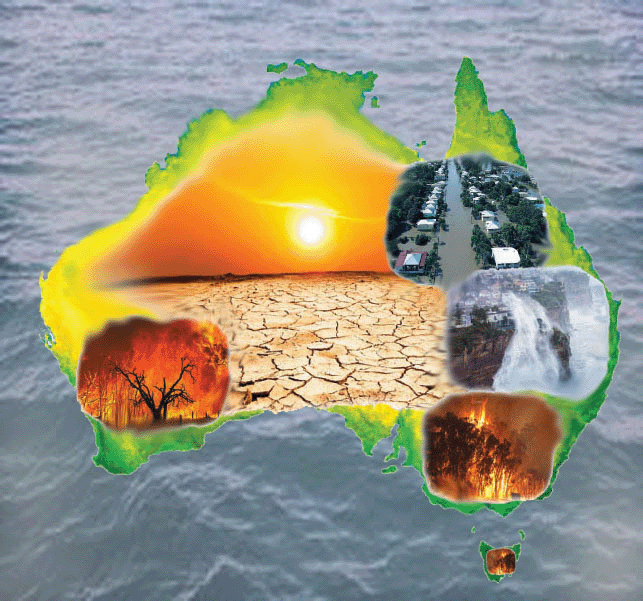
Parts of Victoria’s Bellarine Peninsula, Melbourne suburbs, at risk from sea level rise
important for local communities to know whether they were at risk so they could decide whether to invest in adaptation strategies, such as infrastructure, to protect the coastline, or simply retreat from the danger zone.
 How coastal communities on Victoria’s Bellarine Peninsula are dealing with the reality of sea level rises, ABC, By Nicole Mills, 26 Jul 20, As Vicki Perrett plays with her granddaughter Rachel on the beach in front of her home on Victoria’s Bellarine Peninsula, she knows she has to cherish these moments.Key points: How coastal communities on Victoria’s Bellarine Peninsula are dealing with the reality of sea level rises, ABC, By Nicole Mills, 26 Jul 20, As Vicki Perrett plays with her granddaughter Rachel on the beach in front of her home on Victoria’s Bellarine Peninsula, she knows she has to cherish these moments.Key points:
And not just because children grow up so fast. She also knows the beach they play on may not be there forever. “The beach is coming closer towards us, towards the road and towards our property,” Ms Perrett says. “It’s very prone to sea level rise here and to storm surges.” This stretch of coastline at Indented Head has already been earmarked as at risk of going underwater by 2100. Ms Perrett’s house is also in the danger zone………… Councils ordered to plan for sea level risesThe Victorian Government has instructed all councils to plan for a 0.8m sea level rise by the year 2100. That figure is based on a 2007 report from the United Nations Intergovernmental Panel on Climate Change, which agreed on the projected rise, but could not rule out larger increases. Although the worst impacts of sea level rises may still be decades away, this bayside community, about an hour-and-a-half south of Melbourne, has already had a taste of what is to come………. Dr McInnes leads the CSIRO’s climate extremes and projections group, which has contributed to the mapping of high-risk areas. Publicly available mapping tools, such as Coastal Risk Australia, allow anyone to find out how their local area would fare under different sea-level rise scenarios. Dr McInnes said it was important for local communities to know whether they were at risk so they could decide whether to invest in adaptation strategies, such as infrastructure, to protect the coastline, or simply retreat from the danger zone. “Land subject to inundation is land that is low-lying, that is potentially at risk from inundation during extreme sea-level events or even potentially high-tide events in the future,” Dr McInnes said. Dr McInnes says while the worst impacts will be felt during storm surges, there might be some areas that will suffer more permanent flooding. “If [the land] is low enough, it could be permanently inundated,” she said. “Parts of Swan Bay [on the Bellarine Peninsula] could potentially become quite affected by inundation, certainly high-tide inundation, in the future.” And it’s not just regional areas. Dr McInnes says Melbourne suburbs such as Elwood, Aspendale and Mordialloc are also at risk of more-regular flooding in future……….. https://www.abc.net.au/news/2020-07-26/climate-change-sea-level-rises-prompt-action-in-coastal-towns/12383968
|
|
Despite Minerals Council lobbying, Australia’s Environmental Law prohibits nuclear and limits uranium mining
K-A Garlick, Nuclear Free WA, 22 July 20, This week, the interim report of the review into the Environmental Protection Biodiversity Conservation (EPBC) Act – Australia’s federal environmental laws was released. This found that the Federal government should maintain the capacity to intervene in uranium mining and that there be no change to the existing prohibition on nuclear activities, including domestic nuclear power.
Environment groups have given a cautious welcome to this continuation of the status quo, especially in the face of lobbying by the Mineral Council of Australia to weaken nuclear protections and scrutiny. This outcome is a tribute to the efforts of those who have worked hard over years to highlight the deep community concerns with the nuclear industry.
While no amount of regulation can make uranium mining socially or environmentally acceptable, it can reduce the impacts. The reports sensible approach means it is now incumbent on both State and Federal government to ensure the highest standards or rigour, transparency and public interest.
The nuclear power ban has been retained despite years of concerted effort by the Mineral Council of Australia and pro-nuclear lobbyists to have this removed. Again, this is testimony to the power, importance and effectiveness of sustained community advocacy and action.
In future updates, there will be more information on further developments and action to take, but in the meantime zip over to the excellent resource page, Don’t Nuke the Climate, Australia for all information and myth-busting to keep sharing that nuclear power cannot solve the climate crisis. Click on website link https://dont-nuke-the-climate.org.au/
Australian govt trying to keep its $1.3bn arms purchase a secret, a dangerous precedent
Coalition says making public parts of $1.3bn Thales arms deal audit would penalise weapons company
Australian government claims disclosure would damage chances of multinational Thales to sell Hawkei combat vehicle to other countries, Guardian Christopher Knaus, The Australian government is arguing parts of an audit of a $1.3bn arms purchase must be kept secret because a multinational weapons company Thales would have trouble selling its product if they were disclosed.But the administrative appeals tribunal has heard that such an argument if allowed to stand would have a “devastating effect” on the auditor general’s ability to transparently and publicly criticise other government purchases.
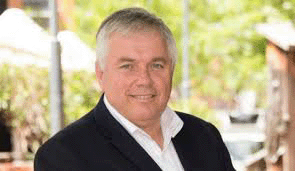 The tribunal is hearing a case between the Department of Prime Minister and Cabinet and crossbench senator Rex Patrick, who is fighting through freedom of information for full release of a 2018 audit report examining the government’s acquisition of the $1.3bn Hawkei combat vehicle fleet from French-based manufacturer Thales.
After representations from Thales, the attorney general, Christian Porter, made an extraordinary and largely unprecedented intervention to redact sections of the audit on the grounds they unfairly prejudiced Thales’s commercial interests and threatened Australia’s national security and defence.
The Guardian has since revealed the redacted material included a cost-comparison suggesting that Australia could have saved money by purchasing a different vehicle – the joint light tactical vehicle – from the United States……. https://www.theguardian.com/world/2020/jul/23/coalition-says-making-public-parts-of-13bn-thales-arms-deal-audit-would-penalise-weapons-company
Australia should join regional nations in signing and ratifying the Treaty for the Prohibition of Nuclear Weapons (TPNW)
 Push to join nuclear weapons banm https://www.afr.com/politics/federal/letters-push-to-join-nuclear-weapons-ban-20200719-p55dhy Daryl Le Cornu, Member of the board of ICAN Australia 22 July 20, It was good to read William Stoltz’s ‘‘How Australia can help the world avoid nuclear war’’ (July 17) about the diplomatic initiative to push for a treaty of no-first-use based on the Chinese model.
His argument that Australia may be the only country that could lobby the US to agree to the principle of no-first-use has merit.
Furthermore, Stoltz argues that it is only through the ‘‘strength of principled examples and ambitious diplomacy that responsible nations can hope to make the legacy of Trinity and the nuclear threat to civilisation a thing of the past’’.
However, there is another potentially more effective ‘‘ambitious diplomacy’’ that Australia could pursue. This would be to join with the majority of the nations in the world and a majority of the people in the world in signing and ratifying the Treaty for the Prohibition of Nuclear Weapons (TPNW) that was created at the United Nations on July 7, 2017.
New Zealand has already done so, as have most of our regional neighbours. The Labor Party at its December 2018 national conference committed a future Labor government to such a diplomatic initiative. Furthermore, the organisation whose 10-year global campaign led to the creation of the TPNW – the International Campaign to Abolish Nuclear Weapons (ICAN) – was born in Australia in 2007 and launched by former Liberal prime minister Malcolm Fraser, who became ICAN’s first patron. With only 10 more ratifications for the TPNW to come intoforce in international law, it is surprising that Stoltz did not devote some time in his article reflecting on the 75th anniversary of the Trinity test to this citizen-initiated global campaign.
Hasty new nuclear dump agency will have some overseas staff, – and law for waste dump is not yet passed!
Nuclear dump to be managed from SA, https://www.cessnockadvertiser.com.au/story/6842627/nuclear-dump-to-be-managed-from-sa/?cs=7, Tim Dornin, 22 July 20
Staff from around Australia and possibly overseas will be recruited for a new government agency to manage a nuclear waste dump in South Australia.
Legislation to establish the dump has already passed federal parliament’s lower house and is before a Senate committee after the location was selected earlier this year.
Resources Minister Keith Pitt said the establishment of the new agency was another step forward in what had been a very long-running process to develop a vitally important facility.
“Two in every three Australians will use nuclear medicine and that means two of every three Australians will produce some low-level radioactive waste that needs to be stored and managed,” he said.
“This is a national piece of infrastructure that is critical for all of those individuals.”
Mr Pitt said ARWA would operate as an independent agency with staff to be drawn from around Australia and possibly around the world to secure those with the right skill set.
But the Australian Conservation Foundation said the government had jumped the gun, establishing the new agency when legislation for the dump was still before the parliament.
“It is absurd to establish a new federal agency for a proposal that is still under active Senate review and has no current legislative basis,” campaigner Dave Sweeney said.
“This initiative has all the hallmarks of a tailor-made political fix for a federal plan that has no broad social licence.”
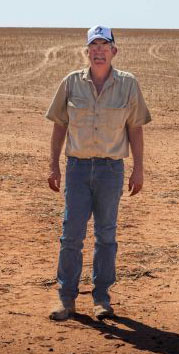 When the Napandee site was chosen, owner Jeff Baldock welcomed the plan and urged the government to move forward.
He said it was a “once-in-a-lifetime opportunity to secure Kimba’s future” and the waste facility would potentially provide jobs and much-needed revenue for the region.
“It’s very rare that a small country community gets the chance to guarantee that it’s still going to be here in 300 years’ time,” he said.
Hasty and crummy pro nuclear media release from Messrs Pitt, Ramsey and Van Holst Pellekaan
Peter Remta, 22 July 2020. Here we go again.
This is a very poorly and hastily planned and quite ill-conceived attempt to deflect from the true situation with the proposed facility at Napandee which only shows up the incompetence and lack of knowledge within the federal government as to the management of nuclear waste
The joint media release is inconsistent within itself and with other previous reports and is surely an embarrassment to the two ministers while confirming the long-held partiality of the local member It is hoped that ANSTO will not be relying on this quite meaningless release as part of its licensing submission requirements for ARPANSA which in turn should immediately as the regulatory and licensing authority require a full explanation of the reasons behind the release
ARPANSA must not on this occasion hide behind its licensing independence in refraining from strong comment as the release could be viewed to be an attempt to usurp its status and functions
I will separately comment on the different parts of the release
South Australian Government must oppose the Federal government’s nuclear waste dump
 Friends of the Earth, 21 July 20, Today’s announcement by federal resources minister Keith Pitt that a new ‘Australian Radioactive Waste Agency’ will be established and located in Adelaide is the latest move by the federal government to impose a national nuclear waste dump in SA. The Agency will be responsible for all functions of the proposed nuclear ‘facility’
including engagement with the Kimba community.
Dr. Jim Green, national nuclear campaigner with Friends of the Earth Australia, said: “‘Locating the Australian Radioactive Waste Agency in Adelaide is a cynical attempt to present the strongly contested nuclear waste dump as a done deal.
“The imposition of a nuclear waste dump is a clear breach of the SA Nuclear Waste Facility (Prohibitions) Act, legislation introduced by Liberal Premier John Olsen and strengthened by Premier Mike Rann. Yet current SA Premier Steven Marshall and energy and mining minister Dan van Holst Pellekaan support the proposed nuclear dump. That support should be reversed.”
“van Holst Pellekaan falsely claims that Kimba has ‘clearly’ expressed its willingness to be the host community. In fact, a narrow majority supported the facility, and that narrow support was won with a multi-year, multi-million-dollar federal government PR campaign including the fictitious claim that 45 local jobs will be created.
“A majority of South Australians oppose the proposed nuclear dump and there has been no consultation let alone consent along transport corridors. Barngarla Traditional Owners were excluded from the Kimba ballot and their separate ballot found unanimous opposition.
“If the results of the Barngarla ballot are included with the ballot of local Kimba residents (and out-of-town ratepayers), the overall level of support falls to just 43.8% of eligible voters (452/824 for the Kimba ballot, and 0/209 for the Barngarla ballot). That is well short of a majority and a long way short of the government’s 65% benchmark for ‘broad community support’,” Dr. Green said.
Prof. Graeme Samuel’s EPBC Interim Report released yesterday noted that the federal government’s framework environment legislation “reflects an overall culture of tokenism and symbolism, rather than one of genuine inclusion of Indigenous Australians”.
An April 2020 report by Federal Parliament’s Joint Committee on Human Rights noted that planned changes to the National Radioactive Waste Management Act, currently the subject of a Senate inquiry, do not sufficiently protect the Barngarla’s rights and interests. The Committee found “there is a significant risk that the specification of this site will not fully protect the right to culture and self-determination”. Importantly, the Human Rights Committee’s report was unanimous and was endorsed by Liberal and National Party members.
Dr. Green said: “Shamefully, the Federal Government has acknowledged that its proposed changes to the National Radioactive Waste Management Act will deny Barngarla Traditional Owners, farmers and other interested parties a right to a judicial review of the proposed nuclear waste facility; indeed, it appears that the purpose of the legislation is to do just that.
“Prof. Samuel’s EPBC Review and the Coalition and Labor members of the federal parliament’s Human Rights Committee have found that the rights of Traditional Owners need to be strengthened, yet Premier Marshall and Minister van Holst Pellekaan are supporting the imposition of a nuclear waste dump unanimously opposed by Barngarla Traditional Owners. Their crude racism diminishes all South Australians and must be resisted,” Dr. Green concluded.
The SA Labor Party argues that Traditional Owners should have a right of veto over nuclear projects given the tragic history of the nuclear industry in South Australia. Deputy Leader of the Opposition Susan Close said that SA Labor is “utterly opposed” to the “appalling” process which led to the announcement regarding the Kimba site. The SA ALP State Conference in Oct. 2018 endorsed a resolution supporting Traditional Owners “in their current struggle to prevent a nuclear waste facility being constructed in their region.”
Federal radioactive waste agency flawed from day one
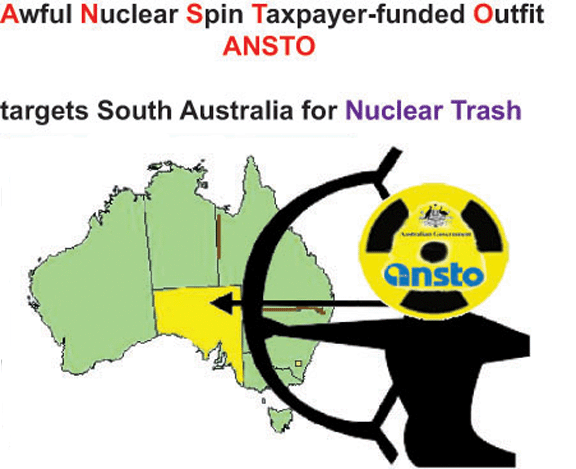 Australian Conservation Foundation, 21 July 20, In response to Resources Minister Keith Pitt’s announcement of a new Australian Radioactive Waste Agency, to be based in Adelaide, the Australian Conservation Foundation’s Nuclear Free Campaigner Dave Sweeney said:
“With his announcement of the Australian Radioactive Waste Agency, Minister Pitt is playing short-term politics with the management of long-term waste.
“This new agency appears to have been set up to rubber stamp and maintain momentum for the Federal Government’s deeply flawed and contested radioactive waste facility planned for Kimba in regional South Australia.
“From day one the perception of this new agency has been tainted – rather than being expert and independent, it has been created primarily to advance the Government’s Kimba plan.
“It is absurd to establish a new federal agency for a proposal that is still under active Senate review and has no current legislative basis.
“Instead of what is needed – an expert and independent authority to oversee radioactive waste management in Australia – this initiative has all the hallmarks of a tailor-made political fix for a federal plan that has no broad social licence.
“It is extraordinary that this announcement to advance a national radioactive waste facility in Kimba against the specific objections of the Barngarla Traditional Owners comes a day after a major review of federal environmental laws highlighted a tokenistic approach to Indigenous concerns.
“Minister Pitt continues to re-state the tired myths that have dominated the Federal Government’s approach to this issue.
“To be clear, nuclear medicine in Australia is not dependent on the Kimba plan. Universities and hospitals that produce radioactive waste will still need to manage waste at these places.
“This is a disappointing, half-baked and deeply compromised response to the growing uncertainty and contest surrounding the Federal Government’s approach to radioactive waste management.”
Minister Against the Environment, Sussan Ley, in a hurry for Environment Laws to help mining industries?
 Environment Minister Sussan Ley is in a tearing hurry to embrace nature law reform – and that’s a worry The Conversation Peter Burnett, Honorary Associate Professor, ANU College of Law, Australian National University, July 20, 2020 The Morrison government on Monday released a long-awaited interim review into Australia’s federal environment law. The ten-year review found Australia’s natural environment is declining and under increasing threat. The current environmental trajectory is “unsustainable” and the law “ineffective”.
The report, by businessman Graeme Samuel, called for fundamental reform of the law, know as the Environmental Protection and Biodiversity Conservation (EPBC) Act. The Act, Samuel says:
[…] does not enable the Commonwealth to play its role in protecting and conserving environmental matters that are important for the nation. It is not fit to address current or future environmental challenges.
Samuel confirmed the health of Australia’s environment is in dire straits, and proposes many good ways to address this.
Worryingly though, Environment Minister Sussan Ley immediately seized on proposed reforms that seem to suit her government’s agenda – notably, streamlining the environmental approvals process – and will start working towards them. This is before the review has been finalised, and before public comment on the draft has been received.
This rushed response is very concerning. I was a federal environment official for 13 years, and from 2007 to 2012 was responsible for administering and reforming the Act. I know the huge undertaking involved in reform of the scale Samuel suggests. The stakes are far too high to risk squandering this once-a-decade reform opportunity for quick wins.
‘Fundamental reform’ needed: Samuel
The EPBC Act is designed to protect and conserve Australia’s most important environmental and heritage assets – most commonly, threatened plant and animal species.
Samuel’s diagnosis is on the money: the current trajectory of environmental decline is clearly unsustainable. And reform is long overdue – although unlike Samuel, I would put the blame less on the Act itself and more on government failings, such as a badly under-resourced federal environment department.
Samuel also hits the sweet spot in terms of a solution, at least in principle. National environmental standards, legally binding on the states and others, would switch the focus from the development approvals process to environmental outcomes. In essence, the Commonwealth would regulate the states for environmental results, rather than proponents for (mostly) process. …….
From the outset, the government framed Samuel’s review around a narrative of cutting the “green tape” that it believed unnecessarily held up development.
In June the government announced fast-tracked approvals for 15 major infrastructure projects in response to the COVID-19 economic slowdown. And on Monday, Ley indicated the government will prioritise the new national environmental standards, including further streamlining approval processes……..
Here’s where the danger lies. The government wants to introduce legislation in August. Ley said “prototype” environmental standards proposed by Samuel will be introduced at the same time. This is well before Samuel’s final report, due in October.
I believe this timeframe is unwise, and wildly ambitious……
The government’s fixation with cutting “green tape” should not unduly colour its reform direction. By rushing efforts to streamline approvals, the government risks creating a jumbled process with, once again, poor environmental outcomes. https://theconversation.com/environment-minister-sussan-ley-is-in-a-tearing-hurry-to-embrace-nature-law-reform-and-thats-a-worry-141697
Australian government could create 76,000 jobs within three years if it invests more in renewables
 Climate Council unveils plan to create 76,000 jobs in three years, The New Daily, KellyReporterThe federal government could create 76,000 jobs within three years if it invests more in renewables, a new report has found.
In conjunction with economic consultants AlphaBeta, the Climate Council has released a 12-point plan to create 76,000 jobs while slashing emissions – recommending everything from restoring ecosystems to retrofitting public buildings.
“The job creation could start immediately and continue over three years. Federal, state and territory governments all have the opportunity to put these measures in train.”
By targeting 12 policy areas, state and federal governments could create employment for communities hit hardest by the COVID-19 economic crisis.
The 12 areas include large-scale projects such as installing wind and solar and investing in pilot-scale green hydrogen, as well as more localised initiatives such as accelerating construction of public transport and increasing the amount of tree canopy cover in urban areas. ………
Ms McKenzie said the plan would create jobs, cut energy bills and reduce Australia’s emissions.
And she said taxpayers wouldn’t have to foot the entire bill, as private investors have a big appetite for investment in renewables.
“We know renewable energy is the cheapest source of power. It can attract the most private investment,”…….. https://thenewdaily.com.au/news/2020/07/21/climate-council-job-creation-policies/
Indigenous Australians have been failed by the nation’s environmental protection laws, a review has found.
|
Indigenous ‘tokenism’ in environment laws HTTPS://WWW.BENDIGOADVERTISER.COM.AU/STORY/6841657/INDIGENOUS-TOKENISM-IN-ENVIRONMENT-LAWS/, Rebecca Gredley, 21 July 20, Indigenous Australians have been failed by the nation’s environmental protection laws, a review has found. Forrmer ACCC chairman Graeme Samuel on Monday released his interim review of the Environment Protection and Biodiversity Conservation Act, which says the laws are not fit for purpose. The laws are supposed to recognise the role of Indigenous Australians in conservation, protect cultural places and promote the use of Indigenous biodiversity knowledge. But Professor Samuel says that’s not occurring. “Traditional knowledge is not valued,” he said.
“There is a culture of tokenism and symbolism…. Indigenous Australians want and frankly, they deserve and we deserve stronger protection of Indigenous culture and heritage.” Prof Samuel said the EPBC Act should have an Indigenous knowledge and engagement committee to provide the federal environment minister with advice. He said there should be a standard for best practice for Indigenous engagement and a comprehensive review of national laws to protect Indigenous cultural heritage. “The EPBC Act has failed to fulfil its objectives as they relate to Indigenous Australians,” the interim report says. “Indigenous Australians’ traditional knowledge and views are not fully valued in decision-making, and the Act does not meet the aspirations of traditional owners for managing their land.” Australia’s Indigenous heritage protections recently came under scrutiny after mining giant Rio Tinto destroyed a significant site in Western Australia that dated back 46,000 years. The Australian Conservation Foundation’s Dave Sweeney said there were many examples of when the national laws failed Indigenous communities. Although Tjiwarl native title holders had taken Western Australia to court to prevent a uranium project, the federal government gave expedited approval in 2019. “Right now, the federal government is seeking to build a national radioactive waste store and dump site near Kimba in regional SA,” Mr Sweeney told AAP. “The area’s traditional owners, the Barngarla people, were not included in a local council’s regional ballot to test the public mood on this and remain strongly opposed to the waste plan.” Federal Environment Minister Sussan Ley and Indigenous Australians Minister Ken Wyatt will hold a meeting with their state counterparts in a bid to improve protections. WA-based Labor MP Josh Wilson said the ministers must be clear about a timetable for reform so change can happen. “Labor will consider all and any reasonable changes to legislation that will deliver proper protection of First Nations heritage, stronger consultation with First Nations people, and greater clarity for all stakeholders,” he said. |
|
1 This month.
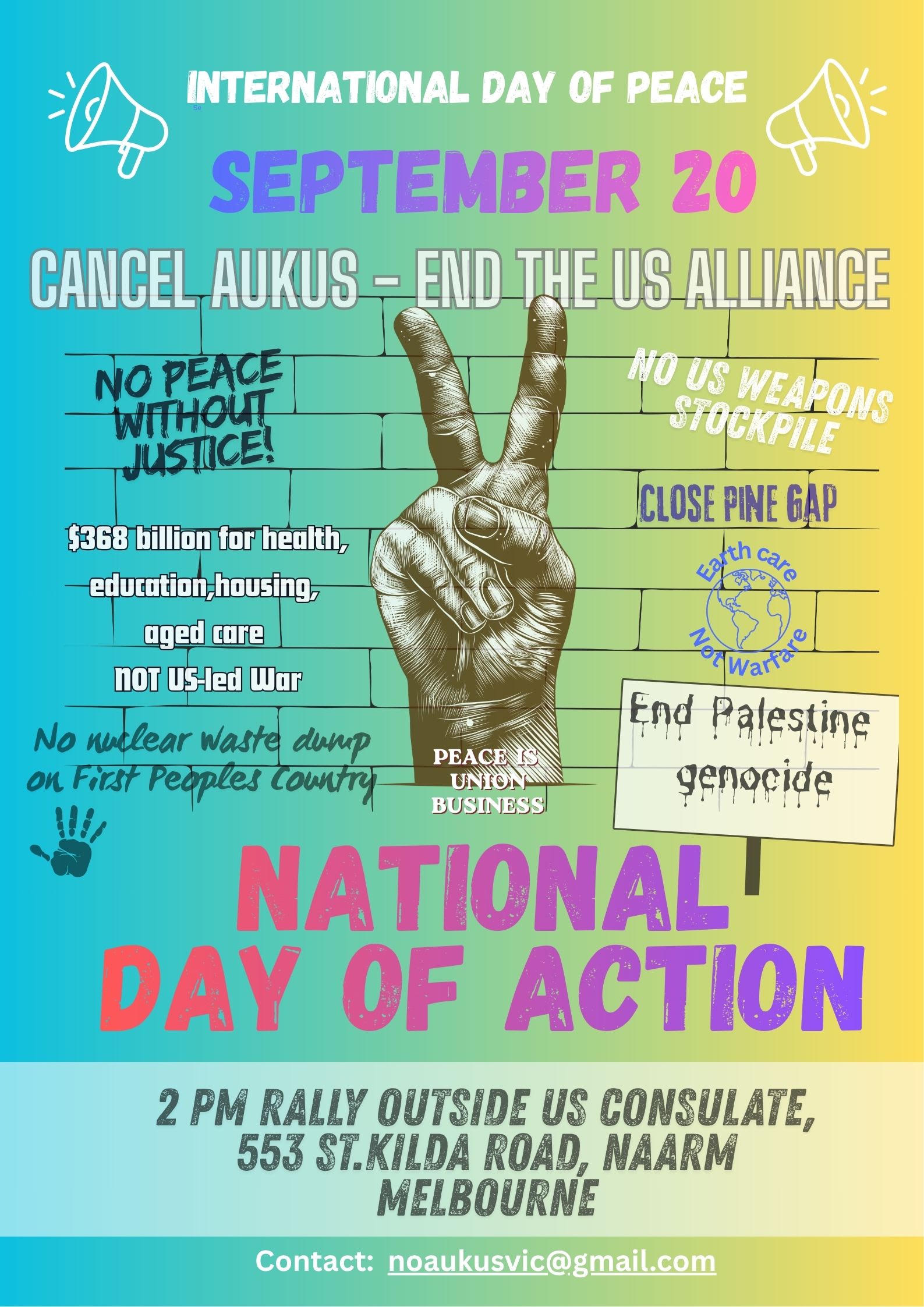
20 September –National Day of Action in Melbourne on the International Day of Peace

Help Aunty Sue Protect Her Land and Sacred Sites From Destructive Rocket Testing.
.

Australians deserve the truth
about
AUKUS – https://aukuspublicinquiry.com/
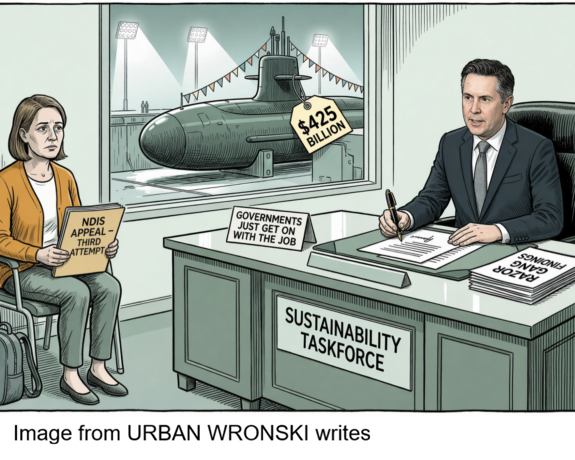

PETITION – To: Prime Minister Anthony Albanese and the Australian Labor Government

of the week – Australians for War Powers Reform (AWPR)
To see nuclear-related stories in greater depth and intensity
 Antinuclear