Australia’s govt betting on a fossil-fuel led recovery – despite expert advice on renewable energy
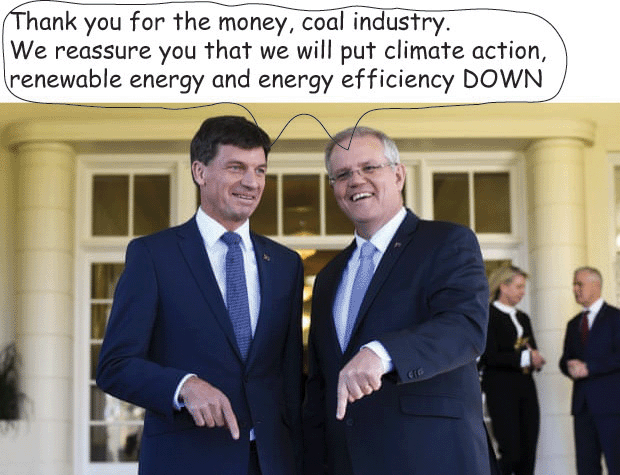 Trouble with gas: the Coalition is betting on the fossil fuel for recovery – but the sums don’t add up
The Australian government says gas is ‘essential’, but the global view is it’s the second-least desirable source of electricity Guardian, Adam Morton Environment editor @adamlmorton, Sun 3 May 2020 The agency that runs Australia’s electricity last week gave its verdict on how to deliver what would have seemed fanciful not that long ago – a power grid that within five years should at times be able to run on 75% wind and solar energy.
The Australian Energy Market Operator delivered a report on integrating renewable energy into the system with an optimistic message.
As described by its chief, New Yorker Audrey Zibelman, the technical capacity was already there, but markets and regulations would have to be adjusted. There were no “insurmountable reasons” why the grid could not take even higher levels of renewables, as it will need to for Australia to meet the Paris agreement goal of zero greenhouse gas emissions.
The minister in charge of both energy and cutting emissions, Angus Taylor, chose a different emphasis.
In a statement issued as the study was released, Taylor said it had highlighted the challenges of increased amounts of solar and wind given the system needed continuous inertia – support from constantly running “synchronous generation” – to ensure grid stability. He suggested that inertia could come from gas-fired power.
The market operator’s report does not mention gas generation, but the fossil fuel – often described as having half the emissions of coal, though recent studies have suggested it could be much more – is clearly on Taylor’s mind. A few days earlier he had given interviews to Nine newspapers to support the idea of a “gas-fired recovery” from the Covid-19 pandemic, suggesting it may be a focus of future economic stimulus measures……..
Andrew Grant, head of oil, gas and mining with London-based financial thinktank Carbon Tracker, says the global view of gas has flipped from it being seen as a cleaner fuel than coal, to it being the second-least desirable source of electricity. He points to analysis by the International Energy Agency that found global gas-fired power generation must begin to decline later this decade under a sustainable development scenario. “Better than coal is not exactly a ringing endorsement,” Grant says. …….
t there is little evidence that the Australian electricity grid will need more gas power. Last year, it provided about 9% of generation. The market operator assessment suggested this could fall to near zero in the second half of this decade before returning in a much smaller amount – less than a third of what it is now – in the 2030s if the grid was to run at lowest cost……
Simon Holmes à Court, senior advisor to the Climate and Energy College at the University of Melbourne, says the services needed for a secure power grid are increasingly available from sources other than gas, including government-backed large batteries and potentially through adjustments at wind or additions at solar farms……… https://www.theguardian.com/australia-news/2020/may/03/trouble-with-gas-the-coalition-is-betting-on-the-fossil-fuel-for-recovery-but-the-sums-dont-add-up
Flinders Local Action Group want a new process for disposal of Australia’s nuclear waste
 From the communities’ perspective this entire process has been dogged by a lack of procedural fairness.
There has been a flood of information but many of the finer details have been obscured. The communities
have been urged to vote “Yes” without knowing exactly what they were voting for.
It is little wonder that we view the proposed amendments, as far as we understand them, with
considerable concern and distrust. We are fearful of opening the way for future nuclear activities that
could be implemented or imposed without the need for public consultation, assent or debate
We are particularly worried that this legislation is being debated under the current cloud of CV-19. We
believe the debate should be postponed at least until this current national crisis has abated and we have
a clearer view of the country’s direction, the effects on our economy and the path to recovery.
We believe that this current process to establish a NRWMF should cease in favour of an entirely new
approach. This should be a fully consultative process, based on the best science to identify a site that is
geologically, culturally and socially suitable for the permanent disposal of Australian generated waste.
Greg Bannon (Spokesperson for the Flinders Local Action Group Inquiry into National Radioactive Waste Management Amendment (Site Specification, Community Fund and Other Measures) Bill 2020 [Provisions] Submission No 79
Introduction: For over 60 years Australia has been operating a nuclear reactor. A by-product of this
operation is nuclear waste. ANSTO plans to greatly increase the production of medical isotopes. To this
day, no single, safe location for the permanent disposal of Australian generated radioactive waste has
ever been established.
In March 2015, the Minister for Industry (DIIS) Ian McFarlane, seeking a new approach for Australia’s
nuclear waste, invited private land nominations from around Australia for assessment as potential sites for
a National Radioactive Waste Management Facility (NRWMF).
Six potential sites were short listed and in 2016 one of those, on Wallerberdina Station near the Flinders
Ranges, became the first to progress to the next stage. The other five sites were abandoned, including two
near Kimba in SA. In 2017, a year behind the Flinders, two new sites near Kimba were nominated, accepted
and embarked on the same process.
Flinders Local Action Group (FLAG): Many people, including Traditional Owners, landholders, residents
and visitors, believed that Wallerberdina was culturally and geologically unsuitable for such a proposal.
They began individually protesting about it. Sadly, individual voices carry little weight against a Federal
Department with a pre-determined agenda. This Group was formed in September, 2016, to bring those
voices together.
We have had over four years of interaction with DIIS on this issue and believe we are well qualified to
comment. We believe this particular model for the NRWMF and process developed to implement it is
badly flawed. It has Continue reading
Dr Helen Caldicott explains the (virtually eternal) problem of toxic nuclear waste – Submission to Senate Committee

how much water would theoretically be required to dilute all the high level waste expected to be on hand in the USA by the end of the 20th century, to existing drinking water standards?
The answer: If you add up all the fresh water in the world, including not only all lakes and rivers and glaciers and ground water, but also all the soil moisture (which far exceeds the sum total of all the other sources), and then double that grand total, then you have about the right amount of water to do the dilution.
The USGS points out that this calculation is only to emphasize why it is so important to keep this material out of the environment to an unprecedented degree.
Dr Helen Caldicott – re National Radioactive Waste Management Amendment (Site Specification, Community Fund and Other Measures) Bill 2020 [Provisions]. Submission No. 71. have deep concerns about the federal governments proposed changes to the National Radioactive Waste
Management Act.
process has been restricted and inadequate.
mutagenicity I attach the following summary of the elements in radioactive waste, which is written for Canada
but applies equally to all radioactive waste. And by the way France which has produced our radioactive waste
from Lucas Heights calls it high level, not low level radioactive waste!
Why does the Morrison govt hear the experts on coronavirus, but ignore the experts on climate change?
|
Perhaps we should ditch the word entirely, and with it the forest of feel opinions about what governments “must” do to advance an author’s previously-held ideological positioning in the post-corona world. Imagine if we took just two lessons from the way Australian governments responded to the coronavirus: that good decisions are made when they consider the evidence and the best available expert advice; and that policy-making can accommodate reasonable differences of opinion, without becoming a “war”…… For six years now leading business, environmental, investor, union, farming and social welfare groups have been trying, largely in vain, to create a space for a sensible discussion about global heating, and to give Australian politicians a way to retreat from the self-defeating culture war that has scuppered all attempts at policy. They wouldn’t put it this way, but in effect the environmentalists, desperate for Australia to make some meaningful move towards reducing emissions, and the business groups, desperate for some kind of investment certainty, have been trying to save Australia’s politicians from themselves. The starting point for the Australian Climate Roundtable’s deliberations is that Australia needs to reach net zero emissions, and that delaying action just increases the cost of reaching that goal. Unremarkable propositions in any fact-based forum, but in some Coalition circles, still close to heresy. Now the roundtable, including its business members, argues that this post-corona reconstruction is a chance to speed up decarbonising the economy. The Business Council of Australia chief executive, Jennifer Westacott, argued in an opinion piece that the post-corona discussion should divest itself of “ideological constraints”. “In resuscitating our economy, we can tackle some of our most vexed problems. Every dollar we invest in energy should be a dollar towards a lower carbon economy and lower energy bills,” she wrote. And expert evidence about what might be possible has been flooding in by the day. The Australian Energy Market Operator this week released its long awaited “renewable integration study”, which found Australia could accommodate levels of up to 75% “instant” penetration of wind and solar in its main grid by 2025 – that we have the know-how, but need to update market and regulatory settings….. And then there was the advice from the International Energy Agency this week that renewable electricity will be the only energy source resilient to the biggest global energy shock in 70 years, triggered by the pandemic. …. – the latest Climateworks report released earlier this month found that net zero emissions by 2035 is possible in Australia, using technologies that are mostly already mature and available. The CSIRO’s roadmap released last year found there was no trade-off between economic growth and transitioning to zero emissions, and in fact strong action could lead to GDP growth, an increase in real wages and net zero emissions by 2050. …… https://www.theguardian.com/environment/commentisfree/2020/may/02/australia-listened-to-the-experts-on-coronavirus-its-time-we-heard-them-on-climate-change |
|


Institute of Public Affairs (IPA) continues attacks on ABC
 Surprise! Surprise! IPA continues attacks on ABC https://www.abcfriends.org.au/ipa_continue_attacks_on_abc
Latest news from ABC Friends , Margaret Reynolds, President ABC Friends National, 28 February 2020 The Institute of Public Affairs has (IPA) commissioned a survey by global firm Dynata to continue its campaign against the ABC and public broadcasting in Australia.
Yes, this is the same IPA which tries to influence the Liberal Party to privatise the ABC!
Guess the results: less than a third of Australians agreed that the ABC was out of touch with ordinary Australians.
So, all you extraordinary Australians who value the ABC may like to phone, text, write or visit the IPA to record why you value the essential services the ABC provides.
Website: ipa.org.au/contact-us
Email: ipa@ipa.org.au
Phone: (03) 9600 4744
Next time the IPA commissions a survey they may like to consider a poll on how many Australians value the IPAs contribution to Australian public policy debate!
Beyond Uranium Canberra. Group calls for an end to Kimba waste plan, wants Inquiry into nuclear waste management
Many thousands of Australians live on transport corridors and have not been informed about the risks or given a say.
The federal regulator has stated that
the ANSTO waste is safe where it is and there is no urgent need to
move it. Further, continuing access to nuclear medicine is not
dependent on a nuclear waste dump and the absence of such a
facility has not hindered the practice of nuclear medicine.
Beyond Uranium Canberra. re National Radioactive Waste Management Amendment (Site Specification, Community Fund and Other Measures) Bill 2020 [Provisions]. Submission No. 59
Beyond Uranium Canberra believes a full independent inquiry into the
best way to manage our most dangerous waste must be held. The
government must stop targeting remote and regional areas and give
Aboriginal people a right of veto for proposals that threaten their
country and culture.
We believe that nuclear power has no role in Australia’s energy future
and is a dangerous distraction from the climate challenges facing
Australia. Although a pro-nuclear NSW upper house inquiry has been
initiated by One Nation MLC Mark Latham who has recommended
removing the state’s long-standing legislative ban on uranium mining
and opening the door to nuclear power, Labor committee members
have reaffirmed their party’s opposition to uranium mining and
nuclear energy.
The inquiry report recommends the repeal of the Uranium Mining and
Nuclear Facilities (Prohibitions) Act , but a dissenting statement by
Labor committee members states that a ‘Labor Government will
maintain a ban on uranium exploration, extraction and export’ and a
‘Labor Government will not introduce nuclear power in NSW’.
The Australian Conservation Foundation has said Australia is blessed
with outstanding renewable resources and does not need to explore
dangerous nuclear energy options. The state ban on uranium mining
in NSW should remain. Uranium mining in NSW would risk the health
of the environment and regional communities for scant promise of
return. There is little to be gained and a lot to lose. We have no
confidence in nuclear reactor concepts that do not exist in the real
world of civilian electricity production. Small nuclear reactors exist on
paper, in corporate funding pitches and on military submarines – they
are not a credible response to the climate crisis.
Australia’s embattled uranium sector has been hard hit by the
commodity price collapse that followed the 2011 Fukushima nuclear
crisis, which was fuelled by Australian uranium. Since then uranium
operations have been routinely deferred or scrapped in jurisdictions
A broad coalition of civil society organisations, representing millions
of Australians, last year declared nuclear power has no role in
Australia’s energy future and is a dangerous distraction from real
progress on the climate challenges facing Australia.
Most of Australia’s waste is currently produced and stored at Lucas
Heights, south of Sydney, and ANSTO has acknowledged it can be
managed on-site for decades. The federal regulator has stated that
the ANSTO waste is safe where it is and there is no urgent need to
move it. Further, continuing access to nuclear medicine is not
dependent on a nuclear waste dump and the absence of such a
facility has not hindered the practice of nuclear medicine.
Most Australians are opposed, and affected communities are deeply divided.
Many thousands of Australians live on transport corridors and have not been informed about the risks or given a say. The ‘broad community consent’ the federal minister seeks does not exist.
Employment promises are deeply implausible and have been
repeatedly inflated. Agriculture and tourism are both market-sensitive
sectors and any planned facility could negatively impact these
industries.
A full independent inquiry into the best way to manage our most
dangerous waste must be held. The government must stop targeting
remote and regional areas and give Aboriginal people a right of veto
for proposals that threaten their country and culture. There are
significant cultural heritage concerns at and opposition from many
Aboriginal Traditional Owners where mining is allowed.
Katrina Lester: major South Australian Aboriginal groups not consulted in Kimba nuclear waste dump decision.
 Katrina Lester, Submission No 49 to Senate Committee Inquiry on National Radioactive Waste Management Amendment (Site Specification, Community Fund and Other Measures) Bill 2020 I, Karina Lester make this submission on behalf of concerned members of the the
Yankunytjatjara Native Title Aboriginal Corporation RNTBC (YNTAC) (SCD2006/001), the
De Rose Hill – Ilpalka Aboriginal Corporation RNTBC (DRHIAC) (SCD2005/001), the
Tjayiwara Unmuru Aboriginal Corporation RNTBC (TUAC) (SCD2013/001), and the First
Nations of South Australia Aboriginal Corporation (FNSAAC).
At this stage, the aforesaid concerned members are opposed to the National Radioactive Waste Management National Radioactive Waste Management Amendment (Site Specification, Community Fund and Other Measures) Bill 2020. This is on the basis that there has been no engagement or consultation with the aforementioned concerned members, or the organisations of which they are a part.
While we acknowledge that the specified site for the radioactive waste management facility lies in the Barngarla Native Title Determination Area, this land has significance for a wider group of Aboriginal people, including members of YNTAC, DRHIAC, TUAC and FNSAAC.
The Bill overrides the proposed use of the specified site is thus a matter of significance for Aboriginal people
from across South Australia, whose non-native title rights and interests would be affected by
the construction and operation of a radioactive waste management facility at this site.
We particularly wish to raise concern about the way section 34GB overrides the application of the Aboriginal and Torres Strait Islander Heritage Protection Act 1984 (ATSIHPA) and the Environmental Protection and Biodiversity Conservation Act 1999 (EPBCA), in relation to the activities authorised under section 34G of the Bill.
Many of the activities contemplated by section 34G have the potential to be highly destructive to Aboriginal sites and objects which would otherwise be protected by ATSIHPA. These activities also have the potential to cause serious environmental damage of the kind that would otherwise be prevented by the EPBCA. Parliament should not allow the introduction into legislation of provisions that undermine the fundamental objects and functionality of essential legislation like the ATSIHPA and the EPBCA.to be negotiated for damage to the heritage and environment of our ancestors. Should our ancient rights and interests be overridden, we will take appropriate action in in court to ensure
justice for our people and their environment.
We would welcome the opportunity to discuss further this submission if requested. Please feel
free to contact me by email at: in this regard.
Yours sincerely,
Karina Lester
Director: Yankunytjatjara Native Title Aboriginal Corporation
Tjayiwara Unmuru Aboriginal Corporation
Member: De Rose Hill – Ilpalka Aboriginal Corporation
First Nations of South Australia Aboriginal Corporation
Lodged on behalf of Karina Lester by:
Osker Linde
Deputy Principal Legal Officer
South Australian Native Title Services
Susan Craig: South Australia’s $27.9 billion food, wine and tourism markets endangered by Kimba nuclear waste dump plan

South Australia’s strength in this marketplace is the trust other countries have, in not only our clean reputation, but SAFE food. The establishment of a nuclear waste facility, in particular one that is built in the heart of agriculture is a profound contradiction of South Australia’s position and will put that reputation and business at risk.
Combined; the food, wine and tourism markets are valued at $27.9 billion, to South Australia, yet operators in this industry have been totally disregarded by the DIIS and denied the rightful and proper mechanisms to become involved and informed and therefore have never been given the opportunity prepare a case to defend their industries.
Susan Craig, Submission 62 (part 1) to Senate Committee re National Radioactive Waste Management Amendment (Site Specification, Community Fund and Other Measures) Bill 2020
CRITICAL THREAD
We must protect the environment serving potential growth areas and industries to maintain our clean, green, reputation and maintain our global competitive advantage in agriculture and food, tourism and other industries – CSIRO- Securing South Australia’s Future, CSIRO Publishing 2017.
Critical stakeholders in the food, wine, agriculture and tourism industries that operate throughout South Australia were never given the rightful and proper opportunity to engage with the Department of Industry Innovation and Science (DIIS) on the details relating to the National Radioactive Waste Management Facility (NRWMF).
The boundaries for consultation did not take into account economic geography and focused only on a local district, overlooking the many South Australian stakeholders who will be adversely affected by the establishment of nuclear waste facility; as it is a profound contradiction of their clean, green, pristine and SAFE reputation, which is the cornerstone of their sustainable competitive advantage in world markets.
SOUTH AUSTRALIA’S FOOD AND WINE REVENUE IS VALUED AT $20.3 BILLION
“Particularly in regional South Australia”. “South Australia’s primary industries are a vital part of the state’s
economy. Grains, livestock, horticulture, wine, seafood, forests and dairy sectors are significant contributors to the state’s exports. In 2017–18, South Australia’s gross food and wine revenue totalled $20.3 billion.”
https://www.pir.sa.gov.au/ data/assets/pdf file/0011/339842/PIR
The most important commodity in South Australia based on the gross value of agricultural production is wheat (valued at $1.7 billion)
o Well-established natural resource management.
o Environmental protection frameworks.
o Impeccable food safety and quality assurance standards.
Protecting South Australia’s clean air, soil and water is vital for the prosperity of our food and wine sectors.
Demand for South Australian products is increasing due to our high quality safety and production standards.
SA Tourism soars to break new record $7.6 billion
South Australia’s visitor economy worth $7.6 billion – NVS and IVS results.
SUMMARY
The cornerstone of South Australia’s food, wine and tourism industries is without question; its premium, clean, green, SAFE reputation which is clearly understood by the South Australian Government, South Australia’s primary producers, tourism industries and the international markets who enjoy these products and services.
South Australia’s strength in this marketplace is the trust other countries have, in not only our clean reputation, but SAFE food. The establishment of a nuclear waste facility, in particular one that is built in the heart of agriculture is a profound contradiction of South Australia’s position and will put that reputation and business at risk.
Combined; the food, wine and tourism markets are valued at $27.9 billion, to South Australia, yet operators in this industry have been totally disregarded by the DIIS and denied the rightful and proper mechanisms to become involved and informed and therefore have never been given the opportunity prepare a case to defend their industries.
Until engagement between the National Radioactive Waste Management committee, the Department of Industry, Innovation and Science and those critical South Australian stakeholders in the South Australian primary industries and tourism sector takes place, the current plans for the NRWMF should be halted
Please accept my submission in asking the committee to reject any amendments to the National Radioactive Waste Management Susan Craig, Independent Campaigner
Susan Craig: in Kimba “Informed Consent” not possible, as the community was not properly informed
Susan Craig Submission No 62. to the Senate Committee Inquiry on National Radioactive Waste Management Amendment Bill (part 2)
CRITICAL THREAD – “Informed Consent” – voting is not possible if there is insufficient knowledge of the process.
Informed consent is based on a clear appreciation and understanding of the facts, identifying the implications, adverse risks and consequences of an action.
Because the KIMBA community were not given an unbiased and objective view
of the long term implications of the National Radioactive Waste Management
Facility (NRWMF), it is not possible for them to be in a duly qualified position
to determine the best long term solution for KIMBA and therefore they were
never afforded the opportunity to execute their decision to vote based on
“informed consent”.
INFORMATION PROVIDED TO THE KIMBA COMMUNITY BY THE DEPT. OF
INDUSTRY, INNOVATION AND SCIENCE (DIIS).information in
support of the NRWMF; outlining ONLY the proposed potential benefits
to the community of KIMBA.
The proponents of the NRWMF, DIIS, only disseminated information in support of the NRWMF ,outlining only the propsed potential benefits to the community of Kimba. At no stage during the consultation process
Because the KIMBA community were not given an unbiased and objective viewof the long term implications of the National Radioactive Waste Management Facility (NRWMF), it is not possible for them to be in a duly qualified position to determine the best long term solution for KIMBA and therefore they were never afforded the opportunity to execute their decision to vote based on “informed consent”.
At no stage during the consultation process did DIIS present the risks associated with a NRWMF to the community. Nor did they actively engage with an independent authority asking them to provide
information on the risks that the facility would pose.
A risk assessment was never carried out by DIIS to explain the
consequences of a radiological release and the effect it would have on
human life, the environment, agriculture and subsequent risk of a shift
in product / region value and land values
Refer to:
“National Radioactive Waste Management Facility Taskforce:
Information pack.” The hyperlink below [on original] is to the list of 25 documents covering various aspects of
the NRWMF and is representative of the print material distributed throughout
the Kimba community, leading up to the ballot. Note the absence of
information/documentation relating to potential risks.
Furthermore, the document titled “Safety and Security,” (extract below) shows
the extreme and unfair bias for the NRWMF. The Task Force in their dealings
and consultation were unethical and opportunist by using deception and
concealment to persuade the ill-informed taskforce-information-pack.
This information serves to demonstrate the inequitable information
that was disseminated to the Kimba community.
THE FOLLOWING INFORMATION REPRESENTS POTENTIAL RISKS
THAT WERE NEVER PART OF THE INFORMATION PROVIDED BY DIIS
TO THE KIMBA COMMUNITY.
Interim might be forever. With regards to the intermediate/high level
nuclear waste, the Kimba community needed to understand that
“interim” could mean storage for an indefinite period—perhaps
forever—if a permanent disposal facility is not constructed. Even if a
date for opening a permanent repository was stated, it is meaningless,
as the community would be relying on future Governments to uphold
the promise over the next 10, 20 – 100 years and make the tenuous
assumption that future Governments would have the expertise, impetus
or financial resources to implement them. DIIS advised the Kimba
community that the intermediate level waste would be ‘temporary,”
never referencing “indefinite” and only once the NRWMF was
established, would they commence identifying a possible permanent
facility for the intermediate/high level
Therefore the Kimba community were never informed.
A risk assessment was never carried out by DIIS to explain the
consequences of a radiological release and the consequence this would
have on human life, the environment, agriculture and subsequent risk of
a shift in product / region value and land values. This information was
never part of the consultation process.
Therefore the KIMBA community were never informed.
A Radiation Emergency Preparedness and Response Action plan was
never presented by DIIS to the Kimba community, in accordance with
ARPANSA regulations that refer to the IAEA Response Assistance
Network (RANET).
As stated by ARPANSA and the IAEA. “It is the responsibility of the State
Emergency response agencies with radiation protection guidance from
State Radiation Safety Officers to respond to a radiation emergency
within their jurisdiction.” (RANET).
“As part of these activities, it develops safety standards, guidelines and
technical tools; assists Member States in building the capacity for
emergency response; and maintains the IAEA Incident and Emergency
System to efficiently implement its role in response to nuclear or
radiological incidents and emergencies, regardless of whether they arise
from accident, negligence or deliberate act.”
A Radiation Emergency Preparedness and Response Action plan
specifically addressing and tailored to the NRWMF at Kimba does not
exist and was never presented as part of the proposal.
Therefore the Kimba community were never informed.
Without the above information being provided to the KIMBA community by
DIIS, the community has absolutely no understanding as to the consequences
of their vote in the community ballot and therefore should be disregarded and
declared to be of no consequence in assessing “broad community support”.
To do otherwise would be morally and legally negligent.
Because the KIMBA community were not given an unbiased and objective view
of the long term implications of the NRWMF, it is not possible for them to be in
a duly qualified position to determine the best long term solution for KIMBA
and therefore they were never afforded the opportunity to execute their
decision to vote based on “informed consent.”
Govt scheme to underwrite gas, hydro and coal power needs investigation – Zali Steggall
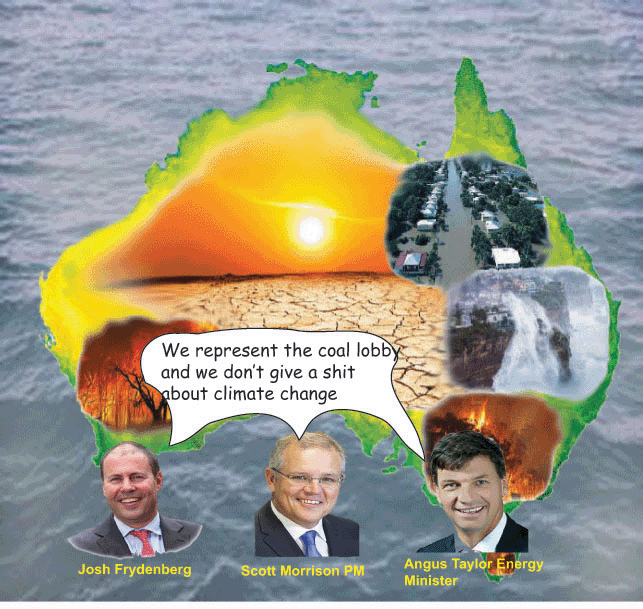 Zali Steggall calls for investigation of Coalition plan to underwrite gas, hydro and coal power
Independent MP says scheme lacks transparency and government has no authority to introduce it, Guardian, Adam Morton Environment editor @adamlmorton, Mon 27 Apr 2020 Independent MP Zali Steggall has asked the auditor general to investigate a Morrison government scheme to underwrite gas, hydro and coal power, saying it lacks transparency and citing legal advice that the Coalition had no constitutional or legislative authority to introduce it.
Announced in late 2018 after the government abandoned Malcolm Turnbull’s proposed national energy guarantee, the underwriting new generation investment (Ungi) scheme promises public support for new dispatchable power generation projects to increase competition in the electricity grid. Twelve projects have been shortlisted, including six pumped hydro plants, five gas generators and an upgrade to the Vales Point coal-fired power plant.
Steggall has written to the auditor general, Grant Hehir, asking him to consider investigating the program “as a matter of priority”. Her letter refers to research by The Australia Institute, a progressive thinktank, suggesting the program has no constitutional or legislative standing, no guidelines or criteria to assess projects, and its development and implementation did not follow a clear process.
She said despite these apparent flaws the government had shortlisted projects, started “advanced negotiations” to support gas-fired plants in Victoria and Queensland and entered a memorandum-of-understanding with the New South Wales government to support three projects in the state. ……
Steggall, who entered parliament last year on a climate action platform, said the focus on fossil fuels was questionable and there was little visibility of how and why the projects shortlisted for underwriting had been chosen….
“There’s just no transparency or accountability around this,” Steggall told Guardian Australia. “We’ve seen what happened with sport rorts. We’re talking about commonwealth money at a time when we know the economy has taken a hit due to coronavirus, and I think it should be properly investigated.”……https://www.theguardian.com/australia-news/2020/apr/27/zali-steggall-calls-for-probe-of-coalition-plan-to-underwrite-gas-hydro-and-coal-power
Australia goes backwards in latest world press freedom index
 Government ‘absolutely committed’ to press freedom as Australia drops in rankings, Brisbane Times, 24 Apr 20 Australia slipped five places to 26th in Reporters Without Borders’ latest world press freedom index, the global watchdog citing Australian Federal Police raids targeting reporters and cost-cutting in the industry as threats to public interest journalism.Attorney-General Christian Porter said the government was committed to protecting press freedom as media organisations and Labor seized on Australia’s slump in the rankings to renew calls for reform. Government ‘absolutely committed’ to press freedom as Australia drops in rankings, Brisbane Times, 24 Apr 20 Australia slipped five places to 26th in Reporters Without Borders’ latest world press freedom index, the global watchdog citing Australian Federal Police raids targeting reporters and cost-cutting in the industry as threats to public interest journalism.Attorney-General Christian Porter said the government was committed to protecting press freedom as media organisations and Labor seized on Australia’s slump in the rankings to renew calls for reform.
The drop in rankings comes after a campaign by the “Australia’s Right to Know” coalition of major media organisations, who have urged the Parliament to legislate on a suite of proposals to curb government secrecy. Labor labelled the global result “worrying” and called for action. Mr Porter said the government was “absolutely committed” to a free press and was awaiting the findings of an inquiry by Parliament’s intelligence and security committee…… The media organisations have put forward six key recommendations, including public interest exemptions from national security laws, expanded safeguards for whistleblowers, freedom of information reform, the right to contest search warrants and defamation changes…… Mr Porter said the the committee’s previous plan to report by early this year had been disrupted by the COVID-19 crisis. The reporting deadline had already been delayed multiple times last year, with members citing the complexity of the task and late submissions. Sources familiar with the committee’s deliberations told The Sydney Morning Herald and The Age the plan was now to deliver the findings by the middle of the year. Reporters Without Borders said Australia “used to be the regional model but is now characterised by its threats to the confidentiality of sources and to investigative journalism”. The organisation also noted the concentration of media ownership, the closure of national news agency Australian Associated Press and that the Australian constitution was “completely lacking in guarantees for the right to inform and to be informed”. A spokesman for Australia’s Right to Know said the coalition had long pursued changes and the High Court’s ruling last week on the search warrants executed at the home of News Corp journalist Annika Smethurst “again illustrated the increasing urgency for law reform in this area.” Journalists’ union the Media, Entertainment and Arts Alliance said the press freedom index result highlighted Australia was going backwards. “Overseas observers are recognising what Australians already know: that press freedom in our country is under sustained assault,” MEAA official Marcus Strom said. Shadow attorney-general Mark Dreyfus and opposition communications spokeswoman Michelle Rowland said in a joint statement the slide down the index “underscores the need for action by the government on law reform to support media diversity, support press freedom and address the concerns of Australia’s Right to Know coalition and civil society organisations”. https://www.brisbanetimes.com.au/politics/federal/government-absolutely-committed-to-press-freedom-as-australia-drops-in-rankings-20200423-p54mn6.html |
|
Brett Stokes: South Australian law has been repeatedly breached by the deceptive National Radioactive Waste Dump plot

(a) encourage and support South Australian police to enforce the law against illegal
use of public money in a manner prohibited under s13 of Nuclear Waste Storage
Facility (Prohibition) Act 2000.
disgraceful “site selection process”.
I am happy for this submission to be made public.
Censored Previous Submission
Subject – Selection process for a national radioactive waste management facility in South Australia (see on this site Brett Stokes shows how plans for nuclear waste dumping in South Australia have breached S.A. law)
Ngoppon Together Reconciliation Group: Kimba nuclear waste dump opposed by Indigenous, and other South Australians
|
Ngoppon Together Reconciliation Group, Submission No 3 to National Radioactive Waste Management Amendment (Site Specification, Community Fund and Other Measures) Bill 2020 . Ngoppon Together Reconciliation Group write to you in support of the Barngarla people of Eyre Peninsula, who have fought so hard to protect their ancestral home from nuclear waste.
Senator Matt Canaban announced that Kimba, Eyre Peninsula, has been selected for the proposed Nuclear Waste Storage Facility. Why select a site within one of South Australia’s best cropping areas? Grain farming in the Kimba district brings in up to $80 million per annum.. The Federal Government’s promise of a $30 million development package is, with respect, “peanuts”, compared with the long terms risks.
Only inhabitants of a small zone around Kimba were entitled to vote. This excleded the Barngarla people, traditional caretakers of the land and native title holders, and other nearby inhabitants who objected to the proposal. If the 50km radius zone had been applied to Kimba,as it was to Hawker, the vote would have failed. Just 52 Kimba locals cannot speak for 1.7 million South Australians, The majority of South Australians have objected to nuclear proposals for many years.
Medical waste is mainly low level radiation with fast breakdown., but 90% of the waste is intermediate level, and can take up to 10,000 tears to degrade It includes spent nuclear fuel rods, classified as high level waste in France. To complicate matters, it will be stored temporarily in above ground structures until a safe reposirary is designed, approved and built. One hundred trucks will transport the wastes over a 1700 km route over a four year period. As yet there has been no community consultation about the route.
The Federal Government has decided to go ahead with the proposal, despite unanimous opposition from the Barngarla people. The Barngarla Determination Aboriginal Corporation initiated a legal action, protesting their exclusion from the ballot. This failed. The BDAC also asked the Australian Electoral Corporation to change the ballot to a confidential postal vote. This was unsuccessful. The BDAC wrote to the Federal Government, calling for the dump proposal to be abandoned.in the light of their unanimous opposition. They are determined to maintain their fight against the Nuclear Waste Dump..
Honorary Secretary Jacqueline Merckenschlager https://www.aph.gov.au/Parliamentary_Business/Committees/Senate/Economics/RadioactiveWaste/Submissions?fbclid=IwAR0v5FeP2_iTZbTmkrFA3HNLS29dko4g2NgxUR7UaiuSUyVDh62bDFOLxwA
|
|
Geraldine Gillen: Napandee nuclear waste dump -illegal, damaging to agriculture’s image, unwanted, unnecessary
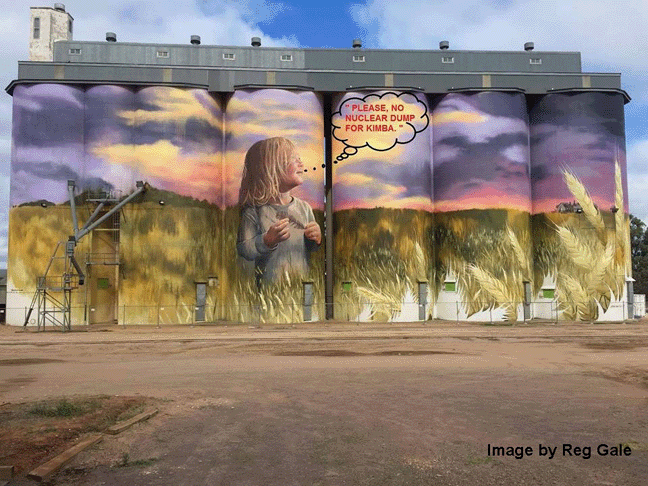 Re: Flawed Federal process contrary to Nuclear Safety Committee advice and untenable interim nuclear waste storage compromises Safety & Security and Rights & Interests in SA Geraldine Gillen Submission No. 18 to National Radioactive Waste Management Amendment (Site Specification, Community Fund and Other Measures) Bill 2020 .
I contend that the Construction of a nuclear waste dump in SA at Kimba is currently illegal under SA Law passed by the State Liberal Government in 2000. We also had a Citizen’s Jury which said “NO”.
The Bill is deeply flawed on many fronts and should be rejected. It specifically targets SA for a national nuclear waste “facility” – a repository for low-level waste and an above-ground ‘interim’ (indefinite) store for long-lived intermediate-level waste including nuclear reactor fuel waste. At the same time the Federal Government is making no effort to find an alternative permanent site for this waste.
Why is the Federal Government not using its own land for this purpose? Why has it looked to private land? What is the real motive?
including cancer, cardiovascular disease, emphysema and cataracts – and if it enters the soil can contaminate our food and water.
continues to disempower and dispossess the Barngarla Traditional Owners who are unanimous in their opposition to the proposed nuclear waste facility. I have stood with them and the Kimba community who are opposed to this dump on the steps of SA Parliament House and this year at Kimba. I will continue to do so.
Besides the Barngarla people, many people in the Kimba community were unable to vote. People who originally were told they were neighbours, suddenly were not because a road between their property and another deemed them to be ineligible. People holding property who were just outside the area, did not get a vote. The process of how was eligible for voting needs to be explored by this Committee. Statistic have been misused both by the Government and then by the media.
how we plan and manage our land, resources and social responsibilities in the future.
Now is the time to scrap this Bill. more https://www.aph.gov.au/Parliamentary_Business/Committees/Senate/Economics/RadioactiveWaste/Submissions?fbclid=IwAR0v5FeP2_iTZbTmkrFA3HNLS29dko4g2NgxUR7UaiuSUyVDh62bDFOLxwA
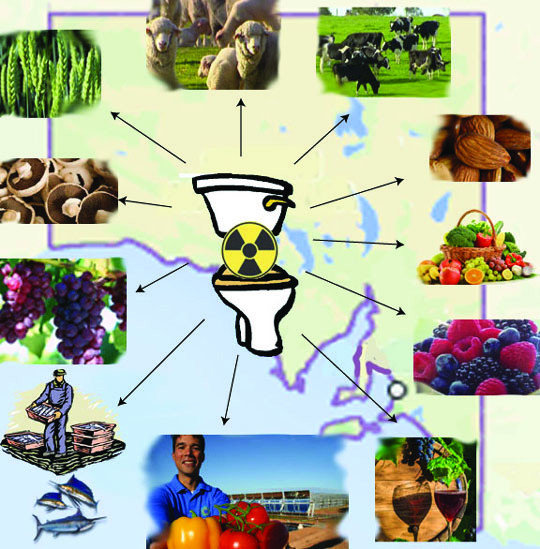
Caring for South Australia reject nuclear waste dumping: it will jeopardise South Australian food production
1 This month.
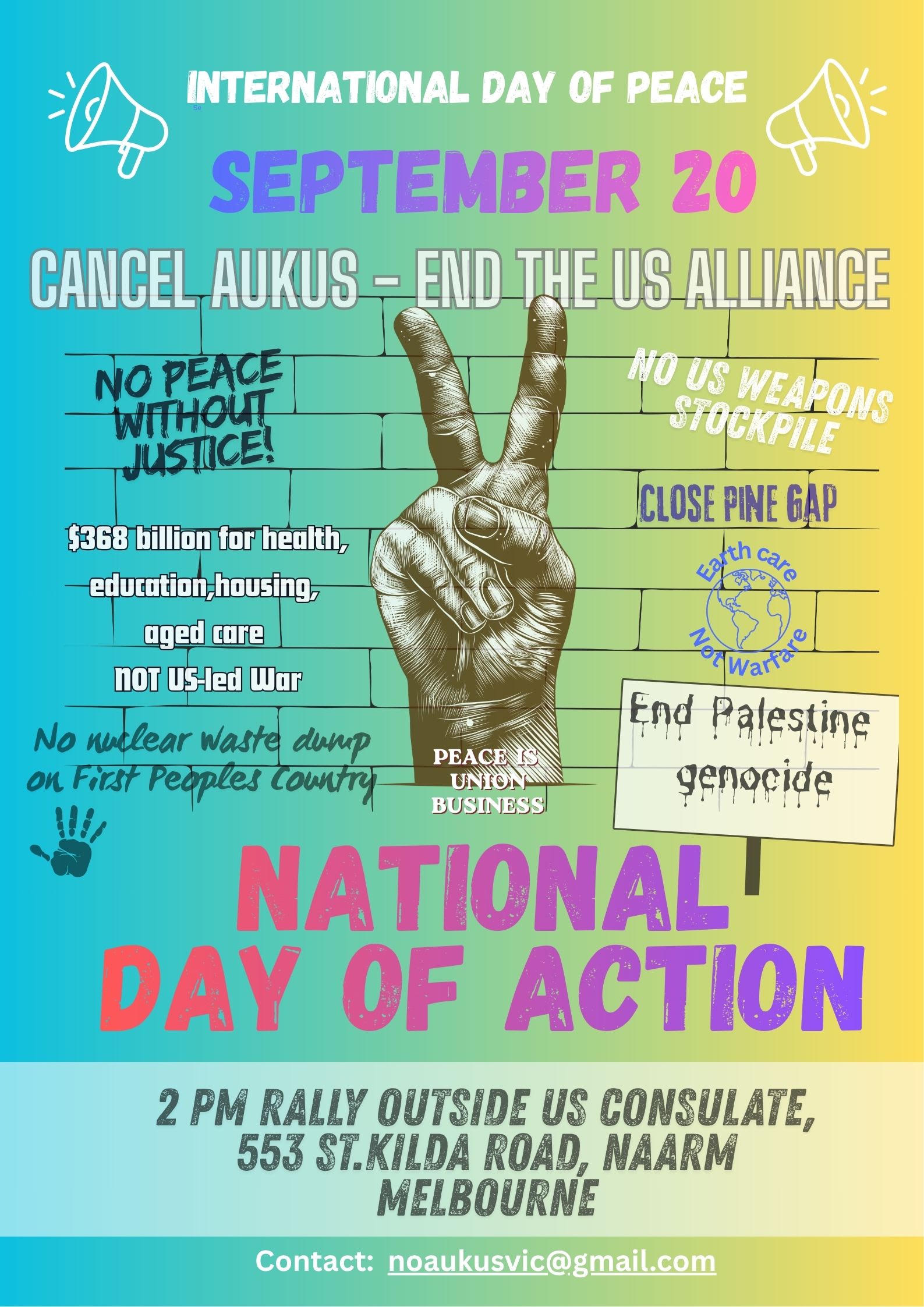
20 September –National Day of Action in Melbourne on the International Day of Peace

Help Aunty Sue Protect Her Land and Sacred Sites From Destructive Rocket Testing.
.

Australians deserve the truth
about
AUKUS – https://aukuspublicinquiry.com/


PETITION – To: Prime Minister Anthony Albanese and the Australian Labor Government

of the week – Australians for War Powers Reform (AWPR)
To see nuclear-related stories in greater depth and intensity
 Antinuclear