Australian govt’s devious ploy to further dispossess the Bangarla Aboriginal people
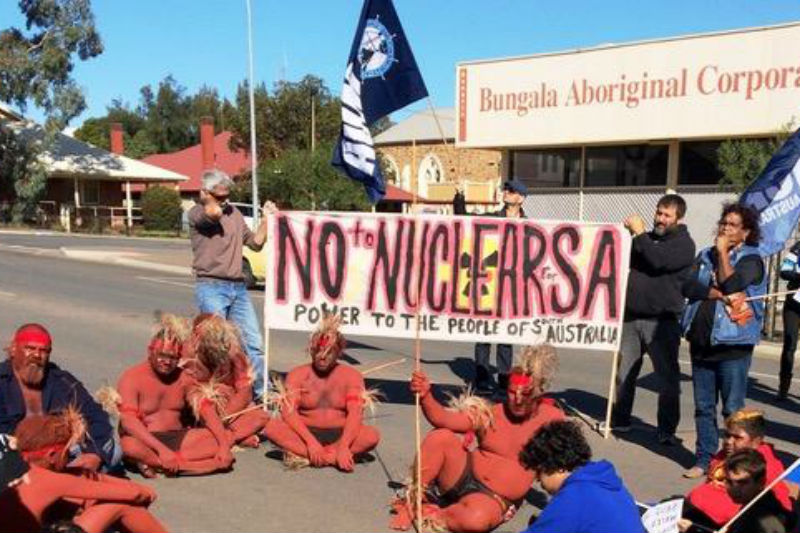
First Nations communities continue to be left behind, Eureka Street, Michele Madigan -22 Apr 20 “………..As well as their own real fears for their health in the COVID-19 pandemic as documented in their recent submission (number 25) to the Senate Standing Economics Legislation Committee of Inquiry the Barngarla peoples of South Australia’s Eyre Peninisula are being forced to counter attempts to further their dispossession in new schemes by federal government. The Barngarla Determination Aboriginal Committee (BDAC) plead with the federal government to delay the current procedures so that the public hearings regarding the site of the federal nuclear waste facility in the Kimba region may take place ‘on Country’ rather than by teleconference, which would greatly disadvantage their cause.
Even more seriously, the BDAC submission (among others) denounces the purposeful strategy by the Resources Minister in refusing to make a formal declaration. Instead, the Minister made ‘a policy decision’ in naming the chosen site of Napandee, having ‘presented it as a declaration’.
BDAC points out, ‘The Government is now seeking to legislate directly, as an indirect but very effective means to prevent judicial oversight.’ That is, the Minister is seeking to change the current legislation of the National Radioactive Waste Management Act so that Parliament itself will ‘select’ Napandee as the site and thereby stopping any judicial oversight of anything untoward in the long administrative process to date.
As the BDAC submission summarises, ‘This is highly concerning to the Barngarla people as it should be to all Australians.’
In the last few days, the federal Parliamentary Joint Committee on Human Rights has written a report critical of the treatment of Barngarla Traditional Owners. It is a unanimous report, endorsed by Coalition members of the Committee.
And there we have it. As Aboriginal communities still await the needed funding to ensure their survival during this pandemic, the wheels of another government ministry are confidently seeking to further dispossess and disempower by such proposed legislation. Shameful indeed.
Michele Madigan is a Sister of St Joseph who has spent the past 38 years working with Aboriginal people in remote areas of SA, in Adelaide and in country SA. Her work has included advocacy and support for senior Aboriginal women of Coober Pedy in their campaign against the proposed national radioactive dump. https://www.eurekastreet.com.au/article/first-nations-communities-continue-to-be-left-behind?utm_medium=email&utm_campaign=Eureka%20Street%20Daily%20-%20Wednesday%2022%20April%202020&utm_content=Eureka%20Street%20Daily%20-%20Wednesda
An initial brief look at the submissions to the Senate Nuclear Waste Bill Inquiry

Initial Summary: – focussing on submissions from individuals , with brief looks at those from organisations
* Of the 102 submissions published, 74 were ‘against’; 19 were ‘for’; one (ANSTO’s) was ‘neutral’; and eight were ‘unknown’ (as details were confidential).
 * The leading explicitly-stated concern was with the process and decision-making (71 of 102), followed by the environment (67 of 102), health and safety (65 of 102), the economy (62 of 102) and traditional owners’ rights (47 of 102).
Six out of 13 favourable submissions were from people with the surname Baldock. (Jeff Baldock sold the land for the site to the government) – Source : https://www.aph.gov.au/Parliamentary_Business/Committees/Senate/Economics/RadioactiveWaste/Submissions
Australia’s climate experts urge govt to use rebuilding economy to combat global heating.
|
Climate scientists say coronavirus could be Australia’s golden opportunity— SBS News
Climate experts say the way Australia chooses to rebuild its economy after the COVID-19 pandemic will seal its climate change fate. BY CLAUDIA FARHART, 22 APR 20
Australian climate scientists are urging the government to recognise the similarities between the COVID-19 pandemic and climate change, arguing they could be the key to stopping global warming. Professor Matthew England from the University of New South Wales’ Climate Change Research Centre said acting early, listening to expert advice and mitigation were the keys to solving both crises.
While the coronavirus is posing a serious risk to millions of lives right now, Professor England said climate change will threaten even more lives over the next five decades. “We’ve seen all around the world that the nations ignoring the best advice of their scientists are suffering the most, and climate change is no different,” he told SBS News. “We have expert reports that have been tabled for the last three or four decades, but many nations are ignoring those, so I think that COVID-19 provides a wake up call for what happens if you do ignore the best scientific advice.”………
While these significant improvements in air and water quality are showing people around the globe what is possible when emissions are reduced, Professor England said it is not time to celebrate yet. Instead, he says Australia needs to recognise the opportunity COVID-19 presents to rebuild in a more environmentally friendly way. “This is going to be a major stall in the global economy, but out of this pandemic we’re certainly going to see a huge economic boom and it’s going to be a real chance to make that boom a low-carbon boom,” he said.
“To solve climate change, we actually need large scale innovation and the huge economic boom that is poised to happen out of this pandemic.” ‘Fight or flight’While COVID-19 has already killed at least 90,000 people, the World Health Organisation has warned that climate change will kill as many as 250,000 people per year by 2030………https://www.sbs.com.au/news/climate-scientists-say-coronavirus-could-be-australia-s-golden-opportunity |
|
During the pandemic, health and wellbeing of the First Nations people is disregarded, as usual.
First Nations communities continue to be left behind, Eureka Street, Michele Madigan, 22 April 2020
On the other hand, while there have been literally billions of dollars allocated to the crisis in general and to very many organisations, it is astounding that the most vulnerable group of all remains at the bottom of the pile. First Nations people themselves and their allies remain nonplussed at the clear lack of resources allocated to First Nations people. No one left behind? The facts suggest otherwise.
Who else in our nation is living in housing with another 26 or so people?
This huge, rarely mentioned and ongoing deeply shameful situation regarding the health and housing of First Nations people comes into sharp relief by the present crisis…….
https://www.eurekastreet.com.au/article/first-nations-communities-continue-to-be-left-behind?utm_medium=email&utm_campaign=Eureka%20Street%20Daily%20-%20Wednesday%2022%20April%202020&utm_content=Eureka%20Street%20Daily%20-%20Wednesda
Current Review of Environment Protection and Biodiversity Conservation Act (EPBC) ? – it’s all about promoting the polluters
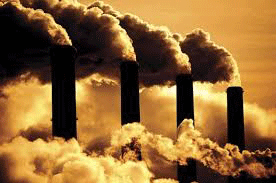 The Government puts business ahead of the environment , Independent Australia, By Sue Arnold | 22 April 2020, The writing is on the wall for the environment. And it doesn’t look good.
Prime Minister Scott Morrison has promised to:
‘Fast-track new and existing major infrastructure projects and adopt an aggressive pro-business strategy ahead of the October budget to help the country claw its way out of an expected virus-induced recession.’
Tax breaks for big business, deregulation and wide-scale industrial relations reform will form part of the Morrison Government’s attempts to lift the nation out of the economic black hole, according to the Sydney Morning Herald.
Environmental organisations, ecologists, wildlife shelters and Australia’s biodiversity are facing an Armageddon as a result of state and federal governments’ absolute failure to protect the environment in the face of a serious economic recession.
Yet this is the nation which has lost over one billion animals to the catastrophic bushfires. A nation with dying and dead ecosystems, and thousands of hectares of burned-out forests. The forests will take many years to recover and ecosystems may never be rehabilitated.
A glimpse of what’s in store can be gained from the current review of the Environment Protection and Biodiversity Conservation Act 1999 (‘EPBC Act’), undertaken under the chairmanship of Professor Graeme Samuel AC.
The review is required under the EPBC Act every ten years, to examine the operation of the legislation and the extent to which its objects have been met.
An expert panel was set up to support Professor Samuel. Panel members include Bruce Martin, an inaugural member of the Prime Minister’s Indigenous Advisory Council and President of the Cape York Peninsula Live Export Group.
Dr Erica Smyth AC is a panel member with over 40 years’ experience in the mineral and petroleum industry, having worked for ten years in the oil and gas industry managing government approvals for offshore facilities, LNG and methanol facilities……
With no ecologists, environmental lawyers, or conservation organisations, the review and its panel completely fails the pub test.
It is important to note that in accordance with section 522A of the EPBC Act, the review is supposed to examine:
‘The operation of the Act; and
The extent to which the objects of the Act have been achieved.’
Added to the terms of reference is the following statement:
‘The review will make recommendations to modernise the EPBC Act and its operation to address current and future environmental challenges.’
The terms of reference may be at odds with section 522A of the Act, if the phrase ‘modernise the Act’ is interpreted as code for change to focus on economic growth at the expense of the environment.
Further evidence of the focus of the Government’s dirty business can be found on the EPBC website which lists as one of the objectives of the EPBC Act to:
‘Provide a streamlined national environmental assessment and approvals process.’
The legislation contains no such provision, and other objectives have also been changed ‘to promote the conservation of biodiversity” to ‘conserve Australia’s biodiversity’.
More importantly, the following legal objective wasn’t included:
‘To promote a cooperative approach to the protection and management of the environment involving governments, the community, land-holders and indigenous people.’
In October 2019, Environment Minister Sussan Ley said that “cutting delays in project approvals could save the economy $300m a year,” with the Morrison Government promising to “tackle green tape”.
No one should be surprised by the review’s focus or the outcome.
The review will be ‘guided by the principles’ which include:
……… Making decisions simpler, including by reducing unnecessary regulatory burdens for Australians, businesses and governments;
…….. Obviously, the first principle should be the predominant, sole guiding focus of the review given the catastrophic state of Australia’s biodiversity and environment.
Instead, the evidence of a drastically changed focus favouring the growth and the economy is made abundantly clear by the guiding principles and panel choices. There’s no explanation of the extraordinary failure to focus on the inability of the EPBC Act to have fulfilled any of its objectives.
April 17 was the final day for submissions to the review’s lengthy discussion paper. Six major environmental groups asked the Federal Government to delay the submission deadline and the review as a result of the chaos caused by the COVID-19 pandemic……..
Australia is currently cursed with governments and politicians who continue to ignore the environment. It’s almost incomprehensible that after the bushfire catastrophes, the environment should sink to the bottom of the pile……. https://independentaustralia.net/environment/environment-display/the-government-puts-business-ahead-of-the-environment,13819

Annie McGovern: stop pretending that the Kimba nuclear waste dump is a”medical necessity”
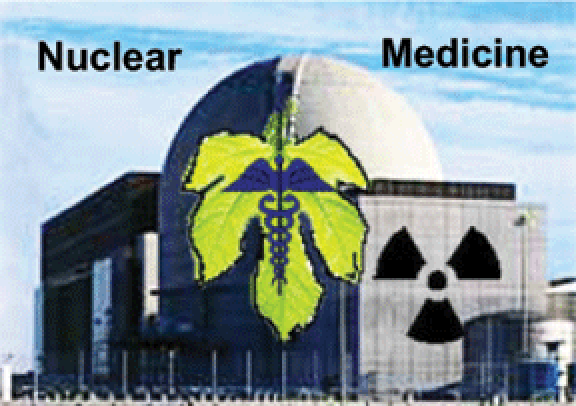
Much of what you and the Public are told is that this is mostly about providing good medicine and
saving lives. According to the Medical Association for Prevention of War ‘Factsheet’:- “Less than 1%
is medical waste (radium and some disused sources). Most states and territories each only have a
few cubic metres of low level medical waste.”
The current ploy of localising all the decision-making regarding this “National Waste Dump”, through
enticements of land procurement and localised funding, has placed this critically important process
at the level of a ‘sausage-sizzle deal’, highly inadequate for the responsibilities involved.
National Radioactive Waste Management Amendment (Site Specification, Community Fund and Other Measures) Bill 2020
[Provisions]
Annie McGovern, Submission 83 To: Senate Standing Committees on Economics.
National Radioactive Waste Management Amendment (Site Specification, Community Fund and
Other Measures) Bill 2020 (Provisions).
As stated in the support document accompanying this Bill, the Federal Government has been in the
process for the past 40 yearsof finding a site in Australia for the Dumping of Nuclear Waste. This Project has been presented bothas an independent National necessity and also as an associated proposal for an International
Industry for disposing of the world’s Nuclear Waste.
For those same 40 years the Australian people have continued to take the position that a Nuclear
Industry is a hazardous, uneconomical and unsustainable incursion into the stability of both National
and International interests, and that Australia should remain Nuclear Free.
Over time we have seen the steady erosion of the rights of the Public to express common will in
relation to industrial development in this country, and usurpation of decision-making of whether an
industry is desirable for the common good or is perceived as destructive and not in the best interests
of the Community or Environment. Clearly the Nuclear Industry falls into the latter category where
the balance of all the detrimental factors far outweigh the positive contributing factors.
The challenge of finding a disposal site is directly correlated to the resistance of allowing an easy
road for the Nuclear Industry to flourish, when it is seen to be both economically and
environmentally unsustainable. Agreement for conditions of disposal should occur when there is an
end in sight. When the Industry is shut down:- weapons, uranium and radioactive sand mining,
reactors and associated arms of the industry, then we are able to consider final disposal. With the
guarantee of no further production of this toxic and dangerous legacy there will be a genuine reason
to consider the disposal of what we have created. Until then, the current proposal is yet another
attempt to justify and legitimize a manipulative and dangerous industry, and to perpetuate its
attempts to grow in power.
The current ploy of localising all the decision-making regarding this “National Waste Dump”, through
enticements of land procurement and localised funding, has placed this critically important process
at the level of a ‘sausage-sizzle deal’, highly inadequate for the responsibilities involved.
A ‘cart-before-the –horse’ scenario occurs when acceptance of the site and facility is put before you
when there have been no Public Environmental Studies performed nor any detailed scrutiny of the
planned infrastructure. Community ratification has been achieved (minus the Indigenous Voice)
without a thorough investigation of the Impacts or ramifications of this site selection, with only an
assurance of what initial Economic gain the Community might make on this deal.
This over-simplification and commercialisation of such an important Project is reflected in the
inclusion of an extensive “Visitor’s Centre” at the site, as though it were a Tourist Attraction. This
attitude indicates a serious lack of awareness of how toxic and hazardous radioactive materials are
and a down-playing of the necessity for safe-guards that have also been eroded over the years.
Why South Australia? It is a well-known fact that the Nuclear Industry has its sites set on an
expansion of all levels of its activities, particularly in S.A. It is also a well-known fact that the people
of S.A. voted against the recent Royal Commission’s facilitation of a proposal to install an
International Radioactive Waste Dump in S.A. Its’ own State Legislation prohibits the development
of Nuclear Facilities so you as the National Senate Committee deliberating on this matter will override
the will of the people of S.A., unless you look below the surface of what you have been
proffered as justifications for this proposal.
Much of what you and the Public are told is that this is mostly about providing good medicine and
saving lives. According to the Medical Association for Prevention of War ‘Factsheet’:- “Less than 1%
is medical waste (radium and some disused sources). Most states and territories each only have a
few cubic metres of low level medical waste.”
Nuclear scans for investigating disease. These produce the vast bulk of medical nuclear waste. This is
short-lived and decays on the medical facilities’ premises until its activity is negligible. It is then
disposed of safely and appropriately in the usual manner of most waste (sewers, incinerators,,
landfill tips etc.) according to set standards.
Cancer treatment radiotherapy. Most radiotherapy uses x-rays or electromagnetic radiation which
do not produce any waste at all. A very small proportion of cancer treatment actually relies on
radioactive materials, which almost all decay rapidly. Longer lived sources must be returned to their
(overseas) sources when used up and so do not need local disposal.”
The Medical Associations for Prevention of War also supports a re-think on the production of
medical isotopes to manufacture the same product without generating radioactive waste.
“…Canada…is switching to non-reactor isotope production, which does not create radioactive wastes.
It goes on to explain: “There are broadly two areas in which radioactive material is used for medical
purposes:
Nuclear scans for investigating disease. These produce the vast bulk of medical nuclear waste. This is
short-lived and decays on the medical facilities’ premises until its activity is negligible. It is then
disposed of safely and appropriately in the usual manner of most waste (sewers, incinerators,,
landfill tips etc.) according to set standards.
Cancer treatment radiotherapy. Most radiotherapy uses x-rays or electromagnetic radiation which
do not produce any waste at all. A very small proportion of cancer treatment actually relies on
radioactive materials, which almost all decay rapidly. Longer lived sources must be returned to their
(overseas) sources when used up and so do not need local disposal.”
The Medical Associations for Prevention of War also supports a re-think on the production of
medical isotopes to manufacture the same product without generating radioactive waste.
“…Canada…is switching to non-reactor isotope production, which does not create radioactive waste.
In contrast, ANSTO is proposing to dramatically increase reactor isotope production to sell 30% of
the world market. As a result Australia will accumulate much more waste from international isotope
sales. Developing cyclotrons instead (like Canada) would eliminate waste from isotope production.”
To ply the Public with guilt-laden decision-making tools which are questionable and possibly wrong is
an underhanded way of bending peoples’ resolve. Clearly, Australia has choices of the way we
proceed into the future. It is not the right of a small group of often underinformed politicians or
vested financiers to force us into untenable industries. We, as a Nation already have enough
Radioactivity to deal with. The legacy of past mistakes and ones that today continue to add to the
problem, unseen, unchecked ‘til some day those hazards will also have to be dealt with. Roxby
Downs, Beverley, Ranger, Yeelirrie, Radium Hill, Honeymoon, Wiluna, Lucas Heights, Woomera and
Marlinga.
The Intermediate Level Waste is promoted as a temporary visitor to this site. Where is its’ long-term
repository? Is this yet another plan that has not yet been divulged? Where is the constraint, the
hazard reduction? The respect for the earth and its people that would cause decision-makers to
recognize that we gone too far?
It is a nightmare of what we already have to deal with, of decaying drums, of shipping highly toxic
huge stockpiles and dangerous goods across the country, of supervising this disposal for hundreds of
years into the future with only 100 years guaranteed by this plan.
Please see the deep and murky waters here and the lack of knowledge that lies at the bottom of
what you are being asked to authorize. There are no easy solutions or truly economically viable ones,
it will all be a cost.
Stop the Nuclear Industry now and then we will discuss what to do with the mess we have made.
Thank you for the opportunity to address this very important issue.
Annie McGovern.
Kim Mavromatis on Radioactive Waste Bill: community consent? transport dangers, on agricultural land. poor process.
Dear Committee Chairperson
I live in Port Pirie, within the Upper Spencer Gulf and Southern Flinders region of South Australia. I’m a filmmaker and have been following and documenting the Nuclear Waste dumps facility process for 5 years. My hometown of Port Pirie,
along with Whyalla and Port Lincoln, have been named potential Nuclear Waste ports by the NRWMF, so I live potentially along the transport route?
Nuclear Ports NRWMF Reference : Site Characterization Tech Report, Wallerberdina Pg 177 Proximity to Ports 4.1.2.1.6.
61.5% of residents supported a facility located in their community”.
In Senator Canavan’s media release 1st Feb 2020, announcing Napandee near Kimba as the site for Australia’s National Nuclear Waste Dumps facility, he replaced the word “residents” with “voters” :Senator Canavan : “…61.6 per cent of voters in Kimba support the proposal”.
facility – all the eligible voters need to be included in the percentages, whether they voted Yes, No or Abstained, to get a true percentage of the Community Support. All the figures need independent scrutiny.
Kimba Council and Barngarla Independent vote gives a very different outcome : 43.75% Support the waste dumps facility (452 Yes from 1,033 eligible voters), which Does Not constitute Broad Community Support.
title rights and this Fed Govt National Nuclear Waste Dumps facility process has
denied them from having a voice and ignored their independent vote. This
process not only has ramifications for the Barngarla people, but for all of
Australia’s Aboriginal people – it will inform future govts of ways to ignore and
exclude Native Title Holders, without proper consultation, and get away with it.
Spent Nuclear Fuel (10,000 x more radioactive than uranium ore) and waste
from reprocessed SNF (still contains 95% of the radioactivity of SNF), which
most of the world classify as High Level Radioactive Waste (Aust classify as
Intermediate), will be transported 1,700km halfway across Aust from Lucas
Heights, via road, rail or ship, and dumped temporarily above ground for up to
100 years on Eyre Peninsula farmland, near Kimba in SA.
South Australia’s Greens fight to stop nuclear waste dumping on Kimba

Mark Parnell, 21 Apr 20 The people of the Flinders Ranges voted to reject the proposal to site the nuclear waste dump in their local area, so the Federal Morrison Government has decided that Kimba, at the top of Eyre Peninsula, will host the dump.
Legislation has been introduced into Federal Parliament and a Senate inquiry is now underway. It is due to report back to Parliament by the end of July. You can find out more and read the submissions here.
the Barngarla people challenged the flawed community ballot and their claim of racial discrimination was dismissed by the Federal Court. But all is not lost. Earlier this month, the Parliamentary Joint Committee on Human Rights found that the Government’s new dump laws posed “a significant risk” that the rights of Traditional Owners under international human rights laws would NOT be protected. This means that it’s more important than ever to show our support to the Traditional Owners to have their voices heard.
In my last update, I flagged the likelihood of an imminent new South Australian Parliamentary Inquiry into the proposed Kimba nuclear waste dump. I now don’t expect that inquiry to commence until much later in the year. Of course, if the Federal Bill is defeated in the Senate, then there may be no need for an inquiry at all! That is our hope.
Finally, I recently tabled a new petition against the nuclear waste dump in State Parliament, which I know some of you have signed. You can read my speech here, or watch it here.
PLanning for waterways – a vital need, as Australia’s river systems are affected by global heating
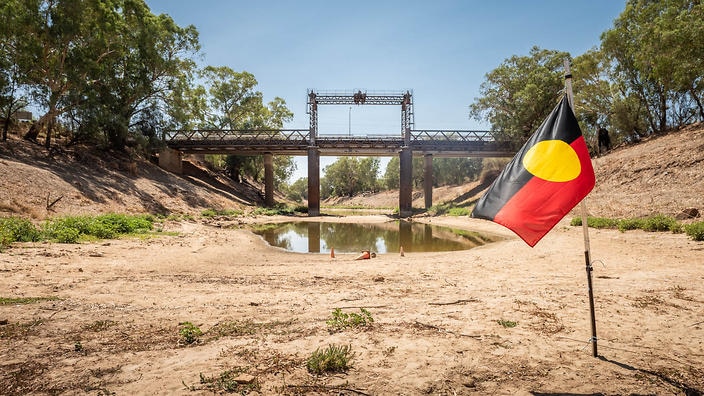 Australia’s inland rivers are the pulse of the outback. By 2070, they’ll be unrecognisable, The Conversation, Australia’s inland rivers are the pulse of the outback. By 2070, they’ll be unrecognisable, The Conversation, April 21, 2020 Zacchary Larkin, Postdoctoral Researcher in Environmental Sciences, Macquarie University, Stephen Tooth, Professor of Physical Geography, Aberystwyth University, Timothy J. Ralph, Senior Lecturer in Environmental Sciences, Macquarie UniversityInland Australia’s complex system of winding rivers, extensive wetlands, ancient waterholes and seemingly endless parched floodplains are rarely given more than a passing thought by many Australians who live on the coastal fringes. Yet these waterways are lifelines along which communities, agriculture and trade have flourished. Etched into the psyche of regional Australia, these river systems are the pulse of the outback. Before asking a local how things are going, peek over the bridge in town for an indication. When relaxing in the shade of an old river red gum alongside one of Australia’s lazy inland rivers, it’s natural to think of them as timeless and resilient to environmental change. Yet, these rivers evolved over millennia and continue to change over years and decades. And we already know from previous studies that future climate change is likely to reduce stream flow and water availability in drylands around the world. But what our new research has shown, for the first time, is that these declines in stream flow may trigger a dramatic change in the physical structure and function (the geomorphology) of Australia’s inland rivers. Meandering rivers and flat, wide floodplainsThe physical structure of a river depends on how much water flows through it, and the sediment that water carries. Reductions in water flow – as expected due to climate change – can lead to a build-up of sediment downstream. In extreme cases, this “silting up” can cause complete disintegration of river channels, where water flows out across the floodplain. Not all rivers are alike, and the rivers of the Murray-Darling and Lake Eyre basins (covering 1.8 million square kilometres) are particularly diverse. Many of these rivers and wetlands are internationally recognised for their hydrological and ecological importance. They range from large meandering rivers swollen by seasonal spring flows (the Upper Murray, Mitta Mitta, Kiewa, and Ovens rivers), to rivers that progressively get smaller until they become exhausted on flat, wide floodplains and disintegrate into large, boom-and-bust wetlands (the Lachlan, Macquarie, and Gwydir rivers). In the drier areas of central Australia, rivers typically persist as a string of isolated waterholes for years at a time, occasionally punctuated by very large floods (Warrego, Paroo, Diamantina, and Cooper Creek). A sobering futureFor Australia’s inland rivers, the average dryness, or “aridity”, of the catchment is the best predictor of what the overall structure and function of the rivers within look like. Compiling a range of climatic data, we modelled aridity for the Australian continent in 2070 under a relatively moderate climate change scenario. The results are sobering. Over the next 50 years, the arid zone – containing the areas of true desert – is projected to expand well into the Murray-Darling Basin and almost entirely envelope the Lake Eyre Basin. At the same time, the humid and dry subhumid fringes around the Great Dividing Range and coastal areas are expected to contract. This is concerning because the relatively wet western slopes of the Great Dividing Range are where many inland Australian rivers begin, with most of their water sourced in these smaller sub-catchments. Evolution of our inland riversThe impact of this projected drying pattern on Australia’s inland rivers is expected to be profound……. A parched futureWhile our research hasn’t investigated the potential ecological, socio-economic or cultural effects of structural changes, we can expect them to be very significant, and potentially irreversible. Many of Australia’s native aquatic and dryland flora and fauna are adapted to a highly variable climate regime, but there are limits beyond which these ecosystems cannot recover or survive. For example, seeds and invertebrate eggs can survive many years buried in dry soil waiting for a flood, but if water doesn’t come, eventually they won’t be viable. What’s more, extracting too much water from our inland river systems for agriculture or other uses will exacerbate the threats posed by a drying climate. Given the complexity and tensions surrounding water use and water sharing in Australia’s inland rivers, particularly in the Murray-Darling Basin, understanding how these critical systems might respond in the future is now more important than ever. Water is one of the most contested resources in Australia, and it’s the fundamentally important river and wetland ecosystems and agricultural industries that will bear the brunt of a drying climate. To make sure outback communities can continue to survive, it’s vital we protect their lifeline. Water resource planning must include consideration of climate change, as the projected changes will likely increase pressure on already vulnerable systems. https://theconversation.com/australias-inland-rivers-are-the-pulse-of-the-outback-by-2070-theyll-be-unrecognisable-136492 |
|
Another revolving door- Air Chief Marshal (ret’d) Mark Binskin AC straight into BAE warships maker
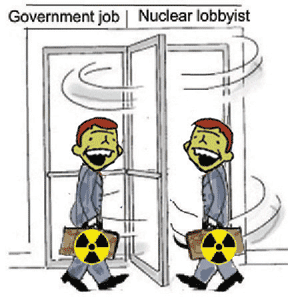 Air Chief Marshal (ret’d) Mark Binskin AC
MILITARY INDUSTRY REVOLVING DOOR. Michael West Media
In June 2018, Mark Binskin was Chief of the Defence Force when BAE Systems Australia was awarded the $35 billion Future Frigate contract, the largest surface warship program in Australia’s history. The following month Binskin retired. He has since been appointed in a non-executive director role with BAE Systems. The contract for the $1.2 billion upgrade of the Jindalee Operational Radar Network was also awarded to BAE in the final months of Binskin’s tenure…… https://www.michaelwest.com.au/air-chief-marshal-mark-binskin-ac-retd/
Australian Radiation Protection and Nuclear Safety Agency (ARPANSA) is critical of Government propaganda on Kimba nuclear waste dump plan
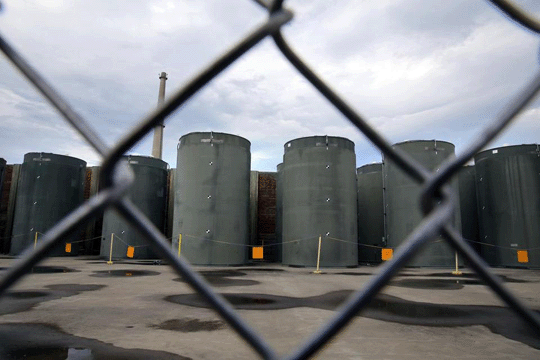
David Noonan, 20 Apr 2020, Australian Radiation Protection and Nuclear Safety Agency (ARPANSA) is  challenging govt propaganda more directly than we would usually expect:
“ARPANSA is aware that some stakeholders have interpreted ARPANSA’s decisions regarding the IWS as a requirement for relocation of the waste stored in the IWS, even suggesting that there is an urgent need for relocation. This is not correct. “
A Note so you may be aware of interesting matters raised in the ARPANSA submission to the Senate Inquiry:
Submission No.86 (7 pages) by the regulator Australian Radiation Protection and Nuclear Safety Agency (PDF 833 KB) has been posted on Senate Inquiry website: https://www.aph.gov.au/DocumentStore.ashx?id=41390f03-33ed-46be-bcb4-2913c6263b99&subId=680048
The UK reprocessed nuclear waste shipment is planned in 2022 – with ANSTO Lucas Heights the “only feasible destination”:
See p.3-4 under Headings:
Commonwealth waste holdings – role of the NRWMF
ANSTO
ANSTO
The Interim Waste Store (IWS) Facility
Additional ILW remains in the UK from reprocessing of HIFAR spent fuel, and is planned to be returned to Australia in 2022. Should the shipment take place at that time, the NRWMF will (again) not be available, which in all likelihood leaves Lucas Heights as the preferred (by ANSTO) option, and possibly the only feasible destination. ARPANSA is aware that the waste in this second shipment is likely to be immobilised and contained in a TN-81 cask with considerably less activity content than the first cask.
ARPANSA expects an application from ANSTO for approval to make a change with significant implications for safety under section 63 of the Regulations10, supported by a revised safety analysis report and an updated safety case, well in advance of the time the second shipment is intended to be loaded on a vessel for shipment to Australia.
So at this stage the UK reprocessed nuclear waste shipment is planned to go into Sydney (presumably to go over Port Kembla).
Unless the UK gov agree to a delay & that’s assuming the NRWMF is progressing to receive shipments of nuclear waste at a port in SA.
Noting the French gov did not agree to a delay back in 2015.
Also, ARPANSA making clear they intend an Application from ANSTO “well in advance of the time the second shipment is intended to be loaded on a vessel for shipment to Australia” – ANSTO didn’t do so in 2015.
So opponents of the nuclear waste plan and MUA may get some useful notice and can engage on that shipment publicly and formally.
If this UK shipment does go into Sydney (like the French reprocessed nuclear waste did in 2015), presumably they and MUA can raise a strong case that it shouldn’t later be moved a second time to ‘temporary’ (indefinite) above ground storage in SA, with a third move then required to a future disposal site…
And the federal gov case for an above ground interim (read indefinite) nuclear fuel waste store in SA is further significantly weakened.
Note – ARPANSA saying (p.4):
“ARPANSA has not raised safety concerns regarding storage of waste at the Interim Waste Store.”
(Regarding the IWS at Lucas Heights which holds the French reprocessed waste and was designed to also take the UK waste and operate for 40+ years)
And acknowledging ANSTO has identified two “contingency measures in short to medium term” – including what we are asking for:
- “Retention of the returned residues at ANSTO until the availability of a final disposal option”
( The other contingency measure is the ANSTO / Department / Minister’s plan for:
- Retention of the returned residues at ANSTO until the availability of the NRWMF for storage )
ARPANSA usefully counter some of the propaganda going around pro-dump circles on claimed ‘need’ to move key nuclear wastes:
“ARPANSA is aware that some stakeholders have interpreted ARPANSA’s decisions regarding the IWS as a requirement for relocation of the waste stored in the IWS, even suggesting that there is an urgent need for relocation. This is not correct. ARPANSA has not raised safety concerns regarding storage of waste at the IWS.”
On Transport:
ARPANSA flag a potential requirement (p.7) for “prior approval of a transport safety and/or security plan by ARPANSA” in a Safety Case before Site Licensing,
So we’d get an opportunity to publicly and formally contest these issues in consultation with the regulator, to show they are not ‘resolved’, before any licensing could happen.
Requiring community engagement / consultation on a ‘transport safety and/or security plan’ prior to Site licensing should become a specific ask of opponents of the plan.
“The safety case should acknowledge the existence of any unresolved issues and should provide information on work proposed to resolve these issues in future stages of the licensing process. Issues that have been resolved with ARPANSA and other stakeholders should be documented and form part of the safety case.
The safety of transport to, from and between radioactive waste management facilities should also be considered noting that the responsibility for transport of waste to a storage or disposal facility lies with the waste owner. This may require prior approval of a transport safety and/or security plan by ARPANSA.”
Note – To add to the call for the Senate Inquiry to be held over until Public Hearings can be held in Adelaide, Whyalla and Kimba:
For the Inquiry timeline to be extended to receive evidence of two ANSTO nuclear waste management reports that are due to ARPANSA by 30th June.
And for the Inquiry and community to be able to hear and consider the ARPANSA response and evaluation of ANSTO’s proposed Intermediate Level Waste plans.
- see p.4 on these two reports in the first two para’s at header: Implications of ILW generation and storage at Lucas Heights for the NRWMF
Also Note the fundamental point made well in the two-page ACF Briefing Note April 2010 to the Senate Inquiry
(attached to ACF submission No.97):
“Advancing responsible radioactive waste management in Australia”
https://www.aph.gov.au/DocumentStore.ashx?id=efb5c09a-d4eb-45cf-82e3-683fa4ef5b12&subId=680115
“There is no regulatory or radiological impediment to extended interim storage at Lucas Heights. ANSTO’s facility is prohibited from becoming a permanent disposal site, however there are no comparable constraints on it as a site for extended storage. Importantly, this approach also provides the ability to have an evidence based and open review of the best long-term management options.”
ANSTO’s own submission is seriously misleading in reading as though Lucas Heights can’t continue to store for decades the nuclear fuel wastes / Intermediate Level Wastes – just because it can’t be a permanent disposal site.
We have called for Extended Storage at Lucas Heights at least until scientifically defensible and publicly acceptable nuclear waste disposal plans may arise – which is one of the two accepted contingencies by the regulator ARPANSA & put forward by ANSTO.
The Committee are still posting submissions received, the Secretary summarises them for Members of Inquiry, and Members usually then decide on whom to call as Witnesses. The Inquiry may shortly hold a ‘tele-conference’ hearing in Canberra with Agencies (ANSTO, Department and ARPANSA) as way of getting started…
Bushfire Survivors for Climate Action taking legal action against NSW Environment Protection Authority
  ‘Kick them into action’: Fire group takes EPA to court over climate, SMH, By Peter Hannam, April 20, 2020 Lisa Roberts spent 25 years building a native plant business that was as sustainable as they come, with off-grid solar power and water harvesting, only to see it go up in flames in the recent bushfires.Her home and nursery in Wandella in southern NSW reduced to rubble, Ms Roberts fled to Canberra, powerless to act as fires threatened another venture in nearby Pialligo. Living in the smoke-choked capital also damaged her vocal cords, which have still not recovered. ‘Kick them into action’: Fire group takes EPA to court over climate, SMH, By Peter Hannam, April 20, 2020 Lisa Roberts spent 25 years building a native plant business that was as sustainable as they come, with off-grid solar power and water harvesting, only to see it go up in flames in the recent bushfires.Her home and nursery in Wandella in southern NSW reduced to rubble, Ms Roberts fled to Canberra, powerless to act as fires threatened another venture in nearby Pialligo. Living in the smoke-choked capital also damaged her vocal cords, which have still not recovered.
“A part of me totally rages at the world for its totally inadequate response to climate change,” Ms Roberts said. “Everybody’s safety is at risk.” That anger is being now channelled into a legal challenge against the NSW Environment Protection Authority. Bushfire Survivors for Climate Action, of which Ms Roberts is a member, began the suit last week with the NSW Environmental Defenders Office “to kick [the EPA] into action”, she said. EDO chief executive David Morris said the case, in the Land and Environment Court, would seek to force the EPA, which does not have a climate policy, to use its powers to keep communities safe from the increasingly severe impacts of a warming world. Mr Morris said the EPA was chosen as a test case among similar agencies nationally in part because of a section of the Protection of the Environment Operations Act 1997. That section requires the agency to “develop environmental quality objectives, guidelines and policies to ensure environment protection”. “It’s an opportunity for the EPA to recognise they have a legal obligation to take action,” he said. “They should have a policy and a plan to address the greatest threat to the environment.”…….. https://www.smh.com.au/environment/climate-change/kick-them-into-action-fire-group-takes-epa-to-court-over-climate-20200418-p54kzl.html
|
|
Parliamentary committee finds that Kimba nuclear waste dump law may breach Indigenous human rights

|
Kimba nuclear waste dump law risks breaching Indigenous human rights, committee finds https://www.abc.net.au/news/2020-04-16/risk-kimba-nuclear-dump-may-breach-human-rights-committee-says/12154474 ABC North and West SA By Gabriella Marchant 17 Apr 20, A cross-party parliamentary committee has found “significant risk” that local Indigenous groups were not consulted about a proposed nuclear waste facility to a standard required under international law.
Key points:
A report by the Joint Committee on Human Rights found that given Barngarla traditional owners unanimously vetoed the proposed facility, the Federal Government’s decision to press ahead with a bill to build it risked breaching Barngarla rights to culture and self-determination. The proposed site outside Kimba on South Australia’s Eyre Peninsula is on land traditionally associated with the Barngarla people and would store Australia’s low to medium-level radioactive waste, most of which is created by nuclear medicine. Two non-binding independent ballots were conducted to gauge community support for the proposal; one for residents in the local government area surrounding the site, the other among Barngarla Determination Aboriginal Corporation members, who largely did not qualify for the first ballot. While more than 60 per cent of voters in the Kimba local government ballot supported the facility, 100 per cent of Barngarla voters rejected the proposal. Rights ‘may not be sufficiently protected’The committee found the site’s nomination seemed to “rest heavily on the local council ballot from which native title holders were excluded, which the Minister uses as evidence of local community support”.
|
|
Amid climate change threat to the Murray Darling river system, the States haggle
|
No water, no leadership: new Murray Darling Basin report reveals states’ climate gamble, The Conversation
April 17, 2020 Daniel Connell, Research Fellow, Crawford School of Public Policy, Australian National University A report released today investigating how states share water in the Murray Darling Basin describes a fascinating contrast between state cultures – in particular, risk-averse South Australia and buccaneering New South Wales. Perhaps surprising is the report’s sparse discussion of the Murray Darling Basin Plan, which has been the focus of irrigators’ anger and denunciation by National Party leaders: Deputy Prime Minister Michael McCormack and NSW Deputy Premier John Barilaro. In general terms, the Murray Darling Basin Plan was originally intended to make water management in the Murray Darling Basin more environmentally sustainable. Its critics see it as a restraint on development, and complain it has taken water away from irrigators during a time of extreme drought. In response to McCormack and Barliaro’s criticisms of the plan in late 2019, federal water minister (and senior National Party figure) David Littleproud commissioned Mick Keelty as Interim Inspector General of MDB Water Resources. For the new report, Keelty investigated the changing distribution of “inflows” – water flowing into the River Murray in the southern states. Climate change has brought the inflow to just a trickle. This dramatic reduction over the past 20 years is what Keelty has described as “the most telling finding”. He also investigated the reserve policies under which the three states choose – or don’t choose – to hold back water in Hume and Dartmouth Dams to manage future droughts. Keelty says there’s little transparency or clarity about how much water states are allocated under the Murray Darling Basin Agreement (the arrangement for sharing water between the states which underpins the Basin Plan). This failure in communication and leadership across such a vital system must change. Sharing water across three statesOne major finding of Keelty’s inquiry is that the federal government has little power to change the MDB Agreement between the three states, which was first approved in 1914-15. Any amendment requires the approval of all three governments. To increase the volume of water provided to NSW irrigators, South Australia and Victoria would need to agree to reduce the volumes supplied to their own entitlement holders. That will not happen. Why has the agreement lasted so long? Over the past century it has proved robust under a wide range of conditions. Its central principle is to share water with a proportion-of-available-flow formula, giving each state a percentage of whatever is available, no matter whether it’s a lot, or not much. After receiving its share of the River Murray flows, each state is then free to manage its allocation as it wishes. …… Reliability of water supply What’s more, each state makes its own decision about how its state allocation is shared between its entitlement holders (95% of water goes to irrigators the rest supplies towns and industry). South Australia chooses to distribute a much smaller proportion to its entitlement holders than New South Wales. It also restricted the number of licences in the 1970s. That combination ensures a very high level of reliability in supply. Victoria took a similar approach…….. When climate change is taken into account these differences between the three states result in their irrigators having significantly different risk profiles. The climate change threat to the basin is very realDespite climate denial in the National Party, the threat is very real in the MDB. The report describes a massive reduction in inflows over the past 20 years, approximately half compared with the previous century. One drought could be an aberration, but two begins to look like a pattern. The report also suggests that in many cases irrigator expectations of what should be normal were formed during the wet period Australia experienced between the second world war and the 1990s. Added to this have been business decisions by many irrigators to sell their entitlements and rely on the water market, a business model based on what now seems like unrealistic inflow expectations. In effect, successive New South Wales governments – a significant part of the state’s irrigation sector in the southern part of the state and the National Party – gambled against the climate and are now paying a high price. In desperation, they’re focusing on alternative sources. This includes the water in Hume and Dartmouth held under the reserves policy of the two other states; environmental entitlements managed by the Commonwealth Environmental Water Holder; the very large volume of water lost to evaporation in the lower lakes in South Australia; and the possibility of savings resulting from changes to management of the system by the Murray-Darling Basin Authority. Failure in leadership and communicationFor reasons already outlined, the state reserves policy is not likely to change and use of the Commonwealth Environmental Water Holder environmental water entitlements would not be permitted under current legislation. Management of the lower lakes is being reviewed through another investigation so is not discussed in the report. The report also states that management of the MDB Authority is subject to regular detailed assessment by state governments, and they have assessed its performance as satisfactory. However the report was critical of the performance of all MDB governments with regard to leadership and communications suggesting that failures in those areas were largely responsible for the public concern which triggered its investigation. https://theconversation.com/no-water-no-leadership-new-murray-darling-basin-report-reveals-states-climate-gamble-136514 |
|
13 Australian peak Non Government Organisations seek stronger Environmental Law on Nuclear Issues

Joint ENGO Submission on Nuclear Issues as they Relate to the Environmental Protection & Biodiversity Conservation Act Review 2020
This submission is made on behalf of the following national and state peak environment groups:
-
- Australian Conservation Foundation,
- Australian Nuclear Free Alliance,
- Friends of the Earth Australia,
- Greenpeace Australia Pacific,
- Mineral Policy Institute,
- The Wilderness Society,
- Arid Lands Environment Centre,
- Environment Centre NT,
- Environment Victoria,
- Conservation Council SA,
- Conservation Council WA,
- Nature Conservation Council NSW and Queensland Conservation Council.
This submission outlines the importance of retaining s140A of the EPBC Act which prohibits nuclear power; the retention of uranium exploration and mining in the definition of a Nuclear Action and the inclusion of Nuclear Actions as a Matter of National Environmental Significance (MNES).
This submission is made in consideration of the broader objects and principles of the Act and is based on evidence from recent inquiries into both nuclear power and uranium mining. There is clear evidence that nuclear activities can have a significant environmental and public health risk and, in many cases, irreversible impacts, and this is consistent with the current dedicated legislative prohibitions for both nuclear power and scrutiny for uranium mining.
While the current Act does not include a prohibition on uranium mining we strongly advocate that there be a national ban on uranium mining consistent with state legal or policy prohibitions in New South Wales, Queensland, Tasmania, Victoria and West Australia Written by Mia Pepper, Jim Green, Dave Sweeney, David Noonan & Annica Schoo.
Summary of Recommendations
Uranium:
• that uranium mining and milling be included in s140A prohibitions as nuclear actions that the Minister must not approve, on the basis that the nuclear industry has failed to successfully remediate any uranium mine in Australia and has impacts inconsistent with the objects and principles of the EPBC Act.
• if the above recommendation is not adopted that uranium mining and milling remains within the definition of a ‘nuclear action’ and that nuclear actions continue to be listed as MNES and the protected matters continue to be listed as the ‘environment’ and so be subject to full environmental assessment at the state level
• DAWE to initiate an inquiry into the human and environmental impacts of uranium mining, as advised by the UN Secretary General following the Fukushima nuclear disaster, noting that Australian uranium was present in each of the Fukushima Daiichi reactors at the time of multiple reactor meltdowns
. • regulatory reform for existing operating mines • that the review committee recommend DAWE prioritise the rehabilitation of abandoned uranium mines and processing facilities, exploration sites and uranium mines that have been in care and maintenance for more than two years.
Nuclear Power:
• the retention of s140A of the EPBC Act 1999 which states “No approval for certain nuclear installations: The Minister must not approve an action consisting of or involving the construction or operation of any of the following nuclear installations: (a) a nuclear fuel fabrication plant; (b) a nuclear power plant; (c) an enrichment plant; (d) a reprocessing facility.”
Other Matters:
• a National Environmental Protection Authority be established
• the effectiveness of assessment bilateral agreements be reviewed, and approval bilateral agreements are not pursued
• legislate requirements for mine closure, address activities that are used to avoid mine closure and to work with states and territories to remediate existing legacy mine sites
• there be established internal process for DAWE to pursue the listing of newly identified species by referring to the Threatened Species Scientific Committee
• that the principles of free, prior and informed consent become a mandatory operational principle within the EPBC Act along with a governance mechanism to operationalise this principle……… . https://dont-nuke-the-climate.org.au/wp-content/uploads/2020/04/Joint_Sub_EPBC_Nukes_FINAL.pdf
1 This month.
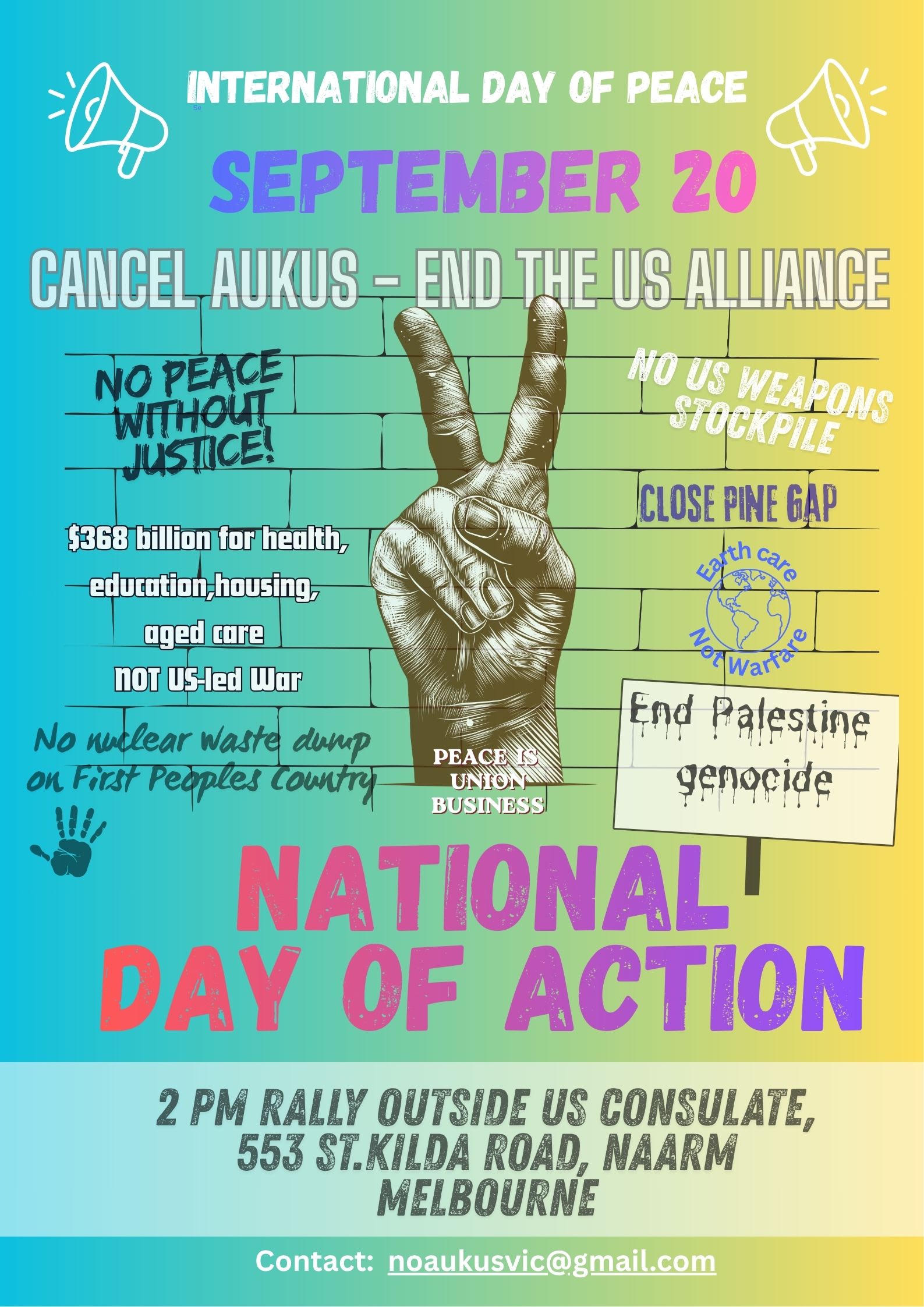
20 September –National Day of Action in Melbourne on the International Day of Peace

Help Aunty Sue Protect Her Land and Sacred Sites From Destructive Rocket Testing.
.

Australians deserve the truth
about
AUKUS – https://aukuspublicinquiry.com/


PETITION – To: Prime Minister Anthony Albanese and the Australian Labor Government

of the week – Australians for War Powers Reform (AWPR)
To see nuclear-related stories in greater depth and intensity
 Antinuclear