Scott Morrison, in the grip of fossil fuel lobby, is wrong about more gas for Australia
So, Scott Morrison, let’s come clean and let the public know that there’s no domestic case for increasing gas extraction. Given that gas extraction threatens landscapes and has a major problem with emissions, it’s better we leave it in the ground
The prime minister, Scott Morrison, surrounded by advisers out of the fossil fuel industry, is stuck in a time warp.
His claim that “there is no credible energy transition plan, for an economy like Australia in particular, that does not involve the greater use of gas as an important transition fuel” is demonstrably wrong. There are many. Continue reading
225 $billion for Australia’s submarine plan – a fleet of B-21 bombers would be better
|
Scrap submarines project before it’s too late says former public service boss, Michael West media, by Jon Stanford | Feb 3, 2020 Australia’s $225 billion SEA 1000 submarine project is so high risk, it would be better for Department of Defence to scrap it and start again, writes former public service chief, Jon Stanford, in the final instalment of his Second Rate Leadership series. In addition to some very serious problems with progress with the SEA 1000 program, there are some more fundamental questions to be addressed in the longer term. The first of these is whether the Attack class will embody the technologies required to be successful in its operations in the mid-2030s and beyond. In other words, will it be fit for purpose? An associated question is around the submarine’s cost effectiveness. The escalating cost of this acquisition means that the opportunity cost is also going up. With the submarines being designed mainly for joint operations with the US Navy, there are also significant risks in the future around whether a continuing US presence can be assumed.
In regard to the first question, it is very difficult to be able to judge whether the submarines will be fit for purpose if we do not know what that purpose is. Based on comments and submissions to Parliamentary inquiries from former Australian submariners we can be fairly confident that our submarines’ main area of operations (AO) is in the South China Sea, 3,500 nautical miles from base. But once there, we are not told what they do. In Australia at least, the missions the submarines undertake are classified….. ……..In addition, at a whole of life cost of $225 billion, this deterrent, such as it is, has a very high opportunity cost. Two former RAAF Chiefs have recently proposed that the ADF needs to acquire a long-range bomber force. Even if the new American B-21 bomber delivers only half the capability currently being spruiked, the early acquisition of two squadrons – 48 aircraft off the shelf – at a cost of around $50 billion looks an attractive power projection proposition. By comparison, the ability to put one conventional submarine on station “up threat” at any time at an acquisition cost of $80 billion, with associated doubts around its effectiveness and survivability, must be of questionable value………. |
|
Australia’s options for climate change action

 What is ‘real’ action on climate change? SMH , What form would greater climate change action take – and what would it cost? By Staff reporters
What does climate action actually mean?
Climate change action takes two forms: mitigation, which means reducing greenhouse gas emissions at a rate fast enough to prevent massive damage to our environment in the future; and adaptation, which means bracing and preparing for the changes that are happening and which will intensify.
Adapting to climate change is essential and there are many ways to do so, such as beefing up emergency services and strengthening farms and infrastructure against fires, storms and rising sea levels.
But the source of the problem is the rising emissions that are trapping heat in the atmosphere and oceans. In Australia, emissions come from electricity, industry, transport and agriculture as well as other sectors.
If we are serious about tackling climate change, we must reduce emissions faster than we are doing now. That’s the view of the world’s leading scientific bodies as well as the key expert bodies in Australia, including the CSIRO and the Australian Academy of Science. Their advice is clear: Australia needs to be close to carbon neutral by the middle of the century.
It would be nice to be able to flick a switch and change to zero emissions next week. In practice, decarbonising the nation will be a long, complex process.
The Garnaut Review, led by senior economist Ross Garnaut almost a decade ago, is still the most comprehensive assessment of Australia’s options for climate change action. It drew on leading Australian research on bushfire impacts to forecast an increase in bushfire danger by 2020. On our current trajectory, we are on track to see catastrophic fire days increase by 300 per cent by the second half of this century.
The review outlines various types of policy that can help cut emissions, both “carrots” and “sticks”. There are public subsidies, such as government funding for wind and solar farms; or special tariffs to pay householders with solar panels. Then there are systems for making polluters pay, such as a carbon price implemented through a carbon tax or an emissions trading scheme. There are also policies that rely on regulating an industry, such as the now-abandoned National Energy Guarantee policy, under which companies would be required by law to use a mix of different technologies.
Several types of policy can operate at the same time. Australia had a carbon price from 2012 to 2014 before it was repealed after a change of government. Currently, it has some direct subsidies for emissions reduction projects but no mechanism for cutting greenhouse gases at the speed required.
The Garnaut Review found – and other studies, including by the OECD and by the Australian National University, have since agreed – that a carbon price coupled with an emissions trading scheme and a cap on greenhouse gas emissions would be the most effective and efficient way of cutting emissions.
The Prime Minister, Scott Morrison, has ruled out a “carbon tax” or other action that would raise electricity prices or affect polluting industries. In the wake of the fires, Mr Morrison has flagged “resilience” and “adaptation” as the areas he wants to focus on……..
Australia currently has no mechanism for controlling its greenhouse gas emissions and may not meet its Paris commitments……. https://www.smh.com.au/national/what-is-real-action-on-climate-change-20200115-p53rok.html
Matt Canavan. Minister for Nuclear Promotion, announces nuclear waste dump for Kimba, South Australia
 This farce must be stopped. One white farmer offers his land for substantial gain. Aboriginal traditional group were denied a voice in this decision. Bribes given to the local white community looked attractive, but would nowhere near compensate for the loss of the area’s clean green image for agriculture.
|
SA nuclear waste dump rally site chosen, Canberra Times, Kathryn Bermingham, 1 Feb 2020,
A farming property on South Australia’s Eyre Peninsula will become a nuclear waste dump, the federal government has announced, as opponents of the facility make a last-bid ditch to stop it. Federal Resources Minister Matt Canavan on Saturday said 160 hectares of the Napandee property in Kimba would host Australia’s radioactive waste, the vast majority of which comes from the production of nuclear medicine and is held across more than 100 sites. “Napandee was volunteered by the landowner, is suitable from a technical perspective, and has broad community support from those who live and work nearby,” he said in a statement.
The site near the town of Kimba will store low-level waste permanently and intermediate-level waste temporarily. It will employ about 45 people and the government will gift the community a $31 million package.
A property at Lyndhurst, also near Kimba, had been in the running but Mr Canavan said the Napandee proposal had more support. “The facility has broad community support in Kimba but I acknowledge there remains opposition, particularly amongst the Barngarla People and their representative group,” he said. “We will work with traditional owners to protect culture and heritage, and to maximise economic opportunities and outcomes for local Aboriginal communities near the future facility.” Before the announcement, Peter Woolford, president of the No Radioactive Waste on Agricultural Land in Kimba or SA committee, said locals and visitors will rally against the project on Sunday. Mr Woolford says five years of consultation has taken its toll on the town and his group is calling on the federal government to abandon both sites. “The process the federal government has undertaken to find a location for this facility has been a long and arduous one for the Kimba community,” he said. “Matthew Canavan’s process has been arbitrary, completely lacking in clarity and an extremely divisive process. “It is time for him to acknowledge that the prerequisite of ‘broad community support’ does not exist in Kimba, and allow the community to move forward.” The dump is opposed by environmental and indigenous groups – but a recent poll conducted around Kimba returned a 62 per cent vote in favour of the facility.
“We’re always looking for ways to attract new industry and try and boost our local community. “This is one of those projects that is not only supplying us with jobs but with an opportunity to attract new industry.” The Department of Industry, Innovation and Science said it had provided a significant amount of material to inform the site decision. “The department has put the community at the centre of this process, which involved more than four years of deep consultation and technical assessments,” it said. Guest speakers at Sunday’s rally will include local Labor MP Eddie Hughes, Conservation Council of SA chief Craig Wilkins and Kimba farmers James Shepherdson and Tom Harris. https://www.canberratimes.com.au/story/6609008/sa-nuclear-waste-dump-rally-site-chosen/?cs=14231 |
|
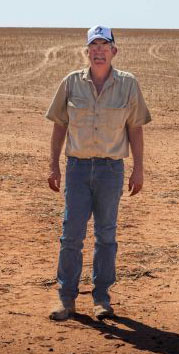
Nuclear waste dump on farming land? NOT A DONE DEAL!
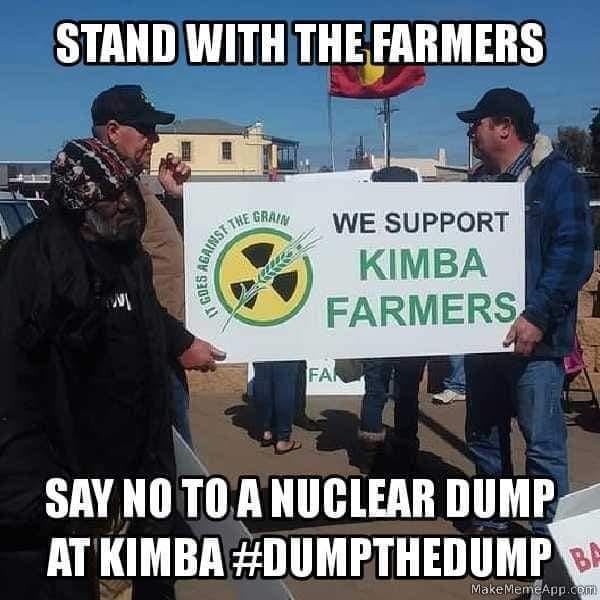
Barb Walker Fight To Stop A Nuclear Waste Dump In South Australia, 1 Feb 2020
THIS IS NOT A DONE DEAL!!! A site has been selected but the process is FAR FROM OVER!!!
The whole state of South Australia needs to get behind our KIMBA FARMERS and say, SOUTH AUSTRALIA IS TOO GOOD TO WASTE!!!
KIMBA IS PART OF A HUGE GRAIN GROWING FOOD BOWL – NOT A PLACE FOR A NUCLEAR WASTE DUMP!!!
Please come and join the bus-loads of people coming from all over the Eyre Peninsula and SA regions tomorrow: KIMBA RALLY tomorrow Sunday 2nd Feb, at 11am.
SAY NO TO A NUCLEAR WASTE DUMP IN KIMBA, SOUTH AUSTRALIA
Please contact South Australia’s Premier, Steven Marshall, and remind him that under our South Australian state legislation we have a PROHIBITION ACT AGAINST THE STORAGE OF NUCLEAR WASTE !!!
https://www.legislation.sa.gov.au/…/NUCLEAR%20WASTE…
LEGISLATION.SA.GOV.AU
South Australian Legislation https://www.facebook.com/groups/941313402573199
A questionable vagueness about the federal govt’s nuclear waste plan for Kimba
Mark Simpkin Fight To Stop A Nuclear Waste Dump In South Australia 1 Feb 2020, Once again smelly. Without fair balanced consultation with the community, disallowing all stockholders to participate in the ballot, there’s a questionable vagueness of what this dump will entail in terms of its storage of intermediate / high level waste.
 When Rowan Ramsay (Kimba’s local federal member) was interview by Peter Goers on ABC Radio, no indication of the proximity of Rowan Ramsey’s own land to the dump site, little mention that land owners can NAME THEIR OWN PRICE for the land with no government oversight .
Finally our own state Liberal government allowed this to run its course with full knowledge of our existing laws that were established to prevent this and to top it all, this announcement at a time when the countries attention and grief is for the bushfires speaks volumes of the nature and character of these individuals. Poor form. https://www.facebook.com/groups/941313402573199/
#ScottyFromMarketing is dodging the need for real action on climate change
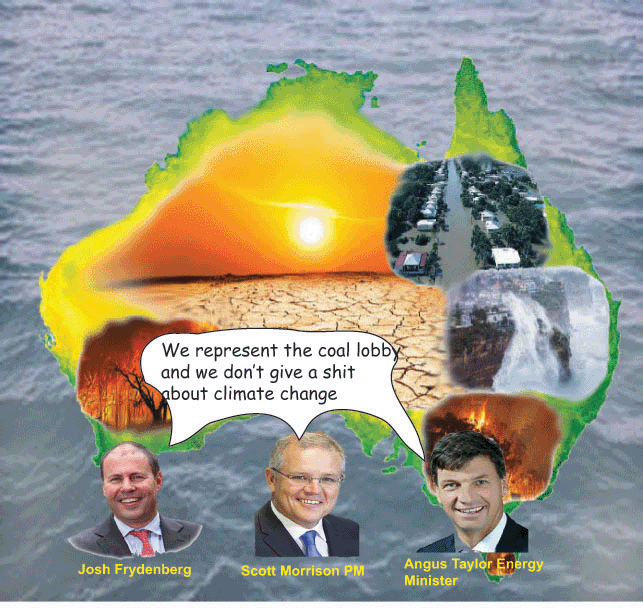
|
Climate change calls for action, not adaptation, SMH January 31, 2020 Judy Dillon, Garran ACT In the midst of our horrific summer, polls show the majority of people want to see urgent action on climate change, (”PM’s bushfire response must include climate change: experts”, January 30). We don’t want a focus on ”resilience and adaptation” or ”meeting and beating” pathetically low targets with the use of accounting tricks. Emissions are continuing to rise while the Morrison government uses weasel words to pretend they are doing something effective, all while handing billions to the fossil fuel industry.
The House of Representatives is scheduled to sit for a total of 72 days in 2020, so politicians have no time to lose. If they are not prepared to get on with the mammoth task of taking real and significant climate action in the interests of all Australians, and indeed the whole world, then they should get out of the way now so politicians who are so motivated can take their place. Quiet Australians have had enough – we will not be silent. –
– Peter Spencer, Castle Hill The PM is setting up an inquiry that avoids the real cause of of this and future bushfires – climate change. Once again, he gives the impression he is doing something when he is avoiding the real issue. Another opportunity wasted.
Adrian Owen, Killawarra , The PM now reluctantly concedes our continent is warming and drying. By saying the effects of the emissions already in the atmosphere will be felt for decades regardless of any action, he seeks to portray emissions mitigation as a lost cause. He must imagine the public will willingly surrender to warming beyond two degrees. His new focus on resilience and adaptation will lead to the absurd situation in which the coal industry will continue apace while federal government will spend money elsewhere to try to protect the rest of us from the ravages of a warming climate. –
– Mike Reddy, Vincentia After listening to Morrison talk about climate change action, I think his government is focused on hope. Hope that individuals keep putting solar panels up. Hope that the states keep pulling their weight. Hope that the rest of the world reduces its emissions. Hope that no one notices he is doing nothing. Hope that rising sea levels don’t swamp Waikiki.
Graham Lum, North Rocks Barilaro claims that Matt Kean’s comments on climate change are unhelpful and do not represent the whole of government. That may be so, but I suggest they do represent the views of the majority of Australians. -… https://www.smh.com.au/national/nsw/climate-change-calls-for-action-not-adaptation-20200129-p53vwp.html
|
|
Aboriginal peoples must be restored as custodians of Country
Research Fellow, University of Melbourne, January 31, 2020 In the wake of devastating bushfires across the country, and with the prospect of losing a billion animals and some entire species, transformational change is required in the way we interact with this land.Australia’s First Peoples have honed and employed holistic land management practices for thousand of generations. These practices are embedded in all aspects of our culture. They are so effective, so perfectly suited to this harshest of continents, that we are the oldest living culture in the world today.
A reintroduction of traditional land management is essential if we want to address the ecological crisis we now face.
Not just ‘consultants Continue reading
Dodgy #ScottyFromMarketing govt process for Kimba nuclear waste dump needs investigation
Inhumane treatment of Australian Julian Assange by UK government
 Julian Assange and the Inhumanity of the British State: ‘Unofficial’ Solitary Confinement as Torture 21st Century Wire, JANUARY 26, 2020 BY NINA CROSS
 Up until this week, Assange has been held in solitary confinement in Belmarsh prison. Incredibly, it was the other prisoners along with Assange’s legal team, who have pressured the government officials to respect the law and allow Assange to be removed from solitary confinement, resulting in his transfer to a general wing. This piece looks at how Assange was unofficially segregated in the prison’s healthcare unit, with no recourse to systems designed for prisoners in official solitary confinement regimes as applied under Prison Rule 45, leaving him out of reach of rules and law.
The sustained violation of the human rights of Wikileaks founder, Julian Assange, has been carried out in full view of the world throughout his arbitrary detention in HMP Belmarsh. Until now, condemnation of his treatment and pleas to end his suffering have been met with denial and silence by the British authorities.
But the announcement this week that Assange has been moved out of Belmarsh healthcare unit where he has been detained in solitary confinement since May, is a sign that the campaign to stop his persecution is gaining traction. Continue reading
Adaptation to bushfires might not be achievable without stronger action to curb emissions
 (Cartoon above, courtesy of Independent Australia and Mark David)
Australia is ‘ground zero’ in climate crisis and must show leadership, top researchers say https://www.theguardian.com/australia-news/2020/jan/29/australia-is-ground-zero-in-climate-crisis-and-must-show-leadership-top-researchers-say Lisa Cox, Wed 29 Jan 2020, Adaptation to bushfires might not be achievable without stronger action to curb emissions, letter warns, Lisa Cox Australia’s current position as “ground zero” for both the impacts of climate change and policy uncertainty presents an opportunity for the country to emerge as a leader in responding to the climate crisis, according to Australian Research Council laureates.
In a letter signed by 80 ARC laureate fellows, some of Australia’s top researchers said claims strong action to cut emissions would be economically destructive have no basis and are not “consistent with Australia’s traditional optimism and ingenuity, nor with historical experience”.
“Reducing emissions is a global challenge that requires collective action,” the letter said.
“But Australia’s current visibility as ground zero for both climate impacts and climate policy uncertainty presents a unique opportunity for us to emerge as a leader on this challenge.”
The ARC laureate fellows are a small group of researchers selected by the ARC as the top researchers across all fields in Australia.
The letter, whose signatories include decorated academics in mathematics, science, economics, and language and culture, said the government’s focus on adapting to changed fire patterns “is not enough”.
It was written as the country’s unprecedented bushfire season continues, with emergency warnings in place on Tuesday for a fire burning in the Namadgi national park near Canberra.
“We welcome government actions to help current victims and improve adaptation to future fires, as well as its acceptance of a role for climate change in the catastrophe,” the letter said.
“But this is not enough, because the greenhouse gas amounts driving warming are still rising: the world is only at the beginning of the climate change phenomenon.”
The bushfire emergency has brought the Coalition government’s climate policies into sharp focus.
The prime minister, Scott Morrison, was criticised for his handling of the crisis through Christmas and early January, and for his failure to meet with former emergency chiefs who warned of the coming catastrophe last year.
Morrison said this month that the government’s response to the increasingly visible effects of the climate crisis would be to address “adaptation and resilience” rather than strengthening policies to reduce emissions.
But the letter warns that without stronger action to curb emissions, the impacts of further temperature rises could be such that adaptation is not achievable.
“This dire outlook demands stronger mitigation of carbon emissions,” it said.
“Many argue that actions to achieve this would be economically destructive. This claim has no basis, nor is it consistent with Australia’s traditional optimism and ingenuity, nor with historical experience.”
They wrote that achieving net zero emissions was a large but achievable task, and “far less risky and irresponsible” than allowing continued global heating.
Australia faced international criticism as one of a handful of countries at the United Nations climate conference in Madrid in December that were responsible for thwarting a deal on the rulebook for the Paris climate agreement.
Australia is the only country that plans to use carryover credits from the Kyoto period to meet its targets under the Paris agreement.
Six legal arguments against the extradition of Julian Assange to America
Six legal arguments show why the US extradition of Julian Assange should be denied https://www.thecanary.co/uk/analysis/2020/01/25/six-legal-arguments-show-why-the-us-extradition-of-julian-assange-should-be-denied/ Tom Coburg 25th January 2020 The first of two articles examining Julian Assange’s upcoming extradition trial.
There are at least six legal reasons why the extradition request by the US against WikiLeaks founder Julian Assange should be dismissed by the UK courts. The main extradition hearing is scheduled to commence 24 February 2020, with district judge Vanessa Baraitser presiding. The evidence to support Assange is compelling.
1. Client-lawyer confidentiality breached
2. The initial charge is flawed
1. Client-lawyer confidentiality breached
3. Initial charge relies on co-operation from Manning
4. Additional charges raised by the US are political
5. US legal precedent argues that Assange’s work is protected by the US Constitution
6. Threats of violence against Assange mean he’s unable to receive a fair trial
1. Client-lawyer confidentiality breached Continue reading
Uranium prospects poor, but Indigenous Australians Minister Ken Wyatt and Northern Land Council agree on a new mine
|
NT uranium and gold mine exploration a step closer at Devil’s Elbow near Ranger Mine https://mobile.abc.net.au/news/2020-01-25/ken-wyatt-approves-new-nt-uranium-mine-exploration/11896844 BY FELICITY JAMES Traditional owners and the Indigenous Australians Minister Ken Wyatt have signed off on a new exploration proposal for a uranium, gold and palladium mine in the Northern Territory.Key points:
Traditional owners fought hard against the Ranger Uranium Mine in the Northern Territory.
The Eclipse Metals project still needs approval from the NT Resources Minister but the company said in an ASX announcement it was confident approval would be granted. The site earmarked for exploration, known as Devil’s Elbow, is within Arnhem Land’s Alligator Rivers Uranium Field and lies 65 kilometres east of the Ranger Uranium Mine. The area has previously been explored and abandoned by other companies, including Cameco in 2008. Rio Tinto withdrew from a joint venture to acquire a majority stake in Devil’s Elbow, according to Eclipse Metals’ most recent annual report. The deal had been negotiated in 2016. In its announcement, Eclipse Metals said Mr Wyatt consented to the licence after a “long-standing” negotiation with the Northern Land Council and traditional owners resulted in an agreement. “The terms of the agreement are quite viable in the current market economy, allowing us to develop the Devil’s Elbow’s full potential,” director Carl Popal said in the statement. “The company looks forward to working closely with the traditional owners and the NLC in making the most of each exploration field from 2020, with bilateral benefits.” Scientist says venture may not be worthwhileThe supervising scientist branch of the Environment Department is responsible for protecting the Alligator Rivers region from the effects of uranium mining through monitoring and research. Gavin Mudd, an associate professor of environmental engineering at RMIT University who sits on the Alligator Rivers scientific committee, assists with this role. Associate Professor Mudd was sceptical about the proposal, considering market conditions and the fact the region has already been heavily explored for more than 60 years. “Sometimes you find something that other drillers and other explorers have missed, but often that’s not the case, it’s actually pretty rare,” he said. “There’s not a long-term prospect there. “I think when you’re looking at the uranium industry globally the future is not bright at all, that’s certainly how I read the tea leaves.” Associate Professor Mudd was sceptical about the proposal, considering market conditions and the fact the region has already been heavily explored for more than 60 years. “Sometimes you find something that other drillers and other explorers have missed, but often that’s not the case, it’s actually pretty rare,” he said. “There’s not a long-term prospect there. “I think when you’re looking at the uranium industry globally the future is not bright at all, that’s certainly how I read the tea leaves.”
But Associate Professor Mudd said Rio Tinto deserved some credit for committing funds to the rehabilitation of Ranger. “They haven’t just walked away, which is often what you would see a mining company do when you’ve got a mine that’s not making money anymore,” he said. |
|
Names of 34 environmentalists and conservationists who received Australia Day Awards
 Australia Day Honours, Maelor Himbury, 27 Jan 2020
Congratulations to the following people who received honours for contributions to the environment and/or conservation. (Apologies to any I may have missed)
Raymond Louis Specht, St Lucia QLD
Elaine Cafferty Carbines, Grovedale VIC
Graham John Faichney, Mosman NSW
David Ronald Leece, Beecroft NSW
Grant Donald Hunt, Isle of Capri QLD
Roderick Tucker Wells, Flagstaff Hill SA
Dedee Daryl Woodside, Umina Beach NSW
Graeme Leonard Worboys, Gilmore ACT
Maree Rosalie Byrne, Bowral NSW
Judith Anne Charnaud, Warriewood NSW
Fred Conway, QLD
Elizabeth Corke, VIC
Daryl James Akers, Melton South VIC
Eulalie Perry Brewster, Inverloch VIC
Raymond Brown, Bulli NSW
Leif Robert Cocks, Willagee WA
Brian Stuart Blythe, Portsea VIC
Marie Ann Ficcara, Cronulla NSW
Peter John Forster, Anglesea VIC
Sherryl Maree Garbutt, Brunswick VIC
Mary Julia Hutton, Stirling WA
William David Incoll, Monbulk VIC
Bronwen Jean Keichery, Subiaco WA
Gregory John Keichery, Subiaco WA
Diana Betty Laube, Tiatukia SA
Sarah Jane Lloyd, Birralee TAS
Peter Phillip Gash, Lady Elliott Island QLD
Lloyd Alwyn Nielsen, Mount Molloy QLD
Catherine Marie-Claire Oelrichs, Coopers Shoot NSW
Margaret Owen, Wembley WA
Carl John Rayner, Anglesea VIC
John Stanisic, Albany Creek QLD
Beverley Jean Weaver, Nundah QLD
Bruce Anthony Wilson, Seacliff Park SA
In Australia, legal action over climate change is on the rise
A class action might be out of the question but climate change litigation, at least against companies, is on the rise.
Australia has so far had the second-highest number of climate cases globally after the United States and the nation’s financial regulators have been warning about an increase of litigation for years now.
On top of that, in 2016 a legal opinion by Noel Hutley QC and Sebastian Hartford-Davis identified climate change as a material financial risk to businesses. As a result, Australian company directors might be legally obliged to consider and report on the risks.

|
Climate activists and lawyers itching to sue Australia government, https://thenewdaily.com.au/news/2020/01/25/climate-change-class-action/ Cait Kelly
As Australia experiences the worst bushfire season on record there are growing calls for a class action against the federal government for the lacklustre response to climate change. Emboldened by a recent case in the Netherlands where citizens successfully mounted a class action against their government for its failure to act on the climate crisis, there are mounting calls to do the same here. One change.org.au petition to rally support for a class action has received more than 63,000 signatures. “The government has failed to increase its emissions targets,” it reads. “Failed to increase the renewable energy target and failed the people of Australia. “We are now witnessing the effects of the climate emergency first hand, and still the government sits on its hands.” But mounting a class action against the government over the issue is “uncharted territory” and highly complicated, said Australian Lawyers Alliance’s Greg Barns. “There is certainly a strong and compelling moral argument that government inaction, in the face of uncontradicted expert evidence warning about the increased risk of number or, and magnitude of fires, should compel it to pay compensation to those impacted by the fires,” he told The New Daily. One argument thrown around for a class action is the historical precedent taken after Black Saturday fires in which 173 people died. Continue reading |
1 This month.
20 September –National Day of Action in Melbourne on the International Day of Peace


Help Aunty Sue Protect Her Land and Sacred Sites From Destructive Rocket Testing.
.

Australians deserve the truth
about
AUKUS – https://aukuspublicinquiry.com/

PETITION – To: Prime Minister Anthony Albanese and the Australian Labor Government

of the week – Australians for War Powers Reform (AWPR)
To see nuclear-related stories in greater depth and intensity
 Antinuclear