Australia’s $multi-billion climate whammy: Ross Garnaut was right
|
Ross Garnaut’s climate change prediction is coming true and it’s going to cost Australia billions, experts warn, ABC News,
By business reporter Nassim Khadem 8 Jan 2020,Twelve years ago, economist Ross Garnaut made a prophecy that has devastatingly come true.
Key points:
In the 2008 Garnaut Climate Change Review, which examined the scientific evidence around the impacts of climate change on Australia and its economy, he predicted that without adequate action, the nation would face a more frequent and intense fire season by 2020. Speaking to the ABC about the latest bushfires and the potential economic fallout, Professor Garnaut refrained from taking a direct shot at policymakers who ignored many of the review’s calls for action. But he noted: “If you ignore the science when you build a bridge, the bridge falls down.”
The initial damage bill from Australian bushfires that began in September has risen to $700 million, according to Insurance Council of Australia estimates, and is likely to grow. ICA’s Campbell Fuller told ABC News that 1,838 homes have been destroyed across Australia since September and there have been 8,985 insurance claims for fire-related damage and destruction. But insured losses are just a small part of wider economic losses. The total cost of the 2009 Black Saturday bushfires was estimated at $4.4 billion. Conservative estimates put the final cost of the current Australian bushfires well into billions of dollars, while some analysts say it could cost the economy $20 billion in lost output. Economist says cost could hit $3.5 billionThe head of economic analysis at SGS Economics and Planning, Terry Rawnsley, has done some early estimates on the economic cost of the bushfires. Based on previous modelling of the Tathra fires in 2018, and taking account of $700 million worth of insured losses, the economic fallout from the latest fires could be as high as $3.5 billion, he said. Between $2 billion to $3 billion includes the direct costs to fire-affected regions such as the loss of tourism and retail income, and the impact on agricultural production. He predicts that some of the worst-affected communities will never fully recover. And smoke haze in major capital cities could be an additional $500 million drag on the economy. “These are places not directly impacted by bushfires, but people aren’t out and about, and people are calling in sick with respiratory and asthma illnesses,” he said. Mr Rawnsley said while SGS Economics had modelled the loss of income from livestock such as sheep and cattle being destroyed, it had not modelled the actual loss of the assets (the loss of the sheep and cattle itself). Professor Tom Kompas, one of three chief investigators in the Centre of Excellence for Biosecurity Risk Analysis (CEBRA) at the University of Melbourne, said the economic cost of the bushfires would be “massive”. He said he intended to do precise modelling on the impact later this month. His earlier research on economic impacts of climate change had predicted $1.2 trillion in cumulative damages from now to 2050 assuming a global temperature increase of 3.8-4C by 2100. But the $1.2 trillion in losses looks at infrastructure lost due to sea-level rise, losses in agricultural and labour productivity and limited human health and biodiversity impacts. “It does not include the cost of bushfires on infrastructure and resulting increases in insurance premiums,” he said. “It also does not include damages from human health effects due to pollution and smoke-related illnesses, losses in tourism, losses to major environmental assets … or the costs of emergency management, recovery and relocation.” Estimated $20 billion could be wiped off GDPAMP Capital chief economist Shane Oliver estimated a reduction of between 0.25 and 1 per cent in the level of national economic output as a result of the fires, which he forecast would show up mostly in the March quarter. Based on Australia’s gross domestic product (GDP) of about $2 trillion, a 1 per cent drag could equate to about $20 billion. Still, even a lesser 0.25 per cent hit would be a major drag on economic growth, in an already slowing economy.
Everyone would pay to some degree via higher premiums as insurance claims spiked, he said…….. https://www.abc.net.au/news/2020-01-08/economic-bushfires-billions-ross-garnaut-climate-change/11848388 |
|
Australia just had its hottest, driest, year on record: Bureau of Meteorology

The BoM made the call as part of its Annual Climate Statement, presented on Thursday morning, calling last year our hottest year with a mean temperature of 1.52 degrees Celsius above average.
Australia’s national average rainfall total was just 277mm – the lowest recorded ever.
“For maximum temperatures, it was a larger departure. It was plus two degrees. So that is the first time we have seen an anomaly that’s two degrees above average and about half a degree warmer than the previous record,” he said.
“We also saw the six hottest days on record peaking at 41.9 and that is temperature averaged over the whole continent.
“I think we saw 11 such days where the national daily temperature went over 40 degrees this summer and that is really quite stark.”
Nation-wide, Australia is experiencing catastrophic bushfires conditions with dangerous blazes burning in New South Wales, Victoria and South Australia.
The BoM report said the link between the fires and record low rainfall and increased temperatures was clear. We were lucky last summer that we didn’t get the sort of fire activity that we’ve seen this year. But this year we weren’t so lucky,” Dr Braganza said.
The report also revealed that evidence pointing to the unprecedented duration of this season’s bushfire became clear two years ago.
“So certainly the combination of extended drought, very low soil moistures in some regions, drier fuels, higher temperatures on most of the outlooks and no meaningful rainfall meant that we had quite early indications that the fire season was likely to be, or include, quite frequent severe fire weather,” Dr Braganza said.
The National Farmers’ Federation said the record warm temperatures are severely impacting the livelihoods of farmers. ……
While it is still early in the new year, Dr Braganza said it is unlikely the weather conditions are going to improve.
“There’s nothing really indicating things will cool down too much over the next few months. We are starting to see some signs that the monsoon is starting to get active.
“At this point I think I’d optimistically say less dry rather than wet if that makes sense so I don’t think we’re seeing an indication that we’ll see significant above-average rainfall.”
He said the science is clear on a link between a warming climate and Australia’s bushfire season over the years.
University students for the Climate Justice group are set to protest on Friday to demand more action on climate change as the country continues to battle dangerous bushfire conditions. HTTPS://WWW.SBS.COM.AU/NEWS/AUSTRALIA-HAS-OFFICIALLY-RECORDED-ITS-WARMEST-DRIEST-YEAR-ON-RECORD-BOM
Murdoch media and climate change denial
 How Rupert Murdoch Is Influencing Australia’s Bushfire Debate, Critics see a concerted effort to shift blame, protect conservative leaders and divert attention from climate change. NYT By Damien Cave, Jan. 8, 2020 WOMBEYAN CAVES, Australia — Deep in the burning forests south of Sydney this week, volunteer firefighters were clearing a track through the woods, hoping to hold back a nearby blaze, when one of them shouted over the crunching of bulldozers.
|
Climate scientists do acknowledge that there is room for improvement when it comes to burning the branches and dead trees on the ground that can fuel fires. But they also say that no amount of preventive burning will offset the impact of rising temperatures that accelerate evaporation, dry out land and make already-arid Australia a tinderbox.Even fire officials report that most of the off-season burns they want to do are hindered not by land-use laws but by weather — including the lengthier fire season and more extreme precipitation in winter that scientists attribute to climate change……. “Leaders should be held to account and they should be held to account by the media,” said Penny D. Sackett, a physicist, astronomer and former chief scientist for Australia……. https://www.nytimes.com/2020/01/08/world/australia/fires-murdoch-disinformation.html?auth=login-facebook&fbclid=IwAR3HGR6KpEAxoU55izrFtdg9O1RUqVF2LtcjHttj8hiHuDJx77RzH_XOarY&smid=fb-nytimes&smtyp=cur |
|
Independent MP Zali Steggall calls on modern Liberals to support her proposed climate change bill
 Zali Steggall urges ‘modern Liberals’ to support her proposed climate change bill: independent MP plans a ‘people-powered’ public campaign for a conscience vote similar to the one for same-sex marriage, Sarah Martin Chief political correspondent, Wed 8 Jan 2020 The independent MP Zali Steggall is calling on self-styled “modern Liberals” to support legislation to establish a new climate change framework, warning them to ignore the views of their constituents “at their peril”.
Steggall, who toppled Tony Abbott in the Sydney seat of Warringah at the May 2019 election, largely on a platform of climate change action, is finalising draft legislation for a “national climate change framework” that sets out a roadmap for Australia to transition to a decarbonised economy.
The legislation is modelled on the UK’s Climate Change Act, passed in 2008, and mirrors framework laws in place in New Zealand and Ireland. Germany and Fiji are considering similar draft legislation.
Steggall aims to begin consultation on the draft bill later this month, and wants to introduce legislation in March, backed by a public campaign calling for a conscience vote in parliament.
Steggall would not reveal full details of the planned public campaign, but said she hoped it would be a similar “people-powered” movement to the same-sex marriage campaign that successfully galvanised support for a yes vote.
Steggall has already begun talking to other independents about the legislation.
In 2008, the Garnaut Climate Change Review predicted this bushfire situation
|
How a climate change study from 12 years ago warned of this horror bushfire season, In 2008, the Garnaut Climate Change Review said Australia would face a more dangerous fire season by 2020. https://www.sbs.com.au/news/how-a-climate-change-study-from-12-years-ago-warned-of-this-horror-bushfire-season– 6 Dec 2020, BY NICK BAKER As the nation’s horror bushfire season shows no sign of abating, a landmark 2008 report that warned of these looming conditions is once again in the spotlight.
Twelve years ago, economist Ross Garnaut led an independent study of the impacts of climate change on the Australian economy. The Garnaut Climate Change Review’s final report said projections of fire weather “suggest that fire seasons will start earlier, end slightly later, and generally be more intense”. “This effect increases over time, but should be directly observable by 2020.” Broadly, the report stated, “the weight of scientific evidence tells us that Australians are facing risks of damaging climate change”. “The risk can be substantially reduced by strong, effective and early action by all major economies. Australia will need to play its full proportionate part in global action. As one of the developed countries, its full part will be relatively large, and involve major early changes to established economic structure.” One of the report’s key recommendations was the implementation of an emissions trading scheme. Conditions ‘will keep on getting worse’On Monday, SBS News asked Mr Garnaut his reaction to the current conditions, in light of the 2008 report. “It’s one of sadness, that I was ineffective. Having been given the opportunity to talk to Australians on this issue, that I was ineffective in persuading Australians that it was in our national interest to play a positive role in a global effort to mitigate the effects of climate change,” he said. However, Mr Garnaut said, “although things are bad, they will keep on getting worse if the concentrations of greenhouse gas emissions in the atmosphere keep increasing”. The report said there could be a 300 per cent increase in the number of days with extreme fire weather by 2067. “It’s in the interest of the whole of humanity that we move promptly towards zero net emissions,” he said. However, Mr Garnaut said, “although things are bad, they will keep on getting worse if the concentrations of greenhouse gas emissions in the atmosphere keep increasing”. The report said there could be a 300 per cent increase in the number of days with extreme fire weather by 2067. “It’s in the interest of the whole of humanity that we move promptly towards zero net emissions,” he said. ‘What will our government do?’Over the weekend, a number of social media users in Australia started sharing the bushfire passage of the 2008 report, as fires raged across the country. ….. ‘What will our government do?’Over the weekend, a number of social media users in Australia started sharing the bushfire passage of the 2008 report, as fires raged across the country. The Rudd government accepted a number of key findings of the report including, “that a fair and effective global agreement delivering deep cuts in emissions consistent with stabilising concentrations of greenhouse gases at around 450 parts per million or lower would be in Australia’s interests”. But climate change policy went on to become both a divisive and defining issue in Australian politics in the years ahead. Mr Rudd tried but failed to pass an emissions trading scheme. A carbon tax was passed under his successor Julia Gillard but it was later overturned by then-Prime Minister Tony Abbott. Australia committed to the Paris Agreement under Mr Abbott but the Coalition has seen sustained criticism that it is not doing enough to curb climate change. |
|
Malcolm Turnbull blasts government’s ‘right-wing’ over energy policy sabotage
Former Prime Minister Malcolm Turnbull has blasted the “right wing” of the Morrison federal government for bringing down his signature energy policy, calling for it to be “reinstated now”.
On Monday, a Twitter user challenged Mr Turnbull for only “calling for coherent energy policies now [he’s] out of government”
The former PM responded by defending his proposed National Energy Guarantee (NEG), which faced opposition in government ranks and was later ditched.
“The National Energy Guarantee was a coherent integration of climate and energy policy,” he tweeted.
“It was sabotaged by the right-wing of the Coalition and their supporters in the media and coal lobby and finally abandoned by Morrison Government. It should be reinstated now.”
The policy was intended to deal with rising energy prices as well as cutting emissions.
Mr Turnbull was later dumped as the leader and his successor Scott Morrison announced the NEG “is dead”…… https://www.sbs.com.au/news/malcolm-turnbull-blasts-government-s-right-wing-over-energy-policy-sabotage
Liberal former Foreign Minister Julie Bishop calls for Australia to show leadership on climate change
Julie Bishop says Australia must show leadership on climate change, SMH By Megan Gorrey, Former foreign minister Julie Bishop says Australia needs to show global leadership on climate change by putting forward a “coherent energy policy” in response to the nation’s bushfire crisis.
Amid growing international criticism of Prime Minister Scott Morrison’s climate change policies as fires burn across six states, Ms Bishop said on Monday other countries looked to Australia for “direction, guidance and leadership”.
“Australia is a highly developed country,” Ms Bishop said in an interview on Nine’s Today show. “We should be showing leadership on the issue of climate change.”
“We don’t have a national energy policy in this country and a national approach to climate change so we are part of a global effort.
“If a country like Australia fails to show leadership, we can hardly blame other nations for not likewise showing leadership in this area.”
Australia should be putting forward “a cogent, a cogent, coherent case for an energy policy” at international conferences, Ms Bishop said…….
Ms Bishop said at the gathering of prominent Liberal figures before Christmas that Mr Morrison was “testing the theory that the best way to resolve a crisis is to be as far away from it as possible”. …..
Greens leader Richard Di Natale told ABC Radio on Monday the bushfires “should be a wake-up call to every single member of the political establishment in Australia”.
“The reality is we’ve had a prime minister who has chosen to effectively work as a lobbyist for the coal industry at a time when he should have been keeping Australians safe.”
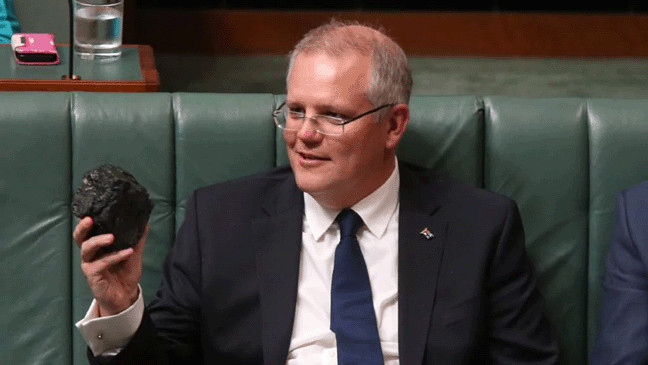
Greens leader Richard Di Natale told ABC Radio on Monday the bushfires “should be a wake-up call to every single member of the political establishment in Australia”.
“The reality is we’ve had a prime minister who has chosen to effectively work as a lobbyist for the coal industry at a time when he should have been keeping Australians safe.” https://www.smh.com.au/national/nsw/julie-bishop-says-australia-must-show-leadership-on-climate-change-20200106-p53p48.html
Mega fire set to form as ‘frustrated’ authorities plead with ‘stubborn’ residents
 Mega fire set to form as ‘frustrated’ authorities plead with ‘stubborn’ residents— Yahoo News 6 Jan 2020
Residents in Victoria have been told a giant 180,000 hectare fire will join with out-of-control fires across the border in NSW to create a ‘mega fire’.
Exhausted firefighters worked tirelessly to contain the bushfires throughout the weekend but a powerful and volatile southerly on Saturday quickly stretched the blazes, with the fires edging closer to each other throughout Sunday.
And while rain has brought a brief period or respite, residents were told at a CFA meeting in Tallangatta on Sunday night it is only a matter of time before the Corryong fire connects with the huge 297,000-hectare Dunns Road fire around the Snowy Mountains, the ABC reported…….
‘Uncharted territory’ for NSW
Ms Berejiklian labelled the ongoing threat “uncharted territory” with hundreds of homes feared lost across southern NSW.
“We can’t pretend this is something we have experienced before – it’s not,” she told reporters on Sunday.
At 6am, there were 136 fires burning across NSW, with 69 uncontained.https://au.news.yahoo.com/mega-blaze-forming-nsw-victoria-border-500000-hectares-213253196.html
Guardian’s latest updates on fires
Australia fires live: NSW and Victoria bushfires heap pressure on Scott Morrison – latest updates, Guardian 6 Jan 2020
The PM’s handling of the Australian bushfire crisis comes under further scrutiny as NSW and Victorian towns gain brief reprieve from fires. Follow the latest news and live updates
The impact the bushfire emergency is having on our First Nations people is required reading as well.
From Lorena Allam:
For First Nations people the bushfires bring a particular grief, burning what makes us who we are ……
Not only is the bushfire disaster devastating for Australia: it’s bad for its image, too
 ‘People aren’t stupid’: bushfire crisis scorches Australia’s image, The Age, By Andrew Taylor, January 5, 2020 A photo of a kangaroo leaping across the pages of British newspapers is the sort of free publicity that tourism authorities usually crave.
Except the animal was another victim of the months-long bushfire crisis, fleeing as flames engulfed a house at Lake Conjola on the NSW South Coast.
Another photo of two German tourists wearing surgical masks against a backdrop of the Sydney Opera House and Harbour Bridge published in the Financial Times last month under the headline “Wildfire smoke endangers lives and Sydney outdoor lifestyle” is likewise the sort of coverage money would not want to buy.
Apocalyptic images of tourists sheltering in water as flames threatened the Victorian seaside town of Mallacoota or stranded on beaches on the NSW South Coast have also featured across television screens, newspapers and news websites around the world.
They provided a stark contrast to Sydney’s New Year’s Eve fireworks, which went ahead despite calls for the event to be cancelled.
Images of terrified tourists, fire-devastated communities and distressed wildlife are also a far cry from the idyllic beaches and landscapes in Tourism Australia’s new $15 million tourism campaign targeting the British market…….
The vitriolic debate over climate change was also at odds with Australia’s claim to be laid back and friendly, Mr Derwin said. “Our reputation as a tourist destination would be greatly enhanced by taking leadership on climate change, and showing the world that we’re serious about protecting our natural habitats.”
The hazards of nuclear wastes, radioactive particles travel in smoke
Paul Waldon Fight To Stop A Nuclear Waste Dump In South Australia, 4 Jan 2020A morning smoke filled wake up call. Where smoke can go, so can radiation. Smoke is an efficient and effective host for the spread of radioactive particles, just think 2, yes two grams of cesium 137 made into micro particles (the size of a 5 cent piece) and spread as a smoke or gas over an area the size of Adelaide’s CBD would make that such area a radiation exclusion zone for a long time. Australia has a high grade nuclear waste dump at Lucas Heights and it will remain there 10 years or more after the closure of the ANSTO installation, we do not need another radioactive dump. Like a fire, one atomic dump is better than two, two dumps multiply the risks, costs and resources dealing with the hazards of nuclear translocation over 1700 kilometers. https://www.facebook.com/groups/941313402573199/ |
|
Scott Morrison’s condescending call for “patience” and “calm” on bushfires and climate change
There may now be so much heat trapped in the system that we may have already triggered a domino effect that could unleash a cascade of abrupt changes that will continue to play out in the years and decades to come.
I single out our political leaders because the rest of the country is already leading the way.
The scientific community has been trying to warn the government of the need to plan to adapt to climate change for at least a decade.
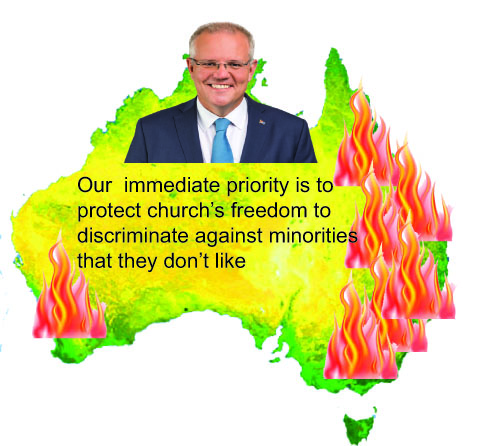 As a climate scientist I find prime minster Scott Morrison’s request for people to be “patient” as infuriating as it is condescending. With respect prime minster, the science of climate change has been ignored in this country for decades. We are now seeing the very worst of our scientific predictions come to pass.
|
We are seeing the very worst of our scientific predictions come to pass
 in these bushfires, https://www.theguardian.com/commentisfree/2020/jan/03/we-are-seeing-the-very-worst-of-our-scientific-predictions-come-to-pass-in-these-bushfires Joëlle Gergis As a climate scientist I am wondering if the Earth system has now breached a tipping point in these bushfires, https://www.theguardian.com/commentisfree/2020/jan/03/we-are-seeing-the-very-worst-of-our-scientific-predictions-come-to-pass-in-these-bushfires Joëlle Gergis As a climate scientist I am wondering if the Earth system has now breached a tipping point
Fri 3 Jan 2020 I had goosebumps watching surreal footage of the mass evacuation of people stranded on the south-east Australian coast. Once again, catastrophic bushfire conditions are bearing down on communities during increasingly horrific summers in Australia. It has been an unprecedented continuation of the horrendous bushfires that started as early as spring in south-east Queensland and northern New South Wales. As I write this, the Australian navy is evacuating over 800 people from the bushfire ravaged town of Mallacoota in eastern Victoria. Holiday makers are being forced to abandon their cars, complete with kids’ bikes strapped to the roof racks, ice melting in Eskies. People hoping for a carefree break over the new year are instead faced with the extraordinary position of having to flee for their lives. Currently, there are tens of thousands of people in coastal NSW and Victoria stranded in towns where the highways are closed, supermarkets are running out of food, and queues for petrol snake down the streets of devastated towns. The scenes experienced by those caught up in the ordeal are being described as apocalyptic – rightly so. Meanwhile, the locals face the infinitely more serious situation of returning to find their homes completely incinerated. Cars melted, pets killed, beloved landscapes destroyed. A lifetime of memories razed to the ground. As Australia’s climate continues to warm, the most intimate places of human safety – our very homes – are being threatened in an increasingly dangerous world. It’s confronting to see military evacuations, usually reserved for developing regions of the world following natural disasters, happening right here in 21st-century Australia. The sheer scale and severity of the emergency has actually overwhelmed our capacity as a nation to deal with the unfolding events. Not just in one area following a single event, but across multiple disasters occurring simultaneously in every state and territory of our nation. To avoid sounding like a broken record, instead I will say that as a lead author on the forthcoming Intergovernmental Panel on Climate Change’s (IPCC) Sixth Assessment report of the global climate due out next year, I can assure you that the planetary situation is extremely dire. Continue reading |
Australian bushfires latest
|
Australian bushfires latest: NSW, Victoria, South Australia and Tasmania face terrifying weekend Examiner, 4 Jan 2020, Authorities have warned of a day like no other – with major concerns consuming emergency services across a number of states.
The NSW RFS wants people to evacuate from five large areas; the military leading the safety operation in Mallacoota after a tragic day in Victoria; emergency warnings in place in South Australia and fears of a worse to come in Tasmania. Forecasters have predicted temperatures in the mid-40s on Saturday for some parts of south-east Australia. The fire danger will be increased by strong winds.
What you need to know:
Please allow the blog a moment to load. ……..https://www.examiner.com.au/story/6565877/all-the-bushfire-updates-from-across-australia-live/?cs=95
 |
|
Kimba nuclear waste ballot – a one-sided exercise by the Australian government
 Peter Remta No Nuclear Waste Dump Anywhere in South Australia, 4 Jan 2020 I have just watched the video presentation by Kim Mavromatis and am horrified and saddened to see very sincere and hardworking people in tears over what is being imposed on their region by the federal government
In all my seventy years in Australia (I as eight years old when I arrived from Europe with my parents) I have never seen or imagined anything like this before and am extremely moved by what can be so easily cured
Having been a lawyer for most of my life and an unabashed admirer of our constitutional and administrative form of government providing stability and freedom with hardly any corruption which makes us the envy of the rest of the world I never imagined what has been done to the Kimba community under the guise of proper public administration was even remotely possible
Perhaps the foremost concern I have is that the ballots to determine the community’s acceptance of the nuclear waste facility at Kimba were carried out as a completely one-sided exercise by the government with no opportunity for any proper explanation or opposing views as would at the very least be required by natural justice which is always referred to by politicians in a most revered manner
Let me quickly say that my comments are not based on my involvement with the Azark Project at Leonora for the disposal of nuclear waste by underground burial but are motivated solely by the injustice of the situation as shown by the video and which may be accepted fare in other countries
After all it was that type of government that my parents were escaping for the freedom and security of Australia which regrettably is not exemplified in the video https://www.facebook.com/groups/1314655315214929/
Morrison’s Aussie ocker, very religious, fans won’t care, but he’s not popular globally
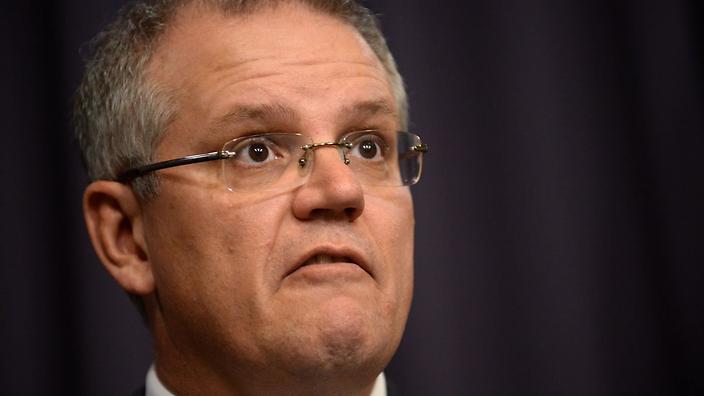 From Bernie Sanders to Bette Midler: The world reacts to the bushfires, SBS , 4 Jan 2020, Figures from across the globe are weighing in on Australia’s bushfire crisis, with many directing criticism at Prime Minister Scott Morrison.The world has taken to social media to express horror and condolences for those affected by the Australian bushfires. From Bernie Sanders to Bette Midler: The world reacts to the bushfires, SBS , 4 Jan 2020, Figures from across the globe are weighing in on Australia’s bushfire crisis, with many directing criticism at Prime Minister Scott Morrison.The world has taken to social media to express horror and condolences for those affected by the Australian bushfires.Personalities across the political spectrum, from legislators to entertainers have used various platforms to react to the “unfathomable loss and destruction”. At least 19 people have died and more than 1400 homes have been destroyed this fire season as flames leave their mark on more than five million hectares. Many observers have made the connection between Australia’s bushfires and climate change. Former Democratic presidential nominee Hillary Clinton said, “with Australia on fire and the Arctic in meltdown, it’s clear we’re in a climate emergency”…. Fellow high-profile Democrat and climate campaigner Al Gore made a similar point, saying “the bushfires in Australia represent a startling climate catastrophe unfolding before us”.
Among the risks of the climate crisis is a normalization of its horrific and deadly consequences. The bushfires in Australia represent a startling climate catastrophe unfolding before us. Important piece from @dwallacewells. http://nymag.com/intelligencer/
The sentiment was shared by US presidential-hopeful Senator Bernie Sanders. “What is happening in Australia today will become increasingly common around the world if we do not aggressively combat climate change and transform our energy system away from fossil fuels,” he said…… Actress Bette Middler had some harsh words for Prime Minister Scott Morrison. “Pity the poor Australians, their country ablaze, and their rotten Scott Morrison saying, ‘this is not the time to talk about climate change, we have to grow our economy.’ What an idiot,” she said, before slamming the PM with even stronger language…… But it was not just progressives who weighed in. Conservative UK commentator Piers Morgan has tweeted a number of times…… Mr Morgan then went on to criticise Mr Morrison, siding with fire victims who heckled him on Thursday….. https://www.sbs.com.au/news/from-bernie-sanders-to-bette-midler-the-world-reacts-to-the-bushfires |
|
1 This month.
20 September –National Day of Action in Melbourne on the International Day of Peace


Help Aunty Sue Protect Her Land and Sacred Sites From Destructive Rocket Testing.
.

Australians deserve the truth
about
AUKUS – https://aukuspublicinquiry.com/

PETITION – To: Prime Minister Anthony Albanese and the Australian Labor Government

of the week – Australians for War Powers Reform (AWPR)
To see nuclear-related stories in greater depth and intensity
 Antinuclear