The prospect of omnicide – whose fault?
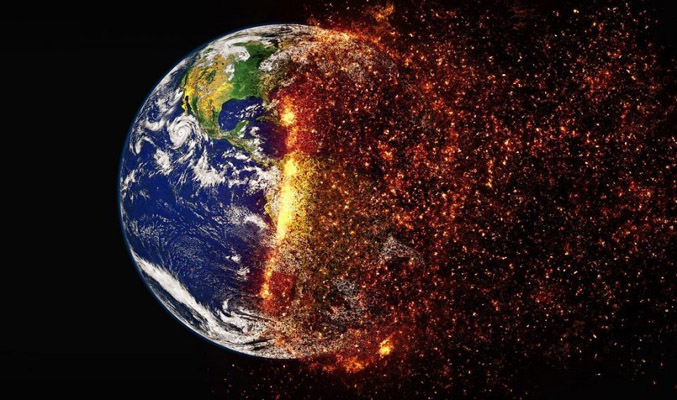
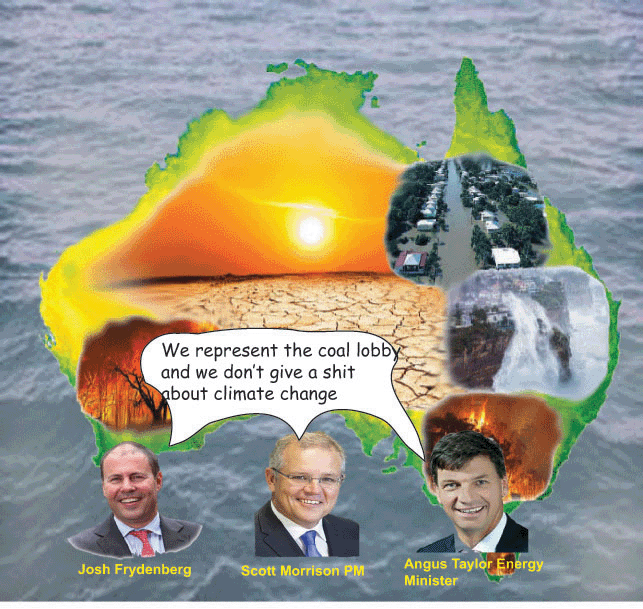 disaster. The same political representatives who approved and continue to approve new coalmines in the face of scientific consensus on the effect that continuing to burn fossil fuels will have on climate in general, and drought and temperatures in particular. The same political representatives who approve water being diverted to support resource extraction, when living beings are dying for want of water and drying to the point of conflagration.
|
Omnicide: Who is responsible for the gravest of all crimes? https://www.abc.net.au/religion/danielle-celermajer-omnicide-gravest-of-all-crimes/11838534?fbclid=IwAR0kOl8bovqqaBMq9XVaiUKq8HUElnk1s13dCWnEOh5p88lxtxb_UyLTj4w Danielle Celermajer 3 Jan 2020,
As the full extent of the devastation of the Holocaust became apparent, a Polish Jew whose entire family had been killed, Raphael Lemkin, came to realise that there was no word for the distinctive crime that had been committed: the murder of a people. His life work became finding a word to name the crime and then convincing the world to use it and condemn it: genocide. Today, not only has genocide become a dreadful part of our lexicon. We recognise it as perhaps the gravest of all crimes. During these first days of the third decade of the twenty-first century, as we watch humans, animals, trees, insects, fungi, ecosystems, forests, rivers (and on and on) being killed, we find ourselves without a word to name what is happening. True, in recent years, environmentalists have coined the term ecocide, the killing of ecosystems — but this is something more. This is the killing of everything. Omnicide. Continue reading |
 Hugh Riminton: We Are A Burning Nation Led By Cowards, https://10daily.com.au/views/a191119irujf/hugh-riminton-we-are-a-burning-nation-led-by-cowards-20191119
Among those determined to do nothing about climate change, the arguments have shifted over time.
|
We know them all too well. But here’s a reminder. 1. It’s a hoax. 2. It’s corruption. Climate scientists are scammers getting rich on grants. 3. It’s a mental illness. People reflecting the science are “alarmists”, “warmists” and “catastrophists” recklessly damaging the mental health of children. 4. It’s something we can’t talk about — especially when the weather and bushfires are behaving precisely as the science predicted they would behave. The trouble is, across the country people who have believed this stuff are having to swap their tinfoil hats for fire helmets. The predictions of the scientists are playing out exactly to the script. Reality is biting Continue reading |
How the Murdoch media murdered Australia’s climate policy
 Michael Pascoe: How Murdoch’s myrmidons murdered climate policy, The New Daily –Michael Pascoe, Contributing Editor 3 Jan 2020, “The Murdoch media, determined to remove the Labor government at any cost, mounted a savage war on the science of climate change and the structural reforms that needed to be undertaken,” wrote former Labor Treasurer Wayne Swan in a 2017 article and reprised this week on Twitter.
It’s an important insight as it suggests an answer to the mystery of the Murdoch media’s rabid climate denialism in Australia – a campaign by our biggest newspaper company that has both enabled and goaded the troglodyte end of the Coalition to make Australia a world leader in fighting carbon reduction, in worsening our changed climate.
Without the on-going Murdoch campaign promoting climate disinformation and sheer lunacy, it’s hard to imagine any government being able to persist with its cynical twisting of emissions policy, never mind outright lies.
If all major Australian media played the climate issue straight, a denialist government couldn’t survive.
But that has been the point of the Murdoch campaign – political power, not economics, not science, not even the pseudo-science it promotes.
Murdoch’s myrmidons have been exploiting climate denialism for so long, they’ve become trapped by it. Having mounted the denialist tiger to take down Malcolm Turnbull as Liberal leader and the federal Labor government, they dare not dismount.
And ride a tiger long enough – it’s 10 years since then-senator Nick Minchin and Tony Abbott used climate change scepticism to roll Malcolm Turnbull as Opposition Leader and officially weaponise climate policy – it’s unsurprising to start believing it’s the natural thing to do. It’s the nature of echo chambers to be self-reinforcing.
The tragedy of the Murdoch echo chamber is that it has come to ensnare its readership as well as its editors. Coalition members and voters are the core of that readership
Tell a lie long enough and loud enough, many people will believe it. The ABC’s Media Watch last year demonstrated the point.
When The Australian printed a surprisingly straight report of the latest consensus climate concerns, readers’ comments were strongly critical of the story, but readers’ comments after a whacky denialist rave were strongly supportive. Murdoch media have been captured by the monster they created. ……A decade of climate denialism has had its way on the Murdoch stable. Now, when the effects of changed climate scorch the land, the Murdoch papers can still delight in publishing nonsense commentary. …..
A decade of climate denialism has had its way on the Murdoch stable. Now, when the effects of changed climate scorch the land, the Murdoch papers can still delight in publishing nonsense commentary. ….. https://thenewdaily.com.au/news/national/2020/01/02/michael-pascoe-murdoch-climate/
Murdoch media: The Australian, Herald Sun and Courier Mail downplay bushfire news

The Australian: Murdoch-owned newspaper accused of downplaying bushfires in favour of picnic races https://www.theguardian.com/media/2020/jan/04/the-australian-murdoch-owned-newspaper-accused-of-downplaying-bushfires-in-favour-of-picnic-races
Herald Sun relegates bushfires to page 4 while Courier Mail brings good news via ‘Onion Oracle’Amanda Meade, Sat 4 Jan 2020 The Australian, Rupert Murdoch’s flagship newspaper, has defended itself against criticism it downplayed unprecedented bushfires by failing to put a picture of the disaster on the front page of an edition, even as newspapers across the world featured the harrowing scenes.
Many of the world’s leading mastheads featured pictures of the devastation of the Australian bushfires on page one on Thursday. But the Australian’s first edition ran an upbeat picture story about the New Year’s Day picnic races at Hanging Rock.
Sources at the newspaper said the newsroom was short-staffed over the holidays, however it was noted that resources were found to attack the ABC with gusto over its New Year’s Eve concert.
“Our readers have been fully informed across the nation both online and in paper all week,” editor John Lehmann told Guardian Australia.
The national broadsheet’s lead story on Thursday was about a secret proposal by police to ban alcohol in Indigenous communities in Western Australia – a story deemed more important than the bushfire report, which said eight people were dead and mass evacuations were underway.
There wasn’t a single photo of the catastrophic bushfires until page 4.
Before readers got to that coverage, they were given an exclusive interview with “rebel marine scientist Peter Ridd” who has challenged reef scientists to test whether or not human actions have caused a collapse in the growth rate of corals on the Great Barrier Reef.
The later editions of the paper dropped the racing story and replaced it with photographs of bushfire victims surveying the damage.
The Australian is not the only Murdoch-owned newspaper that has been accused of downplaying the bushfires.
On the same day, Sydney’s Daily Telegraph blamed the Bureau of Meteorology for inaccurate weather predictions, which may have “lulled residents into a false sense of security about conditions”.
But it was the Courier Mail’s story about the “Onion Oracle” that had some readers wondering what was going on at News Corp.
The Queensland tabloid carried the optimistic news that “Onion Oracle” Halwyn Hermann was predicting rain using an old German tradition. They even compared the Onion Oracle’s predictions to those of the bureau of meteorology.
The Australian has been consistent on one front. Throughout the bushfire season it has kept up its coverage of climate denialism.
Before Christmas, the Australian attempted to smear Greg Mullins and his Emergency Leaders for Climate Action group as “largely a vehicle for Tim Flannery”. Flannery is a leading environmentalist and chief counsellor at the Climate Council.
The former fire and emergency chiefs from multiple states and territories say Australia is unprepared for worsening natural disasters from climate change and governments are putting lives at risk.
The Australian says they are a front for Flannery who is an “alarmist” for urging that coal-fired power stations be shut down.
On New Year’s Eve, the paper led with another “exclusive” report that pushed the line Australia should not speed up its response to global warming.
The Institute of Public Affairs has poisoned climate discussion in Australia
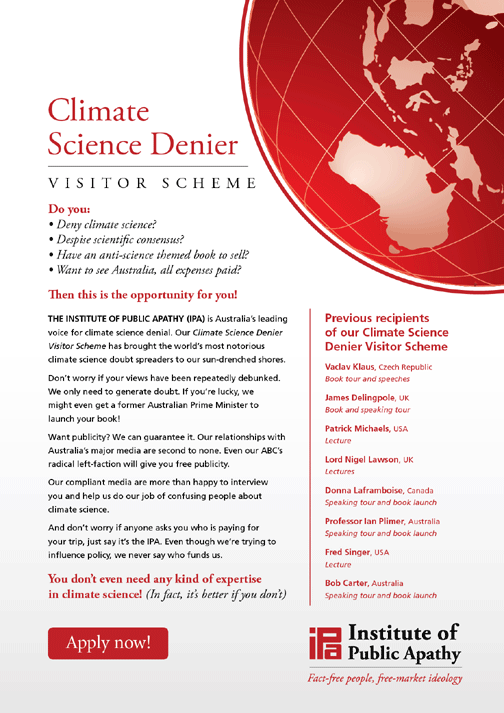
How one think tank poisoned Australia’s climate debate, Crikey NAPIER-RAMAN, JAN 29, 2019 One of the Institute of Public Affair’s greatest successes has been to stitch climate denialism into the very fabric of the conservative political identity.
From anti-vaxxers to climate deniers to a general simmering scepticism of science, denialism in all its forms is everywhere. Crikey is presenting a four-part series on how the seeds of doubt are planted and how they blossom through media and politics. Read the first three parts here.
In the 1980s, long before there was widespread public awareness of the proximity of imminent environmental apocalypse, before climate change became a wedge issue that toppled Australian prime ministers and divided politics, free market think tanks like the Institute of Public Affairs were busy sowing the seeds of doubt.
Today, those seeds have grown into vast tendrils which have a stranglehold on politics. The IPA exists as a conduit between the respectable mainstream right, represented by the Liberal Party, and fringe climate deniers, whose marginal views are largely rejected by the rest of the scientific community. Their greatest success, mirroring that of other free market think tanks in the United States, has been to stitch climate denialism into the very fabric of the conservative political identity. Continue reading
Why does the Australian govt want to put nuclear waste ont Australia’s precious agricultural land?
|
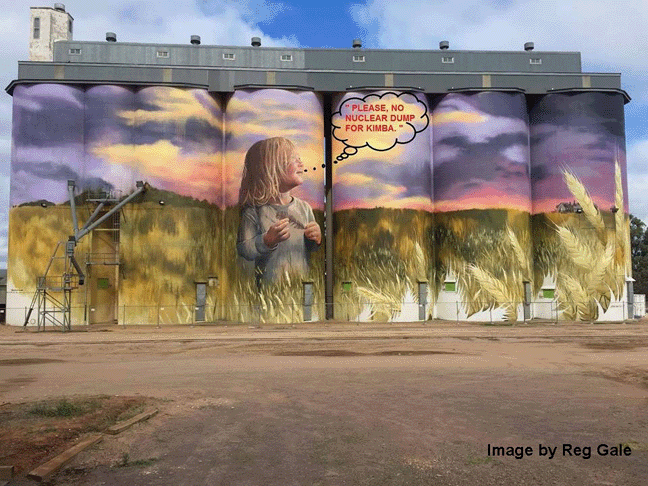
SAVE SA FARMLAND – KIMBA, EYRE PENINSULA :
KIMBA FARMERS AND RESIDENTS SPEAK OUT to Protect Kimba, Eyre Peninsula, South Australia, their communities and future generations from Radioactive Nuclear Waste Dumps.
Scomo’s Federal Govnt Ignores it’s own Guidelines, Ignores SA law and Ignores Barngarla Aboriginal Native title holders.
Federal Govnt Bribes Contaminate Kimba Vote.
Only 4.5% of South Australia’s land is Agricultural cropping land, so why on earth does Scomo’s Federal Govnt want to dump / introduce toxic radioactive nuclear waste on Agricultural Farmland near Kimba and Lake Gilles Conservation Park ???
|
|
Michael Mann- climate change is now upon Australia
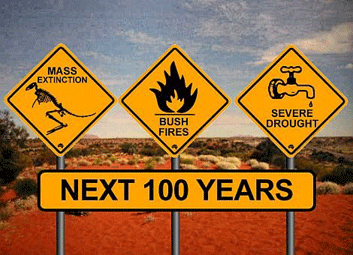
Australia, your country is burning – dangerous climate change is here with you now , Guardian, Michael Mann 1 Jan 2020, I am a climate scientist on holiday in the Blue Mountains, watching climate change in action,
After years studying the climate, my work has brought me to Sydney where I’m studying the linkages between climate change and extreme weather events.
Prior to beginning my sabbatical stay in Sydney, I took the opportunity this holiday season to vacation in Australia with my family. We went to see the Great Barrier Reef – one of the great wonders of this planet – while we still can. Subject to the twin assaults of warming-caused bleaching and ocean acidification, it will be gone in a matter of decades in the absence of a dramatic reduction in global carbon emissions.
We also travelled to the Blue Mountains, another of Australia’s natural wonders, known for its lush temperate rainforests, majestic cliffs and rock formations and panoramic vistas that challenge any the world has to offer. It too is now threatened by climate change.
I witnessed this firsthand.
I did not see vast expanses of rainforest framed by distant blue-tinged mountain ranges. Instead I looked out into smoke-filled valleys, with only the faintest ghosts of distant ridges and peaks in the background. The iconic blue tint (which derives from a haze formed from “terpenes” emitted by the Eucalyptus trees that are so plentiful here) was replaced by a brown haze. The blue sky, too, had been replaced by that brown haze. ……
The brown skies I observed in the Blue Mountains this week are a product of human-caused climate change. Take record heat, combine it with unprecedented drought in already dry regions and you get unprecedented bushfires like the ones engulfing the Blue Mountains and spreading across the continent. It’s not complicated.
The warming of our planet – and the changes in climate associated with it – are due to the fossil fuels we’re burning: oil, whether at midnight or any other hour of the day, natural gas, and the biggest culprit of all, coal. That’s not complicated either.
When we mine for coal, like the controversial planned Adani coalmine, which would more than double Australia’s coal-based carbon emissions, we are literally mining away at our blue skies. The Adani coalmine could rightly be renamed the Blue Sky mine.
In Australia, beds are burning. So are entire towns, irreplaceable forests and endangered and precious animal species such as the koala (arguably the world’s only living plush toy) are perishing in massive numbers due to the unprecedented bushfires.
The continent of Australia is figuratively – and in some sense literally – on fire.
Yet the prime minister, Scott Morrison, appears remarkably indifferent to the climate emergency Australia is suffering through, having chosen to vacation in Hawaii as Australians are left to contend with unprecedented heat and bushfires.
Morrison has shown himself to be beholden to coal interests and his administration is considered to have conspired with a small number of petrostates to sabotage the recent UN climate conference in Madrid (“COP25”), seen as a last ditch effort to keep planetary warming below a level (1.5C) considered by many to constitute “dangerous” planetary warming.
But Australians need only wake up in the morning, turn on the television, read the newspaper or look out the window to see what is increasingly obvious to many – for Australia, dangerous climate change is already here. It’s simply a matter of how much worse we’re willing to allow it to get.
Australia is experiencing a climate emergency. It is literally burning. It needs leadership that is able to recognise that and act. And it needs voters to hold politicians accountable at the ballot box.
Australians must vote out fossil-fuelled politicians who have chosen to be part of the problem and vote in climate champions who are willing to solve it.
- Michael E Mann is distinguished professor of atmospheric science at Pennsylvania State University. His most recent book, with Tom Toles, is The Madhouse Effect: How Climate Change Denial Is Threatening Our Planet, Destroying Our Politics, and Driving Us Crazy (Columbia University Press, 2016).
Scott Morrison’s govt under pressure for its lack of climate policy
Australia bushfires: PM’s climate stance criticised as thousands flee blazes
Scott Morrison’s government under pressure as fires feared to have killed 17 people,Guardian, Ben Smee , Calla Wahlquist Helen Davidson in Sydney and Jon Henley– 2 Jan 2020
Navy ships and army aircraft have been dispatched to help fight devastating bushfires on Australia’s south-east coast that are feared to have killed at least 17 people, amid a spiralling debate over the government’s stance on the climate emergency.
Thousands of people have fled apocalyptic scenes, abandoning their homes and huddling on beaches to escape raging columns of flame and smoke that have plunged whole towns into darkness and destroyed more than 4m hectares of land.
Thousands of firefighters were still battling more than 100 blazes in New South Wales (NSW) state and nearly 40 in Victoria on Wednesday, with new fires being sparked daily by hot and windy conditions and, more recently, dry lightning strikes created by the fires themselves.
At the end of Australia’s hottest-ever decade, Canberra, the capital, was blanketed in a cloud of dense smoke that left its air quality more than 21 times the hazardous rating and could be seen more than 1,200 miles (2,000km) away, on the South Island of New Zealand, where it turned the daytime sky orange.
Fanned by soaring temperatures, strong winds and a terrible three-year drought, huge blazes have ravaged a tinder-dry landscape, causing immense destruction: since November, more than 900 homes have been lost in NSW alone.
With three months of the summer still to go, the early and devastating start to the country’s fire season has led authorities to rate it the worst on record and prompted urgent questions about whether the conservative government of the prime minister, Scott Morrison, has taken enough action on global heating.
Polls show a large majority of Australians see the climate emergency as an urgent threat and want tougher government action, but Morrison has focused instead on the nation’s response to the bushfire crisis and defending Australian business, while other government officials have publicly disparaged climate activists.
In his New Year’s Eve address to the nation, Morrison did not make any connection between the bushfires and global heating, suggesting that while they were a terrible ordeal, Australians had faced similar trials throughout history.
Past generations had “also faced natural disasters, floods, fires, global conflicts, disease and drought” and overcome them, the prime minister said in a video message. “That is the spirit of Australians, that is the spirit that is on display, that is a spirit that we can celebrate as Australians.”…….
Criticism of the Morrison government’s climate stance has intensified as the fires have raged. Australia is the world’s largest exporter of coal and liquefied natural gas, but the prime minister, who won a surprise election victory in May, last month rejected calls to downsize Australia’s lucrative coal industry.
His government has pledged to cut greenhouse gas emissions by 26-28% by 2030, a modest figure compared with the centre-left opposition Labor party’s pledge of 45%. The leader of the minor Australian Greens party, Richard Di Natale, demanded a royal commission, the nation’s highest form of inquiry, on the crisis.
“If he (Morrison) refuses to do so, we will be moving for a parliamentary commission of inquiry with royal commission-like powers as soon as parliament returns,” Di Natale said in a statement……. https://www.theguardian.com/australia-news/2020/jan/01/australia-bushfires-defence-forces-sent-to-help-battle-huge-blazes
Fact checking Angus Taylor: does Australia have a climate change record to be proud of?
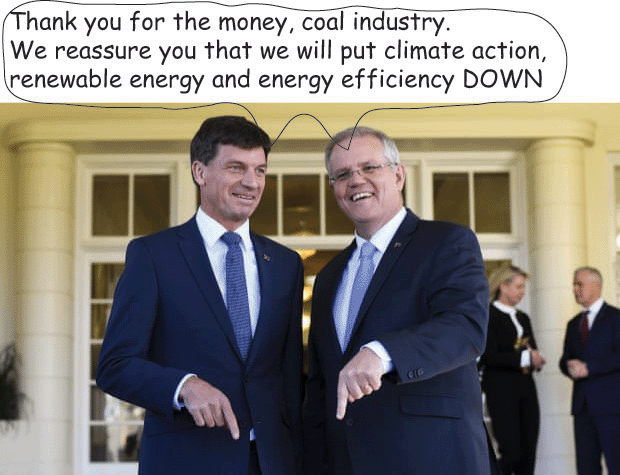
On a day of extraordinary bushfires the energy minister argued that the country has ‘strong targets, clear plans and an enviable track record’ on reducing emissions. Is he right? Guardian, Graham Readfearn
Angus Taylor spoke at the COP25 climate summit in Madrid. The energy minister says Australia has an enviable record on climate change – the Guardian fact checks his claims.
Australians should be proud of the country’s achievements on climate change, energy minister Angus Taylor has argued in a newspaper column that claims “quiet Australians” don’t accept the “shrill cries” of the government’s climate critics.
The column, published in The Australian, makes a series of claims about Australia’s emissions and how they compare to other countries, as well as highlighting exports such as LNG that are “dramatically reducing emissions” in other countries.
So is Australia really a paragon of climate virtue – cutting emissions at home while helping the world to cut emissions?
As is always the case when it comes to climate and energy policy, there is much to check and understand in Taylor’s article.
Prof Frank Jotzo, director of the Centre for Climate and Energy Policy at the ANU Crawford School of Public Policy, told Guardian Australia: “I would characterise [Taylor’s article] as a selective use of statistics that make Australia’s emissions trajectory look good, when in reality it does not look good at all.”
Tiny footprint?
Taylor writes that Australia is “responsible for only 1.3 per cent of global emissions, so we can’t single-handedly have a meaningful impact without the co-operation of the largest emitters such as China and the US.”
In the context of global emissions, there is much that Australia can, and does, do that has a meaningful impact.
The 1.3% figure does not account for Australia’s contribution to global emissions from the fossil fuels we dig up and export.
If this exported coal and gas was accounted for, one analysis suggests Australia would be responsible for almost 5% of the global carbon footprint from fossil fuel burning.
When countries report their emissions to the United Nations Framework Convention on Climate Change, they only report emissions occurring inside their borders, so it could be argued that using this larger number is unfair.
But the problem is that elsewhere in Taylor’s article, he says Australia’s exporting of LNG is helping countries cut emissions.
Jotzo says: “If we are going to talk about impacts on global emissions of Australia’s energy exports, then we need to consider all fuels, including coal. Any exporting of coal will result in higher global emissions because it increases the availability and lowers the price of coal, and encourages the use of coal.”
While Taylor admits that LNG processing in Australia has pushed domestic emissions higher, he claims that “our LNG exports are dramatically reducing emissions in customer countries such as Japan, South Korea and China — the equivalent of up to 30 per cent of our emissions each year”.
He says the “lion’s share” of the exports will actually replace gas from other sources, rather than displacing coal generation. There is also a risk, he says, that increasing LNG exports also encourages countries to build more gas infrastructure, making it harder to move away from the fossil fuel.
He adds: “It is not clear that the availability of Australian LNG decreases emissions internationally.”
Easy target
“Australia meets and beats its emission-reductions targets, every time,” writes Taylor. “We beat our first Kyoto targets by 128 million tonnes. We expect to beat our 2020 targets by 411 million tonnes.”
The key reason why Australia has easily beaten its targets, is that they were very low to begin with.
Australia’s first Kyoto target allowed it to increase emissions by 8% between 1990 and 2010. The second target period required a 5% cut below 2000 levels by 2020.
Much of Australia’s cuts to emissions in recent decades, says Jotzo, has been achieved through drops in land clearing, rather than reductions in other parts of the economy the government could have influence over.
Australia wants to use some 411 million tonnes of CO2 “credits” amassed over the Kyoto periods against future targets under the separate Paris agreement, even though it admits it is probably the only country looking to use these “carryover credits”.
Using carryover credits would cut the amount of emissions reductions Australia would need to find to meet its Paris target by about a half.
At the latest UN climate talks in Madrid, Australia came under harsh criticism from more than 100 countries for its desire to use the credits, which some analysts say is a proposal with no legal basis.
Proud and quiet Aussies?
According to Taylor, “Australia has strong targets, clear plans, an enviable track record” on climate change, and Australians should be proud of it.
But when overseas groups look at Australia’s record compared to the rest of the world, the assessments come out differently.
An analysis by Climate Action Tracker says Australia’s Paris targets are “insufficient” and inconsistent with the Paris goal of keeping global warming well below 2C.
Australia has been placed consistently towards the bottom in the annual Climate Change Policy Index analysis of the world’s top 57 emitting nations.
The most recent analysis ranked Australia as the sixth worst country on climate change overall.
Jotzo, who attended the Madrid climate talks as an observer, said: “Australia was highly regarded at the talks for its technical competence, and it always has. But Australia is not highly regarded at all for its policies or for its efforts to water down effective ambition of the Paris agreement.”
Jotzo adds: “They are flabbergasted that Australia is digging in to its stance of getting an easier deal when it would so obviously be in its national interest to encourage strong global action.” https://www.theguardian.com/australia-news/2019/dec/31/fact-checking-angus-taylor-does-australia-have-a-climate-change-record-to-be-proud-of
Apocalypse now the time to accept climate change
|
Apocalypse now the time to accept climate change, SMH, 2 Jan 2020, What will it take for Scott Morrison to face up to reality? During his New Year’s speech when referring to the bushfires, he said “We have faced these disasters before and we have prevailed, we have overcome” (”Tragedy shows the need for climate leadership”, January 1).We have never faced any disaster as destructive as the current season of fires. The PM is incapable of expressing any comment that could to the slightest degree be considered as an admission that climate change is real. – Tony Lyons, Lithgow
The PM’s appeal to the Australian spirit in this bushfire crisis rings hollow because Australia feels insecure in the face of this unprecedented ”invasion” by the terrifying forces of climate change. For more than a decade the Coalition has never presented a policy designed to protect the Australian way of life from the anger of a wounded environment. We, the Australian people, elected this government knowing that climate change was decidedly not a priority. And so Wednesday’s front page of the Herald looks like it is describing an all-out invasion. Our national security is at risk. – Michael Kennedy, West Pymble We have a PM who helped end the possibility of a decent carbon tax, who brought a lump of coal into Parliament and smirked at its harmlessness, who constantly assures us that with our minimal efforts towards mitigating climate change are world leading, who refused at least twice to meet fire chiefs and other experts to discuss their concerns for the current summer, who thinks school children, whose future is the most effected, should not demonstrate and should not be alarmed by talk of climate change, who had to be dragged to offer compensation to the RFS volunteers. Is it then any wonder that we are enduring the summer that we are? I wonder how relaxed and comfortable children are with the headlines on New Year’s Day. – Brenton McGeachie, Queanbeyan West Our PM urges us to celebrate and his Energy Minister says we should be proud of our efforts on climate change. I can’t celebrate our “amazing country” when so much of what makes it amazing is gone. Forests have been destroyed, koalas killed en masse and too many people have died. I feel nothing but shame for our paltry efforts on climate change, let alone the part we played in sabotaging the recent UN climate talks in Madrid. Our government is recklessly indifferent to the apocalypse engulfing eastern Australia and to the existential threat faced by its people. How out of touch is that? – Bronwyn Scott, Croydon ……. https://www.smh.com.au/national/nsw/apocalypse-now-the-time-to-accept-climate-change-20200101-p53o0v.html |
|
Climate patterns behind Australia’s bushfires, heat and drought set to improve
Climate patterns behind Australia’s bushfires, heat and drought set to improve Bureau of Meteorology says two climate patterns behind the dangerous fire conditions have shifted towards neutral.Guardian, Graham Readfearn @readfearn, Wed 1 Jan 2020 Two climate patterns that have been influencing Australia’s ongoing drought, deadly bushfire weather and record-breaking heat have shifted towards neutral, according to the Bureau of Meteorology.
The changes should reduce the chances of hot winds from the west that have been adding to the extreme risk of bushfires in the south-east.
But Dr Andrew Watkins, the head of long-range forecasts at the bureau, told Guardian Australia the damage caused by the two patterns – the positive phase of the Indian Ocean Dipole (IOD) and a negative Southern Annular Mode (SAM) – would likely remain for several months……. https://www.theguardian.com/australia-news/2020/jan/01/climate-patterns-behind-australias-bushfires-heat-and-drought-set-to-improve
Australia’s unprecedented bushfires, and the role of global heating

|
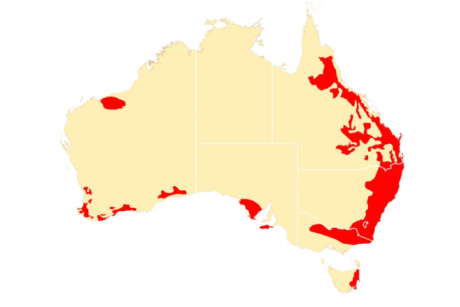
Yes, Australia has always had bushfires: but 2019 is like nothing we’ve seen before. Record low rainfall has contributed to a continent-scale emergency that has burned through more than 5m hectares and alarmed scientists, doctors and firefighters, Guardian, Adam Morton Environment editor @adamlmorton, Wed 25 Dec 2019 As the area burned across Australia this fire season pushes beyond five million hectares, an area larger than many countries, stories of destruction have become depressingly familiar.
At the time of writing, nine people have been killed. Balmoral, in the New South Wales southern highlands, is the latest community affected in a state where up to 1,000 homes have been destroyed. A third of the vineyard area and dozens of homes were razed in the Adelaide Hills. It is too early for a thorough examination of the impact on wildlife, including the many threatened species in the fires’ path. Does this qualify as unprecedented? Plenty of experts say yes, but not all politicians and newspaper columnists are convinced. Last week the acting prime minister, Michael McCormack, assured the nation that “we’ve had these smoke hazes before. We’ve had bushfires before.” After returning from Hawaii, Scott Morrison, acknowledged the fires were severe, but also adopted a familiar line: Australia has always had bushfires. That’s true. But a key question is whether it has always had bushfires like this. Who says the bushfires are unprecedented?The firefighting agency in the state worst affected, for starters.
The NSW Rural Fire Service says the scale of what has burned in that state is unprecedented at this point of the fire season. By Monday, 3.41 million hectares had burned. “To put it in perspective, in the past few years we have had a total area burned for the whole season of about 280,000 hectares,” RFS spokeswoman Angela Burford said. A slightly larger area burned across the 1974 calendar year, but those fires were of an entirely different nature: fuelled by above-average rainfall, it burned through mostly remote outback grasslands in the state’s far west. By comparison, this year’s fires are further east, where people live, and have been fuelled by a vast bank of dry fuel following the country’s record-breaking drought. Soil moisture is at historic lows in some areas, and rainfall in the first eight months of the year was the lowest on record in the northern tablelands and Queensland’s southern downs. What do scientists say?David Bowman, director of The Fire Centre at the University of Tasmania, says the most striking thing about this fire season is the continent-scale nature of the threat. The damage in each state is explained here. “The geographic range, and the fact it is occurring all at once, is what makes it unprecedented,” Bowman says. “There has never been a situation where there has been a fire from southern Queensland, right through NSW, into Gippsland, in the Adelaide Hills, near Perth and on the east coast of Tasmania.” He says one of the less explored issues, though it has begun to receive some attention in recent days, is the economic impact of having prolonged fires that affect so many Australians. “You can’t properly run an economy when you get a third to a half of the population affected by smoke, and the media completely focused on fires,” he says. “I’m not quite certain why anybody would want to be claiming fires have been like this before. It’s concerning as it is a barrier to adaptation. To deal with these sort of fires the first step is to acknowledge the scale of the problem.” ……. What role does climate change play?The explanation should be familiar by now: greenhouse gas emissions do not cause bushfires, but they play a demonstrated role in increasing average and particularly extreme temperatures and contribute to the extraordinarily dry conditions afflicting eastern Australia.
Scientists cite the near absolute lack of moisture in the landscape as a key reason the fires have been so severe. Multiple studies, here and overseas, have found the climate crisis is lengthening the fire season. In the past, the season started in spring in NSW before moving south to Victoria, South Australia and Tasmania in the new year. Just as Australia’s fire season is more overlapping with that in California, making resource-sharing more difficult, it is also running simultaneously across the country……. https://www.theguardian.com/australia-news/2019/dec/25/factcheck-why-australias-monster-2019-bushfires-are-unprecedented |
|
Uncle Kevin warns that the people, and the lizard are fighting back against BHP and its uranium mine
Uncle Kevin “The lizard has had enough and so have the people. And the old country has been ruined, devastated by BHP.
In 2020, we’ll be having serious meetings on the Borefield road, somewhere near Canegrass swamp.
BHP is one of the biggest miners in the world and Olympic dam at Roxby is the biggest uranium mine in the world. They are fully supported by the federal and state governments.
At Canegrass swamp people were tricked by WMC who started this development. We could not do anything about it back then in the 70s and 80s.
Olympic dam development is taking 42m litres of sacred artesian water from the Lake Eyre basin each day. This is going to be expanded to 50m litres per day for the next 25 years. We must stop this now.
Native title and ILUAS have made it harder for us. Our people are being tricked and this has been devastating for the Arabunna people who don’t want their land destroyed.
I am calling out for all people land and water protectors concerned about global warming and environmental destruction to come and help.
The lizard has had enough, come and help us close Roxby down. Dates will be announced, we’re thinking of June/July 2020.
BHP at Roxby are sucking the blood out of the land – the water of the great Lake Eyre basin.
And BHP wants more.
They are killing us.
Turning our mob against each other as they fight over the crumbs of the destruction.
Greed is poison. Their lust for the poison will kill us all unless we take a stand.
Lake Eyre is talking. Be aware.
Are u listening? https://www.facebook.com/groups/941313402573199/
Australia’s dangerous subservience to the war-obsessed USA

|
JOHN MENADUE: Tugging our forelock again and again to our dangerous ally. An update, Michael West.com by John Menadue — 30 December 2019 The US has coming calling again. Not an Admiral this time but the Pentecostalist Secretary of State, Mike Pompeo. He is whistling us up as a faithful dog to join with the US in tackling the problems which Donald Trump created with Iran and presumably to soften us up to host missiles to protect the US marines and port facilities in Darwin. And Pine Gap. John Menadue reports.
We are being softened up again step by step to support the US military and industrial complex that promotes perpetual war. The US is the greatest threat to peace in the world. It is an aggressor across the globe. It is the most violent country both at home and abroad. And people know it. The Pew Research Centre found in 2018 that 45% of people surveyed around the world saw “US power and influence as a major threat”. Retired US Defence, Secretary James (Jim) Mattis, complained that President Trump should show more respect for allies. But the US shows most respect for allies that do what they are told or supinely comply, like Australia. Our PM even gets an invitation to dinner with Trump. Scott Morrison could not contain his eagerness. Our media join in the vicarious thrill of it all. Apart from brief isolationist periods, the US has been almost perpetually at war; wars that we have been foolishly drawn into. The US has subverted and overthrown numerous governments over two centuries. It has a military and business complex, a “hidden state”, that depends on war for influence and enrichment. It believes in its “manifest destiny” which brings with it an assumed moral superiority which it denies to others. The problems did not start with Trump. They are long-standing and deep rooted. Unfortunately, many of our political, bureaucratic, business and media “elites” have been so long on an American drip feed that they find it hard to think of a world without an American focus. We had a similar and dependent view of the UK in the past. That ended in tears in Singapore. Conservatives rail about Chinese influence but they and we are immersed and dominated by all things American, including the Murdoch media. Our media do regard Australia as the 51st American state. Just look at the saturation coverage of the Democrat primaries with the presidential election still 10 months away! Easy and lazy news. I’ts harder and nowhere near as interesting to cover much more important news in Indonesia and Malaysia. In an earlier article (Is war in the American DNA?), I drew attention to the risks we run in being “joined at the hip” to a country that is almost always at war. The facts are clear. The US has never had a decade without war. Since its founding in 1776, the US has been at war 93% of the time. These wars have extended from its own hemisphere, to the Pacific, to Europe and most recently to the Middle East. The US has launched 201 out of 248 armed conflicts since the end of WWII. In recent decades most of these wars have been unsuccessful. The US maintains 700 military bases or sites around the world including in Australia. In our own region it has massive deployment of hardware and troops in Japan, the ROK and Guam. …. Despite all the evidence of wars and meddling in other countries’ affairs, the American Imperium continues without serious check or query in America or Australia. …… The second reason why the American Imperium continues largely unchecked is the power of what President Eisenhower once called the “military and industrial complex” in the US. In 2019, I would add the intelligence community and politicians to that complex who depend heavily on funding from powerful arms manufacturers across the country and the military and civilian personnel in over 4,000 military facilities across the US. Democrats and Republicans both court these wealthy arms suppliers and their employees. The intelligence community, universities and think-tanks also have a vested interest in the American Imperium. This complex which co-opts institutions and individuals in Australia, is often called “the hidden state”. It has enormous influence. No US president nor for that matter any Australian prime minister would likely challenge it. Australia has locked itself into this complex. Our military and defence leaders are heavily dependent on the US Departments of Defence and State, the CIA and the FBI for advice. But it goes beyond advice. The “five eyes” led by the CIA applied pressure to us on 5G as part of a broader campaign to attack almost all things Chinese.We willingly respond and join the US in disasters like Iraq and the Middle East. While the UN General Assembly votes with large majorities to curb nuclear proliferation, we remain locked in to the position of the US and other nuclear powers…… The US military and industrial complex and its associates have a vested interest in America being at war and our defence establishment, Department of Defence, ADF, Australian Strategic Policy Institute and the “Intelligence” community are locked-in American loyalists…… Like many democracies, including our own, money and vested interests are corrupting public life. “Democracy” in the US has been replaced by “Donocracy”, with practically no restrictions on funding of elections and political activity for decades. Vested interests are largely unchecked. House of Representatives electorates are gerrymandered and poor and minority group voters are often excluded from the rolls. The powerful Jewish lobby, supported by fundamentalist Christians, has run US policy off the rails on Israel and the Middle East. The US has slipped to number 21 as a “flawed democracy” in the Economist’s Intelligence 2016 Democracy Index. (NZ was ranked 4 and Australia 10). It noted that “public confidence in government has slumped to historic lows in the US.” That was before Trump! Many democracies are in trouble. US democracy is in more trouble than most. There is a pervasive sickness…….
But it is not just the destructive role of News Corp in US, UK and Australia. Our media, including the ABC and even SBS, is so derivative. Our media seems to regard Australia as an island parked off New York. We are saturated with news, views, entertainment and sit-coms from the US. It is so pervasive and extensive, we don’t recognize it for its very nature…… A further reason for the continuing US hegemony in Australian attitudes is the galaxy of Australian opinion leaders who have benefitted from American largesse and support – in the media, politics, bureaucracy, business, trade unions, universities and think-tanks. Thousands of influential Australians have been co-opted by US money and support in “dialogues”, study centres and think tanks. The US has nourished agents of influence in Australia for decades. China is a raw beginner in the use of soft power. How long will Australian denial of US policies continue? When will some of us stand up? When will our humiliation end?……. https://www.michaelwest.com.au/john-menadue-us-alliance-more-likely-to-get-us-into-trouble-than-out/ |
|
|
South Australia’s Liberals keen to weaken health and safety laws on uranium
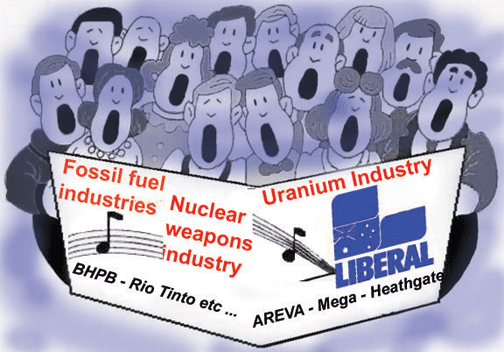
Push to cut green tape for new uranium mines in South Australia, https://www.adelaidenow.com.au/news/south-australia/push-to-cut-green-tape-for-new-uranium-mines-in-south-australia/news-story/5cee611673d15b550eabeb7210afdf8f?fbclid=IwAR3nf_aFghOlO3glVVwF964xz0H9dvJJ_GeX-libfDWV1ehu9o6R-allX2Q
29 Dec 19 “Unnecessary” green tape is choking the potential for lucrative new uranium mines in South Australia, the State Government says.
The Marshall Government is calling for Canberra to slash federal environmental approvals to pave the way for new mines as a once in a decade review of the nation’s environmental laws gets underway.
SA already has four of the country’s six uranium mines, which have produced 24,300 tonnes and $2.1 billion worth of uranium over five years.
But SA has made a submission to a federal inquiry into nuclear power calling for Canberra to axe the requirement for Commonwealth environmental approvals, in addition to state approvals, for new uranium mines.
It argues the removal of this duplication “will not diminish existing standards of regulation safety and compliance and will increase efficiency, reduce costs bourne by industry”.
It would also boost SA’s status as a “favourable investment destination”.
The submission notes “unnecessary” extra green tape is a “significant barrier to the viability of new uranium mine developments” in SA.
It also calls for changes to the Environment Protection and Biodiversity Conservation Act to remove the ‘nuclear action trigger’ for uranium and other mines with naturally occurring radioactive minerals, to stop the need for federal approvals.
SA will push for the power to go it alone in a once in a decade review of the EPBC Act, currently being conducted by former ACCC chair Graeme Samuel.
A state government spokesman said SA wanted the federal and state approval duplications removed “so costs can be reduced and economic benefits increased”.
“The nature of our State’s geology means radioactive impurities found in other productive ores are inadvertently captured by the nuclear action trigger, and the review is an important opportunity to address this anomaly,” he said.
Two of SA’s uranium mines are operational, while Boss Resource’s Honeymoon mine is in the process of restarting.
BHP has also discovered copper, which uranium could potentially be found near, at the Oak Dam site 65km from its existing Olympic Dam mine.
New Liberal senator for SA Alex Antic has called for SA to look at using nuclear power generation along with a nuclear fuel waste storage facility, saying it could add
“billions of dollars from our participation in the nuclear fuel cycle”.
The state government’s submission said nuclear power was “unviable now and into the foreseeable future” in SA but noted it could be used in remote mining if small modular reactor technology advanced, although the state was currently looking at renewables with power storage for those situations.
The submission also highlighted that nuclear power could be viable in other states, which would create more demand for SA’s “significant” uranium deposits.
Senator Antic welcomed the possibility of next generation nuclear power technologies playing a role in SA’s future energy grid.
He hit out at nuclear power critics, saying: “Those who tell us that we are in the middle of a climate emergency can’t have their ideological cake and eat it too.”
“Nuclear power has proven to be virtually emission free, reliable, and safe.”
SA Chamber of Mines & Energy chief executive Rebecca Knol welcomed the call to slash “unnecessary duplication” of approvals, saying it could save an estimated $426 million in regulatory and operational costs.
It could help SA achieve its 3 per cent annual growth target, she said.
Mr Samuel is due to report to federal Environment Minister Sussan Ley by October.
A spokesman for the Minister said she had been clear that “stringent environmental protection” was fundamental to any review outcomes.
1 This month.
20 September –National Day of Action in Melbourne on the International Day of Peace


Help Aunty Sue Protect Her Land and Sacred Sites From Destructive Rocket Testing.
.

Australians deserve the truth
about
AUKUS – https://aukuspublicinquiry.com/


PETITION – To: Prime Minister Anthony Albanese and the Australian Labor Government

of the week – Australians for War Powers Reform (AWPR)
To see nuclear-related stories in greater depth and intensity
 Antinuclear