Scott Morrison on the drought (“Climate” is a dirty word)
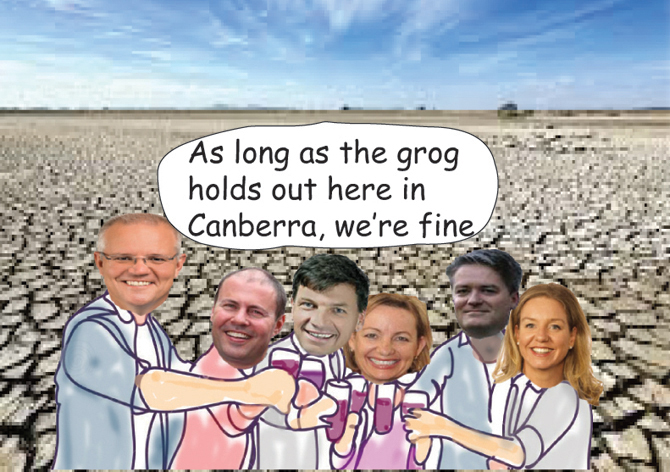
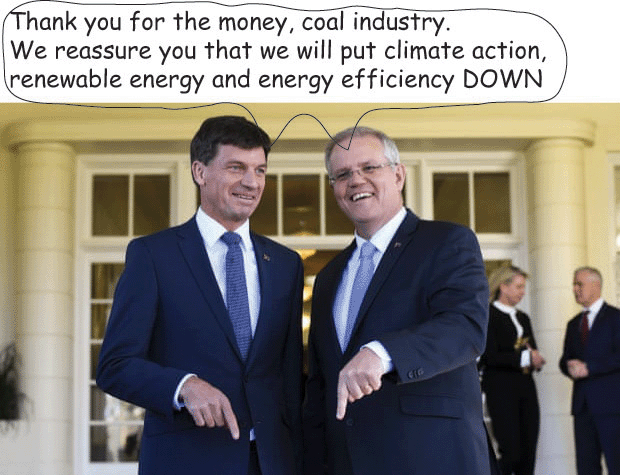 Scott Morrison says drought the Coalition’s ‘first call’ – but makes no mention of climate
Prime minister suggests Coalition may commit to extra funding relief in Liberal party federal council speech, Ben Doherty, @bendohertycorro, Sat 19 Oct 2019 The Guardian
Scott Morrison has indicated the federal government might be prepared to commit extra relief funding to drought-stricken communities, reaffirming the drought is the government’s top priority.
In a triumphal speech to the Liberal party’s federal council in Canberra on Saturday, Morrison again said the drought was “the most pressing and biggest call on our budget”.
“It is the first cab off the rank, the first thing we sit together and say, ‘Once we have done everything we can in this area, then we can consider other priorities’…….
The prime minister did not mention the climate crisis while detailing the government’s three-phase drought response package thus far: the farm household allowance for eligible farming families; the drought communities program dedicating $100m to councils affected by the drought; and long-term drought resilience plans, including money for new dams and the drought future fund. ………
The government has been criticised by Labor for moving too slowly on the drought. Accusing the government of “six years of inaction”, Labor’s Joel Fitzgibbon has called for a bipartisan drought war cabinet to be established.
“What began as crisis for our farmers fast moved to a crisis for our rural townships, which are literally running out of water,” he said. “And I fear that we now are fast approaching a threat to our food security … We need to sit the major parties down together and to start making some pretty significant decisions.”
The drought response has also been questioned by some councils, including Moyne shire in south-west Victoria, which was given $1m despite not being in drought and whose mayor said he wanted to refuse it……. https://www.theguardian.com/australia-news/2019/oct/19/scott-morrison-says-drought-the-coalitions-first-call-but-makes-no-mention-of-climate
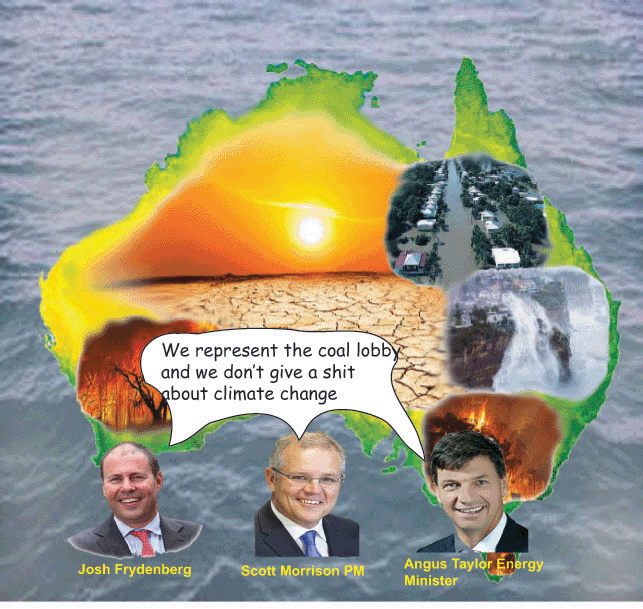
Australian government’s “entrenched” anti-climate attitude – John Hewson
 John Hewson slams Coalition on climate change while business takes lead reducing emissions, ABC, NSW Country Hour, 20 Oct By Joshua Becker
Key points:
- John Hewson takes aim at the Government’s policies and its “entrenched anti-climate sentiment’
- The former Liberal leaders argues that regenerative agriculture can offset a large amount of future emissions
- Academics say government policy might be less influential than market forces as companies move faster to reduce emissions
“We don’t have a sense of urgency to achieve these emission [reduction] targets,” he told the Australian Farm Institute Roundtable in Canberra.
“There’s an entrenched anti-climate sentiment in the Government at the moment, and indeed government ministers are not turning up at events if they have the word ‘climate’ in the title.
“The comments made by the Prime Minister at the UN, that we are going to meet our emissions targets, was a gross misrepresentation and was staggering for someone in his position.”
Dr Hewson, who is now the chair of the Business Council for Sustainable Development, said he would like to see regenerative agriculture form part of the solution.
“Regenerative agriculture can offset a very significant portion of our future emissions, and I’m staggered that is not being recognised by the National Party,” he said.
“It would have a lot of benefits for regional Australia; a farmer could earn carbon credits or a stream of income for sequestering carbon on their farm.”
Is agriculture prepared to be part of the solution?
Large multinational food companies are moving to adopt new targets to reduce emissions in line with the Paris Agreement on climate change.
The Sustainable Food Policy Alliance, which represents companies like Nestle, Unilever, Mars and Danone, has backed calls for companies to use their political influence to push governments to implement a science-based policy agenda.
Some academics believe this marks a shift in the global effort to combat climate change, when companies are moving faster than governments to reduce emissions.
Richard Eckard, a professor of agricultural sciences at the University of Melbourne, said government policy might be less influential than market forces.
“In the past six months, I’ve been back and relooked at all these companies’ sustainability statements and noticed that they’ve all switched to absolute emission reduction targets in line with the Paris Agreement,” he said.
“Some of them have interim steps to get there, but all of them are aiming for carbon-neutral food production by 2050.”…… https://www.abc.net.au/news/rural/2019-10-19/hewson-slams-coalition-on-climate-change-as-business-takes-lead/11617292
Federal govt trying to con Australians that a national nuclear waste dump is a “local” not a NATIONAL ISSUE

|
Blank Cheque For A Bad Plan: Canberra’s Nuclear Waste Problem Council Is South Australia’s Nightmare, https://newmatilda.com/2019/10/18/blank-cheque-for-a-bad-plan-canberras-nuclear-waste-problem-council-is-south-australias-nightmare/
By Dave Sweeney on October 18, 2019 The process for establishing a national nuclear waste repository in remote South Australia is deeply flawed on numerous fronts, writes Dave Sweeney.
At the request of federal Resources Minister Matt Canavan, the Kimba District Council in regional South Australia recently posted letters to registered Council voters asking if they supported the area becoming home to Australia’s radioactive waste. In November the Flinders Ranges Council is set to do the same. Local communities should certainly have a say in decisions with direct impacts for them – and hosting radioactive waste that lasts 10,000 years is certainly a direct impact. But to make an informed decision a community needs access to detailed and accurate information and, unacceptably, this is missing. Estimates of the facility size, design, economics and employment have shifted and remain uncertain. There is little or no detail about waste acceptance criteria, transport and handling procedures or future plans for the management of the most contaminating waste. Minister Canavan refuses to define what level of community response would constitute “broad community support”.The community is effectively being asked to give a blanket approval to a concept, not measured consideration of a specific proposal. And not all the local community is invited or involved. Barngarla people have been excluded from the ballot even though they are Native Title holders who neighbour the proposed Kimba site. In the Flinders many in the Adnyamathanha community are set to miss having a say, while others with long standing interests don’t meet the arbitrary ballot boundary and will not have a vote. Successive governments’ approach to radioactive waste management over many years has been divisive and lacked the evidence base required to achieve community consensus and a lasting solution. The current plan would see low-level waste interred at the site while the more problematic intermediate level wastes would be stored above ground pending future underground disposal at a separate site.There is no clear proposal, process, funding or timeline for this pivotal next stage. This unnecessary double handling of waste that needs to be isolated for up to 10,000 years is not consistent with international best practice. There is a real risk this waste will become stranded in a place with far fewer institutional assets to manage it than those sites where it is housed now. At present most of Australia’s radioactive waste is stored at two secured Commonwealth facilities – Lucas Heights in NSW and Woomera in SA. There is no compelling radiological or public health rationale for prematurely advancing the selection of a new site, especially one based on the current sub-optimal process. The Lucas Heights facility has the capacity to continue to store the most problematic intermediate level waste for many years. ARPANSA, the federal nuclear regulator, has clearly stated there is no urgent need to re-locate this material.Radioactive waste management is a complex issue, but it need not be an intractable one. And regardless of the complexity, politics should not be given priority over sound process. Trust, transparency and evidence are essential preconditions to achieving a credible and lasting radioactive waste management solution. All are sadly lacking in the federal government’s approach. Many civil society stakeholders, including national environment, public health, trade union and Aboriginal groups, support a public and independent assessment of the full range of radioactive waste management options in Australia. This would include, but not be solely restricted to, the government’s preferred remote or regional central facility model. This waste problem was not created by the people of Kimba or Hawker, nor is it their sole responsibility to solve. The federal approach has been to shrink the space for a discussion about this waste and to seek to turn a needed national debate into a local infrastructure opportunity and bidding war. This approach has been deeply divisive. It has failed to consider other options or address existing deficiencies. It has not given a voice to people in the wider communities of the Eyre Peninsula, the Flinders Ranges or South Australia. The current plan also neglects the interests of the tens of thousands of Australians who live along potential transport corridors. This exclusion is even more galling considering that what Canberra is proposing is in direct conflict with existing South Australian law. The waste plan is unpopular, unnecessary and unlawful. Securely managing radioactive waste is a complex and costly challenge. Giving Canberra a blank cheque for a bad plan is simply not a good idea for any of us – now or for the future. |
|
South Australia: ballot on nuclear waste dump: Labor reaffirms anti-nuclear policy

 Dave Sweeney, 19 Oct 19, Things are getting pointy around the federal radioactive waste plan in SA.
A community ballot (which does not include Native Title holders) is currently underway in the Kimba region with a comparable initiative due to start next month in the Flinders Ranges.
There are high levels of community concern and contest and continuing legal and procedural challenges in both the Federal Court and the Australian Human Rights Commission.
 Also below is the common sense position adopted by SA Labor at its recent state convention in Adelaide on October 12.
No Nuclear Waste Dump in South Australia
State Convention acknowledges that radioactive waste management continues to be a complex policy challenge that requires the highest level of transparency and evidence and that the current federal approach to site a national waste facility in regional South Australia is strongly contested.
- Supports Traditional Owners and community members in the Flinders Ranges and Kimba regions of South Australia in their current struggle to prevent a nuclear waste facility being constructed in their region.
- Acknowledge that Native Title holders in both affected regions in SA have taken legal and procedural action against their non-inclusion in the federal governments’ community ballot
- Calls for full transparency, broad public input and best practice technical and consultative standards during the current site nomination and selection process.
- Expresses concern at the federal government’s continuing focus on finding a single remote site for radioactive waste to be disposed (low level) and stored (intermediate level) to the exclusion of all other waste management options.
- Reaffirms its support for the civil society call for the extended interim storage of federal wastes at federal sites pending a broad independent inquiry that examines all options for future responsible radioactive waste, transport and storage and management
- Commits to support communities opposing the nomination of their lands or region for a dump site, and any workers who refuse to facilitate the construction and operation or transport and handling of radioactive waste material destined for any contested facility or sites including South Australian Port communities.
- Commits to defend the SA Nuclear Waste Facility (Prohibition) Act 2000
- Oppose the double handling of the intermediate level waste, currently produced and stored at Lucas Heights
- Note federal Labor’s national conference commitment to ‘responsible radioactive waste management’
Environment groups are working to support the affected communities and advance the circuit breaker of extended interim storage at existing federal sites and a management options review.
Nuclear Power Uninsurable and Uneconomic in Australia
 australia
New research has revealed that financial services in Australia will not insure against nuclear accidents, and if developers of nuclear power stations were forced to insure against nuclear accidents, nuclear power would be completely uneconomic.
 The Australia Institute’s submission to the Inquiry into the prerequisites for nuclear energy in Australia, shows that establishing a nuclear power industry in Australia is economically unfeasible, particularly given the uninsurable nature of the technology means the risks of a nuclear incident are borne substantially by Australian taxpayers.
Submission key findings include:
- Nuclear power is far more expensive than other forms of power and has a long history of getting more expensive over time, not less.
- Nuclear power is slow to build, with the average build time taking a decade, face numerous delays and nearly all facing significant cost blow outs.
- While renewable energy is booming globally, nuclear power generation is going backwards, nuclear companies are facing distress or bankruptcy, and governments are giving bailouts using taxpayer money. While China is the largest recent source of new reactors, it has not begun building any new nuclear power plants since 2016, and currently generates twice as much power from renewable energy as nuclear power.
- New nuclear power technologies remain economically speculative; so-called ‘Small Modular Reactors’ face numerous diseconomies of scale and many analysts doubt their viability.
- Nuclear power is subject to substantial outages, both planned and unplanned, and does not have the flexibility required for a modern energy grid.
- In a country prone to extreme heat and prolonged droughts, nuclear power is extremely water intensive and vulnerable to extreme heat.
“The biggest barrier to nuclear power in Australia is that it is uneconomic, the costs of establishing a nuclear industry simply don’t stack up,” says Richie Merzian, Climate & Energy Program Director at The Australia Institute.
“Insurance policies by Australia’s major insurers contain specific language excluding coverage of nuclear disasters; none will insure against nuclear incidents.
“If nuclear power operators were made to adequately insure against the risk of nuclear accidents, the insurance premiums would make nuclear power completely uneconomic.
“Renewables, demand management and storage can meet Australian energy needs safely and at best-cost. In a country with no existing nuclear industry and vast renewable energy resources, it makes no economic sense to establish nuclear generation.”
“A sensible, fact based conversation about nuclear power in Australia must start in economics, and given the industry’s dismal economic outlook, really that is where the conversation should end.”
The Australia Institute report which expands on its inquiry submission, Over Reactor: The economic problems with nuclear power, by Tom Swann and Audrey Quicke can be downloaded here.
Barkindji people have title to Darling River area – but their river is dying, killed by drought, and whiteys’mismanagement
Indigenous community say they’ve lost their culture to water mismanagement, SBS, This is the final part in a series of reports from communities along NSW’s Darling River that have been impacted by water mismanagement and drought. BY ANEETA BHOLE 18 Oct 19, An Aboriginal community in rural NSW fears their culture may be lost, as dry conditions and low river flows threaten the future of the Darling River.
The Barkindji people have lived, hunted and passed down their oral history on the banks of the Darling for more than 40,000 years.
Now the river is drying up due to over-extraction by irrigation upstream and drought.
The community’s fears surfaced at a recent corroboree in the small town of Wilcannia, which was once a thriving Murray-Darling River port.
The Yaama Ngunna Barka corroboree had been travelling to towns along the river from Walgett to Menindee. The corroboree have been travelling to towns in outback New South Wales in a bid to raise awareness about the plight of the Darling river.
‘Dead water’
Lilliana Bennett can still recall her grandmother talking about taking the family down the riverbank to fish and hunt for goanna. The river was a place of safety and community for her family.
“It’s a place they go to relax, to tell stories,” she told SBS News.
“For me, it’s been really devastating, I mean we went down and camped by the river where there’s still a bit of water around and it just doesn’t have the same feeling, it’s dead water.”…….
With water levels at an all-time low and the drought continuing to ravage the region, native animals have also started to disappear from the river banks. Many with spiritual significance. …….
The Barkindji community fought for Native Title of the land – covering 128,000 square kilometres — from Wentworth at the Victorian border to near Wanaaring in the state’s north-west, including Broken Hill, Wilcannia, Menindee, Pooncarie and Dareton.
They started the claim in 1997 and won two decades later, but many have said without water flowing in the river they feel robbed. …….
Case for change
Last month, the National Resources Commission (NRC) released an independent report looking into the water-sharing plan of the Barwon-Darling River system.
The system takes in the the Barwon River, from upstream of Mungindi at the confluence of the Macintyre and Weir rivers, to where the Barwon meets the Culgoa River.
At this point the river channel becomes the Darling River and the Barwon–Darling system extends downstream to the Menindee Lakes.
It found that provisions that allow increased access to low flows resulted in poor ecological and social outcomes downstream of Bourke, including the town of Wilcannia where part of the Barkindji community live.
The NRC has made 17 recommendations, including one which has called for stricter regulation of when irrigators, including cotton farmers, can pump water from the river………. HTTPS://WWW.SBS.COM.AU/NEWS/INDIGENOUS-COMMUNITY-SAY-THEY-VE-LOST-THEIR-CULTURE-TO-WATER-MISMANAGEMENT
Morrison government’s drought policy mess
 Has drought policy become a casualty of the federal-state blame game? ABC The Conversation By Michelle Grattan 18 Oct 19, Government sources insist shock jock Alan Jones didn’t drive Thursday’s announcement of a cash payment to drought-stricken farmers about to be turfed off their household support because they’d reached the four-year time limit.They say the measure — giving up to $13,000 to a couple and $7,500 to individuals at a cost of $12.8 million this financial year — had been in Cabinet’s expenditure review committee process for some time.
But the National Farmers Federation says it wasn’t given any notice, which seems odd since Drought Minister David Littleproud is constantly referencing the NFF.
Regardless of the sequencing, Mr Jones’ extraordinarily angry and emotional performance on Tuesday, haranguing Mr Morrison on radio, breaking down on TV, and warning of dire political consequences if the Government didn’t do something, certainly concentrated the Prime Minister’s mind.
As one official puts it, Mr Morrison is “attuned to the zeitgeist”.
Described more prosaically, the PM is highly sensitive to public opinion, and he judges that in metropolitan areas as well as the regions, people want more action — and then more still — to help those brought to their knees.
Can drought policy deliver better outcomes?
When he became PM, Mr Morrison was immediately anxious to own the issue of the drought. He referred to it in his news conference the day he was elected leader, saying it was “the first thing I need to turn attention to”, and was quickly off to a drought-affected area.
Now he is feeling the full cost — political as well as financial — of that ownership, as he’s confronted with pressure on all sides.
NFF president Fiona Simson continues to say she doesn’t think the Government has a drought policy…….
A sign of weakness?
Also, the Government has no credible reason for keeping under wraps the report it commissioned from Stephen Day, who was its drought coordinator, which would provide some useful overview.
Thursday’s announcement of the cash payment was messy: Mr Morrison trumpeted it on radio at the same time as the Nationals unveiled it at a press conference.
The Coalition’s handling looks ad hoc and reactive……..
Also, the Government has no credible reason for keeping under wraps the report it commissioned from Stephen Day, who was its drought coordinator, which would provide some useful overview.
Thursday’s announcement of the cash payment was messy: Mr Morrison trumpeted it on radio at the same time as the Nationals unveiled it at a press conference……. https://www.abc.net.au/news/2019-10-18/drought-gives-scott-morrison-a-harsh-political-lesson/11614698
Few permitted to vote on nuclear waste dump

Barb Walker shared a post Flinders Local Action Group– 17 Oct 19
Only the residents living within the small Council areas of Kimba and Flinders Ranges have been given to opportunity to vote for or against the establishment of a Nuclear Waste Dump in South Australia. This proposal is driven by the Federal Government which, under the Radioactive Waste Management Act, have the power to override all State laws. SA Premier Steven Marshall has stated that he will back the dump if there is ‘Broad Community Support’.
If you have been denied a vote, or disagree with what is happening,
let someone know how you feel.
Please go to : https://www.foe.org.au/have_your_say
A new bribe given on the eve of Kimba and Wallerberdina nuclear waste dump ballot

Peter RemtaOctober 15 No Nuclear Waste Dump Anywhere in South Australia
Suddenly on the eve of the ballot another $4 million is given to the communities – is this incredible or Just plain vote buying?

Public excluded from Delloitt Risk Assessment report for the radioactive waste repositary
 Tim Bickmore No Nuclear Waste Dump Anywhere in South Australia, 17 Oct 19
At the Flinders Ranges District Council meeting last night, the public were excluded when the Delloitt Risk Assessment report for the radioactive suppository was tabled ~ implied ‘commercial in-confidence’ reasoning ~ so details yet to be released….
Will that info be provided to punters before the Poll? https://www.facebook.com/groups/1314655315214929/
Liberal Democrat MP David Limbrick pushes for nuclear power to be approved as “renewable”
Tomorrow I will be putting forward an amendment to add nuclear to the list of approved energy sources for the Renewable Energy Target Bill. If the purpose of the bill is to encourage low carbon electricity production, it doesn’t make sense to exclude it.

Australia’s climate crisis: destruction of forests
An epidemic of land clearing is sabotaging efforts to address climate change. Farming communities are bitterly divided over the issue – but it also has global consequences
Roger Fitzgerald’s family has been farming near Moree since 1925. But these days he feels under siege on his own farm. His 1,700-hectare property, 50km north of the town, is now surrounded by the operations of the sprawling agribusiness Beefwood Farms, which has been steadily buying up land in New South Wales to expand its operations.
The old easement to Fitzgerald’s cottage across the sprawling Beefwood property has been planted over with crops. His letterbox has mysteriously disappeared on several occasions, making it hard for visitors to spot the entrance to his farm. But it is the extent of land clearing by his neighbour, Beefwood’s owner, Gerardus Kurstjens, that has upset him the most.
Fitzgerald says the microclimate of the nearby Welbon plains has moved a kilometre further on to his property since losing a tree line on Kurstjens’ property that once sheltered his land.
Pockets of remaining vegetation have been ripped from the grey soil to expand cultivation and square up paddocks – and the first Fitzgerald knows of it is when the bulldozers arrive.
“There is something seriously not right about the extent of land clearing in my little part of the world,” he says.
Think of land clearing like a rezoning in the city. Land cleared for cropping west of Moree sells for $2,500 a hectare whereas grazing land will sell for between $700 and $1000 a hectare. East of Moree most of the prime land has already been converted to crops and sells for $6,800 a hectare, three times the value of grazing land.
Clearing vegetation has the potential to add millions to a property’s value, as well as yielding high returns in a good year.
That alone is enough for farmers to risk up to $1m in fines for illegally clearing, according to one former NSW Office of Environment and Heritage compliance officer, who asked not to be named.
But while land clearing might benefit individual farmers in the short term, the loss of native vegetation comes with enormous costs for the rest of us.
“Land clearance and degradation is one of the greatest crises facing Australia and the world,” says Bill Hare, the chief executive and senior scientist with Berlin-based Climate Analytics. “It undermines the basis for food production, is causing species loss and ecological decline, destroys climate resilience, degrades water resources and reverses carbon storage on the land.”
Pollution from land clearing is projected by the federal government to remain at about 46m tonnes of carbon dioxide a year to 2030, roughly equivalent to emissions from three large coal-fired power plants. The rate at which we are clearing land in Australia is almost immediately wiping out gains being made under tax-payer funded schemes to address climate change.
Australia is among the 11 worst countries when it comes to deforestation, according to the World Wildlife Fund.
Queensland, with its vast swathes of untouched land on Cape York, has the highest clearing rate, but NSW is rapidly becoming a hotspot – and there is less to lose, with only 9% of the state’s vegetation in its original state.
What is becoming clear is that successive NSW governments have failed to explain the science behind preserving native vegetation – both in relation to climate change and protecting the landscape and endangered species – to farmers and the public.
Instead, land clearing laws in the state have been successively weakened, first by Labor and then more comprehensively by the Coalition, with the introduction of amendments to the Local Land Services Act in August 2017.
“NSW’s native vegetation laws were [once] based on the principle that broad-scale land clearing would not be permitted and clearing could only proceed if it could be shown to maintain or improve environmental outcomes,” says Rachel Walmsley, a solicitor at the NSW Environmental Defenders Office.
“The new act brought in a new approach with the twin stated objectives of arresting the current decline in the state’s biodiversity while also facilitating sustainable agricultural development.”
But while farmers are mostly happy with the new rules, environmentalists say they have ushered in an environmental disaster because they allow farmers to self-assess whether clearing is permissible.
The old act also protected paddock trees; the amended act has made it much easier to get rid of them.
Critics say farmers have been given the green light to clear.
“I have sat in meetings where arguments have been put that driving a tractor around a tree is a significant cost in diesel for farmers,” Walmsley says.
“There’s no valuation of the ecosystem services these trees provide: clean water, clean air, healthy soils and hosting pollinators. There’s no dollar value put on vegetation.”………
The facts are unequivocal. NSW is losing vegetation at an alarming rate………………… https://www.theguardian.com/environment/ng-interactive/2019/oct/17/stripped-bare-australias-hidden-climate-crisis
Severe fire danger for northern New South Wales
|
Plenty more bush to burn’: Severe fire danger for northern NSW, SMH. By Josh Dye, October 16, 2019 A total fire ban has been declared for six regions in the state’s north and north-east on Thursday as firefighters brace for “severe” fire conditions.The NSW Rural Fire Service is warning residents to be vigilant with “hot and windy” weather putting firefighters on high alert. There’s plenty more bush out there to burn,” an RFS spokesman said.
“Winds are likely to average 40km/h from the north to north-west with gusts up to 70km/h.” Temperatures are forecast to reach up to 35 degrees in parts of the state’s north on Thursday, including near Casino where two bushfires burnt out of control last week. Two people died, 64 homes were destroyed and more than 122,000 hectares were scorched in the fires. Firefighters are also worried about the possibility of extra fires being ignited from lightning strikes with possible storms on the radar……. https://www.smh.com.au/environment/weather/plenty-more-bush-to-burn-severe-fire-danger-for-northern-nsw-20191016-p531bt.html |
|
|
Keep Australia’s ban on nuclear power – Noel Wauchope at Federal Inquiry Hearing
 I’m here today to state that I totally oppose changing Australia’s present laws banning nuclear activities. At the present time, Australia’s in a bit of a mess energy-wise. There’s a big transition happening with energy, and—not much helped or understood by government, it seems—renewable energy is taking off pretty fast in Australia. But Australia is a kind of test canary for climate change. I think you all would know of the extremes of climate which we’re getting more of now, already, and which will come on in the future with climate change. It’s very important for Australia to decide what to do about it, and at present we have no energy policy for going forward, and the world is watching us—watching our energy policy and watching our Prime Minister cuddling a lump of coal, which doesn’t go down very well with the world. We are not showing ourselves to be a good global citizen. Worse, we’re not helping our own selves.
So what we need is a way forward. We need to head towards a zero-carbon economy. We have all the ability to go in that direction. We’ve got an intelligent, educated population. We can largely work very hard on energy efficiency. That is something which is kind of the forgotten, the ugly stepsister of energy, but the biggest thing we could do is plan and organise energy efficiency in our buildings, in our transport and in many other ways. As well as that, we need to pursue renewable energy and properly phase out coal.
When it comes to nuclear power, a debate on nuclear power for Australia is simply a waste of energy, time and money. We all know that it’ll take many decades to have nuclear power established in this country. The idea of small modular reactors, which has been put forward at times, is absolutely ridiculous. It would not happen for at least two decades. Imagine little reactors dotted about the country. It’s absurd. I believe that, while that discussion is on, we’re not heading in the direction that is practical and could be done. If we change the policy and cease to ban nuclear activities, that opens the door for the big nuclear companies, and the little ones—I suppose you could call NuScale little, although it’s probably very well funded for its propaganda if not for its actual setting up. With that distraction of removing the ban, we open the door for propaganda to be spread by these companies and their friends in Australia. Of course, some people in the defence industry are very interested because they’d be looking to small modular reactors for nuclear submarines. So I see this as a great distraction from what we should be talking about and what we should be doing.
Our laws were not just set up as a random whim; they were set up because of a realisation, well before the Fukushima thing happened, of the environmental and health hazards of nuclear power and of the issue of nuclear waste. Nobody has solved the problem, as Rosamund has said, of where to finally dispose of it. That hasn’t been worked out, and it seems quite ridiculous to keep on producing something for which we have no proper garbage can.
As well as that, there’s the question of weapons proliferation. Continue reading
Dick Smith, Julian Assange, and USA’s “outrageous” claim to “universal jurisdiction over every person on earth”.
|
Dick Smith lobbied US to drop Julian Assange extradition The campaign for the Morrison government to intervene gathered momentum on Monday after former deputy prime minister Barnaby Joyce lent his support to the WikiLeaks founder’s cause. Independent MP Andrew Wilkie also revealed that a multi-party parliamentary group to “agitate” for Mr Assange to be brought home to Australia would be launched in the coming weeks and would include some members of the Coalition government. In April, Mr Smith voiced concerns to Washington’s man in Canberra that Mr Assange could be charged under an “outrageous” US claim to “universal jurisdiction over every person on earth”. “Australians, like Americans, may have mixed opinions on Julian Assange, however, I believe the tide will turn if it appears an Aussie is being made a scapegoat for a security failure of the US intelligence services,” Mr Smith wrote in the letter seen by The Age and The Sydney Morning Herald. “I can assure you that many Australians will not readily accept that Mr Assange is being held responsible for such a serious security failure, as embarrassing as it may be.” He said it was “imperative to maintain the good relations” between Australia and the US, but Washington would “jeopardise” the relationship by asking its courts to “criminalise journalistic endeavours”. “I believe this will damage the reputation of the United States as an upholder of freedom of speech and a defender of human rights, and result in untold damage to the good relations between Australia and the American people.” Treasurer Josh Frydenberg said the government would not intervene in attempts by the US to have the 48-year-old Australian stand trial, where he faces a sentence of 175 years if found guilty of computer fraud and obtaining and disclosing national defence information……. Confidential government briefing notes, inadvertently released on email by the Prime Minister’s Office on Monday, gave “talking points” to MPs if they were asked about Mr Assange and his fight against extradition from Britain to the US. …. https://www.theage.com.au/politics/federal/dick-smith-lobbied-us-to-drop-julian-assange-extradition-request-20191014-p530lf.html |
|

1 This month.
20 September –National Day of Action in Melbourne on the International Day of Peace


Help Aunty Sue Protect Her Land and Sacred Sites From Destructive Rocket Testing.
.

Australians deserve the truth
about
AUKUS – https://aukuspublicinquiry.com/


PETITION – To: Prime Minister Anthony Albanese and the Australian Labor Government

of the week – Australians for War Powers Reform (AWPR)
To see nuclear-related stories in greater depth and intensity
 Antinuclear