Wildly exaggerated economic claims by Australia’s National Radioactive Waste Management Taskforce
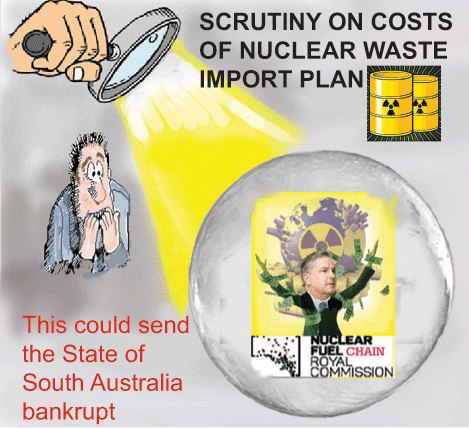 Kazzi Jai .Fight To Stop Nuclear Waste In The Flinders Ranges, 15 Oct 19,
“Down in the Dumps” Report – August 2018
The Full Report is available in the Link below:
https://d3n8a8pro7vhmx.cloudfront.net/conservationsa/pages/9910/attachments/original/1534679998/Down_In_the_Dumps.pdf
Northern Territory Aboriginals call out for climate action as mangroves dieback with heat
 NT traditional owners urge climate change policy makers to witness mangrove devastation ABC News, By Jane Bardon 14 Oct 19, Traditional owners are devastated by the lack of recovery at the site of Australia’s worst recorded mangrove dieback and are calling for action to limit climate change threats.
Key points:
- Scientists have said the severity of the mangrove dieback is on a par with Great Barrier Reef bleaching
- The Top End is experiencing sea level rise at two to three times global averages
- The CSIRO is warning the world is not on track to halt sea level rise
Traditional owner Patsy Evans had hoped there would be signs of recovery at the site of the mangrove dieback, in the Gulf of Carpentaria.
But during a recent visit to the area for the first time since 2015, when she and her husband alerted the Northern Territory Government to the extent of the damage, she was devastated by the scene.
She said she wanted policy makers to see how climate change was affecting the land near her home on the Limmen River, 750 kilometres south of Darwin.
“Go out and see what’s happening, be aware and look at it, and don’t make decisions where you are,” she said.
The mangroves were once nurseries for the mud crab, barramundi and prawn fisheries, but now consist mainly of dead trees and dusty earth.
The few live seedlings coming through are exposed, and vulnerable to damage from the fallen dead trees……
On par with Great Barrier Reef bleaching
“We can’t see any other driver of the dieback other than the extreme climatic envelope has shifted,” Charles Darwin University professor Lindsay Hutley said.
Dr Hutley said the extent and duration of the dieback was on a par with the severity of Great Barrier Reef bleaching………
Polar icecap melting underestimated
The CSIRO has mapped the average sea level rise of the Top End at between six and 13 millimetres a year — two to three times the rate off southern Australia and the global average……… https://www.abc.net.au/news/2019-10-14/climate-change-mangrove-traditional-owners-call-for-action/11598238
Weather experts predict more heat and fire risk coming, though fewer cyclones

|
Australia could see fewer cyclones, but more heat and fire risk in coming months The Conversation, Jonathan Pollock, Climatologist, Australian Bureau of Meteorology, Andrew B. Watkins, Head of Long-range Forecasts, Australian Bureau of Meteorology, Catherine Ganter Senior Climatologist, Australian Bureau of Meteorology. Paul Gregoryn, BOM, Australian Bureau of Meteorology, October 14, 2019
Northern Australia is likely to see fewer cyclones than usual this season, but hot, dry weather will increase the risk of fire and heatwaves across eastern and southern Australia.
The Bureau of Meteorology today released its forecast for the tropical cyclone season, which officially runs from November 1 to April 30.Also published today is the October to April Severe Weather Outlook, which examines the risk of other weather extremes like flooding, heatwaves and bushfires. Warmer oceans means more cyclones On average, 11 tropical cyclones form each season in the Australian region. Around four of those cross the coast. The total number each season is roughly related to how much cooler or warmer than average the tropical oceans near Australia are during the cyclone season……..
when ENSO is neutral, there is little push towards above or below average numbers of cyclones. Temperatures in the tropical Pacific Ocean have been ENSO-neutral since April and are likely to stay neutral until at least February 2020. However, some tropical patterns are El Niño-like, including higher-than-average air pressure at Darwin. This may be related to the current record-strong positive Indian Ocean Dipole – another of Australia’s major climate drivers – and the cooler waters surrounding northern Australia. The neutral ENSO phase alongside higher-than-average air pressure over northern Australia means we expect fewer-than-average tropical cyclones in the Australian region this season. The bureau’s Tropical Cyclone Season Outlook model predicts a 65% chance of fewer-than-average cyclones………. Other severe weatherWhile cyclones are one of the key concerns during the coming months, the summer months also bring the threat of several other forms of severe weather, including bushfires, heatwaves and flooding rain. With dry soils inland, and hence little moisture available to cool the air, and a forecast for clear skies and warmer days, there is an increased chance that heat will build up over central Australia during the spring and summer months. This increases the chance of heatwaves across eastern and southern Australia when that hot air is drawn towards the coast by passing weather systems.
Likewise, the dry landscape and the chance of extreme heat also raise the risk of more bushfires throughout similar parts of Australia, especially on windy days. And with fewer natural firebreaks such as full rivers and streams, even greater care is needed in some areas. Widespread floods are less likely this season……..https://theconversation.com/australia-could-see-fewer-cyclones-but-more-heat-and-fire-risk-in-coming-months-125139 |
|
Climate change – heat -drought – more mass fish deaths to come
The communities preparing for more devastating mass fish deaths in rural NSW, In the first in a series of reports from communities along the Darling River, SBS News meets those who have been impacted by water mismanagement and drought., BY ANEETA BHOLE 14 Oct 19, Rural New South Wales communities are bracing for another ecological disaster, despite efforts to save local fish populations.
More than a million fish died in December 2018 and January this year along the Darling River at Menindee, which was once home to 60 different fish species.
Local fisherman Graeme McCrabb still recalls the stench that saturated the town following what has been called Australia’s largest fish kill on record……….
Disconnected river system
A lack of fresh flows down the river, combined with the drought, are exacerbating the disaster.
“There’s six kilometres of dry riverbed and think when you’re looking at that everyday it’s really confronting,” he said.
“It’s a stark reminder of just how dire the situation is.”…………
Loss of culture
Barkindji man Michael ‘Smacka’ Whyman, lives upstream in Wilcannia.
He said the state of the water system is devastating to his community, the Barkindji people, or ‘Darling River folk’.
“I’d like to see the government stop draining or rivers our national waterways we’re living in the longest river in Australia and they’ve killed,” he said.
“The environmental damage alone is bloody massive.”
In September, an independent review by the state’s Natural Resources Commission found that the Barwon-Darling river system is an ‘ecosystem in crisis’.
The review found: “The weight of scientific evidence is clear: while reduced inflows due to drought, upstream extraction, and climate change are all impacting the flows in the Barwon- Darling, the Plan provisions that allow increased access to low flows have resulted in poor ecological and social outcomes downstream of Bourke.”……….
https://www.sbs.com.au/news/the-communities-preparing-for-more-devastating-mass-fish-deaths-in-rural-nsw
Clean Energy Council slams Federal Nuclear Inquiry as “distraction” from real energy challenges
 CEC slams nuclear inquiry as “distraction” from real energy challenges, https://reneweconomy.com.au/cec-slams-nuclear-inquiry-as-distraction-from-real-energy-challenges-40379/
Sophie Vorrath. 14 October 2019 The Clean Energy Council has delivered a scathing submission to the federal government’s nuclear power inquiry, describing the review itself as a waste of time, and the consideration of nuclear energy as a viable generation source in Australia as “beyond comprehension.”The CEC’s belated submission on the prerequisites for nuclear energy in Australia said the clean energy industry was disappointed the federal parliament had prioritised the inquiry over “much more pressing and worthwhile topics” such as the need for integrated energy and climate policy.
The Clean Energy Council has delivered a scathing submission to the federal government’s nuclear power inquiry, describing the review itself as a waste of time, and the consideration of nuclear energy as a viable generation source in Australia as “beyond comprehension.”
The CEC’s belated submission on the prerequisites for nuclear energy in Australia said the clean energy industry was disappointed the federal parliament had prioritised the inquiry over “much more pressing and worthwhile topics” such as the need for integrated energy and climate policy.
“Inquiries such as this are not only misdirected, but also act as a distraction to addressing the real challenges confronting investors, customers and institutions attempting to facilitate and respond to this transition,” CEC chief Kane Thornton said.
And it said little had changed since past analysis of the topic had concluded that nuclear power was too costly, took too long to develop, and would require “a minor miracle” to win community support.
These factors, considered in the light of the “extraordinary progress” of renewable energy and energy storage, and its potential to deliver reliable, affordable and clean power for Australia, just made the inquiry seem even more ridiculous.
“It is beyond our comprehension as to why Australia would contemplate replacing one dirty energy energy production technology with another that produces large amounts of highly hazardous waste, when it could fulfil its objectives of zero emissions with technologies that are lower-cost, faster to develop and readily available now,” the CEC said.
The submission points to the findings of the CSIRO’s GenCost study of 2018, which puts the cost of small modular reactors in excess of $250/MW/hr, compared to the prices of wind and solar energy at $50/MWh. Firmed wind and solar costs, meanwhile, are now below $70/MWh.
And it points out that the only remaining roadblock to the wholesale shift to renewables in Australia is a political one.
“A lack of federal energy policy and combination of a range of regulatory challenges mean that investment confidence in large-scale renewable energy and the accompanying energy storage is fragile,” the submission says.
“As Australia’s coal fired generation continues to close, there is a clear need for policy and regulatory reform to support the continued deployment of renewable energy and energy storage that will secure system reliability and lower energy prices.”
Barnaby Joyce and former foreign minister Bob Carr urge stopping extradition of Julian Assange to USA
 Barnaby Joyce joins calls to stop extradition of Assange to US, The Age, By Rob Harris, October 13, 2019 Former deputy prime minister Barnaby Joyce has joined calls for the Morrison government to try to halt Julian Assange’s potential extradition from Britain to the United States on espionage charges, as the WikiLeaks founder’s supporters intensify their campaign to bring him to Australia.
Mr Joyce joined former foreign minister Bob Carr in voicing concerns over US attempts to have the 48-year-old Australian stand trial in America, where he faces a sentence of 175 years if found guilty of computer fraud and obtaining and disclosing national defence information.
Also seeking to increase pressure on the federal government is actress Pamela Anderson, who is demanding to meet Prime Minister Scott Morrison to request he intervene in the case. She plans to visit Australia next month.
Assange’s supporters say they are increasingly concerned about his health and his ability to receive a fair trial in the US………
Mr Carr has challenged Foreign Minister Marise Payne to make “firm and friendly” representation to US Secretary of State Mike Pompeo, believing Australians would be “deeply uneasy” at a fellow citizen being handed over to the “living hell of a lifetime sentence in an American penitentiary”.
Mr Joyce, who in 2007 was the first Coalition MP to call for the then Howard government to act over the detention of Australian David Hicks in Guantanamo Bay, said his position was principled and he gave “no opinion of Mr Assange whatsoever”.
“If someone was in another country at a time an alleged event occurred then the sovereignty of the land they were in has primacy over the accusation of another nation,” Mr Joyce said.
“It would be totally unreasonable, for instance, if China was to say the actions of an Australian citizen whilst in Australia made them liable to extradition to China to answer their charges of their laws in China. Many in Hong Kong have the same view.”
Assange is serving a 50-week sentence in Belmarsh Prison in south-east London for bail violations after spending seven years inside the Ecuadorian embassy in London in a bid to avoid extradition to Sweden to answer allegations of rape and molestation in 2012.
In June, the then British home secretary, Sajid Javid, signed an extradition request after the US Justice Department filed an additional 18 Espionage Act charges over Assange’s role in obtaining and publishing 400,000 classified US military documents on the war in Iraq in 2010.
Mr Carr, the former NSW premier who served as foreign minister in the Gillard government, said he understood many people would have reservations about the “modus operandi” of Assange and his alleged contact with Russia.
Mr Carr said the Morrison government should make strong representations to the US on behalf of an Australian citizen who “is in trouble because he delivered on our right to know”.
“I think the issue will gather pace and in the ultimate trial there’ll be a high level of Australian public concern, among conservative voters as much as any others.”……..
Mr Carr said the Morrison government should make strong representations to the US on behalf of an Australian citizen who “is in trouble because he delivered on our right to know”.
“I think the issue will gather pace and in the ultimate trial there’ll be a high level of Australian public concern, among conservative voters as much as any others.”…….https://www.theage.com.au/politics/federal/barnaby-joyce-joins-calls-to-stop-extradition-of-assange-to-us-20191013-p53080.html
Kalgoorlie Mayoral Candidate John Katahana wants a Small Nuclear Reactor for the town
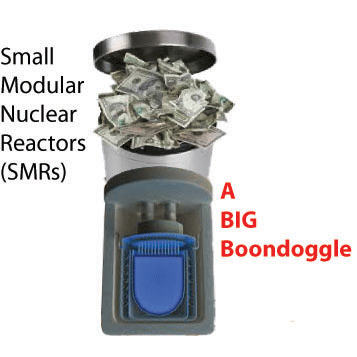 Cannabis, nuclear power and Mardi Gras: General Hercules’ out-of-this-world pitch for Kalgoorlie mayoral tilt, The West Australian,
Pamela Anderson to confront Scott Morrison and plead for Australia to help Julian Assange
Pamela Anderson is on her way to Australia, and she’s challenging our Prime Minister on entry.
The former Baywatch superstar is headed to the Gold Coast next month to shoot a series of ‘Unexpected Situation’ commercials for Ultra Tune.
The ads are expected to air over summer, in conjunction with the 2020 Australian Tennis Open and Big Bash Cricket.
She’s no stranger to the land down under, after her affiliation with jailed Wikileaks founder and Australian, Julian Assange, gained world-wide attention.
Late last year, Anderson made a public plea on 60 minutes for Prime Minister Scott Morrison to do more to help. “Defend your friend, get Julian his passport back and take him back to Australia and be proud of him, and throw him a parade when he gets home,” Ms Anderson said.
Scott Morrison then told 1029 Hot Tomato’s Flan, Emily Jade and Christo that he’s had “plenty of mates who’ve asked me if they can be my special envoy to sort the issue out with Pamela Anderson.”
Ms Anderson called out the comments as ‘disappointing’, ‘smutty’, and ‘unnecessary’, and is now – a year later – wanting to address them face to face.
She’s announced she’ll again be petitioning him to intervene on Julian Assange’s behalf.
“What is also important to me about this visit is the opportunity to speak to the Australian people and petition Prime Minister Morrison to intervene on behalf of Australian citizen, Julian Assange, who is being made a scapegoat of and suffered inhumanely for disseminating factual information we all should know about.
“Mr Morrison made a series of personally, disparaging remarks about me and I’d like to challenge him to debate this matter in front of the Australian people,” Ms Anderson said in a recent statement.”
Sources of content : http://www.mygc.com.au/pamela-anderson-challenges-scott-morrison-ahead-of-australia-visit
Government study found Kimba and Flinders Range areas to be unsuitable for nuclear waste dump
Fight To Stop Nuclear Waste Dump In Flinders Ranges https://www.facebook.com/groups/941313402573199/ 11 Oct 19
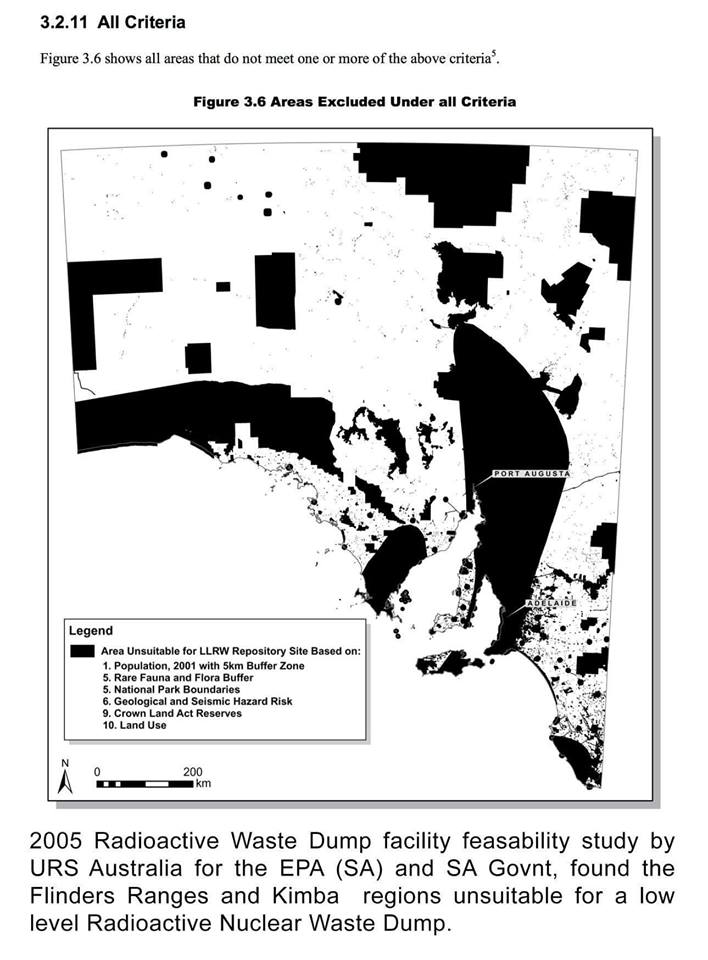
A 2005 feasibility study by URS Australia for the SA government found both Flinders Ranges and Kimba unsuitable for Radioactive Nuclear Waste Dump. Anyone told Canavan and Marshall?
Kimba ballot on nuclear waste dump- a good idea, but very badly done
 Flinders Local Action Group, Dave Sweeney,Australian Conservation Foundation–12 Oct 19
WASTE The federal government ballot to measure community sentiment over plans for a radioactive waste facility near Kimba is a good idea that has been very badly done.
Clearly, affected local communities should have a say in decisions with direct impacts, and hosting radioactive waste that lasts 10,000 years would certainly impact.
But to make an informed decision a community needs access to detailed and accurate information. This is missing at Kimba. There is little or no detail on waste acceptance criteria, transport and handling procedures, or future plans for the most contaminating waste.
The community is effectively being asked to give a blanket approval to a concept, not measured consideration of a specific proposal.
The federal government wants to set up a purpose built facility: national in
scope, long term in duration and intended to host Australia’s most problematic
radioactive waste.
This problem was not created by the people of Kimba, nor is it their sole responsibility to solve.
The federal approach has been to shrink the space for a discussion around this waste and to seek to turn a needed national debate into a local infrastructure opportunity and bidding war.
This approach has been divisive, failed to consider other options and has not
provided people in the wider Eyre Peninsula or South Australia with a voice.
Securely managing radioactive waste is a complex and costly challenge and giving Canberra a blank cheque for a bad plan is not a good idea.
The role of climate change in Australia’s early bushfire season
Climate change partly to blame for early bushfire 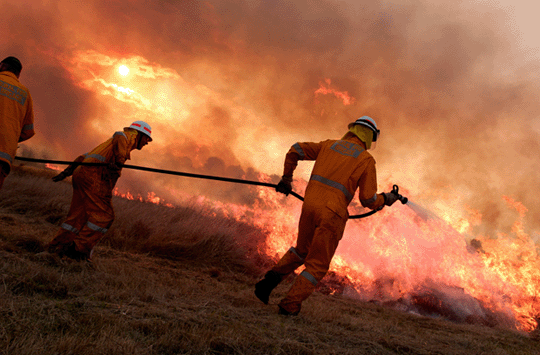 season, New analysis confirms the relationship between climate drivers such as El Niño, climate change and the Australian bushfire season, Guardian, Chris Lucas and Sarah Harris for The Conversation, 11 Oct 19
Summer might be more than six weeks away but out-of-control bushfires have already torn across parts of eastern Australia in recent days, killing two people, destroying homes and threatening more lives.
By Wednesday afternoon up to 30 homes were feared lost or badly damaged by bushfires burning in northern New South Wales. About 40 fires burned across the state.
This did not surprise meteorologists and fire agencies. Record-breaking heat and windy conditions were forecast for parts of NSW and Queensland this week, prompting severe fire danger ratings.
We’re often told the Australian bushfire season is starting earlier. This year it began in September on the eastern seaboard. Last year and in 2013 significant spring fires hit NSW and in 2015 they affected much of the nation’s southeast.
But what lies behind this phenomenon? We examined seasonal fire weather history for 44 years at 39 weather stations to find the answer.
This analysis is the most comprehensive ever conducted in Australia. It confirms the strength of the relationship between climate drivers such as El Niño, climate change and the Australian bushfire season. It also demonstrates that a few milder bushfire seasons do not mean climate change isn’t happening.
Hot, dry, windy conditions spell fire trouble
The prerequisites for a severe bushfire season are high temperatures, low humidity, and strong winds that coincide with long periods of low rainfall.
These weather ingredients are used to calculate an area’s fire danger rating, using the forest fire danger index. The index produces a score reflecting the severity of fire weather on a given day, where zero represents minimal anger, 50 represents conditions where a fire ban may be issued, and 100 is potentially catastrophic………
Climate change is a culprit too
The changed conditions have led to an average increase in severe seasonal bushfire weather across Australia, especially in southern parts of the continent. The increased severity affects all seasons but in particular spring, which means that, on average, the bushfire season is starting earlier.
Pulling it all together
Our research has made clear that climate modes bring large and rapid swings to the fire weather, while human-induced climate change gradually increases background fire weather conditions. The trend generally means an earlier start to the bushfire seasons than in the past.
Similarly, a few milder bushfire seasons among a string of record high seasons do not mean that climate change should be dismissed.
- Chris Lucas is a senior research scientist at the Australian Bureau of Meteorology and Sarah Harris is manager research and development at the Country Fire Authority.https://www.theguardian.com/australia-news/2019/oct/11/climate-change-partly-to-blame-for-early-bushfire-season
Navy chief looks to nuclear submarines for Australia

Vice Admiral Mike Noonan has opened an international maritime conference in Sydney, where he says defence is keeping a close eye on emerging technologies.
By Andrew Greene on AM 9 Oct 19, Australia’s navy chief says it’s possible the country’s future submarine fleet could eventually switch to nuclear power.
Vice Admiral Mike Noonan has opened an international maritime conference in Sydney, where he says defence is keeping a close eye on emerging technologies.
More bribery to Kimba and Hawker communities as nuclear waste dump ballot nears

Robyn Wood, 9 Oct 19, More bribes for both Kimba and Flinders communities to sway the vote. This government is so blatant. To say the community needs mental health support for those distressed by the dump is a massive insult. My excerpts with underlining of the unbelievable bits:
Federal government announces $4 million funding program for communities in radioactive waste debate, Transcontinental
A new benefit program has been announced for communities at the crux of the radioactive waste facility debate.
The federal government has revealed a $4 million funding program for each of the two communities considering the facility, around Kimba and Wallerberdina Station.
Minister for Resources and Northern Australia Matt Canavan said the new funding is a response to community feedback and reflected the delays in the site selection process.
Consultation on the proposed facility commenced in 2016.
“We recognise that the communities have engaged in debate in good faith and we remain committed to supporting them through the site selection process. This investment will support the communities as well as deliver projects and initiatives that can further diversify the local economies,” he said.
“The Flinders Ranges and Kimba are great country places that I have had the pleasure to get to know better through this process.
“We have been listening to the community and we are responding, particularly with respect to investing in services that support the wellbeing of people in these local communities.”
A range of projects and initiatives can meet the criteria for funding through the program, including local infrastructure upgrades, services, apprenticeships and mental health initiatives.
The funding is not dependant on the results of the upcoming ballots which will take place in the District Council of Kimba and the Flinders Ranges Council.
An additional $31 million will also be available through a Community Development Package for the community chosen to host the proposed facility.
Radioactive waste is currently spread over more than 100 locations around Australia and the federal government wants to see it consolidated into a single purpose built facility in line with international best practice.
But Australian Conservation Foundation’s Dave Sweeney said there is no urgency to move the material and more conversations are needed.
“There is no radioactive waste management crisis in Australia,” he said.
“95 per cent of the material that will head to any site in South Australia is currently in secure storage under federal control today, and it will be tomorrow, and it will be for a year and can be for 35 more years.
“The federal regulator, the Australian Radiation Protection and Nuclear Safety Agency, has said repeatedly that there’s no urgency to move the most severe and the most problematic material which is the intermediate level waste which is currently based at Lucas heights in Sydney.”
Voting commences in the District Council of Kimba this week, while the Flinders Ranges Council have confirmed that it will hold a community ballot between November 11 and December 12.
Dr Jim Green addresses Australia’s Federal Nuclear Inquiry
Dr Green: Thanks for the invitation to speak. Mr O’Brien, I would respectfully ask you to revisit and reconsider your express view that small modular reactors and other new technologies are leading to ‘cleaner, safer and more efficient energy production’. That argument would be compelling if there were fleets or networks of these SMRs operating anywhere in the world and operating successfully, but as you know, and as Dr Switkowski mentioned in his testimony, there are no such networks anywhere in the world, so we have no idea if or how a network of SMRs might operate in Australia. Further, there isn’t even one single SMR operating anywhere in the world. There isn’t even one prototype SMR operating anywhere in the world. So operating SMRs, of which there are precisely none, clearly provide no basis for arguing that new technologies are leading to cleaner, safer and more efficient energy production.
The next level of evidence that we would logically turn to would be SMRs under construction. And if we ignore the icebreakers, and the floating nuclear power plant under construction by the Chinese and Russian governments, then we’re left with just two SMRs under construction. One is the disaster in Argentina, which has been several decades in gestation. The latest cost estimate for that is $32.4 billion per gigawatt, so wildly uncompetitive. The second one is China’s high-temperature SMR. There’s not a great deal that we know about that reactor, but we do know that plans for 18 further high-temperature SMRs at the same site have been dropped—to use the language from the World Nuclear Association. There have clearly been cost overruns. There have clearly been delays. It’s not terribly promising.
Given the absence of any operating SMRs and the unpromising nature of the two under construction, or the two relevant ones under construction, the argument that SMRs are leading to cleaner, safer and more efficient energy production could only possibly be justified with reference to paper designs until the unproven claim is promoted by the nuclear industry. It ought to be obvious, and I’m sure it is obvious, to everyone here that paper designs and corporate claims are no basis for public policy, especially given the history of the past decade.
The current cost estimates for EPR reactors in the UK are seven times greater than the estimates going back to the mid 2000s—not seven per cent greater or even 70 per cent greater but 700 per cent greater. It’s even worse in the United States where the current cost estimates for AP1000 reactors are 10 times greater than the numbers being floated by Westinghouse in 2006, a 1,000 per cent increase. So we need to be incredibly sceptical with corporate cost claims. I think a good starting point for those claims is to add a zero onto the end and it’s a good chance that your estimate would be better than the company estimates.
NuScale is said to be the next big thing in the SMR world, if only because most of its competitors have collapsed. It’s notable that the South Australian royal commission’s estimate of NuScale costs is 2.4 times higher than NuScale’s own estimate. That’s highly significant because if NuScale can deliver power at its projected costs it will certainly be competitive. But if the royal commission’s figures are correct, as I believe they will be and quite possibly understanding the real costs, then it’s not going to be competitive. The royal commission’s figure was $225 per megawatt hour……….
The private sector is not prepared to bet billions of dollars on SMRs, not even to get a prototype up and running. This is what we see in the US, the UK, Canada and elsewhere. It will not build a single prototype in the absence of very large amounts of taxpayer subsidies, amounting at a bare minimum to hundreds of millions of dollars and almost certainly into the billions of dollars. To date governments are resisting. The British government has invested tens of millions of pounds in grants, but that would need to be increased by one to two orders of magnitude if a single prototype is to be built, let alone a fleet of SMRs. In the US, government largesse has amounted to roughly half a billion dollars. Once again, it’s not even close to getting a single prototype off the ground. The debate in Canada is at an earlier stage, and they haven’t come up with any serious ideas about how they’re going to get a single prototype SMR funded, let alone a fleet of SMRs.
The only thing that would actually change in Australia if the ban against nuclear power were repealed is that nuclear companies would descend on Canberra to try to gouge as much taxpayer money as they could possibly get from the federal government. That would be the one practical change. Dr Switkowski told the committee that, because of Australia’s prohibition against nuclear power, the US company TerraPower can’t collaborate with an Australian company. But if an Australian company were rich or brave or crazy enough to invest in TerraPower, they’d be most welcome. TerraPower, like all of these other companies, has no intention of building even a single prototype in the absence of huge taxpayer subsidies. So, once again, if Australia’s legal prohibition against nuclear power were repealed, the only change would be that TerraPower company representatives would be lined up outside ministerial offices trying to stitch together a package of direct and indirect taxpayer subsidies.
There are dozens of start-ups involved in the SMR sector and the advanced reactor sector. There are said to be well over 50 in the United States alone. But if all of those companies pooled all of their money into one single pot it’s highly doubtful they would have enough money to build one single prototype—hence the attempts to get billions of dollars of taxpayer money. The executive summary from our joint NGO submission includes a very long and growing list of failed SMR and advanced reactor projects, and there have been further failures in the short time since this committee was initiated.
Finally, Mr O’Brien, in light of the findings of the South Australian royal commission, I would ask you to reconsider your expressed view that SMRs are leading to cleaner, safer and more efficient energy production. The royal commission investigated these issues in detail. It commissioned expert research, and the royal commission concluded:
… fast reactors or reactors with other innovative designs are unlikely to be feasible or viable in South Australia in the foreseeable future. No licensed and commercially proven design is currently operating. Development to that point would require substantial capital investment. Moreover, the electricity generated has not been demonstrated to be cost-competitive with current light water reactor designs……
Julian Assange and Wikileaks have exposed nuclear scandals
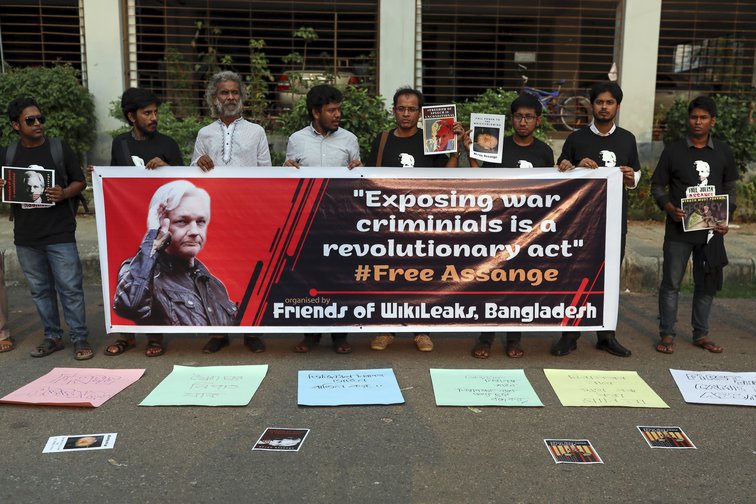
What we know about nuclear weapons and the nuclear industry thanks to WikiLeaks
“The Nobel Peace Prize will be awarded on 11 October. Why I support the nomination of Julian Assange and WikiLeaks.” Open Democracy, Felicity Ruby, 7 October 2019 The Nobel Peace Prize will be awarded on 11 October. Julian Assange and WikiLeaks have been nominated for the prize again this year, as they have since 2010. As the first staffer of the campaign that won the Peace Prize in 2017, the International Campaign to Abolish Nuclear Weapons (ICAN), I support this nomination for a number of reasons.
Below are just ten examples of where WikiLeaks exposed wrongdoing on the part of governments and corporations that meant citizens could take action to protect themselves from harm, or governments were held to account:
After the Chalk River nuclear reactor was shut down for routine maintenance on 18 November 2007, inspectors verified the reactor’s cooling systems had not been modified as required by an August 2006 licensing review. Atomic Energy of Canada Limited (AECL) did not start the reactor but said upgrades could be done as part of maintenance while still operating safely. This impasse lasted a month, with the government intervening to grant an exemption to the reactor to allow its restart. The responsible Minister for Natural Resources, Gary Lunn MP, fired Linda Keen, the President of the Nuclear Safety Commission. Their exchange of letters revealed much about the safety standards and routine practices of the Canadian nuclear regulatory system, and particular problems with the ageing Chalk River reactor previously unknown to the public.
– Footage of the 1995 disaster at the Japanese Monju nuclear reactor – released 25 January 2008
Following the 2008 announcement that the Japanese Monju fast breeder nuclear reactor would be reopened, activists leaked the suppressed video footage of the sodium spill disaster that led to its closure in 1995. Named after the Buddhist divinity of wisdom, Monju, located in Japan’s Fukui prefecture, is Japan’s only fast-breeder reactor. Unlike conventional reactors, fast-breeder reactors, which “breed” plutonium, use sodium rather than water as a coolant. This type of coolant creates a potentially hazardous situation as sodium is highly corrosive and reacts violently with both water and air. On December 8, 1995, 700 kg of molten sodium leaked from the secondary cooling circuit of the Monju reactor, resulting in a fire that did not result in a radiation leak, but the potential for catastrophe was played down the extent of damage at the reactor and denied the existence of a videotape showing the sodium spill. Further complicating the story, the deputy general manager of the general affairs department at the PNC, Shigeo Nishimura, 49, jumped to his death the day after a news conference where he and other officials revealed the extent of the cover-up.
– Serious nuclear accident lay behind Iranian nuke chief’s mystery resignation – released 16 July 2009 WikiLeaks revealed that a source associated with Iran’s nuclear program confidentially told the organisation of a serious, recent, nuclear accident at Natanz. Natanz is the primary location of Iran’s nuclear enrichment program and the site targeted with the Stuxnet worm that contained 4 zero days and was designed to slow down and speed up centrifuges enriching uranium. WikiLeaks had reason to believe the source was credible, however contact with this source was lost. …………..
WikiLeaks and Assange have brought forward many truths that are hard to face, publishing well over 10 million documents since 2006. Often forgotten is that each one was provided by a whistleblower who trusted this platform to publish, and who sought reform of how political, corporate and media power elites operate. Each release has shared genuine official information about how governments, companies, banks, the UN, political parties, jailers, cults, private security firms, war planners and the media actually operate when they think no one is looking.
Assange is nominated for the Nobel Peace Prize because of these many releases of information, used as evidence in court cases, freeing prisoners and exposing scandals, torture, murder and surveillance for which redress is only possible when the wrongdoing is dragged into the light. For publishing this true information, Assange, an Australian based in the UK at the time of publication, is on the health ward of Belmarsh Prison, facing extradition and charges attracting 175 years in a US jail, an effective death sentence….. https://www.opendemocracy.net/en/can-europe-make-it/what-we-know-about-nuclear-weapons-and-nuclear-industry-thanks-wikileaks/
1 This month.
20 September –National Day of Action in Melbourne on the International Day of Peace


Help Aunty Sue Protect Her Land and Sacred Sites From Destructive Rocket Testing.
.

Australians deserve the truth
about
AUKUS – https://aukuspublicinquiry.com/
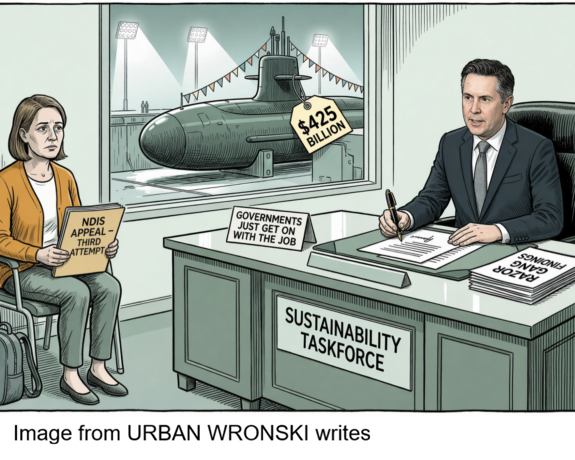

PETITION – To: Prime Minister Anthony Albanese and the Australian Labor Government

of the week – Australians for War Powers Reform (AWPR)
To see nuclear-related stories in greater depth and intensity
 Antinuclear