Federal nuclear waste dump plan- it’s really High Level wastes!

Thing about this waste dump is, it is not “low” level At all but a Intermediate nuclear waste dump
Intermediate-level waste (ILW) contains higher amounts of radioactivity compared to low-level waste. It generally requires shielding, but not cooling. Intermediate-level wastes includes resins, chemical sludge and metal nuclear fuel cladding, as well as contaminated materials from reactor decommissioning
By standards in Europe, this is classified high , they say it’s only gloves and other stuff, but don’t go into detail about the the intermediate material, what are they really trying to do? Is this the High Level Nuclear Dump by the back door?
Come on South Australia wake up and smell what Canberra is cooking, they want us to be the dump state https://www.facebook.com/groups/941313402573199/
Climate protest in Perth: arrests in Sydney, Brisbane – Melbourne?
|
Dozens arrested on east coast as Extinction Rebellion protests begin https://thewest.com.au/news/environment/dozens-arrested-on-east-coast-as-extinction-rebellion-protests-begin-ng-b881345425z
Geoff Parry, 7NEWS ,Monday, 7 October 2019 Dozens of people have been arrested at climate change rallies on the east coast of Australia.
Protests organised by the group Extinction Rebellion have been held in most capital cities, including Perth. About 100 “climate protectors” started at Elizabeth Quay and walked through the city, eventually finishing at Yagan Square. As promised by the organisers disruption was kept to a minimum and no arrests. In Sydney about 30 people were arrested by police, including some elderly demonstrators and school-age children. Hundreds of them blocked a major street near Central Station forcing police to remove some of them. Several handcuffed themselves to a water tank to frustrate police. In Brisbane several people were detained by police as several hundred marked through the centre of the city. They stopped at a number of intersections along the way deliberately blocking traffic for long periods. In Melbourne a big climate change rally is getting underway this afternoon with organisers predicting there will be arrests. Here in Perth they described today’s rally as an introduction to a week or protests and promised this is just the beginning.We feel the disruption is justified, warranted and actually long overdue,” Extinction Rebellion spokeswoman Jesse Noakes said. “Unfortunately there is major major disruption coming whether we like it or not.” They say their big protest day will be Friday. |
|
Arrests in the global climate rebellion
Protesters chained themselves to vehicles and other structures and lay down in the middle of streets in defiance of police across Europe and parts of Asia, Africa and North America.
Protesters chained themselves to vehicles and other structures and lay down in the middle of streets in defiance of police across Europe and parts of Asia, Africa and North America.
Police had made 217 arrests by 17:15 pm (1615 GMT).
“Getting arrested sends a message to the government that otherwise law-abiding citizens are desperate,” IT consultant Oshik Romem, from Israel but working in Britain for 19 years, told AFP while sitting on a road outside parliament.
‘Running out of time’
Hundreds of Australians joined a sit-in on a busy inner Sydney road before being dragged away by the police. Thirty people were later charged.
“We have tried petitions, lobbying and marches, and now time is running out,” Australian activist Jane Morton said.
Australia’s conservative government has resisted adopting new environmental standards and backed lucrative coal exports.
Protests occurred in 60 cities around the world, including New Delhi, Cape Town, Paris, Vienna, Madrid and Toronto.
At New York’s Battery Park, some 200 demonstrators took part in a “funeral march” to Wall Street, where protesters threw fake blood over the financial district’s famous bronze statue of a bull.
“We need imagery like this in order to get people’s attention,” 29-year-old James Comiskey told AFP, as he carried a cardboard coffin in the procession.
‘Burn capitalism!’
The movement is partially credited with pushing the UK government in June to become the first in the Europe Union to commit itself to a net-zero target for harmful emissions by 2050.
Extinction Rebellion is demanding governments reach that target by 2025, as well as holding “citizens assemblies” to decide on policies to achieve that aim.
The parliament in Norway, not an EU member, in June adopted a target of 2030.
There has been less movement in other parts of Europe or the most impacted cities of Asia.
And not everyone out on the streets was impressed with the campaign.
“They’re taking it out on everyday people trying to go about their business. They should go after big people,” London taxi driver Dave Chandler told AFP.
Extinction Rebellion counters that emergencies like the one heating up the climate demands action from everyone across the world.
Hundreds barricaded themselves inside a Paris shopping center for hours over the weekend. Groups unfurled banners with slogans such as “Burn capitalism, not petrol” above Paris restaurants and fashion boutiques.
And hundreds brought blankets and sleeping bags to one of the main roundabouts in central Berlin which police expect to be shut down for many days.
Extinction Rebellion’s tactics in Australia prompted senior conservative politicians to call for protesters’ welfare payments to be cut.
Sydney assistant police commissioner Mick Willing accused protesters of putting themselves and others at risk, warning that such disruptive protests in the future would “not be tolerated”.
David Glynne Jones on the unwisdom of nuclear power for Australia in a heating climate
 Inquiry into the prerequisites for nuclear energy in Australia Submission 249 David Glynne Jones
…………4. Australia’s fresh water supplies are already under extreme pressure to meet 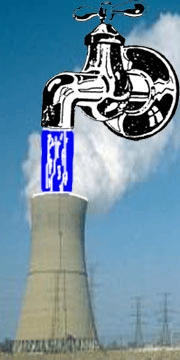 existing and future environmental flow, agricultural, urban and industrial requirements, and the use of very large quantities of fresh water for the cooling of nuclear power stations is unlikely to be either viable or acceptable.
- Consequently the only likely viable option will be to use seawater cooling, requiring nuclear power stations to be located close to the coastline, and with significant environmental impacts on affected coastal waters resulting from water heating and very large water flows.
- By comparison, solar photovoltaic and wind turbine generating systems do not require the use of any significant water resources for cooling……..
Energy affordability and reliability
 Recent European experience has shown that nuclear power generation is not reliable during extreme heatwave conditions, with nuclear power stations being required to operate at reduced power levels or shutdown completely.
- Given that the future climate outlook for Australia is longer hotter heatwaves during the summer, this must be given serious consideration in any decision to adopt nuclear power generation in Australia.
- There is no evidence that nuclear power generation using either LMR or SMR technology can compete with other emerging 21st century electricity generation technologies, which are evolving at an increasingly high rate and have gained broad market investor confidence.
- The AEMO/CSIRO GenCost 2018 report projects capital and operating costs for both LMR and SMR technology at uncompetitive levels for the foreseeable future.
- There is no evidence of market investor appetite for nuclear power generation investment in the absence of government subvention.
- The UK SMR program has a NOAK target of GBP 60/MWh (~ AUD 110/MWh), but this cannot be demonstrated until a significant number of reactors haved been built and operated for a significant period. The FOAK target is GBP 75/MWh (~ AUD 140/MWh).
-
- The report found that “Investing in a nuclear power plant is uneconomical. This This
holds for all plausible ranges of specific investment costs, weighted average cost of
capital, and wholesale electricity prices”.-
 Economic feasibility
 - A recent report published by the German Institute for Economic Research (known as DIW Berlin) reviewed the development of 674 nuclear power plants built since 1951, finding that none of the plants was built using ‘private capital under competitive conditions’. A full copy of the report is available at https://www.diw.de/documents/publikationen/73/diw_01.c.670581.de/dwr-19-30-
1.pdf. holds for all plausible ranges of specific investment costs, weighted average cost of capital, and wholesale electricity prices”.
-
-
- It would be sensible for the Committee to seek input from the energy investment
- It is highly unlikely that the commercial insurance industry would ever be prepared
- The cost of firmed renewable-generated electricity is already as low as AUD
- For a proposed Australian nuclear power generation industry capacity of 20 GWeThe report found that the expected economic loss for a 1000 MWe (1 GWe) nuclear power station would be in the range of Euro 1.5-8.9 billion – approximately AUD 2.4-14.4 billion).this would translate to a future economic loss in the range of approximately AUD50-300 billion………..
10.The biggest risk for potential market investors in nuclear power generation is the future uncertainty created by competing technologies, given that there is currently no operational evidence that nuclear power generation can ever compete directly with other electricity generation technologies. 70/MWh (https://reneweconomy.com.au/stunning-low-costs-inspire-alinta-to-rampup-renewables-push-flag-early-coal-exit-82836/), and is likely to reduce further over the next two decades.
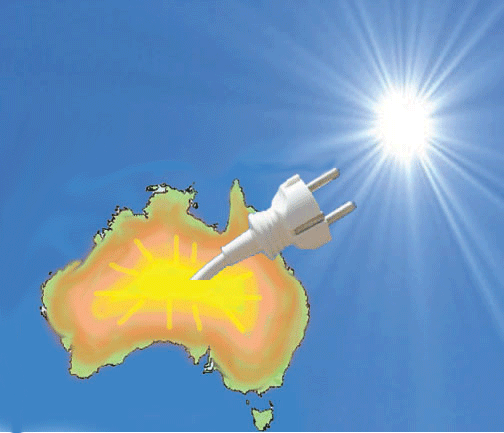
 12.Australia has a superabundance of solar energy resources – the largest of any nation state in the world. At current solar energy conversion efficiencies Australia has the potential to produce 30% of the world’s current electricity demand from just 1% of its land area (by comparison agriculture uses 53% of Australia’s land area).
13.The increasing technological and commercial viability of long distance HVDC transmission means that Australia will be able to export highly competitive low cost renewably generated electricity directly to the Asian market. to underwrite the risks of catastrophic failure, and consequently this will need to be underwritten by government (ie taxpayers), as is currently the case in other countries with nuclear power industries. and insurance industries.
- The cost of firmed renewable-generated electricity is already as low as AUD
- It is highly unlikely that the commercial insurance industry would ever be prepared
- It would be sensible for the Committee to seek input from the energy investment
- The report found that “Investing in a nuclear power plant is uneconomical. This This

Senator Sarah Hanson-Young defending the right to peacefully protest


The right to peacefully protest is at the core of our democracy. Home affairs Minister Peter Dutton threat to cancel welfare payments of climate protesters is an attempt to silence their views and is completely inappropriate.
Rather than resort to serious threats and attempt to shut down community views, the Government should come up with a national plan for dealing with the climate crisis that we’re in.
Article: Peter Dutton opens door to cancelling welfare of climate protesters, The Australian:
https://www.theaustralian.com.au/…/4907f2938e9099f2f7db1680…
Labor challenge to nuclear power fan MP Keith Pitt – where would you put nuclear reactors?
|
The LNP Party in Queensland is considering to open a nuclear plant
By SAHAR MOURAD FOR DAILY MAIL AUSTRALIA, 5 October 2019 A chilling warning has been issued of a ‘Fukushima-style’ disaster in Australia as the LNP continue to push to explore nuclear power. Nuclear power is currently a banned source of power in Australia despite the country having the world’s biggest uranium reserves, but the Queensland Government is looking to open a nuclear power plant in Maryborough. Bruce Saunders, the Labor member for Maryborough in Queensland’s Legislative Assembly, has slammed Keith Pitt – the LNP member for the federal seat of Hinkler – for his push to open the ‘Fukushima-style’ nuclear plant. ‘Mr Pitt – the man behind it all – owes it to our community to declare where he sits in the widening rift that is LNP energy policy,’ Mr Saunders told The Chronicle. …….. https://www.dailymail.co.uk/news/article-7540527/Chilling-warning-Fukushima-style-nuclear-disaster-Australia-government-pushes-forward.html |
|

Australia’s drought disaster a political disaster too, for its climate-sceptic Morrison govt?
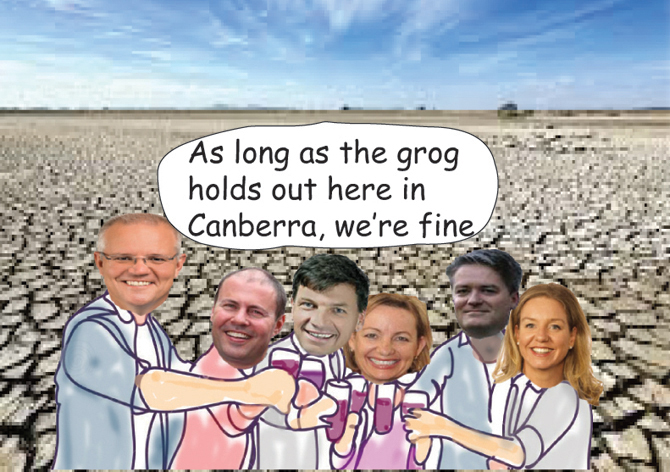
Inadequate drought preparation may prove to be political disaster too, Brisbane Times, Tony Walker 4 Oct 19
Panicky. That’s a word to describe the Morrison government’s response to a national drought emergency. Lack of rain, arid conditions, scorching winds and higher temperatures are contributing to an evolving disaster against the background of a contentious climate change debate.
This is a challenge that will become increasingly difficult for the governments, federal and state, to ignore as water supplies run down in New South Wales towns such as Dubbo and Queensland towns such as Stanthorpe. Risks of bushfire will be further elevated.Judging by Bureau of Meteorology forecasts, drought over much of eastern Australia is set to surpass all others in living memory going back to the beginning of record keeping. In other words, things may get a lot worse before they get better. What is left unspoken by government officials and farm representatives is this aridity will prove to be the new normal. Let’s repeat these words in capitals: NATIONAL DROUGHT EMERGENCY.
It might also be observed that no less than a drought emergency, this is a POLITICAL EMERGENCY for the Morrison government. Governmental responses, both federal and state, to a catastrophic dry across central and northern New South Wales and southern Queensland have been unfocused, according to farm representatives. Tony Mahar, chief executive of the National Farmers’ Federation, the peak body for Australian farmers, awards federal and state governments a “fail” when it comes to developing a national drought strategy to deal with emergencies. “No government, red or blue, has successfully nailed drought policy,” Mahar tells me.
Government inattention may well reflect agriculture’s diminishing share of the national economy at just three per cent of Gross Domestic Product. On the other hand, 1.6 million jobs reside in the complete agricultural supply chain. Prime Minister Scott Morrison’s dash – on his return to Australia from a state visit to the United States – to Dalby in the heart of drought-stricken southern Queensland to announce a $100-million relief package as part of an overall $7-billion allocation reflects government political concerns.
Morrison himself would not need reminding that the 2001-2010 millennium drought contributed to John Howard’s undoing, given he was perceived – rightly or wrongly – to be indifferent to climate change. At least six Coalition seats are at risk in the face of seething local anger over water mismanagement, or no management at all. In all of this, what tends to be overlooked is that the government has a wafer-thin majority of one after the Speaker is excluded……….
Finally, the latest Bureau of Meteorology bulletin provides little encouragement to believe that drought conditions will ease in the short term. The BOM reports the lowest rainfall on record extending from the Great Dividing Range as far as Dubbo and Walgett in central NSW. This is a huge swathe of the country under some of the most extreme drought conditions in the history of white settlement. Only the peak of the terrible 1900-02 “Federation Drought” was worse.
This is bad enough but meteorologists at the BOM are also reporting that a phenomenon known as sudden strategic warming above the South Pole risks contributing to a further deepening of the drought. The SSW effect would cause warmer westerly winds to track north, intensifying drought conditions in southern Queensland and northern New South Wales. If those forecasts prove correct, distinctions between a natural disaster and a national emergency will certainly become moot. Regardless, in a cloudless sky, these weather conditions will constitute an accelerating political emergency. https://www.brisbanetimes.com.au/national/governments-scandalously-little-drought-preparation-is-accelerating-disaster-20191004-p52xmv.html
With temperatures heading for 40C, New South Wales and Queensland at bushfire risk
 Large swathes of NSW at bushfires risk as temperatures set to reach 40Cm
 Bourke and Brewarrina brace for 40C day as dust storms set to sweep western parts of state, Guardian, Australian Associated Press, Sun 6 Oct 2019 The Bureau of Meteorology says an unseasonal heatwave hitting western and north-western New South Wales could demolish October heat records and place large swathes of the state at bushfire risk.While Sydney’s top temperature was expected to reach a mild 23C on Sunday, Bourke and Brewarrina braced for their first 40C day since March.
Wilcannia, Cobar and Dubbo were also set to exceed 37C while dust was forecast for most parts west of Griffith and Bourke.
The BoM warned the fire danger rating in almost every NSW/ACT region was high or very high for Sunday, prompted by heat, high winds and low humidity.
By early afternoon, no bushfires were rated higher than “advice” alert level.
Meteorologist Jake Phillips said the bureau was particularly concerned by conditions to the west of the Great Dividing Range. “It’s quite unusual to see temperatures this warm,” Phillips said.
“In large areas of the state we’re seeing daytime temperatures between 8C and 12C above average for this time of the year, and in some places more.
“As we move into tomorrow, it’s quite likely we will see some places getting pretty close to or maybe breaking October records, the most likely areas being the northern tablelands and north-west slopes.”
Very high fire danger was forecast in ACT and 10 NSW regions: greater Hunter, central ranges, southern ranges, Monaro alpine, lower central west plains, upper central west plains, far western, New England, northern slopes and north western. On Sunday afternoon none were yet subject to total fire bans.
All other regions except eastern Riverina had a high fire danger rating…..
The BoM said Queensland was also set to scorch through another heatwave this week, with hot, dry and windy conditions increasing fire danger, particularly in the south-east….. https://www.theguardian.com/australia-news/2019/oct/06/bushfire-danger-soars-as-parts-of-nsw-forecast-to-reach-40c
Tasmanian renewable energy projects tipped to pour $6.5 billion in state’s economy
Premier Will Hodgman says the state will benefit from an economic injection of $6.5 billion through two key renewable energy projects.
Mr Hodgman said the business case for a second interconnector was stronger after new analysis from TasNetworks showed the Marinus Link project would be able to transport a higher amount of energy to the mainland as previously anticipated……. https://www.examiner.com.au/story/6423824/states-energy-potential-better-than-anticipated/?cs=95
Energy Efficiency the FIRST FUEL – a top Submission from Brenda Hugget
Submission to the Inquiry into the prerequisites for nuclear energy in Australia Brenda Huggett Submission 235
My submission will mainly focus on these two terms of reference:
- energy affordability and reliability
- Economic feasibility
The invitation to make a submission to this inquiry is headed by this statement:
The Australian Government supports an energy system which delivers affordable and reliable energy to consumers while fulfilling Australia’s international emissions reduction obligations.
I thoroughly endorse this aim, but would like to ensure that the Committee of Inquiry draws into this‘energy system’ a serious effort towards ENERGY EFFICIENCY – what the international Energy Agency and the G7 Ministers at their 2016 Japan meeting called the ‘first fuel’ – with its massive potential to power industry and homes cheaply, incrementally and with zero risks or cost blowouts.
At the same time the National Electricity Market is seeing a significant increase in capacity in intermittent low emissions generation technologies…
I believe this sentence should have been followed with “However the dramatic developments in a range of options to store PV and wind energy for ‘when the sun don’t shine and the wind don’t blow’ (the folksy way to refer to the ‘intermittency’ of renewables!) just may – over the coming decade or so – show Australia that it really can rely on renewables so we can truly phase out the last of our fossil fuel energy generation altogether, dodging nuclear power entirely.
Meanwhile our nuclear science academics and their grad students can keep a watching brief on nuclear developments overseas, in case we do find around 2030 that there is a real need for the nuclear option. A real need is totally different from a ‘niche’ where some industrialist (eg a Bill Gates, a Gina Rinehart or an Andrew Forrest) could build a nuclear power facility ‘just because they can’ (ie if there is no prohibition) because they have a passion to give it a go and a spare billion for the land, the plant, the phenomenally expensive insurance that presumably our Government would surely insist upon so that the venture can ‘stand on its own two feet’ (as PM Morrison wants!) and a workforce of eager nuclear engineering graduates.
The SA Nuclear Fuel Cycle Royal Commission
Although Commissioner Kevin Scarce recommended lifting the prohibition (which I strongly oppose at this time) the modelling for the Commission suggested that ‘a nuclear power plant would not be viable in South Australia even under carbon pricing policies consistent with achieving the ‘well below 2 °C’ target agreed in Paris because other low-carbon generation would be taken up before nuclear. p62
However Commissioner Scarce did recommend that the SA government collaborate with the Australian Government to ‘commission expert monitoring and reporting on the commercialisation of new nuclear reactor designs that may offer economic value for nuclear power generation.’ This sounds like a very sensible thing to do at this stage!
Small Modular Reactors
I appreciate that there must be no-one left in Australia who harbours a desire to see a huge ‘traditional’ nuclear power plant built anywhere. Rather the attention of nuclear enthusiasts has been diverted to SMR’s. There are many and varied types of Small Modular Reactors on drawing boards around the planet, reactors that can be factory-made, niftily deployed (only a couple of years, not decades, of work) and because they are small (producing only 300MW or less) the number of reactors at any plant can be scaled up or down according to demand. These drawing board SMR’s utilise a range of differing technologies some of which can be classified as ‘Generation IV’ initiatives and some which are just scaled down versions of earlier technology. Inquiry into the prerequisites for nuclear energy in Australia
These developments can and undoubtedly are all being monitored by Australian nuclear scientists, who can be presumed to also be monitoring ongoing developments in the quest for fusion pow
Tony Irwin of Sydney-based SMR Nuclear Technology complains (p. 14 of his submission)
that ‘serious consideration of the merits of N-power generation in Australia is precluded by our legislative prohibitions’. This is spurious at best! Nuclear Engineering is taught in Australian universities ANU and UNSW and probably more. Yes of course students and graduates will be champing at the bit to apply their learning on their home turf. But they can easily make themselves useful by either monitoring what is happening overseas and/or gaining experience elsewhere. With PhD scholarships, they can like their professors, even be paid by Australian taxpayers to watch and learn.
Mr Irwin goes on to complain ‘SMR vendors not treating Australia as a potential market while prohibitions remain.’ Of course these vendors would be fools to do so! We are not a market for any further nuclear technology (except for OPAL at Lucas Heights) while our legislative prohibitions remain in place – which will be until we as the Australian community have come to a conclusion that this new eg NuScale SMR technology has been truly proven up, has overcome all the safety concerns directed at previous nuclear technology, and that the costs are less than renewables+ batteries and moreover that it really is NEEDED!!! (not just ‘wanted/desired/wished for’)
The NuScale SMR project
Mr Irwin refers several times to the NuScale SMR project, based in Oregon. A little Googling shows that the 3 year review by the US Nuclear Regulatory Commissions of this 12000 page proposal should conclude by Sept 2020. One big – and controversial – ask by the company is that the normal requirement for a 32 km wide emergency evacuation zone be waived, because the company is so confident that their SMR will be safe and they would like to promote their technology as suitable for installing on the sites of decommissioned coal-fired power plants. NuScale has indeed lined up its first customer, Utah Associated Municipal Power Systems, for a plant at Idaho Falls, aiming to open it in 2027.
There is, predictably, local opposition with opponents arguing that it is more expensive than renewables with batteries, it will still produce nuclear waste (for which the US still has no real solution!) and local authorities don’t have the resources to adequately vet a nuclear plant. NuScale may live up to its (admittedly impressive) promise re safety, use of less water, etc. Australia can wait and see!
During these Watch and Learn years, there should absolutely be no lifting of our moratorium on the development of nuclear energy – a moratorium that has no doubt frustrated some, but has clearly satisfied an overwhelming majority of Australians as poll after poll has shown.
If… around 2030 Australia still has a demonstrable shortfall in energy production from renewables + storage AND cutting edge nuclear developments with concomitant waste elimination have been truly proved up then the Australian government would have a much more realistic chance of gaining much-needed ‘social licence’.
However, it may be just too late….
“Solar PV and onshore wind have won the race to be the cheapest sources of new ‘bulk generation’ in most countries. But the encroachment of clean technologies is now going well beyond that, threatening the balancing role that gas-fired plant operators, in particular, have been hoping to play.” Tifenn Brandily, Energy Economics Analyst at BloombergNEF. https://about.bnef.com/blog/battery-powers-latest-plunge-costs-threatens-coal-gas/#_ftnref1
ENERGY EFFICIENCY as the FIRST FUEL
The Energy Ministers of Canada, France, Germany, Italy, Japan, the UK, the USA, and the European Commissioner for Climate Action and Energy, met in Kitakyushu in May 2016, to discuss developments since the Hamburg meeting held in 2015, against the background of volatile energy prices and the COP21 Paris Agreement. They issued a joint statement for Leaders’ consideration including, under Improving Energy Efficiency:
- We affirm that improving energy efficiency is key to decarbonisation of our economies, enhancing energy security and fostering economic growth and should be regarded as the “first fuel.” We aim to strengthen our efforts to further improve energy efficiency and also call on other countries to follow suit.
We emphasize the importance of the strong interconnection between, and simultaneous improvement of, energy efficiency and resource efficiency
More to ‘Watch and Learn’ for Australia
In June this year, the International Energy Agency’s held its biggest ever Global Conference on Energy Efficiency in Dublin, attended by over 400 energy efficiency leaders from governments and corporations. The gathering aimed to identify how to unlock the vast potential of energy efficiency, bringing a wide range of important benefits, from greenhouse gas emissions reduction, to improved energy security and supporting economies to grow while delivering environmental and social benefits.
At this Conference a new Global Commission for Urgent Action on Energy Efficiency was launched, comprising government and industry leaders, chaired by Mr Richard Bruton, Ireland’s Minister of Communications, Climate Action and Environment.
It notes that energy efficiency policy implementation has slowed and progress is weakening. Global energy-related CO2 emissions increased last year at their highest rate sin The Commission will produce a concise list of clear, actionable recommendations next year.
“No meaningful energy transition can take place without energy efficiency,” the CEO of the IEA, Dr F. Birol said. More than any single fuel, energy efficiency has a central role to play in meeting global sustainable energy goals.
As a keen exponent and part-time worker in the field of energy efficiency education, I am dismayed but not surprised by Australia’s performance vis a vis the regard paid to this ‘first fuel.’
The AEEEC The American Council for an Energy-efficient Economy rates 20+ nations for their efforts towards energy efficiency. Australia is currently ranked at 18th, between Indonesia and the Ukraine. I BELIEVE WE CAN DO SO MUCH BETTER THAN THIS!!!!!!!
The point about Energy Efficiency, seen as a first fuel, and given commensurate support by Federal, state and local governments is that it could replace the 11% of world energy that is currently nucleargenerated and alongside renewables+storage can probably totally displace fossil-fuelled energy generation. I say probably because just maybe in 10 or 20 years we may have to consider whatever is then proved up to be the best nuclear option, to complement efficiency/renewables/storage in some locations in our wide brown land…
INCIDENTS RELATED TO TRANSPORT OF RADIATION INSTRUMENTS IN AUSTRALIA
Kim Mavromatis No Nuclear Waste Dump Anywhere in South Australia, October 2
 INCIDENTS RELATED TO TRANSPORT OF RADIATION INSTRUMENTS IN AUST (ARPANSA Aust Radiation Protection and Nuclear Safety Authority website identifies transport accidents) : “The most common incidents include vehicles carrying the source (radioactive material) being involved in a road accident or the source falling from the vehicle carrying the source. On other occasions containers may be damaged in transit and subsequently sources (radioactive material) may be dislodged from internal packing and shielding. CAUSES : Human Error, speed, alcohol, fatigue, loose fittings, maintenance, inadequate systems, training, oversight”.
Transport accidents of nuclear waste have occured in Aust, because of human error :
THE DAILY TELEGRAPH / THE ADVERTISER (2012) : TOXIC HIGHWAY : “Why radioactive materials, a banned pesticide and food were on the same truck that crashed on the New South Wales Pacific Highway in 1980 is a mystery. But the political fallout of its roadside burial and discovery 32 years later – which left five contractors vomiting and exposed another 13 workers to possibly lethal toxic waste – will be nothing short of nuclear”.https://www.facebook.com/groups/1314655315214929/
Climate change the essential factor in planning about droughts
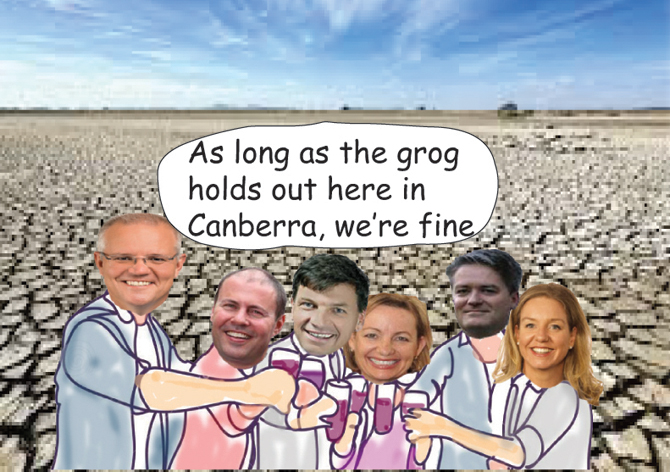
Drought plan must factor in climate change, https://www.smh.com.au/ business/small-business/drought-plan-must-factor-in-climate-change-20191003-p52xfn.html Lisa Davies, 4 Oct 19, As country towns across the inland run out of drinking water, the federal government has started to show its concern for farmers affected by the drought.
Prime Minister Scott Morrison went to Dalby in Queensland last week to announce a $100 million drought package and Treasurer Josh Frydenberg has taken time off his day job for a three-day tour of NSW and Queensland.
On one hand, country people will be comforted that the government is paying attention to their plight. On the other, they will ask whether another parade of politicians putting on moleskins and fronting a press pack in the dust will make any difference.
As country towns across the inland run out of drinking water, the federal government has started to show its concern for farmers affected by the drought.
Prime Minister Scott Morrison went to Dalby in Queensland last week to announce a $100 million drought package and Treasurer Josh Frydenberg has taken time off his day job for a three-day tour of NSW and Queensland.
On one hand, country people will be comforted that the government is paying attention to their plight. On the other, they will ask whether another parade of politicians putting on moleskins and fronting a press pack in the dust will make any difference.
Everyone says the government needs to do something but for now the government’s basic approach is to dribble out more money and hope that it rains.
That is probably all that can be done in a crisis.
But it is not the whole answer. It ignores the crucial issue of what to do if the scientists are right and droughts are becoming longer and more frequent.
This question should not be conflated with the equally important issue of whether Australia should have a stronger climate change policy.
Deeper cuts in Australia’s carbon emissions are needed to help slow the rise in global temperatures but it will not solve the farmers’ problems overnight. Scientists say droughts will get worse for decades.
The Herald backs drought assistance to help farmers cope but it should be fair and efficient and it should be designed to encourage farmers to adjust to the new climate conditions.
In fact, the Productivity Commission says a lot of money is already being spent. Sheep, cattle and grain farmers in 2017-18 received about $1.3 billion in state and federal government subsidies. Those farmers now receive 5.8 per cent of their income as subsidies from the government, compared with just 3.7 per cent five years ago, a higher rate of subsidy than any industry sector.
Farmers also receive lots of other indirect help such as state subsidies on freight for fodder as well as generous household payments worth up to $37,000 per couple, far more than age pensioners or single parents.
Yet many people who receive drought relief are not poor. The latest drought package has allowed people with assets up to $5 million to apply.
Mr Morrison says this is not welfare but it is still taxpayers’ money and it should be spent prudently.
Sometimes it seems it is not. The government was left red-faced this week when it emerged that Moyne Shire in western Victoria that got $1 million under Mr Morrison’s announcement was not actually affected by the drought. Equally, it appears that former “drought envoy” Barnaby Joyce was was not required to produce a report to justify his salary and expenses.
Farmers groups sometimes call for more dams as a panacea. But it is often hard to produce a long-term business case for them. Fans of dams also often ignore the risk that they will reduce water flows to surrounding farms and the environment.
Unfortunately, even with the best government plan, climate change will reshape Australia’s rural society.
Some farmers will adjust their methods and succeed. Some will decide to sell up their farms to big businesses and do something else. Governments should help those in need but rural Australia must accept that the times are changing
Black swans – the bushfires of the future are already here.
Australia is not prepared to fight the bushfires of the future, experts warn, Background Briefing Oct 5 19, An investigation by Background Briefing, ABC Regional and Landline The bushfires of the future are already here. They burn earlier in the season, and more ferociously, and can interact with extreme weather events to create fires we don’t know how to fight.
Key points
- The national aerial firefighting centre, which two years ago flagged the need for an $11m funding boost, still has not received a decision from the Federal Government
- The Government has not guaranteed funding for the only national body researching the future of bushfires
- Twenty-three emergency services experts calling on the Government to consider the threat of climate change in fire planning have not received a response
This year, the bushfire season began with the worst September in recorded history, with 55 homes destroyed.
The Australian winter was only just in the rear-view mirror when 130 bushfires ripped through southern Queensland and northern NSW in one day.
Australia’s former chief scientist, Ian Chubb, said it was clear the climate was changing.
“It’s not just some passing phase that it didn’t rain this decade,” he said. “The implications of that for fire are pretty obvious.”
Former New South Wales fire and rescue commissioner and Climate Council member Greg Mullins said unprecedented conditions could give rise to so-called Black Swan fire events.
“We’re going to have fires that I can’t comprehend, and I’ve been in the game for nearly half a century,” he said.
A Black Swan is something without precedent and thought to be impossible, until it happens.
When it comes to bushfires, these Black Swans happen as our environment changes, creating conditions firefighters have never seen before.
Emergency experts and senior scientists have told a joint ABC investigation that a comprehensive national plan is needed to tackle the fires of the future, and they are concerned about the lack of financial commitment from the Federal Government for resources and research.
“This is a national issue that all people in Australia, regardless of whether they are left or right, have a right to expect that we will face up to challenges that are ahead,” Professor Chubb said.
Inside a Black Swan fire event
When an unprecedented heatwave swept New South Wales in 2017, it set the conditions for a Black Swan fire event.
The Sir Ivan fire began east of Dunedoo and would burn through 55,000 hectares……….
Australia: NSW fires out of control and the temperatures nears 50C
The blaze was unlike anything the NSW RFS had ever dealt with, according to Commissioner Shane Fitzsimmons.
“It was unprecedented in New South Wales,” he said……..https://www.abc.net.au/news/2019-10-04/the-bushfires-of-the-future-are-here-black-swan/11559930
A nuclear industry for Australia would be a huge cost to taxpayers

Nuclear inquiry hears cost, health h risks https://www.9news.com.au/national/environment-groups-front-nuclear-inquiry/79884d6e-f161-4624-9bac-b6f283d96598 By AAP Oct 1, 2019 Taxpayers would be bear the brunt of a potential nuclear energy industry in Australia, a parliamentary committee has been told.
Environment groups began the inquiry on Tuesday in Melbourne, a day after the committee was told the potential economic benefits of more uranium mining.New involvement of Attorney General in press freedom
The order could shield News Corp’s Annika Smethurst and the ABC’s Dan Oakes and SamClark who were named in Australia Federal Police (AFP) warrants used during raids in June and have not yet been cleared of any criminal charges. The move, however, has ignited debate about an elected politician’s direct involvement in police matters and press freedom.
Now, Smethurst, Oakes and Clark can only be charged if the Attorney-General gives written consent to the charges. A directive was signed to the Commonwealth Director of Public Prosecutions (CDPP) in September, the details of which have only come to light this week. The decision follows legal challenges from both the ABC and News Corp Australia over the legitimacy of the raids and the warrants used.
“The direction means where the CDPP independently considers that there is a public interest in a prosecution for one of the relevant offences involving a journalist, the consent of the Attorney-General will also be required as a separate and additional safeguard,” Porter said in a statement.
“This will allow the most detailed and cautious consideration of how an allegation of a serious offence should be balanced with our commitment to freedom of the press.
“I have previously said that I would be seriously disinclined to approve prosecutions of journalists except in the most exceptional circumstances and would pay particular attention to whether a journalist was simply operating according to the generally accepted principles of public interest journalism.”
Porter hasn’t yet commented on the cases regarding Smethurst, Oakes or Clark.
An ABC spokesperson called the directive a ‘welcome step’, but said the organisation continues to look forward to the results of the two press freedom inquiries which have been triggered by the raids.
“The Attorney General’s directive is a welcome step. It is one plank in a raft of legislative reform that the ABC identified in its submissions to the two concurrent media freedom parliamentary inquiries,” said the spokesperson.
“The ABC looks forward to seeing the recommendations from those inquiries as well as an expeditious conclusion to the current AFP investigation into ABC journalists.”
“The direction issued by The Attorney General is unremarkable. They make the Commonwealth Department of Public Prosecution seek the Attorney General’s consent to take legal action against journalists in a few more instances but they offer no comfort for journalists disclosing information in the public interest that they are safe from prosecution for doing their job,” said Reid.
“This so-called safeguard falls a long way short of what media organisations are seeking to recognise the role of journalists to keep the public informed.”
The Law Council of Australia has also weighed in on the move, with president Arthur Moses SC citing grave concerns over the Attorney General’s involvement with press freedom.
“I have grave concerns that this sort of direction undermines the independence of the CDPP by requiring her to obtain the consent of the Attorney General before prosecuting an offence,” Moses said.
“What will enhance press freedoms in this country is a proper review of our laws to ensure that the actions of journalists doing their job as a watchdog of government are not criminalised and put at risk of prosecution.
“I have no doubt the Attorney General would act in good faith. But it puts the Attorney General – a politician – in the position of authorising prosecutions of journalists in situations where they may have written stories critical of his government.
“It creates an apprehension on the part of journalists that they will need to curry favour with the government in order to avoid prosecution. The media must be able to lawfully report on matters of public interest without fear or favour.
“Journalists should not need to fear prosecution because of a story that embarrasses government.”
1 This month.
20 September –National Day of Action in Melbourne on the International Day of Peace


Help Aunty Sue Protect Her Land and Sacred Sites From Destructive Rocket Testing.
.

Australians deserve the truth
about
AUKUS – https://aukuspublicinquiry.com/

PETITION – To: Prime Minister Anthony Albanese and the Australian Labor Government

of the week – Australians for War Powers Reform (AWPR)
To see nuclear-related stories in greater depth and intensity
 Antinuclear