Make nuclear power free, Barnaby Joyce says. https://www.smh.com.au/politics/federal/make-nuclear-power-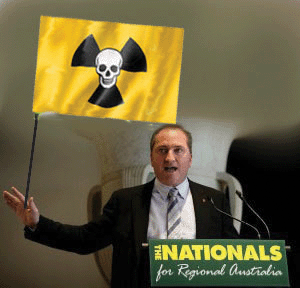 free-barnaby-joyce-says-20190721-p5299j.html, By Nicole Hasham, July 21, 2019 Nationals MP Barnaby Joyce says free nuclear power could be offered to residents living close to a reactor to help build support for the controversial technology, as an analysis pinpoints which Australian towns are best placed to host a nuclear plant.
But the pro-nuclear push by Coalition backbenchers may be losing momentum after one colleague dismissed it as a “distraction” and a senior minister said the government had “no desire to go down that path”.
Federal and state laws prohibit the development of a domestic nuclear power industry. However, federal MPs Keith Pitt and James McGrath are pushing for a parliamentary inquiry into the technology’s feasibility in Australia and the NSW Nationals last month passed a motion supporting nuclear energy.
A leading lobby group for the technology, the Australian Nuclear Association, has identified dozens of potential sites for nuclear reactors – those with stable geology and proximity to the existing grid, transport and water. The locations include those in Mr Joyce’s New England electorate in northern NSW and Liberal Ken O’Dowd’s Queensland seat of Flynn. Both MPs have backed a nuclear inquiry.
Mr Joyce said nuclear technology had come a long way in the past few decades and rejected claims that even if Australia’s nuclear ban was overturned, communities would refuse to host reactors over safety and environmental concerns.
“You just have to come up with the right policy settings and they will accept it … People will think with their wallets,” he said.
Mr Joyce floated a potential policy whereby “if you can see the reactor [from your house], your power is for free. If you are within 50 kilometres of a reactor, you get power for half price.” Discounts would scale down to 25 per cent for those living 75 kilometres from a nuclear facility.
Such a policy would trigger a rush of proposals for “hills in the middle of towns that people want a reactor on”, Mr Joyce said.
In NSW, the association also identified sites in Energy Minister Angus Taylor’s seat of Hume and Environment Minister Sussan Ley’s seat of Farrer. Proposed Victorian sites include those in the seats of Wannon and Gippsland, held by ministers Dan Tehan and Darren Chester.
Wide Bay MP Llew O’Brien, whose Queensland electorate is also on the list, said he was “not enthusiastic” about the prospect of a parliamentary probe into nuclear power.
“We need to focus on bringing down power prices and bringing more supply into the market … which can be done a lot quicker than legalising nuclear energy and then building the infrastructure needed,” he said.
“It seems to be a distraction from the very real issues at hand.”
Prime Minister Scott Morrison said during the election campaign that his party had “no plans” to change its nuclear power stance and Mr Taylor told this publication on Sunday “the business case has got to stack up”.
A government minister told the Sydney Morning Herald and The Age that “there’s no desire to go down this path” in the broader Coalition.
“Financially it doesn’t stack up and … there’s also the not-in-my-backyard issue, which is a very difficult one,” the minister said.
Labor’s climate change and energy spokesman Mark Butler said Mr Morrison had allowed Mr Taylor and backbenchers to “pursue their nuclear power fantasy” as power prices rose.
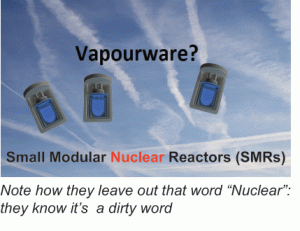
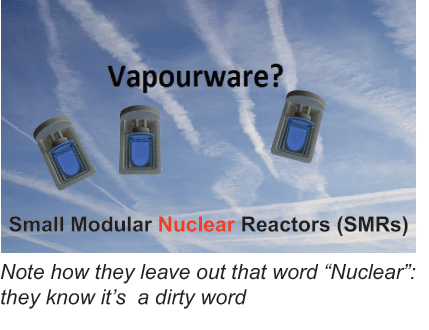
Consultancy SMR Nuclear Technology promotes the benefits of small, modular nuclear reactors. Technical director Tony Irwin said about ten community groups and others had expressed interest to his firm in hosting such a reactor, should the ban in Australia be lifted.
“People are now concerned about climate change and they can see that renewables aren’t the total answer and we need everything that we’ve got,” he said.
July 22, 2019
Posted by Christina Macpherson |
AUSTRALIA - NATIONAL, politics |
Leave a comment
|
More protests in Malaysia but no clarity as Lynas shutdown approaches, The Age, Colin Kruger
July 21, 2019 Rare earths miner Lynas Corp is facing renewed pressure in Malaysia with environmental groups staging a last ditch attempt to ensure the country’s government keeps an election promise to close its billion dollar processing plant in six weeks time.
“The Malaysian government need to hold Lynas accountable for its massive radioactive waste problems,” said Greenpeace Malaysia Campaigner Heng Kiah Chun at a press conference on Sunday launching the new campaign against Lynas, backed by 88 different non government organisations.
“Lynas has misled Malaysia by giving two undertakings to remove its toxic radioactive waste from Malaysia even though Western Australia had made it clear back in 2011 that its waste would not be accepted back in WA,” said a joint statement from the groups.
Lynas extracts rare earth ores, 17 elements crucial to the manufacture of many hi-tech products like mobile phones, electric cars and wind turbines, from a mine near Perth and then sends the materials to a facility in Malaysia for processing.
There have been signs of renewed tensions within Malaysia’s ruling coalition in recent weeks. In a sign of how divided the government is on Lynas’, Malaysia’s Natural Resources Minister Dr Xavier Jayakumar announced last week that the government is looking at exploiting the country’s mineral reserves and potentially mining for rare earth minerals itself.
“We are alarmed by these ministers championing Lynas’ corporate profit at the expense of Malaysia’s environment and public health,” said the groups protesting against Lynas.
The Malaysian Energy, Science, Technology, Environment Minister Yeo Bee Yin, is set to make a decision by mid August on the Lynas appeal against the new conditions her ministry imposed in December on the company’s processing plant.
These conditions would force Lynas to export its low level radioactive waste from the country or face the non renewal of its license to operate in Malaysia which expires September 2.
A cabinet meeting on Friday failed to settle the issue among the five party coalition, but Prime Minister Mahathir Mohamed has twice indicated that he thinks Lynas should be allowed to continue operating in the country if it agrees to extract the low level radioactive waste from its ore before it reaches Malaysia.
Lynas is expected to give the market an update on the regulatory issues in Malaysia at its quarterly results briefing Monday July 29……..https://www.theage.com.au/business/companies/more-protests-in-malaysia-but-no-clarity-as-lynas-shutdown-approaches-20190721-p52983.html
|
|
July 22, 2019
Posted by Christina Macpherson |
AUSTRALIA - NATIONAL, politics international, rare earths |
Leave a comment
 Greens seek ‘climate emergency’ this year, SBS News 20 July 19
The Australian Greens are focusing on climate change and the need to transition to renewable energy at its annual conference in Adelaide. The Australian Greens are demanding the country declare a “climate emergency” while calling for a royal commission into the Murray-Darling Basin plan.
Aside from those core messages at the party’s annual conference, Greens leader Richard Di Natale also had a crack at the Labor Party for capitulating on the Morrison government’s personal income tax cuts.
And he urged Australia to forge an independent, non-aligned foreign policy rather being tied to a “dangerous and unhinged” US President in Donald Trump.
It’s now clearer than ever that the Greens are the real opposition,” Senator Di Natale declared at the Greens national conference in Adelaide on Saturday in response to the actions of Labor since the May election.
“We don’t believe one thing before an election and another thing after it.”
Addressing reporters after his speech, Senator Di Natale said a key focus for the conference will be the transition from coal and fossil fuels to renewable energy.
“There needs to be a transition that brings tens of thousands of new jobs and that looks after people so that we are better off as a result of making this transition,” he said.
“Unless you accept that there is a serous problem you’re not going to come up with the solutions that are necessary to deal with it.”
Greens federal spokesman on climate change, Adam Bandt said he hopes to bring a motion to have the parliament declare a climate emergency before the end of the year.
He said the UK, France and Canada have already made such declarations, as has the ACT government. Labor and the crossbench also took climate change policies to the election.
“We think there is a really good chance in having the parliament unanimously declare a climate change emergency before the end of the year,” Mr Bandt told reporters……. https://www.sbs.com.au/news/greens-seek-climate-emergency-this-year
July 22, 2019
Posted by Christina Macpherson |
AUSTRALIA - NATIONAL, climate change - global warming, politics |
Leave a comment
|
 Victorian solar farm to generate enough electricity to power Melbourne’s entire tram network Victorian solar farm to generate enough electricity to power Melbourne’s entire tram network
By Rhiannon Tuffield 20 July 19, A solar farm in northern Victoria will soon generate enough electricity to power Melbourne’s entire tram network.
The 128-megawatt solar farm near Numurkah, north of Shepparton, took less than a year to build and will use more than 300,000 panels to power the city’s trams.
Key points:
- Melbourne’s tram network is set to be powered by the state’s largest solar farm
- The solar facility sits on 500 hectares of land once used for grazing cattle
- More than 300,000 panels will put 255,000 megawatt hours of electricity into the national power grid annually
It is one of two solar farms supplying renewable energy to the network, and will generate approximately 255,000 megawatt hours of electricity into the national grid each year.
Victorian Minister for Energy Lily D’Ambrosio said the project was the largest in the state.
“The Numurkah solar farm will play an important role in supporting the transformation of our energy system towards clean, renewable energy and reaching our renewable energy target,” Ms D’Ambrosio said.
Farm built in record time
Based just outside of Numurkah in the tiny town of Drumanure, the farm spans 500 hectares of land once used for cattle grazing and cropping.
The carbon emission reduction generated by the farm is the equivalent of taking 75,000 cars off the road or planting 390,000 trees…….. https://www.abc.net.au/news/2019-07-20/numurkah-solar-farm-to-power-tram-network/11327346
|
|
July 22, 2019
Posted by Christina Macpherson |
solar, Victoria |
Leave a comment
Barnaby Joyce’s thwarted ambitions glow like a nuclear meltdown,  “………. Mr Joyce’s commentary this week on nuclear energy, raising Newstart, and an Indigenous voice to Parliament is also a transparent re-branding exercise – the type favoured by disgraced politicians when they’re trying to rebuild their leadership credentials.
You might recall that Mr Joyce was doing a lot of leadership posturing in the lead-up to the May federal election. Some political observers even reported that the former Deputy PM’s return to the Nationals leadership was such an inevitability that it could possibly happen even before the election…….
the backbencher missed out on a seat in Scott Morrison’s new ministry and also lost his special drought envoy role, although Mr Joyce did retain a gig as chair of a parliamentary committee.
Using what was left available to him, namely the chairman’s role, Mr Joyce kicked off a campaign to become relevant again by claiming his committee should hold an inquiry into establishing nuclear power in Australia.
Yet again demonstrating his expertise in energy policy, the former accountant claimed in a radio interview last weekend that technological advances had essentially made nuclear energy “safe” – and that impoverished Australians living in regional Australia would vie to live near a nuclear power plant if it meant they would receive lower-cost or free electricity in return. To be fair, this is how the French established their nuclear power stations with minimal community dissent.
These reassuring words may well be what mining magnate Gina Rinehart and other investors with uranium interests told Mr Joyce, but the vested interests omitted to explain how expensive it is to build a safe nuclear power station, and how long it takes.
Meanwhile, solar and wind farms with battery storage can be built in remote locations too, but at less cost and in less time, with no need to worry about long-term radioactive waste. Yet pesky details are not what the Barnaby 2.0 campaign is all about……… https://thenewdaily.com.au/news/world/2019/07/19/barnaby-joyce-leadership-ideas/
July 20, 2019
Posted by Christina Macpherson |
AUSTRALIA - NATIONAL, politics |
Leave a comment
https://wanganjagalingou.com.au/federal-court-adani-decision-%EF%BB%BFwjs-rights-fight-will-continue/ 12 July 2019 ‘Near enough is good enough for Aboriginal rights’ under Native Title Act
Adani ILUA remains tainted, W&J to consider High Court action
Court decision will not silence dissent
THE Wangan and Jagalingou Family Council says today’s decision by the Federal Court dismissing their appeal confirms that when it comes to Aboriginal rights in Australia, “near enough is good enough” under the Native Title Act.
The Council says it will not give up, but instead consider grounds to seek leave to the High Court and work to build public pressure on the Queensland Government to accept their part in dividing their people and ignoring their rights.
The full bench of the Federal Court today dismissed the appeal brought by five W&J appellants against the certification and registration of the Adani ILUA.
The Council noted the decision hinged only on the question of whether the certification and registration of the Adani ILUA were handled according to the legal requirements of the Native Title Act. It did not ‘pull back the veil’ on the contested dealings leading up to and after the Adani meeting more than three years ago.
The Council says no one can draw any conclusion from this decision that those attending the Adani meeting were actually entitled under the laws and customs of Wangan and Jagalingou people to sign away their rights in land for monetary compensation.
Wangan and Jagalingou Council senior spokesperson, Adrian Burragubba said: “Today is NAIDOC. A day of celebration for our community, where we come together to share our culture, and our dreams and aspirations, with our families and friends, brothers and sisters. We join together in strength as First Nations people.
“But this is a day to remember. On ‘black fella day’ the Full Bench of the Federal Court denied us our right to stand up and say ‘that’s our land and we’re not going to give it away’.
“We don’t intend to give up. We will build public pressure on the Queensland Government to accept their part in dividing our people and ignoring our rights.
“In keeping with international law, there has never been any free prior and informed consent when it comes to this ILUA with Adani. A lot of our people were played into position by the Government and Adani and stitched up by a legal process they have no control over.
“We will continue our fight with the support of the Aboriginal and Torres Strait Islander communities, as demonstrated at NAIDOC here in Brisbane today,” he concluded.
Murrawah Johnson, a spokesperson for the Wangan and Jagalingou Council said: “Our Council will continue to pursue all legal and political avenues in opposition to the coal mine and the destruction of Wangan and Jagalingou Country.
“We will review the decision of the Federal Court and take legal advice. We will consider any grounds to seek leave to the High Court. The Adani ILUA has been upheld, as Justice Perry said, “notwithstanding any deficiencies which might have tainted the validity of the certification”.
“With Adani commencing initial works, our focus will shift to exposing the failure of the State Government in issuing the mining leases without an ILUA and without consent.
“Today’s decision does not retrospectively validate the Queensland Government’s abysmal conduct in backing Adani and stepping on our rights.
“We will challenge the issuing of environmental approvals, given without regard to First Nations cultural rights in our land and waters, and the plants and animals that depend upon them.
“We know we have always had a fight on our hands. That fight is not just with Adani, but with the Federal and Queensland Governments. It is shameful that the State delivered mining leases to Adani without an ILUA or our consent, and twice the Federal Government intervened in our cases to ensure Adani’s interests, including in this most recent appeal”, she concluded.
July 20, 2019
Posted by Christina Macpherson |
aboriginal issues, AUSTRALIA - NATIONAL |
Leave a comment
Adani has set a dangerous precedent in requesting scientists’ names, The Conversation Samantha Hepburn, Director of the Centre for Energy and Natural Resources Law, Deakin Law School, Deakin University
July 17, 2019 A freedom of information request has revealed Adani sought the names of CSIRO and Geoscience Australia scientists involved in reviewing
groundwater management plans related to its proposed Carmichael mine.
Adani argued it required a list of people involved in the review so as to have “peace of mind” that it was being treated fairly and impartially on a scientific rather than a political basis.
Ten days before Adani’s request, Geoscience Australia’s acting director of groundwater advice and data reportedly raised concerns that Adani had “actively searched/viewed” his LinkedIn profile and that of a colleague.
Significantly, Adani’s request to the government was made before CSIRO and Geoscience Australia had reported their review findings back to the Queensland government.
While the federal Department of the Environment and Energy reportedly declined to hand over the names, the fact the letter was sent in the first place is concerning. It fundamentally interferes with the capacity of individual scientists to provide clear and informed evaluation………..
The letter sent by Adani requesting the names of scientists was allegedly grounded in concerns about the possibility of anti-Adani activism by expert reviewers. Despite this, Adani made it clear that it was not explicitly alleging bias. Its objective, the letter said, was a desire to be “treated fairly and in a manner consistent with other industry participants”.
The real purpose of the letter
If Adani was seriously concerned about a breach of procedural fairness in the review of their groundwater management plan, it would have sought a judicial review. It did not – because there was no breach.
The scientists working at CSIRO and Geoscience Australia are all experts in their disciplines. They were engaged in the important process of determining whether Adani’s plan for managing groundwater around their mine would meet the environmental conditions of their mining licence. In other words, the scientists were doing their job…….
As Adani has not brought an action for judicial review, the substantive purpose of the letter appears to be, as suggested by CSIRO representatives, to pressure scientists and potentially seek to discredit their work. The potentially chilling effect is clear.
Concern about climate change is not bias
The profound concerns raised by climate change and fossil fuel emissions are shared by many scientists around the world. The reports prepared for the International Panel on Climate Change make it clear that coal fired electricity must drop to nearly zero by 2050 to keep warming within 1.5℃.
This shared concern does not make scientists political activists. Nor does it prevent scientists from acting fairly and impartially when reviewing a groundwater management plan.
An acceptance of climate science and even a belief that coal-fired energy should be decommissioned does not constitute bias. A reasonable bystander would expect most environmental scientists to be concerned about climate change…….
The letter, sent before the review was handed down, sets a dangerous precedent. Not because it suggests the scientists were impartial or there was any procedural unfairness involved in the process. But rather, because it jeopardises the independence of our scientists who, in seeking to ensure the longevity of our water, food and energy resources, carry a heavy responsibility to the public interest. https://theconversation.com/adani-has-set-a-dangerous-precedent-in-requesting-scientists-names-120487?utm_medium=email&utm_campaign=The%20Weekend%20Conversation%20-%201363812812&utm_content=The%20Weekend%20Conversation%20-%201363812812+CID_b76b199d2a9f41a0b97b5b71ad372c57&utm_source=campaign_monitor&utm_term=Adani%20has%20set%20a%20dangerous%20precedent%20in%20requesting%20scientists%20name
July 20, 2019
Posted by Christina Macpherson |
AUSTRALIA - NATIONAL, civil liberties, politics |
Leave a comment
The idea of producing nuclear energy in Australia before 2040 is absurd https://www.theguardian.com/commentisfree/2019/jul/16/the-idea-of-producing-nuclear-energy-in-australia-before-2040-is-absurd
Joyce and Barilaro revived this idea after the release of a report by Industry Super Australia, which took as the starting point the need to replace most of Australia’s coal-fired power stations by 2040. The report concluded: “It is difficult to see how the the problem can be resolved without some nuclear in the mix.”
 It would perhaps be churlish to observe that the small reactors advocated by Barilaro exist only as designs and may never be built. There is a much bigger obstacle which is essentially impossible to overcome.
To make the central point as bluntly as possible: even with a crash program there is no chance of deploying nuclear power in Australia in the required timeframe. I looked at this question in a submission to the South Australian royal commission into the nuclear fuel cycle and concluded that “there is no serious prospect of Australia producing nuclear energy before 2040”.
That was in 2015, and the news for nuclear power since then has all been bad. All of the nuclear power plant construction projects under way in the developed world have experienced substantial delays (the VC Summer plant in the US has been cancelled with a loss of billions of dollars).
Most of these projects (Flamanville in France, Olkiluoto in Finland and Vogtle in Georgia) received their initial approval around 2005, and none is now likely to start before 2020. So, to be sure of getting nuclear power going by 2040, we’d need to have projects in their initial stages before 2025, in the term of the next parliament.
To see how absurd this is, consider some of the steps that will be needed before a project could begin.
First, both major parties need to be convinced of the case for nuclear power. That’s highly unlikely but let’s suppose it can somehow be done by 2020. Next, the current ban on nuclear power needs to be repealed. This ban looms large in the minds of nuclear advocates but actually it’s such a minor problem we can ignore it.
The first big problem is the need to set up, from scratch, a legislative and regulatory framework for nuclear power. That would require adapting an overseas model such as that of the US, where the nuclear industry is regulated by at least eight different acts, covering more than 500 pages. Back in the 1970s the French government could do this kind of thing by fiat, without parliamentary debate, but that’s not a feasible option for Australia.
Having passed the necessary legislation, the next task would be to establish and staff a regulator similar to the US Nuclear Regulatory Commission or the UK Office for Nuclear Regulation. The only Australian body with any relevant expertise is the Australian Nuclear Science and Technology Organisation which operates a 20 megawatt (research reactor at Lucas Heights. Ansto has little or no capacity to deal with the problem of licensing and regulating commercial reactors of 1,000MW.
Even with a massive effort, and assuming no political obstacles, it’s hard to see these tasks being accomplished within five years, which would already take us to 2025. But there are many more remaining difficulties.
Most obviously, as the Industry Super report states, we would need a carbon price or a market mechanism with similar effects, such as an emissions trading scheme. On any realistic political analysis, that’s impossible – the overlap between supporters of nuclear power and advocates of carbon pricing in Australia is virtually zero. At a minimum, the adoption of a carbon price would require a change of government at the next election, which may happen though it doesn’t seem likely at the moment. Even if it would occur (and assuming, improbably, that a Labor government relying on Green support could be persuaded to back nuclear power), there would be further delays before the carbon price could be put in place.
But that’s just the beginning. Before any project could be considered, it would be necessary to license designs that could be built and operated here. The processes of the NRC in the US, which were expedited in the hope of spurring a “nuclear renaissance” typically take three to four years.
We could simply accept the judgement of overseas regulators, but even then we would have a problem – there may be no designs available.
In my submission to the SA royal commission, I argued that the only serious contender for Australia was the Westinghouse AP1000. Since then, however, cost overruns and cancellation have sent Westinghouse bankrupt, almost taking its owner, Toshiba, with it. There is no serious prospect of any more plants of this design being built. Areva, which is building its EPR model in Europe, is in similar difficulty. There’s a serious risk that the only contenders would be Chinese or Russian designs, which would pose some obvious problems.
The most difficult step would be the need to identify greenfield sites for multiple nuclear power plants, almost certainly on the east coast, and go through the relevant environmental processes. Reliance on overseas models won’t be of much use here. All the plants under construction in western countries are “brownfield”, that is, situated next to existing plants, built last century, and approved as far back as the 1970s.
In summary, it would be a heroic endeavour to get construction started on a nuclear plant even by 2030. Getting it finished and generating electricity by 2040 is virtually impossible.
Fortunately, there are alternatives, though the Industry Super report dismisses them. The combination of solar photovoltaics and battery storage is already cheaper than new coal-fired power. As a backup, Australia has huge potential for storage using pumped hydroelectricity. We don’t need to call on the phantom of nuclear power to secure a reliable, carbon-free electricity supply for the future.
• John Quiggin is professor of economics at the University of Queensland
July 18, 2019
Posted by Christina Macpherson |
AUSTRALIA - NATIONAL, politics |
Leave a comment
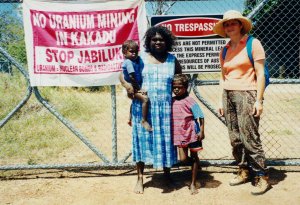
Leave it in the ground: stopping the Jabiluka mine, Red Flag Fleur Taylor, 15 July 2019 “…… The election of John Howard in March 1996 marked the end of 13 years of ALP government…..
Australia’s giant mining companies – major backers of the Coalition – got their wish list. Howard immediately abolished Labor’s three mines policy, and the business pages crowed that “25 new uranium mines” were likely and possible. And in October 1997, then environment minister Robert Hill blew the dust off an environmental impact statement from 1979 that said mining at Jabiluka was safe. Approval of the mine quickly followed.
The Jabiluka uranium deposit, just 20 kilometres from the Ranger uranium mine, is one of the richest in the world. The proposal was to build a massively bigger mine than that at Ranger, which would be underground and therefore more dangerous for the workers. It was projected to produce 19 million tonnes of ore over its lifetime, which would be trucked 22 kilometres through World Heritage listed wetlands.
The Liberals hoped to make a point. After all, if you could put a uranium mine in the middle of a national park in the face of Aboriginal opposition, what couldn’t you do?
The fight immediately began. The traditional owners of the area, the Mirarr, were led by senior traditional owner Yvonne Margarula and the CEO of the Gundjeihmi Aboriginal Corporation, Jacqui Katona. They were supported by anti-nuclear campaigners around the country, most notably Dave Sweeney of the Australian Conservation Foundation, as well as a network of activist groups.
The most important objective was to delay construction of the mine, scheduled to begin in 1998. To do this, the Mirarr called on activists to travel to Jabiluka in order to take part in a blockade of the proposed mine site until the onset of the wet season would make construction impossible.
The blockade was immensely successful. Beginning on 23 March 1998, it continued for eight months, attracted 5,000 protesters and led to 600 arrests at various associated direct actions. Yvonne Margarula was one: she was arrested in May for trespass on her own land after she and two other Aboriginal women entered the Ranger mine site.
The blockade also attracted high-profile environmental and anti-nuclear activists such as Peter Garrett and Bob Brown. This helped signal to activists that this was a serious fight. The sheer length of time the blockade lasted created a fantastic opportunity for the campaign in the cities. Activists were constantly returning from Jabiluka with a renewed determination to fight.
The Jabiluka Action Group was key to building an ongoing city-based campaign in Melbourne, and the campaign was strongest there of any city. It held large – often more than 100-strong – weekly meetings, organised endless relays of buses to the blockade and took the fight to the bosses and corporations that stood to profit from the mine.
We were determined to map the networks of corporate ownership and power behind the mine. But in the late 1990s, when the internet barely existed, this wasn’t as simple as just looking up a company’s corporate structure on its glossy website. It took serious, time consuming research.
A careful tracing of the linkages of the North Ltd board members showed that they were very well connected – and not one but two of them were members and past chairmen of the Business Council of Australia (BCA) – one of Australia’s leading bosses’ organisations. So our June 1998 protest naturally headed to the Business Council of Australia. We occupied their office, and the two groups of anti-uranium protesters, 3,800 kilometres apart, exchanged messages of solidarity, courtesy of the office phones of the BCA.
We were also staggered to learn that the chairman of a company that owned two uranium mines and was Australia’s biggest exporter of hardwood woodchips was also a member of the Parks Victoria board, the national president of Greening Australia and the Victorian Environmental Protection Authority (EPA) board president!
The EPA, and corporate greenwashing in general, thereby became a target for the campaign. Another target was the Royal Society of Victoria, which made the mistake of inviting Sir Gus Nossal, a famous scientist and longstanding booster for the nuclear industry, to give a dinner address. We surrounded its building, and the organisers, somewhat mystified, cancelled the dinner. This action once again made headline news, helping to keep the issue of the Jabiluka mine in people’s minds.
We held regular protests at the headquarters of North Ltd on Melbourne’s St Kilda Road. On the day that Yvonne Margarula was facing court on her trespass charge, a vigil was held overnight. When we heard she had been found guilty, the protest erupted in fury. Cans of red paint – not water-based – materialised, and the corporate facade of North Ltd received an unscheduled refurbishment. The Herald-Sun went berserk.
The leadership of the Mirarr people gave this campaign a different focus from other environmental campaigns of the time. It was fundamentally about land rights, sovereignty and the right of Aboriginal communities to veto destructive developments on their land. In Melbourne, the Gundjeihmi Aboriginal Corporation appointed long-time Aboriginal militant and historian Gary Foley as their representative. Gary worked tirelessly to provoke and educate the many activists who turned up wanting to “support” or “do something” for Aboriginal people.
At a time when “reconciliation” was strongly supported by liberals and much of the left, Foley told us that reconciliation was bullshit. He argued native title (supposedly a key achievement of Keating) was “the most inferior form of land title under British law”, and that the ALP was every bit as racist as One Nation – if not worse. He insisted activists must educate themselves about sovereignty and the struggles happening right here, not just those happening 3,800 kilometres away. The way the Jabiluka Action Group activists approached this challenge was an example of how people’s ideas change. Many came into the campaign primarily as environmental activists, but almost all left as committed fighters for Aboriginal rights.
**********
When the blockade wound down at the onset of the wet season, it was an opportunity to fight on some other fronts. Representatives of the UN World Heritage Committee visited Kakadu in late 1998 and issued a declaration that the World Heritage values of the area were in danger. They called on the government to stop the mine. Yvonne Margarula and Jacqui Katona travelled to Paris to speak to the European Commission about the mine.
John Howard, at the time mired in ministerial scandals and resignations, had called an election for September 1998, and there was hope in some quarters that Labor might win and stop the mine. But Howard scraped back in on only 48.3 percent of the vote, and it was clear that the fight on the ground would have to continue.
In the meantime, an important legal loophole had been identified. North Ltd had failed to secure agreement for the Jabiluka ore to be trucked to the Ranger mine for processing. It turned out the Mirarr did have the right to refuse this, and by exercising this right they would increase the cost of the project by $200 million (the cost of building a new processing plant at Jabiluka). This, combined with the ongoing protests, became a huge problem for the company.
Something we enjoyed doing at the time was monitoring North Ltd’s share price. It started out high when the Liberals took power. But after a year of protest and controversy, it had started to sink. The slump world uranium prices were going through didn’t help. But what the share price correlated to most closely was the major protests – it showed a drop after every single one.
Fund managers everywhere had absorbed the simple message that Jabiluka meant trouble, and early in 1999 this formerly prestigious blue-chip mining stock was described as one of the year’s “dog stocks”. Encouraged by this, the campaign launched its most ambitious action to date – the four-day blockade of North Ltd, from Palm Sunday until Easter Thursday 1999. This was the beginning of the end for the mine. In mid-2000, Rio Tinto bought out the struggling North Ltd. With no appetite for a brawl, the new owners quietly mothballed the Jabiluka project, signing a guarantee with the Mirarr to that effect. The campaign had won.
**********
The Jabiluka campaign was one of those rare things – an outright victory. It was a win not just for the Mirarr people, but for every community threatened by a devastating radioactive mine. And it was a win for humanity as a whole, protected from more of this deadly substance. Our chant – “Hey, North, you’re running out of time! You’re never going to get your Jabiluka mine!” – for once came true.
The victory inspired a neighbouring traditional owner, Jeffrey Lee, single-handedly to challenge the development of the Koongarra uranium deposit, resulting in the cancellation of that entire mining lease. In Melbourne and other cities, the Mirarr resistance inspired sustained and creative campaigning from a wide variety of participants – from vegan Wiccans and revolutionary socialists to doof-doof rave organisers and corporate-philanthropist Women for Mirarr Women. The campaign was chaotic and argumentative, but united by a commitment to challenging corporate power and standing up for Aboriginal sovereignty.
It still serves as an inspiration for anti-nuclear and anti-mining campaigns, such as the brave and determined opposition of the Wangan and Jagalingou traditional owners to the Adani mine. It stands as a great example of how blockades on country can nourish and inspire actions in the cities. https://redflag.org.au/node/6839
July 18, 2019
Posted by Christina Macpherson |
aboriginal issues, AUSTRALIA - NATIONAL, history, Opposition to nuclear, opposition to nuclear, reference |
Leave a comment
|
 Large Man Looking At Co-Worker With A Magnifying Glass — Image by © Images.com/Corbis Young climate activists ‘most at risk’ of being spied on by AFP, New Daily, Cait Kelly, Reporter, 16 July 19
Children and young adults who go to protests are the most likely Australians to have their phones tracked and monitored by police, a prominent security analyst has warned in a submission to an inquiry cybersecurity laws.Dr Stanley Shanapinda of La Trobe University said that politically minded youth are “the most at risk” of having their digital footprint watched by the AFP.
“They’re the most at risk because of their social media habits, they’re a lot more vocal. As a community they’re the most likely to be targeted,” he told The New Daily.
Under the metadata laws passed in 2015 the Australian Federal Police force (AFP) has the power to view the metadata of citizens who are deemed as a risk to national security, up to two years old without a warrant.
Dr Shanapinda argues that both Liberal and National politicians have highlighted young climate change activists, Adani protestors and The Greens as threats.
“Senior members of the government have labelled the protest actions of the young people and the Greens … as threats to national security and the national economic interests, openly in national media,” he said.
During the federal election, Prime Minister Scott Morrison warned that The Greens are a greater political threat to national and economic security than Clive Palmer or Pauline Hanson.
Dr Shanapinda said that these concerns over Greens policies, and young protestors could open the door to party members and activists having their metadata watched.
“Opposing the Adani coal mine and protesting against it, on climate change on ideological bases, may therefore legally be categorised by the government as posing a threat to national security, if the government wanted to, because of its economic and job creation value,” Dr Shanapinda said.
Protestors having their phones used against them has become an increasing issue around the globe…… https://thenewdaily.com.au/news/2019/07/16/metadata-activists-climate/
|
|
July 18, 2019
Posted by Christina Macpherson |
AUSTRALIA - NATIONAL, civil liberties, climate change - global warming |
Leave a comment
|
 Adani demands names of CSIRO scientists reviewing groundwater plans https://www.abc.net.au/news/2019-07-16/adani-requests-names-of-csiro-scientists/11308616 Adani demands names of CSIRO scientists reviewing groundwater plans https://www.abc.net.au/news/2019-07-16/adani-requests-names-of-csiro-scientists/11308616
Exclusive by Josh Robertson Adani demanded the names of all federal agency scientists reviewing its contentious groundwater plans so it could check if they were “anti-coal” activists, emails obtained under freedom of information show.
Key points:
- Emails show Adani gave the federal environment department five days to provide the names of people from the CSIRO and Geoscience Australia involved in the review
- Adani says it wrote to the department to request “assurance that individuals involved in any review processes were independent”
- CSIRO’s Sam Popovski says “our scientists just want to get on and do their best job … without their social media being tracked”
The revelation has alarmed CSIRO staff representatives, who said it indicated Adani had “a deliberate strategy” to pressure scientists by searching for personal information it could use to try to “discredit their work”.
Emails obtained under freedom of information by environmental group Lock The Gate show Adani gave the federal environment department five days to provide “a list of each person from the CSIRO and Geoscience Australia involved in the review”.
“Adani simply wants to know who is involved in the review to provide it with peace of mind that it is being treated fairly and that the review will not be hijacked by activists with a political, as opposed to scientific, agenda,” the company told the department on January 25.
A department spokeswoman said it “consulted with CSIRO and Geoscience Australia about Adani’s request” but did not provide the names “as the advice on the plans was received from CSIRO and Geoscience Australia, rather than individuals within those agencies”.
Days before the demand, in a January 21 newspaper article Adani had questioned the independence of a scientist leading a Queensland review into the company’s bird conservation plan because he tweeted from a climate rally nine months earlier.
The ABC revealed in February that Adani last year hired a law firm, AJ & Co, that had drafted a commercial proposal called “Taking the Gloves Off”, in which it vowed to act as the company’s “trained attack dog”.
It proposed a “war” strategy including that Adani “not settle for government department’s dragging out decisions — use the legal system to pressure decision makers”.
|
|
July 16, 2019
Posted by Christina Macpherson |
AUSTRALIA - NATIONAL, civil liberties, climate change - global warming |
Leave a comment
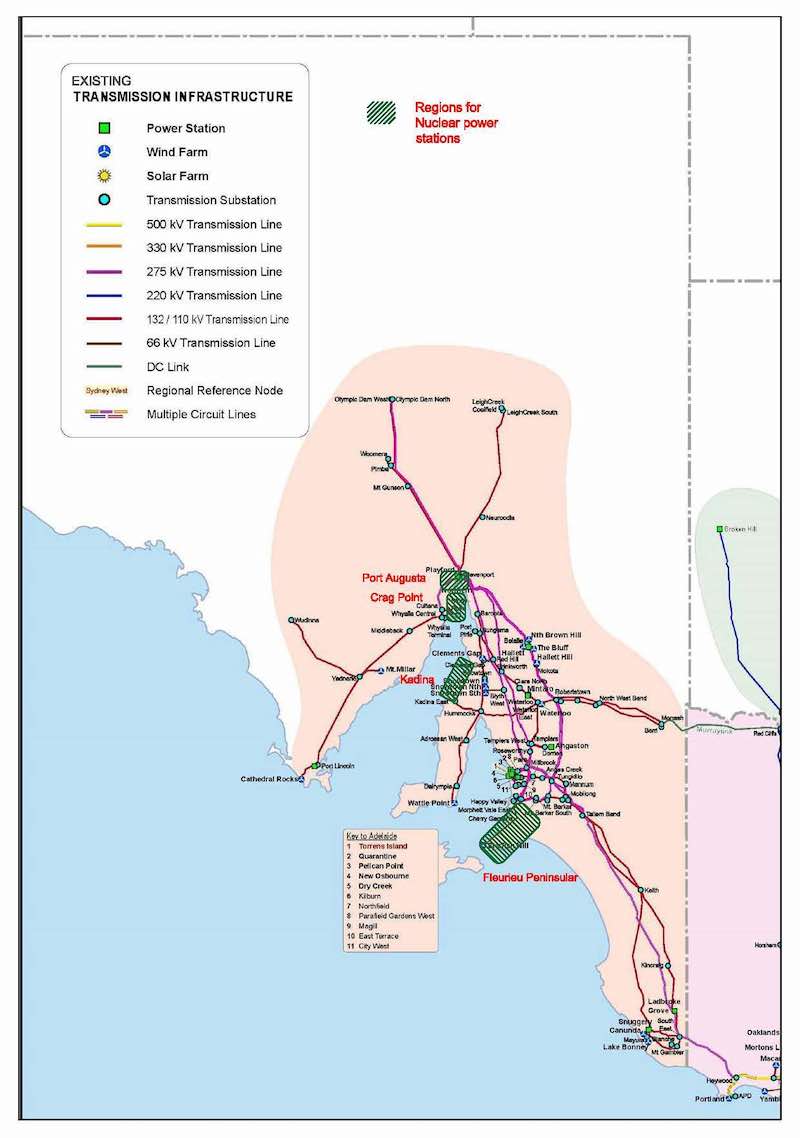
Nuclear lobby identifies preferred sites for 20 nukes in Australia https://reneweconomy.com.au/nuclear-lobby-identifies-preferred-sites-for-20-nukes-in-australia-19298/?utm_source=RE+Daily+Newsletter&utm_campaign=11f2638fe2-EMAIL_CAMPAIGN_2019_07_15_03_5, Giles Parkinson15 July 2019 National Party luminaries such as Barnaby Joyce and NSW deputy premier John Barilaro must be tickled pink. The electorates of these outspoken pro-nuclear advocates have been identified by the local nuclear lobby as some of the most prospective locations for their call to build 20 nukes in Australia’s main grid.

The organisation’s website includes this map and others that outline preferred sites for nuclear plants in NSW, Queensland and South Australia. (See below.)
It comes as the Coalition faces intense pressure from its own MPs and Senators, and One Nation, and, of course, the conservative media, to allow nuclear to be built in Australia.
Most of the MPs behind this push – like Joyce, Barilaro, Keith Pitt and Mark Latham – either reject climate science outright, mock any moves to address it, and/or at the same time are pushing for the construction of new coal-fired generators. That shouldn’t surprise anyone. At an industry level, the push for nuclear also comes from the main coal lobby, the Minerals Council of Australia, whose former CEO and deputy CEO are key advisors in prime minister’s Scott Morrison’s office, and who, of course, also want the government to underwrite new coal-fired generators, and are ensuring the current government has no long-term policy or plan for renewables.The reason for this symbiotic relationship is that the coal and nuclear industries share a common enemy – wind and solar and distributed renewables plus storage that undermine the traditional energy system of centralised power generation and “base-load” power.
So, the nuclear lobby had dusted off its plans and ramped up its campaign to demonise the competition. Seminars are being held, reports are being released, and the trolls have been let loose on social media.
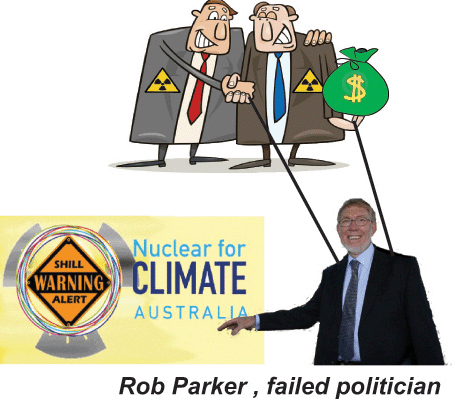
Parker’s presentation is interesting only because it gives warning to residents of where the nuclear proponents think they could build a nuclear power plant.
Of course, how and why Australia would build the 20 gigawatts of nuclear plants he suggests – and in the time-frames offered and at a cheap enough price – is not addressed by Parker, who often refers to renewables as “pixie dust”.
Dylan McConnell, from the Climate and Energy College, attended the presentation and tweeted his observation that neither cost nor social licence were addressed in the seminar. He said it “defied credulity” and further comments can be found here.
That the nuclear boosters don’t address this issue is not surprising, because these are the impossible questions for the nuclear industry.
A new study by the CSIRO and the Australian Energy Market Operator found nuclear to be by far the most expensive option for Australia’s main grid, and the very idea of new nuclear plants is laughed at by those with a serious interest in the electricity industry and its future.
Parker suggests – the EIA has published the slideshow – that a nuclear grid providing 82 per cent of Australia’s annual demand would deliver output that looks something like this:
It’s a fantasy, of course, and deliberately misleading, like much of what is said by the coal and nuclear lobbies and climate deniers.
Apart from not mentioning the enormous cost of nuclear, Parker simply wishes away wind energy, ignores the more than 10GW of large-scale wind and solar currently installed or committed to the main grid, not to mention the 9GW of rooftop solar, which is likely to total close to 30GW by 2030, when Parker heroically suggests the first nuclear plant could be completed.
Even South Australia is suggested for one or more nuclear plants, despite the fact that even the state’s conservative government suggests that the local grid will be “100 per cent net renewables” by that time, and the idea of trying to jam a nuclear plant into the local grid was rejected by the Nuclear Royal Commission.
That 10-year time-line for the first nuke in Australia, apparently based on approval being given last year, isn’t remotely realistic given the huge delays in every new reactor currently being built in the UK, Europe and north America, not to mention the huge cost blowouts.
At best, Australia is looking at a 20-year timeframe for its first nuclear reactor, should approval be given now. But by then, like South Australia, the rest of the main grid will be largely renewable, with close to 50 per cent delivered by distributed energy.
The centralised system will be rapidly becoming a thing of the past, as market operators around the world readily acknowledge.
So, in reality, the regions identified by the nuclear lobby should have nothing to worry about at all, apart from their elected representatives doing all they can to deprive them of the opportunities that might be presented in wind, solar and storage.

July 15, 2019
Posted by Christina Macpherson |
AUSTRALIA - NATIONAL, politics |
Leave a comment
Defence lacks ‘overarching strategy’ to deal with climate change conflict, internal notes warn By Mark Willacy, ABC Investigations and Freedom of Information Editor Michael McKinnon, 14 July 19, Australia’s military has warned of a possible influx of climate refugees and an increased potential for conflict because of the effects of climate change.
Key points:
- A briefing note warns there is no “overarching strategy” to address climate change risks
- The Indo-Pacific region is projected to experience prolonged droughts and increased flooding from rising sea-levels
- Defence admits that their operations could be impacted by ocean acidification and extreme weather
Internal Australian Defence Force (ADF) briefing notes from last year, obtained by the ABC under Freedom of Information, also predict the military may be forced to increase patrols in Australia’s northern waters to deal with “sea-borne migration” sparked by rising sea levels in the Indo-Pacific.
One document warns that climate change could “exacerbate the potential for conflict” and contribute to “state fragility and the undermining of economic development in our immediate region”.
Former Defence Force chief Chris Barrie said Australia would be seen as the “land of opportunity” for many people affected by climate change………..
Climate change ‘may directly impact’ Defence operations
The ADF has refused to release documents relating to the impact of sea level rises and flooding on defence training areas, telling the ABC that it is not in the national interest.
“Release of this information could reasonably be expected to cause damage to the ability of the Defence Force to remain an effective force as well as potentially providing an avenue through which foreign incursions could significantly impact our critical infrastructure,” it said.
But one briefing note warns that the Indo-Pacific region is projected to experience challenges such as prolonged droughts and increased flooding from increased sea levels.
“Sea level rise, ocean acidification, increase in extreme temperatures and a forecast increase in intensity of bushfires and extreme weather events may directly impact Defence capabilities, personnel and equipment,” it read.
The ADF has already identified climate change as a challenge to Australia’s future security.
Its 2016 Defence White Paper predicted that Australia may be called on to conduct more humanitarian and disaster relief operations.
The internal notes obtained under freedom of information go further in warning about climate change risks.
“Further, an increase in illegal foreign fishing or sea-borne migration to Australia because of climate change effects may increase demands for Australian Defence Force patrols in Australia’s north waters,” the briefing note said.
 Admiral Barrie said Australia was “wide open” for climate refugees, using Bangladesh as an example — its border with India is already being heavily patrolled by the Indian military.
“Bangladesh — a very populated country — runs out of fresh water and also has problems with sea level rise. Where will all the Bangladeshis go?” he said.
‘Impacts are unavoidable’
The briefing documents include a report assessing the impact of sea level rises and flooding on “selected defence training areas and ranges”.
The report, by global infrastructure consultancy Aecom, says the “warming of the climate system is unequivocal…atmospheric concentrations of carbon dioxide, methane and nitrous oxide have increased to levels unprecedented in at least the last 800,000 years”.
It states that the warming of Australia’s mean air temperature could “reach 0.6 degrees Celsius to 5.1C depending on the emission scenarios”.
The report cites such impacts as increased flooding, coastal erosion, bushfires and heatwaves.
“Even with considerable reductions in global greenhouse gas emissions, the inertia of the global climatic system means that many of these impacts are unavoidable.”
Last year defence chiefs told the Senate’s Foreign Affairs, Defence and Trade committee that rising sea levels and coastal erosion could damage military bases “in the short to medium term”.
The committee’s report warned that “climate change may also eventually contribute to greater irregular migration pressure in vulnerable countries to Australia’s north, potentially becoming a substantial security threat to Australia”…….. https://www.abc.net.au/news/2019-07-15/defence-lacks-overarching-strategy-for-climate-change-conflict/11304954
July 15, 2019
Posted by Christina Macpherson |
AUSTRALIA - NATIONAL, climate change - global warming |
Leave a comment

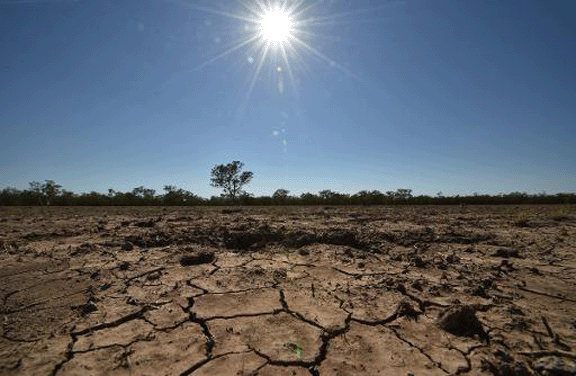
Country towns close to reaching ‘day zero’, as water supplies dry up in the drought, ABC News, By National Regional Affairs reporter Lucy Barbour 14 July 19, Across New South Wales and Queensland’s southern downs, country towns are approaching their own ‘day zero’, as water supplies dry up in the drought.
Ten towns, including major centres, are considered to be at high risk of running out within six months, if it doesn’t rain and if water infrastructure isn’t improved.
Councils are rushing to put emergency measures in place, but more than a decade since the end of the millennium drought, water security is still almost non-existent for many rural communities……….
Bigger centres like Tamworth and Orange, and potentially Dubbo and Armidale, plus smaller towns like Cobar, Narromine and Nyngan are all considered to be at “high risk” of running out within six months if things do not change.
Across the border in Queensland, water shortages are biting hard in towns like Stanthorpe and Warwick, which are inching towards emergency restrictions.
Southern Downs Shire Mayor Tracy Dobie says water may have to be carted from Warwick to Stanthorpe in December, and she fears ratepayers may have to foot the bill.
“We could be looking at anything from $500,000 to $1.5 million per month, to transport the water, depending on how far we have to truck it from,” she says.
Trucks are already a big part of the landscape in southern Queensland and northern New South Wales, carting livestock between saleyards and abattoirs.
But water restrictions are making those journeys longer, more expensive and messier, because councils have closed the wash stations drivers use to clean excrement from their vehicles……… https://www.abc.net.au/news/2019-07-14/day-zero-approaching-as-towns-run-out-of-water/11271430
July 15, 2019
Posted by Christina Macpherson |
AUSTRALIA - NATIONAL, climate change - global warming, environment |
Leave a comment
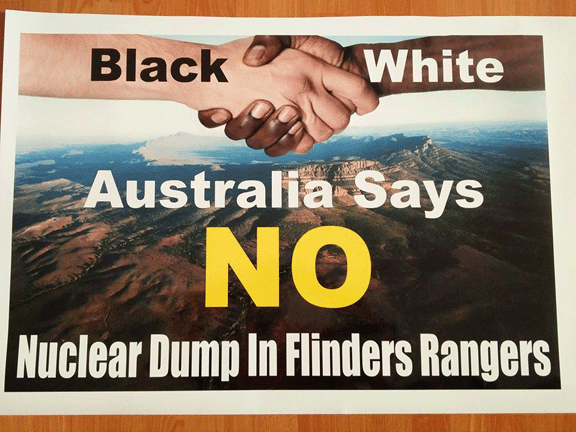
12 July 2019, Civil society groups and members of the communities affected by the federal government’s proposed National Radioactive Waste Management Facility (NRWMF) are deeply disappointed with Justice White’s ruling that the exclusion of Barngarla Traditional Owners from a ballot intended to gauge community support was not a breach of the Racial Discrimination Act.
Ballots were to be held in the Flinders Ranges and Kimba districts in August 2018. Eligibility to participate was severely restricted and while non-resident rate-payers were included, Traditional Owners who live outside the small geographic areas were excluded.
The Barngarla Determination Aboriginal Corporation, Native Title Holders for the Kimba District, sought an injunction in the Supreme Court, asserting that their exclusion breached the Racial Discrimination Act. This effectively put the site selection on hold.
In December 2018, the Adnyamathanha Traditional Lands Association (ATLA) lodged a formal complaint with the Human Rights Commission based on poor treatment and consultation with Traditional Owners throughout the divisive site selection process. This case is ongoing.
Mara Bonacci, Nuclear Free Campaigner for Friends of the Earth Australia said: “Today’s announcement is very disappointing, but not surprising. The federal legislation governing the nuclear waste management process, the National Radioactive Waste Management Act 2012, is undemocratic and systematically disadvantages Aboriginal people. The Act gives the federal government the power to extinguish rights and interests in land targeted for a radioactive waste facility. The Act allows the Minister to proceed with a nuclear waste dump without securing the consent of Traditional Owners. Traditional Owners, local communities, pastoralists, business owners, local councils and State/Territory Governments are all disadvantaged and disempowered by the NRWMA.
“It is important to note that today’s ruling is not a vindication of the federal site selection process, only finding that it is not a breach of the Racial Discrimination Act. The lack of inclusion of Aboriginal people is inconsistent with community expectation, best practise and Australia’s international obligations under the UN Declaration on the Rights of Indigenous Peoples. It is galling that Justice White’s ruling was delivered in NAIDOC week.
“The Federal government process has also denied a voice to many Australians concerned about this issue and about responsible radioactive waste management – this is a national issue and national responsibility, the burden of which should not be placed on regional and remote communities.
“It is appalling that federal resources Minister Matt Canavan is contemplating proceeding with a nuclear waste dump on Barngarla land despite the clear opposition of Traditional Owners. The SA Marshall Government also needs to voice its clear opposition to the imposition of a nuclear waste dump.”
“This Sunday marks the 15th anniversary of a famous day in South Australia’s history. On July 14, 2004, a campaign led by an Aboriginal Women’s Council, the Kupa Piti Kungka Tjuta, finally persuaded the Howard Government to abandon its plan to impose a national nuclear waste dump on SA. It seems nothing was learnt from that experience.
“Despite today’s ruling, community members, civil society groups and many others will continue to fight to protect South Australia from becoming home to Australia’s radioactive waste and for a fair and transparent site selection process based on responsible radioactive radioactive waste management”, Ms Bonacci concluded.
July 13, 2019
Posted by Christina Macpherson |
AUSTRALIA - NATIONAL, Federal nuclear waste dump, opposition to nuclear |
Leave a comment















 Antinuclear