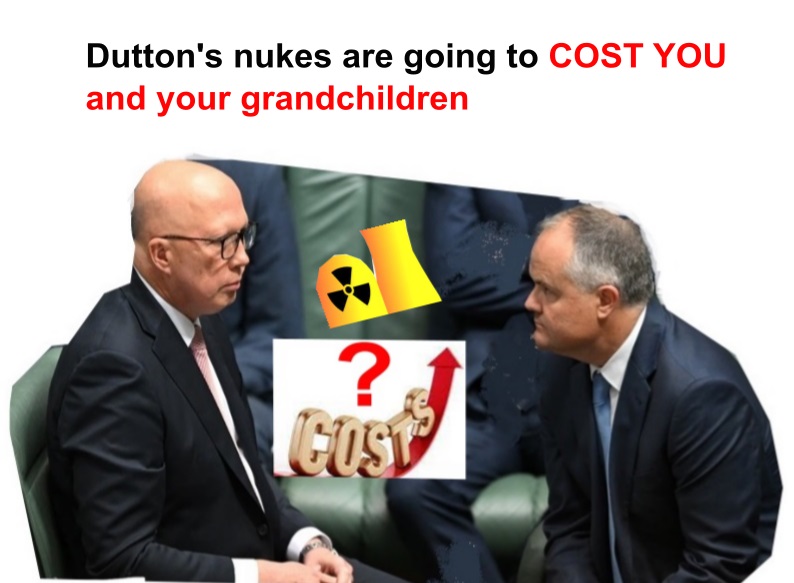
Peter Dutton’s nuclear plan could blow out household electricity bills by up to $600 a year by 2030
https://reneweconomy.com.au/peter-duttons-nuclear-plan-will-blow-out-household-electricity-bills-by-up-to-600-a-year-by-2030/ Sophie Vorrath, Mar 4, 2025
A new report has torpedoed Peter Dutton’s claim that the Coalition’s nuclear power plan for Australia would be 44 per cent cheaper than Labor’s plan for renewables, finding instead that it would inflate average consumer electricity bills by up to 41 per cent between now and 2030.
The report, commissioned by the Clean Energy Council, models the outcomes on electricity prices across Australia’s main grid, the NEM, if the build rate of utility scale renewable generation capacity was reduced significantly – as it promises to be under a Coalition government.
The modelling, conducted by global consultancy, Jacobs, sets a base case using the Australian Energy Market Operator’s (AEMO) Integrated System Plan Step Change Scenario, where 26 gigawatts (GW) of renewables in 2025 grows to 72.7 GW by 2030.
This base case is then contrasted against two scenarios based on the modelling by Frontier Economics for the federal Coalition, which restricts renewables to 49.1 GW by 2030 and relies on coal and gas while waiting for nuclear power.
In that report, Frontier Economics reduced the build rate for renewables, in particular, onshore and offshore wind, big solar and big batteries, in a world where longer term, post 2035 nuclear capacity is installed to meet customer electricity needs.
Frontier’s economic modelling has since been used to underpin claims from Liberal Peter Dutton that his plan for a power system including a significant role for nuclear will be 44% cheaper than a system relying predominantly on renewables.
As Tristan Edis writes in a series of articles starting here, a range of energy analysts and economists have found an array of problems with how this number was derived, but this hasn’t stopped the LNP leader from repeating it every chance he gets.
The Clean Energy Council has therefore decided to fight fire with fire.
Nuclear power struggling to maintain current level of stagnation, let alone achieve any growth
Alongside the risk of Fukushima-scale disasters, the weapons proliferation risks, the risk of attacks on nuclear plants (and the reality of attacks on nuclear plants in Ukraine), and the intractable nuclear waste legacy, the reality is that nuclear power just can’t compete economically.
The industry’s greatest problem at the moment is a recognition of this by investors, resulting in a capital strike.
Darrin Durant, Jim Falk & Jim Green, Mar 3, 2025, https://reneweconomy.com.au/nuclear-power-struggling-to-maintain-current-level-of-stagnation-let-alone-achieve-any-growth/
The current push in Australia to deploy nuclear power reactors once again contrasts an excessive optimism by nuclear proponents against the continuing stagnant situation of nuclear power worldwide. That contrast is the subject of our new report for the EnergyScience Coalition.
The latest nuclear proposals are built on three speculations.
First, projected AI-related energy demand where – as with nuclear power proponents in the 1970’s who projected huge demand that never eventuated – there are already signs demand is overblown. For example the new leading AI entrant DeepSeek requires just 10 per cent of the energy of competitors.
Second, speculative techno-optimism that new technologies such as small modular reactors will resolve industry project management issues. Yet these small reactors are unproven.
Third, prospective wish-fulfilment, where dozens of nuclear ‘newcomer’ countries are offered as saviours, despite not having reactor approvals and funding in place in a large majority of cases.
So what is the state of nuclear power in 2024? A review by the World Nuclear Industry Status Report notes that seven new reactors were connected to grids last year while four reactors were permanently closed. The net increase in operating nuclear capacity was 4.3 gigawatts (GW).
Worldwide nuclear power capacity was 371 gigawatts (GW) at the end of 2024. That figure is near-identical to capacity of 368 GW two decades earlier in 2005.
As of 1 January 2025, the mean age of the nuclear power reactor fleet was 32.1 years. In 1990, the mean age was just 11.3 years. Due to the ageing of the reactor fleet, the International Atomic Energy Agency projects the closure of 325 GW of nuclear capacity from 2018 to 2050 – that’s 88 per cent of current worldwide capacity. Thus the industry faces a daunting challenge just to maintain its pattern of stagnation, let alone achieve any growth.
There were no ‘small modular reactor’ (SMR) startups in 2024. Indeed there has never been a single SMR startup unless you count so-called SMRs not built using factory ‘modular’ construction techniques, in which case there is one each in China and Russia.
The SMR sector continues to go nowhere with setbacks in 2024 including the suspension of the Nuward project in France (following previous decisions to abandon four other SMR projects) and the bankruptcy of US company Ultra Safe Nuclear.
Nuclear growth dwarfed by renewables
In striking contrast to nuclear power’s net gain of 4.3 GW in 2024, the International Energy Agency’s October 2024 ‘Renewables 2024’ report estimates 666 GW of global renewable capacity additions in 2024. Based on the Agency’s estimate, renewables capacity growth was 155 times greater than that of nuclear power.
The International Energy Agency expects renewables to jump sharply from 30 per cent of global electricity generation in 2023 to 46 per cent in 2030.
Conversely, nuclear power’s share of global electricity generation has fallen steadily since the 1990s. As of 1 January 2025, nuclear power accounted for 9.15 per cent of global electricity production, barely half of its peak of 17.5 per cent in 1996.
A Bloomberg analysis finds that renewable energy investments reached $A1.17 trillion in 2024, up 8 per cent on the previous year, whereas nuclear investment was flat at $A55.1 billion. Thus renewable investments were 21 times greater than nuclear investments.
In contrast to massive cost overruns with nuclear projects, renewable costs have fallen sharply.
Lazard investment firm data shows that utility-scale solar and onshore wind became cheaper than nuclear power from 2010-2015. From 2009-2024, the cost of utility-scale solar fell 83 per cent; the cost of onshore wind fell 63 per cent; while nuclear costs increased 49 per cent.
Nuclear newcomer countries
Claims that 40-50 countries are actively considering or planning to introduce nuclear power, in addition to the 32 countries currently operating reactors, do not withstand scrutiny.
As of 1 January 2025, reactors were under construction in just 13 countries, two less than a year earlier. Seven percent of the world’s countries are building reactors; 93 percent are not.
Of the 13 countries building reactors, only three are potential nuclear newcomer countries building their first plant: Egypt, Bangladesh and Turkiye. In those three countries, the nuclear projects are led by Russian nuclear agencies with significant up-front funding from the Russian state.
The World Nuclear Association observes that apart from those three countries, no countries meet its criteria of ‘planned’ reactors, i.e. “approvals, funding or commitment in place, mostly expected to be in operation within the next 15 years.”
The number of potential newcomer countries with approvals and funding in place, or construction underway, is just three and those projects are funded heavily by the Russian state. That is the underwhelming reality underlying exaggerated claims about 40-50 countries pursuing nuclear power.
There is no evidence of a forthcoming wave of nuclear newcomer countries in the coming years and decades. At most there will be a trickle as has been the historical pattern with just seven newcomer countries over the past 40 years and just three this century.
The number of countries operating power reactors in 1996–1997 reached 32. Since then, nuclear newcomer countries have been matched by countries completing nuclear phase-outs and thus the number is stuck at 32. And less than one-third of those countries are building reactors (10/32).
It is doubtful whether the number of nuclear newcomer countries over the next 20-30 years will match the number of countries completing phase-outs.
Capital strike
Alongside the risk of Fukushima-scale disasters, the weapons proliferation risks, the risk of attacks on nuclear plants (and the reality of attacks on nuclear plants in Ukraine), and the intractable nuclear waste legacy, the reality is that nuclear power just can’t compete economically.
The industry’s greatest problem at the moment is a recognition of this by investors, resulting in a capital strike. Even with generous government/taxpayer subsidies, it has become difficult or impossible to fund new reactors – especially outside the sphere of China and Russia’s projects at home and abroad.
Who would bet tens of billions of dollars on nuclear power projects when the recent history in countries with vast expertise and experience has been disastrous?
In France, the latest cost estimate for the only recent reactor construction project increased seven-fold to A$39.4 billion for just one reactor. Construction took 17 years. No reactors are currently under construction in France.
In the US, one project in South Carolina, comprising two Westinghouse AP1000 reactors, was abandoned in 2017 after $A14.3 billion was spent. Westinghouse declared bankruptcy and its debts almost forced its parent company Toshiba into bankruptcy. All that remains is the nukegate scandal: an avalanche of legal action including criminal cases.
The only other reactor construction project in the US – the twin-reactor Vogtle project in the state of Georgia – reached completion at a cost 12 times higher than early estimates. The final cost was at least $A27 billion per reactor. Completion was six to seven years behind schedule.
No power reactors are currently under construction in the US. Thirteen reactors have been permanently shut down over the past 15 years.
The situation is just as bleak in the UK where there have been 24 permanent reactor shut-downs since the last reactor startup 30 years ago, in 1995.
The 3.2 GW twin-reactor Hinkley Point project in Somerset was meant to be complete in 2017 but construction didn’t even begin until 2018 and the estimated completion date has been pushed back to 2030-31.
The latest cost estimate – A$46.6 billion per reactor – is 11.5 times higher than early estimates. The UK National Audit Office estimates that taxpayer subsidies for the Hinkley Point project could amount to $A60.8 billion and the UK Parliament’s Public Accounts Committee said that “consumers are left footing the bill and the poorest consumers will be hit hardest.”
The estimated cost of the planned 3.2 GW twin-reactor Sizewell C project in the UK has jumped to $A81 billion or $A40.5 billion per reactor, twice the cost estimate in 2020. Securing funding to allow construction to begin is proving to be difficult and protracted despite a new ‘Regulated Asset Base’ funding model which foists the enormous risk of enormous cost overruns onto taxpayers and electricity ratepayers.
Lessons for Australia
Those three countries – France, the US and the UK – have vast nuclear expertise and experience. They all enjoy synergies between civil and military nuclear programs – President Macron said in a 2020 speech that without nuclear power in France there would be no nuclear weapons, and vice versa.
All of the above-mentioned construction projects were (or are) on existing nuclear sites. All projects were (or are) long delayed and tens of billions of dollars over-budget.
Claims that potential nuclear newcomer countries such as Australia, without any of those advantages, could build reactors quickly and cheaply are not credible.
Our report expanding on these issues is posted at the EnergyScience Coalition website.
Darrin Durant is Associate Professor in Science and Technology Studies at the University of Melbourne. Jim Falk is a Professorial Fellow in the School of Geography, Earth and Atmospheric Sciences at the University of Melbourne and Emeritus Professor at the University of Wollongong. Dr. Jim Green is the national nuclear campaigner with Friends of the Earth Australia and a member of the Nuclear Consulting Group.
Global Ocean Treaty two years on: Australia’s chance for international cooperation
Greenpeace SYDNEY, Tuesday 04 March 2025 – Two years after the United Nations agreed to bring the historic Global Ocean Treaty into force, Greenpeace is urging the Australian government to make good on its pledge for ocean protection and finally ink the treaty into law.
The UN treaty to protect the high seas was agreed two years ago today in 2023. It is a legally binding pact to conserve international waters, a crucial component in global efforts to protect 30% of the world’s oceans and lands by 2030. While 110 countries have signed the treaty, only 18 countries have ratified the treaty into law so far.
Greenpeace Australia Pacific Senior Campaigner Georgia Whitaker said:
“The government has been sitting on the Global Ocean Treaty for two years while other countries rapidly move to ratify and bring the treaty into force. We are an ocean-loving nation, and the Australian government could act as a proud leader on the world stage by making good on its promise to protect the high seas now. Our oceans don’t have the luxury of time – we need to ratify now, then deliver protected ocean sanctuaries in our big blue backyard: the Tasman Sea.”
Once the treaty is in force, governments can propose ocean sanctuaries for the high seas. A 2023 scientific report by Greenpeace identified the South Tasman Sea and Lord Howe Rise – the high seas between Australia and New Zealand – as being of critical importance for protection.
Until the treaty enters into force, the management of our global oceans is very fragmented. There is no legal global instrument that allows for the creation of sanctuaries in international waters. To this day, less than 1% of the high seas – the largest habitat on Earth, comprising 64% of the world’s ocean – is fully or highly protected from human activities.
The countdown is on, as the pivotal UN Ocean Conference (UNOC) will take place in Nice, France, in less than 100 days.
“UNOC is a unique chance for Governments to show global leadership for ocean protection. Australia must use this opportunity and ratify the treaty before arriving in Nice,” added Whitaker.
Peter Dutton’s nuclear plan is off in the never-never, but our power bills and emissions pledge are not

Peter Dutton’s nuclear plan is off in the never-never, but our power bills and emissions pledge are not
Lenore Taylor, Guardian 28th Feb 2025 https://www.theguardian.com/australia-news/commentisfree/2025/mar/01/peter-duttons-nuclear-plan-is-off-in-the-never-never-but-our-power-bills-and-emissions-pledge-are-not
The nuclear plan handily leapfrogs the next 10 years – when a Dutton government might actually hold office – a critical time for emissions reduction.
I don’t often agree with Matt Canavan on matters to do with global heating. But when the senator labelled the Coalition’s nuclear plan a “political fix” last year, I think he was speaking the truth.
For 15 gruelling years the Coalition has been trying to distract a voting public, ever more aware of the climate crisis, from its inability to get a credible climate and energy policy past the climate sceptics and do-nothing-much-to-reduce-emissions exponents in its own ranks (including the Queensland senator).
Peter Dutton’s nuclear policy is the latest iteration, framing the “debate” as one between two different technological means to get to the same goal of net zero emissions by 2050, and those critical of nuclear power as “renewables only” ideologues who blindly refuse to consider a credible solution.
But even under the Coalition’s very optimistic calculations nuclear power cannot come onstream for a decade, so this is also a framing that handily leapfrogs the next 10 years; the decade when a Dutton government might actually hold office, and also a decade when today’s voters will still need to pay power bills and require a reliable energy supply, and when the world must reduce emissions to avoid the most disastrous impacts of heating.
Having so carefully set up the nuclear-in-the-never-never policy for some time now, the Coalition can be quite aggressive when anyone points out its many near-term deficiencies.
This week’s target was the Climate Change Authority, which found the Coalition’s plan – to slow the roll-out of renewable energy and somehow keep crumbling coal-fired power plants running until after 2040 when taxpayer-funded nuclear reactors might become available – would massively increase Australia’s carbon dioxide emissions, by more than 2bn tonnes.
It’s pretty obvious, really, that continuing to burn coal will produce more emissions, and it certainly wasn’t an outlandish estimate, being based on the Coalition’s own modelling, and broadly in line with estimates from energy experts at the University of New South Wales.
But the Coalition chose not to address it, but rather to shoot the messenger; in this case the independent authority and its chair, the former NSW Liberal minister Matt Kean. The authority, it said, had become “a puppet of Anthony Albanese and [energy minister] Chris Bowen”. There were strong hints that under a Dutton government Kean himself might be sacked.
Dutton’s claim that power prices will be 44% cheaper in the near term under his plan are also unsubstantiated and somehow also less scrutinised than all the competing assessments of what nuclear may or may not cost in the long term, if it is ever eventually built.
Experts say Dutton’s pronouncements on near-term costs show he clearly doesn’t know what he is talking about.
The opposition leader routinely cites modelling from Frontier Economics, itself contested, which did find that nuclear power would reduce the energy system costs in the longer term by 44%. Frontier’s managing director, Danny Price, confirms his work did not forecast household power bills or electricity prices, and that nearer term reductions in system costs were not quantified.
And then there are the deep fears, from the Australian Energy Market Operator, among others, about how the ageing coal-fired power system would hold together in the 10 years or more during which nuclear power was being developed.
Canavan’s criticism of his own party’s policy was made in the context of his argument that neither major party was being upfront about the challenges of keeping the energy system running while reaching net zero by 2050.
I disagree with him there. Australia is just starting to shake off the decades of stultifying climate wars to achieve a necessary and long-delayed energy transition. The east coast grid now runs on about 43% renewable energy. The lights are staying on. Investment is increasing.
As the AGL chief executive, Damien Nicks, said last week: “Both time and cost won’t allow nuclear to be done on time … the question right now is about getting on and getting this done as soon as we can.”
If Dutton wants to discuss nuclear as a long-term option, that’s fine, but it’s no substitute for knowing what his plan means for the here and now, for power bills, and emissions, and the promises we have made on the international stage. That is, if it is actually a serious policy rather than another tactic for delay.
Dutton’s nuclear gamble short on detail, but voters don’t seem to care

Dutton is unlikely to be bothered by the pockets of negativity towards nuclear, as they are concentrated among “high-information” voters who pay a lot of attention to politics………. he’s pitching himself to the so-called low information voters.”
the specific unpopularity of nuclear is unlikely to be politically significant in the outer-suburban electorates that Dutton covets.
The Coalition does not really want to talk about the practicalities of establishing nuclear energy in Australia. The question is: does anyone?
AFR, Ryan Cropp, 3 Mar 25
ppearing in front of local media in the north Queensland town of Ingham last month, Opposition Leader Peter Dutton was asked about his nuclear policy.
Did he expect the teals to support the Coalition’s nuclear plan? Dutton said yes, citing the new bipartisan support for nuclear in the UK and US, before unspooling a range of loosely related talking points: power bills, Victorian gas imports, and the floods that were affecting mobile phone and internet coverage.
For those opposed to Dutton’s nuclear policy, the pivot was telling. If elected, the Coalition has promised to build seven nuclear reactors, from scratch. But eight months since announcing the policy, Dutton has so far managed to dodge questions on many of the key details of his nuclear gamble.
Those details include the cost of building them, which Labor puts at $600 billion; the earliest a reactor could be built, arguably a decade later than Dutton’s plan; the extra billion tonnes of emissions caused by running old coal plants for longer, threatening Australia’s international commitments to reduce its carbon pollution; not to mention questions about water use, insurance and safety and health risks.
“It’s not clear exactly how they’re going to introduce nuclear,” says Tony Wood, an energy expert at the Grattan Institute.
“What is the policy plan? [There is a] vague idea that they’re going to have some big nuclear plants in seven places … and they’re also going to have these small ones – but they’re not too sure where and how they would run.
“It’s a high-risk strategy and the opposition is really not very clear on how they’re going to deliver on that.”
Despite the big outstanding questions, Labor has so far struggled to land any significant punches on the subject. The Coalition, it appears, does not really want to talk about the practicalities of establishing nuclear energy in Australia. The question is: does anyone?
Mentions of Dutton alongside nuclear in print and online media have halved since their peak in December 2024, when the Coalition released the policy costings, according to media intelligence provider Streem.
A survey of Dutton’s recent doorstop interviews and radio and television appearances also shows the nuclear issue falling from the top of the agenda, overwhelmed by concerns around antisemitism, Donald Trump and interest rates.
The longer Dutton can keep his big policy a small target, the longer he can keep the focus on his core message: cost-of-living, energy prices, and why Labor’s “renewables only” policies are making it worse.
That high-level, “vibes-based” messaging appears to be part of a broader political strategy.
Dutton wants to use nuclear to replace the country’s ageing coal-fired power generators and shore up the country’s energy security for decades to come. He says the first would be built in 2035 if a small modular reactor, or 2037 if a large power plant.
The policy ostensibly aligns a party with a large contingent of fierce climate sceptics behind Australia’s Paris Agreement commitments to net zero emissions by 2050. It also contrasts with Labor’s plan, which relies for the most part on a massive build-out of large-scale wind and solar, plus 10,000 kilometres of new poles and wires to connect it all to the grid.
According to one former senior Liberal who remains close to the party, Dutton’s nuclear gambit not only puts a Band-Aid over the party’s internal warfare on energy, but also shifts the debate over the green transition back onto Labor.
“He’s been able to change the debate with the government into a question of how you get [to net zero], and in doing so, has backed the government into the position of being seen to be the dogmatists,” said the former Liberal, who requested anonymity in order to speak freely.
For his part, shadow energy minister Ted O’Brien denies the small target strategy. “We’re not taking a small target approach – we’re leading the debate on how to fix Labor’s energy mess. The real question is: why is Labor running scared from serious conversations about nuclear?”
Opponents of Dutton’s nuclear plan take heart from a steady stream of studies that show the technology to be among the least favourable energy sources among voters.
Polling commissioned by the Clean Energy Council found only a third of voters supported nuclear, with half supporting gas and close to 80 per cent favouring rooftop solar.
Similar Australian Financial Review/Freshwater polling over the last two years has consistently shown that nuclear comes in only marginally above coal on a net favorability basis, and is well behind renewable sources of power like solar and wind.
But according to the former Liberal politician, Dutton is unlikely to be bothered by the pockets of negativity towards nuclear, as they are concentrated among “high-information” voters who pay a lot of attention to politics.
“That’s not where Dutton is pitching himself,” the former Liberal says. “In this area – and in a lot of other areas – he’s pitching himself to the so-called low information voters.”
“These are people who are not particularly interested in politics anyway, but they hear through the fog: ‘Oh, Dutton wants nuclear. The government’s against it. That’s interesting.’ That’s all they hear.”
Voters are ‘not resistant’ to nuclear
That’s a view shared by electoral experts, who say that the specific unpopularity of nuclear is unlikely to be politically significant in the outer-suburban electorates that Dutton covets.
To win government, the Coalition is targeting voters aggrieved by the difficult economic circumstances of the post-COVID years – many of whom live in mortgage belt seats held by Labor.
Dutton, pollsters say, will not be overwhelmed with demands for details of his nuclear policy on the streets of western Sydney.
Redbridge analyst Kos Samaras says there is not a huge amount of opposition to the idea of nuclear energy in Australia…………………………………
Rural support is key to the Coalition’s plan. Under Labor’s preferred energy mix, copious new solar and wind facilities need to be built in the regions, then connected to the grid by a vast new network of poles and wires. Many of these projects have been plagued by pockets of intense community pushback, undermining the social licence required for the renewables rollout to proceed…………………………………..
Also significant in the opposition’s calculations is the apparent age differential on support for nuclear, which Samaras says is clearly evident, but not likely to be a huge vote-swinger.
“I don’t believe nuclear is an issue in the marginal seats.”— John Black, demographic analyst
“Younger Australians in particular don’t want to rule out all solutions,” he said. “But it is nuanced. When it comes to nuclear, young people do have some reservations about things like safety.”
This age dynamic is well understood within Coalition ranks, according to two party sources not authorised to speak publicly….. those of a younger vintage are open to persuasion……………………………………
The most recent cost of energy report published by US investment bank Lazard, which looks at global averages, also found large-scale onshore wind and solar to be substantially cheaper than nuclear.
On top of the cost, Labor has zeroed in on the logistical difficulties of actually building the reactors, on time and on budget. Experts appearing at a recent Labor-led inquiry into nuclear energy estimated that in a best-case scenario, the earliest Australia was likely to get a nuclear plant up and running from a standing start was the mid-2040s – well beyond the Coalition’s estimates.
In addition to production and supply chain difficulties, the switch to nuclear would also involve overturning a handful of state and federal laws, as well as navigating even more complex planning and environmental approvals.
And given the cost and timing blowouts of other large infrastructure projects like Snowy Hydro and the National Broadband Network, only the most optimistic of nuclear boosters would be willing to put money on a facility being up and running in just over a decade.
And that delay comes with its own costs. In a dramatic intervention last week, the government’s independent advisory body, the Climate Change Authority, said that even under the optimistic scenario modelled by Frontier Economics, the Coalition’s plan to extend coal and gas generation until nuclear comes online would produce an additional billion tonnes of carbon emissions from the electricity sector alone………………………………………
Dutton should expect the government to keep up the negative messaging. On Friday, the prime minister advised Australians to “buy some popcorn” after Bowen invited O’Brien to debate him on nuclear at the National Press Club.
The opposition leader, for his part, lets it all roll off his back.
With recent polls showing the Coalition edging ahead of the government on a two-party preferred basis, it appears nuclear is not registering as the political liability many on the Labor side of politics think it could be………………..https://www.afr.com/companies/energy/dutton-s-nuclear-gamble-short-on-detail-but-voters-don-t-seem-to-care-20250219-p5ldj0
New report details nuclear power’s demise
March 3, 2025 AIMN Editorial, EnergyScience Coalition , https://theaimn.net/new-report-details-nuclear-powers-demise/
A new report by the EnergyScience Coalition corrects false claims by the federal Coalition and others that ‘the world is going nuclear’.
Co-authors Assoc. Prof. Darrin Durant, Prof. Jim Falk and Dr. Jim Green note that:
- The number of operating power reactors worldwide has fallen to 411, which is 27 fewer than the peak of 438 reactors in 2002.
- In 2024 there were 666 gigawatts (GW) of global renewable power additions compared to nuclear growth of 4 gigawatts, a ratio of 155:1. In China the ratio was 100:1.
- Nuclear power’s contribution to global electricity production fell to 9.15 percent last year, barely half of its peak of 17.5 percent in 1996. Conversely, the International Energy Agency expects renewables to jump sharply from 30 percent of global electricity generation in 2023 to 46 percent in 2030.
- Global nuclear power capacity is no greater than it was 20 years ago.
- Of the 32 countries operating power reactors, less than one-third (10) are building new reactors.
- The number of countries building nuclear power reactors fell from 15 to 13 last year. Seven percent of the world’s countries are building reactors; 93 percent are not.
- The number of potential nuclear ‘newcomer’ countries with reactor approvals secured and funding in place, or construction underway, is just three and those projects are all heavily funded by the Russian state.
- The ‘small modular reactor’ sector continues to go nowhere with setbacks in 2024 including the suspension of the Nuward project in France and the bankruptcy of US company Ultra Safe Nuclear.
Report co-author Prof. Jim Falk said: “Reactor construction projects in countries with vast expertise and experience ‒ such as France, the US and the UK ‒ have run literally tens of billions of dollars over-budget and construction schedules have slipped by many years. Since those countries have failed to build reactors on-time and on-budget, it would be naïve to believe that a nuclear ‘newcomer’ country such as Australia could do so.”
Co-author Dr. Jim Green said: “This report provides a factual rebuttal to the pro-nuclear disinformation campaign currently underway in Australia. Simple facts are ignored by the nuclear lobby, such as the fact that there has been zero growth in nuclear power over the past 20 years and the number of countries operating reactors is the same as it was in the late 1990s.”
The report, titled ‘Nuclear Power’s Global Stagnation and Decline’, is co-authored by Assoc. Prof. Darrin Durant (Associate Professor in Science and Technology Studies at the University of Melbourne), Prof. Jim Falk (Professorial Fellow in the School of Geography, Earth and Atmospheric Sciences at the University of Melbourne; Emeritus Professor at the University of Wollongong) and Dr. Jim Green (President of Friends of the Earth Australia and a member of the Nuclear Consulting Group).
AUKUS ‘impact assessment’ report ignores nuclear submarine risks in SA

By David Noonan, Feb 28, 2025, https://johnmenadue.com/aukus-impact-assessment-report-ignores-nuclear-sub-risks-in-sa/
Environment Minister Tanya Plibersek has released an EPBC Act ‘Impact Assessment Report’ (IAR) to address the environmental impacts of constructing nuclear submarines at Osborne, Port Adelaide. A deluge of documents — the 200-page IAR with 750 pages of appendices — have been released for “public consultation” running till 17 March. However, the IAR fails to provide answers to community’s “right to know” on nuclear submarine accident risks and radioactive waste storage facing Port Adelaide.
The proponent Australian Submarine Agency ruled a range of lead community safety concerns as “out of scope” of this Osborne assessment. The IAR says: “Information on potential sources of radiation has been provided to inform, however does not form part of the Strategic Assessment as these sources will be managed via separate environmental assessment processes and approvals as necessary.”
Impacts of commissioning and operation of the “power module” (the nuclear reactor) “is considered outside the scope of this assessment” ‒ that assessment is to be “held over” for a new non-independent military nuclear regulator that reports to Defence Minister Richard Marles. The military are to effectively take over public safety at Port Adelaide even though the federal Health Minister Mark Butler is the local MP.
Federal Labor is in denial over nuclear submarine reactor accident risks. The word “accident” does not even appear in the 200-page IAR. Even a visit by a nuclear-powered submarine to a port in Australia requires emergency response planning that sets evacuation zones for potential nuclear reactor accidents. It is at best inept to decide to impose nuclear sub reactor accident risks onto communities across Lefevre Peninsula and Port Adelaide while failing to conduct full impact assessments and limiting “public consultation” to only those aspects that suit Labor’s staged roll-out of the AUKUS nuclear sub agenda.
The management facility for radioactive waste at Osborne, and the disposal pathway for such radioactive waste, “is considered outside the scope of the Strategic Assessment”. Marles is already a year late on his own schedule to announce a “process” for managing AUKUS nuclear waste storage and disposal, due back in March 2024. The IAR radioactive waste management section says: “The facility is to be designed to have the capacity to manage radioactive material over the 50-year Strategic Assessment timeframe.” Thus, radioactive wastes may accumulate and remain ‘stored’ at Osborne for decades.
The IAR also misrepresents nuclear submarine reactor radioactive wastes to be stored at Osborne as “similar to those that occur in over 100 locations nationwide, including hospitals, science facilities and universities” and “similar to the waste generated by hospitals and research facilities around Australia”.
Emergency services workers have a ‘right to know’
SA emergency services workers — first responders, the police, fire, ambulance and hospital personnel — have a right to know what nuclear health risks they face. Federal emergency provisions apply in event of a nuclear sub reactor accident at Port Adelaide. The civilian Australian Radiation Protection and Nuclear Safety Agency “Guide for Radiation Protection in Emergency Exposure Situations” and “Nuclear powered vessel visit planning” set out the studies and Emergency response measures that are to be put in place.
The ARPANSA Guide authorises very high ionising radiation dose exposures to emergency workers in tasking them to undertake “urgent protective actions” on site at a nuclear accident, at a dose of up to 50 milliSieverts (mSv). That is 50 times in excess of the recommended civilian maximum allowed dose of 1 mSv per year.
Affected members of the public within an “Urgent Protective Action Zone” of 2.8 km radius from the site of a nuclear sub reactor accident also face authorised high ionising radiation dose exposure of up to 50 mSv. In a “Reference Accident” the local population may face evacuation and may require “decontamination” and medical treatment. A wider zone where “the surrounding population may be subject to hazards” is described as having a radius of several kms. ARPANSA also require studies of a local population out to 15 km from a nuclear submarine mooring.
Catastrophic conditions
In an even more severe AUKUS nuclear accident, federal provisions provide for civilian SA emergency workers to face “the development of catastrophic conditions”. Emergency workers and designated shipyard workers are then to be called upon to “volunteer” to risk dangerously high ionising radiation dose exposures of up to 500 mSv. The ARPANSA Guide states female emergency workers are to be excluded: “Female workers who might be pregnant need to be excluded from taking actions that might result in an equivalent dose exceeding 50 mSv”.
The ARPANSA Guide authorises “actions to prevent the development of catastrophic conditions” by civilian workers. “Category 1 Emergency workers” may “receive a dose of up to 500 mSv”, a dangerously high ionising radiation dose exposure that is 500 times the maximum allowed civilian annual dose. The ARPANSA Guide states:
“Emergency workers may include workers employed, both directly and indirectly, by an operating organisation, as well as personnel of response organisations, such as police officers, firefighters, medical personnel, and drivers and crews of vehicles used for evacuation. …
“Emergency workers undertaking mitigatory actions and urgent protective actions on-site, including lifesaving actions, actions to prevent serious injury, actions to prevent the development of catastrophic conditions that could significantly affect people and the environment, and actions to prevent severe tissue reactions. … They may also receive a dose of up to 500 mSv for life saving actions, to prevent the development of catastrophic conditions and to prevent severe tissue reactions.”
Federal and SA governments have a responsibility to be transparent over a required “Emergency Response Plan” for AUKUS nuclear reactor accidents. No government can claim to have a social licence for AUKUS nuclear subs while failing to inform affected community and affected workers of the nuclear accident and ionising radiation health risks they may face.
Further information is online.
Australia’s Nuclear Plan: Climate & Security threat.
The Australian Security Leaders Climate Group, 28 Feb 25
Australia’s proposed nuclear power plan is facing serious pushback from former defence and security leaders, who warn that it increases national and regional security risks and delays climate action.
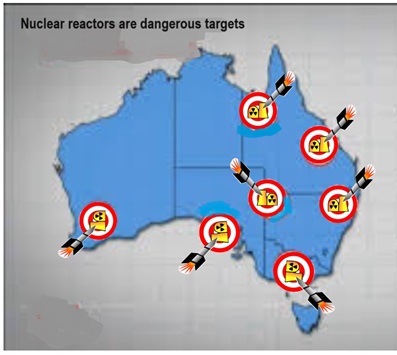
The Australian Security Leaders Climate Group (ASLCG) has issued a strong statement today highlighting the dangerous vulnerabilities nuclear power plants would introduce:
A Target in Modern Warfare – Nuclear power plants would become high-value, vulnerable targets for missile strikes, sabotage, and cyberattacks. With all proposed sites located within 100 km of the coast, they are easy targets in times of conflict.
A Military Dilemma – Admiral Chris Barrie (Retd), former Chief of the Australian Defence Force, warns that these power stations would divert critical defence resources away from protecting Australian cities and military bases. “Where do we allocate limited national defence capabilities?” he asks.
A Costly Security Burden – Cheryl Durrant, former Defence Department Director, says that Australia lacks a layered missile defence system to protect these plants. “Building one would be complex, expensive, and stretch our security resources even further.”
A Climate Setback – The nuclear plan would perpetuate reliance on coal-fired power for decades, adding two billion tonnes of carbon emissions and derailing our climate targets.
Chinese warships sailing the Tasman Sea expose AUKUS folly
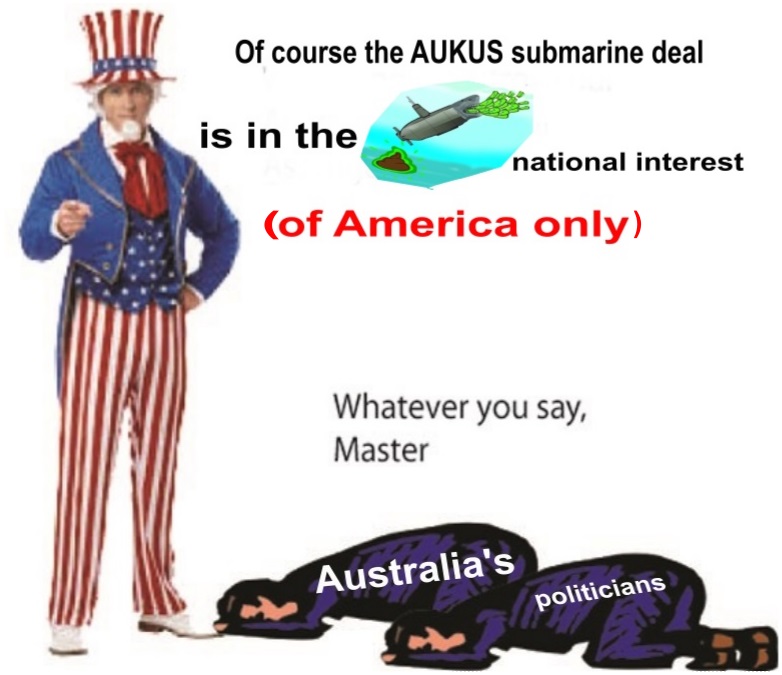
Australia needs to abandon its bankrupting $368B all-eggs-in-one-basket monolithic AUKUS nuclear submarine program and get back to Defence basics.
MichaelWest Media, by Rex Patrick | Feb 28, 2025
China exposes a fundamental flaw in Australia’s nuclear submarine project. While their navy operates off our coast, AUKUS is sapping funds from capabilities needed today. Former submariner Rex Patrick reports.
Rex Patrick reports.
Many Australians have been disturbed, indeed angered, by Chinese warships operating in our exclusive economic zone over the past weeks. How dare they! But the fact is that the Chinese vessels – a destroyer, a frigate and a replenishment ship – are operating in accordance with international law and simply doing to us what we’ve done to them for decades.
Readers will remember a number of recent incidents in which the Chinese military confronted Australian military assets conducting maritime operations in areas of interest to China.
In April 2018, three Australian Naval vessels operating in international waters off Vietnam were challenged by People’s Liberation Army Navy (PLAN) warships.
On all of these occasions, Australia asserted the right of our navy and air force to operate freely in international waters and air space.
Maybe we need to contain our anger!
Strategic takeaways
There are a couple of significant takeaways from the Chinese task group deployment.
The first is that PLAN is no longer a ‘brown-water navy‘. It’s a blue-water navy that can project itself at significant range. In months and years to come, we can expect to see more PLAN warships in Australia’s immediate region and, indeed, in our Exclusive Economic Zone. That’s inevitable.
The second thing to recognise is the fact that our AUKUS submarine strategy is fundamentally flawed.
AUKUS flaw
As the Chinese are operating off the coast of Australia now, we might, and it’s a big might, get our first Virginia Class nuclear-powered submarine in a decade, around 2035.
Whilst Australia embarks on a $368B submarine procurement program, money is being sapped from current programs that would deliver relevant capability now. There is also a huge opportunity cost for procuring other relevant capabilities that could be purchased for near-term delivery.
As PLAN warships were conducting live-fire exercises off the coast of Australia, the only possible contribution that the AUKUS project team could have made in response to it would have been to visually identify those ships by one of its team members flying in a commercial jet over the Tasman Sea en route to another taxpayer-funded junket in Washington.
Furthermore, the nuclear submarines we are currently trying to acquire have the capability to operate for extended periods off the coast of China, but that’s simply unnecessary – the PLAN has well and truly arrived off our coast. They’re bringing the party to us. Even a relatively modest PLAN deployment across our sea lanes would keep our modestly sized navy well and truly tied up.
President Trump may well just see the fate of Taiwan as another real estate deal, something to be traded away for the right price.
This PLAN ‘visit’ to Australian waters highlights our current force weakness. Whilst we have been cooperating with New Zealand in shadowing the three-ship task group, we really don’t have much in the way of assets to deal with the PLAN’s enhanced capabilities.
Indeed, the Chief of Defence Force has advised the Senate that, despite having a budget this financial year of $58B, it was a Virgin Australian pilot that first advised the Australian Government that the PLAN was conducting live-fire exercises off the east coast…………………………………………………………………………………………………………………………………….
needs to be asking the same questions as the Europeans.
Stand on our own
Two decades ago, Australia had a capable, flexible defence force configured for the defence of Australia with the option of expeditionary deployments where our capabilities complemented a multinational operation.
“The current plan on record has abandoned that sovereign goal and focussed on total integration with the US armed forces.”
Our forces are now so integrated with and reliant upon the US military that not only is our capability to defend Australia gravely weakened but our own sovereign decision-making is compromised.
Maybe it’s not just the Chinese that have done us a favour with their task group deployment. President Trump is helping out too.
Australia needs to abandon its bankrupting $368B all-eggs-in-one-basket monolithic AUKUS nuclear submarine program and get back to Defence basics. We need a modern, capable, flexible and self-reliant Defence force that can meet our own sovereign needs. That is entirely achievable and affordable, provided we make the right decisions now.
Rex Patrick
Rex Patrick is a former Senator for South Australia and earlier a submariner in the armed forces. Best known as an anti-corruption and transparency crusader, Rex is running for the Senate on the Lambie Network ticket next year – www.transparencywarrior.com.au.
Why the Coalition should stop trying to silence nuclear power critics

SMH, Nick O’Malley February 27, 2025 ,
News emerged on Monday that the Climate Change Authority had concluded the Coalition’s nuclear power plan would create an extra two billion tonnes of greenhouse gas emissions by extending the life of the nation’s geriatric coal power plants.
The Coalition’s response was swift and emphatic. It attacked the Climate Change Authority as partisan – the CCA that is headed by former NSW Liberal treasurer and energy minister Matt Kean.
“The Climate Change Authority has become a puppet of Anthony Albanese and [Climate Change and Energy Minister] Chris Bowen, as its latest report parrots Labor’s untruthful anti-nuclear scare campaign,” said Coalition energy spokesman Ted O’Brien, as reported by the Australian Financial Review.
The opposition’s finance spokeswoman Jane Hume suggested that should the Coalition win government in coming months, Kean, or the agency he heads, might have to go. “I cannot imagine that we possibly maintain a Climate Change Authority that has been so badly politicised,” she told ABC TV.
“It simply isn’t serving its purpose to provide independent advice to the government on its climate change policy.”
The problem the opposition faces is that if it was to abolish all the bodies casting doubt on its nuclear power plan, it would have to do a lot of abolishing.
Both the CSIRO and the Australian Energy Market Operator have published findings that the opposition’s nuclear plan would be a slower and more expensive way to replace the coal stations than the government’s policy of speeding up deployment of wind and solar, backed by gas and energy storage infrastructure including batteries and pumped hydro.
Both those bodies have copped criticism from the Coalition for stating their case, too.
On Wednesday, a (Labor-dominated) parliamentary inquiry into nuclear power published its interim report, which also found that nuclear would be more costly – in cash and emissions – than the renewables path charted by Labor
O’Brien dismissed the inquiry as a “sham”.
Messenger-shooting is an old sport in politics and has a particularly rich history in climate and energy policy.
Just over a decade ago, the incoming Abbott government wasted no time in knocking off the Climate Commission, an advisory body established by Kevin Rudd. Its chief commissioner, Tim Flannery, was sacked over the phone within hours of the government being sworn in. A few months later, the CSIRO’s “Climate Adaptation Flagship” was also knocked on the head.
Now, in the US, the Trump administration is at work not just unpicking the considerable achievements of Joe Biden in climate, as we have reported, but even scrubbing references to climate change from official websites, including that of the White House.
This week the president ramped up his attack on the very fabric of the science the world is relying on in its response to climate change by preventing a group of scientists from attending a planning meeting of the Intergovernmental Panel on Climate Change, the UN’s key climate science body……………………………………..
as heating accelerates, the world can little afford to have its elected representatives solving political problems by shooting the messengers that serve us all. https://www.smh.com.au/environment/climate-change/why-the-coalition-should-stop-trying-to-silence-nuclear-power-critics-20250227-p5lfnw.html
Nuclear reactors could become targets of war, defence experts warn
The Australian Security Leaders Climate Group has warned the Coalition’s nuclear plans could leave Australia vulnerable to devastating attacks.
Key Points
- The Australian Security Leaders Climate Group has warned nuclear reactors could become targets of war in Australia.
- Nuclear reactors could be targeted by missile attack and sabotage, the group said.
- The Coalition is planning to build seven small nuclear reactors across five states.
Australian nuclear reactors could become a target of war if the Coalition was to go ahead with plans to build them, a group of former defence leaders warn.
The plan to build seven small nuclear reactors across five states on the sites of coal-fired stations could leave Australia vulnerable to missile warfare and sabotage, the Australian Security Leaders Climate Group says.
The group, including former Australian Defence Force chief Chris Barrie and former director of preparedness and mobilisation at the Department of Defence Cheryl Durrant, is urging the nation not to go down the path of building nuclear power stations.
Modern warfare is increasingly being fought using missiles and unmanned aerial systems, Barrie said.
“Every nuclear power facility is a potential dirty bomb because rupture of containment facilities can cause devastating damage,” he said.
“With the proposed power stations all located within a 100 kilometres of the coast, they are a clear and accessible target.”
Durrant cited the Russia-Ukraine war where both sides have prioritised targeting their opponents’ energy systems
Australia would be no different,” Durrant said.
Nuclear power plants could become a dual target due to their role in energy supply, but also the catastrophic devastation which would occur if facilities were breached.
This means Australia would need to consider introducing expensive and complex missile defence systems and cyber and intelligence resources to defend the plants if war were to break out — which the nation currently lacks.
“Do we prioritise the protection of cities and population centres and military bases, or do we divert vital resources to defending seven nuclear power stations scattered across Australia?” Barrie said.
The group said building nuclear capabilities would derail Australia’s climate targets and exacerbate risks in the region.
‘Not everyone knows acronyms’: Australian politicians shrug off Trump blunder on AUKUS

By Richard Wood • Senior Journalist Feb 28, 2025, https://www.9news.com.au/world/donald-trump-stumbles-when-asked-about-aukus-defence-deal/6a602864-b990-4d37-95a4-530e31bd96e8
Politicians from both sides in Australia have weighed in today on US President Donald Trump’s apparent stumble when he said he did not know what AUKUS was.
Trump was hosting visiting British Prime Minister Keir Starmer at the White House when the pair were asked by a reporter whether they’d be discussing AUKUS, under which Australia will acquire nuclear-powered submarines.
“What does that mean?” Trump replied.
Too slow, too risky, too impractical: Interim senate report pans nuclear
February 26, 2025 AIMN Editorial, https://theaimn.net/too-slow-too-risky-too-impractical-interim-senate-report-pans-nuclear/
Greenpeace Australia Pacific has welcomed findings by an interim senate report that “there is limited utility in pursuing nuclear power at this point,” and called for parties to focus on delivering achievable and affordable, renewable energy solutions instead.
“The Senate Inquiry heard evidence from thousands of people and reached the logical conclusion that nuclear is unlikely to be developed in Australia until the mid-2040s at the earliest, is deeply unpopular among Australians, and will be more expensive to build than renewable energy,” Susie Byers, Head of Advocacy, Greenpeace Australia Pacific, said.
“Taking into account the additional significant risks associated with nuclear waste management and accidents, there are dozens of reasons why nuclear just doesn’t make sense for Australia; and not a single proven reason to support it.
“This evidence-based report underscores that the Coalition’s nuclear fantasy is nothing more than a dangerous, nonsensical distraction, and a blatant ploy to keep coal and gas in our system until the 2040s, worsening climate change to deadly extremes.
“Remarks by Coalition MP Andrew Constance revealing the party’s plans to take the Paris Agreement’s 2035 target “off the table” earlier this week further underscore the Coalition’s absolute disinterest in doing anything to stop the worsening bushfires, floods, and storms that have devastated millions of Australians in recent years.
“Nuclear is a waste of Australians’ time, money, and a bet against a safe climate future for all of us. It will also impose potentially catastrophic risks on communities where the reactors and nuclear waste sites will be located.
“Choosing nuclear for Australia’s energy future will threaten our economy, air, land and water, and our kids’ futures, while backing in 100% affordable, safe, proven renewable energy, will strengthen our place in a global clean economy and help avoid unsurvivable consequences of climate change. The choice is clear.
If China can’t scale nuclear, Australia’s got Buckley’s

Dutton’s proposal has seven nuclear power plants, including five large-scale reactors and two SMRs. This isn’t critical mass for a nuclear program. As of February 2025, the United States operates 94 nuclear reactors, France has 57, and South Korea maintains 26 reactors. Those are sufficient numbers of GW-scale reactors to achieve program economies of scale. Australia’s peak electricity demand of 38.6 GW isn’t sufficient to provide an opportunity for sufficient numbers of reactors of a single design to be built.
Michael Barnard, Feb 25, 2025, https://reneweconomy.com.au/if-china-cant-scale-nuclear-australias-got-buckleys/
The platypus of energy in Australia has reared its duckbill and stamped its webbed feet again in recent years.
A fractious group of bedfellows is advocating for nuclear generation, primarily driven by the Liberal-National Coalition under Peter Dutton, who has proposed repurposing decommissioned coal-fired stations for nuclear power, with the remarkable claim that reactors could be operational between 2035 and 2037.
Other political supporters include the Libertarian Party and One Nation. Unsurprising advocacy organisations such as the Australian Nuclear Association, Nuclear for Australia, the Minerals Council of Australia, and the South Australian Chamber of Mines and Energy are calling for legislative changes to allow nuclear development, citing its reliability and low emissions.
Notable figures like opposition energy spokesperson Ted O’Brien, who has chaired parliamentary inquiries into nuclear energy, and Indigenous leader Warren Mundine, who sees nuclear as an economic and climate solution, have also voiced strong support.
But nuclear energy, like the platypus, is an oddly shaped beast, and needs a very specific hole to fit into the energy jigsaw puzzle.
Successful nuclear programs share several key conditions, drawn from historical examples in the United States, France, South Korea, and the UK. These countries achieved large-scale nuclear deployment first by making it a top-priority national goal, tied to military strategy or energy security.
Bipartisan support ensured long-term stability, while military involvement helped enforce cost discipline and continuity over decades. Australia clearly doesn’t have bipartisan support for nuclear energy.
Previous countries found political consensus in the face of serious geopolitical threats from nuclear armed enemies such as the Soviet Union and North Korea. Australia isn’t threatened by invasion or nuclear war by any country, and the major political parties are clearly on opposite sides of the fence on the subject.
Teal MPs, supported by Climate 200 and a major new force, are in general not supportive of nuclear energy either.
Australia’s federal laws prohibit nuclear power development through the Environmental Protection and Biodiversity Conservation Act 1999 (EPBC Act), which explicitly bans the approval of nuclear power plants.
The Australian Radiation Protection and Nuclear Safety Act 1998 (ARPANS Act) restricts certain nuclear activities, reinforcing the ban. Both laws would have to be repealed or substantially altered, requiring draft legislation to start with. No draft legislation has been in evidence from the Liberal-National Coalition, which appears par for the course for a campaign plank which is very light on details.
If the Liberal-National Coalition were to regain power, they would first have to draft a bill, and then shepherd it through the extensive legislative process, something that with contentious bills can take up to two years. That’s just the beginning.
Australia’s status as a signatory to international nuclear non-proliferation treaties adds a layer of complexity to any move toward nuclear power. Compliance with agreements such as the Treaty on the Non-Proliferation of Nuclear Weapons (NPT) and safeguards enforced by the International Atomic Energy Agency (IAEA) would require strict oversight of uranium handling, enrichment, and waste disposal.
Any shift to nuclear energy could trigger lengthy negotiations with global regulatory bodies to ensure Australia remains within its non-proliferation commitments, delaying and complicating the development of a civilian nuclear program.
The duration for individual countries to negotiate and implement these protocols has ranged from a few months to several years, influenced by national legislative processes and political considerations.
Strong central control is another common factor in successful nuclear programs. National governments directly managed nuclear projects, maintaining tight oversight of construction schedules and decision-making. This approach prevented fragmentation and ensured that experienced leadership remained in place throughout the deployment.
In Australia, power systems are largely under state control, meaning any attempt to build nuclear power plants would require approval from individual state governments. While the federal government sets national energy policies and regulates nuclear safety, states have the authority over planning and construction approvals.
Several states, including Victoria, New South Wales, Queensland, and South Australia, have explicit bans on nuclear power, adding another layer of legislative hurdles. Even if the federal ban were lifted, nuclear development would still depend on state cooperation, making a nationwide rollout politically and legally complex.
Building a skilled workforce was essential to scaling nuclear generation. Successful programs invested in national education and certification systems, training engineers, construction workers, and technicians specifically for nuclear projects. Strict security measures were also necessary to vet personnel and prevent risks.
That’s challenging for Australia. The Australian National Training Authority (ANTA) was abolished on July 1, 2005, with all its functions transferred to the Department of Education, Science and Training. This move aimed to centralize vocational education and training (VET) oversight at the federal level, streamlining operations and reducing administrative complexities associated with the previous federal-state arrangements.
Despite this degree of centralisation, the administration and delivery of VET programs remain primarily under state and territory control, with public technical and further education institutes and private providers delivering courses under regional oversight.
While the coordination and policy aspects of ANTA’s functions persist at the national level, the execution and management of training programs continue to be managed by individual states and territories.
That’s not a good basis for a nationally run and managed nuclear workforce education, certification and security clearance program that would need to persist for thirty to forty years. A nuclear ANTA would have to be established, taking time in and of itself, and then it would take time to attract and create a critical mass of skilled nuclear engineering, construction, operation and security human resources.
Speaking of security, Australia’s nuclear ambitions come with an often overlooked cost: an immense, multilayered security burden that taxpayers will likely shoulder.
In the US, nuclear power requires an extensive web of international, national, state, and local security measures, yet much of this expense is not covered by reactor operators.
The US government funds $1.1 billion annually in international nuclear security, including protecting supply chains and waste management through agencies like the IAEA, the Department of Defense, and the CIA. These costs translate to $8 million per reactor per year, with a full lifecycle cost of $1.2 billion per reactor—expenses that remain largely hidden from public scrutiny.
Domestically, the security footprint is even larger. The U.S. Nuclear Regulatory Commission, the Department of Energy, Homeland Security, and law enforcement agencies provide a $26 million per reactor per year security umbrella, ensuring compliance, protecting fuel transport, and defending against threats.
On-site security measures – including armed patrols, cyber protection, and emergency response teams – add another $18 million annually per reactor. In total, US taxpayers effectively subsidise $34 million per reactor per year, or $4 billion over a nuclear site’s lifespan, a cost that is rarely included in nuclear energy debates.
For Australia, these figures should serve as a stark warning. If nuclear reactors are built, the country will need to establish entirely new layers of security infrastructure, from federal oversight and emergency response teams to military-style site defenses.
The financial burden won’t fall on private operators alone – it will land squarely on the Australian taxpayer. As policymakers debate nuclear’s role in the country’s energy future, they must ask: are Australians ready to take on a security commitment of this scale?
A single, GW-scale, standardised reactor design was crucial to keeping costs under control. Countries that succeeded in nuclear deployment avoided excessive customization and focused on repeating a proven design, allowing for efficiency gains and predictable outcomes.
At present, there are various proposed reactor designs under consideration. Dutton’s proposal includes evaluating various reactor technologies, with a focus on South Korea’s APR1000 and APR1400 pressurized water reactors.
O’Brien has led a delegation to South Korea to study its nuclear power industry and assess the suitability of these reactor models for Australia.
It’s worth noting that while South Korea was successful in scaling nuclear generation, it did so with corruption that included substandard parts in reactors that led to a political scandal that resulted in the jailing of politicians and energy company executives.
Small modular nuclear reactors (SMR) have been proposed as part of the mix. They aren’t GW-scale and they don’t actually exist. As the Australian Academy of Technological Sciences and Engineering (ATSE) accurately pointed out in mid-2024, SMR technology remains in developmental stages globally, with no operational units in OECD countries.
The ATSE suggests that a mature market for SMRs may not emerge until the late 2040s, while I think it’s unlikely to emerge at all. Small reactors were tried in the 1960s and 1970s and were too expensive, leading to reactors being scaled up to around the GW scale in successful programs. There is nothing to indicate that anything has changed since then that will make SMRs successful and inexpensive the second time around.
Scale and speed mattered. Effective programs built between 24 and 100 reactors of very similar designs within a 20-to-40-year timeframe, ensuring that expertise remained within the workforce. Spreading projects over longer periods led to skill erosion and inefficiencies.
Dutton’s proposal has seven nuclear power plants, including five large-scale reactors and two SMRs. This isn’t critical mass for a nuclear program. As of February 2025, the United States operates 94 nuclear reactors, France has 57, and South Korea maintains 26 reactors. Those are sufficient numbers of GW-scale reactors to achieve program economies of scale. Australia’s peak electricity demand of 38.6 GW isn’t sufficient to provide an opportunity for sufficient numbers of reactors of a single design to be built.
Finally, strict adherence to design was non-negotiable. Countries that allowed constant innovation or design changes saw costs balloon and timelines slip. The lesson from history is clear: nuclear success depends on disciplined execution, a committed national strategy, and a workforce dedicated to repeating a single proven approach.
Australia’s strong engineering culture, known for innovation and adaptation, could pose challenges to a strictly controlled nuclear deployment program. Unlike industries where iterative improvements drive progress, nuclear power requires rigid standardization to control costs, ensure safety, and meet regulatory demands.
Australia’s history of engineering-led modifications – seen in mining, renewables, and infrastructure – could lead to pressures for design changes mid-project, a factor that has contributed to cost overruns and delays in nuclear projects overseas.
While flexibility has been a strength in other sectors, in nuclear energy, deviation from a single, proven reactor design undermines efficiency and drives up costs, making strict oversight and discipline crucial to success.
Parliamentary inquiry finds nuclear is high risk, zero reward

The Climate Council 26 FEBRUARY 25 https://theaimn.net/parliamentary-inquiry-finds-nuclear-is-high-risk-zero-reward/#google_vignette
THE COALITION’S NUCLEAR SCHEME is high risk, zero reward—that’s the clear takeaway from the interim findings of the federal inquiry into nuclear power generation in Australia. The committee’s interim report confirms that nuclear energy is not a viable option to meet Australia’s energy needs or climate commitments.
The Climate Council, which appeared at the inquiry, said the inquiry’s interim findings confirm what experts have long warned: nuclear reactors are too risky for Australia. Australians need action now to cut climate pollution and secure our energy future, not a nuclear fantasy that locks us into higher costs, worsening unnatural disasters, and decades of delay.
Amanda McKenzie, Climate Council CEO, said: “The climate crisis is here, now. Australians are already facing more unnatural disasters – record-breaking floods, deadly heatwaves and bushfires, and declining rainfall. In the 15 years that we would be waiting for a single watt of nuclear energy to enter the grid, our climate pollution would soar.
Every coal-fired power station in Australia will be closed before a single nuclear reactor could be built. Already, 40% of our national grid is powered by renewables, and experts have shown that we can power our economy 24/7 with renewables backed by storage and peaking generation, and we can do it well before a single nuclear reactor is online.
“Delaying action to slash climate pollution has real consequences. The catastrophic conditions that led to the Black Summer bushfires will become the average without sustained, urgent action.
“Nuclear reactors in the 2040s is a delay tactic. The consequence is 2 billion tonnes more climate pollution endangering our kids’ future.”
Greg Bourne, Climate Councillor and energy expert, said: “The numbers don’t lie. Nuclear reactors are wildly expensive and painfully slow. The UK’s flagship nuclear project is 14 years late and facing a $60 billion cost blowout. Australians can’t afford to waste tens of billions of dollars on a major energy project that delivers too little, too late.
“There’s an explosion of misinformation and political spin, but here’s the simple truth: not a single investor is lining up to build nuclear reactors in Australia. Meanwhile, investment in renewable power is surging ahead. In 2024, investment in batteries soared, with new energy storage commitments nearly matching new generation. A total of 4 gigawatts of storage was committed, equivalent to the output of around 2,000 wind turbines. Globally, ten times as much money is flowing into renewable power as into nuclear reactors.”
“Renewable power is already delivering—cutting climate pollution, creating jobs, and keeping the lights on. Australia is at 40% renewables and on track for 82% renewable power in only five years. That will slash pollution and provide the energy security we need.”
he Climate Council is Australia’s leading community-funded climate change communications organisation. We provide authoritative, expert and evidence-based advice on climate change to journalists, policymakers, and the wider Australian community.
1 This month

of the week – Australians for War Powers Reform (AWPR)
To see nuclear-related stories in greater depth and intensity
 Antinuclear