Department of Industry, Innovation and Science – no resolution of dispute with Barngarla Aboriginal group. Submissions are still accepted
Statement on Australian Human Rights Commission conciliation meeting 2 OCTOBER 2018
https://radioactivewaste.gov.au/news/statement-australian-human-rights-commission-conciliation-meeting
The following can be attributed to a spokesperson for the Department of Industry, Innovation and Science:
“The department understands the Barngarla Determination Aboriginal Corporation and District Council of Kimba have ended conciliation in the Australian Human Rights Commission without being able to resolve their differences,” said the spokesperson.
“Community consultation is central to this process, and the department is continuing to actively seek views about the National Radioactive Waste Management Facility. As the legal case between the two parties’ remains ongoing it is not possible at this point to fix a date for the closure of the consultative processes.
“However, we are mindful of the need to reach a decision on the current nominations as quickly as possible and the department thanks the communities around the three nominated sites for their patience.
“The Government continues to work to hear the views of all community members, including local residents, neighbours, business owners and Traditional Owners.
“This includes our direct work with Aboriginal communities both for and against the proposal, and surrounding all three sites currently under consideration.
“We are continuing to accept submissions, our community liaison officers continue to work on the ground and the department is continuing to visit the relevant communities.
“Anyone wanting more information about the project ahead of the decision on the three sites this year, can continue to drop in to one of our project offices, call, email or make a submission.”
For more information on the project, go to: www.radioactivewaste.gov.au
WA Indigenous community tries to rid water supply of unsafe level of uranium
Western Australian government refused to install water treatment plant due to size of Buttah Windee, Guardian, Calla Wahlquist, 3 Oct 18, An Aboriginal community in Western Australia is trying to raise money to fix its water supply, which contains unsafe levels of uranium.
Buttah Windee is a community of four houses about 3km from Meekatharra, a mining town that’s name means “place of little water” in the local Yamatji language.
It has 12 permanent residents and is supplied with bore water that is contaminated with uranium at more than twice the maximum safe level.
The WA government was notified of the uranium contamination in 2012 but refused to install a water treatment plant, saying the cost of doing so was “excessive given the small size of the community”.
Instead it put up signs warning residents not to drink or cook with the water and offered alternative public housing in Meekatharra itself.
Yamatji man Andrew Binsiar has been fighting to stay put. He has raised more than $10,000 through crowdfunding and an art auction and hopes to install a water filtration system to supply both the community and a new fish farm, which is part of a remote Indigenous employment program.
Binsiar discovered the uranium contamination nine years ago when all of the fish in his backyard koi pond died. He sent the water away to be tested and found that it had uranium levels of 0.04mg/L.
Health guidelines state that the maximum safe level is 0.017mg/L.
“I had it tested again this year, it’s still exactly the same,” Binsiar told Guardian Australia.
He installed a 9,000-litre tank on each house, which he fills with tap water from the town supply, to be used for drinking and cooking.
Uranium is a naturally occurring contaminant throughout parts of outback Australia.
A 2015 report by the state auditor general’s office found that the water in one in five remote Aboriginal communities in WA exceeded safe levels for nitrates or uranium.
The Department of Communities currently tests the water supply in 82 remote Aboriginal communities, and said it had seen a significant improvement in water quality since installing chlorine treatment units and reverse osmosis filtration systems in some communities.
“The community elected to continue to reside at Buttah Windee and accept responsibility for the provision of housing and associated services to residents,” assistant director Greg Cash said. “The department ceased providing management services in 2013 and has had no formal relationship with the community since then.”
Binsiar said: “They came and sat on the veranda over here and said they were going to put a bulldozer through my house and put be back into [public housing provider] Homeswest.”
In 2014, then premier Colin Barnett said up to 150 remote Aboriginal communities faced “closure” because they were “not viable” after the federal government withdrew municipal services funding.
The current government opposed that policy but has adopted the remote community reform process started under Barnett which focuses investment on larger communities. It has also cited funding woes linked to the end of the remote housing agreement.
Binsiar said many remaining residents – Wadjarri people and his wife’s extended family – had lived there since it was established on Wadjarri land in 1993.
He said the community was a safer place to raise children, away from the drug and alcohol issues of Meekatharra.
Unless the community’s water supply can be fixed, the new aquaculture enterprise, which is part of the federal community development program, will have to close.
“If we get this thing to a stage and we can’t fix the water, all the young fellas are going to say, ‘Oh, we have to get this far and then stop again’,” Binsiar said. “I want to show people that Australia is truly a generous, generous mob of people. If you are willing to work, people will help.”
Flinders Ranges – a top tourist destination – a crazy choice for a nuclear waste dump

TODAYS ADELAIDE NEWS HEADLINE (3rd October 2018): “South Australia’s outback landscapes, such as Wilpena Pound, are attracting domestic tourists.
Staggering, the Flinders Ranges hosting the Jewel in our tourism crown “Wilpena Pound” recently nominated for consideration as one of Australia’s “7 Wonders” is being celebrated here yet as we speak, Scott Morrison (ScoMo)‘s Federal Government is planning to build an above ground National Nuclear Waste Storage Dump within a short drive from Wilpena Pound and the Hawker, South Australia Township.
Our Premier Steven Marshall committed in the lead up to the last State Election that: “A Marshall Liberal Government will not support the building of a nuclear waste repository in South Australia”..”Let’s Aim Much Higher” yet he will not be drawn on this topic. It would seem his Federal counterparts have his measure and have compelled him to silence as it also seems our Tourism Minister, David Ridgway has also been silenced on this matter.
Curiously David Ridgway was quoted in this article as saying: “Our outback landscapes and other assets are attracting 62 per cent of all domestic visits – that’s huge,”
Huge! yet clearly not huge enough to advocate for its protection.
If that doesn’t concern you, we have learnt in recent times that: Project leaders demonstrate little to no knowledge of the life cycle of a TN81 storage canister, ANSTO’s safety record is deplorable, it is proposed to be built within one of Australia’s most seismic regions, on a fault line, on a flood plain, above ground, with national parks either side, neighbouring working farmland, near human habitation, defying traditional ownership appeals to not do this, heck the list for lunacy goes on.
In the light of all this, it would be safe to say Brand South Australia will certainly be swimming against the tide trying to sell one of our great Wonders once it has the NUCLEAR tag over the top of it. https://www.facebook.com/groups/344452605899556/?multi_permalinks=838591016485710¬if_id=1538530176717096¬if_t=group_activity
SA tourism: visitors expenditure reaches record $4 billion, Jade Gailberger, Federal Political Reporter, The Advertiser, October 3, 2018 FAMILY and friends visiting South Australians are splashing a record amount of cash and choosing day trips to the state’s iconic regions, new tourism data shows.
SA’s national visitor expenditure reached a record $4 billion, up four per cent for the year ending June 2018. (subscribers only)
Greens propose 30 renewable energy zones, backed by grid fund
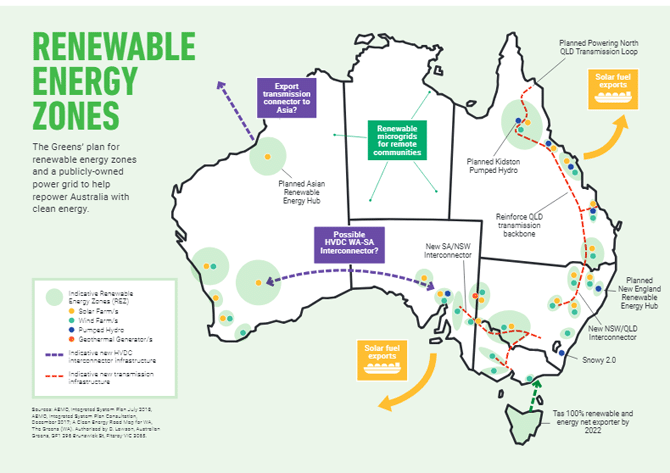
REneweconomy 3 October 2018 The Australian Greens are proposing to create up to 
 30 special renewable energy zones across Australia, backed by a $2.8 billon grid transformation fund to help drive the transition towards 100 per cent renewables.
Victoria’s renewable energy boom set to create thousands of jobs
 Green Energy Markets predicts more than 6,000 annual jobs will be created but urges federal policy intervention, Guardian, Calla Wahlquist @callapilla 2 Oct 2018 The renewable energy construction boom in Victoria is on track to create more than 6,000 annual jobs, according to a new analysis.
As of August 2018, large-scale wind and solar projects under construction in Victoria had created 5,169 job years of employment – meaning one person working full time for one year – overtaking Queensland with 5,156, according to an analysis by Green Energy Markets released by GetUp on Tuesday.
When the remainder of the projects greenlit under Victoria’s renewable energy auction come online, job years of employment will increase to 6,072.
Victoria has 26 operational large-scale wind and solar projects, 12 under construction and 28 with planning approval.
But the Green Energy Markets director of analysis, Tristan Edis, said that without federal policy intervention the construction boom would being tapering off in 2020, because the large-scale generation certificates scheme would be over-supplied.
Renewable energy made up 25.5% of the electricity fed into the major east and west coast power grids in August, enough to power 12.1m homes, the report said.
As of August there were another 6,184MW of new large-scale renewable energy projects under construction, creating 15,511 jobs, the bulk of which were in Queensland and Victoria. Wind generation accounted for 54% of the new projects and the remainder were large-scale solar……..
Victoria and Queensland also on track to meet their state-based renewable energy generations targets of 40% and 50% respectively by 2030.
Victorian environment minister Lily D’Ambrosio said the construction jobs were the product of a record investment in renewable energy and that investment would be under threat if the Coalition won the state election next month.
NSW currently leads the number of jobs in the rooftop solar installation industry, followed by Queensland, Victoria and WA, although jobs in rooftop solar in Victoria are forecast to increase due to its $2250 solar panel rebate.https://www.theguardian.com/australia-news/2018/oct/01/victorias-renewable-energy-boom-set-to-create-thousands-of-jobs
The Federal Government’s plan for a Radioactive Nuclear Waste Dump is blatantly negligent
The Federal Government’s plan for a Radioactive Nuclear Waste Dump is blatantly negligent in identifying and evaluating the best site in Australia. The Australian Government fail in their duty of care to select a site that constitutes the highest level of safety now and into the far future for the purpose of protecting people and the environment from harmful effects of radiation and display an irresponsible use of Australian tax payer’s money.
This calls for an independent enquiry to reassess the proposal in scientific manner, devoid of political agendas. In the meantime, ANSTO have the expertise and capacity (500 hectares) to continue storing Australia’s nuclear waste for another three decades. We should use this time to develop a cohesive, intelligent solution for the safest place in Australia for a national radioactive nuclear waste facility. https://www.facebook.com/groups/344452605899556/?multi_permalinks=837501786594633%2C837469919931153¬if_id=1538379410382955¬if_t=group_activity
Morrison government cynically tries to hide the truth on greenhouse gas emissions
Our emissions reduction target of 26-28 per cent below 2005 levels by 2030 is woefully inadequate and is not aligned with what the science says is necessary to effectively tackle climate change. Rather than doing it at “a canter” we’re like the champion sprinter, Chautauqua, stuck in the barriers.
Australia is one of the most vulnerable developed countries in the world to the impacts of climate change.
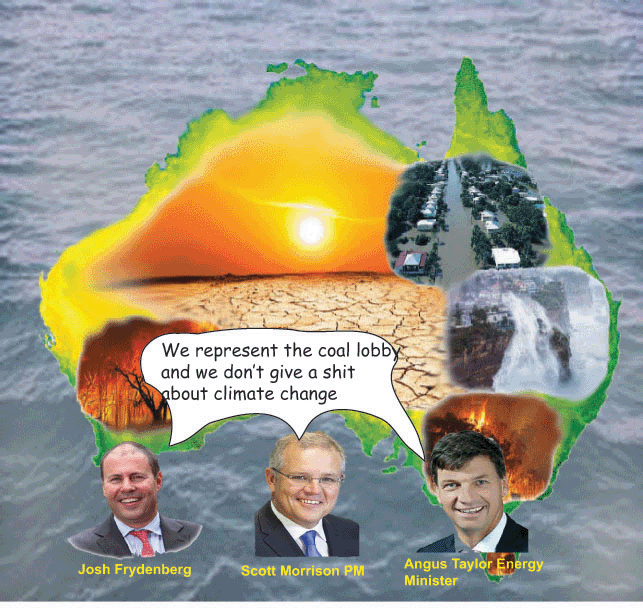
A cynical attempt to avoid scrutiny https://www.brisbanetimes.com.au/environment/climate-change/a-cynical-attempt-to-avoid-scrutiny-20181001-p5074d.html, By Martin Rice, 1 October 2018 —
It had held onto the information for months, seemingly waiting for the right time to “take out the trash”. The news for it, and for us, was grim. Australia’s greenhouse gas pollution levels have risen yet again.
The reporting of Australia’s rising emissions has been buried on a number of occasions, with data released on Christmas Eve, on weekends, holiday periods, or during major events. It’s a cynical attempt to avoid scrutiny.
For climate policy to be a winner, greenhouse gas pollution levels must be trending downwards; there are no Norm Smith or Clive Churchill medals for the federal government, with emissions increasing by 1.3 per cent for the year to March 2018. Worse still, greenhouse gas pollution has risen three years in a row – we’re chasing the wooden spoon.
On Sunday, Prime Minister Scott Morrison told the ABC Insiders program that people “choose and pick their figures to make a political argument”. This is not a political argument. The figures tell us very clearly that emissions are going up.
The Prime Minister also repeated his claim that Australia will meet its Paris obligations “at a canter”. There are numerous reports – from the Australia Institute last week and the UN Environment Program last year – that outline why Australia won’t meet its 2030 Paris commitments.
Our emissions reduction target of 26-28 per cent below 2005 levels by 2030 is woefully inadequate and is not aligned with what the science says is necessary to effectively tackle climate change. Rather than doing it at “a canter” we’re like the champion sprinter, Chautauqua, stuck in the barriers.
Australia is one of the most vulnerable developed countries in the world to the impacts of climate change. Heatwaves are becoming longer, hotter and starting earlier in the year. In the populous south of the country, dangerous bushfire weather is increasing, and cool season rainfall is dropping off, stretching firefighting resources, putting lives at risk and creating challenges for the agriculture industry.
The unprecedented bleaching events on the Great Barrier Reef in 2016 and 2017 resulted in mass coral mortality, with the 2016 bleaching event at least 175 times more likely to occur due to intensifying climate change. Not only is the reef a natural icon of global significance, it’s a multi-billion dollar economic asset, contributing around $6.4 billion to the Australian economy a year (of which $5.7 billion comes from the tourism industry), and supporting 64,000 direct and indirect jobs. Climate change is putting this industry, and the broader economy, at risk.
NSW and Queensland are experiencing severe drought conditions, with dire consequences for farming and rural communities. Southern Australia, particularly along the eastern coast and hinterlands, could experience devastating bushfire conditions this season. There would be little reprieve for firefighters exhausted from battling fires in the height of the Australian winter (yes, winter!) or helping suppress fires overseas.
The burning of coal, oil and gas is causing temperatures to rise at unprecedented rates and is making extreme weather events more intense, damaging and costly. The window of opportunity to effectively tackle climate change is closing fast. We need to rapidly and deeply cut our emissions.
The solutions are available. We need to accelerate the transition to clean, affordable and reliable renewables and storage technologies and ramp up other climate solutions in the transport, agriculture and other sectors.
At a time when credible federal government climate policy remains missing in action, it has never been more important for transparent greenhouse gas pollution information. Yet the federal government has consistently withheld or hidden vital emissions data; it’s a serial offender when it comes to climate censorship.
Martin Rice is the Climate Council’s acting chief executive and head of research.
Kidston Renewable Energy Hub in Far North Queensland fast tracked
 Kidston renewable energy hub one step closer, REneweconomy,
 Minister for State Development, Manufacturing, Infrastructure and Planning Cameron Dick said the project, located at the decommissioned Kidston Gold Mine within Etheridge Shire, proposes an innovative use of two existing adjacent water-filled mine pits to generate hydroelectricity.
“If approved, the project could employ 370 people during the two-year construction and have a minimum lifespan of 50 years,” he said.
“When complete, Stages 1 and 2 of the Kidston Renewable Energy Hub will provide enough energy to power around 160,000 Australian homes – enough power for a city bigger than Cairns.
“Stage 1 alone will produce enough power to supply more than 26,000 Australian homes, offsetting 120,000 tonnes of CO2 per year and remove 33,000 cars off Australian roads.
“Genex has set a strong mandate to provide local residents with job opportunities, whether that be direct on-site employment, consultancy or indirect contract work.
“This renewable energy project has the ability to revitalise the local economy and I commend Genex on making sure locals benefit from the project……..
The Kidston Renewable Energy Hub comprises:
Stage 1 solar power project (50 MW) which has been constructed
Stage 2 proposed new solar project (270 MW) to integrate with the K2H project (250 MW) currently undergoing assessment
Stage 3 wind farm project (150 MW) which is in the feasibility stage.
Energy generated by Stage 2 (combined solar and hydro) will be via a new transmission line connecting the Kidston site to Mount Fox, near Ingham…….
Mr Dick said the introduction of large-scale, low-cost flexible energy storage also provides another solution to Queensland’s growing power requirements.
If approved construction is due to commence in 2019 and expected to be completed by 2021.
For more information visit: www.dsdmip.qld.gov.au/kidstonhydro https://reneweconomy.com.au/kidston-renewable-energy-hub-one-step-closer-34630/
Nuclear whistleblowers strive for a green future for generations to come.
We are in debt to people like Rick Parks receiver of the IEEE Barus Ethics award while being a nuclear whistleblower, and Australia’s own ANSTO whistleblower David Reid, whom I hold in great regard of their honesty and credibility, that of which the opposing dichotomy has proven to have shortcomings. These whistleblowers have suffered loses to erode our ignorance, and we owe it to them to keep passing the anti-nuclear baton and strive for a green future for generations to come. https://www.facebook.com/groups/344452605899556/?multi_permalinks=837501786594633%2C837469919931153¬if_id=1538379410382955¬if_t=group_activity
Julian Assange’s health in danger- but he lacks medical care
 Assange’s Defense Attorney Denounces Risks to Client’s Health https://www.telesurtv.net/english/news/Assanges-Defense-Attorney-Denounces-Risks-to-Clients-Health-20180930-0011.html
“We are very concerned about his health: he has been locked up in the embassy for more than six years, without proper access to medical care,” said Robinson during an interview with the Catalan publication, Nacio Digital.
The lawyer stressed her client’s wavering health, which, she said, the embassy is unable to properly moderate due to lack of proper medical equipment and facilities.
“The embassy is not equipped for prolonged detention to provide a reasonable environment … the prolonged uncertainty of indefinite detention deeply affects the psychological and physical trauma above and beyond the expected stressors of incarceration,” the Australian lawyer said.
Robinson also showed concern over the “very serious” threat of Assange’s extradition to the United States for trial. “If Assange faces a trial in the US, he can not benefit from the first amendment of the Constitution, which refers to freedom of the press.
“We can not forget that he is only an editor who published material of public interest,” Robinson said.
The defense lawyer also explained the recent change in Ecuador’s administration has only served to complicate the case, which she described as a 180-degree change in political position between President Rafael Correa to his successor, the incumbent President Lenin Moreno, particularly in regards to bilateral relations with the United States.
On Mar, 28, just days after hosting a delegation of the United States Southern Command (Southcom), Ecuador’s President Lenin Moreno decided to cut his guest’s communications with the outside world, denying him access to the internet and banning visitors who are not part of his legal team.
Julian Assange was granted political asylum in the Ecuadorean embassy in the U.K. in 2012. Assange faced extradition to Sweden from England, over allegations of sexual assault on two women, which he categorically denied.
Although the judicial process for the alleged sexual crimes in Sweden was lifted, he fears that if he is given to British authorities he could face prison for skipping bail and face extradition to the United States, where he would be tried for espionage and could be sentenced to death for exposing U.S. war crimes in Iraq and Afghanistan.
The value of Australia’s coal exports is forecast to decline sharply
Thermal coal prices forecast to drop 25% and metallurgical coal prices 23% as value of iron ore exports also falls, Guardian, Gareth Hutchens@grhutchens, 2 Oct 2018 The value of Australia’s coal exports is forecast to decline sharply over the next 18 months as thermal coal prices drop 25% and metallurgical coal prices fall 23%.
Department of Industry, Innovation and Science chief economist enthusiastic about the lithium industry
|
Lithium ‘buzz’ could be worth hundreds of billions to Australia, WA Today By Hamish Hastie, 2 October 2018 —Australia has the potential to capture more wealth and jobs from its lithium sector by moving down the battery supply chain but this would be contingent on a number of factors, one of the federal government’s top economists thinks.
In his resources and energy quarterly update Department of Industry, Innovation and Science chief economist Mark Cully said lithium and battery demand could result in billions of dollars for a country that grabbed the opportunity………https://www.watoday.com.au/business/the-economy/lithium-buzz-could-be-worth-hundreds-of-billions-to-australia-20181002-p507cb.html |
|
|
‘Economic benefit’ from nuclear waste dump falsely pushed by Department of Industry, Innovation and Science
 Paul Waldon Fight To Stop Nuclear Waste Dump In Flinders Ranges SA, 1 Oct 18,
 ANSTO has a duty to deal with their waste, and as their name implies it should be done scientifically and not by shifting the waste to a backroom of the country. However this is an industry that has shortcomings worldwide in the R&D arena, with one claim that Consolidated Edison’s of New York only principle innovation after 25 years of operating was to paint their smoke stacks red white and blue.
Moreover the Department of Industry, Innovation and Science’s cogent manufactured factoids lead the minority of locals to espouse to radioactive wastes for purely false economical reasons. https://www.facebook.com/groups/344452605899556/?multi_permalinks=837324089945736%2C837259113285567%2C837129993298479%2C836953179982827%2C836913929986752¬if_
‘Adani and the War Over Coal’ – a new book: Quentin Beresford spills the devious beans
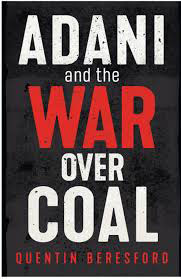 BOOK REVIEW: ‘Adani and the War Over Coal’ — a pox on both their Parties, Independent Australia John Biggs 30 September 2018 The story of the devious and secretive negotiations between Adani and Australian governments of both stripes is appalling, writes John Biggs. “…… Conservation groups, Indigenous people and, eventually, a strong majority of ordinary Australians are outraged. In this book, Dr Beresford brings his sharp research and writing skills to tell this story of the war over coal.Gautam Adani had close connections with India’s PM Narendra Modi, who protected Adani over environmental and human rights violations in India. Adani donated heavily to both major Australian parties, especially to the Coalition. The Abbott and subsequent Coalition governments pushed for Adani as hard as they could. At first, so did Labor, but then sort of didn’t, but if certain conditions are met, well, maybe .
ISSUES IN DISPUTE
The major issues in dispute, as Bereford see it, are as follows.
Climate change
If all the Carmichael coal is burned – here or anywhere – the carbon emissions would be more than Australia already produces. That would likely tip global warming irreversibly. The pro-Adani group deny this.
Great Barrier Reef
The Reef is already seriously endangered by climate change, drainage from fertilised farmlands, and starfish. The mine would make matters immeasurably worse, as dredging (authorised byLabor’s Tony Burke) has already indicated.
Julie Bishop even denied the Great Barrier Reef would be in any danger.
Beresford notes (p.361):
‘None of the major parties has been prepared to unequivocally put the reef’s long term health over the interests of the fossil fuel industry.’
Great Artesian Basin
The Great Artesian Basin, vital for Australian agriculture, would be seriously endangered by the mine, either through using the water or by puncturing and draining the Basin. Adani supporters say this is exaggerated, and anyway coal mining is a thirsty business.
Native title
Doongmabulla Springs is in the mining area and is of high cultural significance to the Wangan and Jagalingou peoples. However Indigenous Land Use Agreements (ILUAs) that favour developers have been foisted onto the locals. These are currently under appeal.
Economic case
The costs of mining coal are now higher than the costs of producing renewables — and the difference is rapidly widening. With Adani’s projected costs, current debts and likely returns, Adani is predicted to lose crippling amounts of money if it proceeds.
Adani’s poor safety, criminal and environmental record
First in India and now here, Adani operations have already badly polluted land in the Carmichael region.
WHY, WHY, WHY?
Given all of this, why on Earth would Australian governments be so determined to support the Adani project?
Beresford discusses these issues and others in depth. His findings and assertions are fully referenced, his arguments convincing.
While much of this is due to the shocking judgement and wickedness of individual people, Beresford sees (p.360) as even more important the way in which the coal wars have transformed politics: …….https://independentaustralia.net/environment/environment-display/book-review-adani-and-the-war-over-coal–a-pox-on-both-their-parties,11949
PM Morrison’s dodgy claim about Australia meeting Paris climate commitment
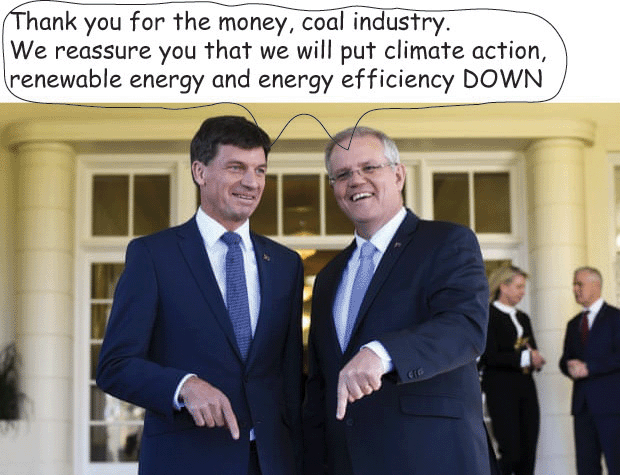 PM claims Australia will meet Paris target ‘in a canter’ despite emissions climbing
Morrison says rate of increase not as high as previous years and renewables investment will ensure Australia meets commitment, Guardian, Amy Remeikis, 30 Sept 18, Australia’s greenhouse gas emissions have continued to rise, but Scott Morrison seized on the silver lining, maintaining Australia would meet its Paris commitment, despite the government having no legislated instrument to help it get there.
Figures released on Friday showed Australia’s emissions increased 1.3% in the year to March 2018, up all sectors – except land use and electricity, where renewable technologies were having an impact on the latter.
The prime minister jumped on the rate of the increase not being as high as in previous years……..
Morrison said Australia would meet its Paris targets “in a canter”, largely based on investment in renewable energy technologies, despite concerns a lack of legislated instrument may impact investor confidence in the sector. …..
“We still have large-scale and small-scale policies there. We still have the Clean Energy Finance Corporation, and we still have the Emissions Reduction Fund for the period that it’s currently for, and we’re on track to hit it.”…..
Critics of the government’s stance have repeatedly called for legislation to ensure Australia meets the targets it agreed to when Tony Abbott signed the nation up to the Paris agreement.
But with the national energy guarantee a casualty of the leadership spillwithin the Liberal party, the government has no legislated instrument to ensure emission reductions, and no plans to create one…..
He said lowering electricity prices remained the government’s priority and criticised Labor for its policy. ….Labor has said it will look to legislate a version of the national energy guarantee the government abandoned as policy to ensure Australia does meet its targets. The Greens announced its parliamentary team will take a “hard line” on making sure any future Labor government does not back down.
Research released earlier this month found that emission reductions targets were not responsible for driving up power prices. https://www.theguardian.com/australia-news/2018/sep/30/pm-claims-australia-will-meet-paris-target-in-a-canter-despite-emissions-climbing
1 This month


Help Aunty Sue Protect Her Land and Sacred Sites From Destructive Rocket Testing.
.

Australians deserve the truth
about
AUKUS – https://aukuspublicinquiry.com/

PETITION – To: Prime Minister Anthony Albanese and the Australian Labor Government

of the week – Australians for War Powers Reform (AWPR)
To see nuclear-related stories in greater depth and intensity
 Antinuclear