With help from floating data-collectors, a new study reveals the impact greenhouse gas emissions and ozone depletion are having on the Southern Ocean. Inside Climate News, Sabrina Shankman SEP 24, 2018 The Southern Ocean around Antarctica is warming at an alarming rate—twice that of the rest of the world’s oceans. Now, researchers have developed more powerful evidence pointing to the human causes.
Australia’s solar hydrogen industry – CSIRO sees an export future
 Sun shines on CSIRO’s cheap hydrogen industry, Brisbane Times, By Cole Latimer, 30 September 2018, Curtin University researchers have developed a cheaper and safer way to bottle and store Australian sunshine as hydrogen fuel.
Researchers from Curtin University’s School of Molecular and Life Sciences have created a lower-cost and less toxic method of developing hydrogen fuel from solar energy, paving the way for the growth of a hydrogen industry in Australia.
Hydrogen is currently being touted by the CSIRO and the government as Australia’s next major energy export industry, valued at up to $1.6 billion by 2025, and as a potential replacement for natural gas and petrol.
Current methods for creating hydrogen from solar power involve running an electric current generated by solar panels through water and requires either highly toxic cadmium or very expensive platinum as a catalyst to kick off the process.
Curtin University’s Dr Guohua Jia said the new process uses an extremely common, and much safer material, zinc selenium, which is sold in many pharmacies around Australia as a vitamin supplement…….
The new development comes as Australia’s chief scientist, Alan Finkel, tours Japan and promotes a hydrogen energy partnership between the two countries.
The Office of the Chief Scientist said Dr Finkel “led a delegation of Australian industry and government leaders interested in pursuing Australia’s potential as hydrogen supplier on an official visit to Japan”…..
the department said. “The Hydrogen Strategy Group, chaired by Dr Finkel, reported to the Coalition of Australian Government energy ministers that Australia has the necessary resources to supply hydrogen produced by near zero-emissions methods, at scale, to Japan and like-minded nations.”……https://www.brisbanetimes.com.au/business/the-economy/sun-shines-on-csiro-s-cheap-hydrogen-industry-20180928-p506px.html
Jobs for South Australians at nuclear morgue? That is a shaky promise.
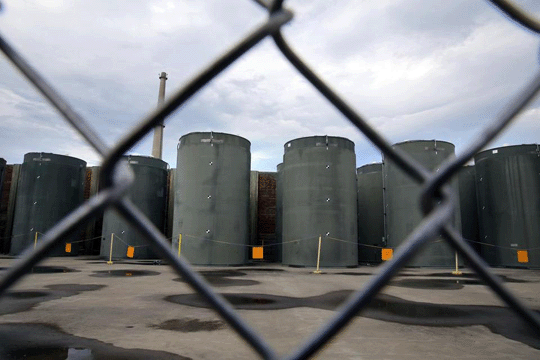
A nuclear waste jobs bonanza for regional South Australia? http://www.onlineopinion.com.au/view.asp?article=19959, – Jim Green, 27 Sept 19
The federal government is trying to persuade regional communities in South Australia to host a national radioactive waste facility – an underground burial repository for lower-level radioactive wastes and an above-ground ‘interim’ store for long-lived intermediate-level waste. One site under consideration is near Hawker in the Flinders Ranges, and two other sites under consideration are on farming land near Kimba at the top of the Eyre Peninsula.
The government is promising 45 jobs, three times its earlier claim that there would be 15 jobs at the proposed facility. The compensation package on offer has also tripled and now stands at $31 million.
Forty-five jobs would be welcome in small regional communities. But is it plausible that 45 jobs would be created? When the Howard government was attempting to establish a radioactive waste repository in SA from 1998 – 2004, the government said there would be zero jobs – not even any security guards. The government-commissioned PR company Michels Warren said: “The National Repository could never be sold as “good news” to South Australians. There are few, if any, tangible benefits such as jobs, investment or improved infrastructure.”
From 2005 to 2014, Coalition and Labor governments targeted sites in the Northern Territory for a radioactive waste repository and said there would be just six jobs, all of them security guards.
Last year, with SA once again in the firing line, the government said: “At least 15 full-time equivalent jobs will be needed to operate the facility. These will be in site management, administration, security, environmental monitoring, site and building maintenance as well as receiving and packaging waste materials.”
Recently, the jobs estimate was upped to 45, with the government saying: “In addition to the 15 operational jobs already confirmed, the structure now includes roles for community liaison, management, tourism, environmental monitoring, security, health and safety: a total of 45 staff.”
This is the breakdownof the 45 jobs:
14 – security and safeguards
13 – waste operations and technicians
8 – site management and community outreach
5 – environmental protection and quality control
5 – safety and radiation protection
That estimate comes with caveats: “the final workforce design and structure will be based on a number of factors including advice from security agencies, the views of the independent regulator and the details of the final business case, with inputs from across government.”
Overseas comparisons
The Centre de Stockage de l’Aube (CSA) radioactive waste facility in France handles over 200 times more waste per yearcompared to the proposed facility in SA yet it employs only four times as many staff as the proposed facility in SA. CSA processes 73 cubic metres (m3) per employee per year (13,164 m3 / 180 staff).
Is the estimate of 45 jobs credible? Not if overseas radioactive waste facilities are any guide.
The El Cabril radioactive waste facility in Spain has a staff of 137 people and processed an average of 1,395 m3 per year from 1993 to 2016. That equates to 10.2 m3 per employee per year.
Yet the Australian government estimates a workforce of 45 people to process 45 m3 per year: 1 m3 per employee per year compared to 10.2 in Spain and 73 in France. The government evidently has a dim view of the productivity of Australian workers, or, more likely, its jobs estimate is grossly inflated.
Will the government pay staff to do nothing?
Measuring jobs-per-employee doesn’t account for some jobs required whether a facility processes 1 m3 or 1 million m3 per year: administration, security and so on. As a government official stated: “There are a base number of jobs related to the management of the waste which are not linear with volume and a number of jobs that would scale with larger volumes.”
Nevertheless, productivity at the proposed Australian facility would be dramatically lower than comparable facilities overseas.
If we assume that Australia matched the lowest of the figures given above – 10.2 m3 per employee per year at El Cabril in Spain – then the staff at an Australian facility would be processing waste for just one month each year and they’d have 11 months to play ping-pong.
The current government might be willing to pay 45 staff to play ping-pong for 11 months each year, but it’s not a sustainable situation. The Department of Finance wouldn’t tolerate it. If staff at the waste facility are paid by the federal government to do nothing for most of the time, what sort of a precedent does that set, and why shouldn’t the rest of us be paid to do nothing for 11 months out of 12 at a cost to taxpayers of several million dollars each year?
Almost certainly, staffing would be dramatically culled. Almost certainly, a future government would revert to the plan pursued by previous governments: keeping the waste facility closed most of the time, and opening it occasionally for waste disposal and storage. In the jargon, this is called a campaign-based approach with occasional waste disposal ‘campaigns’.
Previous governments said that waste would be sent to the facility just once every 3 – 5 years. For example, the government said in 2003 that waste would be transferred to the facility just once every five years: “It is considered for planning purposes that an average period of 5 years between campaigns will be appropriate” (Volume III of DEST application to ARPANSA, Ch.9, ‘Waste – Transfer and Documentation’, p.5).
In a recent attack on me for questioning its estimate of 45 jobs, the Department of Industry, Innovation and Science said it was unable to locate any previous government documents regarding periodic, campaign-based plans. The federal government can’t find federal government documents? Seriously?
The government says that it wants continuous operation of the repository (for reasons unexplained) rather than a periodic, campaign-based approach. But even so, the government only plans to shift waste to the facility once or twice each yearaccording to a 2016 document. A July 2018 government document states: “This facility will be an operational facility and not as some have suggested, a minimally crewed warehouse to be opened once or twice a year.” But it is the government itself which says that waste will only be transported to the facility once or twice each year!
Broader economic impacts Continue reading
Barngarla Determination Aboriginal Corporation to continue legal fight over proposed nuclear waste dump
 Kimba District Council, 28 Sept 18 : The Australian Human Rights Commission has today formally terminated conciliation between the Barngarla Determination Aboriginal Corporation and the District Council of Kimba. The matter is now likely to proceed through a judicial process. In the meantime, the National Radioactive Waste Management Facility site selection ballot will not be undertaken until the matter is resolved.
A spokesperson for Council said that during the conciliation, alternative options for resolution were put to BDAC by the Department of Industry, Innovation and Science, but were not accepted. For this reason, the outcome is disappointing, but Council remains committed to facilitating a forum on behalf of the Minister for Resources and Northern Australia that ensures the Kimba community has an opportunity to be heard on the issue.
Given the matter is still before the court, Council will be making no further comment, but will keep the community informed as the situation develops.

American transnational corporation AECOM would be the biggest beneficiary from a South Australian radioactive suppository
 Tim Bickmore shared a link No Nuclear Waste Dump Anywhere in South Australia,
Q. Who would mostly benefit financially from a South Australian radioactive suppository?
A. American transnational corporation AECOM. They already have Oz Gov brass in pocket from the NRWMF, from ADANI, from the NBN. In the UK AECOM services both the Sellafield & Cumbria radioactive waste facilities. AECOM is the 18th largest service provider to the US Govt; runs Los Alamos plutonium factory; Kennedy Space Center & NY World Trade Center.
AECOM is in the box seat to manage & run any OZ radioactive waste facility……https://www.facebook.com/groups/1314655315214929/
Great Barrier Reef scientists told to focus on projects to make government look good
 Emails tabled in Senate inquiry recommended ‘trade-offs’ to Great Barrier Reef Foundation, Guardian, Ben Smee @BenSmee 26 Sep 2018
Great Barrier Reef scientists were told they would need to make “trade-offs” to the Great Barrier Reef Foundation, including focusing on projects that would look good for the government and encourage more corporate donations, emails tabled in the Senate reveal.
The documents, including cabinet briefing notes, contain significant new details about the workings of the foundation and the government decision to award it a $443m grant, including:
- The executives of mining, gas and chemicals companies – and international financial houses that actively back fossil-fuel projects – were among the guests at a six-star retreat hosted by the foundation less than a month after the grant was announced;
- The media companies Foxtel and Fairfax and the tech giant Google are among a tightly held list of donors to the foundation;
- The only CSIRO employee contacted about the grant before the announcement in April was in Patagonia, and did not get the email. Documents have previously revealed that the government’s peak science agency was cut out of the decision to award the grant;
- In August, as scrutiny of the grant intensified, public servants pushed to block a long-planned meeting between the then science minister, Michaelia Cash, and the head of the foundation, Anna Marsden, because of concern about the “optics”.
Emails sent by staff at the Australian Institute of Marine Science outline how government expectations, the ability to leverage private donations and public perceptions “may drive the [foundation] to prioritise shorter-term research initiatives in order to demonstrate progress and return on investment”.
“Where it becomes challenging is that … interventions with the largest future benefit also take the longest to develop,” the institute’s executive director of strategic policy, David Mead, wrote in an email to colleagues.
“Among other trade-offs, we will need to determine to what degree we focus on quick wins or whether we progress longer-term strategic interventions and accept that we will only partially progress them during the next five years (perhaps with little outward visibility of success/progress).”
The emails also reveal an initial state of uncertainty about how a $100m allocation for reef restoration and adaptation would be handled……. https://www.theguardian.com/environment/2018/sep/26/great-barrier-reef-scientists-told-to-focus-on-projects-to-make-government-look-good?CMP=share_btn_tw.
Lobbyists for nuclear-related firms hold key positions in National Party
|
Nuclear industry-related firms – Heathgate Resources, General Dynamics, Delta Electricity, St Baker Energy Innovation Fund – some of the firms represented by the two lobbying firms mentioned in the article below. Top Nationals pair hold senior roles at big-business lobby firms Katrina Hodgkinson and Larry Anthony – as well key Labor and Liberal figures – are part of an industry with little oversight
|
|
|
Weapons-making corporation, Raytheon hoping for nuclear industry in SouthAustralia?
John Matheson Fight To Stop Nuclear Waste Dump In Flinders Ranges SA, 26 Sept 18, Weapons-making corporation, Raytheon purchased and renovated a two story office building on Greenhill Road, Parkside a couple of years ago. it is a substantial building and the lights are on, but nobody seems to be home. I wonder whether the Raytheon “headquarters” in Adelaide is just a shopfront for the lobbying and tendering of the $squillions up for grabs if – sorry when – the nuclear dump is coerced by guvmint. https://en.wikipedia.org/wiki/Raytheon https://www.facebook.com/groups/344452605899556
Greenhouse gas emissions and ozone depletion causing Antarctic Ocean to heat up
What’s Causing Antarctica’s Ocean to Heat Up? New Study Points to 2 Human Sources
Adani coalmine: most Queenslanders want water licence revoked, poll finds
‘A poll conducted for Lock the Gate found a majority of Queensland voters want water rights taken off Adani and given to farmers. Guardian, Ben Smee www.theguardian.com/profile/ben-smee @BenSmee , 23 Sep 2018 A majority of Queensland’s voters want the government to cancel the Adani mining company’s 60-year unlimited water extraction licence
amid growing concern about the severity of the drought.
‘Polling conducted by ReachTel for the environmental group Lock the Gate shows concern about water extraction by Adani, and the impact on agriculture, is strong among conservative voters.
‘Almost 70% of all voters agreed the licence,
to extract groundwater for the Carmichael coalmine,
should be revoked to safeguard water for farmers. …
‘The national coordinator of the Lock the Gate Alliance, Carmel Flint, said the results showed “incredible support across the political spectrum
to put water above mining and look after Queensland farmers”.
The national coordinator of the Lock the Gate Alliance, Carmel Flint, said
the results showed “incredible support across the political spectrum
to put water above mining and look after Queensland farmers”.
‘“I think this really does reveal that as this drought really bites,
people don’t accept that we can hand over vast quantities of water to Adani,” she said. … ‘
Read much much more of BenSmee’s comprehensive,groundbreaking, interesting article:
www.theguardian.com/business/2018/sep/23/adani-coalmine-most-queenslanders-want-water-licence-revoked-poll-finds
MAKE A SUBMISSION BY 24 SEPTEMBER : SENATE INQUIRY INTO RADIOACTIVE WASTE
K-A Garlick , Nuclear Free WA, 21 Sept 18
 To have your voice heard about Flinders Ranges nuclear waste dump plan, make a submission to Federal Minister for Resources Senator Matt Canavan via email at radioactivewaste@industry.gov.au by 24 September.
On 6 February 2018, the Senate referred an inquiry into the selection process for a national radioactive waste management facility in South Australia to the Senate Economics References Committee for inquiry and report by 14 August 2018. Read our submission here. Read all submissions on the government website here. The report acknowledged and validated many of the concerns about the process but unfortunately did not call for an end to the process and for a better way to manage the process of selecting a site for Australia’s most hazardous waste. You can read the Senate report here. Read the Conservation SA media release here.
Points to mention for WA are;
- CCWA calls for an independent inquiry to explore the full range of options to deal with radioactive waste. This should include consideration of the option of keeping waste at ANSTO’s Lucas Heights site, keeping in mind that much of the waste is already securely stored at Lucas Heights (over 90% measured by radioactivity).
- Leonora should not be Plan B, as stated by Minister Canavan in The Australian June 18, 2018. https://www.theaustralian.com.au/national-affairs/race-to-lock-in-nuclear-dump-before-federal-election/news-story/b2ea0780ec1e6971cbce51abddb8ee6e
Plutonium: there’s a plan to send it to Australia
REAL PLUTONIUM, Paul Richards shared a link. Nuclear Fuel Cycle Watch South Australia, 21 Sept 18
Something to think about since plutonium will make a percentage of the nuclear waste and material being stored that is to proposed is sent to Australia from the rest of the world.
A global nuclear brotherhood driving weapons proliferation, that still haven’t anywhere to store;
* unspent & spent nuclear fuel,
* excess radionuclides,
* redundant weapons arming material
* contaminated material and their
* respective short &
* long-term containment systems as canisters, or
* short-term storage, 200-litre drums.
Containers at worst need repacking in
* five years in case of the 200-litre drums, with best practice, every
* hundred years, and that is
* unless sealed five kilometres below
the surface or more, this repacking of nuclear waste containers is ad infinitum ∞ https://www.facebook.com/groups/1021186047913052/?multi_permalinks=2123030991061880%2C2123017674396545%2C2122319811132998¬if_id=1537435582423128¬if_t=group_activity
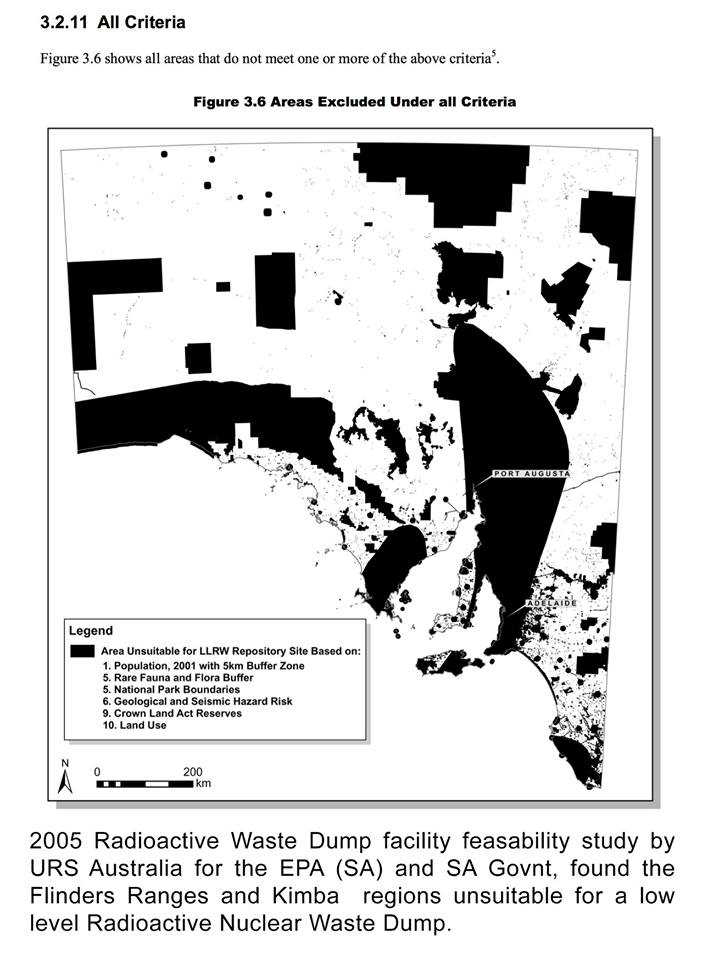
Feasability Study found Radioactive Waste Dump UNSUITABLE for Flinders Ranges and Kimba regions
Kim Mavromatis-Fight To Stop Nuclear Waste Dump In Flinders Ranges SA-19 Sept 18
. Using several criteria, the feasability study by URS Australia for the EPA (SA) and SA govnt, found the Flinders Ranges and Kimba regions (current proposed sites) UNSUITABLE for a low level radioactive nuclear waste dump. See attached map and links to feasability study.
https://www.epa.sa.gov.au/fi…/4771324_radioactive_stage1.pdf
https://www.epa.sa.gov.au/fi…/4771325_radioactive_stage2.pdf
https://www.epa.sa.gov.au/fi…/4771324_radioactive_stage1.pdf
https://www.epa.sa.gov.au/fi…/4771325_radioactive_stage2.pdf
Tim Bickmore Susan Craig Map [Stage 2 – 3.2.11 figure 3.6] of all excluded areas. Likewise the Stage 2 document @ 3.3 refers to a 1994 C’wealth study which also determined that Wallerberdina & Kimba are unsuitable https://www.facebook.com/groups/344452605899556/
Brave New World – I mean Bright New World pushing for a South Australian nuclear Morgue


This is an extract of an email being sent out to encourage YES submissions for the waste dump from Bright New World. It is misleading, as the email states the THE MAJORITY OF PEOPLE in KAWKER AND KIMBA support the dump. The email makes the process simple by writing the submission and asking the recipient of the email to fill in their name only. Here’s the email in total. Please send an email to Bright New World if you believe that the majority of people do not want the dump and ask for a recall of the email as it is not factual.
Call for Submissions!
The Department of Industry, Innovation and Science is calling for submissions on the National Radioactive Waste Management Facility. The two volunteered sites, Kimba and Hawker, are progressing through the second consultation stage of this process. Submissions along with community feedback and voting will inform the Minister of their decision to progress to the next stage.
Submissions are due 24th September 2018
Bright New World has provided an easy to use letter below to email the Department supporting the process to the next stage. Continue reading
Radon gas leaked from Woomera’s radioactive waste drums
 Tim Bickmore No Nuclear Waste Dump Anywhere in South Australia, 21 Sept 18
 Just a reminder that in 2016 ARPANSA found that the 10,000 CSIRO drums of radioactive waste at Woomera [material flagged by DIIS as +/- 40% by volume of the national dump inventory] held Thorium – & that Radium had leaked out through on-going deterioration of containment.
Both Thorium & Radium produce the toxic invisible odourless radioactive gas Radon – however ARPANSA consistently refuses to confirm or deny whether Radon gas will flow out of their proposed facility.
2016 ARPANSA Inspection Report link here:
https://www.arpansa.gov.au/…/regulatory/…/2016/R16-05292.rtf https://www.facebook.com/groups/1314655315214929/?multi_permalinks=2563961080284340%2C2563869900293458¬if_id=1537398758031391¬if_t=group_activity
‘Welcome’ to Steve Ciobo, the new Australian Minister for the Arms Trade
‘, http://www.anti-bases.org/campaigns/reduce-military-spending/welcome-steve-ciobo-to-the-new-australian-minister-for-the-arms-trade/, September 18, 2018,
Steve Ciobo is the new Defence Industry Minister taking over from Christopher Pyne. He is now the Australian Minister who is responsible for our arms trade with other countries. He is responsible for the transfer of Australian arms and equipment to the biggest trouble spot in the World, the Middle East. The Australian Government maintains that they will not trade arms with human rights abuser or war fighting countries yet they are trading arms and materiel with Israel and Saudi Arabia. Both Israel and Saudi Arabia are human rights abusers and the Australian Government turns a blind eye to their misdeeds. It is up the citizens of Australia to reject this and send a reminder to our new minister!
Sample letters to Steve Ciobo
1 This month


Help Aunty Sue Protect Her Land and Sacred Sites From Destructive Rocket Testing.
.

Australians deserve the truth
about
AUKUS – https://aukuspublicinquiry.com/

PETITION – To: Prime Minister Anthony Albanese and the Australian Labor Government

of the week – Australians for War Powers Reform (AWPR)
To see nuclear-related stories in greater depth and intensity
 Antinuclear