Any South Australian nuclear waste dump must have broad social consent and specific community consent
 Tim Bickmore Fight To Stop Nuclear Waste Dump In Flinders Ranges SA, 29 Jan 18
Joint Committee on Findings of the Nuclear Fuel Cycle Royal Commission. Final report. Tabled in the SA Parliament October 2017…..
p19:
“The Royal Commission found that “both broad social consent and specific community consent must be obtained for any new nuclear activity to commence in South Australia”. (Finding No. 95).
……..
[Commissioner Scarce] …. We have seen overseas that a particular vote has been taken at a particular point in time and then the community has subsequently lost confidence in that process.
………
…it is not about just having one vote from the public at one point in time. Social licence is something that needs to be maintained for the life of a project, and it therefore needs to be an ongoing dialogue and an ongoing relationship between the developer and the public.
”
p29
“…….. based on the failure of pure voluntarism in the UK, the NDA is currently revising its policy away from this model. In order to obtain outcomes, and streamline negotiations, it aims to tighten definitions of “community”, “representation” and “consent”. ….. The NDA also hope that an appropriate definition of “community” will inhibit contribution from non-representative groups.”
Turnbull govt to give $3,8billion to develop a weapons export industry
 Australia to become major defence exporter under $3.8b Turnbull plan, The Age, Adam Gartrell, 29 Jan 18, Australia is set to become one of the world’s top 10 defence exporters under an ambitious $3.8 billion government plan.
The new defence export strategy to be released by Prime Minister Malcolm Turnbull on Monday aims to put Australia on par with major arms-exporting countries like Britain, France and Germany within 10 years.
The government believes the strategy will create new jobs and bolster Australia’s troubled defence manufacturing industry, which struggles to sustain itself based on Australian Defence Force needs alone. A big boost in exports will insulate local manufacturers from the peaks and troughs – sometimes called the “valley of death” – of domestic demand.
“This strategy is about job creation. It will give Australian defence companies the support they need to grow, invest and deliver defence capability. It will make Australian defence exports among the best in the world,” Mr Turnbull said……..
The centrepiece of the strategy will be a new financing facility that will make up to $3.8 billion available to Australian defence companies looking to sell overseas…….
The government will seek to use the exports to cement relationships with key countries in volatile regions like the Middle East. Defence Industry Minister Christopher Pyne has previously nominated Australia’s relationship with the United Arab Emirates as one that could benefit from deeper, export-led economic ties…..
A new Australian Defence Export Office will be established to implement the strategy, and an Australian Defence Export Advocate will be appointed to co-ordinate with the industry, and state and territory governments.
The strategy is designed to complement the government’s promise to invest a record $200 billion in ADF capability over the next decade. http://www.theage.com.au/federal-politics/political-news/australia-to-become-major-defence-exporter-under-38b-turnbull-plan-20180127-h0pc4w.html
Australian Government Department of Industry and Science hides the truth on radiation risks
 Paul Waldon Fight To Stop Nuclear Waste Dump In Flinders Ranges SA 29 Jan 18 “People lie when they want something, because they think the truth wont get it for them.” (Cary Grant, Charade).
DIIS failure to catalogue the known risks of a radioactive waste dump in Hawker or Kimba may be testimony of burying the truth, in a attempt to jump-start the progress of waste abandonment, while knowing they can’t tick all the boxes.
We must remain resolute in our fight to preserve a clean, safe environment for future generations.
Dishonest scare-mongering linking nuclear medicine and radioactive waste dumps
NUCLEAR MEDICINE AND THE PROPOSED NATIONAL RADIOACTIVE WASTE REPOSITORY , Jim Green 27 January 18, “As health organisations, we are appalled that access to nuclear medical procedures is being used to justify the proposed nuclear waste dump. Most waste from these procedures break down quickly and can be safely disposed of either on site or locally.” − Dr Bill Williams, Medical Association for the Prevention of War
“Linking the need for a centralized radioactive waste storage facility with the production of isotopes for nuclear medicine is misleading. The production of radioactive isotopes for nuclear medicine comprises a small percentage of the output of research reactors. The majority of the waste that is produced in these facilities occurs regardless of the nuclear medicine isotope production.”
− Nuclear Radiologist Dr Peter Karamoskos.
Proponents of a national radioactive waste facility (a repository for lower-level wastes and a co-located store for higher-level wastes) claim or imply that nuclear medicine would be jeopardised if the facility does not proceed. There is no basis to such claims – they amount to dishonest scare-mongering.
Proponents claim that most or all of the waste that the federal government wants to dispose of or store at a national repository/store arises from medicine, specifically the production and use of medical radioisotopes. However, measured by radioactivity, the true figure is just 10-20%. Measured by volume, the figure may be within that range or it may be higher than 20% − but it takes some creative accounting to justify the claim that most or even all of the waste is medical in origin.
In any case, the fact that some waste is of medical origin doesn’t mean that a national repository/store is the best way to manage the waste.
If the plan for a national repository/store does not proceed, medical waste will continue to be stored at the Lucas Heights reactor site operated by the Australian Nuclear Science and Technology Organisation (ANSTO) and, in much smaller volumes, at hospitals. Some waste is used in hospitals and then sent back to ANSTO (e.g. molybdenum ‘cows’ that have been ‘milked’ of the daughter radionuclide, technetium-99m − by far the most commonly used medical radioisotope). That is no problem since ANSTO and hospitals continue to produce radioactive waste and thus they have an ongoing need for on-site waste stores and waste management expertise regardless of the options for periodic off-site disposal.
Nuclear medicine is not being adversely affected by the absence of a national radioactive waste repository/store. Nuclear medicine will not benefit from the creation of a national radioactive waste repository/store.
The incessant references to nuclear medicine to ‘sell’ the proposed radioactive waste repository/store amount to emotive propaganda and scare-mongering. Ironically, that is what critics of the proposed national radioactive waste repository/store are routinely accused of!
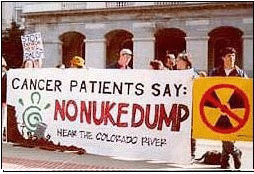 Dishonest scare-mongering linking nuclear medicine and radioactive waste dumps is also evident in other countries. Protests by cancer patients helped end plans to build a radioactive waste dump in Ward Valley, California. http://ens-newswire.com/ens/jun2002/2002-06-04-06.html
What should be done?
Two parallel processes should be initiated regarding radioactive waste management in Australia: a radioactive waste audit, and a National Commission or comparable public inquiry mechanism.
The federal government should immediately initiate an audit of existing waste stockpiles and storage. This could be led by the federal nuclear regulator ARPANSA in consultation with relevant state agencies with responsibility for radioactive waste. This audit would include developing a prioritised program to improve continuing waste storage and handling facilities, and identifying non-recurrent or legacy waste sites and exploring options to retire and de-commission these.
A National Commission would restore procedural and scientific rigour, and stakeholder and community confidence in radioactive waste management. It would identify and evaluate the full suite of radioactive waste management options. That would include the option of maintaining existing arrangements, keeping in mind that 95% of the waste is securely stored at two Commonwealth facilities: ANSTO’s Lucas Heights facility, and a large volume of very low level waste stored on Defence Department land at Woomera, SA.
The above issues are addressed in detail in a 2014 paper posted at: www.nuclear.foe.org.au/waste
The Anti-Nuclear Coalition South Australia’s survey of political candidates and MPs

 Antinuclear Australia and associated social media will be following with interest the responses of South Australian election candidates to this very important survey
Dear [candidate or MP]
In 2017 South Australians were asked to consider a number of nuclear options for our state. With a State election to be held this year we consider that it is appropriate for all candidates contesting the election to clarify their position on nuclear issues.
Thus we respectfully ask all candidates for the S.A. 2018 election to provide answers to the questions on the accompanying Survey. These questions relate to the policy you will take to the election on :
.uranium mining in S.A.?
.a national nuclear waste dump in S.A.?
.nuclear for defence industry?
.nuclear power generation?
We would greatly appreciate it if you could take the time to answer these questions by circling the appropriate responses on the included survey form.
Thank you for your participation. Mnem Giles (for Anti-Nuclear Coalition SA) PO Box 504 MontacuteSA 5134
SURVEY OF CANDIDATES
CANDIDATE NAME:
CANDIDATE ELECTORATE:
please circle either YES or NO for each of the following questions
DO YOU SUPPORT :
- Expansion of uranium mining in S.A.? YES NO
- Nuclear power generation in S.A.? YES NO
- A storage facility in S.A. for international nuclear waste ? YES NO
- A storage facility in S.A. for Australian nuclear waste? YES NO
- Increased isotope production at Lucas Heights for international market? YES NO
- Construction of nuclear powered submarines in S.A.? YES NO
- Australia signing the UN Treaty on the Prohibition of Nuclear Weapons? YES NO
8 Upholding S.A.’s Nuclear Waste Storage Facility (Prohibition) Act 2000 in the
case of the Federal Government wishing to impose a nuclear waste dump ? YES NO
Please return this form to:
The Anti-Nuclear Coalition SA
using the enclosed addressed envelope.
THANK YOU FOR PARTICIPATING IN THIS SURVEY.
The facts on PROPOSED NATIONAL RADIOACTIVE WASTE DUMP
Anti-Nuclear Coalition South Australia antinuclearcoalition@gmail.com 24 Jan 18 The Federal Government proposes to establish a National Radioactive Waste Management Facility in SA. This ‘repository’ would co-locate:
- Various low-level and hazardous but short lived intermediate level wastes requiring isolation for 300 years in a shallow ground repository.
- An above-ground store designed to operate for 100 years to house used reactor fuel from Lucas Heights. This intermediate-level long-lived waste requires isolation from
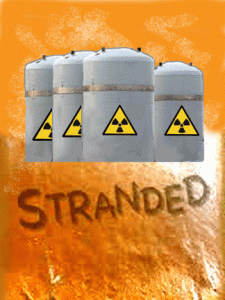 the environment for over 10,000 years.
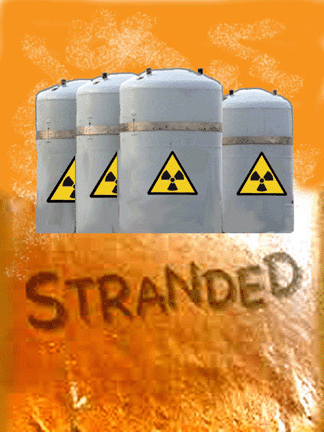
No plans have been made available for structures or maintenance for the first 100 years of this above-ground store. Plans for the ensuing 10,000 years are unavailable.
There are no plans available to establish a ‘permanent’ solution for this waste. It is not currently known how to safely store such higher level nuclear waste in isolation from the environment for such a long period of time.
Nuclear waste is currently stored at Lucas Heights where it is securely monitored.
Lucas Height’s ‘Interim Waste Store” has been identified by ANSTO as capable of safely storing reprocessed nuclear fuel waste and intermediate-level waste has been stored at Lucas Heights since the 1950s. Lucas Heights has been identified as the best resourced and secure facility to responsibly manage the extended storage of Australia’s nuclear waste.
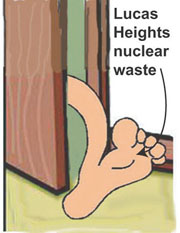 A national radioactive waste dump could be used as a “foot in the door” to establish an International Radioactive Waste dump at the same site or another site in the future. This was advocated as an objective by state Liberal Party adviser Richard Yeeles who advised that “…as a first step in such further development, the
S A Govt. offers to host a national facility for storage and disposal of Australia’s own low and intermediate-level radioactive waste with the ultimate aim of securing Federal Govt. support for hosting an international radioactive waste management facility in SA.”
Although plans for an international waste dump in SA have been rejected by the public at this time advocates for an international waste dump and the nuclear industry continue to lobby and work towards the establishment of such a dump. If a national waste dump was established with higher-level radioactive waste stored above ground at the same site, pressure could be brought to bear to establish a deep-level below ground facility to store both this waste and international radioactive waste from overseas.
New Trans-Pacific Partnership agreement “less problematic”
 ‘Hallelujah’ moment: Revised TPP to be signed in March Radio New Zealand, 23 Jan 18 The revised Trans-Pacific Partnership agreement is to be signed in March, the Trade Minister has confirmed. Australia’s Trade Minister, Steve Ciobo, said the 11 nations, including New Zealand, are “finally at the finish line” following talks between officials in Tokyo………
The rebranded the Comprehensive and Progressive Trans-Pacific Partnership (CPTPP), covers nearly 500 million people and the 11 countries involved make up 14 percent of global economic activity, or about $US10 trillion.
If the trade pact is successfully concluded, lower barriers and standardised rules are expected, making it easier for businesses to sell their goods and services in these markets.
Speaking at the World Economic Forum in Davos, Switzerland, Canada’s Prime Minister Justin Trudeau called the agreement the “right deal”.
The country’s trade minister said it included an improved arrangement on autos with Japan and the suspension of intellectual property provisions that had been a concern…….
Trade specialist Stephen Jacobi said it was a less problematic deal than the initial one.
“It suspends a number of the more problematic areas of TPP, particularly intellectual property provisions and some aspects of the investor state settlement that was very controversial in New Zealand.
“It’s taken the hard edge off TPP … in those areas.”
Mr Jacobi said [New Zealand] parliament needed to ratify the agreement, but while he did not think there would be major issues passing it in New Zealand there would still be critical voices in this country.https://www.radionz.co.nz/news/national/348764/hallelujah-moment-revised-tpp-to-be-signed-in-march
Minerals Council lobbying hard for the coal industry
Minerals Council steps up coal advocacy despite BHP call for neutrality, MCA publicises report asking governments to commit similar resources to carbon capture and storage as to renewables, Guardian, Michael Slezak@MikeySlezak, The Minerals Council of Australia has stepped up its advocacy for coal power in spite of its biggest member, BHP, saying it will leave the group unless it shifts its stance to become technology-neutral.
Australian government’s repressive action against charities
 Silencing the Poor, https://probonoaustralia.com.au/news/2018/01/silencing-the-poor/By attacking charities and their ability to advocate, we’re creating a society where only those with power and access to start with have the ability to influence policy, writes Anglicare Australia executive director Kasy Chambers. 23rd January 2018 Kasy Chambers @ProBonoNews Over the past four years, community organisations and charities have gotten used to being under sustained attack. Think of the de-funding (and later re-funding) of community legal centres, the targeting of environment groups, and the recent appointment of charities critic Gary Johns to head up the charity regulator.
But the latest attack goes beyond the sector and threatens democracy itself. The government is proposing to classify most major charities as “political campaigners”, allowing it to audit their advocacy work and their sources of income. It suggests an impurity of motive, yet nothing could be further from the truth.
This is because a new amendment to the Electoral Act would force any group to register as a political campaigner if it has spent more than $100,000 on “political expenditure” in a three-year period.
Political expenditure is defined as: “The public expression of any views on an issue that is, or is likely to be, before electors in an election (whether or not a writ has been issued for the election).”
In other words, this would apply to any comment on any policy issue at any time. Every charity that employs someone to analyse issues like aged care, homelessness, disability, living costs and virtually any other issue is likely to end up classified as a political campaigner.
The end result will be a set of requirements so complicated that some charities will be forced to hire staff simply to manage their compliance. Any charity would rather spend this money on their core mission. Others might stop speaking out altogether, deterred by the new requirements and huge penalties for getting it wrong – miscalculating the date that you become a “political campaigner” could cost up to $50,000 per day in fines.
So why, when almost everyone would agree that the most corrupting influence on public debate comes from lobbyists and big donors, is civil society being targeted?
Charities already enter the public debate with a huge disadvantage compared to moneyed interests. They are barred from endorsing candidates, donating to parties, or advocating outside their charitable purpose.
The big influencers in Australian politics can do all of this and more. Charities now have their DGR status threatened regularly, while business spending on advocacy and lobbying can be written off as a legitimate cost. Membership fees that companies pay to their own advocacy bodies are tax deductible. Even donations to political parties, from both businesses, unions and individuals, can be taken from pre-tax income. Just this week, the Minerals Council admitted that its donations are designed to buy access to decision-makers.
On top of that, big business and vested interests can afford to spend millions on lobbyists to help them secure important meetings, on advertising before elections, and on airspace to set the political agenda.
All of this is known to have a major impact on public debate, yet none of it would be curbed by the new rules. In light of that, attacking the groups who speak up for the public good, a purpose that goes beyond their own self-interest, seems perverse. Unless it was the point all along.
Maybe it simply suits governments these days for charities to provide essential services (work that many Australians would rather see done by government itself), without ever questioning the root causes of poverty, inequality, and homelessness. It serves the dual purpose of turning charities into an arm of government while also silencing the poor and protecting an unfair system from scrutiny.
The charity sector is uniting against the proposed changes. But seeing off the Electoral Act amendments won’t end the attacks. One of Gary Johns’ first major tasks as commissioner will be to review the ACNC, and there is every reason to be concerned that community advocacy will be threatened yet again.
It seems to us that all of these attacks are driven by an agenda to exclude the least powerful members of society, and those who speak up on their behalf, from public debate. By attacking charities and their ability to advocate, we’re creating a society where only those with power and access to start with have the ability to influence policy.
Community advocacy has proven to be one of the only ways we can balance the coordinated, self-interested, and privileged forces that drive decision making and policy in Australia. It is in everybody’s interests to protect it.
About the author: Kasy Chambers is executive director of Anglicare Australia. Anglicare Australia is a network of 40 agencies, more than 20,000 staff and volunteers, working with over 900,000 clients annually across Australia.
Controversial Pacific trade pact revived
Perth Now Lisa Martin with Reuters | AAP January 24, 2018 The Trans-Pacific Partnership trade pact, which had been on life support since America’s withdrawal, has finally been resuscitated.
Canada threw a spanner in the works at the APEC summit in Vietnam last year derailing efforts to finalise the deal.
Ottawa has since been coaxed back to the fold following lobbying efforts from Tokyo and Canberra……….The TPP 11 is made up of:
Australia, Brunei, Canada, Chile, Japan, Malaysia, Mexico, New Zealand, Peru, Singapore and Vietnam……..
Some opponents of the TPP fear it opens doors for companies to sue governments for changing policies if it harms their investments. The deal has a controversial investor state dispute settlement clause.
* China is not part of the TPP and is trying to get up a rival deal with seven TPP countries, including Australia, and eight others.
The Regional Comprehensive Economic Partnershp is much narrower and less ambitious.https://www.perthnow.com.au/business/controversial-pacific-trade-pact-revived-ng-s-1822008
Cory Bernardi’s Australian Conservatives standing for South Australian election, with pro nuclear policy
Among policy positions to be revealed in greater detail in coming weeks are the scrapping of the Safe Schools program, capping the premier’s tenure to two terms, and developing a nuclear fuel cycle industry.
Senator Bernardi said the direction of preferences would be “subject to negotiation between the major parties”.
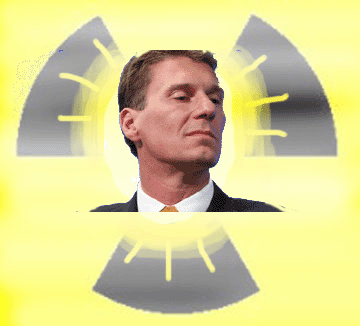 Cory Bernardi’s Australian Conservatives to fight for 20 seats in SA election, http://www.theaustralian.com.au/national-affairs/state-politics/cory-bernardis-australian-conservatives-to-fight-for-20-seats-in-sa-election/news-story/7130de833df916429b388f70b26ff443, MICHAEL OWEN, SA Bureau Chief, Adelaide@mjowen, – 19 Jan 18
Cory Bernardi’s conservative party will run at least 20 candidates in lower house seats at the South Australian election, mirroring the plans of Nick Xenophon’s SA Best and heightening the critical role of preferences in determining the outcome of the March 17 poll.
The move comes after the Australian Conservatives ran candidate Joram Richa in the federal seat of Bennelong, in Sydney’s north, in a key by-election last month, polling 4.5 per cent of the vote and directing preferences to Liberal John Alexander, who retained the seat. Continue reading
Film company to abandon plans for production in South Australian area if Federal nuclear waste dump goes ahead
 Paul Waldon Fight To Stop Nuclear Waste Dump In Flinders Ranges SA, 20 Jan 18,
Professor Hugh White warns on risks of an alliance between Japan and Australia
An Australian-Japan alliance?, Hugh White http://sdsc.bellschool.anu.edu.au/experts-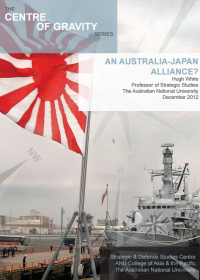 publications/publications/1854/australian-japan-alliance
 Policy paper
In this Centre of Gravity paper, Professor Hugh White explores the potential and risks of an alliance between Japan and Australia. Japan is one of Australia’s most important economic partners, a close ally of the US and might be prepared to sell Australia a highly advanced submarine fleet. Yet, for all the overlap of values, Professor White cautions that there is not necessarily an overlap of interests. In particular the rise of China poses difficult questions for the long term potential for the relationship, and for Australia’s desire to avoid having to choose between the US and China.
South Australia’s heatwave will not affect power supply
 SA heatwave will not affect power supply, Treasurer says, as TDU amateur cyclists ignore warnings, ABC News 19 Jan 18, By political reporter Nick Harmsen and staff The South Australian Government is not expecting to use the state’s new backup diesel power generators despite temperatures well into the mid-40s forcing a tight power supply balance.
The Australian Energy Market Operator (AEMO) has issued a level two lack of reserve notice for the state late this afternoon, meaning there is a small buffer of surplus generation available.A level three notice means unexpected load shedding blackouts are likely.
The power supply situation is even tighter in Victoria — with AEMO flagging the possibility of curtailing power to some industrial customers who have volunteered to be part of a demand management scheme.
SA’s hottest temperature so far recorded today was a scorching 47.4 degrees Celsius at Wudinna on Eyre Peninsula.Port Augusta hit 46.5C, Whyalla reached 46.4C and Lameroo and Tarcoola both had tops of 46C.SA Treasurer Tom Koutsantonis said while the state’s temporary generators were ready, they were unlikely to be used this afternoon.
“In terms of supply we should be okay,” he said.
“Victoria I understand is about to load shed industry. So they’re not coping with the power supply.
“They are a coal-dependent state and they are having to take industry offline to support their households. In South Australia we’re not having to do that today.”
In Adelaide today, the mercury climbed to 42.2C just after 12.30pm, after reaching a top of 41C yesterday and 38C on Wednesday……… State Emergency Service volunteers have handed out water at Adelaide Airport today and provided advice to international visitors to help them cope with extreme temperatures. http://www.abc.net.au/news/2018-01-19/sa-heatwave-will-not-affect-power-supply/9342306
India Enters Australia Group, Inches Closer to Joining Nuclear Suppliers Group
 BY ON 19/01/2018 The Ministry of External Affairs hopes India’s ‘credentials’ are taken into account as and when a decision is taken (on its NSG application). New Delhi: India on Friday joined the Australia Group which aims to stop the development and acquisition of chemical and biological weapons, a move that may take the country an inch closer to joining the Nuclear Suppliers’ group (NSG).
This is the third multilateral export control group – after the Missile Technology Control Regime (MTCR) and Wassenaar Arrangement – that India has become a member of.
In a press release, the 42-member Australia Group said there had been “very strong support” for India’s membership at its plenary meeting in June 2017. Following that, “consensus was reached intersessionally” to admit India to the club. “India then reaffirmed its intention to join the group,” said the announcement.
The Ministry of External Affairs said that the series of multilateral export control groups that India has joined “helps in establishing our credentials” for joining the NSG. India joined the MTCR in June 2016, followed by the Wassenaar Arrangement in December 2017.
Stating that India remains engaged with other countries over its application to join the NSG, external affairs ministry spokesperson Raveesh Kumar said, “We hope that our credentials are taken into account as and when a decision is taken (on NSG application)”…….. https://thewire.in/215482/india-enters-australia-group-inches-closer-joining-nuclear-suppliers-group/
1 This month


Help Aunty Sue Protect Her Land and Sacred Sites From Destructive Rocket Testing.
.

Australians deserve the truth
about
AUKUS – https://aukuspublicinquiry.com/

PETITION – To: Prime Minister Anthony Albanese and the Australian Labor Government

of the week – Australians for War Powers Reform (AWPR)
To see nuclear-related stories in greater depth and intensity

