How Sydney could become a zero-carbon city
Sydney’s closer to being a zero-carboncity than you think, The Conversation, You live in one of the sunniest countries in the world. You might want to use that solar advantage and harvest all this free energy. Knowing that solar panels are rapidly becoming cheaper and have become feasible even in less sunny places like the UK, this should be a no-brainer.
Despite this, the Australian government has taken a step backwards at a time when we should be thinking 30 years ahead.
Can we do it differently? Yes, we can! My ongoing research on sustainable urbanism makes it clear that if we use the available renewable resources in the Sydney region we do not need any fossil resource any more. We can become zero-carbon. (With Louisa King and Andy Van den Dobbelsteen, I have prepared a forthcoming paper, Towards Zero-Carbon Metropolitan Regions: The Example of Sydney, in the journal SASBE.)
Enough solar power for every household
Abundant solar energy is available in the Sydney metropolitan area. If 25% of the houses each installed 35 square metres of solar panels, this could deliver all the energy for the city’s households.
We conservatively estimate a total yield of 195kWh/m2 of PV panel placed on roofs or other horizontal surfaces. The potential area of all Sydney council precincts suited for PV is estimated at around 385km2 – a quarter of the entire roof surface.
We calculate the potential total solar yield at 75.1TWh, which is more than current domestic household energy use (65.3TWh, according to the Jemena energy company).
Wind turbines to drive a whole city
If we install small wind turbines on land and larger turbines offshore we can harvest enough energy to fuel our electric vehicle fleet. Onshore wind turbines of 1-5MW generating capacity can be positioned to capture the prevailing southwest and northeast winds.
The turbines are placed on top of ridges, making use of the funnel effect to increase their output. We estimate around 840km of ridge lines in the Sydney metropolitan area can be used for wind turbines, enabling a total of 1,400 turbines. The total potential generation from onshore wind turbines is 6.13TWh.
Offshore turbines could in principle be placed everywhere, as the wind strength is enough to create an efficient yield. The turbines are larger than the ones on shore, capturing 5-7.5MW each, and can be placed up to 30km offshore. With these boundary conditions, an offshore wind park 45km long and 6km wide is possible. The total offshore potential then is 5.18TWh.
Altogether, then, we estimate the Sydney wind energy potential at 11.3TWh.
Turning waste into biofuels
We can turn our household waste and green waste from forests, parks and public green spaces into biogas. We can then use the existing gas network to provide heating and cooling for the majority of offices………
Extracting heat from beneath the city
Shallow geothermal heat can be tapped through heat pumps and establishing closed loops in the soil. This can occur in large expanses of urban developments within the metropolitan area, which rests predominantly on deposits of Wianamatta shale in the west underlying Parramatta, Liverpool and Penrith.
Where large water surfaces are available, such as in Botany Bay or the Prospect Reservoir, heat can also be harvested from the water body…….
Hydropower from multiple sources
The potential sources of energy from hydro generation are diverse. Tidal energy can be harvested at the entrances of Sydney Harbour Bay and Botany Bay, where tidal differences are expected to be highest………
Master plan for a zero-carbon city
All these potential energy sources are integrated into our Master Plan for a Zero-Carbon Sydney. Each has led to design propositions that together can create a zero-carbon city.
The research shows there is enough, more than enough, potential reliable renewable energy to supply every household and industry in the region. What is needed is an awareness that Australia could be a global frontrunner in innovative energy policy, instead of a laggard. https://theconversation.com/sydneys-closer-to-being-a-zero-carbon-city-than-you-think-85976
AUSTRALIA’S RADIOACTIVE WASTE: WHAT TO DO WITH IT? WHERE TO PUT IT? WHERE DOES IT COME FROM? WHY KEEP PRODUCING IT?
by ENuFF(Everyone for a Nuclear Free Future SA) enuff.sa@gmail.com November 2017.In 2015 the SA Weatherill government established the SA NUCLEAR FUEL CYCLE ROYAL 
 COMMISSION (RC). The following year, the government adopted 9 out of 12 of the RC’s recommendations including to expand uranium mining and to collaborate with the federal government on nuclear power developments. A proposal to remove the state’s Nuclear Waste Storage Prohibition Act and, thereby, allow the state to pursue an international highlevel radioactive waste (HLW) dump was not adopted.
Less publicised, the RC’s Report also recommended that the government pursue the disposal of Australia’s own radioactive waste in SA; hardly a novel idea! (Previous attempts have been made, and failed.) And, this recommendation was adopted.
 Running in parallel with the RC; confusing many people, the federal government was, again, doing just that: seeking a ‘suitable site’ for shallow burial of decades of Australia’s accumulated low-level waste(LLW) and indefinite storage (co-location) of long-lived and highly hazardous intermediate-level waste (ILW).
A short list of three sites was selected; all in SA: one at Barndioota in the Flinders Ranges – traditional land of the Adnyamathanha people – and two sites at Kimba.
A decision about a final site in SA for the nation’s waste is imminent. State politicians are surprisingly mute about such an important decision. Clearly they do not want this issue raised in the forthcoming (March 2018) state election.
So where has Australia’s radioactive waste come from? Australia has been accumulating nuclear waste since the Cold War era of the late 1940’s. Initially, it is mostly this legacy waste that would be destined for a national waste dump.
During the post-World War 11 and Cold War decades, Australia mined and milled uranium for US and UK bomb projects; provided sites at Monte Bello, Emu Fields and Maralinga for British atomic bomb tests; established a research reactor at Lucas Heights and developed the Woomera Rocket Range. The forerunner to the CSIRO and a number of nuclear physics research laboratories at universities, especially at the ANU, were also conducting nuclear-related research. The facilities mentioned above were developed in close collaboration with the UK’s quest to develop and test atomic weapons, and the means to deploy them. They all produced and/or stored radioactive waste. There was no thought about what to do with the waste.
 Following the dropping of the atomic bombs on Hiroshima and Nagasaki, many in military and government circles considered that the next war would be fought with nuclear weapons.
Some influential Australian politicians and scientists considered that Australia, too, should eventually produce its own bombs and nuclear power reactors. For example secret work on centrifuge uranium enrichment technology, ostensibly, to reduce the ‘lead-time’ required to develop weapons, was being conducted by the Australian Atomic Energy Commission (AAEC) in the 1960s. However, until now, apart from research reactors, such nuclear dreams have not yet come to fruition.
Since the 1970s after much controversy, a new era of uranium mining creating millions of tonnes of radioactive tailings has commenced; the oldest reactor at Lucas Heights(HIFAR) has been de-commissioned, the Moata reactor is due for decommissioning and a third reactor – the OPAL – has been built; all with no long-term plans for the waste.
A group of nuclear enthusiasts, undeterred by the intractable nature of nuclear waste and catastrophic nuclear accidents, is determined to take Australia further down the nuclear road. They wish for Australia to build nuclear power stations and nuclear submarines.
According to ANSTO (formerly AAEC), the organisation responsible for operating the Lucas Height’s OPAL research reactor, the nuclear isotopes currently being produced are for nuclear medicine; engineering; making our food more nutritious and undefined research. No reference is made about defence-related research, from either the past or present (ENuFF considers that at least 50% of Australia’s radioactive waste could have been created by defence activities. However, it is difficult to verify this.)
In spite of a backlog of decades of waste, no federal government has succeeded in persuading any community to willingly host either the LLW or the much more hazardous and long-lived ILW. Yet ANSTO is in the process of significantly expanding OPAL’s production of medical isotopes for export, thereby, increasing future highly hazardous spent fuel and reprocessed spent fuel waste.
Where is Australia’s waste currently located? It is estimated that there are around 100 sites; many of them in hospitals, universities and engineering businesses, generally holding very small amounts. Such wastes are the responsibility of the state in which they were used. But, the majority of the waste, both in terms of its quantity and level of radioactivity, is held at a number of federally controlled sites including Lucas Heights, Woomera, Radium Hill, Maralinga, St Mary’s in suburban Sydney and Amberley Air Force Base. Waste from these sites is a federal responsibility.
Like a dirty old can being kicked down the road, Australia’s radioactive waste has been moved from one temporary site to the next: for example, waste stored at Derrimut near Melbourne was shifted to St Mary’s in suburban Sydney. From St Mary’s it was moved to Woomera. CSIRO waste from Fisherman’s Bend was moved to Lucas Heights and, after three years, moved again to Woomera, where it has been ‘temporarily’ stored for the past 23 years.
And how is the waste being managed? Records for some of it are lost. Aircraft washings, following the atomic bomb tests, ended up in the Pacific Ocean. Waste from the first decade of Lucas Height’s operation was buried on site. Radioactive valves were buried in old paint tins at Derrimut. At Hunters Hill it was simply forgotten, until rediscovered when building work on a new development commenced there. The Fisherman’s Bend waste is currently stored in 10.000 corroding metal drums housed in a tin shed at Woomera, where the Defence Department doesn’t want it, and where it is leaking Radium-226. Uranium tailings exist in massive and growing quantities; they are stored in ‘dams’ which leak into surrounding soils and ground water when wet, or are blown away when dry and powdery. Uranium tailings, like higher levels of waste, remain radioactive for hundreds of thousands of years.
Meanwhile, the English routinely release waste into the Irish Sea and wanted to wash their hands of the Maralinga site. The Americans have polluted many sites: the Colorado River, Hanford, swathes of Nevada and the Marshall Islands to name just a few. The Russians, too, have a long history of radioactive pollution, most infamously the poisoning of Belarus and Ukraine from the Chernobyl disaster, and the Mayak region from their bomb programme. The Japanese do not know what to do with waste from their nuclear reactors, let alone from the Fukushima multiple melt-downs, that is, apart from releasing it into the Pacific Ocean.
Would a permanent dump for Australia’s LLW waste at Barndioota or Kimba be any better managed? Who Knows? But the highly hazardous waste, including reprocessed spent fuel classified by ANSTO as ILW but by France as HLW, would be kicked further down the road and stored ‘temporarily’ at the proposed national dump. There it would remain, until a permanent repository for hundreds of thousands of years is planned and built hundreds of metres below the ground.
The federal government insists that many other countries have successfully resolved their radioactive waste issues. But, they have not. Why else is there ongoing interest in the establishment of an international waste dump in Australia as recommended by the RC? A national radioactive dump could well become an opportunity to leapfrog into just such an international waste project, as proposed by state Liberal Party adviser Richard Yeeles.
STOP PRODUCING THE WASTE, ONLY THEN WILL WE TALK ABOUT WHAT TO DO WITH IT
Queensland Premier’s first act will be to veto Adani railway line loan
Annastacia Palaszczuk to officially veto Adani railway loan after swearing in
Letter confirming veto will be sent to Malcolm Turnbull as Liberal National party elects new leadership team, Guardian, Amy Remeikis, 12 Dec 17, The Queensland premier, Annastacia Palaszczuk, will move to officially veto any loan to the Indian mining company Adani from the Northern Australia Infrastructure Facility, as soon as she and her new government are sworn into office.
After almost two weeks of vote-counting, Labor was declared the winner of the 25 November poll on Friday, returning to parliament with a majority for the first time under Palaszczuk’s leadership.
A letter confirming the Adani veto, which marked a turning point in Labor’s campaign, will be sent to the prime minister immediately after Queensland’s governor swears in the new state government on Tuesday……
The move to veto the Naif loan has frustrated the federal government, particularly the minister for resources and northern Australia, Matt Canavan, who last week told News Corp the Queensland government decision was motivated by “xenophobia” and “racisim”, comments Bill Shorten’s office labelled “unhinged”…….
She further vowed to stop all direct taxpayer funds going to the mine and its associated infrastructure……. https://www.theguardian.com/australia-news/2017/dec/12/annastacia-palaszczuk-to-officially-veto-adani-railway-loan-after-swearing-in
Any integrity Turnbull ever had is now blown as he kowtows to the Right on energy
 Turnbull blows trumpet for right wing idiocy on energy http://reneweconomy.com.au/turnbull-blows-trumpet-for-right-wing-idiocy-on-energy-35004/
After more than two years at the helm, Turnbull has done nothing to change the policies laid out by his predecessor Tony Abbott, and has only added to uncertainty by canning the major recommendation of the Finkel Review and trying to force the likes of AGL to invest yet more money in their ageing coal fired generators.
In an appearance on ABC TV’s Q&A program on Monday night, on the same day as a series of end-0f-year interviews with mainstream media, Turnbull appeared triumphant, cock-sure and combative, and unwavering from the hard right line on climate and energy.
Asked about his warnings – made in 2010 – that failing to address climate change would endanger future generations, Turnbull predicted a long future for fossil fuels, and repeated the usual fear-mongering about wind and solar.
“Energy policy has to be driven by engineering and economics, not by ideology, and as we’ve seen, for example, in South Australia, sheer idiocy.
“You know, where you had an enormous investment in wind power – nothing wrong with that, except they didn’t have anything to keep the lights on when the windmills stopped turning. A catastrophe. So you’ve got to plan it right. There will be a role for fossil fuels for a long time.”
But whether Turnbull likes it or not, the idiocy does not lie with Labor in South Australia; it lies with the mind numbing ignorance and obstinacy of the right wing in Australia’s politics and media, forever holding on to their attachment to coal.
The blackout in South Australia proved one thing, that the country’s ageing dumb grid was no longer fit for purpose, and the solution would not come from last century technologies like coal and gas, but a new system built around wind, solar, smart thinking and new management practices.
The Coalition’s response to wind and solar, and new technologies such as battery storage and smart things like demand response, betray their own ideology and their lack of respect to both engineering and economics.
Turnbull will be buoyed by the fact that the mainstream media has declared the energy policy issue to be “sorted” – the AFR on Tuesday said the energy policy conundrum was “fixed” and even the Guardian has suggested any opposition to the proposed National Energy Guarantee is just “playing politics”.
But energy and climate policy is anything but: stitched up maybe, fixed no.
Turnbull claims, and did so again on Q&A, that the NEG – currently little more than a thought bubble – has widespread support, but that is only among the incumbents and big business players that stand to profit from it, and their lobbyists and boosters.
The support of others is highly conditional, and is on the basis that the NEG must not look like what the modelling suggests it might look like – useless on emissions, inviting no new investment, doing little on prices, and simply reinforcing the market power of the incumbents.
The lack of scrutiny from mainstream media, and its willingness to pursue Coalition and fossil fuel industry talking points about “clean coal” and “base-load”, will make Turnbull’s task easier and take much of the political risk out of his informal treaty with the technology troglodytes on his right.
But his pursuit of these lines is all the more disappointing because he has plenty of evidence say otherwise.
+ The government’s own modelling suggested that more rnewsbles, not less, would lead to the greatest price reductions;
+ The Finkel report on storage reinforced what the CSIRO and the networks had already made clear, that the level of storage required is remarkably small and almost non-existent for the levels contemplated by this government;
+ And numerous reports put emissions at their ever highest level, point out the uselessness of the current Direct Action policy and the growing risks from global warming.
That’s why the AGL decision on Liddell is significant. A combination of renewables, storage, and some gas peaking plant would slash emissions and offer technology 20 per cent cheaper than the Coalition’s preferred option of spend money keeping ageing and unreliable coal generators on line.
But as the Institute of Sustainable Futures points out, emissions could be cut even further, and costs halved (rather than cut by 20 per cent), if an even smarter approach was adopted – a mixture of renewables and energy efficiency and demand management.
However, as ISF’s Chris Dunstan points out, this does require the government to actually do something, and reframe policy so that utilities and consumers benefit.
The sole incentive for the utilities under current market settings is to invest in more generation and continue to extract the monopoly rents from their market dominance that are screwing consumers. This report from the regulator last week underlines exactly how they are doing that.
This makes Turnbull’s latest utterings completely indefensible.
It is no longer good enough to lock himself into the Abbott era policies designed and framed by climate deniers and technology skeptics who sought to do the minimum possible.
(It may be partially explained by the fact that one of his principal climate and energy policy advisors, Sid Marris, used to work for the Minerals Council of Australia. And Patrick Gibbons, the former advisor to environment minister Greg Hunt, is now head of climate and energy at the MCA).
If he wants it, Turnbull has all the evidence he needs to argue that the energy trilemma – emissions, reliability and affordability – is best addressed by wholesale market and policy reform and ambitious renewable and climate targets.
It would lead to a smarter, cleaner, cheaper, and more reliable grid. And in quick time. What’s not to like about that?
The issue over marriage equality showed how reasoned argument, and just a little political and a lot of community leadership, can overcome the fear and loathing of the small but powerful conservative base.
But Turnbull has shown that he has not the courage, nor the political need, to push these through.
Instead, he is likely to push ahead with Snowy 2.0 pumped hydro scheme. Its feasibility study, due to be released soon, will make fascinating reading.
But if climate policies stay as they are, then Snowy 2.0 will not be, as Turnbull claimed on Q&A, “the largest single renewable project in our history since the Snowy Mountains Scheme was built”.
In fact, it won’t be renewable at all, it will simply be using excess coal power at night to push water up hill and then wait for high prices before allowing it to cascade back down again.
And if Snowy 2.0 is built in these circumstances, it will lock in the power of the incumbents, the arrival of zero marginal cost generation from wind and solar will be kept to a minimum, and it won’t just be customers getting screwed, it will be the planet as well.
But that’s the Turnbull we’ve come to know.
13 Dec REneweconomy News
 RenewEconomy
-
Turnbull blows trumpet for right wing idiocy on energyMalcolm Turnbull now appears perfectly comfortable parroting right wing nonsense about energy policy, branding high renewable policies as “idiocy” and defending the future of coal. That may be because mainstream media won’t challenge him.
-
Queensland names new energy minister – meet Dr Anthony LynhamA post-election cabinet reshuffle has delivered a new energy minister for Queensland. Here’s what we know about Dr Anthony Lynham.
-
CEFC continues to expand clean energy investments in South AustraliaThe CEFC is helping demonstrate the diverse potential of energy efficiency programs by helping finance clean energy improvements to two Adelaide buildings.
-
ARENA gives perovskite solar tech a push, with $6m Greatcell grantCommercial development of cheap, printable, Australian made perovskite solar cells boosted with $6m ARENA grant to Greatcell Solar.
-
AEMO relaxes constraints on wind power in South AustraliaAEMO relaxes limits on wind generation in South Australia as it continues to review system strength needs of the grid with the highest penetration of wind and solar in the world.
-
80MW solar farm proposed for Tamworth, NSWNew Australian solar developer, Oriens Energy, announces plans for 80MW solar farm in Tamworth, with more projects in the pipeline.
-
New study smashes myths about “embodied” energy in wind and solarCritics have argued renewable energies could come with high hidden greenhouse gas emissions that would negate their benefits to the climate. A new study shows the opposite is true.
My people are still suffering from Australia’s secret nuclear testing
http://www.canberratimes.com.au/comment/my-people-are-still-suffering-from-australias-secret-nuclear-testing-20171208-h01a3l.html Sue Coleman-Haseldine,
 My name is Sue Coleman-Haseldine. I was born into poverty on the margins of Australian society on the Aboriginal mission of Koonibba in 1951. At this time my people were not allowed to vote and we had very few means to be understood, let alone be heard.
I was born into one of the oldest living cultures known on Earth and into a place that I love – a dusty, arid paradise on the edge of a rugged coastline. Our land and waters are central to our outlook and religion and provide the basis for my people’s health and happiness.
And I was born just before the desert lands to our north were bombed by the deadliest weapons on Earth in an extensive, secretive and devastating manner by the Australian and British governments.
In the 1950s, areas known as Emu Fields and Maralinga were used to test nine full-scale atomic bombs and for 600 other nuclear tests, leaving the land highly radioactive. We weren’t on ground zero, but the dust didn’t stay in one place. The winds brought the poison to us and many others.
Aboriginal people, indeed many people at that time, knew nothing about the effects of radiation. We didn’t know the invisible killer was falling amongst us. Six decades on, my small town of Ceduna is being called the Cancer Capital of Australia. There are so many deaths in our region of various cancers. My grand-daughter and I have had our thyroids removed, and there are many others in our area with thyroid problems. Fertility issues appear common.
But there has been no long-term assessment of the health impacts in the region and even those involved in the botched clean-ups of the test sites have no recourse because they cannot prove their illness is linked with exposure to nuclear weapons testing.
The impact of the Maralinga and Emu Fields testing has had far-reaching consequences that are still being felt today. Ask a young person from my area, “What do you think you will die from?” The answer is, “Cancer, everyone else is”.
I have lived my life learning about the bomb tests and also learning that the voice of my people and others won’t always be understood or heard. But I learnt from old people now gone that speaking up is important and by joining with others from many different places and backgrounds that our voices can be amplified.
Through these steps I found the International Campaign to Abolish Nuclear Weapons (ICAN), or perhaps ICAN found me.
ICAN – as an organisation, as a collective of passionate, educated people working for a clear goal – has been so important to me. To know that my story and my voice helps bring recognition to the past and can shape the future of nuclear prohibition has strengthened my resolve.
Being involved in ICAN has been a double-edged sword. On one hand and for the first time in my life, I no longer feel alone or isolated. I have met others from many parts of the globe who have similar stories and experiences and who are passionate advocates for a nuclear-free future.
But the flip side of this is my understanding of just how widespread and just how devastating the nuclear weapons legacy is across the globe. To learn that so many weapons still exist sends fear to my heart. ICAN is a worthy winner of the Nobel Peace Prize – in a short time we have gathered support for a treaty to finally outlaw nuclear weapons and help eliminate the nuclear threat.
The vision was reached in part with so many nations adopting the Treaty on the Prohibition of Nuclear Weapons in July 2017. And we should celebrate this win and the opportunity to work together to stop the suffering and assist countries to make amends to nuclear weapons victims by acknowledging the permanent damage done to land, health and culture.
Unfortunately, the Australian government, along with other first world nations, didn’t even participate in the treaty negotiations, and they haven’t signed the treaty yet, but over time we feel confident they will.
A lot has changed since I was born. Aboriginal people now have the right to vote in Australia, but still we battle for understanding about our culture and the Australian nuclear weapons legacy. My home is still remote and most of my people still poor. But we are also no longer alone. We have the means and the will to participate – to share and to learn and to bring about lasting change.
ICAN’s work is not done, our work is not done. We will continue to work together. A world without nuclear weapons is a world we need and are creating. I stand here in hope and gratitude for the opportunity to participate. I stand here with pride and I stand here for our future and the generations to come.
Sue Coleman-Haseldine is a Kokatha woman who lives in Ceduna, South Australia. This is an extract of her speech in Oslo marking the awarding of the Nobel Peace Prize to ICAN.
Prime Minister Turnbull snubbed Nobel prize winner International Campaign to Abolish Nuclear Weapons (ICAN)
Turnbull Government criticised for not congratulating ICAN on Nobel Peace Prize, ABC News 10 Dec, 17 By Europe Correspondent James Glenday in Oslo, Norway Anti-nuclear activists have attacked the Turnbull Government for not formally congratulating an Australian-born group, which will receive the Nobel Peace Prize in Norway later today.
Key points:
- The UN treaty banning nuclear weapons remains opposed by all nuclear powers and many of their allies
- Anti-nuclear activist Sue Coleman-Haseldine says the Government “should be ashamed” for not congratulating the group
- Australia has long argued banning the bomb outright will not lead to any meaningful reduction in nuclear weapons
 The International Campaign to Abolish Nuclear Weapons (ICAN) won the prestigious award for successfully securing the backing of 122 countries to set up a controversial UN treaty banning nuclear weapons.
But the document is somewhat symbolic because it remains opposed by all nuclear powers and many of their allies — NATO and Australia, for example, have fought against it.
“The Government should be ashamed of themselves [for not congratulating the group],” South Australian Indigenous anti-nuclear activist Sue Coleman-Haseldine said.
“Australians helped win this.
“They [the Government] could have said ‘Congratulations — even if I don’t agree with you’. They could have said that. But they haven’t………
Karina and Rose Lester, daughters of the late Yankunytjatjara Elder Yami Lester who went blind after British nuclear testing in South Australia in 1950s, said they were proud an Australian organisation would win the Nobel Peace Prize.
ICAN helped bring attention to their community’s struggle, Karina Lester said.
“The British government thought that our country was barren, nothing and nobody was out there,” she said.
“But there were communities, Anangu communities there as well.
“So it was really important for us as Anagu community to get that voice out to the international world to say we’re on that same journey as everybody else.” http://www.abc.net.au/news/2017-12-10/nobel-peace-prize-australian-government-accused-of-shame-job/9244194
Unrealistic call for rural Australians to host Small Modular Nuclear Reactors (SMRs)
Volunteers wanted – to house small modular nuclear reactors in Australia,Online Opinion, Noel Wauchope , 11 Dec 17,
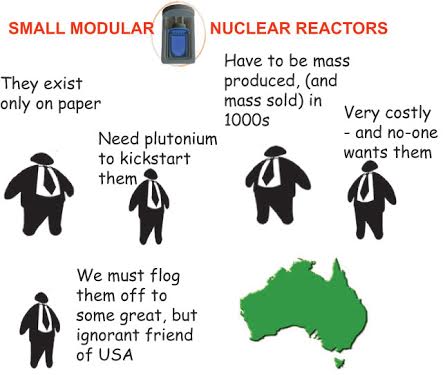
We knew that the Australian government was looking for volunteers in outback South Australia, to take the radioactive trash from Lucas Heights and some other sites, (and not having an easy time of it). But oh dear– we had no idea that the search for hosting new (untested) nuclear reactors was on too!
Well, The Australian newspaper has just revealed this extraordinary news, in its article “Want a nuclear reactor in your backyard? Step this way” (28/11/17). Yes, it turns out that a Sydney-based company, SMR Nuclear Technology, plans to secure volunteers and a definite site within three years. If all goes well, Australia’s Small Modular Reactors will be in operation by 2030.
Only, there are obstacles. Even this enthusiastic article does acknowledge one or two of them. One is the need to get public acceptance of these so far non-existent new nuclear reactors. SMR director Robert Pritchard is quoted as saying that interest in these reactors is widespread. He gives no evidence for this.
The other is that the construction and operation of a nuclear power plant in Australia is prohibited by both commonwealth and state laws.
But there are issues, and other obstacles that are not addressed on this article. A vital question is: does SMR Nuclear Technology intend to actually build the small reactors in Australia, or more likely, merely assemble them from imported modular parts – a sort of nuclear Lego style operation?
If it is to be the latter, there will surely be a delay of probably decades. Development of SMRs is stalled, in USA due to strict safety regulations, and in UK, due to uncertainties, especially the need for public subsidy. That leaves China, where the nuclear industry is government funded, and even there, development of SMRs is still in its infancy.
As to the former, it is highly improbable that an Australian company would have the necessary expertise, resources, and funding, to design and manufacture nuclear reactors of any size. The overseas companies now planning small reactors are basing their whole enterprise on the export market. Indeed, the whole plan for “modular” nuclear reactors is about mass production and mass marketing of SMRs -to be assembled in overseas countries. That is accepted as the only way for the SMR industry to be commercially successful. Australia looks like a desirable customer for the Chinese industry, the only one that looks as if it might go ahead, at present,
If, somehow, the SMR Technologies’ plan is to go ahead, the other obstacles remain.
The critical one is of course economics. …….
Other issues of costs and safety concern the transport of radioactive fuels to the reactors, and of radioactive waste management. The nuclear industry is very fond of proclaiming that wastes from small thorium reactors would need safe disposal and guarding for “only 300 years”. Just the bare 300!
The Australian Senate is currently debating a Bill introduced by Cory Bernardi, to remove Australia’s laws prohibiting nuclear power development. The case put by SMR Technologies, as presented in The Australian newspaper is completely inadequate. The public deserves a better examination of this plan for Small Modular Reactors SMRS. And why do they leave out the operative word “Nuclear” -because it is so on the nose with the public? http://www.onlineopinion.com.au/view.asp?article=19460&page=2
Despite the Turnbull government, Australia quietly waking up to the existential threat of climate change
And as 2017 draws towards a close, Environment and Energy Minister Josh Frydenberg is putting the final touches to a review of Australia’s climate policies due for release by month’s end…..
Scrutiny
While festive seasonal distractions may dim the chance of an immediate and close scrutiny of his climate review, the challenges for the Turnbull government will still be waiting when politicians reconvene in the new year.
International attention will also remain, whether at this week’s One Planet Summit in France to assess the progress on the Paris climate deal two years on, or late in 2018, when all nations will be pressed to increase their ambition to curb the greenhouse gas emissions driving global warming.
On the emissions front, Frydenberg has already had his options significantly reduced.
The government’s signature National Energy Guarantee aimed at providing a more reliable, affordable and sustainable electricity supply locks the power sector into the same 26-28 per cent pollution reduction that the whole economy is supposed to track.
Even if Frydenberg can convince the states to sign up – a huge ask unless there is a major power outage over the summer – such an approach won’t be the best.
“Electricity production in OECD countries is always part of the cheapest options to decarbonise the economy, and it’s also a big source of emissions,” said Yann Robiou du Pont, a researcher at Melbourne University’s Australian-German Climate & Energy College.
“There are fewer assets to transform and they’re usually closer related to governmental decision-making.”
In Australia’s case, the electricity sector is the largest source of emissions, accounting for about a third of the total, and home to many ageing and relatively dirty coal-fired power plants.
Another big source, land clearing, is again on the increase in states such as Queensland and NSW……..
Mr Robiou du Pont notes the Climate Change Authority’s own recommendation that Australia’s fair contribution to emission cuts would be much higher than the Abbott-Turnbull government’s offer, given the country’s high per capita pollution and also relative wealth – if not political will – to transform its economy.
The authority – which the Coalition government tried but failed to abolish – called for a 25 per cent cut of 2005-level emissions by 2020, and 54 per cent by 2030. That’s roughly double the government’s ambition.
‘Not serious’
Mark Butler, Labor’s climate spokesman, said his party is sticking with a 45 per cent emissions reduction goal that “is consistent with the Paris Accord goal of limiting global warming to below two degrees”.
“It is clear that the government’s approach of a pro rata allocation of abatement between sectors will ensure the costs of meeting any emission reduction target will be higher than they need to be,” Butler said.
“The electricity sector has a lower cost of abatement than most other sectors in the form of renewable energy, and renewable energy is already the cheapest option to replace ageing coal-fired power stations that will inevitably retire,” he said.
(Energy giant AGL is expected to announce details within days of what its plans are post-2022, when it closes the ailing Liddell coal-fired power station in the Hunter Valley.)
Sectors like manufacturing and livestock agriculture have a much larger cost of abatement and few ready-to-deploy abatement technologies.
“The government’s insistence each sector meets targets based on a pro rata division of the national emission reduction target just confirms they do not take climate change seriously,” Butler said.http://www.smh.com.au/environment/climate-change/existential-threat-climate-change-risks-finally-grab-australias-attention-20171206-h00am7.html
11 December More REneweconomy news
RenewEconomy-
Zibelman: Resisting energy transition like trying to resist internetAEMO boss Audrey Zibelman says energy transition as unstoppable as the internet, because economics and technology have changed. Some baseload may be needed in the future, but it doesn’t need to be coal.
-
CRC awards Solar Analytics $1.9M for Smart Home Energy Management SystemSolar Analytics evolves from a solar monitoring platform to a holistic Smart Home Energy Management System with the announcement of a $1.9 million grant from the Australian Federal Government.
-
Flinders’ renewable frontierThe Flinders Island community can look forward to a secure and cleaner energy future thanks to its new Hybrid Energy Hub.
-
Construction begins at Kennedy wind, solar and battery storage hubConstruction begins on first 60MW of proposed 1200MW Kennedy Energy Park, the world-leading wind, solar, and battery storage project in north Queensland.
-
ERF review fails to douse doubts over Coalition key climate policyCCA review of Coalition’s Emissions Reduction Fund fuels concerns the scheme is an expensive, inefficient and risky way to cut carbon.
-
Know your NEM: Liddell plans could drown in Snowy 2AGL’s plans for Liddell are vague and lacking, most likely because the company is waiting to see what the Coalition aims to do with Snowy Hydro.
Policy delay -“the new form of climate denialism”.
 ‘Existential threat’: climate change risks finally grab Australia’s attention, SMH, Peter Hannam, 10 Dec 17 “………...‘New denialism’
Submissions to recent and ongoing Senate inquiries also indicate that whichever parties take government at the next election, many agencies already have preparations underway to adapt to climate change.
Peter Whish-Wilson – the Greens’ spokesperson for Healthy Oceans who led a Senate inquiry into the impact of climate change on the marine environment that last week released its report – said policy delay was “the new form of climate denialism”.
“Whether you stick your head under the water up on the Great Barrier Reef and see the devastation first-hand or you talk to the defence force personnel involved in planning for natural disasters in the Pacific, you know that the effects of global warming are upon us and that without action the future is looking grim,” Whish-Wilson said.
“We now need to think about the increase of marine heatwaves as part of the range of climate impacts we need to prepare for, like we do with bushfires and droughts,” he said.
‘Threat-multiplier’
For its part, the Defence Department’s report to a separate Senate inquiry into the implications of climate change for Australia’s national security detailed how it expects the “threat-multiplier” effect will hinder its “warfighting role”.
“The national security threats that may emerge include inter-group rivalries, water, food and resource shortages and irregular migration,” it said. “Many of the states in Australia’s region face some or all of these challenges, in addition to being vulnerable to climate change impacts such as temperature and sea level rise.”
Defence noted how it deployed 1000 staff to help Fiji recover from its $2.5 billion hit from Cyclone Winston, a category-5 storm in 2016. The HMAS Canberra was part of the deployment, along with planes that delivered 520 tonnes of humanitarian aid.
In its submission, the Department of Immigration and Border Protection said “climate change effects could permanently alter normal business, including the accessibility of assets and capability”.
Interestingly, it noted that “there is no internationally agreed position on expanding the current definition of a refugee or impetus to create a new international protection obligation to encompass people displaced by climate change”………
Pacific nations are watching with concern the Australian and Queensland governments’ efforts to promote the huge Adani-owned Carmichael mine, which threatens to open up a massive new coal province.
“The execution of the Adani project will be a huge carbon bomb for us in the Pacific,” Fruean said.
She dismissed the characterisation of funds from rich nations to help her people cope with worse weather extremes and rising sea levels.
“I see it as climate debt,” she said. “We wouldn’t need that aid if it weren’t for these countries investing in fossil fuels, and really creating the damage that we’re seeing in our islands today.” http://www.smh.com.au/environment/climate-change/existential-threat-climate-change-risks-finally-grab-australias-attention-20171206-h00am7.html
Traditional Owners fighting Adani make demands of new Labor Govt
New Queensland polling released showing support for mine delay wanganjagalingou.com.au/wj-make-demands-of-new-labor-govt-on-adani/ ‘Brisbane, 8 December 2017.
‘With the announcement of a new majority Qld Labor government, and
with the National Native Title Tribunal set to decide today whether to register Adani’s sham Indigenous Land Use Agreement,
the Wangan and Jagalingou Traditional Owners Council have presented a clear set of demands.
‘Wangan and Jagalingou (W&J) Traditional Owners Council Spokesperson Adrian Burragubba said,
‘“Our fight to protect our country and heritage will continue until Premier Annastacia Palaszczuk acknowledges
that we are the people from that land, and Adani does not have the consent it requires from us for this destructive mine.
‘“We call on the Palaszczuk Government to stand up for our rights and not the interests of Adani.
We have written to our more than 100,000 supporters in the wider community this morning,
asking them to press the Premier and Deputy Premier to demand that the returned Palaszczuk Government –
‘acknowledge that Adani and the Queensland Government do not have the consent of W&J Traditional Owners for the Carmichael mine
remove Queensland’s ‘signature’ from Adani’s contested Indigenous Land Use Agreement
rule out extinguishing Native Title to allow Adani to proceed, even if the ILUA is registered by the NNTT
stop opposing the rightful W&J Traditional Owners in court and wait for all our cases to be heard, and
end Adani’s special treatment – which will enable the destruction of W&J country and heritage – including keeping the Premier’s election promise to veto Adani’s $1BN taxpayer-funded loan”’
‘“This follows an an authorisation meeting of our Claim Group on 2 December at which,
for the fourth time since 2012, our people voted unanimously to reject an Indigenous Land Use Agreement (ILUA) with Adani. … ‘
INTERNATIONAL HUMAN RIGHTS DAY 10th December 2017
‘International Human Rights Day and the International Declaration of Human Rights
https://rollbacktheintervention.wordpress.com/irag/
‘The Universal Declaration of Human Rights empowers us all.
Human rights are relevant to all of us, every day.
Our shared humanity is rooted in these universal values.
Equality, justice and freedom prevent violence and sustain peace.
Whenever and wherever humanity’s values are abandoned, we all are at greater risk.
We need to stand up for our rights and those of others. …
‘In the coming year IRAG Alice Springs will be calling on people all around the country and overseas
to support us in our stand to have people’s human rights upheld, and
their rights under the UN Declaration on the Rights of Indigenous Peoples.
‘This will be a campaign to have the Stronger Futures laws repealed as this is destroying people and our culture.
‘We are working on strategies to call on all politicians to listen to what we are saying.
Governments need to work with us instead of treating people like children.
‘IRAG is grateful for all your support in the past
and we look forward to working with you in the future.
IRAG UPDATE
‘IRAG group is meeting regularly to plan a strong campaign for the next year.
We need more people to join us as there is much work to be done.
Please send us a message via our Facebook page if you are interested in joining us.’
11 December REneweconomy News
RenewEconomy
-
Maoneng lands Australia’s biggest solar PPA with AGLChina-Australia renewable energy firm lands PPA with AGL for construction of 300MW of large scale solar – the biggest contract so far in Australia.
-
AGL proposes 1.6GW wind and solar, plus storage, to replace LiddellAGL confirms plans to invest in 1.6GW of wind and solar, plus storage and other technologies, to replace the ageing coal clunker, Liddell, which it will close in 2022, much to the annoyance of the federal Coalition.
Call For Senate Inquiry Into South Australia’s Nuclear Dump Sites
Going Ballistic Over “Pathetic” Nuclear Dump response
*Call For Senate Inquiry Into SA’s Nuclear Dump Sites After Minister Squibs on Senate Documents Order
NXT Senator Rex Patrick and SA-Best Leader Nick Xenophon say the only way to get answers for the communities of Kimba and Hawker on the reasons their townships were selected as a potential radioactive waste dump sites is through a Senate inquiry into the consultation and selection process.
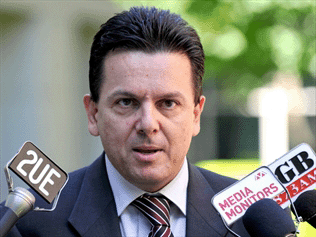 Both Senator Patrick and his SA-Best colleague, Nick Xenophon, are gobsmacked at the totally inadequate response by Senator Matt Canavan, the Minister for
  Resources and Northern Australia, to a Senate order to produce all the documents he used to determine there was ‘broad community support’ to continue exploring Kimba as a site for the low-level waste dump.
On Wednesday Senator Patrick successfully moved the motion for the Minister to make public all the information gathered by Government departments.
Earlier in the year the Minister advised he would need a figure in the range of 65% community support to progress plans in Kimba. Three ballots have been run in Kimba and none have reached 60%.Yet despite not hitting the criteria he set himself, the Minister selected two Kimba sites for further assessment.
Senator Patrick sought the Senate order after the Government refused to provide a local community member with a definition of ‘broad community support’ under freedom of information laws.
“When I asked for all the information used by Minister Canavan on how he came to make his determination to proceed to the next phase of consultation, all I got was a disingenuous response saying that there was no threshold which constituted ‘broad community support,” Senator Patrick said.
Nick Xenophon said: “None of the information used to make the decision was provided. We need to see and share with the community what was put to him to make his decision.”
Senator Patrick will move for the Senate inquiry into the contentious issue when parliament resumes next year.
“If I cannot get satisfactory answers, then there’s no choice but to ask the Senate to look into the process undertaken to date and the Government’s reasoning in moving forward to the next stage of the assessment despite the deep division in the community,” he said.
“I made it very clear to the Government during my first speech in the Senate that I had a strong interest in accountability and transparency.
“I want to work constructively with this Government but my enthusiasm to do so is contingent on them embracing a key principle of responsible government – openness and transparency.
“When it comes to decisions made about the people and supposedly for the people, they must be open about them, particularly when it comes to a nuclear dump site, “ said Senator Patrick. Follow links to the response from Minister Canavan and Senator Patrick’s Senate motion
https://www.pdf.investintech.com/preview/437f7094-dbb4-11e7-9f8d-0cc47a792c0a/index.html
1 This month


Help Aunty Sue Protect Her Land and Sacred Sites From Destructive Rocket Testing.
.

Australians deserve the truth
about
AUKUS – https://aukuspublicinquiry.com/

PETITION – To: Prime Minister Anthony Albanese and the Australian Labor Government

of the week – Australians for War Powers Reform (AWPR)
To see nuclear-related stories in greater depth and intensity

