No real gift in giving: culture of Christmas must change Brisbane Times 19 Dec 17 Christmas, we’re assured, brings out our best selves. We’re full of goodwill to all men (and women). We get together with family and friends – even those we don’t get on with – eat and drink and give each other presents.
We make an effort for the kiddies. Some of us even get a good feeling out of helping ensure the homeless get a decent feed on the day………
there’s a darker, less charitable, more Scrooge-like interpretation of what Christmas has become since A Christmas Carol.
Under the influence of more than a century of relentless advertising and commercialisation – including the soft-drink-company-created Santa – its original significance as a religious holy-day has been submerged beneath an orgy of consumerism, materialism and over-indulgence.
We rush from shop to shop, silently cursing those of our rellos who are hard to buy for. We attend party after party, stuffing ourselves with food and drinking more than we should.
All those children who can’t wait to get up early on Christmas morning and tear open their small mountain of presents are being groomed as the next generation of consumerists. Next, try the joys of retail therapy, sonny.
But the survey also reveals a (growing?) minority of respondents who don’t enjoy the indulgence and wastefulness of Christmas.
A fifth of respondents – more males than females – don’t like buying gifts for people at Christmas. Almost a third expect to get gifts they won’t use and 42 per cent – far more males and females – would prefer others not to buy them gifts…….
Rich people like us need to reduce our demands on the environment to make room for the poorer people of the world to lift their material standard of living without our joint efforts wrecking the planet.
This doesn’t require us to accept a significantly lower standard of living, just move to an economy where our energy comes from renewable sources and our use of natural resources – renewable and non-renewable – is much less profligate.
This is the thinking behind the book Curing Affluenza, by the Australia Institute’s chief economist – and instigator of the survey – Dr Richard Denniss……
Planet Ark have declared a festive war on waste, as Australians get set to buy, eat and party more than ever this Christmas.
Introducing their 12 DOs of Christmas, Planet Ark are calling on people to consider some simple actions to help reduce the amount of waste produced.
The Christmas and New Years period see a significant increase in the amount of kerbside material sent for recycling.
Higher consumption rates also see increases in a number of non-recyclables items, with common Christmas gifts like computers, printers, iPads, mobile phones, clothing and fashion accessories leading to older items and packaging being discarded.
Planet Ark’s Recycling Programs Manager, Ryan Collins, said he is hoping Australia’s approach to the festive season will have been influenced by the success of the ABC documentary series War on Waste.
“2017 has been a landmark year for Australia’s waste and recycling discussion, and this Christmas is a great time to look at the best and worst parts of our habits,” he said.
“Over the festive period councils report a steep spike in the amount of waste they collect, but with 12 DOs every Australian can fight a festive war on waste.”
Research commissioned by Planet Ark looking at the most popular methods for reducing waste at Christmas found that over half of Australians save food for Boxing Day, while 40 per cent reuse their old wrapping paper.
The report also found 39 per cent write and stick to a shopping list and 37 per cent find out what recipients want before buying gifts.
Guardian, Eleanor Ainge Roy, 20 Dec 17, In the shadow of a cabinet reshuffle yesterday, the government released a long-anticipated review of its climate policies which foreshadows loosening the current safeguard mechanism for pollution levels.
Labor and the Greens blasted the new annual emissions projections, which predict Australia will increase its emissions all the way to 2030 and beyond, and called the Coalition’s action on climate change woefully inadequate. “When you look at those numbers you really do start to understand why [the government] would sneak them out, because they are a shocking set of numbers,” the shadow climate change minister, Mark Butler, said.
Butler also condemned the permissive signal on the safeguards mechanism in the review, as did the Greens’ climate spokesman, Adam Bandt, who noted the government wanted to weaken its “flawed” emissions reduction fund by allowing companies’ pollution baselines to be increased. “The data is devastating and the policy review is a travesty,” Bandt said. “Pollution is going up, we won’t meet even our paltry Paris targets and the government’s only plan is to make matters worse by allowing companies to buy dodgy permits from pig farms in China instead of cutting Australia’s emissions.”…..https://www.theguardian.com/australia-news/2017/dec/20/morning-mail-labor-and-greens-slam-coalition-climate-review
Adani scraps $2bn deal to outsource Carmichael coalmine operation
Decision to end Downer EDI agreement follows Palaszczuk government’s blocking of federal loan for the Queensland project, Guardian, 19 Dec 17, Adani has blamed the Queensland government’s decision to kill off a taxpayer-funded loan for its decision to ditch a $2 billion agreement with a major contractor.
But the Indian miner says it remains committed to building its controversial Carmichael coalmine and the decision to part ways with Downer EDI has no bearing on that.
Adani had intended to outsource the operation of its Carmichael mine to Downer under an agreement that was worth $2bn at the time of its announcement in 2014, but now says it will run the mine itself.
It made pointed references to the Palaszczuk government’s loan veto and the need to keep production costs down in announcing the “mutual” split with Downer……
Anti-Adani protesters, who have targeted Downer over its involvement in the project, say it’s a welcome blow.
“Downer walking away from Adani is the biggest nail in the coffin for the Carmichael mine thus far. Adani are unlikely to find another Australian company willing to risk building and operating such a controversial mine,” Galilee Blockade spokesman Ben Pennings said.
“Adani have never operated a mine of this scale and have absolutely no experience operating mines in Australia.”
The very first act of Queensland’s newly re-elected Labor government was to make good on its election promise to veto a loan to Adani of up to $1bn from the federal Northern Australian Infrastructure Fund (Naif).
The government has said it backs the mine and wants the jobs it will create, but also says the project must be viable without taxpayer funds, including federal funds.
AAPBHP Billiton will remain a member of the Minerals Council of Australia for now but has decided to exit the World Coal Association over differences in climate and energy policy.
The stance follows a push by BHP investors in September for the company to review its relationship with industry bodies advocating “obstructive or misleading” policy positions on climate change and energy.
The Australasian Centre for Corporate Responsibility, a not-for profit association, filed a resolution at BHP’s annual general meeting seeking to end the Minerals Council membership, which attracted about 9 per cent of votes.
In a report published on Tuesday, BHP said a review of 21 industry association memberships showed it held materially different positions over climate and energy policy with three lobby groups — the Minerals Council, the US Chamber of Commerce and the World Coal Association.
Key among the issues is the Minerals Councils’ push for energy policy that prioritises costs and reliability over emissions reduction, and encouraging coal power plant development over other sources.
Despite this, BHP said it has decided to remain with the Minerals Council for now, given the high level of benefit it derives from the membership.
It will, however, ask the Minerals Council to refrain from policy advocacy in these areas, and has threatened to review membership in 12 months time if the lobby group does not agree.
Given the scale of its operations in Australia, BHP is the biggest funding source for the Minerals Council. The miner said it has decided to exit the World Coal Association, given the differences and the narrower activities that benefit the company.
BHP said it will discuss the nature of its policy differences with the US Chamber of Commerce, prior to taking a final decision by the end of March 2018.
Responding to BHP’s decision, Australasian Centre for Corporate Responsibility executive director Brynn O’Brien said it is extraordinary that the world’s biggest miner has signalled an intention to exit the world’s peak coal lobby.
“This is a message that even organisations, like BHP, with large coal assets, do not value aggressive anti-climate lobbying,” he said.
“However, BHP’s equivocation in relation to membership of the MCA points to the highly charged environment in which climate policy is made in Australia.”
Steve Dale shared a link.Nuclear Fuel Cycle Watch South , Australia, 18 Dec 17,
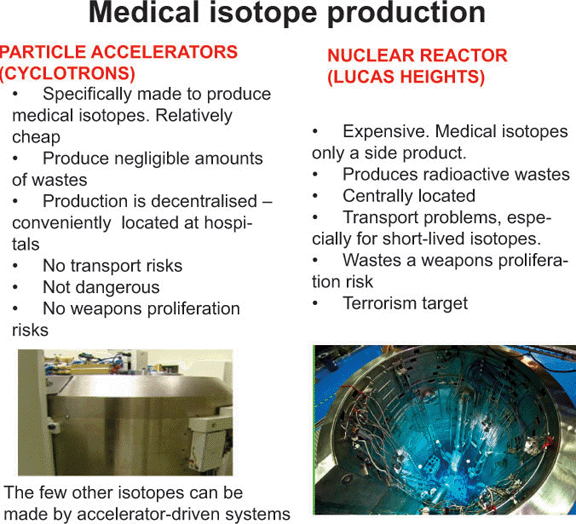
Can anyone help ANSTO? They are heading down the wrong track with their medical isotope world domination dreams. Cyclotrons are the no-waste future. “The advantage of using cyclotron rather than buying isotopes for medical application is that as the isotopes has short half-life period. By the time an isotope reaches its destination it covers its half-life. However, by having a cyclotron in the medical facility it not only reduces the cost but also, increase the number of scans to the patients in a given day. ” – and yes, they can now produce high quality Technetium 99m.
Significant Growth Foreseen by Medical Cyclotron Market During 2017-2027, BY PERSISTENCE MARKET RESEARCH, SATPRNEWS
Medical cyclotron is a machine used in the medical imaging and research field to make relatively short lived radioisotopes. Cyclotron is a particle accelerator. It is an electrically powered machine that produces a beam of charged that is then further used in medical, industrial and research processes. A cyclotron machine takes the hybrid atom (these are hydrogen that make up water except they have a negative charge) and accelerate it to very high speed. When this procedure has enough energy, the energy is spent into a target where the reaction is taken.
The new element that is produced with the strike of positive ion and neutron is radioactive element that is used for the treatment in medical research. The major isotope that is used for the cyclotron is fluorine-18. Its ability to decay itself to produce positrons, which is used around the world for Positron Emission Tomography and PET scans.
PET scans are used for the diagnosis and treatment of cancer. With the product obtained from a cyclotron, we can produce a wide variety of isotopes of our interest for medical imaging such as iodine-123, Technetium-99m and Gallium-67.
The advantage of using cyclotron rather than buying isotopes for medical application is that as the isotopes have short half-life period. By the time an isotope reaches its destination it covers its half-life.
However, by having a cyclotron in the medical facility it not only reduces the cost but also, increase the number of scans to the patients in a given day. The medical facility that used cyclotron is required to be built with extensive safety such as multiple levels of shielding, monitoring and protection to ensure safe operations…….http://www.satprnews.com/2017/12/13/significant-growth-foreseen-by-medical-cyclotron-market-during-2017-2027/
Ramping and duck curves Grid reliability and flexibility in the NEM would be much of an issue for the next few years except for the fact that the coal generation fleet is getting very old.
New appointments to the clean energy finance corporation board
The new appointments bring experience and skills in finance and investment, energy markets and corporate governance skills and add to the geographical diversity to the Board.
CWP Asset Management to provide asset management services to two new Wirsol Energy solar farms in Australia CWP Asset Management has been awarded contracts by Wirsol Energy to provide asset management services to two new solar PV projects in Australia. The 110MW Wemen Solar Farm in Victoria and the 89MW Clermont Solar Farm in Queensland reached financial close yesterday, and will commence construction in January 2018. CWP’s Managing Director Alex Hewitt said “We’d like to congratulate Wirsol on the successful financing of these two large solar projects. We are really looking forward to working with the Wirsol team.“ CWP Asset Management will deliver services to these projects through its asset management team in Canberra, which manages 690 MW of wind and solar farms on behalf of project owners. “Our team in Canberra is growing very quickly, as we offer our experience and our capabilities to other renewable energy project owners, to maximise their project value and to provide a safe pair of hands for their investments” said Mr Hewitt. “Canberra is a great central location for providing asset management services nationally, and it is seeing the benefits of the ACT Government’s strong support for the renewable energy sector. We look forward to employing more Canberrans and to working with other renewable energy project owners nationally” said CWPs Head of Asset Management, Bill Filby.
The 110MW Wemen Solar Farm in Victoria and the 89MW Clermont Solar Farm in Queensland reached financial close yesterday, and will commence construction in January 2018.
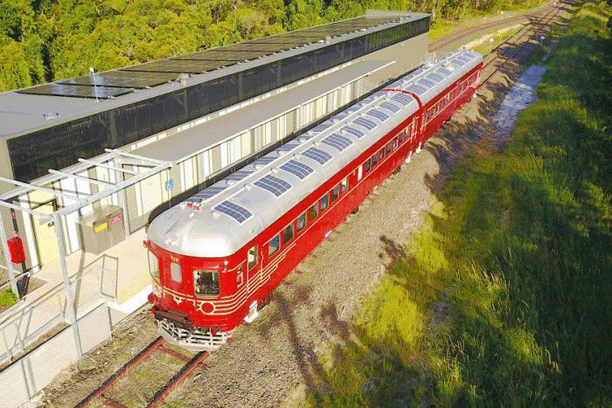
World-first solar train now leaving the platform in Byron Bay with zero emissions,ABC North Coast , By Bruce Mackenzie, 17 Dec 17, What is claimed to be the world’s first fully solar-powered train is operating on the New South Wales North Coast.
A refurbished 70-year-old ‘red rattler’ is running on a three-kilometre stretch of disused rail line at the popular tourist destination of Byron Bay.
It made its maiden trip yesterday with almost 100 passengers on board.
Electric bus solar system
The $4-million project is the brainchild of multi-millionaire businessman Brian Flannery, who owns a resort in the area.
“Hopefully it attracts people to Byron Bay,” Mr Flannery said.
“I think international tourists will come here to have a look at this world’s first solar train.
“So let’s see, in five years’ time they’ll probably still say I’m mad, but it’s a bit of fun.”
Tim Elderton, from the Lithgow Railway Workshop, was tasked with building curved solar panels and a battery system to power the train.
“Of course the major difference is it’s got solar panels on the roof so it can recharge itself.
“For those cloudy days we’ve also got 30 kilowatts of solar panels in this [station’s] roof here so we can also plug it in.
“On a sunny day like today we can do about four or five trips before we have to plug it in.”……..
Tram infrastructure a possibility
Longer trips than this one — 10 minutes to cover three kilometres or so — would require regular recharging stations along the route, but Mr Flannery said the technology might be suited to inner-city trams.
A lot of the tram networks of course have overhead wires and they’re electric but they’re powered off the grid from overhead,” he said.
“But in a case where you want to build a tramline without that infrastructure, I think you could.
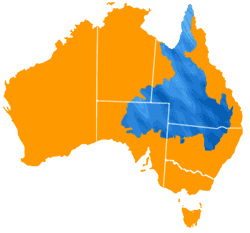
“A PLAN to capture and store liquid CO2 in the Precipice Sandstone Aquifer of the Great Artesian Basin has been bluntly opposed by a room of 50-odd landholders at an information session in Wandoan.
The “non-profit” wholly-owned subsidiary of Glencore, Carbon Transport and Storage Company spent two hours on Tuesday afternoon informing the community of their proposed plan to drill 1300m underground into the aquifer and inject CO2 in the form of a “supercritical liquid”, with half the density of water.
The project is still in its infancy, with another six years of modelling and technical studies to get through before a trial injection can even be contemplated in 2022.
If the trial does go ahead in 2022, 60,000 tonnes of liquid CO2 would be injected into the aquifer from a Glencore-owned property 15km west of town for three years to determine the feasibility of a larger-scale project.
The liquid CO2 would dissolve into the aquifer’s water, acidifying it to a pH of 5. Water has a pH of 7.
The acidified water would form a plume.”
‘The WandJ Traditional Owner’s Council is one of the final barriers to one of the world’s largest coal mines. And it is now scared its native title will be extinguished before its day in court.’
‘W&J spokesperson Murrawah Johnson told BuzzFeed News that there are concerns the Queensland government could move “at any time” to extinguish native title over the site, before a Federal Court hearing in March that will challenge the validity of the ILUA. That’s the reason W&J are seeking an injunction.
‘”We have a court case, challenging the legitimacy of this agreement, and they seem to be willing to go and extinguish our native title in the face of all of that, despite the agreement being illegitimate,” Johnson told BuzzFeed News. … ‘
Unfortunately, due to climate change, we are going to see a lot more catastrophic days in the future in Tasmania and indeed globally.
To fight the catastrophic fires of the future, we need to look beyond prescribed burning California is burning – a sentence we’ve heard far too often this year. Sydney is currently on bushfire alert, as firefighters battle a fire in the Hunter Valley region and temperatures are set to top 40℃.
A cocktail of factors, from climate change to centuries of ignoring indigenous burning practises, means that catastrophic fires are likely to become more common.
One of Australia’s favourite fire prevention measures is prescribed burning – using carefully controlled fires to clear out flammable materials. We’re almost obsessed with it. Indeed, it seems the outcome of every major inquiry is that we need to do more of it.
The Royal Commission inquiry that followed Victoria’s 2009 Black Saturday fires recommended that 5% of all public land in Victoria be treated per year – a doctrine that was subsequently dropped due to impracticality.
Yet our research, published today in the International Journal of Wildland Fire, modelled thousands of fires in Tasmania and found that nearly a third of the state would have to be burned to effectively lower the risk of bushfires.
The question of how much to burn and where is a puzzle we must solve, especially given the inherent risk, issues caused by smoke smoke and shrinking weather windows for safe burning due to climate change.
Why use computer simulations?
The major problem fire science faces is gathering data. Landscape-scale experiments involving extreme fire are rare, for obvious reasons of risk and cost. When a major bushfire happens, all the resources go into putting it out and protecting people. Nobody has the time to painstakingly collect data on how fast it is moving and what it is burning. We are therefore restricted to a few limited data sources to reconstruct the behaviour and impact of fire: we can analyse the scar on the landscape after a fire, look at case studies, or run simulations of computer models. Continue reading →
Julian Assange welcomes UK ruling that WikiLeaks is a media organisation, WikiLeaks founder welcomes ruling by UK tribunal. IBT ,By Jason Murdock, December 14, 2017WikiLeaks has been recognised as a “media organisation” by a UK tribunal in a ruling that flies in the face of claims by US officials who have branded it a “hostile intelligence agency”.
The anti-secrecy website – helmed by Julian Assange – has faced the ire of CIA director Mike Pompeo, who has compared its work to Hezbollah, Isis and al-Qaeda. Over the years, WikiLeaks has disclosed countless documents pilfered from the US government……….
The tribunal, in a section detailing the public interest for disclosing any withheld information, described Assange as “the only media publisher and free speech advocate in the Western world who is in a situation that a UN body has characterised as arbitrary detention”.
The Advertiser can reveal the accident occurred on August 22 when a vial of the nuclear medicine product Molybdenum-99 was dropped when its cap was being removed during a quality-control test. The incident was rated “severe” by regulators and has led to changes in safety procedures.
Molybdenum-99 is produced by the Australian Nuclear Science and Technology Organisation at Lucas Heights, below, for use in cancer and heart disease scans.
ANSTO Health general manager Mark Moore said the analyst has a slightly elevated risk of developing skin cancer after the liquid spilt on their hands.
“The analyst was working in a shielded fume cupboard that, in normal operation, limits a dose received, but the dropping of the vial resulted in the radiation dose,’’ Mr Moore said.
“Our employee remains at work and is currently performing alternative quality assessment work in the nuclear medicine field.”
Mr Moore said the staff member had burn-like symptoms, including blistering and reddening of the skin.
“While ANSTO is still waiting to be advised on the final estimate dose by an independent clinical specialist, we know it was above the annual statutory dose limit of 500 millisieverts, and expect to be issued with a formal breach from the regulator,” Mr Moore said.
“At this stage, the dose is estimated to be more than 20 Sieverts, which is 40 times above the extremity dose limit.”
The incident was reported to the Australian Radiation Protection and Nuclear Safety Agency and the International Atomic Energy Agency.
An ARPANSA investigation criticised some safety practices in Lucas Heights’ radiopharmaceutical production facilities.
Tim Bickmore, Fight To Stop Nuclear Waste Dump In Flinders Ranges SA, 14 Dec 17,This week some locals tried to attend the Barndioota Consultative Committee December Meeting – but were not welcome. They were advised that 1] there were no protocols for allowing such, & 2] should the BCC formulate observer guidelines then there was a high probability that peeps would need to sign a confidentiality agreement.
This is a joke, right? Isn’t it a foundation purpose of the committee to provide an interface? What business could they have which requires official secrets remain hidden from the rest of us? http://www.radioactivewaste.gov.au/…/Barndioota%20Consultat…