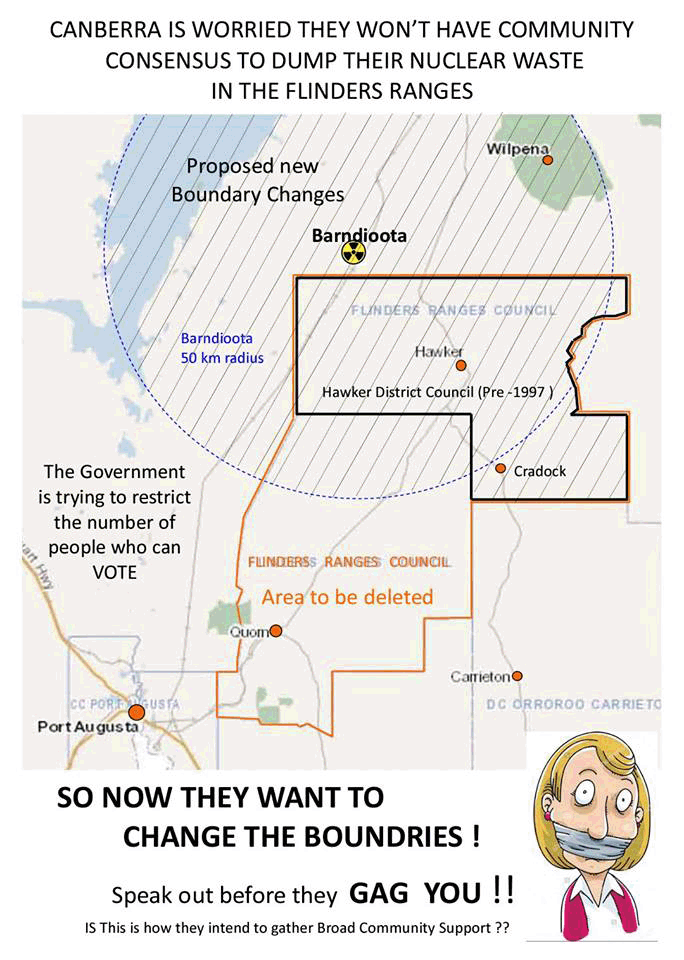
Australian govt changing electoral boundaries, in effort to get support for radioactive waste dump in South Australia?
New South Wales Senate debated the idea of a nuclear power station for Jervis Bay
NSW senate debates Jervis Bay nuclear plant, South Coast Register,  @fistjourno
NSW deputy premier John Barilaro called for a debate in the senate, and the contentious issue was discussed on Thursday.
“The technology they use today is a lot safer than what they used in Chernobyl, but Jervis Bay is not the place,” Christian Democratic Party member Paul Green said. “Not in Jervis Bay’s clean, green, pristine environment.“Over my dead body Jervis Bay will end up with one there.”
Meanwhile, his colleague Fred Nile, was open to the idea….. http://www.southcoastregister.com.au/story/4984329/nsw-senate-debates-jervis-bay-nuclear-plant/
A futuristic family car at the World Solar Challenge
Guardian 15th Oct 2017, A futuristic family car that not only uses the sun as power but supplies
energy back to the grid has been hailed as “the future” as the annual
World Solar Challenge wrapped up in Australia. The innovative bi-annual
contest, first run in 1987, began in Darwin a week ago with 41 vehicles
setting off on a 3,000km (1,860-mile) trip through the heart of Australia
to Adelaide. A Dutch car, Nuna 9, won the race for the third-straight time,
crossing the finish line on Thursday after travelling at an average speed
of 81.2kmh (55.5 mph).
https://www.theguardian.com/environment/2017/oct/15/this-is-the-future-solar-powered-family-car-hailed-by-experts
Adani needs $2bn of loans for Abbot Point coal terminal: Westpac Bank may not refinance Adani
 Abbot Point coal terminal: Westpac may not refinance Adani loan, Guardian, Michael Slezak, 12 Oct 17 Report reveals Adani needs to refinance $2bn of loans for Abbot Point coal terminal, which is more than it paid for it in 2011. Adani’s financing for its proposed Carmichael coalmine could face a further hurdle, with Westpac appearing to indicate it will not refinance its existing loan to Adani’s coal terminal at Abbot Point.
A recent report by the Institute for Energy Economics and Financial Analysis (Ieefa) revealed Adani needed to refinance more than $2bn worth of loans for its Abbot Point coal terminal in the coming year – an amount that is more than it paid for the port in 2011. That means the company has negative equity on the facility – owing banks more than it is worth.
The refinancing of its port comes as the company must find $5bn of loans for its Carmichael coalmine, which every Australian bank – and many international banks – have said they will not support.
Moreover, the two projects are entirely linked, meaning any bank that decides to support one project is supporting the other and taking a bet on its success: the Port’s financial viability depends on coal coming from the mine, and the mine will not be able to be built without the port operating.
The news that one of Adani’s major existing lenders is likely to withdraw support for Abbott Point therefore adds to ongoing doubts about the ability of the company to find financing for the controversial coalmine, and could jeopardise any potential loan it might get from the government’s $5bn Northern Australia Infrastructure Facility.
In April Westpac released its new climate policy, in which it revealed it would only lend money to projects supporting existing coal basins – not ones that opened up new coal basins. It also said it would only lend to projects that supported mining of coal that had energy content “in at least the top 15% globally”.
Both rules would rule out Westpac lending to the Carmichael mine. But Westpac already lent hundreds of millions of dollars to Adani for its Abbot point terminal, and questions remained whether it would refinance that loan at the end of its term…….
Julien Vincent from financial activist group Market Forces said all eyes will now be on the refinancing arrangements with Commonwealth Bank, with whom Adani has borrowed more money for Abbot Point.
The Commonwealth Bank, has not said it will not continue to invest in Abbot Point, but in August it did explicitly say that it would not be lending to the Carmichael coalmine….https://www.theguardian.com/environment/2017/oct/12/abbot-point-coal-terminal-westpac-may-not-refinance-adani-loan
Tony Abbott warns Prime Minister Malcolm Turnbull against supporting renewable energy
 Tony Abbott launches warning shot on climate policy, SMH, Mark Kenny, 16 Oct 17 Tony Abbott has fired a telling shot across Malcolm Turnbull’s bow, warning that any energy package agreed to in cabinet must also pass a party room wary of anything approaching a clean energy target or other subsidy scheme for renewables.
It came as the Turnbull government received more bad news in the fortnightly Newspoll series, prompting Mr Abbott to declare a future return to the leadership was possible but would occur only if he was drafted by colleagues, which he described as “almost impossible to imagine”.
Signalling that Coalition MPs will be no rubber stamp on energy, the dumped former prime minister said the backbench deserved “plenty of chance to digest” the formula.
Mr Abbott’s blunt message sets the stage for another showdown over a policy area that has divided moderates and conservatives within the Coalition for a decade, and become a constant cipher for simmering leadership rivalries…….http://www.smh.com.au/federal-politics/political-news/tony-abbott-launches-warning-shot-on-climate-policy-20171016-gz1m6z.html
Deceptive trickery of Native Title processes
Ghillar Michael Anderson, 16 Oct 17, First Nations inherent sovereign rights are being grossly and repeatedly violated.
‘It is shameful that the parliamentary lawmakers and the lawyers who call themselves ‘specialist Native Title lawyers’ have complete disregard for the fundamental Human Rights of First Nations Peoples.
The time has come for people to make a stand against these criminals who are making a complete mockery of the judicial process, while at the same time writing deceptive agreements that deny Aboriginal people the future right to challenge and appeal these major injustices.
‘Our Peoples have no protection against these wonton Human Rights abusers and violators,
who can get away with this because our people are kept in poverty by the Crown and
are without sufficient financial support that will allow us to make legal challenges
to right these wrong doings.
‘On the other hand, there are some of our people who choose to take the easy road
and do not want to create any form of confrontation over the breaching of our inherent sovereign rights.
In other words, the two-bob mob are prepared to take what’s on offer and shut up.
This stems from the problem of losing pride, identity and dignity and/or
being educated exclusively white-way and losing touch with core values of our Law and culture.
Independent action to free ourselves
‘I now make a call to all those protagonists, white and black, to lessen the damage that has been created by the likes of those who run ‘reconciliation’, ‘recognise campaign’, referendum council campaign’, ‘constitutional reform campaigns’ and those who are prepared to be agents of the coloniser and be on their payroll.
‘One of our main antidotes to the scourge of colonialism is to take our own independent actions to free ourselves from the tyranny of oppression and injustice by:
Mapping our respective Nation’s territorial boundaries;
declaring independent Sovereignty by way of Unilateral Declarations of Independence (UDIs);
designing and flying your own Nation’s flag;
writing the code of laws, traditional constitutional rules and laws;
presenting them to the Crown and governments saying: “This is what applies to our Country/our Nation.”
‘If Nations seek to incorporate both law-ways then it is time to negotiate Peace Accords or Treaties with each respective Nation.
‘We must now put paid to racially discriminatory legislation in all its forms and thereby end the scourge of colonialism in all its manifestations. … ‘
To continue reading Ghillar’s excellent and inciteful MR go to this link: www.sovereignunion.mobi/content/deceptive-trickery-native-title-processes
Richard Di Natale – Adani’s Carmichael coalmine won’t go ahead
Adani’s Carmichael coalmine won’t go ahead, Greens leader says
Richard Di Natale ‘confident’ if project can’t be stopped in parliament or for financial reasons, Australians will stand in front of bulldozers, Guardian, Amy Remeikis, 15 Oct 17, Adani’s Carmichael coalmine won’t go ahead, the Greens leader Richard Di Natale said, predicting “many, many thousands” of Australians would come together to protest any moves to stop the project.
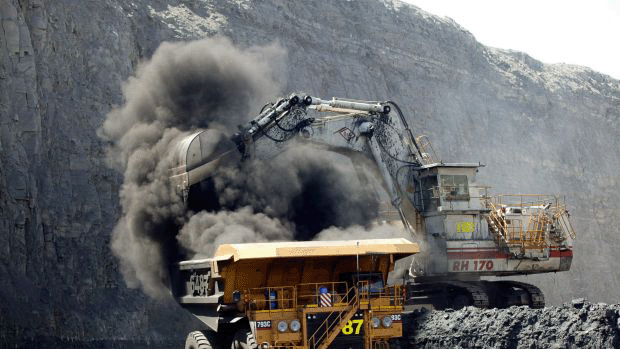
Di Natale said he believed Australians largely stood against the Carmichael coalmine, choosing the Great Barrier Reef and the environment over the construction of what has been billed as the largest coal project in the southern hemisphere…….
Di Natale said he would “absolutely 100%” join in any on-the-ground protest against the mine, if it went ahead, predicting it would be as big as the protest movement which stopped the Franklin Dam from going ahead in Tasmania three decades ago.
“I’ll be more than happy to join those activists right across the country, many of whom I know are preparing, should we fail in the parliament, to ensure that we win it by standing in front of the bulldozers.”
Di Natale said it was about saving both the environment and jobs of the future, instead of a “short-term hit” he said the Carmichael mine would provide……. https://www.theguardian.com/environment/2017/oct/15/adanis-carmichael-coalmine-wont-go-ahead-greens-leader-says
Climate change, sea level rise, and the plight of Australia’s island neighbours – Kiribati

Former president Anote Tong compares Kiribati’s future to the sinking of the Titanic, ABC News By Sarah Hancock , 13 Oct 17 Anote Tong is the former president of the Republic of Kiribati and his island home, in the central Pacific Ocean, is already suffering from the effects of climate change.
Rising sea levels are causing land to be engulfed by tidal waters, driving people away from their homes and leaving them displaced.
Anote Tong is the former president of the Republic of Kiribati and his island home, in the central Pacific Ocean, is already suffering from the effects of climate change.
Rising sea levels are causing land to be engulfed by tidal waters, driving people away from their homes and leaving them displaced.
“What I have seen in my lifetime over the years has been villages, communities, who have had to leave … because it is no longer viable,” he said. “The sea is there and there is nothing. Everything has been taken away so they have had to relocate.”……..
“As a grandfather I have got to think beyond that, as a leader I have to think beyond what will happen today, and knowing what we know today, what will happen to the next generation,” he said.
Mr Tong compared Kiribati’s future to the sinking of the Titanic.
“We are the people who will be swimming,” he said.
“The question will be — will those people on the lifeboats bother to pull us in or push us away because we would be too problematic?” http://www.abc.net.au/news/2017-10-13/anote-tong-delivers-strong-message-on-climate-change/9048088
Small-scale solar cutting $billions from electricity bills
 http://www.theage.com.au/business/energy/smallscale-solar-cutting-billions-from-electricity-bills-20171012-gyzf2c.html, Cole Latimer, 14 Oct 17,
Small-scale solar systems have cut wholesale electricity costs by up to half in the past 12 months, a study has shown.
The report by consulting firm Energy Synapse, commissioned by a community-based organisation Solar Citizens Australia, found solar photovoltaic (PV) installations in NSW had saved consumers up to $2.2 billion from May 2016 to April 2017
During this period, small solar PV systems are estimated to have generated 1540 gigawatt hours of power within the state.
The report says the volume-weighted average price of wholesale electricity would have been between $29 and $44 per megawatt hour higher than the actual average price for the period of $88 per megawatt hour.
The study found that small-scale solar had the largest impact during February, when record heatwaves were experienced, reducing the volume-weighted average price of wholesale electricity by between $119 and $258 per megawatt hour.
There has been a massive increase in renewable energy investment and construction this year. New solar energy generation has grown by 50 per cent globally, according to a report by the International Energy Agency. The IEA’s Renewables 2017 report says 165 gigawatts of new energy came online from renewables as a whole – including solar, wind and hydro power.
“We see renewables growing by about 1000 GW by 2022, which equals about half of the current global capacity in coal power, which took 80 years to build,” IEA executive director Fatih Birol said.
“What we are witnessing is the birth of a new era in solar PV. We expect that solar PV capacity growth will be higher than any other renewable technology through 2022.”
In Australia, there are more than 40 large-scale renewable energy projects that have either started, or will start, construction this year.
Clean Energy Council chief executive Kane Thorton said this represented an investment of more than $8 billion.
“These 41 projects will deliver over 4330MW of new capacity, which is crucial to increasing supply in the energy market, replacing old coal-fired generation that continues to close, and ensuring downward pressure on power prices,” Mr Thornton said.
There are 26 projects being built, and another 14 projects that have secured finance with the expectation that construction will start before the end of the year.
“We have already seen six times the investment value in 2017 of what we saw in 2016, and the new capacity will also help with energy security,” Mr Thornton said.
“In 2016, the combined capacity from all projects completed stood at 264.1 MW. This year 2210.2 MW of projects have been committed and 1881.2 MW are in construction with a whole financial quarter still to go.”
Solar power juggernaut is catching Australia by surprise
 Australia’s solar juggernaut is coming – quicker than anyone thinks, [excellent diagrams and graphs] REneweconomy By Giles Parkinson on 13 October 2017 It is perhaps not surprising that the fossil fuel industry has hit the panic button and is pushing hard for the Turnbull/Abbott Coalition government to dump the proposed clean energy target and replace it with something that might be called a coal energy target.
They can see what’s coming – and there is probably no better way to describe it than a solar juggernaut.
The fact that solar will become the dominant energy source appears to be under no doubt, even the International Energy Agency admits it. And the CSIRO and AEMO appear to be in agreement that even behind the meter solar will account for around half of all demand by the 2040s or 2050s.
But what if it happened a lot quicker than that? Australia’s grid prices have jumped again to absurdly high levels, and this has lit a fire under the rooftop solar market, which will be followed by a major push by corporate buyers into the large-scale market. The solar sector could boom in ways not previously imagined.
At this week’s All-Energy Australia conference he was asked to speak about the implications of a continued solar boom in the Australian energy market, and what it means for incumbent fossil fuel generators, and others – particularly the storage industry. It was a fascinating insight.
First of all, it should be noted that Hoogesteger focused only on solar – so his observations take no account of the 4.5GW of wind energy already in the market, and the likely doubling of that capacity in coming years (particularly as it defies doubters and matches the falling cost of solar)………
Hoogesteger says most forecasts are based around a continued linear uptake of solar, that puts the country’s capacity at about 21GW in the mid 2030s……… Base on his experience, with a near doubling of just rooftop installations, the massive investment in large-scale solar, and the technology’s falling costs, along with high grid prices, he says it could happen a lot quicker than that……http://reneweconomy.com.au/australias-solar-juggernaut-is-coming-quicker-than-anyone-thinks-70985/
14 October REneweconomy news
-
 How to fix Australia’s embarrassing failure in electric vehiclesTAI report shows 64% of all party supporters in favour of policies to increase EV uptake – so what aren’t governments doing?
 -
The UK Government has announced an ambitious new Clean Growth Strategy to drastically cut carbon emissions and combat climate change.
-
UK solar fund buys stakes in three Queensland projectsUK-based Foresight Solar Fund Limited continues Australian buying spree, taking shares in three Queensland projects under development.
-
Don’t waste time on CET – there are other options for renewables, efficiencyWe will never have an effective broad-based emission reduction policy – no matter who is in government. Best to look at alternatives, like reverse auctions.
-
NSW network to trial 1MWh grid support battery, as new suburbs boomMPower tapped by Endeavour Energy to install 1MWh battery on network in NSW, in a trial hoped to save $1m a year on grid costs.
-
Storage on hold as Victoria still reviewing battery tenderClock ticks down on Victoria government’s plans to have two large scale battery storage projects in place by January 1, with the winners still not known.
-
China halts more than 150 coal-fired power plantsChina is to stop or delay work on 151 planned and under-construction coal plants as Beijing struggles to respond to a flat-lining of demand for coal power.
-
Shark Tank’s Steve Baxter joins climate science deniers and islamophobes for Australian LibertyFestWhat do you get when you bring together some of Australia’s most fervent climate science deniers with anti-Islam activists, fledgling right-wing political groups, and an American “free market” Libertarian?

Australia’s role in monitoring North Korea’s nuclear tests
North Korea nuclear tests: How Australia is watching Kim Jong-un http://www.news.com.au/technology/innovation/north-korea-nuclear-tests-how-australia-is-watching-kim-jongun/news-story/0db7b03f8ebb9d99b045a6e4e9d6e23b
THE key to stopping North Korea’s nuclear technology could lie in Australian towns you’ve never even heard of. debra.killalea@news.com.au
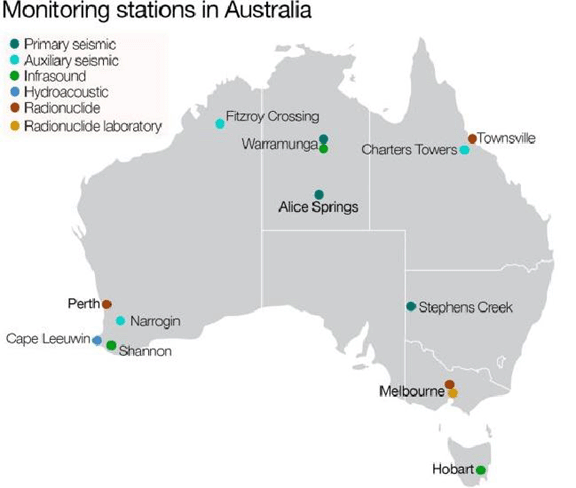
THERE are 321 monitoring stations around the world all designed with one common goal. The International Monitoring System (IMS) uses four technologies to monitor nuclear activity in countries including North Korea.
Unsurprisingly some of these stations are located within our own borders and play a powerful role in monitoring rogue nations.
In a piece for The Conversation, Trevor Findlay, Senior Research Fellow Department of Social and Political Sciences at the University of Melbourne reveals the key role Australia plays.
Dr Findlay writes Australia hosts six seismic, two infrasound, and one hydroacoustic station, including a large seismic array and infrasound station at Warramunga in the Northern Territory.
DETECT AND RELAY
The Vienna-based Comprehensive Test Ban Treaty Organization (CTBTO) uses the IMS to detect nuclear tests around the world.
This means if Kim Jong-un decides to conduct another nuclear test there are several monitoring stations in Australia which could potentially pick up this abnormal activity.
According to Dr Findlay its monitoring system, which began construction in 1996, is “sensitive enough to detect underground nuclear tests below 1 kiloton”.
The CTBTO picked up the September 3 blast detecting a seismic magnitude of 6.1 and a blast yield of 160 kilotons.
Data such as this is picked up is transmitted to Vienna via satellite where it is analysed and distributed to member states.
The CTBTO’s International Monitoring System is basically designed to verify compliance with the 1996 Comprehensive Nuclear Test Ban treaty.
POWERFUL TOOL
According to Associate Professor at Australian National University’s Strategic and Defence Studies Centre Dr Stephan Fruhling, the monitoring system is hugely beneficial.
“The technologies used by the monitoring system (seismic, infrasound, and radionucleides) were all used developed the Cold War to monitor other countries’ nuclear tests, and/or are also the same as used in geophysical monitoring,” he said.
However, it has a much more vital function.
“The main innovation of the CTBTO system is that it makes all raw data freely available, which means that all member states have now access to a global detection system that is meant to give confidence that the treaty is effective, whereas before only the superpowers had such capabilities,” Dr Fruhling said.
He also said the system is operating “even though the CTBTO itself isn’t actually legally in force, and probably never will be.”
Dr Fruhling said the system was very effective and expects it to become even more so over time as sensors and computing improve and the last few stations come online.
He said the system wasn’t perfect.
“There are some limits to the system in terms of very low-yield tests, especially where reduced enrichment fuels are used that do not produce a full yield but still a useful neutron flux to validate a weapons design,” he said.
“However, this is something that is of more use to the advanced nuclear powers who have a lot of experience and access to past testing data, than it is to a new proliferant like North Korea.
AUSTRALIA’S ROLE
Nuclear disarmament campaigner John Hallam said the system and Australia’s role in it was actually quite remarkable.
Mr Hallam said the system has managed to not merely detect, but diagnose every North Korea test right from their first which was just a fraction of a kiloton.
“Australia plays quite a key role, mainly with the big seismic and infrasound array at Warramunga and the Hydroacoustic station at Cape Leeuwin,” he said.
“The CTBTO manages to do amazing work not only in detection of nuclear blasts, but also in detecting earthquake and volcanic activity and a secondary role as a tsunami early warning network.”
However Mr Hallam said the current policies of the US threaten all of that as the CTBTO has been in effect “boycotted” by the Government, despite being the first to actually sign it.
CTBTO’s executive Secretary Lassina Zerbo is geophysicist who used to be the Director of the International Data Centre which processes and analyses all the data coming from the more than 300 stations around the globe.
CTBTO’s work, including the establishment and maintenance of the IMS, is mandated by the Comprehensive Nuclear-Test-Ban Treaty which was negotiated under the auspices of the United Nations Conference on Disarmament in the 1990s and endorsed by the General Assembly. It opened for signature in 1996.
Julie Bishop says that USA should keep Iran nuclear deal
 US should keep Iran nuclear deal: Bishop http://www.sbs.com.au/news/article/2017/10/12/us-should-keep-iran-nuclear-deal-bishop
Foreign Minister Julie Bishop has made the case to the US that the nuclear deal with Iran should remain. Australia has urged the US to retain the nuclear deal with Iran in the absence of any credible alternatives.
US President Donald Trump will make an announcement this week on an “overall Iran strategy”, including whether to decertify the international deal curbing Tehran’s nuclear program, the White House says.
“We are urging that it be maintained and Iran’s other behaviour be dealt with in different circumstances,” Foreign Minister Julie Bishop told ABC TV.
Foreign Minister Julie Bishop slaps down Abbott’s climate speech
Bishop slaps down Abbott’s climate speech, THE AUSTRALIAN Australian Associated PressDeputy Liberal Leader Julie Bishop has slapped down Tony Abbott’s changing opinions on climate change following his controversial key-note speech to sceptics in London this week.
Ms Bishop, who is in South Korea for security talks, said the former prime minister was entitled to express his views on global warming but pointed out they were vastly different to when he was in power.
Mr Abbott supported the Paris Climate Agreement while he was prime minister, set national emissions targets and established the Renewable Energy Target.
“I think the question that has to be asked of Tony Abbott is why does he have a different view now than when he was prime minister,” Ms Bishop told the ABC on Thursday evening.
“He is entitled to change his mind, but I am sure that is why there is a deal of interest in what he has to say.”
Ms Bishop steered clear of questions about whether Mr Abbott was going to lose the next election for the coalition with his constant undermining of Malcolm Turnbull, or whether he ought be expelled.
The foreign minister’s intervention came after former Liberal leader John Hewson urged Mr Turnbull to stand up to Mr Abbott.
Dr Hewson believes the prime minister should call out his predecessor, especially over energy policy, which Mr Abbott focused on during his London speech.
“How long do you want to sit back and be beaten up, because that’s what (Mr) Abbott’s doing,” he told Fairfax Media on Thursday.
Mr Turnbull should draw a line in the sand in adopting a progressive clean energy target in the full knowledge that Mr Abbott would fight back, he said.
Dr Hewson thinks Mr Abbott would “make a bit of noise” and “a few that would back him”, but ultimately voters would appreciate the prime minister standing up for his beliefs.
“It’s time for Malcolm to just take a stand and I think the electorate is looking for him to show leadership on so many issues,” he said……..http://www.theaustralian.com.au/news/latest-news/stand-up-to-abbott-hewson-tells-pm/news-story/8bd574b9e6a0962bbdf0d668a141ed1a
13 October More REneweconomy news
-
Victoria attracts another wind farm proposalAustralian outfit Synergy Wind has proposed building a 34 turbine wind farm in Victoria’s south-east.
-
Politics be damned – consumers jump aboard the energy revolutionAustralian energy politics might have reached peak stupid, but Australia’s energy revolution – led by innovators and incumbents alike, all focused on delivering smarter, cheaper power – is just hitting its stride. And consumers are getting into it.
1 This month



Help Aunty Sue Protect Her Land and Sacred Sites From Destructive Rocket Testing.
.

Australians deserve the truth
about
AUKUS – https://aukuspublicinquiry.com/

PETITION – To: Prime Minister Anthony Albanese and the Australian Labor Government

of the week – Australians for War Powers Reform (AWPR)
To see nuclear-related stories in greater depth and intensity

