Base load power: The dinosaur in the energy debate http://www.abc.net.au/news/science/2017-10-12/renewable-energy-baseload-power/9033336 ANALYSISABC Science, By environment reporter Nick Kilvert, 12 Oct 17, Base load power is a term we’re hearing a lot in discussions about our energy future. But what does it mean, and is it really relevant?
Because wind and solar are intermittent, the argument goes, we need a constant power source chugging away in the background to cover supply when the sun goes down and the wind stops.
Key points:
The ‘base load’ concept is misinterpreted and outdated
Demand varies hugely and energy production needs to be responsive
Hydro can be used to balance intermittent solar and wind
But energy researchers say the term is a “dinosaur” that has been misunderstood, and that it no longer applies to our dynamic energy market.
What is base load power? Continue reading →
October 13, 2017
Posted by Christina Macpherson |
AUSTRALIA - NATIONAL, energy |
Leave a comment
-
Solar park to drive plastic heliostat development
A field trial to develop highly efficient solar energy heliostats made from plastic has opened in South Australia.
-
Smart grid, dumb grid: Conservatives hit peak stupid over demand response
Technology troglodytes in conservative media have collective meltdown over “demand response” – a new initiative to encourage consumers, particularly industry, to shift loads to help manage demand peaks and moderate prices.
-
Award winners light the way for booming solar industry
The Clean Energy Council congratulates the winners of the 2017 Solar Design and Installation Awards, which were announced yesterday at the All-Energy Australia Exhibition and Conference in Melbourne.
-
Carnegie Clean Energy Board of Directors Update
Carnegie is pleased to announce the appointment to its Board of Directors of two new, non-executive directors
-
Darius Salgo joins Wattwatchers team to drive business growth
‘New energy sector’ innovator Darius Salgo is joining Wattwatchers in a part-time business development role with a focus on Australian and international market opportunities.
-
Telstra unveils its big battery – its nearly 10 times bigger than Tesla’s
Never mind Tesla’s big battery in SA, Telstra has 1GWh of battery storage in its current fleet, and plans to put it to use on the energy market.
October 13, 2017
Posted by Christina Macpherson |
AUSTRALIA - NATIONAL, energy |
Leave a comment

If only Australia could get a Nobel prize for sport – wouldn’t Turnbull be thrilled with THAT?
 Malcolm Turnbull won’t congratulate Australia’s first Nobel peace laureate, because he supports nukes http://www.smh.com.au/comment/malcolm-turnbull-wont-congratulate-australias-first-nobel-peace-laureate-because-he-supports-nukes-20171010-gyxwdg.html, Sue Wareham , 11 Oct 17,
Sometimes, the most obvious words can be the most difficult for leaders to utter when a situation demands they utter something. So it was with former prime minister John Howard and that word “sorry”, which he refused to offer to Aboriginal people who were forcibly and shamefully removed from their families.
Prime Minister Malcolm Turnbull is having trouble with the word “congratulations”. On Friday, the Norwegian Nobel Committee announced that the 2017 Nobel peace prize will be awarded to the International Campaign to Abolish Nuclear Weapons. The campaign originated in Australia as an initiative of the Medical Association for Prevention of War. It was launched in 2007 in Melbourne by, among others, former Liberal prime minister Malcolm Fraser. It grew rapidly to became a strong, international campaign in more than 100 countries.
This is the first Nobel peace prize to have its roots in Australia. A first in other fields, such as sport, would almost certainly elicit at least a “congratulations” from our leader, if not something more effusive, but not on this occasion. It seems peace is something different. Turnbull acknowledged the campaign’s commitment but reiterated his government’s view that the United States’ nuclear weapons help keep us safe. Continue reading →
October 11, 2017
Posted by Christina Macpherson |
AUSTRALIA - NATIONAL, politics |
Leave a comment
 Tony Abbott says climate change is ‘probably doing good’
Former Australian PM delivers speech in London comparing global warming action to ‘killing goats to appease volcano gods’, Guardian, Karl Mathiesen 10 Oct 17 Former Australian prime minister Tony Abbott has suggested climate change is “probably doing good” in a speech in London in which he likened policies to combat it to “primitive people once killing goats to appease the volcano gods” .
Abbott delivered the annual lecture to the London-based Global Warming Policy Foundation (GWPF), a climate sceptic thinktank on Monday evening. The Guardian and several other media outlets were blocked from attending the event but a copy of the speech was later circulated.
Abbott told the group the ostracisation of those who did not accept climate science was “the spirit of the Inquisition, the thought-police down the ages”. He also reprised his 2009 assertion that the “so-called settled science of climate change” was “absolute crap”.
Measures to deal with climate change, which Abbott said would damage the economy, were likened to “primitive people once killing goats to appease the volcano gods”.
“At least so far,” he said, “it’s climate change policy that’s doing harm. Climate change itself is probably doing good; or at least, more good than harm.”
“There’s the evidence that higher concentrations of carbon dioxide – which is a plant food after all – are actually greening the planet and helping to lift agricultural yields. In most countries, far more people die in cold snaps than in heatwaves, so a gradual lift in global temperatures, especially if it’s accompanied by more prosperity and more capacity to adapt to change, might even be beneficial.”
When he was prime minister, Abbott said he took the issue of climate change “very seriously”. But since he was deposed as prime minister by his Liberal party colleague and bête noire Malcolm Turnbull in 2015, Abbott has returned to many hardline views he had tempered as leader……..
The GWPF is chaired by Nigel Lawson, who served as Margaret Thatcher’s treasurer. Lawson has been an outspoken critic of climate science and recently incorrectly told the BBC the global temperature had slightly declined in the past decade. The BBC was heavily criticised for leaving his assertions unchallenged.
John Hewson, who led the Liberal party from 1990 to 1994, said Abbott’s speech to Lawson’s group “sees him in like-minded, if disturbingly deluded, company”.
“Tony Abbott has had a long history of playing short-term politics, for his own political benefit, with the existential threat posed by a rapidly changing climate,” Hewson said.
“Abbott was effective in opposition – a man of nope rather than hope. His basic thrust is that if you can’t understand it, don’t believe it, or accept it. When it comes to climate, and the magnitude and urgency of the challenge, Abbott is prepared to deny the undeniable, and to ignore the risks and costs if left to future generations. History will undoubtedly judge Abbott and Howard and their small band of deniers harshly. When they could have acted on climate and emissions they failed as leaders, miserably.”Abbott’s speech – titled Daring to Doubt – contained echoes of his mentor and prime ministerial predecessor John Howard, who gave the same annual lecture to the GWPF four years ago. In 2013 Howard said climate “zealots” had turned the issue into a “substitute religion”.
Abbott, who trained to be a Catholic priest, called climate change a “post-Christian theology” and said the decline of religion in society had left a hole in which other forms of “dogma” could take root.
A Lancet study in 2015 supports Abbott’s claim that more people die from cold weather than hot. But the World Health Organisation has found that by 2050, climate change will cause 250,000 extra people to die each year from malnutrition, malaria, diarrhoea and heat stress.
Abbott went on to deny many of the central findings of the UN’s climate science body and claimed, without providing evidence, that climate records had been “adjusted” and data sets “slanted”…….
The Guardian asked repeatedly for an invitation to attend the event. Abbott’s spokesperson said the speech was “not considered a media event”. The Guardian understands the Times of London was invited to attend and excerpts of the speech were distributed to News Corp newspapers in Australia.
This article was originally published on Climate Home https://www.theguardian.com/australia-news/2017/oct/10/tony-abbott-says-climate-change-is-probably-doing-good?CMP=twt_a-environment_b-gdneco
October 11, 2017
Posted by Christina Macpherson |
AUSTRALIA - NATIONAL, climate change - global warming, politics |
Leave a comment
Nuclear energy is green, it’s safe, Heard asserts, Saudi Gazette
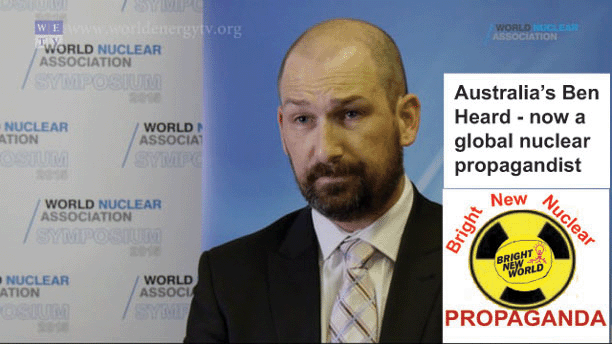
This guy should know better than this – “There is a hazard, particularly freshly used fuel is hazardous for the first 5 years and then it comes down very fast and is not so dangerous any more, but we manage it very effectively. ”
Compare this with what Hedin says “Approximately one year after the fuel has been discharged from the reactor, the dose rate is around 1,000,000 mSv/h. This means that a lethal dose, about 5,000 mSv, is received in about 20 seconds. The dose is dominated completely by the contribution from gamma rays. The radiation declines with time, but the dose rate after 40 years, when the spent fuel is to be emplaced in the deep repository, is still as high as 65,000 mSv/h.” From Allan Hedin 1997, “Spent Nuclear Fuel – How Dangerous is it”
October 11, 2017
Posted by Christina Macpherson |
AUSTRALIA - NATIONAL, spinbuster |
Leave a comment
“Nobel prize but PM has no time for peaceniks”, Dimity Hawkins and Tilman Ruff. The Australian, October 9, 2017, Sean Parnell Melbourne doctor Tilman Ruff might have helped initiate a global movement awarded the Nobel Peace Prize but that doesn’t mean he will be congratulated by the Australian Prime Minister.
Indeed, last night, about 48 hours after the announcement, Professor Ruff had still not received a call from Malcolm Turnbull nor anyone acting on his behalf.
“I’m a little disappointed that this is the first time that an organisation founded in Australia has been recognised with the highest global award in the world for peace and I would have hoped that would warrant some acknowledgments or congratulations,” Professor Ruff said.
“I haven’t had the phone calls, but I guess that’s the nature of the beast.”
The beast, on this occasion, is the nuclear bomb. Professor Ruff was one of the founders of the International Campaign to Abolish Nuclear Weapons, awarded the Nobel prize as North Korean leader Kim Jong-un and US President Donald Trump all but threaten nuclear war. Continue reading →
October 11, 2017
Posted by Christina Macpherson |
AUSTRALIA - NATIONAL, politics |
Leave a comment
 Tony Abbott’s climate frolic is strange and sad – and all about
  politics https://www.theguardian.com/australia-news/2017/oct/10/tony-abbotts-climate-frolic-is-strange-and-sad-and-all-about-politics Katharine Murphy
The pitch behind the London speech was that a climate ruckus aids the Coalition. He should have been laughed out of the room It would be tempting to laugh at Tony Abbott’s feelings about how carbon dioxide is secretly good for humanity, and his insights into the goat sacrificing habits of primitives subduing volcano gods – except it isn’t that funny.
The London outing is more strange and sad, and the strangeness and the sadness manifests itself on multiple fronts.
Let’s start with strange.
The bloke who hobnobbed with the climate sceptics at Global Warming Policy Foundation is the same bloke who took a decision as prime minister to sign Australia up to the Paris international climate agreement.
He’s also the same bloke who produced a set of initiatives in government which was badged as a policy to incentivise emissions reductions.
That policy still exists and it’s called Direct Action.
He’s also the same bloke who kept Australia’s renewable energy target, while abolishing the mechanism designed to give the market certainty to make future investments in baseload power generation.
Abbott has a whole lot of feelings, and some loyal media megaphones to help him spread his singular insights, but these are basic facts he can’t escape.
Abbott’s record in government points to him being a “warmist” (as Andrew Bolt is fond of characterising the modest band of weirdos who don’t think they know better than the world’s most eminent climate scientists).
London’s hardcore climate sceptics, frankly, should have laughed him out of the room.
Now let’s get to sad. Abbott’s climate frolic isn’t about a substantive issue. It’s about politics, because Australians haven’t had quite enough of politics, right?
Abbott wants to cause a ruckus. He wants to make enough ruckus to constrain Malcolm Turnbull from producing a sensible energy policy.
The lightbulb moment he’s trying to manufacture for colleagues is simple: the Abbott rationale is we can win the next election like I won the election in 2013 – by belting Labor on climate and energy policy.
The country, the national interest, actually needs the major parties to come to terms and settle the climate wars which have generated the current problems we are all experiencing in the energy market, and settle them in sensible fashion.
But politicians behind in the polls like to win elections.
Put simply, Abbott’s pitch is an appeal to baser instincts – a pitch that prolonged polarisation serves the Coalition’s immediate interests.
The former prime minister has also positioned himself in the public domain as a critical player in Turnbull’s ultimate settlement of energy policy, when the truth is all the heavy lifting on the new policy is happening completely outside Abbott’s orbit.
The actual decision makers in the government are heads down bums up on the new investment framework, swerving around the many obstacles, trying to land something vaguely credible, which doesn’t blow up the Coalition.
That’s the objective. Whether the government can produce something credible, given one of the core objectives has to be not blowing up the Coalition, is at this point seriously moot.
Meanwhile, Abbott’s persistent wrecking tactics allow Labor to claim with a veneer of truth and credibility that the former prime minister is driving the government’s energy policy rather than Turnbull – elevating his status from fringe agitprop activist to centre-stage.
In politics that sort of caper is called frontrunning, but I struggle for a word to adequately characterise that behaviour.
Perhaps we can just keep it nice, and say cynical?
October 11, 2017
Posted by Christina Macpherson |
AUSTRALIA - NATIONAL, politics |
Leave a comment
Australia blocks North Korean youth football team over nuclear program, http://www.sbs.com.au/news/article/2017/10/10/australia-blocks-north-korean-youth-football-team-over-nuclear-program A youth football qualifying fixture is likely to be moved offshore after the government moved to stop the North Korean team from entering Australia. The federal government has prevented a North Korean youth football team from coming to Australia to play in a tournament, saying allowing them would be contrary to its opposition to the rogue nation’s nuclear program.
The North Korean U19 team was due to play in the Asian Football Confederation championship qualifiers in November, amongst a group consisting of Australia, Hong Kong, and the Northern Mariana Islands.
The North Korean team was due to play Australia on November 8 in Shepparton, Victoria. A Victorian Government spokesman said the fixture will now be moved to a “neutral venue”.
Foreign Minister Julie Bishop confirmed she stopped the group from arriving.
“The government has decided to not allow the North Korean U19 soccer team to enter Australia for the Asian Football Confederation U19 Championship Qualifiers,” Ms Bishop told SBS World News in a statement.
“Hosting the team would be contrary to the Government’s strong opposition to North Korea’s illegal nuclear and missile development programs.
“It would also be inconsistent with our efforts to increase diplomatic and economic pressure on Pyongyang to comply with UN Security Council resolutions.”
Football Federation Australia said it was disappointed that the qualifying fixtures would now be played elsewhere.
“Football Federation Australia is disappointed that qualifying fixtures for the Asian Football Confederation U-19 Championship … are now likely to be relocated outside Australia due to the Federal Government’s decision not to grant visas to the team from DPR Korea,” a spokesman told SBS World News.
“FFA respects the Australian Government’s responsibility to make decisions on visa applications.”
It’s understood the potential financial losses from the hosting rights would be minimal but the decision would cost the Australian youth team competitive advantage.
Earlier this year, Malaysia’s qualifying match against North Korea for the 2019 Asian Cup was postponed after the two countries were involved in a tiff over the assassination of the estranged half-brother of Pyongyang ruler Kim Jong-un.
October 11, 2017
Posted by Christina Macpherson |
AUSTRALIA - NATIONAL, politics, politics international |
1 Comment
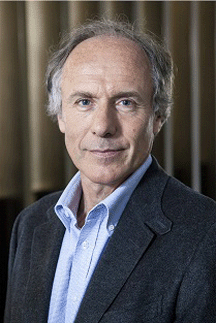 Chief Scientist Alan Finkel makes last ditch plea for clean energy target, SMH, James Massola, Cole Latimer, 9 Oct 17 Australia’s Chief Scientist Alan Finkel has made a last-ditch plea to save the proposed clean energy target, even as the Turnbull government signalled it will reject the proposal by the end of the year.
South Australian premier Jay Weatherill responded on Monday to the apparent standstill, saying the states should “bypass the federal government and provide investment certainty for the electricity sector” by adopting their own target.
The Turnbull government asked Dr Finkel to review Australia’s electricity market to set a policy path that would ensure reliability in the electricity system while also providing clear policy settings to drive investment in generation – something the business community has been demanding.
But in the face of strong opposition from sections of the Coalition backbench to the clean energy target, the Turnbull government delayed any decision on the target while adopting the other 49 recommendations in the Finkel review.
Now, it appears all but certain the target is dead in the water. The expectation is that by the end of the year, an alternative policy proposal that will focus on energy affordability and reliability – and removes incentives for renewable energy – will be brought by Energy and Environment Minister Josh Frydenberg to the cabinet and party room for approval.
That proposal could be put forward as soon as next week, when Parliament returns, though government insiders said that was unlikely at this stage.
Speaking at the Australian Financial Review‘s energy summit on Monday, Dr Finkel said his proposal offered a mechanism to solve the energy crisis and was still needed, while arguing that going back to coal was not the answer as Australia was making the transition away from fossil fuel energy………
The Australian Conservation Foundation’s chief executive, Kelly O’Shanassy, said: “Australia’s climate policy is now looking more and more like Donald Trump’s.” http://www.smh.com.au/federal-politics/political-news/chief-scientist-alan-finkel-makes-last-ditch-plea-for-clean-energy-target-20171008-gyww1o.html
October 11, 2017
Posted by Christina Macpherson |
AUSTRALIA - NATIONAL, climate change - global warming, energy, politics |
Leave a comment
Abbott went for the whole canon of tired climate science denial talking points – carbon dioxide is just food for plants, the climate has always changed, it’s the sun –
Abbott’s speech was also chock-full of internal contradictions. He suggested a conspiracy to tamper with temperature readings, but admitted the globe was warming. He described carbon dioxide as a “trace gas” and dismissed its role in warming, but elsewhere thought warming (which might not be happening) would be good. And the “trace gas” is insignificant, but not when it comes to its ability to “green the planet” and help plants grow.
Tony Abbott dares us to reject evidence on climate, but reveals a coward https://www.theguardian.com/environment/planet-oz/2017/oct/11/tony-abbott-dares-us-to-reject-evidence-on-climate-but-reveals-a-coward Graham Readfearn
The former Australian prime minister’s misleading speech to a London thinktank was full of climate denial mythology @readfearn
Go on, I dare you.
Throughout his speech, the former Australian prime minister urged listeners to think that dismissing decades of research backed by the world’s leading scientific institutions required bravery and fortitude, rather than other less celebrated human attributes.
But what would constitute bravery for a conservative politician like Abbott? Changing your mind when the evidence tells you you’re dead wrong, or saying what you’ve always said, using the logical fallacies that you’ve always used? One step is brave, the other is cowardly.
Abbott was giving the Global Warming Policy Foundation’s annual lecture – an “honour” previously bestowed on his spiritual and political mentors John Howard and Cardinal George Pell.
October 11, 2017
Posted by Christina Macpherson |
AUSTRALIA - NATIONAL, climate change - global warming, politics |
Leave a comment
RenewEconomy
-
SolarEdge presenting large-capacity commercial inverters at Australia’s All Energy
SolarEdge is presenting its new large-capacity commercial inverters at All Energy.
-
600MW pumped hydro project proposed for northern NSW
A 600MW pumped hydro facility with six hours storage – a $1 billion project – proposed to tap into renewable energy hub in northern NSW.
-
Netherlands to close all coal-fired generation by 2030
Netherlands decision to close coal plants include those only completed in 2015 – the phase-out combines with rise of renewables and the impact of improved efficiency that put old models at risk.
-
Adani signs PPA for Rugby Run solar plant, but won’t say with who
Adani Australia says it has a contract with Rugby Run solar farm in Queensland, but does not reveal who.
-
Liddell extension could be more expensive than solar plus storage
RepuTex says extending life of ageing Liddell coal generator would result in higher costs than new large scale solar project with battery storage.
-
Get smart: AEMO unveils 200MW “virtual power plant”
AEMO and ARENA unveil a 200MW “virtual power plant” from demand response initiatives featuring incentives for commercial and household users, battery storage, and a range of Australian monitoring, smart meters and voltage control devices,
October 11, 2017
Posted by Christina Macpherson |
AUSTRALIA - NATIONAL, energy |
Leave a comment
 Nobel Peace Prize winners ICAN urge Australia to sign nuclear weapons treaty, SBS News 7 Oct 17 An Australian-born group that was awarded this year’s Nobel Peace Prize says Australia needs to join global efforts to abolish nuclear weapons.A Victorian-born international group that was awarded this year’s Nobel Peace Prize says it’s a shame the Australian government has not signed the treaty banning nuclear weapons that led to its award……
The organisation worked on negotiations for the Treaty on the United Nations Prohibition of Nuclear Weapons, which was adopted by 122 countries in July.
However, the treaty was shunned by nuclear powers the US, Britain, Russia and China. Australia also did not sign the treaty.
“It is a matter of deep regret that the Australian government has thus far refused to join the treaty, and boycotted the conference to negotiate it,” the group said in a statement on Saturday.
ICAN says Australia led a small group of nations who tried to derail efforts in 2016 to secure a UN mandate to launch treaty negotiations.
“Our government’s belief that nuclear weapons, for a select few, are a legitimate and essential source of security is not only misguided, but also dangerous, for it incites proliferation and undermines disarmament,” the group said.
ICAN hopes the federal government will change its stance on nuclear weapons given Australia’s commitment to other treaties prohibiting chemical and biological weapons, anti-personnel landmines and cluster munition.
“For the sake of our collective security, the government must now embrace the global ban on nuclear weapons. “Greater public pressure is needed, along with enlightened leadership.” ICAN founder Tilman Ruff AM says being awarded the Nobel Prize was “quite humbling” and “unbelievably joyful” http://www.sbs.com.au/news/article/2017/10/07/nobel-peace-prize-winners-ican-urge-australia-sign-nuclear-weapons-treaty
October 9, 2017
Posted by Christina Macpherson |
AUSTRALIA - NATIONAL, weapons and war |
Leave a comment
 ICAN now has 468 partner organisations in 101 countries. It was pivotal to the UN adopting the Treaty on the Prohibition of Nuclear Weapons (TPNW) on July 7 this year
A Nobel Peace Prize born in Australia http://www.smh.com.au/comment/a-nobel-peace-prize-born-in-australia-20171007-gyw93r.html, Margaret Beavis Australians can be very proud. The winner of the 2017 Nobel Peace Prize, the International Campaign to Abolish Nuclear Weapons (ICAN), started in Melbourne. It began when the Medical Association for the Prevention of War (MAPW) recognised that nuclear weapons, the very worst of the weapons of mass destruction, were still “legitimate”. This contrasted with chemical weapons, biological weapons, cluster munitions, land mines – even dumdum bullets, which all have been made illegal by UN treaty, with impressive results. Continue reading →
October 9, 2017
Posted by Christina Macpherson |
AUSTRALIA - NATIONAL, weapons and war |
Leave a comment
 Richard di Natale targets Adani at Greens’ Queensland campaign launch https://www.theguardian.com/australia-news/2017/oct/07/greens-leader-targets-adani-queensland-campaign-launch
Leader attacks connection between lobbyists and politicians, saying democratic rules are ‘rigged’ in the state, Guardian, Gareth Hutchens and Katharine Murphy, 7 Oct 17 The Greens say they will offer Queensland voters a chance to clean up politics at the looming state election, and send a clear message that they don’t want the controversial Adani mine to proceed.
The federal Greens leader, Richard di Natale, will launch their campaign on Saturday with a speech declaring the state has a democratic deficit because of lobbying and political connections, with “a revolving door between politicians, their staff and the companies that profit from government decisions”.
Di Natale will declare that “the rules in Queensland are rigged”.
The Greens leader will criticise the practice of political staff from the major parties going on to work as corporate lobbyists, and point out that Adani’s lobbyists in Queensland, Next Level Strategic Services, also “act for property developers, gambling firms and Broadspectrum – the company running Manus and Nauru detention centres”.
Federal leaders from all parties have been highly attentive to Queensland in recent months, preparing the ground for when the Labor premier, Annastacia Palaszczuk, fires the starting gun.
One Nation is likely to be the kingmaker, with neither Labor nor the LNP guaranteed to win the 47 seats required for power in the unicameral parliament.
The Greens will also be in fierce competition with Labor for inner Brisbane seats. The Adani project provides a major point of difference between the two parties, and one the Greens will run hard on, as they have done in Melbourne.
Di Natale on Saturday will zero in on Labor’s assistance for the project. “Despite Queensland Labor’s election promise not to give any public money to Adani, they ultimately were able to secure a loan from the Queensland government so Adani don’t have to pay coal royalties that would go towards vital public infrastructure, schools and hospitals.”
The Greens leader will say the company was assisted in securing support from the state government by lobbyists, who were in frequent contact with the state government in the lead up to the royalties decision.
“We still don’t know what is in this contract, because the Palaszczuk government refuses to release it,” the text of Di Natale’s speech says.
“But what we do know through Queensland’s lobbyist contact register is that Next Level lobbyists were in contact with the premier’s office and her chief of staff every single day in the lead-up to the royalties announcement.”
The Queensland lobbyists contact register shows Next Level had daily contact with senior members of the Queensland government from 25 May to 30 May, when the final decision was made.
“We also know that up until that point the premier had had only 10 appointments with lobbyists – six of them were with Adani’s handlers.”
October 9, 2017
Posted by Christina Macpherson |
politics, Queensland |
Leave a comment
Adani: Thousands turn out across Australia to protest against Carmichael coal mine, ABC News 8 Oct 17 A national day of action to oppose the proposed Carmichael coal mine has seen thousands of protesters turn out in locations across Australia.
Rallies in locations including Sydney, Brisbane, Melbourne, the Gold Coast and Port Douglas in North Queensland heard messages against Indian company Adani’s proposed mine in the Galilee Basin.
Adani has promised thousands of local jobs but opponents say the project will fuel global warming and destroy the Great Barrier Reef.
The ABC’s Four Corners program on Monday revealed alleged cases of bribery, corruption and environmentally destructive behaviour by the Adani Group in India.
Adani is seeking a $900-million loan from taxpayers so it can build the railway line from the proposed mine site in the Galilee Basin to the Abbot Point coal port.
“If this mine does go ahead it drives us into a dirty future and Australia is a country that’s smarter than that,” said Simon Fosterling, a Bondi surf life saver at the Sydney protest, which attracted about 2,000 people.
Protesters spelled out ‘#STOP ADANI’ by standing in formation on the sand………
Sydney Stop Adani campaigner Isaac Astill called the construction of the mine an international issue.
“It’s going to be the biggest coal mine in the southern hemisphere at a time when our climate is crumbling,” Mr Astill said.
It’s an international issue and that’s why we’re seeing people around the world and in Australia coming out in their thousands to say no to Adani.”
About 2,000 people rallied in Melbourne’s Princes Park carrying placards reading ‘Coal=CO2!!!’ and ‘Protect Our Future’.
Australian Conservation Foundation CEO Kelly O’Shanassy said she hoped the “big day of action” would send a strong message that taxpayers did not want their money subsidising the project…..
At Miami on the Gold Coast around 200 people turned out to oppose the mine.
“We know how important this is and we know there’s a growing movement and more and more people are realising how desperately we need this to stop,” said Shane Primrose of the Stop Adani Gold Coast group…….
The protests were organised by the Stop Adani Alliance, which is made up of 31 organisations.http://www.abc.net.au/news/2017-10-07/thousands-protest-adani-mine-across-australia/9026336
October 9, 2017
Posted by Christina Macpherson |
AUSTRALIA - NATIONAL, climate change - global warming |
Leave a comment