 New CEFC boss sees focus on distributed energy, REneweconomy, By Giles Parkinson on 31 March 2017 The new head of the Clean Energy Finance Corporation, Ian Learmonth, says distributed energy – including solar, battery storage and demand management – will be one of his main focuses when he takes the reigns of the $10 billion institution in May.
“The CEFC is very broad ranging – and we’re agnostic about clean energy technologies – but I’m particularly interested in the way that distributed energy is emerging in Australia,” he told RenewEconomy in an interview on Friday after his appointment was announced. “There are 1.5 million solar households in Australia, battery technology is emerging, there is demand management, and some very interesting opportunities.
“We are seeing those already coming to the CEFC. There is an incredible entrepreneurial spirit.”
Many in the energy industry expect a rapid shift in the energy market from one that focuses on large, centralised fossil fuel generators, to a “distributed” system where much of the power required is sourced from household and business consumers.
These technologies, mostly rooftop solar and battery storage, will dovetail with smart software that can integrate the systems, demand response, trading and back-up power.
It also fits in with his recent work as the head of impact investing at Social Ventures Australia, where the focus was on helping disadvantaged households.
“At Social ventures, we have been looking at reducing costs to government and employment benefits, hopitalisation and prison costs – and we’ve also been working on affordable housing,” he said.
“Government is increasingly looking at private capital to build out the shortfall in affordable housing – and if that can be done in an energy efficient way, that is even better.”
Learmonth said he was not worried about the political debate around the CEFC, which the Coalition has tried to dismantle, has widely criticised and then tried to push towards non-renewable technologies such as “clean” coal.
“I’d like to think that lot of the challenges of the past are behind the organisation, and it is seen as an important participant in this market. I think the government has a huge amount of respect for the organisaiton. I am not troubled by (the past).”
However, he agreed with outgoing CEO Oliver Yates, another former Macquarie banker, that there is virtually no investment interest in clean coal technology.
“They are not opportunities that have been presenting themselves; for various reasons they have enormous challenges about them. They are not investable projects – for many reasons that are unlikely to change.”
Learmonth said he had had a big involvement with renewable energy financing whilst at Macquarie’s London base, financing wind projects in Germany, solar projects in Italy and offshore wind in the UK…….http://reneweconomy.com.au/new-cefc-boss-sees-focus-distributed-energy-30097/
April 1, 2017
Posted by Christina Macpherson |
AUSTRALIA - NATIONAL, energy |
Leave a comment
Australia had a great electricity policy – let’s get it back, REneweconomy, By David Leitch on 31 March 2017 When the ALP lost government in 2013 Australia had a secure, but rising, cost of electricity. Network prices had risen substantially, causing bill shock mainly because the AEMC and COAG had failed to rein in the Australian Competition Tribunal; and because networks were – and are – entitled to earn a perpetual rate of return on sunk costs, even when those costs have been fully recovered and notwithstanding that capacity utilisation has fallen.
The carbon tax was adding around $30/MWh to electricity prices, but the increase in network costs and the community emphasis on energy efficiency driving lower consumption were the key factors. The wires and poles cost tripled between 2008 and 2013.
However, over the next five years it’s the generation cost that drives prices up from $274/MWh (before retail discounts) to maybe $324/MWh (and the federal government loses, say, $10 billion of tax revenue in the process).
More importantly Australia had a suite of policies that:
- Encouraged energy efficiency. Every large corporate had to explicitly report on its energy efficiency plans.
- A carbon tax. Although this was meant to transition to floating carbon price it was actually far more effective as a tax. The advantages were.
- It raised final prices encouraging efficiency.
- Simple to administer
- At $30/t raising more than A$10 bn a year. By contrast fuel excise which most people don’t really think about raises about $12 bn a year. For an average house in Australia that carbon tax added $180 per year to their costs. By contrast the fuel excise at $0.38 litre and assuming a motorist uses 9 litres/100 Km, and drives 15,000 km a year costs say $600 a person. In two car households the cost could easily be over $1000 a year. This to your author’s mind shows the difference between perception and reality.
- The known price enabled both generators and consumers to plan around the fixed cost. Space does not permit in this article but providing confidence around the cost of capital is the main way Govts can contribute to keeping electricity prices low.
- Most importantly it penalized high carbon emission raising the variable cost of brown to or above that of black coal and making gas cheaper, at the time, than coal
But what if the carbon tax forced old generation to close but no new generation was built? Wouldn’t that be a problem for energy security? So that’s where…
- Renewable energy incentives come in. That was done by the LRET. In addition, state governments decided to offer high feed-in tariffs for rooftop PV. This lead to a glut of RECs and so the LRET scheme was split in two, small and large. The surplus of large certificates has only recently been worked off. We’ve criticised the LRET policy several times as being a high cost and unreliable way to get new renewables into the system but it did at least a provide a carrot. Reverse auctions can do the same job in a cheaper and more targeted fashion.
The net impact of these policies was to raise final electricity prices to households by 10 per cent and to business by about 15 per cent. By and large the Australian system was regarded as one of the best in the world. Fig 1 shows that the explicit cost of the LRET and SREC scheme is small, even at today’s inflated REC prices.
The coalition eliminated the old policies, but didn’t replace them with anything newEnergy efficiency was completely de-emphasised……….
Announcements as a substitute for policy
To this day there is no federal policy other than what’s left of the RET. Zero, zip, nada. There is no policy because the federal government is opposed to the policies being adopted all over the world, which a majority of Australians want and which the electricity industry wants.
This is leading to a breakdown of the cooperative federalism of the past decade and is another impediment to reform of the management of NEM. In fact, there is no management, just a committee (COAG energy committee) and government organisations with no KPIs (the AEMC for instance). There are announcements “Snowy 2”; and now, an after-the-horse-has-bolted ACCC review of retail prices…….
Some might see this as a hopeless situation, but because of Australia’s fantastic wind and PV resource, and because the cost of wind and PV has fallen, its actually a great opportunity to build a 21st century grid that will be the envy of the world.
Wind in the USA produces electricity at US $42/MWh = A$63/MWh unsubsidised (the consumer pays $20/MWh and the tax credit is worth about $22/MWh). Capacity factors in the USA are getting up to 45-50 per cent – by comparison, a typical combined cycle gas plant is at 50-60 per cent. Australia’s newest wind farm is at 43 per cent in its first three months.
Australia’s 5GW of distributed solar and the low energy density of networks (electricity consumed per Km of wires) makes this a fantastic country to build a decentralised grid using solar PV and household storage. But again, where is the federal government vision? Where is the policy? Where is the modelling? The lack of initiative and policy cannot be excused on any level, 3 year election cycle or no. Australians have a right to, and do expect more.
Despite our advantages we are well behind what the rest of the world is up to………
In the USA a very recent survey of 600 utility companies confirmed they they plan to continue their decade old shift to wind, and PV and distributed energy despite the election of Donald Trump. And why wouldn’t they? Its good economics and sound policy with a decade of experience behind it.
April 1, 2017
Posted by Christina Macpherson |
AUSTRALIA - NATIONAL, energy, politics |
Leave a comment
ACF Australian Conservation Foundation: Palaszczuk to put Adani before Queensland
with secret water licence deal http://www.4-traders.com/news/ACF-Australian-Conservation-Foundation-Palaszczuk-to-put-Adani-before-Queensland-with-secret-water–24137075/ 31 March 2017:
“The Courier-Mail has reported today that the Palaszczuk government is set to grant a water licence for Adani to suck millions of litres of groundwater for its mega-polluting Carmichael Coal Mine in secret.
“‘The Queensland Government have created one rule for Adani and a different set of rules for everyone else when it comes to managing groundwater.’ said ACF Healthy Ecosystems Campaigner Basha Stasak.
“‘This is a secret decision to prop up a mine that will help destroy the Reef and the 70,000 Queensland jobs that rely on it. A secret decision to prop up a mine that no one else will fund because it is too risky and dangerous for the climate. … “
April 1, 2017
Posted by Christina Macpherson |
politics, Queensland, secrets and lies |
Leave a comment
Australia, she says, is actually going to lead the world on this, both on the breadth and the scale of what she, chief scientist Alan Finkel and many others describes as the inevitable and unstoppable energy transition.
She is talking storage, and demand response. And she is not just talking about grid scale, but about households and businesses, and tapping into their own resources of rooftop solar and battery storate, something that SA Power Networks says will be everywhere, thanks to its plunging costs.
Zibelman does not have the regulatory powers that she had in New York, and more’s the pity because AEMO, according to its submission to the Finkel Review, is clearly frustrated by the glacial pace of change in the country’s rule maker, the Australian Energy Market Commission.

How AEMO’s new boss will reform Australia’s energy vision http://reneweconomy.com.au/how-aemos-new-boss-will-reform-australias-energy-vision-37484/ By Giles Parkinson on 29 March 2017 Audrey Zibelman, the new chief executive of the Australian Energy Market Operator, has been in the job for little over a week, but is already making her mark, signalling the biggest shift in energy management philosophy in a generation.
If Australia’s fossil fuel industry had hoped that last September’s state-wide blackout would lead to a u-turn on the shift to cleaner and decentralised energy system, then the release of the Australian Energy Market Operator’s final report in the event would leave them bitterly disappointed.
And if they had any thoughts that the new CEO of AEMO, Audrey Zibelman, was going to afford them the indulgences that they had gotten used to over the last few decades, then they are going to be disappointed on that too. Several hundred energy market participants converged on Adelaide’s Hilton Hotel on Wednesday to hear the findings from the final report into the now notorious system black and, more crucially, to hear the first public insights from the new AEMO boss.
“Thank god you’re here,” said the Grattan Institute’s Tony Wood, referring to a former TV program, but echoing the mood of most.
And while many in mainstream media chose to focus on the role of wind farms in South Australia’s “system black,” and wonder why the shuttered Northern coal fired station is not being fired up again, both AEMO and its new boss were looking to the future, and with a sense of urgency.
Zibelman is the former head of New York’s Public Service Commission, charged with implementing that state’s ambitious Reforming the Energy Vision program, and its target of 50 per cent renewable energy by 2030, which is going to focus a lot on decentralised generation. Continue reading →
March 31, 2017
Posted by Christina Macpherson |
AUSTRALIA - NATIONAL, energy |
Leave a comment
 Still here: Night Parrot rediscovery in WA raises questions for mining, The Conversation, Robert Davis, Edith Cowan University, March 29, 2017 The Night Parrot is unquestionably one of Australia’s most enigmatic, elusive and enthralling species. The final frontier of Australian ornithology, this cryptic parrot eluded dedicated expeditions to find it for nearly half a century.
Last week, a momentous chapter in the Night Parrot story was written, with the first photograph of a live Night Parrot in Western Australia. The photos come in the wake of several other recent sightings, including the parrot’s rediscovery in Queensland in 2013.
Despite media reports, the parrot has never been officially listed as extinct, with sporadic evidence of its existence throughout the 20th century. But now we know for sure that the parrots are alive and found across the continent, we can move on to making sure they remain so in the future.
Mystery bird We know that Night Parrots favour spinifex or tussock grasslands, often close to inland wetland systems. But the areas of potential habitat are vast throughout inland Australia.
The Night Parrot has been listed as endangered in the Action Plan for Australian Birds since 1992. It is listed as endangered under federal legislation…….
The significance of the latest find is immense…….The latest record cements the fact that Night Parrots are present at several locations in WA and potentially throughout arid Australia, including in regions rich in mineral resources.
In contrast to the Queensland populations, which have so far been found in national parks and pastoral leases, the WA situation sets up a quandary for how to manage development, Night Parrots and mining…….
Recent developments by other WA resource companies have seldom considered Night Parrots. My personal experience is that surveys usually look for endangered mammals such as Northern Quolls and Bilbies, but rarely search properly for Night Parrots. This is likely due to two main reasons.
The first is the incredibly cryptic nature of the Night Parrot. Clearly the species has evaded detection for so long because it is difficult to find.
The second is what I term “the Thylacine factor”. The only equivalent species in Australia that has the same degree of scepticism and mythology is the Thylacine.
Thylacines have (so far) not been rediscovered. But developers, consultants and regulators take the same attitude to Night Parrot sightings. The parrots are often seen as a mythical animal that doesn’t exist. The idea of looking for them is met with mirth……..
Let’s hope government bodies will strongly enforce the requirement to search for Night Parrots in all areas of potential habitat within their known current and historic range. This should ensure that we don’t lose any parrots before they are even found. https://theconversation.com/still-here-night-parrot-rediscovery-in-wa-raises-questions-for-mining-75384
March 31, 2017
Posted by Christina Macpherson |
environment, uranium, Western Australia |
Leave a comment
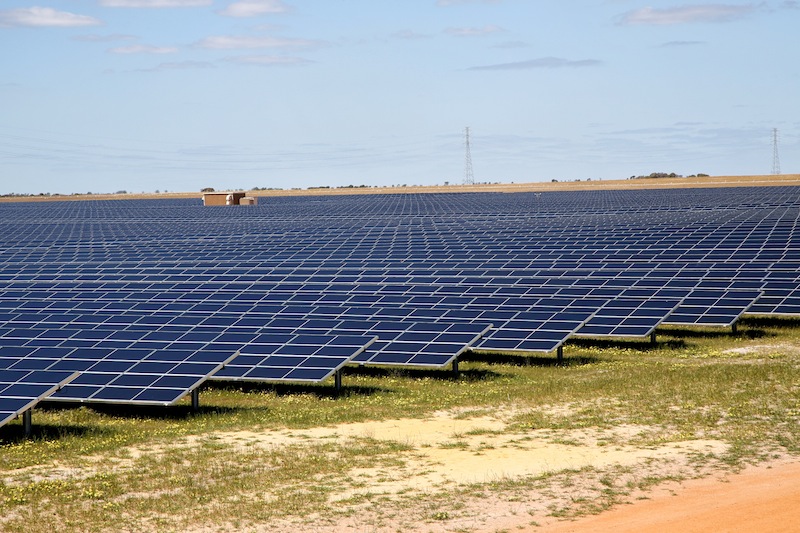
 Australia on cusp of large-scale solar boom as setup costs tumble, experts say, ABC News, PM By Angela Lavoipierre , 30 Mar 17 Large-scale solar looks to be on the cusp of an Australian boom.
The country has quietly had a record-breaking year in the construction of major solar projects, and the trend is predicted to continue.
Seven large-scale solar projects were completed in 2016 and even more will be built over the next 12 months, as rapid advances in technology propel large-scale solar towards price parity with wind power.
Clean Energy Council CEO Kane Thornton said it was “a record year” for large-scale solar, which could soon overtake wind as the cheapest form of renewable energy, thanks to rapid advances in technology.
“Already this year in 2017, we’ve had over a dozen projects committed and now moving onto construction,” he said.
“The costs of large scale solar has halved in just the last few years here in Australia. “We expect over the next couple of years [it] will really reduce the cost to a point that it is the lowest cost form of renewable generation in this country.”
Ivor Frischknecht, who heads the Australian Renewable Energy Agency (ARENA) — the agency that delivers Federal Government funding for renewable projects — said the boom was approaching sooner than anyone expected.
“A couple of years ago we analysed the market and thought that by the early 2020s we might be able to get there, to be cost competitive with wind,” he said.
“But in fact we’re there already — we’re seeing large scale solar projects happen without any support.”
ARENA said the formation of a domestic solar industry had also brought down costs.
Moree solar farm ‘ground-breaking’
Moree is the site of one of Australia’s newest large-scale solar farms and the fourth largest in the country.
The town of less than 10,000 people in northern New South Wales has perfect conditions for generating solar power, enduring a record 54 consecutive days over 35 degrees Celsius this summer.
The Moree solar farm is an example of the kinds of challenges once faced by large-scale solar in Australia……http://www.abc.net.au/news/2017-03-29/australia-on-cusp-of-large-scale-solar-boom-experts-say/8377226
March 31, 2017
Posted by Christina Macpherson |
AUSTRALIA - NATIONAL, solar |
Leave a comment
 Call to expand Indigenous rangers program http://www.abc.net.au/news/2017-03-30/indigenous-rangers-boosting-habitat-and-species-preservation/8401662 by national Indigenous affairs correspondent Bridget Brennan, 30 Mar 17, Indigenous rangers are helping to prevent habitat loss and species decline across an area 10 times the size of Tasmania, a new report says.
The Country Needs People alliance — which represents dozens of ranger groups across the country — said it should be an incentive for the Federal Government to commit to extending funding for Indigenous Protected Areas.
The report found multiple examples of ranger groups, in each state and territory, controlling fires and destroying feral animals and weeds. The Prime Minister’s Indigenous Affairs adviser, Chris Sarra, said he supported a call to expand ranger numbers.
In the report, Dr Sarra said rangers were succeeding because supporting their work encouraged self-determination and connection to country.
“That success is built on the strength of our connection to culture and country,” he said.
Country Needs People also called on the Government to set an ambitious target to employ an extra 4,200 Indigenous rangers by 2022.
The chief executive of the Olkola Aboriginal Corporation, Debbie Symonds, said her group had just four rangers covering 860,000 hectares on Cape York in Queensland.
“To be able to employ even another four rangers would be an amazing leap for us,” Ms Symonds said.
Funding for 800 rangers has been given a lifeline by the Federal Government until 2020, but funding to operate the 75 Indigenous Protected Areas they work on runs out in the middle of next year. Ms Symonds said on a recent “bush blitz”, Olkola Land Managers had recorded new skinks, bats, moths, spiders and birds in their area.
She said with “limited resources”, the rangers were also working to conserve the tiny population of the golden-shouldered parrot, a totem for the Olkola people.
“It was on the brink of extinction and we’re slowly bringing it back from extinction,” she said.
March 31, 2017
Posted by Christina Macpherson |
aboriginal issues, AUSTRALIA - NATIONAL |
Leave a comment
 Australia will not dump Paris climate deal if Trump does: Frydenberg, AFR, by Laura Tingle,30 Mar 17 Energy Minister Josh Frydenberg has rejected suggestions from some Coalition MPs that Australia will need to review its participation in the Paris agreement on climate change following Donald Trump’s new executive order on the environment
The chair of the government’s backbench committee on environment and energy, Craig Kelly, repeated on Wednesday his earlier predictions that the Paris climate deal was “cactus” if the US President followed through with his threat to withdraw from the treaty.
President Trump signed a new “energy independence” executive order on Tuesday to undo a range of regulatory measures to combat climate change by his predecessor Barack Obama, including eliminating the clean power plan, which sets limits on the amount of greenhouse gases that power plants emit.
Mr Trump said his plan would launch “a new energy revolution” that will put “miners back to work”.
While the executive order does not withdraw the US from the Paris agreement, the possibility remains open amid reports the Trump administration has yet to decide whether it intends to withdraw from the international climate change deal
Mr Kelly told Guardian Australia on Wednesday that he was aware of the new executive order, and if President Trump went the extra step and withdrew from the Paris agreement: “I think we have to review it.”……..
Asked whether a majority of his Coalition colleagues would be in favour of quitting the Paris deal in the event Mr Trump pulled out, Mr Kelly argued “it would be a close-run thing”….. http://www.afr.com/news/politics/australia-will-not-d
March 31, 2017
Posted by Christina Macpherson |
AUSTRALIA - NATIONAL, climate change - global warming, politics |
Leave a comment
 Renewables roadshow: how Canberra took lead in renewable energy race In the latest in our series on Australian green energy projects, we find out how the ACT is transitioning to 100% renewable energy, aided by the country’s largest community-owned solar farm
• How the ‘nonna effect’ got Darebin’s pensioners signing up to solar
• How Daylesford’s windfarm took back the power, Guardian, Michael Slezak, 30 Mar 17, As Australia remains mired in a broken debate about the supposed dangers of renewable energy, some states and territories are ignoring the controversy and steaming ahead.
While Australia is far from the renewable capital of the world, the Australian Capital Territory may soon be among the world’s top renewable energy regions. And as it transitions, the ACT is demonstrating the benefits of the renewables boom to the rest of the country. Continue reading →
March 31, 2017
Posted by Christina Macpherson |
ACT, energy |
Leave a comment
 Hazelwood exits, taking with it myth of cheap fossil fuels, REneweconomy By Giles Parkinson on 30 March 2017 The giant Hazelwood brown coal generator shut down the last of its 8 units at 4pm yesterday, the latest and the most powerful symbol of the vast and rapid change in our energy system.
Conservatives and the fossil fuel lobby might have wanted to describe the closure of the western world’s most polluting power plant as a futile act, given the attempts by the Trump government to jump back into last century’s technology and ignore climate science.
But just one day after Hazelwood closed, a new $1 billion solar PV and battery storage plant was being unveiled for South Australia, with its proponents insisting that construction would begin later this year.
Indeed, solar projects are popping up everywhere. Concannon, the former head of Hazelwood – once a staunch critic of Australia’s renewable energy target – has switched camps, heading up a large-scale solar company and plans 300MW of solar, possibly with storage, in South Australia.
He’s not the only one, with Lyon Solar’s announcement and Zen Energy and others, including Adani and DPP Energy, all planning major solar projects in South Australia.
In Queensland, the push to solar is even more rapid. One major energy user, Sun Metals, is building its own 116MW solar plant because the cost of electricity in a grid almost entirely dependent on coal and gas is too expensive.
Meanwhile, the incumbents have got other things to think about, particularly SAPN’s prediction that the cost to households and business of solar and storage will be around 15c/kWh within a few years.
Think about what that means. That is cheaper than just the transport cost of delivering electricity down the poles and wires.
Few in the industry doubt that we are shifting rapidly to a faster, cleaner, smarter and cheaper energy system. The imponderable is that no one knows what the business model looks like.
Networks are convinced that they will remain essential, because someone has to connect the homes, business, and communities. But they, too, are worried that things will move so fast that consumers – having been badly treated by utilities in the past decade – will simply take matters into their own hands.
If SAPN’s forecast are right, they will have an overwhelming economic incentive to do so. To deal with that, it is hard to see how networks will avoid any other action than to write off the value of their networks so they can compete.
The outlook for traditional gentailers, is more bleak. The cosy oligopoly that dominated supply, and accounted for virtually all demand, is starting to unravel……..
The Finkel Review will not, as the conservatives hope, recommend the sort of fantasy dance back into the last century that Donald Trump is trying to achieve in the US. Already, the conservatives sense this and are beginning to attack.
“What would he know,” they say, “he’s only an electrical engineer and the chief scientist.”
And the tribal politics won’t help either. The Greens appear to be the only ones who “get” what is happening, and don’t have vested interests in business and unions to protect. The final report into the Senate inquiry into the retirement of coal-fired power stations split three ways. Only the Greens seemed to understand the need for an orderly transition.
Indeed, denial is the last refuge of the incumbents and the ideologues. Technology marches on, and because it is so readily available to consumers, so will they. This is not about ideology any more. It is about simple economics. The rest is just detail, and politics. http://reneweconomy.com.au/hazelwood-exits-taking-myth-cheap-fossil-fuels-15425/
March 31, 2017
Posted by Christina Macpherson |
climate change - global warming, Victoria |
1 Comment
Lyon Group announces $1b battery and solar farm for South Australia’s Riverland, ABC News, By political reporter Nick Harmsen, 30 Mar 17 A $1 billion battery and solar farm will be built at Morgan in South Australia’s Riverland by year’s end in a project the proponents describe as “the world’s biggest”.
The builder, Lyon Group, has already proposed a smaller solar farm and battery storage facility, named Kingfisher, in the state’s north.
Lyon partner David Green said the project was 100 per cent equity financed and construction would begin within months, employing 270 workers.
“Riverland Solar Storage’s 330-megawatt solar generation and 100-megawatt battery storage system will be Australia’s biggest solar farm with 3.4 million solar panels and will also include 1.1 million batteries,” he said.
Mr Green said land had already been secured and grid connection was already well advanced.
Work on Lyon’s 120 megawatt Kingfisher project is slated to begin in September next year……
Lyon to bid for SA battery tender
The Lyon Group has already signalled its intention to bid for a SA Government tender to build a battery storage system with 100-megawatt output. The tender arrangement would give the Government the right to tap the battery storage at times of peak demand, but allow the project owner to sell energy and stability into the market at other times.
An expressions of interest process closes on Friday.
Other companies, including Carnegie, Zen Energy and Tesla, have all suggested they could be interested in bidding…….http://www.abc.net.au/news/2017-03-30/new-solar-project-announced-for-sa-riverland/8400952
March 31, 2017
Posted by Christina Macpherson |
solar, South Australia, storage |
Leave a comment
Hazelwood’s closure shows industry and government must plan ahead for climate change https://www.theguardian.com/sustainable-business/2017/mar/29/hazelwoods-closure-shows-companies-and-governments-must-plan-ahead-for-climate-change
More coal generators will close as Australia shifts to renewable energy, so there must be more plans in place to smooth the transition, Guardian, Nicholas Aberle, 29 Mar 17,
When Hazelwood stops generating electricity this week, it will be the first Australian power station to close, at least in part, because of climate change. Hazelwood’s owner, French energy giant Engie, has said it is “making climate a priority” and has committed to retiring its most outdated coal plants worldwide.
Hazelwood’s closure will bring the total to nine coal power stations in Australia that have retired in the last five years – including the Port Augusta power stations in South Australia, the Munmorah and Wallerawang power stations in New South Wales and the smaller Energy Brix and Anglesea power stations in Victoria. It’s a clear indication the global industrial transition from coal to renewable energy across the world has reached our shores.
Like all such transitions, this one will involve a big upheaval for the affected workers, but never before has an industrial transition had so much else at stake. Never before has the end of one industry been so essential to the wellbeing of the rest of society. Continue reading →
March 31, 2017
Posted by Christina Macpherson |
AUSTRALIA - NATIONAL, climate change - global warming, Victoria |
Leave a comment
The real reason our power companies block battery systems, http://www.theage.com.au/business/the-real-reason-our-power-companies-block-battery-systems-20170329-gv8ybe.html, Brian Robins, 29 Mar 17, If you’re wondering why battery storage is still on the fringe of the energy debate in Australia, and why power prices are high, just ask Dr Tony Marxsen, the head of the Australian Energy Market Operator (AEMO).
He made it plain earlier this week the big power companies have invested hundreds of millions of dollars on quick start power stations, so-called “gas peakers” and they aren’t going to be giving up their sway over the market any time soon: they want to make sure they get a return on their money.
Richard Turner, the founder of Zen Energy, a renewable energy outfit, asked Marxsen on Tuesday when the electricity market would shorten to five minutes from the present 30 minutes the settlement period. Sound technical? Sure, but that change would see a rapid rollout of battery storage with the potential to bring down power prices.
At the heart of the electricity market is a 30-minute settlement period. Power generators bid to supply electricity in five-minute blocks but the price they receive is averaged out over 30 minutes. Pressure is building for change, but the power generators don’t want to budge since the status quo gives the coal and gas generators a return over a longer period, while batteries which can be turned on, and off, quickly, are penalised.
“The fundamental challenge is it will affect adversely the business model of investors in gas peaking plants,” AEMO’s Marxsen said of any change. “They’ve entered into contracts based on existing arrangements therefore there is the need for transition.
“A five-minute [interval] is the long term future of Australian energy but it is a matter of transition – in a matter of years.”
The trouble is Australia’s thermal power generators are a powerful oligopoly and have been lobbying hard to keep storage out and to prevent the market operator from changing the rules. The overseer of the energy market, the Australian Energy Market Commission has just extended for the second time, now until mid-year, a review into the vexed issue.
“Transition can be painful,” Grattan Institute’s energy program head Tony Wood said of the roadblocks to changing the competitive landscape. “The losers will shout louder than the winners will.”
But the way Zen Energy’s Turner sees it the lack of access to the electricity market is forcing some states, like South Australia, to put $150 million on the table to back battery storage. He expects Victoria to follow suit with the closure this week of the giant Hazelwood power station.
“Governments are putting money on the table … to substitute for what should be available on the grid,” he said. “The rules have to change quickly.”
“Last Wednesday in Adelaide, we had four 30-minute periods when in the first five minutes the wholesale electricity price hit $14,000 a megawatt hour. When those events happen, the big generators power up to meet that demand. Even if the price is negative in the final few minutes of that 30-minute window, the generators receive the average price for that 30 -minute period of, say, $2500.
“Is that market manipulation? Maybe, but they get away with it. If there was five-minute pricing, the battery would come in, grab that demand and eliminate that pricing event. Batteries just help make the system more stable rather than wait for generators to fire up and get going. Even after averaging the price out over 30 minutes they’re making a ridiculous amount of money, protecting their investment – and preventing the introduction of new technology.”
Chaired by Ross Garnaut, who headed up the federal government’s climate change review, Zen has teamed up with Santos to use gas as a back-up for renewables. It is also working up plans for solar farms as it evolves towards becoming a power utility.
“What people don’t understand about renewables is the need for diversity of sources. You can’t just have wind,” he says. You also need solar for when the wind doesn’t blow and batteries to help smooth the energy flows to meet demand.”
So removing the half-hour average settlement rule and allowing payment in five-minute blocks would tilt the playing field towards batteries, which store output from wind and solar systems, and save energy users money.
The road blocks slowing the penetration of renewables in the energy sector comes as the Commonwealth Bank has raised $650 million through an issue of five-year green bonds, carrying an interest rate of 3.25 per cent on the fixed rate portion of the raising and 2.715 per cent on the floating rate portion of the raising. The funds are to be invested in renewable energy and low carbon assets.
March 31, 2017
Posted by Christina Macpherson |
AUSTRALIA - NATIONAL, business, energy |
Leave a comment
 Norfolk Island has “too much” solar, now it wants storage,REneweconomy, By Giles Parkinson on 30 March 2017 Norfolk Island, the former penal colony and now tourist destination located nearly 1,500km off the east coast of Australia, is calling for proposals for energy storage to maximise its use of solar PV, minimise a growing “solar debt,” and cut its crippling electricity costs.
The island, with a population of around 1750, and a floating tourist population of 300-600 people, has one of the highest penetrations of rooftop PV, with 1.4MW of solar that produces more than its daytime demand.
This is despite the fact that the Norfolk Island regional council actually brought the installation of solar PV to a halt in 2013 with a moratorium designed to stop the “ad hoc” installations, and because it had no other means of controlling and managing the output.
Now, things have changed.
The cash-strapped administration wants to try and store the excess output of solar so it can reduce its reliance on diesel, cut its hefty electricity charge of 62c/kWh (unlike other islands, like King Island, it gets no subsidies), address the growing bank of “grid credits” given to those who produce excess power from their PV and perhaps allow more people who don’t have solar PV to add it to their rooftops.
Back in 1997, the council bought the last of its six second hand 1MW diesel generators, partly on the assumption that demand would grow. Instead it has fallen around 20 per cent, and it only ever uses two of the units at most, and outside peak times it uses only one.
The council says the oversupply of solar is occurring each day “at all times of the year and not only in summer” when the sun is out.
Because the diesel generator needs to operate at a minimum 30 per cent capacity, excess solar output is shed via a 400kW load bank. Excess solar did not get a cash tariff, but grid credits that are now amassing into a considerable continent liability.
“The fuel savings from less usage of diesel in the daytime have not been matched by actual savings as, effectively, those PV consumers (generating more than they or their fellow consumers are using during daylight hours) are resulting in the need for Norfolk Island Electricity (NIE) to shed the excess in daylight whilst then burning diesel at night time to supply both PV and non-PV connected households at no/limited cost to the PV consumer.”
So, now it is is looking for battery storage as part of a wholesale review of its pricing structures, and as the administration comes under pressure from households that have not been allowed to install solar PV, but can clearly see it as a cheaper option than the current grid prices…….http://reneweconomy.com.au/norfolk-island-much-solar-now-wants-storage-58159/
March 31, 2017
Posted by Christina Macpherson |
Queensland, storage |
Leave a comment
UN nuclear treaty: Australia plays deputy as US ‘sheriff’ baulks at ban Daniel Flitton, The Age, 29 Mar 17 Nikki Haley marched in on her first day as Donald Trump’s ambassador to the United Nations with a blunt warning to the world: “For those who don’t have our backs, we’re taking names.”
Australia has now gone to extraordinary lengths to make sure its name stays off Trump’s naughty list. With negotiations for a new treaty to outlaw nuclear weapons kicking off on Monday (New York time), Haley called an extraordinary press conference outside the UN to declare the US opposition to the talks.
And there, at her heels, was Australia.

At the very moment representatives from more than 120 countries were starting their negotiations inside, Australia stood with Trump’s appointee and a group widely known as the “weasel countries” who are opposed to banning the bomb.
According to anti-nuclear campaigners, 21 countries joined Haley’s protest. They included Albania, Turkey, Croatia, Romania, Poland, Estonia, Slovenia, Hungary and South Korea. Britain and France, both nuclear armed, also spoke against a ban. Other NATO allies joined in, although not all……
Back in January, Haley had made plain the attitude the Trump administration would take to the world body. “Our goal … is to show value at the UN, and the way to show value is to show our strength, show our full voice,” she declared. “Have the backs of our allies and make sure our allies have our backs as well.
“For those who don’t have our backs, we’re taking names, and we will make points to respond to that accordingly.”
On Monday, after the protest at the UN, she told a key lobby group for Israel in Washington: “For anyone who says you can’t get anything done at the UN, they need to know there’s a new sheriff in town.”
And she made the nuclear issue personal…….
Tilman Ruff, of the International Campaign to Abolish Nuclear Weapons, told Fairfax Media from New York that the US action was alarming and Australia was “aligning itself with the extremes of the Trump administration”.
“What credibility does Australia have to criticise North Korea’s reckless nuclear proliferation when it continues to claim protection itself through the very same weapons, and oppose efforts to ban them?” Dr Ruff said. http://www.theage.com.au/federal-politics/political-news/un-nuclear-treaty-australia-plays-deputy-as-us-sheriff-baulks-at-ban-20170328-gv8bge.html
March 29, 2017
Posted by Christina Macpherson |
AUSTRALIA - NATIONAL, politics international, weapons and war |
Leave a comment