The nuclear dump plan proposes sitting a Nuclear port and an above ground high level nuclear waste storage facility in Project Year 5 – before potential nuclear waste contracts in Year 6′ This depends on assessment and approval by an lndependent Nuclear Regulator- that does not exist in Australia’
The current Federal nuclear regulator would requiré legislative amendments before it could claim to ‘regulate’ lnternational nuclear wastes. SA is disqualified from doing so by clear conflict of interest’
This senate can block any nuclear dump legislation up to the next Federal Election ALP, Greens and the Xenophon team can together block any pro-dump legislation in the senate
Four key themes in community concern over international nuclear waste dumping:
It is quite clear that there are 4 key concerns that have to be dealt with collectively. Failure to pass any of these tests should stop further consideration of a Nuclear Dump. They are:
1. safety of workers and community throughout the nuclear waste supply chain.
2. Flawed Economic assumptions
3. Aboriginal veto
4. Environmental and inter-generational concerns, risks and impacts
Safety is compromised by import of nuclear waste long before any disposal capacity
The Nuclear Commission proposed import of nuclear waste in Project Year 11′ four years ahead of an agreed licensed disposal site and some 16 years ahead of any potential waste disposal capacity
SA faces the threat of a Nuclear port receiving nuclear waste ships every month for decades
Reality check analysis shows there is No Profit in Nuclear waste
South Australians are being misled by inflated revenue claims, untenable assumptions including globally unprecedented scale of dump plans and under reported nuclear waste costs & liabilities’
Nuclear dump plans are prone to fail- like Yucca Mountain in the USA, and end in debt not profit.
Future generations – importing international nuclear waste is an irrevocable decision
The nuclear waste would be here forever and remain dangerous for hundreds of thousands of years’ our children will have no say in this decision hgt be left with this liability into the future ‘
The Campaign needs to mobilise mainstream community to oppose nuclear waste dumps
Countering the Premier’s nuclear waste agenda requires mobilising SA community’ working through the steps in who? when? where? and How? to engage groups across society on these issues’
We can all contribute to protect SA from nuclear dumping and build strength in our community’ For further info see: www.foe.org.au/import-waste & http://www.nodumpalliance.org.au/
October 17, 2016
Posted by Christina Macpherson |
NUCLEAR ROYAL COMMISSION 2016, South Australia, wastes |
Leave a comment
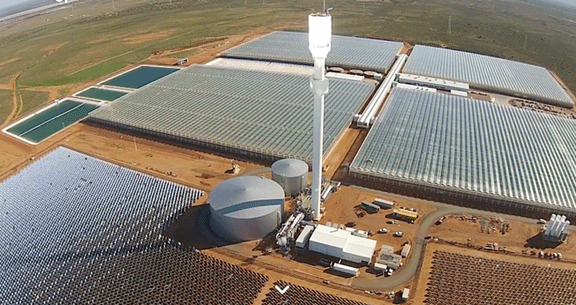
An international team of scientists has spent the last six years fine-tuning a system that pipes seawater in from the ocean and desalinates it using a state-of-the-art concentrated solar energy plant. The water is then used to irrigate 180,000 tomato plants grown in coconut husks instead of soil, kept in a network of greenhouses.
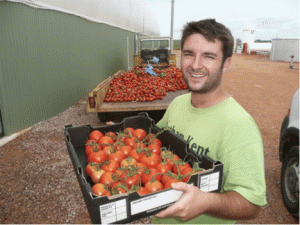 The result is Sundrop Farms, a commercial-scale facility located just off the Spencer Gulf in South Australia that began construction in 2014. Today it’s producing an estimated 17,000 tons of tomatoes per year to be sold in Australian supermarkets.
Given the increasing demand for fresh water around the world — a problem that’s particularly apparent in the sunburned landscape of South Australia — this might just represent future of large-scale farming, especially in coastal desert regions that have previously been non-arable.
The heart of the farm is the 23,000 mirrors that reflect sunlight towards a 115-meter high receiver tower. All of that concentrated sunlight produces an immense amount of power, up to 39 megawatts. That’s more than enough to cover the desalination needs of the farm and supply all the electricity needs of the greenhouses.
The seawater, too, has other purposes besides just irrigation. During scorching hot summers, seawater-soaked cardboard lines the greenhouses to help keep the plants at optimal temperature. Seawater also has the remarkable effect of sterilizing the air, meaning that chemical pesticides are unnecessary.
All in all, the facility cost around 200 million dollars to get up and running. That might sound excessive, but in the long run the facility should save money compared to the costs of conventional greenhouses that require fossil fuels for power. It’s a self-sustaining, cost-efficient design so long as the initial investment can be provided. Facilities similar to the Australian one are already being planned for Portugal and the U.S., as well as another in Australia. Desert areas like those seen in Oman, Qatar and the United Arab Emirates could be next in line.
“These closed production systems are very clever,” said Robert Park of the University of Sydney, Australia, to New Scientist. “I believe that systems using renewable energy sources will become better and better and increase in the future, contributing even more of some of our foods.”
October 16, 2016
Posted by Christina Macpherson |
reference, solar, South Australia |
Leave a comment
THE hi-tech home energy storage battery revolution, allowing households to better manage solar rooftop power, has been promised for more than a decade and now it could finally arrive in South Australia.
Battery installers in Australia have reported more than 100,000 customer inquires this year, although sales of the systems – which are adaptable, stylish, and small compared to the ugly lead acid batteries of the past – number less than 5000 units.
World leaders in battery production include Elon Musk’s Tesla company that produces the popular bar fridge sized ‘Powerwall’ unit, and German firms Sonnen and BMZ.
 Leading players offering home battery solutions include ZEN Energy, based at Clovelly Park in Adelaide, with Professor Ross Garnaut as chairman, and Redflow, based in Brisbane, led by SA-based innovator Simon Hackett, as chairman, chief executive and majority shareholder.”
But the biggest indicator that this is a growing, competitive and lucrative market is that major energy providers, AGL and Origin, now offer their own storage battery solutions.
ZEN Founder and Director of Innovation, Richard Turner, said while South Australia was plunged into darkness last week, its customers were completely uninterrupted.
“They were using their electric ovens, watching television, and going about their night like nothing had happened,” Mr Turner said.
“These systems are designed to generate and store ample solar energy during the day to meet their home’s power needs at night and provide backup power during blackouts.”
Mr Turner said while luxury homeowners were among the first adopters of solar energy storage, solutions were now affordable and within everyone’s reach. Continue reading →
October 16, 2016
Posted by Christina Macpherson |
AUSTRALIA - NATIONAL, South Australia, storage |
1 Comment
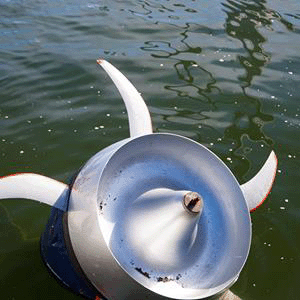 Australian Maritime College launches new tidal turbine in Tamar River http://www.examiner.com.au/story/4230602/the-future-of-energy/?cs=5312 16 Oct 2016 An emerging form of renewable energy has been met with overall positive reviews from the Tamar community.
The Australian Maritime College and Sydney-based developers MAKO have come together to install and monitor a new tidal energy turbine in the Tamar estuary near Launceston. Field experiments at a site near Reid Rock, north of the Batman Bridge, of a 2.4 metre-wide prototype have already started.
The turbine is secured beneath a floating platform and will be connected to a mooring on the east side of the estuary.
AMC project lead Irene Penesis said tidal energy was particularly exciting as it was very predictable compared with solar and wind power because of its consistent and monitorable cycles. “Through the kinetic energy of the tidal flow, we generate mechanical power and we then convert that to electricity,” Associate Professor Penesis said.
“Because tides are extremely predictable and we can predict them two years in advance, we can predict how much power we’re going to get – when you transfer that power back into the grid you know how much you’re transferring back and you can monitor that.
“It’s absolutely essential to have the community behind these types of events because if there’s an opportunity to install tidal turbines in the Tamar River, we would want those community members to have access to that power being generated.”
Owner of the nearby Tamar River Retreat Ian Stewart said after a community meeting was held to discuss the turbines last week, there was positive interest from residents and businesses in the area.
“To use tidal power to generate electricity would be absolutely fantastic,” Mr Stewart said. “I spend about $5000 a year on electricity because of my business, it’s probably my single biggest business expense, and if I can get that down even lower that would be great. “I think that a lot of people in the community want to get behind this idea and want to support it.”
October 16, 2016
Posted by Christina Macpherson |
energy, Tasmania |
Leave a comment
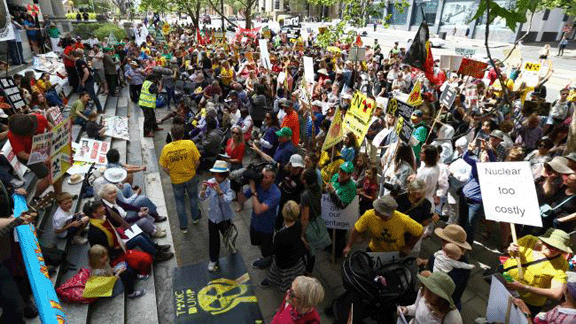
Nuclear waste dump protesters bring the fight from outback South Australia to the city, By Lauren Waldhuter http://www.abc.net.au/news/2016-10-15/nuclear-waste-dump-protesters-bring-the-fight-to-adelaide/7935954
Traditional landowners from South Australia’s outback have brought their fight against proposed nuclear storage facilities to the steps of Parliament House.
About 3,000 people rallied against proposed nuclear waste dumps, with Aboriginal families affected by nuclear testing at Maralinga among the crowd.
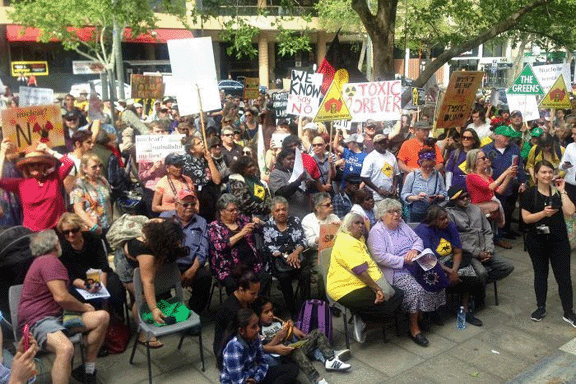
The State Government is considering whether it should store the world’s high-grade nuclear waste at a site somewhere in South Australia.
At the same time, the Federal Government is considering building its first storage facility for Australia’s low-grade radioactive waste, having short-listed Wallerberdina station, near Hawker in the Flinders Ranges, as a preferred site.
Traditional landowner Karina Lester said many people did not want to see either proposal go ahead.
“We are starting to unite and we are starting to really think about how we’re going to fight this, because it concerns us and we have a cultural responsibility,” she said.
“People travelled from the Mid North [and] from Ceduna as well to be part of this event and it was so important that they gathered here today to say ‘enough is enough’.
“Having Yalata crew, having Ceduna crew, the Yappala crew being involved is so strong for us as Aboriginal people.”
Renowned film director Scott Hicks lent his voice to the cause, with particular concern about the high-grade dump.
“To me it’s an idea that doesn’t make sense on any level I can look at it,” he said.
“It doesn’t make economic sense. We can’t even predict the price of coal a month from now. How can we predict the price of nuclear waste 100 years from now?
“Why would we want to leave a legacy for our children’s, children’s children and beyond 100,000 years, that can never be taken away?”
What is being proposed?
Federal
- Low-to-intermediate level radioactive waste generated in Australia stored in a purpose-built facility
- It would include materials such as nuclear medicine by-products
- This waste is currently stored in more than 100 sites across Australia, in metropolitan areas, regional towns and cities
- The project promises at least 15 ongoing jobs and $10 million in funding for the host community once the facility is operational
South Australia
- The Nuclear Fuel Cycle Royal Commission found SA could store the world’s high-grade nuclear waste
- Sealed waste would be stored 500 metres underground in a purpose-built facility
- The facility could create up to 5,000 jobs during construction and 600 ongoing jobs
- It is tipped to generate $5.6 billion of annual revenue for SA once established
October 15, 2016
Posted by Christina Macpherson |
AUSTRALIA - NATIONAL, Opposition to nuclear, South Australia, wastes |
Leave a comment
 I have received several reports from those who attended the rally in Adelaide – estimates of attendance numbers range from 100o to 3000.
A smaller rally was held in Melbourne, and in Alice Springs. At this stage, I have no reports on the rally held in Sydney.
Hundreds march against nuclear dumping in South Australia http://www.9news.com.au/national/2016/10/15/12/51/hundreds-march-against-nuclear-dumping-in-south-australia Hundreds of land owners have converged in Adelaide’s city centre to resist the South Australian government’s plans for two nuclear waste dumps in the state’s north.
Groups opposing the government’s plans to store high-level waste from other countries have flooded the steps of Parliament House in Adelaide’s CBD.

Many have come bearing flags and signs protesting the dumps, which were proposed in July. Traffic in the local area has been restricted to one lane as a steady stream of protesters continue to arrive. Motorists are advised to avoid the area.
Karina Lester, from the No Dump Alliance, said people need to send a strong message of opposition to the state and federal governments.
“All traditional owner groups need to unite and fight this as we all know the international waste storage facility is not going to be Norwood or Unley (in Adelaide), it will be in the far north of the state,” Ms Lester said.
Aboriginal Congress SA chairman Tauto Sansbury said people need to understand what building nuclear waste dumps means for future generations.
“We are talking about the importance of country and the preservation of culture and safety of our peoples,” Mr Sansbury said.
Conservation SA chief executive Craig Wilkins believes today’s rally is “another opportunity for all South Australian to express their concerns over the dump proposals”.
The rally also marks the 63rd anniversary of the first British atomic bomb test at Emu Field, in SA’s far northwest, in 1953.
October 15, 2016
Posted by Christina Macpherson |
AUSTRALIA - NATIONAL, Opposition to nuclear, South Australia, wastes |
1 Comment
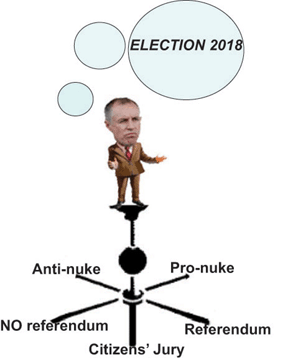 Power to the people may mean pulling plug on Jay Premier Jay Weatherill must pull off complex balancing act on SA’s energy infrastructure Daniel Wills, The Advertiser,October 14, 2016 PREMIER Jay Weatherill is strangely now both a hero and villain of the environmental movement.
Jobs have long been the biggest issue in SA politics, and will undeniably dominate the campaign in 18 months’ time. It’s a sign of how desperate the situation in SA has become that beating Tasmania back into last place on the unemployment ladder is now a cause for muted celebration.
We also wait to see what future, if any, Whyalla has and the full impact of Holden’s closure.
But leaping up into the top strata of vote-changing issues, which includes the State Government’s overhaul of the health system, are two divisive topics that evoke powerful emotions……….
An Advertiser-Galaxy poll on the blackout published on Monday showed only 16 per cent of people supported dialling back renewables in favour of coal and gas generation……..Voters seem to want something existing technologies don’t offer – carbon-free renewable energy that is cheap and reliable……..
In two Saturdays’ time, Mr Weatherill will head to a Labor Party state convention where the prospect of the state taking high-level nuclear waste for cash will be a flashpoint.
Already, Labor MP Steph Key is speaking out against any change to the party platform. Stakeholders such as SA Unions are expressing grave doubts about the business model…….
The numerical dominance of Labor’s Right faction, plus hesitant support in elements of Mr Weatherill’s Left, makes it likely his nuclear position will survive………
The same people cheering speech lines about wind farms may roll their eyes at nuclear. And vice-versa. This is the core and complex balancing act Mr Weatherill must pull off in the bid for a fifth term – holding a coalition of diverse and often opposed interests to win the day.
It’s not about being all things to all people. It’s about being just enough to just enough.http://www.adelaidenow.com.au/news/opinion/daniel-wills-premier-jay-weatherill-must-pull-off-complex-balancing-act-on-sas-energy-infrastructure/news-story/69403007930c182f4d0f679491a3eee9
October 15, 2016
Posted by Christina Macpherson |
politics, South Australia |
Leave a comment
 WA uranium mines: Race for environmental ticks in Goldfields before WA election, conservationists say http://www.abc.net.au/news/2016-10-14/wa-uranium-mine-approvals-race-ahead-of-wa-election-cc-says/7931254 By David Weber, 14 Oct 16, Proponents of uranium mines in Western Australia are racing to gain environmental approvals ahead of the state election, in case Labor wins, according to the Conservation Council.
Three projects in the Goldfields are at various stages of assessment.
They include Vimy Resources’ proposed mine at Mulga Rock, Toro Energy’s proposal to mine near Wiluna, and Cameco’s nearby Yeelirrie project.
The Council’s anti-nuclear campaigner, Mia Pepper, said companies were seeking security for the projects. “Certainly we are getting the sense that [for] the three uranium projects that’re under assessment … they’re clearly seeking some level of approval before the state election,” she said.
The Environmental Protection Authority (EPA) has recommended conditional approval for Toro Energy’s proposal, 30 kilometres south of Wiluna.
Cameco’s project at Yeelirrie, 70 kilometres south-west of the town, was knocked back after the EPA said there was too much risk to the subterranean fauna. However the EPA in August recommended the green light for Vimy’s project at Mulga Rock, 260 kilometres north-east of Kalgoorlie, and preliminary site works have been given the go-ahead.
Approvals could lead to ‘pressure’ on Labor Ms Pepper has met the EPA appeals convenor expressing concern about Mulga Rock. She said if a project cleared certain hurdles, it would be harder to wind it back. “An environmental approval is just one layer of approval that a uranium project requires,” she said.
“[It] is a long way from final approval, so it doesn’t lock in Labor to any of these projects, but … there would be seen to be that kind of pressure.
“It’s a political issue, it’s a very contentious issue and certainly the companies are doing everything they can.”
Even after a positive EPA assessment, uranium projects still required state and federal ministerial backing as well as other approvals and licences.
Cameco’s open cut mine at Kintyre, 270 kilometres north-east of Newman, has gone as far as gaining conditional approval from the Federal Government last year. Labor’s stated policy suggests mines that have been granted final state approval for construction will be permitted to operate and export in the same manner as other mining ventures.
October 15, 2016
Posted by Christina Macpherson |
politics, uranium, Western Australia |
Leave a comment
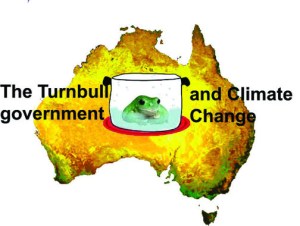 Australia facing questions at UN over post-2020 climate change stance, The Age, 13 Oct 16, Adam Morton Australia is facing renewed international pressure to explain what it is doing to tackle climate change, with a United Nations reviewfinding its emissions continue to soar and several countries calling for clarity about what it will do after 2020.
Countries including China and the US have put more than 30 questions to the Turnbull government, asking for detail about how Australia will meet its 2030 emissions target and raising concerns about a lack of transparency over how the government calculates and reports emissions.
It comes as the federal government has been facing calls at home – sparked by its own criticism of ambitious state renewable energy targets – to reveal what it would do on climate change and clean energy beyond 2020.
An expert review commissioned by the UN found, based on data submitted by Australia, its emissions would be 11.5 per cent higher in 2020 than they were in 1990. Industrial emissions – not counting those from forestry and land-clearing – were expected to rise 33.5 per cent over the three decades.
The reviewers found a recent Australian report lacked transparency about how it estimated its future emissions. And they noted the report failed to mention the abolition of the carbon price scheme, or explain what impact scrapping the policy would have on it meeting targets……..
Physicist Bill Hare, chief executive of Climate Action Tracker and an adviser to developing countries at climate negotiations, said the questions asked of Australia showed deep scepticism and frustration beneath a diplomatic veneer. “It is very strange that the government had put forward no projections, which are the sine qua non [essential ingredient] of this area of policy,” he said. “It is as if the Treasury produce a report for the International Monetary Fund with no future numbers in it. It raises alarm bells.”
A Climate Action Tracker analysis found Australia’s emissions were headed to be more than 27 per cent greater than 2005 levels in 2030…….. http://www.theage.com.au/federal-politics/political-news/australia-facing-questions-at-un-over-post2020-climate-change-stance-20161011-gs0avq.html
October 13, 2016
Posted by Christina Macpherson |
AUSTRALIA - NATIONAL, climate change - global warming, politics international |
Leave a comment
 Solar should power government schools, TAFE, hospitals: report, Brisbane Times, 13 Oct 16 Tony Moore
 Solar panels will be installed in Queensland Government buildings including TAFE colleges, schools, hospitals and public houses, to help drive Queensland’s renewable energy from seven per cent today to 50 per cent by 2030, a far-reaching strategic report into Queensland’s renewable energy says……..
Energy Minister Mark Bailey on Wednesday night said the push to put solar on government buildings was now being explored.
“The Palaszczuk Government is currently investigating the use of solar PV on state-owned buildings,” Mr Bailey said. Report author and investment banker Colin Mugglestone led a team of researchers who spent seven months analysing how Queensland should reach a position where 50 per cent of its energy is provided by renewable energy by 2030.
The state government now has 9 megawatts of solar panels on government buildings and hopes to generate 2000 megawatts of solar energy from government property by 2030, the report says…….
What could a renewable energy push to 50 per cent by 2030 provide? “It is projected that Queensland could reach 2200 MW of wind, 5200 MW of large-scale solar PV, and 4900 MW rooftop PV by 2030, including 5500 MW of new large scale capacity built after 2020.”
It could provide between around 6400-6700 extra full-time jobs, mainly in the construction of large scale renewable energy plants.
Last month the federal government’s renewable energy body ARENA agreed to fund $51.4 million to seed six new large-scale solar plants in Queensland. That will help potential big solar plants in Dalby, Oakey, Longreach and Kidston west of Townsville and two in Collinsville……..
What do The Greens say?“The Greens welcome this draft report, which confirms that clean energy is good for jobs,” Mr Bartlett said.”But we are dismayed at the years of delay, lack of ambition, and no transition plan for coal power workers.” http://www.brisbanetimes.com.au/queensland/solar-should-power-government-schools-tafe-hospitals-report-20161012-gs112t.html
October 13, 2016
Posted by Christina Macpherson |
Queensland, solar |
Leave a comment
~ Wangan & Jagalingou Family Council http://wanganjagalingou.com.au/ http://wanganjagalingou.com.au/traditional-owners-fighting-adani-mine-meet-un-rapporteur/ 13 October 2016
“Traditional owners fighting Adani mine meet UN Rapporteur today:
“Raise ‘egregious failure’ of Qld Mines Minister & Coordinator General to respect Indigenous rights
“The declaration of Adani’s Carmichael coal project as “critical infrastructure” by Qld Government Mines Minister, Anthony Lynham,
is “a political absurdity, and continues the egregious failure of the Queensland Government to respect our rights”,
said Wangan and Jagalingou (W&J) Traditional Owners Council senior spokesperson, Adrian Burragubba today,
before a meeting with the UN Special Rapporteur on the Situation of Human Rights Defenders.
“Mr. Burragubba confirmed he would today raise this new development with Mr. Michel Forst,
who is currently conducting an official visit to Australia.
More detail about his visit is provided below.
“Mr Burragubba said, “Minister Lynham’s declaration is like calling a state of emergency for coal mining. Giving Adani this advantage provides cover for the abuse of the rights of Traditional Owners
who have stood firm in the face of the destruction that would befall their lands, waters and culture
if this massive, inappropriate project were to ever proceed.
““Adani and the Queensland government have used coercive powers under Native Title and State Development legislation, and the threat of compulsory acquisition of our land rights, to drive the development of the mine forward, over our vehement objections.
The Coordinator General, Mr Barry Broe, has been instrumental in making this happen and
this week Minister Lynham handed him even more power to override our legitimate concerns
about the destruction of our environment and the disregard of our rights”, Mr Burragubba said.
“Mr. Burragubba, and W&J youth spokesperson, Ms. Murrawah Johnson, said the meeting today will build on a previous submission W&J made to the UN Special Rapporteur on the Rights of Indigenous Peoples in which they sought assistance to deal with the failure of both State and Federal Governments to properly respect the human rights of W&J Traditional Owners, as both Governments fell over themselves in obscene haste to get Adani’s coal mine approvals out the door. … “
October 13, 2016
Posted by Christina Macpherson |
aboriginal issues, Queensland |
Leave a comment
The Greens want to see a national audit of all abandoned and operational coal mines to determine the gap between the real cost of rehabilitation and the amount held in bonds. We need a national inquiry into mine rehabilitation, and this formed part of the Greens’ comprehensive mining rehabilitation policy which we took to the 2016 election. As a first step I will be asking Labor and the Coalition for their support to establish a Senate inquiry into this issue.
 Miners must be forced to clean up their messes http://www.smh.com.au/comment/miners-must-be-forced-to-clean-up-their-messes-20161011-grzjx1.html
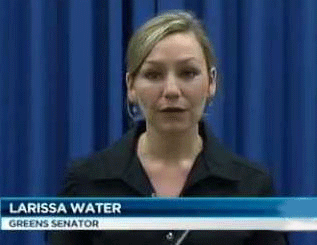
Larissa Waters, 13 Oct 16 Some people may be surprised to hear a Greens Senator say this, but here goes. Coal has been a key part of the Queensland economy for many years. Yes, the number of jobs provided by coal has always been overblown (more people work at McDonalds than in coal mining); it makes up less than 0.5 per cent of all jobs in Australia. On the other hand, for places like Clermont and Collinsville, coal has provided a sense of identity as well as stable employment.
All of that is changing, and we need our governments to catch up. The urgent threat of global warming, combined with the world-wide transition to clean energy, have pushed thermal coal into “structural decline”.
Globally the transition away from coal power is already underway. In Queensland, that transition is already hitting home along with the end of the mining boom, with thousands of jobs lost in coal mines, and more job losses to come. In September, it was reported that Hazelwood, Australia’s dirtiest coal power station, will close in 2017. Our job as leaders is to make sure there is a just transition away from coal which looks after workers and communities.
Clean energy will play a huge part in Queensland’s future. Last month, Queensland secured 1100 mostly regional jobs from five large-scale solar projects funded by the Australian Renewable Energy Agency. To create more jobs and to stop dangerous global warming, the Greens want to see 100 per cent clean energy as quickly as possible, with at least 90 per cent by 2030, and a $1 billion Clean Energy Transition Fund to make sure no one is left behind.
Coal communities should be supported to plan their own future, with government investment to help them create jobs. Part of that just transition must be secure jobs in mine rehabilitation, especially for older workers who may have trouble retraining or relocating. Alongside thousands of new regional jobs in clean energy, mine rehabilitation can provide employment in the same communities and regions most affected by the coal downturn.
Queenslanders are being ripped off. Again and again, big mining companies like Rio, BHP, Peabody and Glencore are simply taking their profits and walking away without securing those much-needed jobs in rehabilitation. Continue reading →
October 13, 2016
Posted by Christina Macpherson |
AUSTRALIA - NATIONAL, politics |
Leave a comment
This is a full list of witnesses chosen by the Nuclear Citizens’ Jury on October 9th and invited to be witnesses for the next Nuclear Citizens’ Jury on 29 October.
Here I have endeavoured to shed light on the likely evidence of each, according to the following code :
GREEN = Anti-nuclear waste dumping , Yellow – doubtful on waste importing. ORANGE=Neutral – Uncertain, about waste dumping, BLACK = I don’t know, PINK = probably pro waste dumping , RED = Pro nuclear waste dumping
- I ran into a spot of bother with the many Aboriginals recommended. As far as I can tell, they are all opposed to importing nuclear waste, except Parry Agius . Some of the most prominent Aboriginal persons are: Kevin Buzzacott, Karina Lester, Rose Lester, Vivienne McKenzie, Enice Marsh.
- Some pro nuclear people might be opposed to the dump plan, so I put those in pink.
 Nuclear Citizens Jury Two: Witness work
WITNESSES CHOSEN BY JURY AND INVITED FOR THE 29th
No List Ref Name Votes Theme
1 123 Richard Dennis 96 Economics
2 121 Professor Richard Blandy 54 Economics
3 128 Professor Barbara Pocock 45 Economics
4 179 Professor Brian Cox 45 Safety
5 166 Hon Nick Xenophon 44 Trust
6 56 Paddy Crumlin 34 Safety
7 1 Timo Aikas 34 Safety
8 4 Professor Rodney Ewing 31 Safety
9 168 Dr Karl Kruszelnicki 30 Safety
10 116 Dr Simon Longstaff 29 Trust
11 5 Robert J Halstead 27 Safety
12 19 Dr Jim Green 25 Safety
13 9 Dr Carl Magnus‐Larsson 25 Safety
14 162 Ian Hore‐Lacy 22 Economics
15 49 Professor Tilman Ruff, AM 22 Safety
16 53 Frank Boulton 21 Safety
17 188 Someone from the Attorney Generals Department to provide advice on the legislation that will be required to be developed/changed. DemocracyCo seeking advice on who. Trust
18 124 Assoc. Professor Mark Diesendorf 20 Economics
19 7 Dr Andrew Herczeg 20 Safety
20 42 Dr Ian Fairlie 19 Safety
21 137 Hon Mark Parnell, MLC 18 Economics
22 39 Dr Margaret Beavis 18 Safety
23 119 Assoc. Professor Haydon Manning 17 Trust
24 122 John Carlson AM 16 Economics
25 200 Dr Benito Cao 16 Economics
26 18 Professor David Giles 16 Safety
27 115 Steven McIntosh 16 Trust
28 2 Dr Ian Chessell 14 Safety
29 34 Professor Sandy Steacy 14 Safety
30 69 Gill McFadyen 11 Consent
31 74 Dave Sweeney 10 Consent
32 104 Bob Watts 9 Consent
33 76 Ross Womersley 8 Consent
34 72 Dr Gerald Ouzounian 7 Consent
35 73 Dan Spencer 6 Consent
36 126 Tim Johnson 7 Economics Invited to provide info on the Royal Commission economic modelling after 20+ requests on Information Gap Cards Dotmocracy Results ‐ 25 plus a few extras to allow for availability Top 6 from Consent ‐ as Gill is unavailable.
Nuclear Citizens Jury Two: Witness work
ABORIGINAL WITNESSES ALREADY INVITED ON THE 29TH Continue reading →
October 12, 2016
Posted by Christina Macpherson |
AUSTRALIA - NATIONAL, NUCLEAR ROYAL COMMISSION 2016, politics, South Australia, wastes |
1 Comment
There’s no doubt it was extreme weather toppling transmission lines that led to South Australia going black, but it is also clear we need a plan for our energy going forward.
That does not mean turning back to dirty energy. Here, in Port Augusta, we know that’s not going to happen. Demolition of the old power station has begun.
South Australia needs strong leadership now so that we can start building the next generation of renewable technologies with storage, starting with dispatchable solar thermal in Port Augusta. Doing so would secure our power supply with on-demand clean energy and create a number of good jobs with it, seeding a new industry.
The move to a more decentralised energy system is underway, not just here but around the world.
The blackouts that followed wild storms in New York meant leaders saw the need to deliver the next generation of renewables both for the environment and for energy security.
Our leaders at the federal and state level need to stop politicking and do the same.
Companies are lining up ready to build solar thermal in Port Augusta and start a new industry. Most recently we heard that building one plant could lead to five more being built in regional South Australia supplying 25 per cent of our state’s power from the sun, on-demand.
Not only would this benefit our region with new jobs, it would provide a local power source if storms take down our network again.
No power source could’ve kept the lights on once the system tripped.
But we’re hearing from experts in the industry that say if solar thermal had been built in the region, power could’ve been brought back sooner to the areas who were blacked out much longer than Adelaide.
Leadership is needed to seize the job and industry benefits building solar thermal in Port Augusta will deliver.
Before the Federal Election, building solar thermal in Port Augusta was named as the number one priority by the Coalition for clean energy funding. It’s time to see that promise delivered.Key to the funding being delivered and a project being viable is a long term power purchase agreement.
The South Australian Government is in the perfect position to provide it. Port Augusta desperately needs Jay Weatherill and Federal Energy Minister Josh Frydenberg to get together and lock in the necessary agreements to bring solar thermal to Port Augusta.
This is a clear, practical step both governments can take to show us they are serious about securing a clean, secure, power supply and supporting jobs in regional South Australia.
South Australia’s future can be powered by an array of renewable technologies with storage, let’s make sure our leaders deliver it. Sam Johnson is Mayor of Port Augusta
October 11, 2016
Posted by Christina Macpherson |
solar, South Australia |
3 Comments
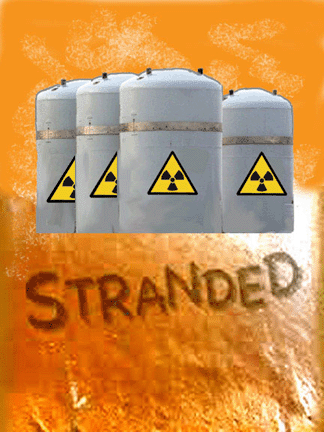
 Malgo Schmidt, from Your Say site 16 Oct 2016 “……..There is no independent Nuclear Regulator in Australia and SA has a conflict of interest





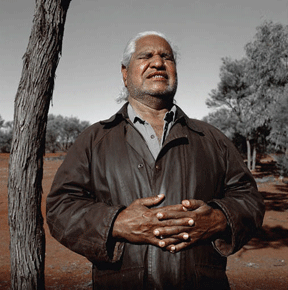 Black Mist Burnt Country review – exhibition covers devastation of nuclear war, Guardian, Clarissa Sebag-Montefiore, 12 Oct 16 With works by Sidney Nolan, Arthur Boyd and Jessie Boylan, Black Mist Burnt Country homes in on the 1956 British atomic tests in the Great Victoria Desert.