Submission- Jennifer Lyons -re new agreement on Naval Nuclear Propulsion- reject AUKUS and its dangerous war games
Enough of the fat cat white men making decisions, that are more about a bunch of boys playing war games than the health and future of our country.
Submission no. 17
Why would Australia spend so much money (our money, the people’s money) on something that
would put us in a volatile position with China?
America and Britain are both crumbling sick societies with useless political leaders, and here we
are following their lead.
Wake up Australia before it is too late. You are killing us, our land and my grandchildren’s future
with stupidity.
Enough of the fat cat white men making decisions, that are more about a bunch of boys playing
war games than the health and future of our country.
I am a concerned citizen and I am begging you to change.
Jennifer Lyons
Submission- Robert Coney -re new agreement on Naval Nuclear Propulsion- this must not stand – its only purpose being to attack China
The AUKUS submarines will not be here to defend Australia, but only to attack China in a subordinate role with the American forces.
Do we buy guns in support of an American led war of aggression? Or commit that funding to the wellbeing of our people?
Submission no.16
AUKUS. This is a horror for which I now fear for the lives of my children and their children.
This is now changing the direction of Australia for the next forty or fifty years.
We have never seen anything like this in peacetime Australia. At any stage.
This must not stand.
The horrors of AUKUS
Firstly, the automatic involvement in war.
We have already been tied to the United States by the bases – by Pine Gap, by North West
Cape, by the Space Surveillance Telescope that take us into space warfare, by the many
other Australian bases to which the US has access.
We are already tied in, hard-wired in many cases, to the American war machine.
And the ADF is barely an autonomous force today.
But AUKUS takes us very much further down that road.
We already know what the submarines are there for.
This is a politically-driven, call-from-Washington-inspired scheme for long-range, long endurance nuclear-powered submarines whose only rational use is to attack China.
The AUKUS submarines will not be here to defend Australia, but only to attack China in a
subordinate role with the American forces.
What could $368 billion in funding – $12 billion per annum for the next 30 years – fund for
Australia and Australians?
That is the question Australians must ask.
With Australia facing the most severe housing crisis in our history, rising cost of living,
increasing inequality, the pressing need to reform our schools, health, disability and aged
care systems, and the critical need to transform our energy systems and reduce our carbon
emissions to net zero, we face a choice.
Do we buy guns in support of an American led war of aggression? Or commit that funding to
the wellbeing of our people?
What, could $368 billion dollars achieve in developing relations with our close neighbour,
Indonesia, and the Association of South East Asian Nations?
Do we forget that any possible aggression – and there is absolutely no sign of it – from China,
would be first experienced by our ASEAN neighbours?
I believe AUKUS must not stand.
South Australia is aiming for 100% renewable energy by 2027. It’s already internationally ‘remarkable’
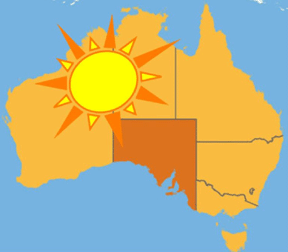
Experts say the state’s approach could provide a template for what can be achieved elsewhere.
Eight years ago, South Australia’s renewable energy future was in doubt as an extraordinary statewide blackout saw recriminations flow.
On 28 September 2016, a catastrophic weather event sent the entire state into system black. Around 4pm, some 850,000 homes and businesses lost power as supercell thunderstorms and destructive winds – some travelling up to 260km/h – crumpled transmission towers, causing three major power lines to trip.
Almost immediately, and despite advice to the contrary, members of the federal government sought to blame the blackout on wind and solar, with the then prime minister, Malcolm Turnbull, saying several state governments had set “extremely aggressive, extremely unrealistic” renewable energy targets.
Instead of relenting,SA chose to persevere. It now leads the world in the integration of variable, or weather-dependent, renewables.
Wind and solar power in South Australia grew to 75% in 2023, with few other systems reaching comparable levels. For instance, frontrunner Denmark achieved 67% in the same year.
The International Energy Agency says demonstrating the ability to power a large grid with wind and solar is crucial in the context of climate change, and South Australia’s share is “remarkable”.
The state government is now attempting to legislate a target of 100% renewable energy by 2027. Experts say the state’s approach could provide a template for what can be achieved elsewhere.
Energy specialist Dr Gabrielle Kuiper says powering a jurisdiction of almost 2 million people with majority wind and solar is a globally significant achievement.
“One of the most impressive things about that feat, from a technical point of view, is there have also been periods, starting in September last year, where the entire state was powered by rooftop solar alone,” Kuiper says.
On New Year’s Eve 2023, rooftop solar met 101.7% of South Australia’s energy needs for 30 minutes. Australia’s energy operator says that’s a world record for a grid of that size. Its engineering roadmap seeks to enable similar milestones throughout the national grid.
Daniel Westerman, chief executive of the Australian Energy Market Operator, says the “world-leading” rooftop solar contribution is made possible by power system equipment providing security, smarter connections between rooftop solar and the grid, and policies which protect consumers from unwanted disruptions.
Dr Susan Close, South Australia’s deputy premier and climate change minister, was a government minister during the 2016 statewide blackout. She believes the then federal government’s reaction at the time, blaming the state’s renewable energy, was “unfair and unsubstantiated”.
But if anything, she says the unhelpful response from Canberra hardened the state’s resolve. “In South Australia, the vast majority of people were proud of what we were doing, and simply wanted us to make sure that it was as secure and stable as possible,” Close says.
Close says the state’s energy shift hasn’t happened by chance. World-leading climate laws, consistent policy and a supportive planning system attracted investment and helped the state gain an early advantage under federal renewable energy targets. High retail power prices combined with a generous feed-in tariff scheme (now finished) to drive early uptake in rooftop solar. Now every second home in the state has solar installed.
Johanna Bowyer, lead analyst at the Institute for Energy Economics and Financial Analysis, said while South Australia does have fantastic wind and solar resources, “that’s the case for a lot of Australia”. Crucially, coal power stations were allowed to close under market conditions, she said. “They didn’t subsidise it to stay open for longer, like what is happening in New South Wales with Eraring.”
As coal generation was phased out, renewable energy grew to fill the gap.
Proposed changes to South Australia’s Climate Change Act include a 100% net renewable energy target, formalising statements by the energy minister earlier in the year.
The “net” terminology recognises that interstate transmission lines – connecting South Australia to Victoria and eventually NSW – will continue to share electricity across state borders.
The amendments also include a 60% emissions reduction target by 2030 – compared to 43% federally, and 50% in Queensland, NSW and Victoria – and a framework for timely updates along the pathway to net zero by 2050.
Kirsty Bevan, chief executive of the Conservation Council of SA, says the state’s “trailblazing renewable energy transition” puts it in a unique position to adopt much stronger emissions targets than other state governments. The council supports the renewable energy and 2030 emissions targets, but is keen to see the net zero target date brought forward.
“We should be proud of our past renewable energy accomplishments, but also build upon and capitalise on those accomplishments – to the benefit of all South Australians, our nature, and our shared planet,” Bevan said.
The state government’s focus is on stability, flexibility and reliability, with more large-scale battery storage following in the footsteps of the Hornsdale battery (the world’s biggest when it was activated), and hydrogen part of the plan to soak up excess wind and sun.
Kuiper says the secure and reliable system is made possible thanks to investment in storage, smarter management and grid flexibility. But the key to SA’s success isn’t merely technical, she says, it’s also political.
“The bipartisan support for renewable energy in South Australia has been really significant. It’s given investors a sense of certainty,” Kuiper said.
“I think there are lessons at a federal level, particularly for the federal opposition, about what can be achieved if you provide consistent support to this vitally important industry – that’s important for the domestic economy and for Australia’s development of export industries into the future.”
The aim of 100% net renewables was initially set under the Marshall Liberal government, with the Malinauskas Labor government bringing the date forward.
Close acknowledges the opposition’s part in supporting the state’s decarbonisation, adding that the current bill protects to a degree from “a sudden shift in temperament from the other side of politics.”
She says there’s no reason the energy and cultural transition in South Australia couldn’t be replicated in other parts of the country.
“The sooner you start, the easier it is,” she said. “The real cost is in being the last ones to make the change. And so we wish our interstate colleagues well in making that shift.”
Submission- G.H. Toll -re new agreement on Naval Nuclear Propulsion- Australia should pursue an independent non aligned foreign policy.
Submission no. 13
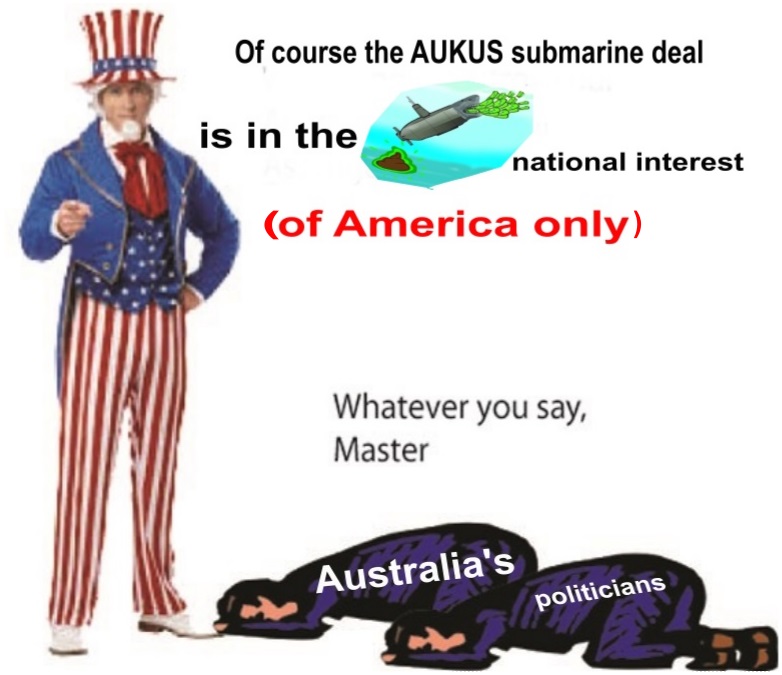
I wish to express my complete opposition to the Aukus agreement.
Australia should pursue an independent non aligned foreign policy.
We should not ratify this Aukus agreement and should refuse to continue to humiliate
ourselves by acting as a vassal state for the will of the USA.
Yours sincerely,
Mr G H Toll
Australian citizen and fully emerged Australian elder.
Voter
Melbourne
For Australia to meet emissions reduction targets, we don’t need nuclear energy
Pearls and Irritations, By Brendan Mackey and David LindenmayerSep 9, 2024
The Federal Opposition’s energy policy includes the construction of nuclear power plants. Peter Dutton says that we need them because Australia’s emissions reduction target of 43% on 2005 levels by 2030 is unachievable. Is this true? We argue that it is not – and especially if the Australian Government works with state and territory governments to stop native forest logging and land clearing.
Ending land clearing and halting logging of native forests would achieve a reduction of between 14.5 million and 37.5 million tonnes of carbon dioxide equivalent a year. This is greater than the annual reduction of 14.2 million tonnes of carbon dioxide equivalent needed to meet Australia’s 2030 target. A major reduction in emissions from logging and clearing forests would be sit admirably along Australia’s efforts to transition from fossil fuels to clean energy – which is now 40% of the electricity market (up from 15% a decade ago).
This is an entirely feasible proposition, as ending native forest logging will serve to further stimulate investment in the plantation sector – where there are the most jobs and the best profits in the forest industry. Indeed, 90% of all sawn timber in Australia (to make roof trusses, floorboards and furniture) already comes from plantations. Native forest logging generates predominantly woodchips, paper pulp and packaging (and not high-quality timber products). Plantations employ, on average, three times more people per ha of trees than do native forests. In addition, the capital investment needed for one full-time equivalent position in a native forest logging operation is almost 10 times that needed for a full-time equivalent in a plantation…………………………………………………………….. more https://johnmenadue.com/for-australia-to-meet-emissions-reduction-targets-we-dont-need-nuclear-energy/
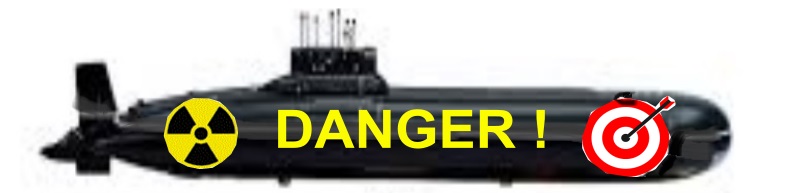
Basing US Nuclear Subs at Stirling on Garden Island makes Western Australia a nuclear target, while risking “catastrophic conditions” in a N-Sub reactor accident.
Briefer by David Noonan, Independent Environment Campaigner, 07 Sept 2024
What price should West Australian’s pay for AUKUS ? see “AUKUS: The worst defence and
foreign policy decision our country has made” by ex-FA Minister Gareth Evans (17 August 2024):
“… the price now being demanded by the US for giving us access to its nuclear
propulsion technology is, it is now becoming ever more clear, extraordinarily high.
Not only the now open-ended expansion of Tindal as a US B52 base; not only the
conversion of Stirling into a major base for a US Indian Ocean fleet, making Perth
now join Pine Gap and the North West Cape – and increasingly likely, Tindal – as a
nuclear target …”
No Emergency capability exists to respond to a nuclear weapons strike on Stirling off Freo
Nor can Federal and WA Labor claim to have a ‘social license’ for a US N-Sub Base at Stirling
while failing to inform affected community of the nuclear Health & Safety risks they could face.
Community has a basic ‘Right to Know’, a right to full disclosure of nuclear risks in advance of
decisions. A Labor Bill to declare Stirling a “Designated Nuclear Zone” is before Parliament
after a Senate Report. Now 3 yrs into AUKUS, it is long past time for Labor to inform community.
Federal & WA Labor Ministers Joint Ministerial Statement on Nuclear Reactors on Agricultural
Land (18 July 2024) have tackled Dutton over his crazy nuclear ‘power’ reactors at Muja, citing
accident impacts out to 80 km, but Labor fails to be transparent on nuclear risks they impose.
Federal and WA Labor have failed to make public required Health Impact Studies and
Nuclear Accident Scenario Modelling for US N-Sub visits and for a N-Sub Base at Stirling.
The WA State Hazard Plan “HAZMAT Annex A Radiation Escape from a Nuclear Powered
Warship” (update 20 Nov 2023) provides only scant over-view information to the public.
Federal Emergency provisions apply in event of a US N-Sub reactor accident at Stirling. The
federal civilian nuclear safety regulator ARPANSA sets out required Health Impact Studies,
Emergency response measures and Zones that are to be put in place (see “Guide for Radiation
Protection in Emergency Exposure Situations, Part 1 & 2, 2019).
A Defence Operations Manual “OPSMAN 1” (update 2023) is supposed to ‘operationalise’ the
Emergency measures for US N-Sub nuclear reactor accidents in Australian Ports and waters.
An “Urgent Protective Action Zone” of up to 2.8 km radius around the site of a US N-Sub
accident requires an Evacuation Plan for workers and affected residents. An “Extended
Planning Distance”, where “the surrounding population may be subject to hazards”, is set at
‘several kms’ around an accident site. This can extend to 5 km in UK N-Sub Emergency Zones.
ARPANSA and Defence also require studies of a local population out to 15 km from a US NSub mooring – as you can’t tell how far a radioactive pollution plume will spread by wind…
Children are at untenable Health risk in a nuclear strike OR in a US N-Sub reactor accident:
In a military nuclear reactor accident at Stirling the ARPANSA Guide Part 2 (p.18-19 & Table 3.1)
‘authorises’ ionising radiation health exposures to affected civilian workers AND to residents
and their children at a high dose of up to 50 mSv (milli-Sievert). Firty times more than Health
Authorities recommended maximum allowed dose of 1 mSv per year for members of the public.
Exposed residents and especially children need to be able to take stable iodine tablets ASAP to
try to reduce the radiological health risk of contracting thyroid cancer. Evacuees could have to
undergo ‘decontamination’ and need medical treatment, care which may have to be ongoing.
.
The Impact of Nuclear Weapons on Children (ICAN Report, August 2024) “shows in compelling
and often gut-wrenching detail, it is children who would suffer the most in the event of a nuclear
attack against a city today”. The Report is a dire warning that urgent action is needed to rid the
world of nuclear weapons. Australia must Sign & Ratify the Nuclear Weapons Ban Treaty.
WA Emergency workers could face “catastrophic conditions” at a N-Sub reactor accident:
In event of a severe US N-Sub reactor accident at Stirling the ARPANSA “Guide for Radiation
Protection in Emergency Exposure Situations (The Guide Part 2, p.18-19 & Table 3.1) authorises
“actions to prevent the development of catastrophic conditions” by designated WA workers.
‘Category 1 Emergency workers’ could “receive a dose of up to 500 mSv”, a dangerously high
ionising radiation dose exposure that is up to 500 times the public’s max allowed annual dose:
“Emergency workers may include workers employed by an operating organisation, as
well as personnel of response organisations, such as police officers, firefighters,
medical personnel, and drivers and crews of vehicles used for evacuation. …
- Category 1: Emergency workers undertaking mitigatory actions and urgent protective
actions on-site, including lifesaving actions, actions to prevent serious injury, actions
to prevent the development of catastrophic conditions that could significantly affect
people and the environment, and actions to prevent severe tissue reactions. … They
may also receive a dose of up to 500 mSv for life saving actions, to prevent the
development of catastrophic conditions and to prevent severe tissue reactions.”
The ARPANSA Guide Part 1 (Annex A, p.64 Table A.1, 2019) states in stark terms that Emergency
workers can be called upon to ‘volunteer’ for actions “to prevent the development of
catastrophic conditions” in event of a severe US N-Sub nuclear reactor accident:
“… under circumstances in which the expected benefits to others clearly outweigh
the emergency worker’s own health risks”.
As evidence of the extent of nuclear risks to the health of Emergency workers, the ARPANSA
Guide Part 1 (Annex A, p.63) requires female workers to be excluded from these roles:
“…female workers who might be pregnant need to be excluded from taking actions
that might result in an equivalent dose exceeding 50 mSv”
Note: the ‘safety’ of N-Subs in UK Ports has been found seriously wanting, see a Report (2009)
by Large and Associates Consulting Engineers on UK off-site Emergency Planning Measures.
Submission- Tom Warwick -re new agreement on Naval Nuclear Propulsion- not in the public interest, designed to provoke China
The other partners in the deal take no risk and Australia agrees to accept all the risks and nuclear waste. The government who agreed to this deal is not acting in the interest of the people and is either naive or traitorous
China does not want war with Australia, China has not fired a shot in 40 years, China is trying to prove that their model of prosperity without war is superior and they are successful in doing so.
Submission no 11 https://www.aph.gov.au/Parliamentary_Business/Committees/Joint/Treaties/NuclearPropulsion/Submissions
Dear senate committee, I am a member of the Australian public, and a voter in the electorate of
Durack. I represent myself and the ordinary people of Australia.
The AUKUS deal is not in the interest of the Australian people.
The opportunities forgone by spending an exorbitant $368B on nuclear submarines is enormous, we
have great need in this country for public spending on social programmes, social and commercial
infrastructure.
Not only does the AUKUS spending not produce social good it is harmful and causes risks to
Australian society.
The other partners in the deal take no risk and Australia agrees to accept all the risks and nuclear
waste. The government who agreed to this deal is not acting in the interest of the people and is
either naive or traitorous. If naïve the government should be removed, if traitorous the government
must be prosecuted and severely punished.
The submarines are not defensive in nature, the reason why nuclear has been chosen is that they
can operate far off shore and not in Australian territorial waters to provoke and possibly attack an
adversary far away, and though it has not been explicitly stated China is the object of this
antagonism, our largest trading partner and the nation upon who most of our prosperity depends.
China does not want war with Australia, China has not fired a shot in 40 years, China is trying to
prove that their model of prosperity without war is superior and they are successful in doing so.
AUKUS is not in the public interest
AUKUS has never been demanded by the Australian people
AUKUS places an excessive financial burden in the public purse, funds that could be much
better spent on public infrastructure.
There are no guarantees that Australia will receive anything from AUKUS except public debt,
nuclear waste from Britain and USA and risk.
AUKUS is provocative to our most valuable trading partner
Please cancel AUKUS now.
Submission- Women’s International League for Peace and Freedom, Australia -re new agreement on Naval Nuclear Propulsion.
Submission no. 6 https://www.aph.gov.au/Parliamentary_Business/Committees/Joint/Treaties/NuclearPropulsion/Submissions
In contributing to this inquiry, the WILPF Australia Board will:
- Introduce WILPF Australia.
- Note that the National Interest Analysis is negligent in that it makes no serious attempt to assess
the public interest of the proposed Agreement - Highlight the significant national interest arguments against acceding to the terms of the
agreement which need to be given proper consideration - Recommend a complete rejection of the Agreement as it would serve to implement decisions
previously made without proper consideration of the national interest.
Women’s International League for Peace and Freedom (WILPF)
WILPF Australia is a feminist peace-building organisation of volunteer activists which is anti-war, antiviolence, non-profit, and non-aligned, bringing civil society together to bring about a sustainable peace.
WILPF staff, sections and members have been active and vocal supporters of the international treaty to
ban nuclear weapons for over a decade, following consistent antinuclear organising and advocacy since the dawn of the nuclear age.
The National Interest Analysis is negligent
The National Interest Analysis is predominantly a summary of what appears in the draft Agreement. There
are only two direct references to the National Interest:
- at item 6, referring to allowing access to information and material necessary to implement a
nuclear-powered submarine program - at item 10, referring to the need to achieve the “Optimal Pathway”
Other issues directly relating to the draft Agreement which would appear to be contrary to the National Interest are not considered, including:- Article IV (C) – the agreement commits Australia to paying whatever price the US or the UK wish to
charge for the “Special Nuclear Material contained in complete, welded Power Units, and other
Material as needed for such Naval Nuclear Propulsion Plants”. The statement that the prices with
be “based on the fair market price of comparable enriched uranium” at IV(B) neglects to consider
that there will be no market price for the goods under consideration. Committing Australia to
paying whatever the UK and the US wish to charge is not in the national interest - Article XI – Intellectual Property – commits Australia to handing over any intellectual property and
patents developed by Australians to the US and/or the UK where it derives from “information,
Material, or Equipment” that they have provided. This applies to both Classified and non-Classified
information. Such a sweeping commitment will ensure that Australia does not benefit from any
innovations developed here for fifty years (to 2075). It is clearly not in the National Interest
The cursory nature of the National Interest Analysis does not inspire confidence that the national interest
is foremost in the minds of the government.
More importantly, however, is the fact that the National Interest Statement takes the commitment to
embark on a nuclear-powered submarine program and the so-called “Optimal Pathway” to implement this commitment, as given. Neither of these have been subjected to National Interest assessment. The
legitimacy of all these agreements and arrangements hinges on the legitimacy of that original decision. In
the following section we set out some of the National Interest arguments that WILPF suggests should be
considered.
National Interest arguments that should have been considered
Firstly, for years, WILPF has debunked the myth that militarisation creates a safer world, showing that
more weapons and arms invariably lead to more violence, instability, and gender inequality. The
masculinist, militarist nuclear deal proposed by the US and UK is not in the National Interest because it will not make Australia safer. On the contrary, changing Australia’s defence policy to be more assertive
towards our major trading partner in the region threatens our economic well-being, our regional alliances
and exposes us to additional threats.
Secondly, the National Interest arguments concerning the nuclear waste that will result from
implementing the draft Agreement have not been considered. Disposal of high-level nuclear waste is
globally unprecedented. Our AUKUS ‘partners’, the US and UK, have proven unable to dispose of the waste\ in the 60+ years since first putting nuclear submarines to sea. It seems that the ALP’s National Platform commitment to “remain strongly opposed to the importation and storage of nuclear waste that is sourced from overseas in Australia” is yet to be considered.
Further, storage and disposal of nuclear wastes already compromises the safety and welfare of the people
in South and Western Australia. The fact that nuclear waste storage is prohibited in South Australia by the
SA Nuclear Waste Storage (Prohibition) Act 2000 can potentially be overridden by Federal law. This is
shameful, and could be an abuse of power that undermines Australians’ basic human rights
Thirdly nuclear weaponry and wastes have gendered impacts …………………………….
Fourthly Australia has a long land ongoing legacy of colonialism………………………….
WILPF Australia recommends that the agreement be rejected……………………………..
The massive new projects propelling South Australia towards 100 per cent net renewables
The season of renewable records has begun early in Australia, sending
average coal power down below 50 per cent for the first time, establishing
new records for wind output, and sending grid demand to new lows across the
main grid.
The state at the forefront of the country’s energy transition
is, without a shadow of a doubt, South Australia. It kicked out coal in
2016, and is steadily reducing its dependence on gas. When a new
transmission link to NSW is completed in the next two years, the state
expects to run at 100 per cent net renewables – reducing gas to a support
role and becoming the first multi-gigawatt scale grid in the world to reach
such a milestone through wind and solar, rather than more conventional
renewable sources.
Big industry is lining up to build new factories and
production facilities to take advantage of cleaner power and lower
wholesale prices, and BHP is talking of doubling its mining production at
the giant Olympic Dam – and its smelting and refining capacity. The
latest data shows that wind and solar provided enough power to meet more
than 70 per cent of the state’s electricity demand in the last 12 months
– although the government says it is 75 per cent.
Over the past 30 days
it has been 86.4 per cent, and over the past week it has been more than 105
per cent. Rooftop solar now supplies the equivalent of all state demand on
occasions, presenting a complication for the market operator which prefers
to run the grid with assets it can control. It’s working on that solution
with new inverter standards and grid protocols, including solar
switch-offs. South Australia also led the country, and the world, in the
installation of the first big battery, the original “Tesla Big Battery”
now properly known as the Hornsdale Power Reserve.
Renew Economy 6th Sept 2024
Another Hunter Valley earthquake sounds alarms on Coalition’s nuclear scheme

Solutions for Climate Australia,
Elly Baxter, Senior Campaigner for Solutions for Climate Australia, 7 Sept 24 https://newshub.medianet.com.au/2024/09/another-hunter-valley-earthquake-sounds-alarms-on-coalitions-nuclear-scheme/65734/
The third earthquake in two weeks in NSW’s Hunter Valley today highlights the serious questions about the Liberal National Coalition’s plans for nuclear reactors they are still refusing to answer, says Solutions for Climate Australia.
The earthquake’s epicentre was again very close to the existing Liddell power station, where the Coalition aims to build at least one nuclear reactor. Solutions for Climate Australia Senior Campaigner Elly Baxter said the Coalition has not answered the many questions already raised about safety, emergency response, radioactive waste and water availability at the site.
“Five of the seven sites proposed by the Coalition as suitable for nuclear reactors experience earthquake activity,” Baxter said. “Their energy spokesman Ted O’Brien told ABC Radio Newcastle that a nuclear reactor at Liddell would not proceed if it was deemed unsafe, but what about the four other sites? If these sites are ruled out, where will the Coalition build their nuclear reactors? And will those communities be informed ahead of the federal election?
“Meanwhile, the safety issues we raised two weeks ago remain unanswered. Would local firefighting volunteers handle the nuclear material? What training would local firefighting volunteers receive in handling nuclear radiation? Who would train them? Would the army come in to help?
“How would iodine tablets be distributed to locals to try to reduce cancer risk? What would be the fallout zone and where would the local emergency staging area be? Where would nuclear refugees be accommodated?
“Would the Federal Government be responsible for the emergency management given under the Liberal National policy, the Federal Government would own the nuclear reactor?
“What would happen to the radioactive waste and who would be responsible for that? Where would the enormous volume of water come from to deal with the toxic, radioactive emergency?
“The safety issues highlighted by these earthquakes only compound our concerns that nuclear reactors will take far too long to build to protect Australians from the worst impacts of climate change.”
ENDS
Give Me Missiles: Gina Rinehart and the Pathologies of Mining
Australian Independent Media, September 6, 2024, by: Dr Binoy Kampmark
Power should only ever be vested carefully, and certainly not in the hands of mining magnate Gina Rinehart, a creature so comically absurd as to warrant immediate dismissal in any respectable commentary. But Australia’s richest human being demands to be noticed, given the insensible influence she continues to exert in press and policy circles. Rants of smelly suggestion become pearls of perfumed wisdom, often occasioned by large amounts of largesse she disgorges on her sycophantic following.
Of late, she has been busy in her narcissistic daftness. At the National Bush Summit held last month, she proved particularly unstoppable. While advertised as a News Corp project backed by a number of Australian corporate heavies (NBN, CommBank, Woolworths and Qantas), Rinehart’s Hancock Prospecting left its unmistakable mark. The events offered a Rinehart Hall of Mirrors, self-reflecting her purchased eminence. She funded much of it; she structured it; she brought the necessary tyrannical boredom in tow.
Before remarking on some of the observations, brief mention should be made about the source of Rinehart’s animal spirit. One should never condemn, outright, the children for the sins of their parents. But she is the exception that proves the rule. Her father, Lang Hancock, was an elemental Australian version of a 20th century conquistador, an enterprising plunderer of the land and equally immune to cultural refinements and such novel notions as human rights. With barbaric clarity and genocidal suggestion, he proposed in 1984 that unassimilated members of the Indigenous populace be given the following treatment: “dope up the water up, so that they were sterile and would breed themselves out in the future and that would solve the problem.”
At the Port Hedland leg of the Bush Summit, Rinehart fantasised about having the military styled comforts offered by the US firm Rafael Advanced Defense Systems in 2011 to Israel. The Iron Dome system, used to shield Israel from rocket attacks, could just as well be deployed in Australia. But instead of focusing on protecting civilians, the batteries would be invaluable in protecting Rinehart’s own mining assets in the Pilbara.
A gorged ego, the country’s perceived welfare and mining interests are all fused in an unsteady mix of justified plunder under the cover of military protection for Hancock Prospecting. “It is no good having the resources of the Pilbara unless we can ship it out. Hence, we should have defence to keep our railways and ports open, and defend our sea lanes.” To the defensive dome could also be added “war drones, and smart sea mines.”
The next target in this spray of barking madness was government regulation – at least the sortthat impairs her extractive practices. With brattish petulance, she even claimed that Canada had treated the mining industry with greater aplomb and respect, despite having, in her words, a “socialist” Prime Minister in the form of Justin Trudeau. Various taxes, such as the Fringe Benefits Tax, should be ditched, given the damage it was doing to Northern Australia………………………………………………………………………………………………………………
…………. All liberal democracies face similar challenges: how to make sure the thick of mind remain distracted and resistant to riot, and keeping the malevolently wealthy contained within the realm of accountability. Rinehart’s commentaries suggest a desire to escape that orbit of accountability, operating as an unelected politician’s wish list. And being unelected is exactly how she likes it. The compromise and messiness of parliamentary debate and the making of policy would prove too excruciating and intolerable. Far better to intimidateelected representatives from afar, using platoons of paid-up lobbyists, consultants and cheering propagandists. When feeling generous, give them a confessional platform to ask forgiveness for their sins.
Were the fossil fuel lobby to be equipped with actual weapons, a coup would not be off the cards. A few Australian prime ministers have already had their heads, politically speaking,served on a platter to the mining industry, with Rinehart’s blessings. A depressing conclusion can thereby be drawn. Australia is a country where rule is exercised by those outside parliament. It’s Rinehart on minerals and metals and the Pentagon and the US military complex on weapons and military bases. What a stupendous state of affairs Australians find themselves in. https://theaimn.com/give-me-missiles-gina-rinehart-and-the-pathologies-of-mining/
Racist statements by mining magnate Lang Hancock, and claims that he had Aboriginal children

Lest we forget – the great mining magnates have not been so great on human rights.
This becomes an issue now, when their names can be attached to Australian sports teams. Surely an embarrassing whitewash of despicable public persons.
THE families of people claiming to be children born out of wedlock to Lang Hancock work in his mines, it was claimed yesterday. http://www.heraldsun.com.au/news/more-news/daughter-claims-lang-hancocks-descendants-work-in-mines/story-fn7x8me2-1226271180226 Gemma Jones From:Herald Sun February 15, 2012
Aboriginal elder Hilda Kickett, 68, who has been accepted as Mr Hancock’s love child by his widow, Rose Porteous, said some of the relatives of seven other suspected part-Aboriginal children of the late mining magnate were even paid royalties from mines opened on their traditional land.
Many of Mr Hancock’s suspected grandchildren have taken jobs in family mines and others in the vast northwest of Western Australia, which was opened up by the businessman……
Mr Hancock, who discovered iron ore in the Pilbara, once called for part-Aboriginals to be sterilised.
He also dismissed indigenous land claims, saying: “The question of Aboriginal land rights and things of this nature shouldn’t exist.”
He referred to part-Aboriginal people as “no-good half-castes” and said to deal with those who were unemployed he would “dope the water up so that they were sterile and would breed themselves out in the future”. ….. http://www.heraldsun.com.au/news/more-news/daughter-claims-lang-hancocks-descendants-work-in-mines/story-fn7x8me2-1226271180226
Climate review backs solar, wind, hydrogen, not nuclear

Marion Rae, Sep 05, 2024, https://www.thenewdaily.com.au/news/national/2024/09/05/climate-review-backs-solar-not-nuclear
An independent review of Australia’s climate response has found no need, or time, for nuclear to be added to the energy mix to reduce emissions.
The Climate Change Authority on Thursday released its review of the ways big-emitting industries must change for the country to reach net zero emissions by 2050.
“We need to seize this once in a generation opportunity to ensure Australia’s rapid and orderly transition as the world transforms to avert the worst impacts of climate change,” chair of the authority Matt Kean said.
But developers of renewable energy projects need to engage with regional communities about the energy transition, and better explain the benefits that can be shared, he said.
As well as solar and wind for electricity generation and batteries for energy storage, the rapid development of emerging technologies such as hydrogen will play a part, the review finds.
The authority steers clear of nuclear power, citing federal and state bans, other available technologies, the long lead time and the premium it would cost for a first-of-a-kind reactor deployed in Australia.
Energy Minister Chris Bowen said the independent advice confirms nuclear could not replace aging coal capacity fast enough to support Australia’s 2050 target.
“Any delay risks not just our energy reliability and security but our ability to act on emissions reduction and secure the future for the next generation,” he said.
But Kean warned the nation must overhaul supply chains, production systems, public and private finance, and workforces.
The advice comes as the federal government faces a deadline on declaring an emissions reduction target for 2035, with Australia within striking range of its legislated target of 43 per cent of emissions cut by 2030.
The Australian Conservation Council welcomed the analysis showing the country can meet and beat its 2030 ambitions and accelerate towards a 75 per cent by 2035 target.
The modelled scenarios make it clear the extraction of fossil fuels will need to be reduced and ultimately phased out, spokesman Paul Sinclair said.
“A high ambition 2035 target is critical to set a clear goal for the government’s Future Made in Australia strategy,” Sinclair said.
The Pathways Review was commissioned by parliament to provide independent and technical advice on decarbonising the economy.
Sectors covered include energy and electricity, transport, industry and waste, agriculture and land, resources, and the built environment.
The Greens said Australia could hit net-zero by 2035 but Labor was “crab-walking away from strong climate targets” while approving coal and gas projects that will run through to 2080.
“Labor are climate frauds. Small targets won’t stop the climate crisis,” leader Adam Bandt said.
How much water does nuclear really need?
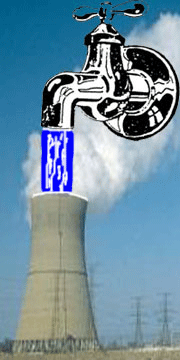
The Coalition’s plan for atomic energy has raised concerns about the amount of water that reactors will use in a hotter and drier Australia.
AFR, Christopher Niesch, 5 Sept 24 .
Opposition Leader Peter Dutton’s proposal to build seven nuclear reactors in five states has put nuclear energy in the spotlight. While Dutton claims nuclear power is a zero emissions solution to the energy transition, Anthony Albanese’s Labor government says it will take too long to build, be too costly, and will use too much water.
Under the Coalition plan, there would be five large-scale power plants and two small modular reactors, with the first to be operational by either 2035 or 2037.
Based on the scant detail so far available, the CSIRO has estimated a total build cost of about $60 billion in today’s dollars for these facilities. Other estimates, based on actual build costs abroad, are much higher.
But Labor has raised concerns about the amount of water that the reactors would consume, especially in a hotter and drier climate more prone to drought in the 2030s and 2040s…………………………………………………………………………………………………………………..
In an interview with Sky News in July, then agriculture minister Murray Watt said nuclear power uses “substantially more” water than coal does.
“There’s a real question about where that water is going to come from, whether some of that water is going to need to be taken off farmers, and what farmers are going to have to pay for their water if there’s a competing use for that water,” he said.
Watt also said that based on international practice, farmers would need to take expensive steps during a nuclear leak and would need to inform their customers that they operate within the fallout zone.
Queensland Premier Steven Miles has also said nuclear power could risk the state’s water security, with water consumption at the proposed stations depleting water reserves during droughts.
As coal stations were decommissioned they would have given up their water rights, but nuclear power stations would have to use that water for their 80-year lifetime, Miles says.
…………………………………………………………………………Where will water for the reactors come from?
The water would be from the same sources that existing coal-fired plants use.
Dutton says that if elected to government the Coalition would build nuclear reactors at locations where there are closed or scheduled-to-close coal-fired power stations.
“Each of these locations offer important technical attributes needed for a zero-emissions nuclear plant, including cooling water capacity and transmission infrastructure,” he says. “That is, we can use the existing poles and wires, along with a local community which has a skilled workforce.”
None are now owned by the commonwealth, which Dutton suggests could be overcome by compulsorily acquiring the sites.
Five full-scale reactors would be built in NSW, Victoria and Queensland, with small modular reactors in Western Australia and South Australia.
How much water does green power use?
Johanna Bowyer, an analyst at the Institute for Energy Economics and Financial Analysis, notes that solar and wind energy don’t rely on water and so the water currently used by coal-fired power stations could be used for agriculture instead.
And wind and solar energy could keep running at full capacity during times of drought, unlike coal or nuclear power.
Bowyer notes that there have been instances where coal-fired power stations have had to reduce their output during drought.
In 2007, the Tarong Power Station in Queensland cut its generation by 25 per cent in January and followed up with another 45 per cent cut in March to save water during the drought.
That water was also being used for drinking, so they prioritised that usage over the power station usage,” she says.
“Who knows what the future holds, but there’s some historical basis there for potential challenges, particularly during droughts. But it all depends on … the water cooling design for the nuclear power plant and it depends on how exactly they satisfy their water cooling requirements.
“That’s all really yet to be detailed in the Coalition’s plan.”
Where does all this leave the Coalition’s plan?
Dutton hasn’t released much more detail about his plans, so we can’t know exactly how much water they will use.
Nor is it clear how much water the small modular reactors (SMR) the Coalition is planning will use. more https://www.afr.com/companies/energy/how-much-water-does-nuclear-really-need-20240826-p5k5b6
Submission- Friends of the Earth -re new agreement on Naval Nuclear Propulsion
underlying premises are false or misleading
most importantly, a wasteful expenditure of public money that will make Australia less safe
It is a logical contortion to suggest that nuclear powered naval submarines are “a peaceful activity”.
Besides spent nuclear fuel from Australian AUKUS submarines, there is a danger that Australia could be pressured into storing and disposing of spent nuclear fuel from UK and US submarines.
a giant millstone bequeathed to the people of Australia.
Submission to the Joint Standing Committee on Treaties re “Agreement … for Cooperation
related to Naval Nuclear Propulsion” Submission no. 5 https://www.aph.gov.au/Parliamentary_Business/Committees/Joint/Treaties/NuclearPropulsion/Submissions
Philip White, For Friends of the Earth Adelaide 4 Sept 24 [Original contains many nots, references, sources)
This Agreement should be rejected for reasons including those outlined below.
- Because the underlying premises are false or misleading.
(a) Australia’s defence and security
The premises stated in the preamble include:
Recognizing that their common defense and security will be advanced by the exchange
of information, including Naval Nuclear Propulsion Information, and the transfer of
Material and Equipment for conventionally armed, nuclear-powered submarines, in
accordance with this Agreement; and
Believing that such exchanges and transfers can be undertaken without unreasonable
risk to each Party’s common defense and security.
These premises are false. In fact, Australia’s security will not be advanced and there is an
unreasonable risk to Australia’s defence and security, as can be seen from the quotes below from
eminent military analysts.
Hugh White (emeritus professor of strategic studies at the Australian National University, former
deputy-secretary of the Department of Defence) states as follows:
The new plan – to buy a nuclear-powered submarine instead – is worse [than the old
plan]. It will make the replacement of the Royal Australian Navy’s fleet of Collins-class
boats riskier, costlier and slower. It means an even bigger slump in our submarine
capability over the next few dangerous decades. And it deepens our commitment to the
United States’ military confrontation of China, which has little chance of success and
carries terrifying risks.1
He concludes that it “tied Australia to a deal that undermines our sovereign capabilities,
overspends on hardware we can barely be confident of operating, and drags us closer to the front
line of a war we may have no interest in fighting.”2
Major General Michael G Smith (retired) says:
In my view this decision to procure nuclear-powered submarines will prove to be as
useless, but even more costly, than was our flawed Singapore strategy before World War
II.3
Sam Roggeveen (director of the Lowy Institute’s International Security Program) is quoted as
saying:
It (AUKUS) is a project of vaulting ambition that is out of step with Australian tradition
as a middle military power, wildly at odds with our international status and, most
importantly, a wasteful expenditure of public money that will make Australia less safe.4
(b) Nuclear non-proliferation
The preamble also includes the following premises:
Reaffirming their respective obligations under the Treaty on the Non-Proliferation of
Nuclear Weapons, done at London, Moscow, and Washington 1 July 1968, and entered
into force 5 March 1970; …
Further recognizing that Australia has announced its intention to negotiate and conclude
an Article 14 arrangement with the International Atomic Energy Agency (“IAEA”)
pursuant to the Australia-IAEA Comprehensive Safeguards Agreement, related to
cooperation under this Agreement.
The premises thus stated fail to acknowledge that the ‘Article 14’ arrangement in question is a
self-contradictory attempt to close a dangerous loophole in the Treaty on the Non-Proliferation of
Nuclear Weapons (NPT). The NPT only requires the application of safeguards to ‘peaceful’
nuclear activities. That leaves unstated the question of what to do about ‘non-peaceful’ nuclear
activities, other than nuclear weapons which are banned for non-nuclear-weapon states
‘Article 14’ of the Australia- IAEA comprehensive safeguards agreement (INFCIRC/217, 13
December 1974) states:
Australia shall inform the Agency of the activity, making it clear:
That the use of the nuclear material in a non-proscribed military activity will not be in
conflict with an undertaking Australia may have given and in respect of which Agency
safeguards apply, that the nuclear material will be used only in a peaceful nuclear activity.
It is a logical contortion to suggest that nuclear powered naval submarines are “a peaceful
activity”.
In a 6 October 2021 letter to President Biden, seven leading US non-proliferation experts explain
the problem as follows:
The IAEA is charged by the Treaty on the Nonproliferation of Nuclear Weapons with
verifying that nuclear material in non-weapon states is not diverted to nuclear weapons.
The IAEA is constrained, however, by Section 14 of its standard safeguard agreement,
“Non-Application of Safeguards to Nuclear Material to be Used in [Non-Explosive]
Non-Peaceful Activities,” which would allow a country to exempt HEU fuel from
normal inspections for decades. This well-known loophole has not yet been tested.5
These nuclear non-proliferation experts go on to articulate the following concern:
We … are concerned that the AUKUS deal to supply Australia with nuclear-powered
attack submarines fueled with weapon-grade uranium could have serious negative
impacts on the global nuclear nonproliferation regime and thereby on US national
security.6
They are concerned that countries including Iran, Brazil and South Korea could use the agreement
between Australia, the UK and the US as a precedent to support their own interest in acquiring
nuclear submarines. The experts express their concern for US national security, but the negative
impacts also apply to the national security of Australia.
- Radioactive waste
If Australia goes ahead with its plan to acquire nuclear powered submarines, the resulting spent
nuclear fuel and other radioactive waste will continue to be dangerous for tens of thousands of
years. It will have to be managed, stored and disposed of, but the countries from which we would
purchase these submarines inspire no confidence that this can be safely achieved. In over 60 years
of operating nuclear submarines, the US and UK have been unable to dispose of their own spent
nuclear fuel.
Besides spent nuclear fuel from Australian AUKUS submarines, there is a danger that Australia
could be pressured into storing and disposing of spent nuclear fuel from UK and US submarines.
Under the Agreement, the status of spent fuel from second hand Virginia class submarines to be
purchased from the US is vague, but it is likely that Australia would be expected to accept US
spent fuel: i.e. to dispose of both the spent fuel produced while the submarines were owned and
operated by the US, as well as that produced while they were owned and operated by Australia.
The situation regarding other UK and US submarines is also unclear.
Minister for Defence RichardMarles has stated that Australia would not accept radioactive waste from overseas, but this has not been explicitly ruled out in the Australian Naval Nuclear Power Safety Bill 2023 currently before Parliament. The words of an under-pressure defence minister in 2024 are unlikely to count for much decades hence if Australian legislation and the Agreement between Australia, the UK and
the US do not prohibit the acceptance of foreign spent nuclear fuel.
It is important to acknowledge Australia’s poor history regarding radioactive waste disposal
facilities. As former Senator Rex Patrick points out, “Australia has been searching for a site for a
National Radioactive Waste Management Facility (NRWMF) site since the 1970s; and after 50
years, it still hasn’t found a spot on which to safely establish such a repository.”8 Several attempts
have been made, but they have been opposed by the Traditional Custodians, as well as the wider
public. The United Nations Declaration on the Rights of Indigenous Peoples states:
States shall take effective measures to ensure that no storage or disposal of hazardous
materials shall take place in the lands or territories of indigenous peoples without their
free, prior and informed consent.9
This principle has not been followed in the search for a National Radioactive Waste Management
Facility. Now the Commonwealth Government is seeking to commit Australia to storing and
disposing of highly radioactive long-lived spent nuclear fuel from nuclear submarines. In the event
that Australia does acquire nuclear submarines, any future disposal site selection process should
adhere to this principle. However, it should not be taken for granted that Australia will be able to
find willing communities to host a site, especially considering that several State and Territory
governments have laws or policies opposing the disposal of nuclear waste in their jurisdictions. The Commonwealth should respect such prohibitions. It should not take the view that it can jus tride roughshod over them.
- Health and Safety
Much as the United States Navy claims that its nuclear-powered submarines are safe,11 the fact is
that the longer they operate the more highly radioactive material accumulates in their reactors.
Unlike civilian nuclear power plants, which have some of their spent fuel removed during regular
outages, US and UK designed submarines, which use highly enriched uranium and do not require
refuelling, keep accumulating radioactive material for the life of the submarine. Therefore, even
though submarine reactors have a lower power output than standard civilian reactors, after they
have been operating for a while they accumulate a substantial inventory of spent fuel.
It is not possible to guarantee that some of that radioactive material will not be released into the
environment, but, under the terms of the Agreement, liability is foisted onto Australia. Article IV.E
states as follows:
Australia shall indemnify, subject to paragraph F of this Article, the United States and
the United Kingdom against any liability, loss, costs, damage or injury (including
third-party claims) arising out of, related to, or resulting from Nuclear Risks connected
with the design, manufacture, assembly, transfer, or utilization of any Material or
Equipment, including Naval Nuclear Propulsion Plants and component parts and spare
parts thereof, transferred or to be transferred pursuant to this Article.
So even if the fault lies with the US or the UK, the liability, which could be huge, lies with
Australia. No government should accept such a risk.
Emergency planning is necessary to respond to potential accidents. In the case of port visits by
foreign nuclear vessels, organisations including the Australian Radiation Protection and Nuclear
Safety Agency (ARPANSA), the Department of Defence, and State and Territory authorities each
play a role in planning and responding to accidents involving the release of radioactive material. According to the Department of Defence,
1.4 The Australian Government requires contingency arrangements to be in place at all
Australian ports visited by NPWs and also requires that there be the capability to
undertake radiation monitoring of the port environment. These arrangements are
formulated to cover two potential release mechanisms, which are failure or malfunction
of radioactive waste control systems within the vessel and an accident involving the
reactor plant.13
One scenario that is not considered is the case of a nuclear vessel being attacked by a hostile
foreign power. As we witness the attacks on the Zaporizhzhia Nuclear Power Plant in Ukraine, we are forced to realise that attacks on nuclear facilities are not confined to the realm of fantasy.
Inevitably a hostile power (be it China, or Russia, or some other country in future) would perceive
Australian nuclear powered submarines operated in alliance with the United States and the United
Kingdom as a threat. We cannot rule out the possibility that such a hostile power might one day
decide to attack an Australian nuclear powered submarine, or a US or UK nuclear vessel while it is
in an Australian port or in waters near the Australian coast.
Even if the probability of a nuclear accident is low, the potential consequences could be
catastrophic. The fact that there are grave risks is essentially acknowledged in the high
“permissible radiation dose[s]” envisaged under the existing emergency response plans.
14,15 There are already risks involved in accepting visits by foreign nuclear ships. However, there have been no nuclear vessel visits to Adelaide, where Friends of the Earth Adelaide is based, so there has
been no need to develop emergency plans for this contingency. We would like to keep it that way.
For that reason, we do not want Osborne to be declared a “designated zone” for nuclear submarine
construction. The claimed benefits (which are mostly illusory) are not worth the risk.
- Waste of money and human resources
The projected cost of AUKUS is extraordinary.
The costs of the submarine component of AUKUS are estimated at $368bn through to
the 2040s; and the total cost also includes $3bn to be transferred to the USA to help with
its current domestic submarine production difficulties (Creighton 2023).16
We live in a time of multiple crises: for example, a failing health system, lack of housing, energy
system transformation, and degradation of the environment. All of these crises are security issues.
The security of ordinary Australians is compromised when they can’t get a hospital bed, or find a
home to live in, or pay their electricity bill, or enjoy the fruits of a sustainable environment. All
these security crises could be greatly ameliorated by the wise use of $368 billion. On the other
hand, nuclear-powered submarines won’t even make us safer from attack (refer discussion above),
let alone solve any of the real security issues faced by Australians on a daily basis.
Politicians like to claim that the submarine project will create jobs.
A government press release in March 2023 claimed that the jobs in South Australia
arising from the AUKUS deal would be fairly evenly divided between 4,000 workers employed to design and build the infrastructure at Osborne (Port Adelaide) and a further
4,000 to 5,500 to build the actual submarines. The AMWU sees around 5,000 workers
being needed to build, maintain and repair the submarines when the build is scheduled to
start in the 2040s. Spread over more than a quarter of a century, this is not hugely
impressive.
Furthermore, as John Quiggin (2023) pointed out, at current estimates, this works out at
roughly $18 million per job.17
Spending this money on health, housing, renewable energy and the environment would create
many more jobs at the same time as addressing the real sources of insecurity for Australians now
and in the foreseeable future. Furthermore, it is not just a matter of the money, but also the
diversion of skills that unwise spending leads to.
For Port Adelaide/Osborne, the lesson is that it would be wise to treat all claims
regarding job growth and related local economic development with a large pinch of salt.
South Australia, like the rest of the country, is facing a massive skills shortage. A 2023
report from Jobs and Skills Australia (JSA 2023) argued that Australia would need more
than two million workers in the building and engineering trades by 2050 and more than
32,000 more electricians by 2030. A development focussed entirely on producing
nuclear submarines to reinforce a growing Cold War is going to suck skilled workers
from other vital sectors.18
- Conclusion
The proposal for Australia to acquire nuclear powered submarines from the US and the UK, was
conceived in secret and presented as a fait accompli to the Australian public by then Prime
Minister Morrison. After taking a few hours to collect its thoughts, judging that so close to an
election it couldn’t afford to be seen to be weak on Defence, as a matter of political expediency the
then Albanese Opposition accepted the deal, even though it made no sense from a security
perspective and represented a massive opportunity cost for every Australian for decades. If
Australia proceeds with the deal, it will be Scott Morrison’s greatest legacy: a giant millstone
bequeathed to the people of Australia.
Despite the fact that the deal has received criticism from both the right and the left, there is no sign
that either Labor or the Liberal/National Coalition are interested in winding it back. But maybe
these submarines have an escape hatch written into the clauses of the Memorandum of
Understanding and the Agreement itself. Clause 6 of the Memorandum of Understanding states:
The Governments affirm that cooperation under the Agreement is to be carried out in
such a manner as to not adversely affect the ability of the United States and the United
Kingdom to meet their respective military requirements and to not degrade their
respective naval nuclear propulsion programs.
The grounds for making this judgement are not specified, but based on the current rate of
submarine construction in the US and the UK, it would not be difficult for those countries to make
the case that delivery of submarines to Australia would “degrade their respective naval nuclear
propulsion programs”.19 Article XIII of the Agreement gives them the right to terminate the
Agreement with one year’s written notice, so there is their escape hatch.
We strongly believe that the Agreement should not be entered into in the first place. The proposal
for Australia to acquire nuclear powered submarines should be rejected on security, safety, nuclear
non-proliferation, environmental and economic grounds. Given that both sides of politics have
committed themselves to these submarines, it would take some political courage to reverse course.
If the government does not have enough political courage to make the right decision now, then it
should encourage the US and UK governments to do the arithmetic and quickly come to the
conclusion that they can’t build submarines fast enough to supply Australia without degrading
their own nuclear propulsion programs. The quicker everyone acknowledges this and exercises
their right to terminate the Agreement, the less money will be wasted.
1 This month

of the week – Australians for War Powers Reform (AWPR)
To see nuclear-related stories in greater depth and intensity
 Antinuclear