Shoalhaven City Councillors voted unanimously to remain a nuclear-free zone at Monday night’s ordinary meeting. A motion was tabled seeking council reaffirm its 2006 position that it would oppose any plan or attempt to establish a nuclear reactor or power plant in the region or in the Jervis Bay Territory. It comes after federal Opposition Leader Peter Dutton flagged seven nuclear sites across Australia in June.
Gundjeihmi Aboriginal Corporation, representing the Mirarr Traditional Owners of Jabiluka, has today welcomed the decision of Northern Territory Mines Minister Mark Monaghan to refuse mining company Energy Resources of Australia’s application to extend the Jabiluka mining lease. This decision ensures that no mining will happen at Jabiluka, ending a decades-long fight by Mirarr and their supporters.
Mirarr Senior Traditional Owner Yvonne Margarula (pictured above) said:
“We have always said no to this mine, government and mining companies told us they would mine it but we stayed strong and said no. Today I feel very happy that Jabiluka will be safe forever. Protecting country is very important for my family and for me”
The Special Reservation (under the NT Mines Act) will protect Jabiluka from the threat of any mining and takes effect from August 11th when the current lease expires. The next steps for Government will be to seek inclusion in the World Heritage estate and to work with Mirarr to establish a new set of arrangements to incorporate the area into Kakadu National Park.
Gundjeihmi Aboriginal Corporation CEO Thalia van den Boogaard said:
“This news has been a long time coming. It’s a hugely significant day for the Mirarr and for all Australians. Jabiluka will never be mined and the internationally significant natural and cultural value of the site is finally being recognised and will now be protected. The Mirarr and their supporters have been steadfast in their opposition to this mining project for over four decades. Now the job starts of caring for Jabiluka as the heritage of all Australians.
“Mirarr are very concerned that ERA has been in serious financial decline for the past 18 months. Focus now needs to be put on the rehabilitation of the nearby former Ranger uranium mine. It is up to the mining company and the Commonwealth Government to ensure that site is fully rehabilitated so it can be safely returned to the Mirarr and included in the national park.”
Mirarr Traditional Owner Corben Mudjandi welcomed the news:
“This day will go down in history as the day the Mirarr finally stopped Jabiluka. It is great day for the Mirarr people, for Kakadu, the Northern Territory and for Australia. This proves that people standing strong for Country can win. We look forward to welcoming all Australians to share our cultural heritage for decades to come.”
So why is Gina Rinehart buying? She has no interest as a shareholder in making money. She wants to buy influence.
In 1979, Gina’s father, Lang Hancock argued: “We can change the situation so as to limit the power of government,” before concluding: “it could be broken by obtaining control of the media and then educating the public”.
The Conversation, By Andrew Jaspan, Editor, 11 Feb 12, News of Gina Rinehart’s tilt at Fairfax Media is a circuit breaker in the never-ending story of the media company’s decline. As a former editor of The Age, one of Fairfax’s prized mastheads, I have spent the day wondering where this might end. Whichever way, it looks bad for quality, independent journalism. This is a defining moment for the kind of Australia we want….
Fairfax’s papers have an awful lot of clout. The combined audience for The Age in print and online is about 1 million readers per day, and the SMH just above. For those who follow these things, that’s higher than for any Channel 7, 9, 10 or ABC news bulletins. And more importantly, the audience for the Fairfax papers, including The Australian Financial Review, is the influential and affluent “AB” market. For these people, what the Fairfax papers report, matters.
Unlike the tabloids read by the bulk of Australians. The Age, SMH and The Fin, along with The Australian, set Australia’s news agenda and are slavishly followed by the radio talk-back and TV news shows.
So why is Gina Rinehart buying? She has no interest as a shareholder in making money. She wants to buy influence. In 2007 she placed full page ads in The Age and SMH against then-Prime Minister Kevin Rudd’s proposed mining tax. That campaign ended with the removal of Rudd and the collapse of the tax. Now instead of buying pages, she wants to buy the papers.
Such motivation is deep in the Rinehart family genes. In a 1979 polemic called Wake up Australia, Gina’s father, Lang Hancock argued: “We can change the situation so as to limit the power of government,” before concluding: “it could be broken by obtaining control of the media and then educating the public”.
And on the miners’ right to mine anywhere, he wrote: “Nothing should be sacred from mining whether it’s your ground, my ground, the blackfellow’s ground or anybody else’s. So the question of Aboriginal land rights and things of this nature shouldn’t exist.” The Murdoch press in Australia is already favourably disposed to the miners and the Minerals Council view of the world. Fairfax provides an alternative view. And one that Gina no doubt wants neutered, silenced or turned around. Perhaps by Gina’s favourite columnist, Andrew Bolt?
THE clean energy industry has accused nuclear energy proponents of threatening the nation’s fragile hold on vital economic reform with “mistruths and outright disinformation”.
“The Australian public are being confused and misled,” Clean Energy Council chief executive Kane Thornton told the industry’s annual summit in Sydney on Tuesday.
“We need to remember the vast majority want wind and solar and hydro to be central to our energy future,” he told business leaders and investors.
He accused “bad faith actors” of preying on anxious communities who feared uncertainty after an energy crisis and amid ongoing cost-of-living pressures, which could be alleviated by cheaper renewable power.
“Vested interests are stepping up to tell their story and peppering it with mistruths and outright disinformation,” Mr Thornton said.
Nuclear power was the “battering ram of bad faith actors” despite it being more expensive and two decades away at best, he said.
Australia has doubled its amount of renewable energy in the past five years and must again by 2030, as coal-fired power plants are phased out and new electrified industries grow.
Coalition energy spokesman Keith Pitt, who says nuclear is the “only option” to achieve net zero emissions and keep the lights on, is due to address the summit on Wednesday.
Dismissing the nuclear debate as a “distraction”, Assistant Minister for Climate Change and Energy Jenny McAllister said it would leave “a pretty big gap” if the coalition pressed pause on renewables now to install nuclear power in the 2040s.
Announcing the fast-tracking of a certification scheme for new exports, Senator McAllister said it would become increasingly important for businesses to be able to account for their products’ emissions intensity to retain access to major markets.
“The guarantee of origin scheme will give Australian companies a competitive advantage by providing government-backed certification of the carbon intensity of key green products,” she said.
A crucial component of the $22.7 billion Future Made in Australia program, the scheme begins with renewable hydrogen in 2025 before expanding to sustainable aviation fuel, green steel and aluminium, and biomethane and biogas.
As the climate-accounting backbone of new green industries, it is designed to allow producers, exporters and users to prove where a product was made and the emissions associated with its production and transport.
Digital certificates, backed by proof of renewable energy use, will be used to establish eligibility for tax credits under the $6.7 billion Hydrogen Production Tax Credit announced in the May budget, and trigger the development of other new industries.
As almost all of Australia’s trading partners have net-zero commitments, official proof of emissions could avoid costly tariffs or trade bans on hydrogen or ammonia production that relies on coal or gas-fired electricity rather than renewable energy.
“Guarantee of origin is a key to new market opportunities for Australian energy exporters in the race to net-zero,” Senator McAllister said.
The first Australia-India renewable energy dialogue was held alongside the Australian Clean Energy Summit, with India aiming for 50 percent renewable energy by 2030.
Despite being big coal and gas exporters and users, the two countries say they share a net zero commitment.
With AUKUS, the pride of politicians has become an obstacle to reaching the best solution to the ‘national security’ conundrum. In the end, it could be that ego-driven reluctance to shift from entrenched positions results in the Australian people being delivered a disaster.
For my own purposes, I have been keeping a record of articles I have read under the topic ‘AUKUS’. There are now some 300 such items on my spreadsheet – nearly all of them finding fault of one kind or another with this extraordinary project.
The criticisms deal with a wide variety of aspects (mainly focussed on the acquisition of nuclear-powered submarines). To summarise a few, the AUKUS project:-
Leads Australia in the direction of war;
Has done damage to Australia’s international reputation;
Destabilises Australia’s immediate region;
Brings a nuclear industry with it;
Introduces the intractable problem of nuclear waste disposal;
Damages our relationship with our most important trading partner;
Causes a significant loss of sovereignty;
Is not good value for money;
Diverts resources away from social programs;
Will not be as effective as conventional submarines;
Is aggressive and not defensive, and
Will probably not come to fruition in any case.
Highly respected commentators, such as Hugh White, Paul Keating, Sam Roggeveen, Andrew Fowler, Rex Patrick and Clinton Fernandes, have all raised significant concerns. Meanwhile ‘civil society’ is also getting mobilised, with ‘anti-AUKUS’ groups springing up in all the major centres.
However, the proponents of AUKUS (and the mainstream media) appear content to ignore the valid, rational arguments being put forward against it. Indeed, industry-based conferences are going ahead as if there is nothing about to the project that needs to be questioned, and, no doubt, secret, military training programs are already well under way. Within the military-industrial establishment, the project is gathering momentum. Those in the military are excited by the prospect of controlling a new, highly lethal weapon, whilst those in the industry are attracted by the smell of the limitless funds being devoted to it.
It is disturbing to have to concede that rational argument appears to have little impact on AUKUS’s proponents. However there is an even more worrying aspect to add. That is the pride of politicians. For the longer the process continues, with all its secrecy and in the absence of meaningful debate at high levels, the harder it is for politicians to change course. Abandoning the project would already cause senior members of both major parties considerable ‘loss of face’. If it falls over (as some predict), or if opposition becomes a vote-winner at the next election, that ‘loss of face’ will be highly embarrassing. With AUKUS, the pride of politicians has thus become an obstacle to to reaching the best solution to the ‘national security’ conundrum. In the end, it could be that ego-driven reluctance to shift from entrenched positions results in the Australian people being delivered a disaster.
In an ideal, democratic society, voters and the politicians they elect appraise themselves of the ‘pros and cons’ of controversial matters and make decisions on a rational basis. If they do that in the case of AUKUS, it is surely doomed. Politicians beware!
The big unanswered question about nuclear power in Australia is how much it would cost. The handful of plants completed recently in the US and Europe have run way over time and over budget, but perhaps such failures can be avoided. On the other hand, the relatively successful Barakah project in the United Arab Emirates was undertaken in conditions that aren’t comparable to a democratic high-wage country like Australia. Moreover, the cost of the project, wrapped up in a long-term contract for both construction and maintenance, remains opaque. Most other projects are being constructed by Chinese or Russian firms, not an option for Australia.
In these circumstances, CSIRO’s Gencost project relied mainly on evidence from Korea, one of the few developed countries to maintain a nuclear construction program. Adjusting for the costs of starting from scratch, CSIRO has come up with an estimated construction cost for a 1000 MW nuclear plant of at least $A8.6 billion, leading to an estimated Levelised Cost of Energy (LCOE) of between $163/MWh-$264/MWh, for large-scale nuclear. But, given the limited evidence base, critics like Dick Smith have been able to argue that CSIRO has overestimated the capital costs.
Thanks to a recent announcement from Czechia, we now have the basis for a more informed estimate. Ever since the commissioning its last nuclear plant in 2003, Czech governments have sought commercial agreements for the construction of more nuclear power plants, with little success until recently.
Finally, after a process beginning in 2020, the Czech government sought tenders from three firms to build at least two, and possibly four 1000 MW reactors. After Westinghouse was excluded for unspecified failures to meet tender conditions, two contenders remained: EDF and KNHP. On 17 July it was announced that KNHP had submitted the winning bid, which, coincidentally, set the cost per GW at $8.6 billion.
Sadly for nuclear advocates, that figure is in $US. Converted to $A, it’s 12.8 billion, around 50 per cent more than the CSIRO Gencost estimate. At that price, the LCOE, even on the most favorable assumptions, will exceed $225/MWh.
And unlike the case in Australia, Czechia is offering a brownfield site, at no additional cost. The new plants will replace existing Soviet-era reactors at Dukovany. By contrast, in Australia under Dutton’s proposals, the costs of a nuclear plant would need to include the compulsory acquisition of existing sites, from mostly unwilling vendors.
The bad news doesn’t stop there. The (inevitably optimistic) target date for electricity generation is 2038, about the time Australia’s last coal plants will be closing. But the Czechs have at least a five year head start on Australia, even assuming that a Dutton government could begin a tender process soon after taking office. In reality, it would be necessary to establish and staff both a publicly owned nuclear generation enterprise and a nuclear regulatory agency with an appropriate legislative framework.
And there’s one more wrinkle. Westinghouse, excluded from the Czech bid is engaged on long-running litigation with KNHP, claiming a breach of intellectual property. It’s been unsuccessful so far, but a final ruling is not expected until 2025. If Westinghouse succeeds, the Czech project will almost certainly be delayed.
Summing up, taking the Czech announcement as a baseline, building two to four 1000 MW nuclear plants in Australia would probably cost $50-$100 billion, and not be complete until well into the 2040s.
If nuclear power is so costly, why have the Czechs chosen to pursue this technology. The explanation is partly historical. The former Czechoslovakia was an early adopter of nuclear power and, despite the usual delays and cost overruns, enthusiasm for the technology seems to have persisted.
More significant, however, is the influence of one man, Vaclav Klaus, a dominant figure in Czech politics from the dissolution of the Soviet bloc to the 2010s. Apart from sharing the same first name, Klaus has little in common with the architect of Czech freedom, Vaclav Havel. Klaus was, and remains an extreme climate science denialist, whose views are reflected by the rightwing party he founded, the Civic Democratic Party (ODS). Although Klaus himself left office under a cloud in 2013, ODS remained a dominant force.
The current Czech Prime Minister, Petr Fiala (also ODS) has followed the same evolution as other ‘sceptics’, shifting from outright denial to what Chris Bowen has described as “all-too-hard-ism”. And with high carbon prices in Europe, persisting with coal is even less tenable than in Australia. In political terms, nuclear power is the ideal solution to the problem of replacing coal without embracing renewables. It’s just a pity about the economics.
With luck, Australia can learn from the Czech lesson. Even under the favorable conditions of a brownfield site and an established nuclear industry, new nuclear power is hopelessly uneconomic.
John Quiggin is a professor of economics at the University of Queensland.
Peter Dutton has hit the sticks to promote his controversial nuclear energy plan but remains mum on how much the “essential” project will cost.
news.com.au Nathan Schmidt, July 22, 2024
Opposition Leader Peter Dutton has for the first time spruiked the Coalition’s controversial nuclear energy plan in an electorate earmarked for a new “modular reactor”, promising the ambitious project will be more efficient than replacing wind turbines “every 25 years”.
The Liberal leader on Monday championed the contested energy project in Mount Murchison, a town of little more than 100 people in the Shire of Banana on Queensland’s central coast, following the unveiling earlier this year of the Coalition’s nuclear energy plan.
Mr Dutton flagged seven sites – two in Queensland and NSW and one each in South Australia, Victoria, and Western Australia – for potential new small-scale nuclear reactors under the plan that he promised to take to the next federal election in 2025.
Despite pushback from energy experts about the proposal’s feasibility, Mr Dutton said nuclear power would be “good for jobs” and “the underpinning of 24/7 reliable power into the future”, blaming Labor for warnings about future power shortages.
“The Coalition’s policy of renewables and gas and of nuclear (power) is absolutely essential to keeping the lights on, to having cheaper power and to making sure that we can reduce our emissions,” Mr Dutton said on Monday alongside Liberal Flynn MP Colin Boyce.
He claimed warnings by the energy regulator about brownouts were based on Labor policies. “The PM and Chris Bowen have us on this 100 per cent renewables-only path which is what’s driving up the price of your power bill. It’s what is making our system unreliable,” Mr Dutton said.
“If we want to have cheaper power, if we want greener power, and if we want reliable power, then nuclear is the way in which we’ll provide that 24/7 power into the future … let’s have an honest discussion because Australians are really struggling under this government.”…………………………………………………..
The extent to which the federal Coalition’s nuclear power plans clash with Australia’s world-leading rooftop solar uptake has been highlighted by new analysis that estimates tens of thousands of residential PV systems would have to be shut off on a daily basis to allow just one nuclear plant to operate.
The Queensland Conservation Council report models the potential impact of nuclear power on the Sunshine State’s future grid by measuring it against the latest projections of the Australian Energy Market Operator’ in its’s 2024 Integrated System Plan.
The ISP sets out a detailed 20 year plan for how Australia will meet its energy needs while retiring all coal fired power stations by 2040, using mostly renewable energy and storage. Nuclear is not a part of this plan.
Using the most likely scenario of the ISP, the Step Change, the QCC finds that adding just one, 1GW nuclear plant to the equation in 2040 would displace more than 3,700 GWh of cheap renewables, due to the inflexible nature of “always on” nuclear power generation.
“A [1,000MW] nuclear power station, which can only run down to 500 MW …would usually be supplying more energy than the system needs (Figure 6),” the report says.
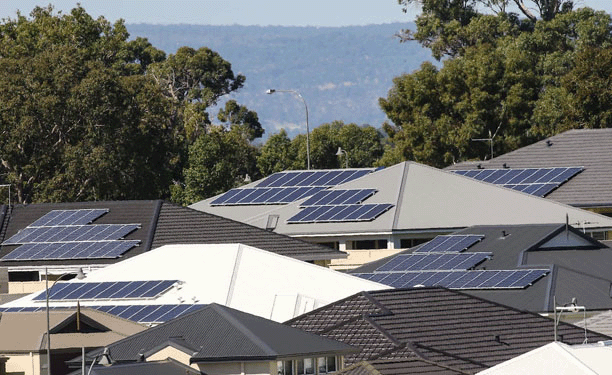
“This means the equivalent of an average of 45,000 Queensland household solar systems would need to be shut off every day. We would be shutting off cheap energy, like people’s rooftop solar, to allow expensive nuclear power to run.
“This report shows that, even if large-scale nuclear energy can be built in 15 years in Australia, we won’t need it.”
The new data supports what just about every other informed participant in Australia’s energy transition – from the market operator, to regulators, policy makers, utilities and the energy market itself – understand, and have been saying, about what will and won’t work in a grid that is changing dramatically.
And just last week, the University of Western Australia’s Bill Grace gave his own detailed analysis of why the sort of baseload power nuclear provides “is no longer necessary or commercially viable.”
QCC energy strategist Claire Silcock says this week’s report confirms that nuclear power has no place on Australia’s grid and isn’t what is needed to meet future energy demands at least cost.
“What we need is flexible generation and storage which can move energy from when we have lots of it, in the middle of the day, to when we need it overnight,” Silcock says. “That is not how nuclear power stations work.
“The earliest we could possibly build a nuclear power plant in Australia is 2040 – by then we will have abundant renewable energy and technology like batteries and pumped hydro will be providing the flexible storage we need to support that renewable energy.
“Nuclear is also much more expensive than renewable energy backed by storage,” she adds.
“It’s as clear as day that the federal Coalition’s nuclear plan is a fantasy to delay the closure of Australia’s polluting coal-fired power stations.
“We would like to see the federal opposition focus on a real plan for bringing down emissions and power prices and that would mean backing renewable energy and storage.”
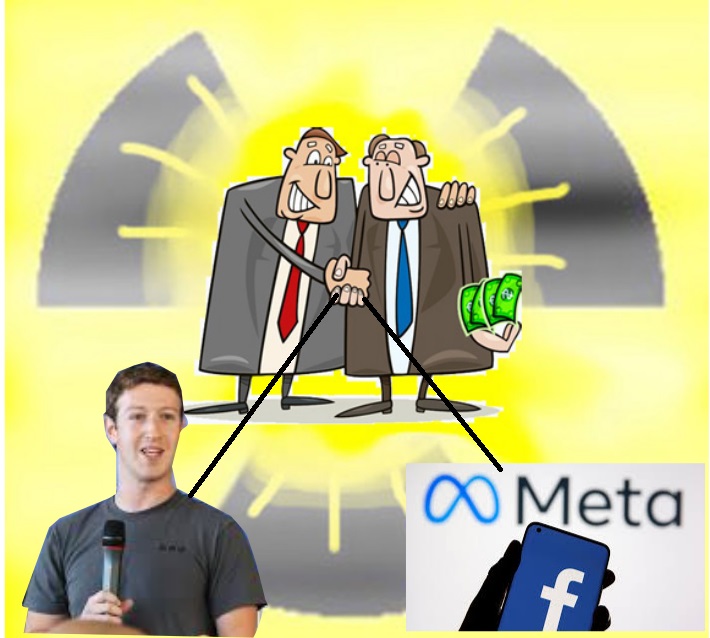
Facebook pages all still full of articles and videos making outrageous claims about renewables and nuclear. But that, it seems, is OK for the social media giant.
Facebook removed the item, saying it was an attempt to generate clicks by providing misleading information. We’d like to know on what basis this decision was made, but Facebook has yet to provide an answer.
It’s a concerning development, and not the first time one of our posts has been removed by Facebook.
Social media platforms including Facebook, X, YouTube, TikTok, and Instagram – are full of unchecked and misleading information about climate change and energy technologies. Much of it is complete nonsense creating FUD – fear, uncertainty and doubt – about new technologies.
It appears to be part of a well-funded and orchestrated plan by vested interests, and the fossil fuel industry in particular, to demonise renewables, electric vehicles, battery storage and other emerging competitors.
Much of this is amplified in mainstream media, where outrageous claims against renewables – and claims of blackouts, economic collapse and environmental failure – are repeatedly given voice.
Social media platforms including Facebook, X, YouTube, TikTok, and Instagram – are full of unchecked and misleading information about climate change and energy technologies. Much of it is complete nonsense creating FUD – fear, uncertainty and doubt – about new technologies.
It appears to be part of a well-funded and orchestrated plan by vested interests, and the fossil fuel industry in particular, to demonise renewables, electric vehicles, battery storage and other emerging competitors.
Much of this is amplified in mainstream media, where outrageous claims against renewables – and claims of blackouts, economic collapse and environmental failure – are repeatedly given voice.
Quiggin notes that the Czechia deal suggests the opposite is true, and confirms the widely held view in the energy industry itself that GenCost underestimates rather than overestimates the costs of nuclear. Nuclear, he says, is really really expensive.
But Facebook has now ruled that such analysis is misleading, and it won’t allow its users to view such information. Over the last few months, this has happened on several occasions to Renew Economy and its sister site The Driven.
Yet Facebook allows media groups such as Sky News Australia to post misleading information about renewables and climate without a check.
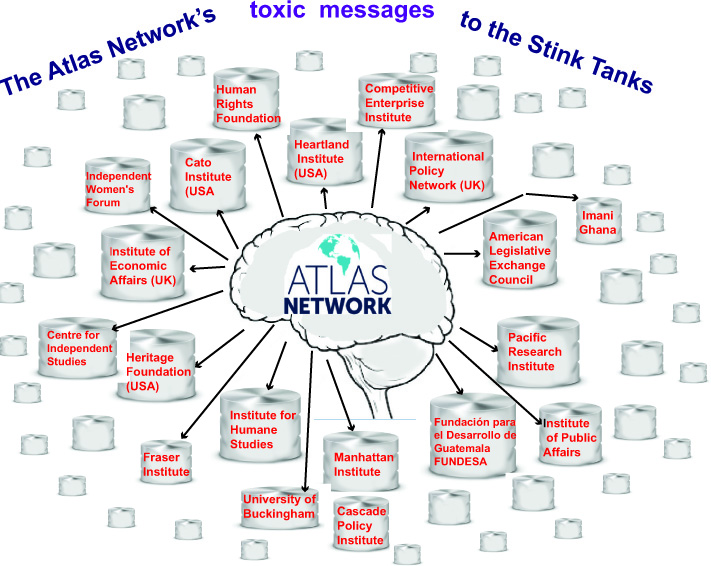
It’s a shocking development, and one that points to the manipulation of information by naysayers and vested interests. Some attribute it to the work of the Atlas Network, a shadowy group with strong Australian fossil fuel links that has campaigned against renewables, the Voice referendum, climate action, and climate protests.
Researchers say that the whole point of the Atlas network of organisations and so called “institutes” and think tanks – which this article in New Republic says includes Australia’s Centre for Independent Studies, which has launched loud attacks against institutions such as the CSIRO, AEMO, and renewables in general – is to drown out actual academic expertise.
The Atlas Network does this, researchers say, to reduce the capacity for public and government influence with its own corporate propaganda that is dressed up as “research.”
George Monbiot, a columnist for the Guardian, calls many of the 500 institutions linked with the Atlas Network “junk tanks.” Jeremy Walker, from the University of Technology in Sydney, wrote in a paper that the network in Australia includes the CIS and the Institute for Public Affairs, both strongly anti renewable, and pro nuclear.
Their Facebook pages all still full of articles and videos making outrageous claims about renewables and nuclear. But that, it seems, is OK for the social media giant.
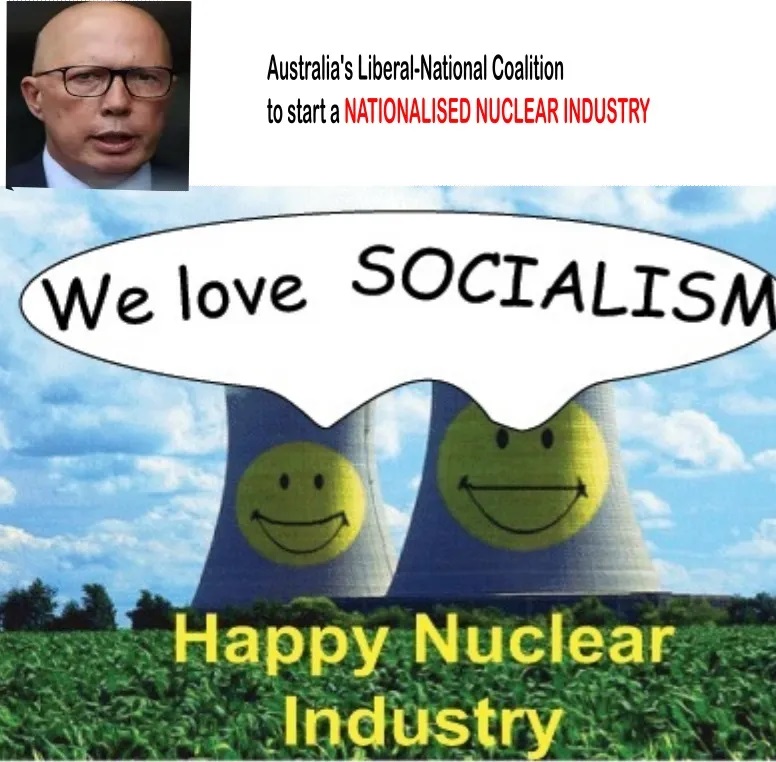
Aspects of the proposed program also go distinctly against the supposedly free market individualism so treasured by those on Dutton’s side of politics. If nuclear power was to become the fundamental means to decarbonise the Australian economy by 2050, it would entail crushing levels of debt and heavy government stewardship.
By its very nature, the Commonwealth would have to take the reins of this venture, given that private investors will have no bar of it
Peter Dutton’s sketchy plan for Australia to go nuclear is nothing more than a political distraction with no actual benefits for the country, writes Dr Binoy Kampmark.
POLITICS AND FACTS are not necessarily good dinner companions. Both often stray from the same table, taking up with other, more suitable company. The Australian Opposition Leader, Peter Dutton, has never been discomforted by facts, preferring the chimera-like qualities demagoguery offers. His vision for Australia is admirably simple and simplistic.
In foreign policy, he supports U.S. interventions in any theatre of the globe without question. Ditto such allies as Israel. To the distant north, the evil Yellow Horde is abominated. Domestically, matters are similarly one-dimensional. Irregular boat arrivals are to be repelled with necessary cruelty. And then there is a near pathological hatred of renewable energy.
Needing to find some electoral distraction to improve the Liberal-National Coalition’s chances of returning to office, Dutton has literally identified a nuclear option. Certainly, it is mischievous, throwing those wishing to invest in the problematic Australian energy market into a state of confusion. As with any investment, the business of renewables is bound to also be shaken.
Last month, Dutton finally released some details of his nuclear vision. Seven nuclear projects are envisaged, using sites with currently working or shuttered coal-fired power stations. These will be plants up to 1.4 gigawatts (GW) to be located at Loy Yang in Victoria, Liddell in NSW’s Hunter Valley and Mt Piper near Lithgow, Tarong and Callide in Queensland. Small modular (SMR) reactors are planned for Port Augusta in South Australia and Muja near Collie in Western Australia.
The SMR gambit is particularly quixotic, given that they have yet to come to viable fruition. Besides, the entire reactor venture already faces glaring legal impediments, as nuclear power is prohibited by Commonwealth and state laws. (The ban on nuclear energy was, with sweet irony, legislated by the Howard Coalition Government a quarter of a century ago.)
Already, the handicaps on the proposal are thick and onerous. Ian Lowe of Griffith University witheringly describes the proposal as ‘legally impossible, technically improbable, economically irrational and environmentally irresponsible’.
The greatest of all handicaps is the fact that Australian governments, despite tentatively flirting with the prospect of a civilian nuclear sector at points, have never convinced the citizenry about the merits of such power. The continuous failure of the Commonwealth to even identify a long-standing site for low-level radioactive waste for the country’s modest nuclear industry is a point in fact.
Aspects of the proposed program also go distinctly against the supposedly free market individualism so treasured by those on Dutton’s side of politics. If nuclear power was to become the fundamental means to decarbonise the Australian economy by 2050, it would entail crushing levels of debt and heavy government stewardship.
By its very nature, the Commonwealth would have to take the reins of this venture, given that private investors will have no bar of it.
‘There is no other way because private capital won’t go anywhere near this risky energy play, with huge upfront costs, very long lead times and the madness that has pervaded our energy transition to meet international obligations.’
The extent of government involvement and ownership of the proposed nuclear infrastructure made The Age and Sydney Morning Herald search for a precedent. It seemed to have an element of “Soviet economics” to it, directly at odds with the Liberal Party’s own professed philosophy of “lean government that minimises interference in our daily lives; and maximises individual and private sector initiative”.
It would also add to the already monstrous AUKUS obligations Australia has signed up to with the United States and the United Kingdom, a sovereignty-shredding exercise involving the transfer and construction of nuclear-powered submarines to Canberra costing upwards and above $368 billion.
The Smart Energy Council has been good enough to offer its own estimate: the seven nuclear plants and reactors would cost somewhere in the order of $600 billion, securing a mere 3.7 per cent of Australia’s energy share by 2050.
While draining the treasury of funds, this nuclear-in-Duttonland experiment would do little to alleviate energy costs. The Commonwealth Scientific and Industrial Research Organisation (CSIRO), Australia’s national science agency, along with the Australian Energy Market Operator (AEMO), have concluded that nuclear power in Australia would not be prudent in terms of cost relative to other sources of power. The obstacles noted in their 2023-24 report are impressively forbidding.
According to the report, Australia, for instance, lacks existing nuclear power projects:
‘Therefore, although it is true that all technologies have extensive pre-construction development times, nuclear is unique in that it has an empty development pipeline in Australia.’
Throw in the layers of legal, safety and security steps, any pioneering nuclear plant in Australia would be ‘significantly delayed’, rendering nuclear power’s role in achieving net zero emissions by 2050 a nonsense.
The Dutton plan is scratched of all empirical shape. Estimates are absent. Numbers, absent. Capacity, absent. Figures, if supplied, will be done immediately prior to the next Federal Election, or while in government. Such moves teeter on the edge of herculean stupidity and foolhardiness, at least in Australian conditions. The exercise is also, quite rightly, being seen as an attempt to stealthily retain coal-fired stations while starving continued investment to the renewable sector.
Dutton’s junior partner, the Nationals, has also been very candid about its position on renewable energy projects.
Party Leader David Littleproud nailed his colours to the mast on that subject early last year. By August 2023, he was explicitly calling for a “pause” to the rollout of wind and solar and transmission links, calling the Albanese Government’s pursuit of its 82 per cent renewables target a “reckless” one. His implicit suggestion: wait for the release of the nuclear genie.
The Coalition Opposition’s nuclear tease continues the tendency in Australia to soil climate policy with the sods of cultural conflict. On any matter, Dutton would be happy to become a flat-Earther were there any votes in it. The problem here is that his proposal might, on some level, be disruptively attractive — in so far as the voters are concerned. With Labor dithering in office with the smallest of majorities, any disruption may be one too many.
It is often claimed that many countries are going nuclear and if Australia wants to be a ‘Developed Country’ we should have nuclear power.
If that is the case, how would we go about it?
The first step is to build a regulatory framework. Regulations differ from country to country partly for historical reasons and partly different circumstances.
Then like all codes, the regulations are modified bit by bit in response to new hazards or changes in practice, but they become cluttered with deadwood with slightly conflicting requirements which make compliance difficult and expensive.
Typically, it takes two to three years and US$1-2bn to get a licence to build a new nuclear plant in the US, even if the plant itself is an approved design on an existing site.
We could work with the international agencies to develop a modern set of regulations, but that could easily take 4-5 years.
So, let’s say we agree to just doing a quick copy and paste job after legislation is passed in late 2025 and we start to recruit the necessary staff in 2026.
The UK has 700 regulation staff, France 1,500 and the US 2,700 so by 2030 the regulations would be published, and site selection could proceed.
The French regulator has a budget of €150m/y and French salaries are about 25 percent lower than ours.
We can then estimate that the first thirty years of the Regulator’s life would cost the taxpayer $3-5bn.
The nuclear workforce
At the same time, we need to establish and train the construction workforce.
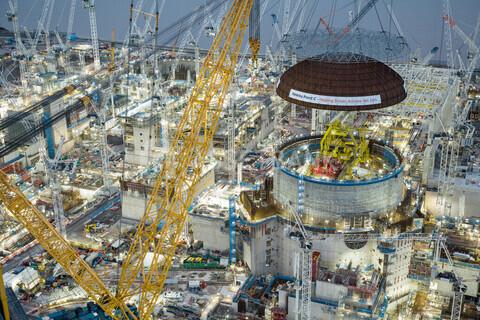
EDF Energy claims that 22,000 people in Britain are working on the Hinckley Point C power station (pictured). This is nine times the size of the Snowy II workforce and almost three times the size of the entire Australian oil and gas extraction industry.
Most of these people would need security clearance and many would need additional training and certification.
If we say that on average it is 3 months training for two thirds of the staff, that is an initial training load of about 900,000 person days, say 1,000,000 days including training the trainers.
ver seven years, that is a cost of about $200m not including students wages.
However, Britain is building two plants in about 17 years. If we want six plants on line by 2065 we would be building a peak of five at one time so the workforce would reach 45-50,000.
With retirements and departures, the training and security bill will be over $700m over thirty years
Fabricating nuclear power stations
Now apart from the lack of skills, we don’t have fabrication workshops with twin 500 tonne cranes and appropriate welding and heat treatment equipment.
These cost about $200m to build and equip.
Further, transport constraints and the distance between projects means that new workshops will probably need to be built near each site as would concrete batching plants etc. Some equipment would be shared but $500m in plant costs is not unreasonable.
Then there is the question of build cost. CSIRO used Korean figures, but they are highly questionable as there have been no public updates since 2018 and the company building and operating the nuclear plants is carrying US$150bn in debt, about two years annual sales.
We do have public data on other reactors, although that data usually doesn’t include all the losses made by contractors such as Westinghouse and Siemens who withdrew from projects after billions in losses.
All these plants are built on existing sites with plentiful cold cooling water and robust transmission access and an established nuclear workforce.
Access to cooling water can’t be dismissed. A single reactor cooling tower evaporates enough water for a city of 350,000 people.
Even without the traditional ‘Australian Premium’ for construction projects, believing we could build plants at less than a 10 percent premium over experienced northern hemisphere countries is stretching credibility, so A$42-45bn each in 2024 dollars is likely with another $2-4bn on water and transmission infrastructure per reactor.
Adding up the bill for nuclear power
ll up the bill is approaching $270bn over thirty years to build enough nuclear capacity to supply about 50-55,000 GWh/y.
If we build the cheapest plant above and somehow manage to give the Americans twenty-three years start and build them for the same cost, it is still close to A$175bn for less than 50,000 GWh/y.
According to the US Department of Energy, fuel, operations, security, maintenance and other overheads are around A$50-65/MWh.
At current cost of capital, amortising the establishment cost over 60 years, finance and depreciation works out at about $400-500/MWh.
Best case total cost of $450/MWh.
Further, as it is not uncommon to have three or four of six plants offline at once for six weeks or more, we would need to maintain even more gas/coal/hydro than we have now to supply 500-600,000 GWh/y of demand in 2060-70.
Or what of wind, solar?
On the other hand, we are currently building enough wind/solar/storage every year to add 7-10,000 GWh/y, roughly the equivalent of one nuclear power plant.
With enough storage to make wind/solar as reliable as nuclear, if the government offered a guaranteed price of A$120/MWh they would be knocked over in the rush.
Peter Farley holds an engineering degree and is a manufacturing leader who built pioneering CNC machine tools for export winning many export and engineering awards. Peter has been studying the electricity sector since his 2012 Election to the Victorian Committee of Engineers Australia. A realistic time frame for building nuclear- by Peter Farley
DECLASSIFIED AUSTRALIA by Peter Cronau | 3 Nov, 2023
The Pine Gap US surveillance base located outside of Alice Springs in Australia is collecting an enormous range of communications and electronic intelligence from the brutal Gaza-Israel battlefield – and this data is being provided to the Israel Defence Forces.
Two large Orion geosynchronous signals intelligence satellites, belonging to the US and operated from Pine Gap, are located 36,000 kms above the equator over the Indian Ocean. From there, they look down on the Middle East, Europe and Africa, and gather huge amounts of intelligence data to beam back to the Pine Gap base.
After collecting and analysing the communications and intelligence data for the USA’s National Security Agency (NSA), Pine Gap’s data is provided to the Israel Defence Forces, as it steps up its brutal assault on Palestinians in the Gaza enclave.
“Pine Gap facility is monitoring the Gaza Strip and surrounding areas with all its resources, and gathering intelligence assessed to be useful to Israel,” a former Pine Gap employee has told Declassified Australia.
David Rosenberg worked inside Pine Gap as ‘team leader of weapon signals analysis’ for 18 years until 2008. He is a 23-year veteran of the National Security Agency (NSA).
“Pine Gap has satellites overhead. Every one of those assets would be on those locations, looking for anything that could help them.”
“Pine Gap facility is monitoring the Gaza Strip and surrounding areas with all its resources, and gathering intelligence assessed to be useful to Israel.”
Rosenberg says the personnel at Pine Gap are tasked to collect signals such as ‘command and control’ centres in Gaza, with Hamas headquarters often located near hospitals, schools, and other civilian structures. “The aim would be to minimise casualties to non-combatants in achieving their objective of destroying Hamas.”……………………………………
Pine Gap base’s global role in fighting wars for US and allies
The sprawling satellite ground station outside Alice Springs, officially titled Joint Defence Facility Pine Gap (JDFPG), has been described as the United States’ second most important surveillance base globally.
About half the 800 personnel working at the Central Australian base are American, with Australian government employees making up fewer than 100 of the increasingly privatised staff.
The base is no mere passive communication collector. Personnel at the Pine Gap base provide vital detailed analysis and reporting on SIGINT (signals intelligence) and ELINT (electronic intelligence) it collects.
As well as surveillance of civilian, commercial, and military communications, it provides detailed geolocation intelligence to the US military that can be used to locate with precision targets in the battlefield.
This was first conclusively documented with concrete evidence in a secret NSA document, titled “Site Profile”, leaked from the Edward Snowden archive to this writer and first published by Australia’s ABC Radio ‘Background Briefing’ program in 2017:
“RAINFALL [Pine Gap’s NSA codename] detects, collects, records, processes, analyses and reports on PROFORMA signals collected from tasked target entities.”
These PROFORMA signals are the communications data of radar and weapon systems collected in near real-time – they likely would include remote launch signals for Hamas rockets, as well as any threatened missile launches from Lebanon or Iran.
This present war in Gaza is not the first time the dishes of Pine Gap have assisted Israel’s military with intelligence, including the detecting of incoming missiles, according to this previous report.
“During the [1991] Gulf War, Israeli reports praised Australia for relaying Scud missile launch warnings from the Nurrungar joint US-Australian facility in South Australia, a task now assigned to Pine Gap.”
During the early stages of the 2003 US invasion of Iraq, the NSA installed a data link to send early warning of any Iraqi missile launches detected directly to Israel’s Air Force headquarters at Tel Nof airbase, south of Tel Aviv.
Israel’s access to the jewels of the Five Eye global surveillance network
The NSA “maintains a far-reaching technical and analytic relationship with the Israeli SIGINT National Unit (ISNU),” according to documents published by The Intercept in 2014. The documents show the NSA and ISNU are “sharing information on access, intercept, targeting, language, analysis and reporting”.
“This SIGINT relationship has increasingly been the catalyst for a broader intelligence relationship between the United States and Israel.
It’s thanks to the Pine Gap base, with its satellites so strategically positioned to monitor the Middle East region, along with its targeting and analysis capability, that Israel is able to make use of these benefits.
………………….This wide intelligence sharing arrangement potentially opens up to the Israelis the ‘jewels’ of the Five Eye global surveillance system collected by the NSA global surveillance network, including by Australia’s Pine Gap base.
Declassified Australia asked a series of questions of the Australian Defence Department about the role of the Pine Gap base in the Israel-Gaza war, and about the legal protections that may be in place to defend personnel of the base should legal charges of war crimes be laid. No response was received by deadline. https://declassifiedaus.org/2023/11/03/targeting-palestine/
In some places, Friday’s mass tech outage resembled the beginning of an apocalyptic zombie movie. Supermarket checkouts were felled across the country and shoppers were turned away, airports became shelters for stranded passengers, and live TV and radio presenters were left scrambling to fill airtime. The iconic Windows “blue screen of death” hit millions of devices globally and rendered them effectively useless.
The ABC’s national youth station Triple J issued a call-out for anyone who could come to their Sydney studio to DJ in person. One woman was reportedly unable to open her smart fridge to access her food.
All because of a failure at CrowdStrike, a company that most of us – least of all those who were worst hit – had never heard of before.
It’s thought to be the worst tech outage in history and Australia was at its epicentre: the crisis began here, and spread to Europe and the US as the day progressed. Surgeries were cancelled in Austria, Japanese airlines cancelled flights and Indian banks were knocked offline. It was a horrifying demonstration of how interconnected global technology is, and how quickly things can fall apart.
At its peak, it reminded us of some of the most stressful periods of the pandemic, when shoppers fought each other for rolls of toilet paper and argued about whether they needed to wear masks.
Many of us lived through the Y2K panic. We avoided the worst outcomes but it was an early harbinger of how vulnerable our technology is to bugs and faults, and showed the work required to keep everything up and running. The CrowdStrike meltdown felt closer to what’s really at risk when things go wrong.
As a technology reporter, for years I’ve had warnings from industry executives of the danger of cyberattacks or mass outages. These warnings have become real.
The cause of this outage was not anything malicious. It was relatively innocuous: CrowdStrike has blamed a faulty update from its security software, which then caused millions of Windows machines to crash and enter a recovery boot loop.
Of course Australians are no strangers to mass outages, even as they become more common and more severe.
The Optus network outage that froze train networks and disrupted hospital services just over six months ago was eerily similar to the events on Friday, not least because it was also caused by what was supposed to be a routine software upgrade.
The resignation of chief executive Kelly Bayer Rosmarin did little to prevent another Optus outage a month later. If anything, Friday’s CrowdStrike outage highlights how many opportunities there are for one failure to cripple millions of devices and grind the global economy to a halt. So many of the devices that underpin our economy have hundreds of different ways that they can be knocked offline, whether through a cyberattack or human error, as was likely the case with CrowdStrike.
The incident would likely have been even worse were it a cyberattack. Experts have long warned about the vulnerability of critical infrastructure – including water supplies and electricity – to malicious hackers. Everything is now connected to the internet and is therefore at risk.
And yet the potential damage of such attacks is only growing. We are now more reliant than ever on a concentrated number of software firms, and we have repeatedly seen their products come up short when we need them to just work.
In the US, the chair of the Federal Trade Commission, Lina Khan, put it succinctly.
“All too often these days, a single glitch results in a system-wide outage, affecting industries from healthcare and airlines to banks and auto-dealers,” Khan said on Saturday.
“Millions of people and businesses pay the price.”
Khan is right. The technology we rely on is increasingly fragile, and is increasingly in the hands of just a few companies. The world’s tech giants like Microsoft and Apple now effectively run our daily lives and businesses, and an update containing a small human error can knock it all over, from Australia to India.
The heat is now on CrowdStrike, as well as the broader technology sector on which we rely so heavily, and some initial lessons are clear. Airlines have backup systems to help keep some flights operational in the case of a technological malfunction. As everyday citizens, it’s an unfortunate reality that we need to think similarly.
Keeping cash as a backup is a smart idea in the event of a payment systems outage, as is having spare battery packs for your devices. Many smart modems these days, like those from Telstra and Optus, offer 4G or 5G internet if their main connection goes down. We need more redundancies built in to the technology we use, and more alternatives in case the technology stops working altogether.
For IT executives at supermarkets, banks and hospitals, the outage makes it clear that “business as usual” will no longer cut it, and customers rightly should expect adequate backups to be in place. Before the Optus outage, a sense of complacency had permeated our IT operations rooms and our company boardrooms, and it still remains. No longer.
The “blue screen of death”, accompanied by a frowny face, was an apt metaphor for the current state of play when it comes to our overreliance on technology. Our technology companies – and us consumers, too – need to do things differently if we’re to avoid another catastrophic global IT outage. There’s too much at stake not to.
In this, the first in an occasional series about nuclear power in Australia, Peter Farley says the claim of nuclear reliability is vastly overstated.
“No amount of experimentation can ever prove me right; a single experiment can prove me wrong,” – Albert Einstein.
As a student in the late 60’s I watched a training film which assured us that nuclear power was available every hour of every day and it would soon be ‘too cheap to meter’ (Chairman of US Atomic Energy Commission 1954).
In the seventies the nuclear story began to unravel – nuclear plants were nowhere near as reliable as claimed.
Nuclear plants must be shut down for maintenance and refuelling which takes 4-6 weeks every 1-3 years.
An additional complication is that due to the huge thermal mass and the risk of fuel containment failing with rapid operating changes, a nominal two-hour repair of a simple wiring fault requires a 48–72-hour power down/power up process.
Consequently, in the seventies and eighties nuclear availability was in the 70-80% range, not the claimed 95%.
Later it was realised that an emergency shutdown due to an external issue such as a turbine fault, loss of transmission etc., xenon gas was generated within the reactor and stopped the nuclear reaction.
Xenon, which itself is radioactive, must be carefully and thoroughly extracted from the reactor before restart.
After the Great Northeast blackout in the US in 1965 some reactors took two weeks to return to service.
Then it became clear that the benefits of a common design had their downsides.
In Canada in 1998 it was discovered that their design led to premature failure of cooling tubes, so 8 of 22 reactors were shut down. It took until 2006 for production to fully recover.
Then by 2014 a series of upgrades began with one to three reactors offline for 24-30 months each. 2023 output was still 16% down on 2014. France had a similar experience in 2020 and 2022.
The British Magnox reactors had problems with graphite blocks. There wasn’t a single year where nuclear output in the UK was above 86% of capacity.
In Switzerland in 2015 for a brief period all five reactors were off-line.
In Belgium in 2015, output was down 46% on the 2000-2012 average. Worse, for six weeks late in 2018, four of five reactors were offline and for the whole second half of 2018 nuclear output was 61% down on historical levels.
Fortunately for Belgium, they burned a lot of cheap gas. More significantly, they imported an average of 24% and up to 44% of their electricity for the half.
Before turning to the big producers, France and the US, let’s check the latest nuclear champion, Finland.
In winter 23/24 nuclear power ran faultlessly but load varies, so its contribution varied between 23% and 48% of the load.
But by March for long periods, imports were larger than nuclear power output. In May, nuclear output was 40% down on January.
While France is a nuclear success story, it is not without significant problems. Nuclear output peaked in France in 2005 at 450 TWh, 79% share of generation and 81% capacity factor.
By 2016-17 problems began to appear and nuclear output dropped below 400 TWh, then by 2020 around 350 TWh and 67.5% market share.
Then in 2022 disaster struck. A new form of stress corrosion was discovered in Civaux-1 which was only 20 years old.
Further, a record drought meant cooling water was restricted at another six reactors halving power output there, even after a temporary suspension of environmental regulations.
Soon half of France’s reactors were offline. The result was that in the midst of the global gas crisis, France’s 2022 nuclear output was 182 TWh below 2005.
That is the equivalent to 520 Snowy 2.0s. Relative to the NEM, the reduction is equivalent to quadrupling our 2022 gas output and completely draining seventy Snowy 2.0.
The NEM was in near crisis when coal output fell by 4.8% between winter 2021 and winter 2022. In July to September 2022 French nuclear output was down 43% from historical levels so instead of exporting 14% of its electricity for those months it imported 10%. Who will we import from?
While the US nuclear system is more productive with 93% Capacity Factor, it also has 870 GW of fossil fuels and hydro/pumped hydro and import capacity to back up the 97 GW of nuclear.
That is equivalent to increasing our existing coal, gas and hydro capacity by 50% to back up 7 GW of nuclear.
Alternatively, US nuclear power works because it only supplies 18% of US grid electricity from 91 reactors.
If we only want 20% of grid supply from nuclear, that means just four or five conventional reactors.
With 43 coal generators we still have problems when there are clusters of outages. If a large number of reactors is required so that the loss of three to five at once, as has happened in Belgium, Switzerland, Sweden, and Canada is not a problem, we need a number about where the US is now, meaning roughly a hundred 80-120 MW reactors.
But even then, it is no guarantee – in April 2023 nuclear output in the US was down 20% on January
In conclusion, a feasible number of nuclear reactors in Australia would not guarantee reliability, regardless of cost.
Peter Farley holds an engineering degree and is a manufacturing leader who built pioneering CNC machine tools for export winning many export and engineering awards. Peter has been studying the electricity sector since his 2012 Election to the Victorian Committee of Engineers Australia.
Clare Silcock, 21 July 2024, https://www.queenslandconservation.org.au/nuclear_option_shutting_off_cheap_solar Queensland Conservation Council (QCC) has today released a new analysis showing that the equivalent of 45,000 Queensland household solar systems would need to be shut off every day to allow just one nuclear power station to operate in 2040. With the renewable energy rollout well underway, by the time we have built a nuclear power station in Queensland, we won’t have the need for it.
Clare Silcock, Energy Strategist at QCC, said:
Nuclear power stations can’t easily turn off, which means by 2040, we’d have to turn off a staggering 3,700 GWh of cheap renewable energy every year just to run one nuclear power station. We would be shutting off cheap energy to allow expensive nuclear power to run.
This report shows that nuclear power simply doesn’t fit into a modern grid and isn’t what we need to meet our future energy demands at the least cost.
Our energy system is changing rapidly. We’ve nearly doubled renewable energy in Queensland in five years. A large part of this has been from rooftop solar systems which have fundamentally changed when we need energy to support the grid.
Baseload generation is what our power system was built on, but it’s not what we need in the future. Saying that we need baseload generation is like saying that we need floppy disks to transfer files between computers.
What we need is flexible generation and storage which can move energy from when we have lots of it, in the middle of the day, to when we need it overnight. That is not how nuclear power stations work.
The earliest we could possibly build a nuclear power plant in Australia is 2040 – by then we will have abundant renewable energy and technology like batteries and pumped hydro will be providing the flexible storage we need to support that renewable energy.
Nuclear is also much more expensive than renewable energy backed by storage. CSIRO estimates nuclear could be up to four times more expensive to build. It’s as clear as day that the Federal Coalition’s nuclear plan is a fantasy to delay the closure of Australia’s polluting coal-fired power stations.
We would like to see the Federal Opposition focus on a real plan for bringing down emissions and power prices and that would mean backing renewable energy and storage.










 Antinuclear