Support for nuclear power will evaporate at next election, Chris Bowen predicts
Polling shows that Australians prefer renewables, climate change and energy minister says
Adam Morton Climate and environment editor, https://www.theguardian.com/australia-news/2024/nov/04/nuclear-power-support-australia-election-chris-bowen
Support for nuclear power is likely to evaporate once Australians face a clear choice at the next election and realise the Coalition’s policy would mean relying more on old coal plants and increased risk of blackouts, Chris Bowen says.
The climate change and energy minister said that while some polling had suggested some voters were open to nuclear plants being allowed in Australia surveys had also consistently found they preferred renewable energy.
“Every bit of research I’ve seen, public and private, says that when shown details and given a choice between nuclear and other forms of energy, nuclear fares very, very badly,” he said. “If you look at the popularity of different forms of energy, it’s solar, wind, gas, daylight, coal, nuclear, in that order, every single time.”
Support for nuclear power is likely to evaporate once Australians face a clear choice at the next election and realise the Coalition’s policy would mean relying more on old coal plants and increased risk of blackouts, Chris Bowen says.
The climate change and energy minister said that while some polling had suggested some voters were open to nuclear plants being allowed in Australia surveys had also consistently found they preferred renewable energy.
“Every bit of research I’ve seen, public and private, says that when shown details and given a choice between nuclear and other forms of energy, nuclear fares very, very badly,” he said. “If you look at the popularity of different forms of energy, it’s solar, wind, gas, daylight, coal, nuclear, in that order, every single time.”
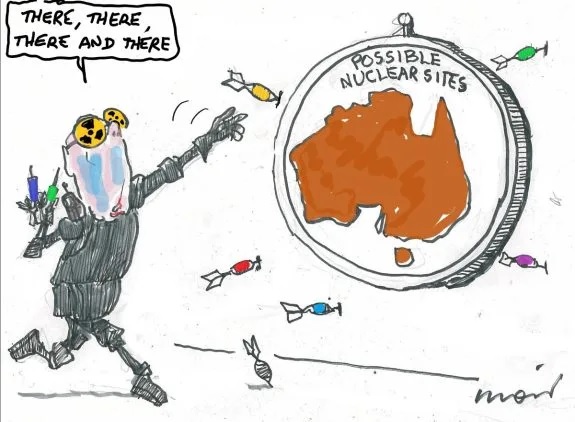
The Coalition has named seven sites where it says it would eventually replace coal-fired power plants with nuclear plants but not how much this would cost. Multiple energy analysts argue nuclear energy would be more expensive than other options and a nuclear industry would not be possible in Australia until after 2040. The bulk of the country’s coal plants are scheduled to close in the 2030s.
The opposition has suggested it would limit the rollout of large-scale renewable energy – it has criticised Labor’s goal of 82% renewable energy by 2030 – and bridge the gap by keeping ageing coal plants running longer and using more gas-fired power.
It has not yet said what type of gas plants this means. With nuclear banned, gas is the most expensive form of electricity in the national electricity market and it use is largely restricted to “peaking” power turned on only when needed. It provided less than 3% of electricity in the national grid over the past month.
The chair of the Australian Energy Regulator, Claire Savage, told a parliamentary inquiry she did not believe that nuclear plants could be built in enough time to cover the closure of coal-fired power plants. More than a quarter of the coal power capacity in the national grid was offline on the day she gave evidence due to planned and unplanned outages.
Australia votes at the UN General Assembly

A few days ago, Australia voted on a number of nuclear weapons resolutions at the UN General Assembly. Thank you to the hundreds of you that emailed Foreign Minister Wong urging Australia to vote in the right way! In good news, Australia voted “Yes” on the scientific research resolution (L.39) supporting a major new UN-mandated study on the effects of nuclear weapons. Several nuclear-armed states were trying to mobilise supporters to vote against this resolution so we know they are threatened by it. Knowledge is power!
Disappointingly, Australia continued its abstention on the TPNW resolution (L.37) and humanitarian impacts resolution (L.36), instead of voting “Yes”.
Earlier in October ICAN visited Parliament to advocate for the TPNW with parliamentarians across the political spectrum. We were also delighted to have met with Siswo Pramono, Indonesia’s Ambassador to Australia, and congratulate him on Indonesia’s recent ratification of the TPNW. Mr Pramono addressed the Parliamentary Friends of the TPNW group and stated that the success of the TPNW also hinges upon the participation of countries who possess nuclear weapons. “We need a concerted effort to convince them to become Parties to the Treaty,” he said. “In doing so, leadership from developed countries such as Australia is needed.”
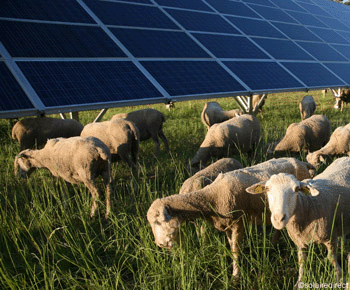
Grazing sheep among solar panels could produce higher quality wool, study finds
Sophie Vorrath, Nov 1, 2024,
https://reneweconomy.com.au/grazing-sheep-among-solar-panels-could-produce-higher-quality-wool-study-finds/
The co-location of solar farming with sheep grazing does not have a negative affect on wool production and could even improve the quality of the wool produced, a new study has found.
The study is based on the results of a second round of wool testing at the Wellington solar farm, south east of Dubbo in New South Wales, which has shared its site with 1,700 merino sheep for the past three years.
Legend has it that the decision to graze sheep at the solar farm came about when an employee of Lightsource bp, the owner of the Wellington project, complained to a local, sixth-generation wool farmer about the hassle and cost of mowing the solar farm six times a year.
According to Tony Inder, who heads up the Allendale Merino Stud, the effect on his sheep has been a lot better than he thought it would be – he says the wool quality they are producing has “increased significantly.”
But Lightsource bp – which is now wholly owned by the oil and gas giant BP, after completing the acquisition of the remaining 50.03% interest – has used the opportunity to gather some formal data.
The study, conducted by EMM Consulting with support from Elders Rural Services, compares two groups of merino sheep – one group grazed in a regular paddock and the other at the Wellington solar farm.
The latest findings show grazing sheep among solar panels does no harm to wool production, even in the case of pre-existing high-quality standards. And it says that some parameters even indicate an improvement in wool quality, although conclusive benefits require further long-term measurement.
Lightsource bp says that while the study at the Wellington solar farm is ongoing, it is another indication that solar farms can exist side-by-side with sheep farming, for the benefit of both enterprises.
“These results are very encouraging and highlight the potential for solar farms to complement agricultural practices,” says Emilien Simonot, Lightsource bp’s head of agrivoltaics.
“By integrating sheep farming with solar energy production, we can achieve dual benefits of sustainable energy together with agricultural output.” . By co-locating grazing with renewable energy, land can remain in agricultural use, offering farmers additional revenue while contributing to cleaner energy for the planet.
“Finding ways for agriculture and clean energy to work together is crucial for a more sustainable future,” says Brendan Clarke, interim head o environmental planning Australia and NZ at Lightsource bp.
“The promising results from this study indicate that we are on the right path, and working closely with farmers to grow our knowledge in this area is paramount.”
As for the sheep, Inder says they “just do really well” when grazing among the Wellington solar farm panels.
“I like to say that panel sheep are happy sheep.”
Sophie is editor of One Step Off The Grid and deputy editor of its sister site, Renew Economy. She is the co-host of the Solar Insiders Podcast. Sophie has been writing about clean energy for more than a decade.
Low-level nuclear waste from submarines to be stored at Osborne, South Australia
Adelaide Now, 30 Oct 24
Legislation passed will see a “radioactive waste facility’’ built in an Adelaide suburb, but federal and state ministers maintain it will only house “low level’’ material. Have your say.
Low-level radioactive waste generated by the building of the AUKUS nuclear submarines will be stored at Port Adelaide after legislation passed the federal parliament allowing for the construction of a “waste management facility’’.
However federal Defence Minister Richard Marles and his state counterpart Stephen Mullighan both denied any “intermediate’’ or “high-level” waste will be stored at the Osborne submarine facility, in Adelaide’s western suburbs
A spokesperson for Mr Marles said “submarine construction, test and commissioning activities planned for Osborne will generate small amounts of low-level radioactive waste’’, including personal protective equipment.
“This low-level radioactive waste will need to be managed and temporarily stored in a licensed facility,’’ the spokesperson said. “No intermediate-level waste or high-level radioactive waste (spent nuclear fuel) will be managed or stored in the facility.’’
Both the Albanese Labor government and the Peter Dutton-led Liberal opposition voted in favour of the Australian Naval Nuclear Power Safety Bill. The Bill ‘’regulate activities relating to conventionally armed, nuclear powered submarines’’.
Do you support a “radioactive waste facility’’ being built at the Osborne submarine base
Yes: It’s the right spot for it
69 %
No, I don’t want it anywhere in SA
31 %
563 votes
It names Osborne as a “designated zone’’ where “a facility for managing, storing or disposing of radioactive waste’’ could be built. The legislation does not specify what level of radioactive waste could be stored.
The legislation has sparked a community backlash, with a change.org petition started by former Liberal candidate Jake Hall-Evans already reaching almost 4000 signatures.
Mr Hall-Evans said there had been a lack of transparency about the possibility of a nuclear waste dump at Osborne.
“The people of Port Adelaide were promised submarine jobs, not a nuclear waste dump,’’ Mr Hall-Evans said.
He said Australia had struggled to find a suitable location for low-level radioactive waste, with a proposed facility at Kimba on the state’s Eyre Peninsula knocked back last year.
Premier Peter Malinauskas also opposed the dump at Kimba.
South Australian Greens Senator Sarah Hanson-Young said the new law was a “dangerous disaster for our state’’.
“This is toxic for South Australia,’’ Ms Hanson-Young, who is holding a nuclear forum at the Burnside Town Hall in the marginal seat of Sturt on Thursday.
“Peter Dutton not only wants nuclear reactors across Australia – he wants Adelaide to be an international dumping ground for nuclear waste,’’ she said.
A spokesperson for Port Adelaide Enfield Council said it had “not been consulted or advised of any licences being approved for a radioactive or nuclear waste storage site at Osborne’’.
Defence Minister Stephen Mullighan said there was “no proposal or capacity for nuclear waste, including low-level waste to be stored in the long term’’. term’’.
Ontario’s huge nuclear debt and other things Dutton doesn’t understand about cost of electricity

Unfortunately for us, Dutton and O’Brien are also in a hurry. They think they can deliver nuclear power plants far faster than what many experts believe is sensible and what many countries with far more nuclear experience than ourselves have been able to achieve.
Dutton and O’Brien also want to do this via a government-owned utility, instead of via a competitive market.
ReNewEconomy, Tristan Edis, Oct 30, 2024
All of this has left taxpayers with a massive budget and timeframe blow-out. This is what happens when we leave it to politicians in a hurry to hand pick power projects.
It seems our alternative Prime Minister Peter Dutton’s favourite topic is your electricity bill. Given how much he talks about electricity prices, you’d think he might know a fair bit about what makes up your electricity bill, wouldn’t you?
According to Dutton and his Shadow Energy Minister Ted O’Brien, the problem is all about too much renewable energy in the mix. And their answer to the problem is nuclear power, as well as more gas.
According to Peter Dutton, “We can’t continue a situation that Labor has us on of a renewables only policy because, as we know, your power prices are just going to keep going up under this Prime Minister.”
Instead, according to Dutton, “we could be like Ontario, where they’ve got 60 or 70 per cent nuclear in the mix, and they’re paying about a quarter of the price for electricity that we are here in Australia.”
O’Brien, elaborated on this point by saying:
“We will have plenty of time in due course to talk about the costings [for their nuclear plan] once we release them here in the Australian context. But I point to Ontario in Canada, there you have up to 60 per cent of their energy mix in the grid, coming from zero emissions, nuclear energy. Their households pay around about 14 cents kilowatt hour. There are parts in Australia that will be paying up to 56 cents a kilowatt hour from July 1 this year.”
Once you actually delve into these numbers it becomes apparent that O’Brien and Dutton don’t seem know much about electricity costs and pricing.
But even worse, they don’t know how badly Ontario’s taxpayers and electricity consumers were burnt by their utility racking up huge debt building nuclear power plants equal to $70 billion in current day Australian dollars.
Do Dutton and O’Brien understand your electricity bill?
You can actually look up what Ontario households pay for electricity via the Ontario Energy Board’s bill calculator website.
This provides you with a break down on the charges a typical household faces depending on the utility you choose…………………………………………………
But notice there’s also other very significant items in this bill separate to the kilowatt-hour charge? There’s a “delivery” charge which is the cost of paying for the distribution and transmission poles and wires. There’s also regulatory charges and also their sales tax is known as “HST” rather than GST for us.
So the Ontario 14 cents per kilowatt-hour charge that O’Brien and Dutton are referring to covers only the wholesale energy portion of their bill.
In Australia, we pay a majority of the costs of distribution and transmission in our cents per kilowatt-hour charge, in addition to wholesale energy costs, and then we get GST added on top. O’Brien and Dutton don’t seem to have appreciated this important aspect of electricity pricing in this country, which is different to Ontario.
But it actually gets worse.
I went digging on the official government energy retailer comparison sites- www.energymadeeasy.gov.au and www.energycompare.vic.gov.au and I initially couldn’t find a single Australian retailer selling electricity at 56 cents per kilowatt-hour.
This was based on looking at offers based on a single rate tariff. Then I had a brainwave and looked at time-of-use rates. In Queensland and Victoria I still couldn’t find anyone wanting to charge me 56 cents for the peak period.
But eventually I succeeded. Right at the bottom of the EnergyMadeEasy list of retailer offers – which were ordered from best to worst – sat EnergyAustralia as the worst offer, charging 57 cents for the peak period in South Australia (although with a compensating high solar feed-in tariff of 8.5 cents)…………………………………
To help out O’Brien and Dutton, I’ve prepared the table below which provides a proper apples versus apples comparison (as opposed to apples vs peak rate bananas) –[on original ]
…………………………………………….. Ontario’s nuclear debt debacle
Yet this comparison between Ontario and Australia misses a far more important part of the story that O’Brien and Dutton seem to be blissfully ignorant of.
That is the history of the Ontario’s state owned utility – Ontario Hydro – and the unsustainable level of debt that it racked up over the 1980’s and 1990’s as a result of an ambitious nuclear plant construction program that went wrong.
While this cost is no longer apparent in current electricity prices, Ontario businesses and households were stuck with paying back CAD$38.1 billion in debt (over $70 billion in Australian current day dollars) for more than 35 years after their public utility committed its last nuclear reactor to construction in 1981.
So what went wrong?
In anticipation of large growth in electricity demand, over the 1970’s and 1980’s Ontario Hydro committed to construction 12 nuclear reactors with 9,000 MW of generating capacity. To fund the projects the public utility accessed commercial debt markets anticipating that it could comfortably repay this debt from the increased electricity demand it forecast. However, several things went wrong.
The nuclear power stations took far longer to build and were around twice as expensive to build than had been planned
– Interest rates on debt rose to very high levels by historical standards over the 1980’s in order to contain the high levels of inflation that unfolded over the 1970’s and early 1980’s. With the nuclear power stations taking longer than expected to build, interest was accumulating on this debt with far less output from the plants to offset it.
– Lastly, Ontario Hydro’s estimate of large growth in electricity demand didn’t eventuate. A 1977 forecast projected a system peak of 57,000 MW by 1997. Actual peak demand in 1997 was 22,000 MW. This meant that the very large cost and associated debt of the large nuclear expansion had to be recovered from a much smaller volume of electricity sales than it had anticipated, making it much harder to pay off the debt without substantial increases in electricity prices.
……………………………………………………………………………………………………………… “On April 1, 1999, the Ministry of Finance determined that Ontario Hydro’s total debt and other liabilities stood at $38.1 billion, which greatly exceeded the estimated $17.2-billion market value of the assets being transferred to the new entities. The resulting shortfall of $20.9 billion was determined to be “stranded debt,” representing the total debt and other liabilities of Ontario Hydro that could not be serviced in a competitive environment.”
So the CAD$38.1 billion in debt was transferred out of the electricity companies and into a special purpose government entity called the Ontario Electricity Financial Corporation (OEFC). This debt management corporation was given the following revenues to service the debt:
– Both residential and business consumers were required to pay a special “Debt Retirement Charge”. This charge was introduced in 2002 and lasted until 2016 for residential consumers and 2018 for business customers.
– The Ontario government would forgo any corporate income and other taxes owed by the offshoot electricity companies from Ontario Hydro so they could be diverted to the OEFC to pay down debt.
– If the cumulative profits of two of the new state power companies exceeded the $520m annual interest cost on their debts, then this would go towards paying stranded debt rather than dividends to the Ontario government.
None of this is apparent on current bills, but the burden of repaying the nuclear debt left the Ontario government and its taxpayers far poorer than Dutton and O’Brien seem to appreciate.
More things O’Brien doesn’t want to understand about Ontario’s nuclear power program
Dutton and O’Brien like to claim that nuclear power plants last a very long time and so therefore the large upfront cost of these plants isn’t something we should be too worried about………………………..
It’s not as simple as this. Nuclear power plants involve a range of components which are exposed to severe heat and mechanical stress. These all need to be replaced well before you get to 60 years, and such refurbishment comes at a cost.
Ontario’s experience is that refurbishment comes at a very significant cost. Less than 25 years after the Darlington Nuclear Power Plant construction was completed, it needed to commence refurbishment. The total cost? $12.8 billion in Canadian dollars or $14 billion Australian dollars.
This is partly why, even though the original nuclear construction cost debt had been largely paid down and nuclear operating costs are lower than coal or gas plant, Ontario still pays more for its electricity than we do.
This is because the current owner of the nuclear power plants – Ontario Power Generation – operates under regulated return model where the regulator grants them the right to recover these refurbishment costs from electricity consumers.
Are O’Brien and Dutton about to commit to another Snowy 2.0 budget blow-out, but on steroids?
………………………………The problem here is that when you don’t know very much and you’re spending other people’s money, ego can easily cloud your judgement. Don’t get me wrong, ego will often cloud business leaders’ judgement too. But their ability to spend money to feed their ego can only so far before either competitors or shareholders intervene.
Ontario taxpayers on the other hand realised far too late that their public utility, in cahoots with their politicians, were pursuing a nuclear vanity project built upon a poor understanding of the future, and without any competitor to discipline their ego.
Australian taxpayers have seen a similar mistake unfold with the Snowy 2.0 pumped hydro plant whose cost now stands at five times greater than the original expectation, and double what was meant to be a fixed price construction contract.
Snowy 2.0 is a parable of what goes wrong when:
– Politicians rush things leading to inadequate planning and preparation;
– Politicians fail to objectively and thoroughly evaluate alternatives; and
– Politicians fail to employ open and competitive markets to deliver end consumer outcomes.
All of this has left taxpayers with a massive budget and timeframe blow-out. This is what happens when we leave it to politicians in a hurry to hand pick power projects.
Unfortunately for us, Dutton and O’Brien are also in a hurry. They think they can deliver nuclear power plants far faster than what many experts believe is sensible and what many countries with far more nuclear experience than ourselves have been able to achieve. Dutton and O’Brien also want to do this via a government-owned utility, instead of via a competitive market.
While the budget blowout of Snowy 2.0 is bad enough, it pales into comparison with the kind of cost blow-outs that can unfold with nuclear power projects. As an example, the budget for completion of UK’s Hinkley Point C nuclear project now stands at $89.7 billion which is three times higher than what was originally budgeted.
We’ve all seen this movie before, including in Ontario, and it doesn’t end well……………………………………………………………………………………………………………….. more https://reneweconomy.com.au/ontarios-huge-nuclear-debt-and-other-things-dutton-doesnt-understand-about-cost-of-electricity/
Let’s be clear, Peter Dutton’s energy plan is more focused on coal and gas than it is on nuclear power
It seems reasonable to call the Coalition’s policy what it primarily is: a proposal to expand fossil fuels
Adam Morton, 29 Oct 24, https://www.theguardian.com/environment/commentisfree/2024/oct/29/peter-dutton-nuclear-power-plan-coal
Some news you may not have clocked last week while the focus was on important things like a royal tour: 44 of the world’s top climate scientists, including four decorated Australian professors, released an open letter warning that ocean circulation in the Atlantic is at serious risk of collapse sooner than was previously understood.
They said a string of studies suggested the Intergovernmental Panel on Climate Change, a body backed by nearly 200 countries, had greatly underestimated the possibility that the Atlantic meridional overturning circulation – or Amoc, a system of ocean currents that brings heat into the northern Atlantic west of Britain and Ireland – could in the next few decades reach a point at which its breakdown was inevitable. The cause? Rising greenhouse gas emissions.
This is consistent with what climate computer models have forecast but there are signs the circulation is weakening more rapidly than expected. Stefan Rahmstorf, from Germany’s Potsdam Institute, told my colleague Jonathan Watts that by his estimation the risk of crossing a tipping point this century so that collapse was unavoidable had increased from less than 10% to about a 50-50 chance.
If it happens, it will reshape the global climate, including cooling parts of north-western Europe so much that places such as Norway and Scotland could become unliveable while most of the planet gets hotter.
It is estimated that the northern Atlantic could rise an extra half a metre in addition to sea rise caused by global heating. Tropical rainfall would shift south, likely leading to rainforests suffering destructive droughts and regions that are now relatively dry being hit with flooding rains. Humanity would survive but the impact on ecosystems, lives and livelihoods would be, in the words of the 44 scientists, “devastating and irreversible”.
The trajectory of the Amoc echoes a similar story off Antarctica, where scientists have estimated the Southern Ocean overturning circulation, which also affects global weather patterns and ocean temperatures, has slowed by about 30% since the 1990s due to the melting of Antarctic glacial ice. This is also caused by – you guessed it – increasing temperatures linked to CO2 emissions.
I don’t raise this to suggest addressing the climate crisis is hopeless, though climate grief is real and understandable. The global effort to limit the climate emergency is not going well but amid the gloom there are some positive trends. And there is plenty of evidence that much more can be done quickly. As the mantra goes, every action – every fraction of a degree of heating avoided – counts.
I raise the warnings about the Amoc because the reality of what climate scientists are telling us is worth holding up against the energy debate in Australia, and particularly the Coalition’s nuclear power push. Too often it is completely missing from the discussion.
The central point is a familiar one: there are reams of evidence that emissions need to be cut as much and as rapidly as possible. There are other considerations that need to be met – primarily, making the project politically sustainable by ensuring energy reliability, affordability and dealing with social licence concerns. But, at the risk of stating the obvious, the overriding goal, the reason for doing any of this, is to cut pollution.
On this, the Coalition’s position fails spectacularly.
Despite all the oxygen dedicated to talking about it, the nuclear element of the opposition’s plan won’t – can’t – be more than a speculative side issue to the main game of how the country will get electricity over the next couple of decades.
The chair of the Australian Energy Regulator, Clare Savage, said in a parliamentary hearing last week it would take up to a decade to just get a nuclear regulatory framework in place. That takes us to 2035 before building even begins. The evidence from overseas is that construction of a large generator could then take twice as long again (the four nuclear plants completed in western Europe or north America this century took a minimum 18 years from announcement).
Small modular reactors? They still don’t exist, commercially.
But there are parts of the Coalition’s plan where Dutton and his climate change and energy shadow, Ted O’Brien, could move quickly – namely, limiting construction of large-scale renewable energy and instead burning more coal and gas.
Given that this is likely to be the early focus on the ground it seems reasonable to call the Coalition’s plan what it primarily is: a proposal to expand fossil fuels.
It is, of course, not the only pro-fossil fuel plan going around. The Albanese government has approved large expansions of export-focused thermal coal mines. Western Australia’s Labor government is taking the remarkable step of helping out the gas industry by no longer allowing its state Environment Protection Authority to consider climate pollution when it assesses fossil fuel developments.
But federal Labor and the Coalition are not the same on these issues. Labor has introduced some domestic climate policies, most significantly to push the country towards 82% renewable energy by 2030. In nearly every case, the Coalition supports Labor’s pro-fossil fuel plans but opposes its efforts to curtail emissions.
On coal, O’Brien accuses Labor of planning to force plants to shut early. As evidence, he points to an Australian Energy Market Operator “step change” scenario under which about 90% of coal plants will close by 2035. O’Brien says this differs markedly from the closure dates previously announced by coal plant owners.
In reality, the coal closure dates announced by companies generally don’t mean a great deal. Australia’s coal generators are becoming less reliable as they age – 26% of capacity was offline late last week – and experts including Savage have made clear their view is that the coal fleet just cannot last until a nuclear industry would be possible.
On the other, if it is possible to shut 90% of the coal fleet in a decade by accelerating renewable energy and firming support technology – as Aemo and others have suggested it is – then this is clearly good news. And a strange thing to oppose.
And, for all their rhetoric, the Coalition and its backers are yet to produce compelling evidence that explains why they think Aemo is wrong.
- Adam Morton is Guardian Australia’s climate and environment editor
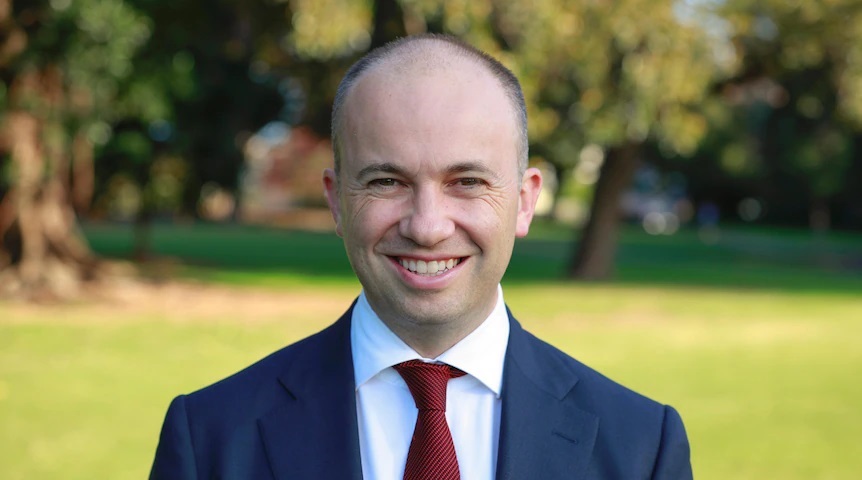
Matt Kean lambasts ‘wild fantasy’ of former Coalition colleagues to extend coal power and build nuclear plants
Climate Change Authority chair says Peter Dutton’s energy policy would drive up electricity bills and deter investment in renewables
Peter Hannam Economics correspondent, Guardian, 22 Oct 24
Extending the life of ageing coal-fired power stations before nuclear plants can be built is a “wild fantasy” that would deter near-term investment in renewables and push up power bills, according to Matt Kean, the Climate Change Authority chair.
The federal Coalition’s nuclear strategy was “an illiberal drive to intervene in the market-led energy transition [that had] been elevated from internet chatrooms and lobby groups to the national stage”, said Kean, a former energy minister in a Coalition government in New South Wales.
“The ‘delay-mongers’ have latched on to nuclear power despite the overwhelming evidence that it can only drive up energy bills, can only be more expensive, and can only take too long to build,” he told an AFR energy conference in Sydney on Tuesday.
“I suspect that even those arguing for nuclear don’t believe we’ll ever build one of these reactors in Australia … and certainly not in time to help manage the exit of coal from the system.”
The Albanese government appointed Kean, who has long advocated for more urgent climate action including by his then federal Liberal colleagues, to head the independent authority in June……………………………………………………… https://www.theguardian.com/australia-news/2024/oct/22/matt-kean-fantasy-coalition-energy-policy-coal-nuclear-power?fbclid=IwY2xjawGFBTtleHRuA2FlbQIxMQABHZOLw35JiI_0LOuO7ud0lCdaODH8ws-XTXtm6BjH-aQRT5FT8Ac8UKeUTQ_aem_yTUmsY_z33BOm66Ol9MkEA
Coalition’s nuclear plan is ‘today’s version of a lump of coal in parliament’, inquiry told.

Renewables advocate tells parliamentary hearing that opposition’s nuclear proposal is a ‘smokescreen’ for burning coal and gas.
Graham Readfearn, 28 Oct 24, Guardian,
The Coalition did not approach Geoscience Australia to ask about the suitability of any of the seven sites where it wants to put nuclear reactors, including asking about risks from earthquakes, a parliamentary hearing was told.
The government called the parliamentary inquiry to scrutinise the Coalition’s proposals to lift the country’s ban on nuclear energy and build taxpayer-funded reactors at seven sites.
One renewables industry figure attacked the Coalition’s plans during the hearing, saying it was a “smokescreen” to continue to burn coal and gas.
During the hearing on Monday, officials from Geoscience Australia said it would probably take two years to carry out comprehensive “geohazard” assessments for each site that would look at risks including earthquakes and tsunamis, and geological formations beneath each site such as groundwater sources and caves…………………………………………..
John Grimes, the chief executive of the Smart Energy Council, an advocacy group representing clean energy businesses, told the inquiry the Coalition’s plan was “all about attacking renewables and boosting fossil fuels”.
Grimes, recalling former prime minister Scott Morrison’s 2017 parliamentary taunt, labelled the proposal “today’s version of a lump of coal in parliament”.
“The motivation [of the Coalition’s plan] is to attack renewables and hold them back,” he said. “Nothing has changed. This is a smokescreen.”
The committee is due to deliver a final report no later than 30 April 2025, which is likely to be before the next general election. https://www.theguardian.com/australia-news/2024/oct/28/peter-dutton-liberal-coalition-nuclear-plan-parliament-inquiry
Atomic power probe shows experts divided on nuclear energy
A probe into atomic power is revealing a deep divide among experts, let alone members of Opposition Leader Peter Dutton’s own party.
Jessica Wang and Joseph Olbrycht-Palmer, news.com.au, 28 Oct 24
The Coaliton’s nuclear plan is both “peak anti-science” and Australia’s only chance of reaching net-zero by 2050, experts have told a committee probing the viability of atomic power in Australia.
Critics and advocates of the Coalition’s nuclear plan made their way to Parliament House on Monday for the house select committee on nuclear energy’s second public hearing.
The Smart Energy Council, which has estimated the plan’s cost as high as $600bn, said the Coalition’s push for atomic power was driven by “anti-renewable” ideology rather than science.
The peak body’s chief executive John Grimes accused Opposition Leader Peter Dutton of trying to frame the energy debate in masculinity.
“It’s all about attacking renewables and boosting fossil fuels,” Mr Grimes told the committee.
“That’s why Mr Dutton tells us that there are two types of electrons: the strong manly man electrons from coal and gas and nuclear and the tepid, insipid, weak electrons from renewable energy.
“The only problem is an electron is an electron in physics. There is no difference at all.
“This is peak anti-science, tin foil hat brigade, poppycock.”
He said nuclear power was “a pinnacle of human engineering” but it was not “the answer for Australia”.
……………………………..Winfield said household bills were kept artificially low under the Ontario model, despite the high cost of refurbishing ageing nuclear facilities.
“There’s a legacy of that still in the system that we are effectively subsidising electricity bills to the tune of about $C7.3 billion a year out of general revenues. That constitutes most of the provincial deficit; that’s money that otherwise could be going on schools and hospitals.”
He said that it was key to decarbonisation of countries “in the extreme north or south of the globe”, but with renewables powering up to 40 per cent of Australia’s grid, changing course did not stack up.
“We’re saying that for Australia, in the Australian context … where we have the best solar and wind resources in the world, where we have so much land you can almost not give it away … renewable energy transition is the lowest cost path to getting to low power bills, a highly reliable engineering system and the right environmental outcomes in environmental outcomes that the Australian government has signed up to internationally.
“So, it is vital that renewables plus the energy storage road map not only continue but be accelerated because that is the future. That is the answer for Australia.”
………………………………………………………………. Last week, the committee heard from Australian Energy Regulator (AER) chair Clare Savage, who said “nuclear may well have a role to play” in meeting Australia’s energy needs, but it would take a long time.
Ms Savage said the red tape associated with getting nuclear off the ground could take “eight to 10 years for a regulatory framework”.
Works to build the nuclear reactors would not be able to start until that framework was in place, she said.
Build times can vary, but recent projects overseas put it at a little north of 10 years.
Ms Savage’s comments cast serious doubt on the Coalition’s claim that it could have small modular reactors up and running by 2035 or larger reactors by 2037.
One thing most experts agree on, whether they be independent or part of government agencies, is that Australia’s fleet of coal-fired power plants only have about a decade of operational life left.
DUTTON ‘RESPECTS’ ANTI-NUCLEAR LNP PREMIER
Mr Dutton said he would continue to convince “sensible premiers” on the Coalition nuclear plan, with newly installed Queensland Liberal National Party premier David Crisafulli committing to his anti-nuclear push.
Speaking on Monday, Mr Dutton appeared unfazed by the divide between the state and federal Coalition, with the election pledge to build seven reactors by 2050, including the first two to come online between 2035-37……………………………………. https://www.news.com.au/national/queensland/politics/peter-dutton-says-he-respects-new-qld-lnp-premiers-antinuclear-stance/news-story/2e6d5000a0e988ecb504f1600ff20825—
‘You couldn’t make this up’: Expert pans Ontario nuclear option

SMH, By Bianca Hall and Nick O’Malley, October 28, 2024
Ontario subsidises its citizens’ electricity power bills by $7.3 billion a year from general revenue, an international energy expert has said, contradicting the Coalition’s claim that nuclear reactors would drive power prices down in Australia.
Opposition Leader Peter Dutton has repeatedly cited the Canadian province as a model for cheaper power prices from nuclear.
“In Ontario, that family is paying half of what the family is paying here in Perth for their electricity because of nuclear power,” Dutton said in March. “Why wouldn’t we consider it as a country?”
In July, Dutton said Canadian consumers paid about one-quarter of Australian prices for electricity.
Professor Mark Winfield, an academic from York University in Canada who specialises in energy and environment, on Monday said the reaction among people in Ontario to the comparison had ranged from disbelief to “you couldn’t make this up”.
Ontario embarked on a massive building spree between the 1960s and the 1990s, Winfield told a briefing hosted by the Climate Council and the Smart Energy Council.
In the process, he said, the provincial-owned utility building the generators “effectively bankrupted itself”. About $21 billion in debt had to be stranded to render the successor organisation Ontario Power Generation economically viable.
In 2015, the Canadian government approved a plan to refurbish 10 ageing reactors, but Winfield said the refurbishment program had also been beset by cost blowouts.
“The last one, [in] Darlington, east of Toronto, was supposed to cost $C4 billion and ended up costing $C14 [billion],” Winfield said.
“And that was fairly typical of what we saw, of a cost overrun in the range of about 2.5 times over estimate.”
In Melbourne, Dutton said while he respected new Queensland Premier David Crisafulli’s opposition to nuclear, he would work with “sensible” premiers in Queensland, South Australia and NSW on his plan, if he was elected………………………………………………..
Winfield said household bills were kept artificially low under the Ontario model, despite the high cost of refurbishing ageing nuclear facilities.
“There’s a legacy of that still in the system that we are effectively subsidising electricity bills to the tune of about $C7.3 billion a year out of general revenues. That constitutes most of the provincial deficit; that’s money that otherwise could be going on schools and hospitals.”
Dutton’s comments came as a parliamentary inquiry into the suitability of nuclear power for Australia continued in Canberra. Experts provided evidence on how long it would take to build a nuclear fleet, and the potential cost and impact on energy prices compared with the government’s plan to replace the ageing coal fleet with a system of renewables backed by storage and gas peakers.
……………………………………………………….. In its annual GenCost, CSIRO estimated earlier this year that a single large-scale nuclear reactor in Australia would cost $16 billion and take nearly two decades to build, too late for it to help meet Australia’s international climate change commitments, which requires it to cut emissions 43 per cent by 2030. It found renewables to be the cheapest option for Australia.
Dutton has so far refused to be drawn on the costs of his nuclear policy. Opposition energy spokesman Ted O’Brien said the Coalition would release costings before the next federal election, which must be held by May.
O’Brien told this masthead “expert after expert” had provided evidence that nuclear energy placed downward pressure on power prices around the world. ……………. https://www.smh.com.au/environment/climate-change/you-couldn-t-make-this-up-expert-pans-ontario-nuclear-option-20241028-p5klx1.html
Ambassador John Bolton tells 7NEWS Donald Trump re-election could mean AUKUS nuclear submarines plan torn up
7 News, By David Woiwod – US Bureau Chief, 27 Oct 24
Australia’s plans to acquire a fleet of nuclear-powered submarines would be torn-up if Donald Trump is re-elected next week, according to a former top Republican party security advisor.
The AUKUS defence pact would be one of the first US alliances to undergo a major review under an incoming Trump administration – with the official warning Australia not to take the agreement “for granted”.
“I think it could be in jeopardy,” former US ambassador to the United Nations, John Bolton told 7NEWS.
“All Trump looks at is the balance sheet, and if he sees more US expenditure than those of other parties to the agreement, then I think there will be trouble.”
The defence bill that passed on Capitol Hill late last year requires the president of the day to give the final tick of approval before any US submarines are delivered to Australia.
And Ambassador Bolton is now encouraging America’s ally to immediately mount arguments in favour of the alliance if Trump wins the November poll……..
The Australian government forked out $4.5 billion dollars to help soothe US fears after lawmakers questioned America’s ability to deliver the specialised boats while meeting its own submarine production targets.
Under the first steps of the deal aimed at deterring Chinese aggression, Australia is set to receive at least three Virginia Class nuclear-powered submarines before Australian-built vessels enter service in the 2040s. https://7news.com.au/news/ambassador-john-bolton-tells-7news-donald-trump-re-election-could-mean-aukus-subs-plan-torn-up-c-16518429
Union slams “false hope” in nuclear push, warns energy jobs at risk

Marion Rae, Oct 23, 2024, https://reneweconomy.com.au/union-slams-false-hope-in-nuclear-push-warns-energy-jobs-at-risk/
Queensland’s sparkies have been warned of the “huge risk” to thousands of jobs in renewable energy posed by nuclear plans.
The Electrical Trades Union told electricians and apprentices in a mass mailout on Wednesday that nuclear energy was a “radioactive pipe dream” that could not replace coal-fired power stations.
National policy director Katie Hepworth says the “false hope” offered by the LNP on the premise that coal-powered stations can keep running is “letting down coal communities”.
“The ETU members, our maintenance workers, who work in these power stations know that they’re being held together by all the will in the world, but they know they can’t hold on forever,” Dr Hepworth told AAP.
“There is a huge risk that if what they’re being given is a fantasy of a nuclear power station without an entire industrial plan and a renewable plan, that they’re just going to be thrown on the scrap heap again.”
Apprentices are among those voting for the first time on Saturday when Queensland goes to the polls.
Dr Hepworth said the ETU was trying to give them a vision of the economy they were stepping into as the next generation of workers.
She said there was “huge excitement” among apprentices in the type of work they would be able to do, such as working on EVs, installing appliances and building clean energy generation.
“By calling into question that renewable transition, we’re really putting all of that at risk,” Dr Hepworth said.
The union’s Nuclear Energy Report for 2024 found nuclear reactors would be more expensive, could not be built before coal exits the electricity grid, and were “simply unnecessary” given abundant renewable energy sources.
The report authored by Dr Hepworth found nuclear power would be the most expensive form of energy for Australia, at 1.5 to three times the cost per kilowatt hour of coal-fired electricity and four to eight times of solar.
Small modular reactors, still unproven on a commercial scale, would be even more costly, the CSIRO has estimated.
The Smart Energy Council has calculated the federal opposition’s proposed fleet of seven nuclear reactors at up to $600 billion, for a mere four per cent of energy supply in the grid.
Nor can nuclear power be considered a clean source of energy because radioactive waste management was “costly, complex, contested and unresolved” in Australia and globally, Dr Hepworth said.
Even countries with existing nuclear capability are choosing renewables over nuclear, including China, because of the speed of deployment, and because the cost curve is low and continues to fall.
The federal opposition’s nationwide nuclear plan, includes two Queensland sites for nuclear generation – the Callide and Tarong coal-fired power stations.
“The Queensland LNP is committed to affordable, reliable and sustainable power,” an LNP spokeswoman told AAP.
“Keeping the lights on at Callide with our Electricity Maintenance Guarantee will ensure power bills are affordable, reliable and sustainable until alternatives are ready to power Queensland,” she said.
Union boss Peter Ong said massive changes to the energy system were already affecting workers and the union had been working hard to move them into well-paid, secure jobs.
“Peter Dutton’s nuclear fantasy will throw ETU members’ jobs in the gutter,” he said.
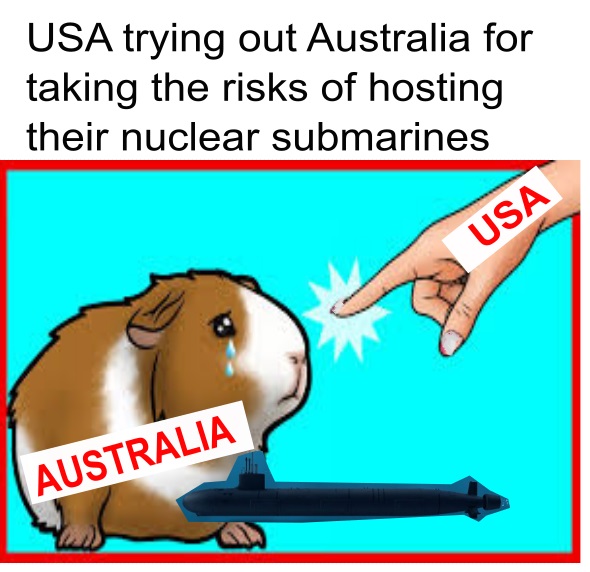
Australia the guinea pig for the safety risks of USA deploying their nuclear submarines on the land of their “friends”?
Why nuclear inspections in Australia have suddenly spiked
The Age, By Matt Wade, October 26, 2024, https://www.theage.com.au/national/why-nuclear-inspections-in-australia-have-suddenly-spiked-20241023-p5kkrl.html
International inspections of Australia’s nuclear facilities and materials have increased by a third in the past year as the nation’s nuclear risk profile changes due to AUKUS.
Since Australia is a signatory to the Nuclear Non-proliferation Treaty, it is required to submit to regular inspections by the International Atomic Energy Agency (IAEA) to verify compliance with nuclear safeguards.
Dr Geoffrey Shaw, director general of the Australian Safeguards and Non-Proliferation Office (ASNO), which ensures compliance with nuclear treaties, said there has been “a 30 per cent increase in inspections in Australia in the last couple of years”.
Under AUKUS, the navy will acquire nuclear-propelled submarines, and Shaw said that has raised Australia’s “risk setting” with the IAEA.
“This country is now going to be acquiring naval nuclear propulsion – it will have high enriched uranium in a country where we don’t currently have high enriched uranium,” he said. “That changes the equation.”
Australia’s nuclear proliferation risk profile is low; it has one research nuclear reactor in Sydney, which uses low-enriched uranium, three uranium mines and some institutions and companies permitted to handle nuclear materials.
But Shaw said the IAEA wants more assurances that there are no undeclared nuclear activities. It is now conducting inspections across the country with “as short as two-hour notification”.
In the year to June 2024, the IAEA made 22 inspections at locations including the Australia Nuclear Science and Technology Organisation (ANSTO), universities, defence facilities and private companies. That compares with 16 the previous year.
The first AUKUS submarines are due to be delivered to the Australian navy in the late 2030s.
When Australia, a non-nuclear-armed nation, acquires nuclear-propelled submarines, a “first-of-a-kind” regulatory approach will be needed to ensure the nation complies with its non-proliferation treaty obligations.
Corey Hinderstein, acting principal deputy administrator of America’s National Nuclear Security Administration (NNSA), said the nuclear safeguards developed in Australia for AUKUS will set a global benchmark for other nations that seek naval nuclear propulsion.
“We know that there are other countries that are interested in developing or partnering on naval nuclear propulsion programs, and those countries are by and large non-nuclear weapon states under the NPT, so they will have the safeguards obligation,” she said………………… https://www.theage.com.au/national/why-nuclear-inspections-in-australia-have-suddenly-spiked-20241023-p5kkrl.html
BHP’s untenable extraction of Great Artesian Basin waters for the Olympic Dam copper-uranium mine.
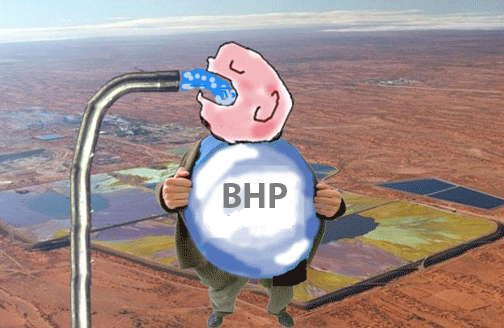
Jim Green, 26 Oct 24. BHP has had to move on Mound Springs protection issues regarding untenable extraction of GAB waters for the Olympic Dam copper-uranium mine, and an important Springs Study had now been released by SA Gov modelling reduced water extraction scenarios and affects on Springs & GAB waters.
A significant – if belated and partial – formal public commitment from BHP:
Milestone : FY2030 – cease abstraction from Wellfield A through switching to coastal desalination supply in partnership with the South Australian Government on the Northern Water Supply Project.
This partial win is a key if limited step toward proper protection for the unique and fragile Mound Springs of the GAB in SA, requiring:
is a key if limited step toward proper protection for the unique and fragile Mound Springs of the GAB in SA, requiring:
- closure of untenable BHP Wellfield A operations as soon as possible, that is warranted far sooner than by end of FY2030;
- BHP could prioritise and pay for whatever extent of water recovery at Olympic Dam to replace continued extraction from Wellfield A, which is projected to be run at 3.9 million litres a day ( Ml/d ) over next few years – about 10% of the volume BHP water take from the GAB;
- a campaign path to realise a phase out of the far larger adversely impacting Wellfield B operations that runs at 32 Ml/day, at least from when Northern Water supply becomes available at/after 2028 (this is difficult as BHP & SA Gov now think closing Wellfield A is all they have to do);
- a continued public interest campaign building on a lot of people’s roles and contributions over time…
an important Springs Study:
“Potential Impacts of Reducing Groundwater Abstraction from the Southwestern Great Artesian Basin: Modelled Aquifer Pressure and Spring Flow Response”
By Daniel Partington, Andrew Love, Daniel Wohling, Mark Keppel.
Goyder Institute for Water Research Technical Report Series No. 2024/01https://yoursay.sa.gov.au/84866/widgets/401081/documents/297652
see an extract from Goyder Institute Springs Study (at p.21 of doc & at p.31 of the pdf file, my bold below) citing the BHP commitment:
3.5 Output From the Modelled Scenarios Six experimental abstraction scenarios were proposed by Infrastructure SA to provide a spectrum of stimuli to assess the responsiveness of the aquifer to a change in abstraction volumes. The future abstraction rates from Wellfield A and B have not been confirmed, however there has been public commitment to cease abstraction from Wellfield A if water from the Northern Water project is available (see Olympic Dam Context- Based Water Targets).
Potential issues’ with Coalition’s planned nuclear reactor sites, safety expert warns
Government agencies and departmental officials spend full day scrutinising Peter Dutton’s controversial plan to build seven nuclear power plants.
Graham Readfearn, The Guardian, 24 Oct 24
A senior government nuclear safety official says the sites of coal-fired power plants “might not be adequate” to house the opposition’s proposed taxpayer-funded nuclear reactors.
Government agencies and departmental officials were grilled in parliament on Wednesday at a government-backed inquiry into nuclear energy. The inquiry was tasked with scrutinising the Coalition’s controversial plan to lift Australia’s ban on nuclear power and build taxpayer-funded reactors at seven sites.
Several officials told the inquiry it would take at least 10 to 15 years to start generating nuclear power once a future government confirmed an intention to build reactors.
The opposition leader, Peter Dutton, has said the Coalition expects to be able to build a small reactor by 2035 or a larger reactor as early as 2037.
The Coalition has said putting reactors at the sites of coal-fired power stations would reduce the need to build expensive transmission lines and towers to connect renewables to the grid.
At Wednesday’s inquiry, the Nationals MP Darren Chester asked the chief regulatory officer of the Australian Radiation Protection and Nuclear Safety Agency, Jim Scott, if that approach could save time.
Scott said it likely would, but added that this “presupposes that the sites of current coal-fired plants would be adequate for nuclear sites, because that might not be the case”.
He said: “You have to look at external events – flooding, natural events – that could occur. That’s part of the siting process. Given that, the potential issue [is] that the sites of current coal-fired plants might not be adequate for nuclear plants.”
Simon Duggan, a deputy secretary in the energy department, listed some of the steps that would be needed for nuclear to go ahead, including setting up management frameworks for health, safety, security, environmental impacts, as well as transport of nuclear fuels and waste, storage of waste and the workforce capability to build, maintain and regulate plants.
“Based on the work and the assessments that you have seen from bodies such as CSIRO and the [International Energy Agency] you are looking at around a 10- to 15-year timeframe to put all those prerequisites in place in order to have nuclear power capability in Australia,” Duggan said.
Many officers raised the issue of social licence and community consultation, saying this would be a critical step if any nuclear reactors were to be built in the future.
The opposition energy spokesman, Ted O’Brien, who is also deputy chair of the inquiry, attacked analysis from the energy department which the energy minister, Chris Bowen, said showed the Coalition’s plan would mean a gap of at least 18% between electricity supply and demand.
Duggan said the analysis was based on assumptions supplied by the minister, where there would be no new investment in renewable energy, and that coal-fired power stations would stick to the closure schedule assumed by the Australian Energy Market Operator…………………………………………….
Clare Savage, chair of the Australian Energy Regulator, told the inquiry she did not believe nuclear could be deployed in enough time to cover the closure of coal-fired power plants, which she said were becoming increasingly less reliable as they aged.
She told the inquiry that on the same day of the hearing, 26% of the total capacity of Australia’s coal-fired power fleet was offline. Eleven per cent of the coal fleet was down due to unplanned outages, she said.
https://www.theguardian.com/australia-news/2024/oct/24/peter-dutton-nuclear-plant-sites-issues
1 This month
.

Australians deserve the truth
about
AUKUS – https://aukuspublicinquiry.com/

PETITION – To: Prime Minister Anthony Albanese and the Australian Labor Government

of the week – Australians for War Powers Reform (AWPR)
To see nuclear-related stories in greater depth and intensity

