French nuclear giant scraps SMR plans due to soaring costs, will start over
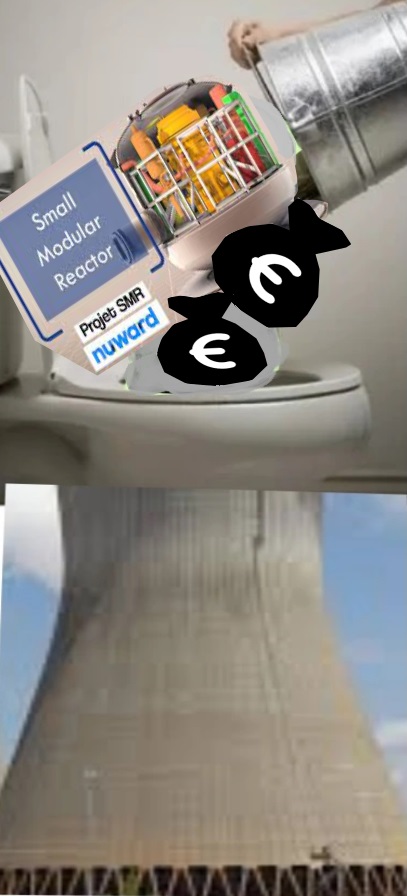
Another Small Modular Nuclear Reactor project goes down the toilet
This time it’s that great nuclear poster boy France that is facing the humiliation and embarrassment of wasting billions on “New Nuclear”
Last time it was the USA with the NuScale fiasco
Giles Parkinson Jul 2, 2024, https://reneweconomy.com.au/french-nuclear-giant-scraps-smr-plans-due-to-soaring-costs-will-start-over/
The French nuclear giant EdF, the government owned company that manages the country’s vast fleet of nuclear power stations, has reportedly scrapped its plans to develop a new design for small nuclear reactors because of fears of soaring costs.
EdF, which is now fully government owned after facing potential bankruptcy due to delays and massive cost over-runs at its latest generation large scale nuclear plants, had reportedly been working on a new design for SMRs for the last four years.
The French investigative outlet L’Informé reported on Monday that EdF had scrapped its new internal SMR design – dubbed Nuward – because of engineering problems and cost overruns. It cited company sources as saying EdF would now partner with other companies to use “simpler” technologies in an attempt to avoid delays and budget overruns.
Reuters confirmed the development, citing an email from a company spokesman that confirmed the program had been abandoned after the basic design had been completed.
“The reorientation consists of developing a design built exclusively from proven technological bricks. It will offer better conditions for success by facilitating technical feasibility,” an EDF spokesperson told Reuters via email.
It’s the latest problem to hit SMR technology, which the federal Coalition wants to roll out in Australia – starting with reactors in South Australia and Western Australia – as part of its goal of keeping coal plants open, building more gas, stopping renewables and putting clean energy hopes on nuclear.
The federal Coalition says it can have the first SMR up and running by 2035, but no SMRs have been built in the western world, and none have even got a licence to be built.
The closest to reach that landmark, the US-based NuScale, abandoned its plans after massive cost overruns and push back from its customers, who refused to pay high prices.
The EdF plans appears to have run into similar problems. Its potential customers, the European energy companies Vattenfall, CEZ and Fortum, wanted guarantees that the SMRs would not have a levelised cost of energy of more than €100 a megawatt hour ($161/MWh) and EdF decided that that was not possible.
It is now not expected to produce its first SMR until the 2030s, at the earliest – even though France is desperate for new reactors to replace its ageing power plants. Because of the costs, it expects to significantly reduce the share of nuclear in its energy mix as it focuses more on large scale solar and offshore wind.
EdF has run into similar problems with its large scale technology. The Flammanville project in France was announced in 2004 with a budget of €3 billion and a deadline of 2012. It is still not in operation and its costs have soared at least four-fold to €13.2 billion.
The Hinkley C project in the UK has been an even bigger disaster. EdF had promised in 2007 that it would be “cooking Christmas turkeys” in England by 2017, at a cost of £9 billion, but is already delayed to 2031 with a spiralling cost of £48 billion when inflation is taken into account, or $A93 billion.
EdF announced another impairment charge of €12.9 billion ($A20.7 billion) from Hinkley earlier this year. It had to be bailed out by the government last year after suffering record losses in 2022 caused by outages at nearly half of its nuclear power plants due to maintenance at its reactors across France.
Tim Buckley, from Climate and Energy Finance, seized on the news and called on Opposition leader Peter Dutton and energy spokesman Ted O’Brien to provide more details of their nuclear plans beyond the one page press release they released last month.
“Come’on guys, how naive do you take the average Australian voter for?” Buckley wrote.
“In your alternate fact world, who do you think will pay for the permanent around 50% increase in Australian energy prices for consumers? Are you really intent on destroying the international competitiveness of Australian industry purely in the service of your fossil fuel funders?”
Numerous cost assessments, particularly by the CSIRO and the Australian Energy Market Operator, have put the cost of nuclear at more than double the cost of wind, solar and storage. But they also point out that first of their kind projects in Australia could cost double that amount, and SMR technology is likely to be even more expensive.
The Coalition has attacked those reports, and the reputation of the CSIRO and AEMO – in concert with a group of so-called “think tanks” and the Murdoch media – but the latest polling from Essential Media suggests that the public might not be buying it.
The poll found that votes believe renewables are the most desirable (59 per cent) and the best for the environment (55 per cent). Nuclear energy was regarded by more as the most expensive (38 per cent versus 35 per cent for renewables).
An overwhelming majority of people aged 18 to 54 thought Peter Dutton’s nuclear energy plan “is just an attempt to extend the life of gas and limit investment in large-scale renewables”, while a majority of those aged over 55 thought the nuclear plan is serious and should be part of the future energy mix, Essential Media’s Peter Lewis wrote.
The federal Coalition has argued that nuclear might be expensive to build, but will deliver cheaper power to consumers. It has not explained how, but it has said that its reactors would be government owned, suggesting that – like France and Ontario – the costs would be borne by taxpayers and the supply of power to customers would be heavily subsidised.
Giles Parkinson is founder and editor of Renew Economy, and is also the founder of One Step Off The Grid and founder/editor of the EV-focused The Driven. He is the co-host of the weekly Energy Insiders Podcast. Giles has been a journalist for more than 40 years and is a former business and deputy editor of the Australian Financial Review. You can find him on LinkedIn and on Twitter.
Coalition nuclear policy leaves traditional owners of Kakadu uranium mine worried

ABC News, By Jane Bardon, 3 July 24
In short:
Kakadu traditional owners are worried the Coalition’s nuclear policy will drive demand for uranium mining on their land at Jabiluka.
Energy Resources of Australia (ERA) and traditional owners have asked the NT and federal governments to decide whether to extend the Jabiluka uranium mining lease.
What’s next?
ERA’s majority shareholder Rio Tinto is worried the Jabiluka lease stoush could drive up the costs of rehabilitating its closed Ranger Uranium Mine.
Mirarr traditional owner Corben Mudjandi is desperate for his spectacular land at Jabiluka to be incorporated into Kakadu National Park, which surrounds it, rather than mined for its uranium.
“Its sacred to us, and it’s a piece of human history, 65,000 years, we want Jabiluka not mined; we want to show people the beauty of nature, and what we call home,” he said.
Mr Mudjandi is worried the federal Coalition’s plan to open nuclear plants if it wins government could drive demand for Jabiluka’s uranium.
The Mirarr are also concerned that almost a year after Energy Resources of Australia (ERA) applied to extend its uranium mining lease over Jabiluka for another decade, the Northern Territory and federal governments have not yet decided whether to reject or approve it.
ERA’s current lease expires on August 11.
“The government are following process, but of course we hope they don’t support the application extension,” Mr Mudjandi said.
Senior Mirarr traditional owner Yvonne Margarula said she was worried that although ERA’s Jabiluka lease agreement enabled traditional owners to veto mining, they felt under constant pressure to change their minds.
“The mining companies might come back asking again and again, it’s annoying them asking more, enough is enough, so I hope the government is going to help us,” she said………………………………..
……………………….Professor of Archaeology at Griffith University Lynley Wallis said the Mirarr had a strong case for Jabiluka to be incorporated into Kakadu instead of mined, because of its 65,000 year-old-evidence of occupation.
“Archaeologically the escarpment that’s encapsulated within the Jabiluka mineral lease is unparalleled,” she said.
“There are hundreds of rock shelter sites, almost all of which have paintings in them, of which are incredibly well preserved, and then there are amazing objects that have been cached in those rock shelters, ceremonial wooden objects, grinding stones, spear points and scrapers.
………. the lease agreement includes a traditional owner right to veto mining……………
Lynley Wallis said the Jabiluka mining lease did not provide adequate protection.
“While a company holds a mineral lease over Jabiluka it is possible for them to apply to develop the resources in that land, and any development would pose imminent threat to the cultural sites that are within the lease,” she said.
While some of ERA’s minority shareholders want to keep the Jabiluka lease, which they estimate is worth $50 billion, its majority shareholder Rio Tinto does not.
Jabiluka is ERA’s only potentially valuable asset, but Rio Tinto estimates the rehabilitation costs would be much more than potential profits.
The cost of ERA’s rehabilitation of its neighbouring closed Ranger Uranium Mine on the Mirarr’s land has now blown out to more than $2.5 billion.
ERA is expected to run out of funds by September, and Rio Tinto has promised to fund Ranger’s rehabilitation.
But the ABC understands Rio Tinto is concerned ERA’s application to extend the Jabiluka lease is worrying Mirarr traditional owners so much, that they could delay further agreements needed on how the Ranger mine rehabilitation continues, adding to the project’s soaring costs.
Dave Sweeney, the Australian Conversation Foundation’s nuclear policy spokesman, has called on both governments to end the prospect of mining at Jabiluka.
“ERA are not making any money,” he said.
“They should be focused on getting the assured financial capacity on delivering on their legal obligations rather than appeasing minority shareholders in a fanciful push for a project that will never happen, but increases pressure on traditional owners who’ve had too much for too long.”
A spokesman for the federal Resources Minister Madeleine King said it was up to the NT government whether to renew ERA’s lease.
The spokesman said when Ms King provides her advice to NT government, she would “consider information about Jabiluka in good faith and with appropriate consultation”.
The NT Mining Minister Mark Monaghan would not explain why his government had not made a decision on the lease.
“We’re not delaying the decision, the decision is going through what is a process,” he said.
NT Opposition leader Lia Finocchiaro has backed ERA’s argument on why the lease should continue.
“Importantly that maintains the veto rights for the Mirarr people which we believe continues to be a very important right for them to have,” she said. worried
The nuclear and renewable myths that mainstream media can’t be bothered challenging
Mark Diesendorf, Jul 4, 2024, https://reneweconomy.com.au/the-nuclear-and-renewable-myths-that-mainstream-media-cant-be-bothered-challenging/
Nuclear energy proponents are attempting to discredit renewable energy and promote nuclear energy and fossil gas in its place. This article refutes several myths they are disseminating that are receiving little or no challenge in the mainstream media.
Myth: Renewables cannot supply 100% electricity
Denmark, South Australia and Scotland already obtain 88, 74 and 62 per cent of their respective annual electricity generations from renewables, mostly wind. Scotland actually supplies 113 per cent of its electricity consumption from renewables; the difference between its generation and consumption is exported by transmission line.
All three jurisdictions have achieved this with relatively small amounts of hydroelectricity, zero in South Australia. Given the political will, all three could reach 100% net renewables generation by 2030, as indeed two northern states of Germany have already done. The ‘net’ means that they trade some electricity with neighbours but on average will be at 100% renewables.
Computer simulations by several research groups – using real hourly wind, solar and demand data spanning several years – show that the Australian electricity system could be run entirely on renewable energy, with the main contributions coming from solar and wind. System reliability for 100% renewables will be maintained by a combination of storage, building excess generating capacity for wind and solar (which is cheap), key transmission links, and demand management encouraged by transparent pricing.
Storage to fill infrequent troughs in generation from the variable renewable sources will comprise existing hydro, pumped hydro (mostly small-scale and off-river), and batteries. Geographic dispersion of renewables will also assist managing the variability of wind and solar. For the possibility of rare, extended periods of Dunkelflaute (literally ‘dark doldrums’), gas turbines with stores of biofuels or green hydrogen could be kept in reserve as insurance.
Myth: Gas can fill the gap until nuclear is constructed
As a fuel for electricity generation, fossil gas in eastern Australia is many times more expensive per kilowatt-hour than coal. It is only used for fuelling gas turbines for meeting the peaks in demand and helping to fill troughs. For this purpose, it contributes about 5% of Australia’s annual electricity generation. But, as storage expands, fossil gas will become redundant in the electricity system.
The fact that baseload gas-fired electricity continues temporarily in Western Australia and South Australia is the result of peculiar histories that will not be repeated. Unlike the eastern states, WA has a Domestic Gas Reservation Policy that insulates customers from the high export prices of gas.
However, most new gas supplies would have to come from high-cost unconventional sources. South Australia’s ancient, struggling, baseload, gas-fired power station, Torrens Island, produces expensive electricity. It will be closed in 2026 and replaced with renewables and batteries.
Myth: Nuclear energy can co-exist with large contributions from renewables
This myth has two refutations:
- Nuclear is too inflexible in operation to be a good partner for variable wind and solar. Its very high capital cost necessitates running it constantly, not just during periods of low sun or wind. Its output can only be ramped up and down slowly, and it’s expensive to do that.
- On current growth trends of renewables, there will be no room for nuclear energy in South Australia, Victoria or NSW. The 2022 shares of renewables in total electricity generation in each of these states were 74%, 37% and 33% respectively.
Rapid growth from these levels is likely. It’s already too late for nuclear in SA. Provided the growth of renewables is not deliberately suppressed in NSW and Victoria, these states too could reach 100% renewables before the first nuclear power station comes online.
As transportation and combustion heating will be electrified, demand for electricity could double by 2050. This might offer generating space for nuclear in the 2040s in Queensland (23% renewables in 2022) and Western Australia (20% renewables in 2022). However, the cost barrier would remain.
Myth: There is insufficient land for wind and solar
The claim by nuclear proponents that wind and solar have “vast land footprints” is misleading. Although a wind farm can span a large area, its turbines, access road and substation occupy a tiny fraction of that area, typically about 2%.
Most wind farms are built on land that was previously cleared for agriculture and are compatible with all forms of agriculture. Off-shore wind occupies no land.
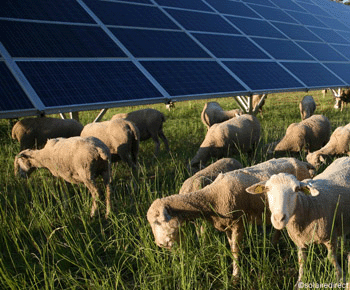
Solar farms are increasingly being built sufficiently high off the ground to allow sheep to graze beneath them, providing welcome shade. This practice, known as agrivoltaics, provides additional farm revenue, which is especially valuable during droughts. Rooftop solar occupies no land.
Myth: The longer lifetime of nuclear reactors hasn’t been taken into account
The levelised cost of energy method – used by CSIRO, AEMO, Lazard and others – is the standard way of comparing electricity generation technologies that perform similar functions.
It permits the comparison of coal, nuclear and firmed renewables. It takes account automatically of the different lifetimes of different technologies.
Myth: We need baseload power stations
The recent claim that nuclear energy is not very expensive “when we consider value” is just a variant of the old, discredited claim that we need baseload power stations, i.e. those that operate 24/7 at maximum power output for most of the time.
The renewable system, including storage, delivers the same reliability, and hence the same value, as the traditional system based on a mix of baseload and peak-load power stations.
When a nuclear power reactor breaks down, it can be useless for weeks or months. For a conventional large reactor rated at 1000 to 1600 megawatts, the impact of breakdown on electricity supply can be disastrous.
Big nuclear needs big back-up, which is expensive. Small modular reactors do not exist––not one is commercially available or likely to be in the foreseeable future.
Concluding remarks
We do not need expensive, dangerous nuclear power, or expensive, polluting fossil gas. A nuclear scenario would inevitably involve the irrational suppression of renewables.
The ban on nuclear power should be maintained because nuclear never competes in a so-called ‘free market’. Renewables – solar, wind and existing hydro – together with energy efficiency, can supply all Australia’s electricity.
Mark Diesendorf is Honorary Associate Professor at the Environment & Society Group in the School of Humanities & Languages and Faculty of Arts, Design & Architecture at UNSW. First published in Pearls and Irritations. Republished with permission of the author.
Why Julian Assange couldn’t outrun the Espionage Act
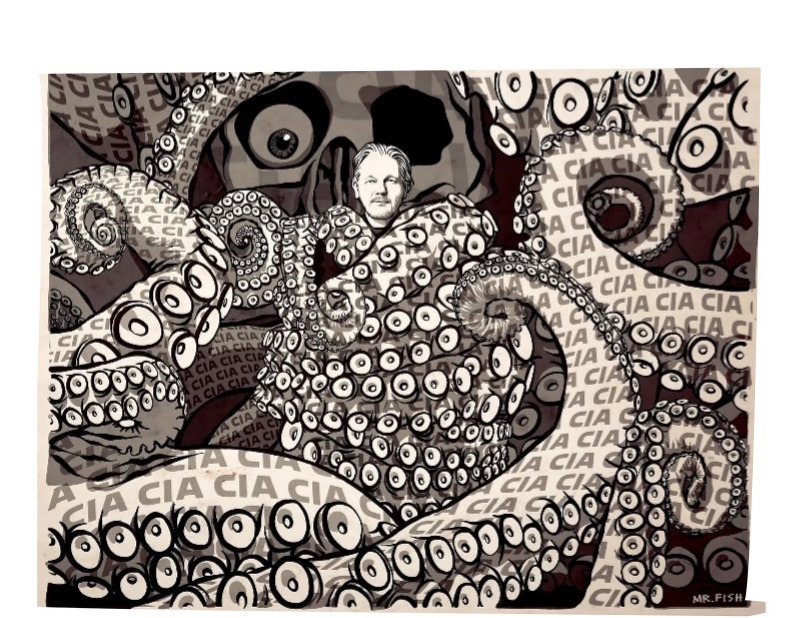
the grave threat the Espionage Act poses to journalism and the First Amendment
SOTT, Jordan Howell The FIRE, Wed, 26 Jun 2024
Julian Assange spent seven years in self-exile in London’s Ecuadorian Embassy avoiding arrest, and five more in prison, for publishing classified documents on WikiLeaks.
Julian Assange is a free man, and one of the most contentious press freedom controversies in living memory may finally be coming to a close.
The WikiLeaks founder reached a plea deal with the Department of Justice on Monday after spending five years in an English prison fighting extradition to the United States. Federal officials sought to charge Assange with conspiracy to obtain and disclose national security information under the Espionage Act of 1917.
Assange and WikiLeaks shocked the world in 2010 by publishing hundreds of thousands of secret military documents and diplomatic cables related to the wars in Iraq and Afghanistan that were leaked by Army intelligence analyst Chelsea Manning. Months later, Assange was on the run and Manning was in jail.
Assange claimed that by receiving and publishing confidential information, what he did was no different than the type of routine news reporting that journalists around the world engage in every day. As the Supreme Court ruled in New York Times Co. v. United States (1971), better known as “The Pentagon Papers” case, publishing leaked documents is protected under the First Amendment.
FIRE has long opposed use of the Espionage Act to curtail the rights of journalists to source information. And in December 2022, FIRE signed an open letter organized by the Committee to Protect Journalists along with 20 other civil liberties groups calling on the federal government to drop its charges against Assange.
“We are united . . . in our view that the criminal case against him poses a grave threat to press freedom both in the United States and abroad,” we argued. “[J]ournalists routinely engage in much of the conduct described in the indictment: speaking with sources, asking for clarification or more documentation, and receiving and publishing official secrets. News organizations frequently and necessarily publish classified information in order to inform the public of matters of profound public significance.”
Assange’s 12 year ordeal, including seven years in self-exile in the Ecuadorian Embassy in London before his arrest and imprisonment, underscores the continued threat that the century-old Espionage Act still poses to civil liberties today — and not just in the United States. Assange is not a U.S. citizen, nor was he ever a resident. But because of modern extradition treaties, there were few places in the world where he could travel to escape the Act’s reach,
Under the terms of Monday’s deal, Assange pleaded guilty to the charges and was sentenced to 62 months incarceration, but with credit for time served, according to documents filed with the U.S. District Court for the Northern Mariana Islands.
Ultimately, freedom of the press is what was at stake with the government’s case against Assange. It was never only about him. The precedent that would have been set by his extradition and trial would have sent a chilling message to journalists across the country and the world: You can run, but you can’t hide from the Espionage Act.
What is the Espionage Act?……………………………………………………………………………………….Based on the Defense Secrets Act of 1911, the Espionage Act of 1917 included much stiffer penalties — including the death penalty — for sharing secret or confidential information or otherwise interfering with the operations of the U.S. military.
The Espionage Act made it a crime to obtain information regarding national defense “with intent or reason to believe” that doing so would hurt the U.S. or to advantage another country. While subsequent amendments and court decisions have refined its language and scope, its core purpose remains the same.
Espionage Act and the Supreme Court
The law was immediately controversial because its use was not limited to actual acts of espionage. Rather, the Espionage Act allowed the government to clamp down on anyone who opposed the war effort.
In Schenck v. United States, in 1919, the Supreme Court upheld the conspiracy conviction against socialist Charles Schenck under the Espionage Act for distributing anti-war leaflets that urged people to boycott the draft.
The problem with the Court’s ruling in Schenck, as subsequent decisions would affirm, is that Schenk’s speech was not calling for violence or even civil disobedience. Rather, his speech was precisely the kind of political expression that decades of subsequent Supreme Court decisions would ultimately uphold. Numerous convictions under the Espionage Act would make their way to the Court, including that of socialist presidential candidate Eugene Debs, who was arrested for giving a speech opposing the war.
Since then, one of the most nefarious uses of the Espionage Act has been to silence journalists. At least insofar as publishing the leaked documents on the Wikileaks website, what Assange did was little different than what The New York Times and The Washington Post did in 1971 when they published and reported on thousands of pages from a classified report about the war in Vietnam.
……………………………………….As the Supreme Court has ruled, freedom of the press is a foundational principle, enshrined in the Bill of Rights. And though Julian Assange is finally free, FIRE continues to have serious concerns about the grave threat the Espionage Act poses to journalism and the First Amendment. https://www.sott.net/article/492768-Why-Julian-Assange-couldnt-outrun-the-Espionage-Act
When it comes to power, solar is about to leave nuclear and everything else in the shade
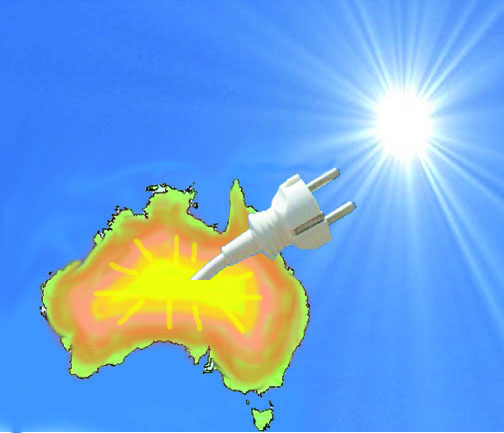
In Australia, solar is pushing down prices
Australia’s energy market operator says record generation from grid-scale renewables and rooftop solar is pushing down wholesale electricity prices.
Peter Martin, Visiting Fellow, Crawford School of Public Policy, Australian National University July 2, 2024 https://theconversation.com/when-it-comes-to-power-solar-is-about-to-leave-nuclear-and-everything-else-in-the-shade-233644
Opposition leader Peter Dutton might have been hoping for an endorsement from economists for his plan to take Australian nuclear.
He shouldn’t expect one from The Economist.
The Economist is a British weekly news magazine that has reported on economic thinking and served as a place for economists to exchange views since 1843.
By chance, just three days after Dutton announced plans for seven nuclear reactors he said would usher in a new era of economic prosperity for Australia, The Economist produced a special issue, titled Dawn of the Solar Age.
Whereas nuclear power is barely growing, and is shrinking as a proportion of global power output, The Economist reported solar power is growing so quickly it is set to become the biggest source of electricity on the planet by the mid-2030s.
By the 2040s – within this next generation – it could be the world’s largest source of energy of any kind, overtaking fossil fuels like coal and oil.
Solar’s off-the-charts global growth
Installed solar capacity is doubling every three years, meaning it has grown tenfold in the past ten years. The Economist says the next tenfold increase will be the equivalent of multiplying the world’s entire fleet of nuclear reactors by eight, in less time than it usually takes to build one of them.
To give an idea of the standing start the industry has grown from, The Economist reports that in 2004 it took the world an entire year to install one gigawatt of solar capacity (about enough to power a small city). This year, that’s expected to happen every day.
Energy experts didn’t see it coming. The Economist includes a chart showing that every single forecast the International Energy Agency has made for the growth of the growth of solar since 2009 has been wrong. What the agency said would take 20 years happened in only six.
The forecasts closest to the mark were made by Greenpeace – “environmentalists poo-pooed for zealotry and economic illiteracy” – but even those forecasts turned out to be woefully short of what actually happened.
And the cost of solar cells has been plunging in the way that costs usually do when emerging technologies become mainstream.
The Economist describes the process this way:
As the cumulative production of a manufactured good increases, costs go down. As costs go down, demand goes up. As demand goes up, production increases – and costs go down further.
Normally, this can’t continue. In earlier energy transitions – from wood to coal, coal to oil, and oil to gas – it became increasingly expensive to find fuel.
But the main ingredient in solar cells (apart from energy) is sand, for the silicon and the glass. This is not only the case in China, which makes the bulk of the world’s solar cells, but also in India, which is short of power, blessed by sun and sand, and which is manufacturing and installing solar cells at a prodigious rate.
Solar easy, batteries more difficult
Batteries are more difficult. They are needed to make solar useful after dark and they require so-called critical minerals such as lithium, nickel and cobalt (which Australia has in abundance).
But the efficiency of batteries is soaring and the price is plummeting, meaning that on one estimate the cost of a kilowatt-hour of battery storage has fallen by 99% over the past 30 years.
In the United States, plans are being drawn up to use batteries to transport solar energy as well as store it. Why build high-voltage transmission cables when you can use train carriages full of batteries to move power from the remote sunny places that collect it to the cities that need it?
Solar’s step change
The International Energy Agency is suddenly optimistic. Its latest assessment released in January says last year saw a “step change” in renewable power, driven by China’s adoption of solar. In 2023, China installed as much solar capacity as the entire world did in 2022.
The world is on track to install more renewable capacity over the next five years than has ever been installed over the past 100 years, something the agency says still won’t be enough to get to net-zero emissions by 2050.
That would need renewables capacity to triple over the next five years, instead of more than doubling.
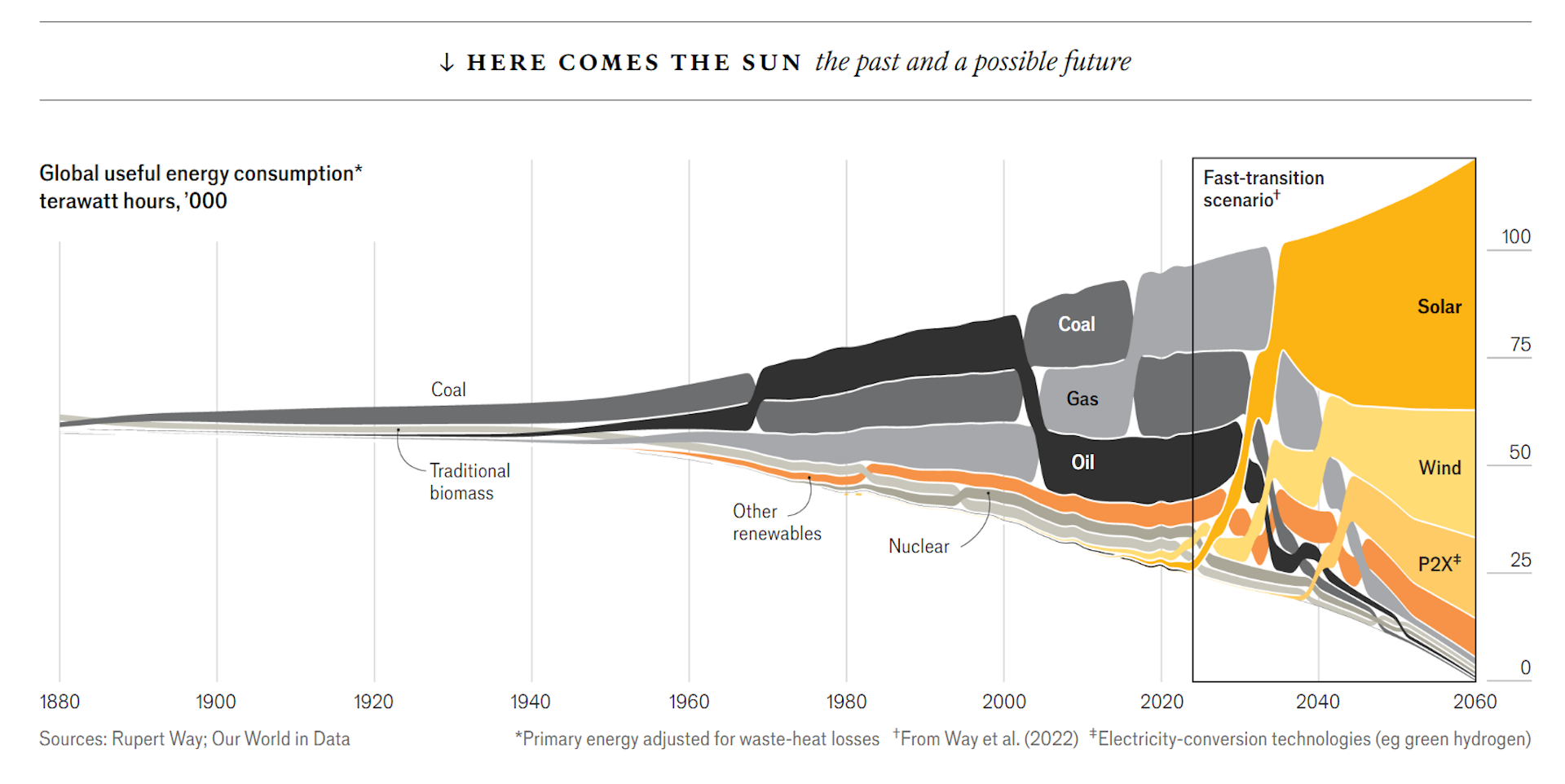
Oxford University energy specialist Rupert Way has modelled a “fast transition” scenario, in which the costs of solar and other new technologies keep falling as they have been rather than as the International Energy Agency expects.
He finds that by 2060, solar will be by far the world’s biggest source of energy, exceeding wind and green hydrogen and leaving nuclear with an infinitesimally tiny role.
In Australia, solar is pushing down prices
Australia’s energy market operator says record generation from grid-scale renewables and rooftop solar is pushing down wholesale electricity prices.
South Australia and Tasmania are the states that rely on renewables the most. They are the two states with the lowest wholesale electricity prices outside Victoria, whose prices are very low because of its reliance on brown coal.
It is price – rather than the environment – that most interests The Economist. It says when the price of something gets low people use much, much more of it.
As energy gets really copious and all but free, it will be used for things we can’t even imagine today. The Economist said to bet against that is to bet against capitalism.
The State Failed to Break Assange

Julian Assange has not been freed, passive voice, the beneficiary of decisions taken by the American and British judiciaries — and almost certainly in the Biden regime’s upper reaches. Julian Assange has achieved his freedom, actively. Even during the darkest moments of his years under house arrest, in asylum at Ecuador’s London embassy, and at Belmarsh, he never surrendered his sovereignty. He remained ever the captain of his soul, and never did he allow his captors entry onto his ship.
SCHEERPOST, JULY 1, 2024 Patrick Lawrence
After apparently lengthy negotiations via Julian Assange’s attorneys, the WikiLeaks founder agreed to plead guilty to one felony charge of illegally obtaining and publishing U.S. government documents of various kinds — many standing as evidence of war crimes and human rights abuses, others exposing the Democratic Party’s corruptions during the presidential campaign of Hillary Clinton in 2016.
Assange was sentenced Wednesday to a term of five years and two months, precisely the time he spent at Belmarsh, the maximum-security prison in southeast London. It was from Belmarsh that Assange fought requests for his extradition to the U.S., where he would have faced multiple charges and a lengthy sentence under the 1917 Espionage Act. When he departed for Australia at the conclusion of the proceeding in Saipan, the largest of the Northern Marianas and also the capital city, he became a free man for the first time in 14 years, counting from his time under house arrest in 2010.
Let us take the utmost care with our diction at this surprising and welcome turn. This will enable us to fathom the moment clearly.
Julian Assange has not been freed, passive voice, the beneficiary of decisions taken by the American and British judiciaries — and almost certainly in the Biden regime’s upper reaches. Julian Assange has achieved his freedom, actively. Even during the darkest moments of his years under house arrest, in asylum at Ecuador’s London embassy, and at Belmarsh, he never surrendered his sovereignty. He remained ever the captain of his soul, and never did he allow his captors entry onto his ship.
It was for this, most fundamentally, that Assange has suffered these past years, especially the five he spent in a cell at Belmarsh. The project was precisely to destroy his sovereignty, to break him one way or another, and he refused to break. His will — and I simply cannot imagine the awesome muscularity of it — has seen him through to victory.
When news of his impending freedom arrived with us last Monday evening, I reacted without hesitation, “It is not a bad deal. Everyone knows the truth and worth of what Assange did. Nothing lost. A good man’s life hung in the balance — this a gain.”
“Everyone” seems already an overestimation, but I will get to this in a moment.
Among the curious details of Assange’s plea is the choice of the federal courthouse in the Northern Marianas, a U.S. possession, for the denouement of his case. Assange’s legal team requested this peculiar location, let us not miss. It is remote from the U.S. mainland but close to his native Australia. There are two things to surmise from this, I think.
One, it is likely Assange’s attorneys thought it a very bad idea for their client to set foot on American soil anywhere near the court in Washington’s environs where cases of this kind, national-security cases, are customarily tried — tried before jurors drawn from a pool well populated with active and retired national security operatives, bureaucrats and assorted apparatchiks.
That the locale for the final settlement was negotiated away from the District Court of Eastern Virginia indicates that Assange’s lawyers remained mistrustful of U.S. assurances of a fair treatment under the law even while their talks proceeded.
Two, and the larger point here, moving the case to so out-of-the-way a courtroom indicated that Assange and his legal defense almost certainly had considerable leverage in determining the terms under which he achieved his freedom. This tells us something important about the years Assange spent at Belmarsh subjected to disgracefully punitive conditions and the circus various judges, Vanessa Baraitser high among them, made of the British courts.
I have long assumed, as many others may have, that the Biden regime and its predecessor simply did not want Assange extradited because it did not want to take up a trial that would more or less automatically lead to a sentence of 170 years. Too potentially messy, too politically risky, too harsh a light on this administration’s hypocrisies in the matter of press freedom and its indifference to, if not its approval of, the British authorities’ inhumane treatment of a man whose organization exposed war crimes.
How else to explain the lengthy delays in the London courts these past five years? And I cannot but think with something close to conviction that the corporate press in America, chiefly The New York Times, had some modest voice in the decision to negotiate a plea that reflects to some extent the Assange side’s terms?
The Times has avoided serious reporting of the Assange case for years. Embarrassing it would have been for the paper to report proceedings in Eastern Virginia, as it would have been obliged to do. We all remember that The Times made full use of WikiLeaks releases until, in April 2017, Mike Pompeo denounced Assange as “a state actor of Russia.” It was at that point Washington turned frontally against the organization and its founder, and the corporate press dutifully followed the lead of Trump’s egregious secretary of state.
The Biden regime has managed at last to drop a hot potato, but it is a stretch to assume it has not burned its fingers. As others have remarked, it could have vacated its case entirely and, indeed, gone so far as to offer Assange compensation for his suffering while facing unjust charges.
That would have marked a dramatic redemption. Instead, it leaves the door still wide open to pursuing cases such as Assange’s whenever a reporter’s truths are similarly inconvenient. This is self-inflicted damage atop years of self-inflicted damage, in my read. The Biden government’s exit from this case more or less mutilates any claim it will henceforth assert to respect press freedom and First Amendment rights.
Sheer Endurance
I measure the magnitude of Julian Assange’s triumph not in passing political terms, although the politics of his achievement of freedom are important. I view it in more personal terms. His greatest victory lies in the strength and sheer endurance he summoned and consistently displayed as the machinery of two sovereign states attempted to destroy him.
Several years ago, readers will recall, Nils Melzer testified in Baraitser’s court that Assange’s treatment met official definitions of psychological and physical torture. Not long after the U.N.’s special rapporteur on torture gave his testimony, I began an essay on the Assange case for Raritan, the cultural and political journal. It came to me as I wrote “Assange Behind Glass,” which I reproduce here from my web site archives, that we had to see it in the context of the “total domination” Hannah Arendt explored in The Origins of Totalitarianism, her look back, in 1951, at the horrors of the 20th century’s first half. “Its intent is to strip humanity of all identity and individuation,” I wrote of Arendt’s theme. And from her text:……………………………………………………………………………………………………………………….
…………….Are there undisclosed codicils attaching to the Assange’s camp’s plea agreement? Will his professional activities henceforth be curtailed by agreement? These are inevitable questions, even if one does not care to pose them. The answers are unclear and may never be clear. Out of respect and admiration for a man who has just won his freedom after paying a very high price in his fight for it, I leave these matters to him and those around him. https://scheerpost.com/2024/07/01/patrick-lawrence-the-state-failed-to-break-assange/
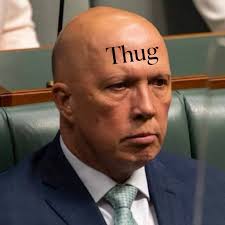
Dutton’s Nuclear ‘Thuggery’ Will Heat Up Debate And Energy Prices, But It Won’t Cool The Climate
An uncooperative Senate could block Dutton’s nuclear power plans, but could not stop him expanding and prolonging the use of fossil fuels and derailing the renewable energy transition.
Only voters can do that.
Jim Green on July 2, 2024, https://newmatilda.com/2024/07/02/duttons-nuclear-thuggery-will-heat-up-debate-and-energy-prices-but-it-wont-cool-the-climate/
Bullying your way to nuclear power might play out well in the Liberal-National Party room, but it’s unlikely to win favour with the states, or the punters, writes Dr Jim Green.
Former Liberal prime minister Malcolm Turnbull famously described Coalition leader Peter Dutton as a “thug”. That description appears particularly apt in Dutton’s nuclear power plans.
The Coalition’s nuclear project is opposed by state Labor governments in each of the five states being targeted. Victoria, NSW and Queensland have laws banning nuclear power. The Labor governments in SA and WA may follow suit if they think state legislation will give them some legal protection, or political advantage. Or both.
Could a Dutton Coalition government override state laws banning nuclear power? Anne Twomey, a Sydney University Professor Emerita with lengthy experience teaching and practising in constitutional law, argues that states probably could not prevent the Commonwealth establishing a nuclear power plant, nor could they prevent necessary associated operations such as transmission lines and nuclear waste transport.
Would a Dutton Coalition government attempt to override state opposition to nuclear power plants? Almost certainly it would. Nationals leader David Littleproud said in March that “if the Australian people vote for us that’s a fair indication to premiers that they should get out of the way”.
Coalition and Labor federal governments have pursued attempts to impose a national nuclear waste dump in SA and the NT despite state/territory laws banning such facilities. Those attempts have all failed, largely due to community opposition led by affected Traditional Owners.
Legal challenges helped stop three of the four proposed nuclear dump sites — Woomera (SA) under the Howard government; Muckaty (NT) under the Abbott government; and Kimba (SA) under the Morrison and Albanese governments. But the legal difficulties could have been overcome if the government of the day was ruthless enough and wasn’t suffering too much political pain because of its racist, undemocratic thuggery.
No doubt a Dutton Coalition government would ignore the wishes of Traditional Owners and Native Title holders opposed to the construction of a nuclear reactor on their country. They would be stripped of their land rights and heritage protections, as has been the case with nuclear waste dump proposals.
Compulsory acquisition
What about the companies who own the sites being targeted by the Coalition for nuclear power plants, and who have their own multi-billion dollar plans to develop their own clean energy industrial hubs based around renewables. According to energy minister Chris Bowen, six of the owners of the seven targeted sites have ruled out agreeing to nuclear power reactors on their land.
Dutton hasn’t bothered to consult these companies, but he has sought legal advice. This is what he said: “We will work with the companies, the owners of the sites. If we find a situation where we apply a national interest test and we require that site to be part of the national grid, then the legal advice that we have is that the Commonwealth has ample power to compulsorily acquire that with ample compensation.”
The Coalition also hasn’t bothered to consult communities around the sites targeted for nuclear reactors. And, like state governments and the owners of the targeted sites, opposition from local communities will be overridden.
Nationals deputy leader Perin Davey made the mistake of saying that the Coalition would not impose nuclear power plants on communities that were adamantly opposed. Davey was corrected by Littleproud, who said: “She is not correct and we made this very clear. Peter Dutton and David Littleproud as part of a Coalition government are prepared to make the tough decisions in the national interest.”
Likewise, Dutton said: “Perin I think made a mistake yesterday as everybody does from time to time…. We’ve identified the seven locations and we believe it’s in the community’s interests and the national interest to proceed.”
Democracy is for wimps, apparently, and for traitors who oppose the ‘national interest’ as Comrades Dutton and Littleproud see it.
All this stands in stark contrast to a 2019 parliamentary inquiry led by current shadow energy minister Ted O’Brien. The Committee’s report was titled ‘Not without your approval: a way forward for nuclear technology in Australia’.
Announcing the release of the parliamentary report, O’Brien said in 2019 that a future government should only proceed with nuclear power on the condition that it make “a commitment to community consent as a condition of approval for any nuclear power or nuclear waste disposal facility”. He also waffled on about “maintaining a social license based on trust and transparency” and putting the Australian people “at the centre of any approval process”.
That was then, this is now. The ‘national interest’ is at stake.
Prof. Anne Twomey notes that the Dutton government would need to get legislation through Parliament, including the Senate, both to repeal federal laws banning nuclear power and also “to provide any necessary legal support and protection for a nuclear power industry in Australia”.
An uncooperative Senate could block Dutton’s nuclear power plans, but could not stop him expanding and prolonging the use of fossil fuels and derailing the renewable energy transition. Only voters can do that.
South Australia
Here in SA, we’ll get one or more nuclear power reactors in SA whether we like it or not and whether or not we need the additional power supply. SA has gone from 1 percent renewable electricity supply to 74 percent over the past 16 years and the government aims to reach 100 percent net renewables by 2027.
While there’s doubt about the 2027 timeline, it’s a safe bet we’ll reach 100 percent net renewables by the time a nuclear reactor could possibly begin generating electricity 20-plus years from now.
The Northern Power Station near Port Augusta, one of the seven sites targeted by the Coalition, was shut down in 2016 and the region has since become a renewables hub. Are Dutton and O’Brien unaware of these developments? Are they planning a renewables-to-nuclear transition for SA? It’s difficult to see their non-negotiable plan for a nuclear power plant in SA as anything other than an ill-conceived, uncosted thought bubble.
The Coalition insists that nuclear power would reduce power bills. But there’s no evidence to support that claim, and plenty of evidence to suggest otherwise. The claim isn’t supported by CSIRO’s ‘GenCost’ report; or in a recent report prepared for the Clean Energy Council by Egis, a leading global consulting, construction and engineering firm; or in a recent report on small modular reactors by the Institute for Energy Economics and Financial Analysis; or in the latest economic analysis released by investment firm Lazard.
SA Premier Peter Malinauskas isn’t convinced about the Coalition’s economic claims either, saying: “Every single objective, independent analysis that has looked at this has said nuclear power would make power more expensive in Australia rather than cheaper. Why we would impose that burden on power consumers in our country is completely beyond me.”
* Dr Jim Green is the national nuclear campaigner with Friends of the Earth Australia and co-author of a new report released by the Australian Conservation Foundation, ‘Power Games: Assessing coal to nuclear proposals in Australia’.
“They just fit in with what we do:” Farmers reap rewards as they play host to wind and solar
ReNewEconomy Liv Casben, Jun 29, 2024
Renewables in agriculture are gaining momentum across the nation as Australia pushes to reach its net-zero emissions target by 2050.
Australia’s energy market operator has declared renewables as the most cost-effective way of reaching net-zero targets in the grid, but just how much of the load will be carried by the farming sector remains unclear.
Across pockets of the nation, farmers are already doing their bit to reduce their carbon footprint.
“Anecdotally, we have seen a huge increase in farmers seeking renewables projects as farmers seek to increase the productivity of their farms,” Farmers for Climate Action’s Natalie Collard told AAP.
“Renewables offer drought-proof income, and drought-proof income keeps farms going through the toughest of times.”
The Lee family has farmed at Glenrowan West for 150 years, but for the past three years they’ve also added solar to the mix.
A German-based company leases the land from the Lees and maintains the solar panels, which run alongside the sheep farming operation.
“The lessee basically runs it just as another paddock, the sheep go in just as they would under any other farming operation,” Gayle Lee said. “We haven’t found there to be any noticeable loss of production.”
……………………………………………………. Karin Stark, who will host the annual Renewables in Agriculture conference in Toowoomba next week, says consultation is key to farmers playing a “critical role” in the renewables transition and keeping everyone happy…………… more https://reneweconomy.com.au/they-just-fit-in-with-what-we-do-farmers-reap-rewards-as-they-play-host-to-wind-and-solar/?fbclid=IwZXh0bgNhZW0CMTEAAR0qML5s3XgsQ3EZd5pJl15CdGXQ60-BC3TLkIVpcaWkgLsBSarHkHoPUYI_aem_OC5kzgz0cTiwWtnLVva56A
The Coalition’s nuclear fantasy serves short-term political objectives – and its fossil fuel backers

This is the truth at the heart of the Coalition’s latest climate fantasy: it gives people concerned about the speed and impact of the energy transition an alternative reality where this change doesn’t have to happen.
This is the truth at the heart of the Coalition’s latest climate fantasy: it gives people concerned about the speed and impact of the energy transition an alternative reality where this change doesn’t have to happen.
Dutton’s policy latches on to genuine concerns about power prices and disruption evident in the latest Guardian Essential report, but what are its real motivations?
Peter Lewis, 2 July 24 https://www.theguardian.com/australia-news/commentisfree/article/2024/jul/02/coalition-nuclear-policy-peter-dutton-power-plants
In 1959 the US government hatched a covert scheme to replace every single bird with a replicant surveillance drone to spy on its own citizens. This is only the second silliest theory flying around the internet right now.
Peter Dutton’s make-believe nuclear plan bears some of the hallmarks of Peter McIndoe’s actual piss-take, “Birds Aren’t Real”, which became so real he wound up doing interviews with Fox News and running large-scale community rallies where only some of the participants were chanting his nonsense slogan ironically.
There’s not too great a distance from ‘bird truthers’ to the Coalition’s latest permutation of fossil-fuelled climate skepticism.
In a world where information is driven by platform algorithms designed to maximise attention and reinforce existing prejudices, any theory can find a home; the crazier and louder the claims, the more likely they are to take off.
This is the truth at the heart of the Coalition’s latest climate fantasy: it gives people concerned about the speed and impact of the energy transition an alternative reality where this change doesn’t have to happen.
As this week’s Guardian Essential Report shows, support for renewable energy is contested. Lining up renewables, nuclear and fossil fuels, we found a lack of consensus on price, environmental impact and economic consequence.
While renewables are seen as the best energy source for the environment and most desirable overall, fossil fuels are seen as cheaper and better for jobs. It is here that the Coalition’s nuclear fantasy plays a critical bridging role.
The rollout of the renewable energy grid is a genuinely disruptive development; coal communities genuinely fear for their long-term economic future; consumers genuinely feel power prices rising as the rollout of renewables gathers momentum.
Coalition energy spokesperson Ted O’Brien is tasked with convincing those who have genuine concerns that if they just embrace nuclear, they can stop all these things they don’t like and still hit net zero by 2050.
Just like the bird conspiracy, this nuclear policy isn’t real: it has no scope, no production estimate, no costings, no timeline. But it’s a device that serves a flock of short-term political objectives.
It creates a reason to delay decommissioning coal and gas because, like magic, nuclear will provide a short cut. That’s good for the LNP’s fossil fuel backers and communities that rely on the production of these energy sources.
It offers hope to coal communities that they can become home to a new heavy industry. While critics of nuclear can make fun of the three-headed fish near the Springfield, the truth is Homer Simpson enjoyed the sort of secure job these communities fear will soon disappear.
And it sends a message to every regional community that they might not need to host the new renewable energy grid that is being rolled out. Because if you have a choice between looking out across a valley or looking out across power lines, who wouldn’t take the valley?
The problem for the Albanese government is that while each of these justifications is patently false, attacking them head-on risks a rerun of the voice referendum dynamic where “two sides” reporting creates a false equivalence that ends up defining the contest as a coin toss.
Exacerbating this challenge is the fact that fewer people trust the main proponents of the energy transition – the government and energy companies. Instead, trust is anchored at the level of the local.
The only people we really trust are those who we know personally – our friends and family and members of our community. Which raises the question, who do the people we trust get their information from? Perversely, the answer can only be “us”.
As McIndoe riffs in a hilarious piece of performance media: “Just because it’s a theory doesn’t mean its fake. It’s on the media, you can find it … Truth is subjective … There’s different proof out there for different things and if you do your research, you just might find it.”
Given this environment, the choice for Labor is whether to get dragged into a nuclear showdown where alternate facts will be wished into existence or simply dismiss the whole charade as the piece of political theatre it is.
A final question in this week’s report suggests the more effective way of confronting the nuclear “debate” is what disinformation experts call “pre-bunking” by calling out the opposition’s real motivations.
These findings show that half the electorate – and nearly two-thirds of young people – will reject the idea that this is a legitimate debate at all. Taking these people out of the equation before embarking on any merit analysis drastically reduces the number of votes in play.
Rather than trading economic models or platforming nuclear safety fears, the best approach might actually be the most honest one: to drag nuclear back into the political swamp from which it has risen.
First, expose the interests that will benefit from Dutton’s nuclear fantasy. Put the spotlight on the fossil fuel and nuclear players, who runs them, where they converge, who they pay to keep their dream alive and how much they stand to make by delaying the energy transition for a couple more decades.
Second, take away the oxygen for nuclear by doing the hard work required to build social licence for renewables, responding to legitimate concerns by giving communities a greater say in the way development occurs and how both costs and benefits are distributed.
Finally, turn the opposition to renewables back on to the LNP. While the political opportunism of the Dutton nuclear play is obvious, there are also risks that this decision comes to define not just him as a leader, but his entire political apparatus.
In a world where younger generations just want to get on with the job of addressing climate change, a major political party is walking away from this challenge in the interests of its corporate masters.
That’s the real conspiracy. And it’s not just a theory.
- Peter Lewis is the executive director of Essential and host of Per Capita’s Burning Platforms podcast
Does the nuclear ‘plan’ add up? Australia’s carbon emissions under the Coalition’s proposal

Professor Clive Hamilton, 2 July 24, https://news.csu.edu.au/latest-news/does-the-nuclear-plan-add-up-australias-carbon-emissions-under-the-coalitions-proposal
The recent proposed nuclear power plan announcement by the federal Opposition prompted a Charles Sturt University climate change analyst and a colleague to model the necessary energy sources implied by the plan. They found that it doesn’t add up.
- A Charles Sturt University analysis of the Opposition’s nuclear power proposal finds that relying on nuclear power to attain net zero by 2050 would require four times as many nuclear power plants to be built in the 2040s as the Coalition currently plans
- The analysis indicates that the increasing reliance on gas generation implied under the Coalition’s plan would result in Australia having much higher carbon emissions through to 2050 than under the current renewables roll-out trajectory
- The analysis indicates that slowing the pace of the renewables roll-out implied or stated by the Coalition would have a severe negative impact on the renewables industries but would be a major boost to the gas industry
The recent proposed nuclear power plan announcement by the federal Opposition prompted a Charles Sturt University climate change analyst and a colleague to model the necessary energy sources implied by the plan. They found that it doesn’t add up.
Charles Sturt University Vice-Chancellor’s Chair of Public Ethics Professor Clive Hamilton and colleague the highly respected energy expert Dr George Wilkenfeld have analysed the implications for Australia’s emissions path of the Coalition’s nuclear plan and how it might help to meet the commitment to net zero by 2050.
The Coalition announced that it plans to commission seven nuclear power stations by 2050 and said it would abandon the government’s 2030 target of reducing the nation’s emissions by 43 per cent (compared with 2005 levels).
Professor Hamilton said their analysis shows that the Coalition’s nuclear strategy, if it met its stated aims, would see nuclear plants account for approximately 12 per cent of total electricity generation by 2050.
“The slowed pace of the renewables roll-out implied or stated by the Coalition would result in renewables supplying 49 per cent of total supply, compared with 98 per cent under Labor’s plan, and gas generation supplying approximately 39 per cent, compared with two per cent under Labor’s plan,” he said.
“It would likely have a severe negative impact on the renewables industries but would be a boon to the gas industry.
“With high continued supply of electricity from gas under the Coalition’s plan, attaining net zero emissions by 2050 would be out of the question.”
Professor Hamilton said the modelling indicates that attaining net zero by 2050 would require four times as many nuclear power plants to be built in the 2040s as the Coalition currently plans.
“Under Labor’s renewables plan, Australia’s electricity emissions are expected to decline year on year until they reach almost zero on 2050,” he said.
“Under the Coalition’s plan for nuclear power, a declining emphasis on renewables and an unavoidably greater role for fossil fuels means emissions from the electricity sector in 2050 would be nearly 19 times higher than under Labor’s plan.”
The full analysis was published in Renew Economy on Thursday 27 June.
The Release of Julian Assange: Plea Deals and Dark Legacies
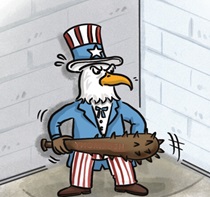
It ultimately goes to the brutal exercise of US extraterritorial power against any publisher, irrespective of outlet and irrespective of nationality…………….. the measure extracts a pound of flesh from the fourth estate. It signals that the United States can and will seek out those who obtain and publish national security information that they would rather keep under wraps under spurious notions of “harm”.
June 27, 2024, by: Dr Binoy Kampmark https://theaimn.com/the-release-of-julian-assange-plea-deals-and-dark-legacies-2/
One of the longest sagas of political persecution is coming to its terminus. That is, if you believe in final chapters. Nothing about the fate of Julian Assange seems determinative. His accusers and inquisitors will draw some delight at the plea deal reached between the WikiLeaks founder’s legal team and the US Department of Justice. Others, such as former US Vice President, Mike Pence, thought it unjustifiably lenient.
Alleged to have committed 18 offences, 17 novelly linked to the odious Espionage Act, the June 2020 superseding indictment against Assange was a frontal assault on the freedoms of publishing and discussing classified government information. At this writing, Assange has arrived in Saipan, located in the US commonwealth territory of Northern Mariana Islands in the Western Pacific, to face a fresh indictment. It was one of Assange’s conditions that he would not present himself in any court in the United States proper, where, with understandable suspicion, he might legally vanish.
As correspondence between the US Department of Justice and US District Court Chief Judge Ramona V. Manglona reveals, the “proximity of this federal US District Court to the defendant’s country of citizenship, Australia, to which we expect he will return at the conclusion of proceedings” was also a factor.
Before the US District Court for the Northern Mariana Islands, he will plead guilty to one count of conspiracy to obtain and disclose national defence information under the Espionage Act of 1917, or section 793(g) (Title 18, USC). The felony carries a fine up to $10,000 and/or up to 10 years in prison, though Assange’s time in Belmarsh Prison, spent on remand for some 62 months, will meet the bar.
The felony charge sheet alleges that Assange knowingly and unlawfully conspired with US Army intelligence analyst Chelsea Manning, then based at Operating Base Hammer in Iraq, to receive and obtain documents, writings and notes, including those of a secret nature, relating to national defence, wilfully communicated those documents from persons with lawful possession of or access to them to those not entitled to receive them, and do the same from persons unauthorised to possess such documents.
Before turning to the grave implications of this single count and the plea deal, supporters of Assange, including his immediate family, associates and those who had worked with him and drunk from the same well of publishing, had every reason to feel a surreal sense of intoxication. WikiLeaks announced Assange’s departure from London’s Belmarsh Prison on the morning of June 24 after a 1,901 day stint, his grant of bail by the High Court in London, and his release at Stansted Airport. Wife Stella regularly updated followers about the course of flight VJ199. In coverage posted of his arrival at the federal court house in Saipan, she pondered “how overloaded his senses must be, walking through the press scrum after years of sensory depravation and the four walls” of his Belmarsh cell.
As for the plea deal itself, it is hard to fault it from the emotional and personal perspective of Assange and his family. He was ailing and being subjected to a slow execution by judicial process. It was also the one hook upon which the DOJ, and the Biden administration, might move on. This being an election year in the US, the last thing President Biden wanted was a haunting reminder of this nasty saga of political persecution hovering over freedom land’s virtues.
There was another, rather more sordid angle, and one that the DOJ had to have kept in mind in thinning the charge sheet: a proper Assange trial would have seen the murderous fantasies of the CIA regarding the publisher subject to scrutiny. These included various possible measures: abduction, rendition, even assassination, points thoroughly explored in a Yahoo News contribution in September 2021.
One of the authors of the piece, Zach Dorfman, posted a salient reminder as news of the plea deal filtered through that many officials during the Trump administration, even harsh critics of Assange, “thought [CIA Director Mike] Pompeo’s extraordinary rendition plots foolhardy in the extreme, and probably illegal. They also – critically – thought it might harm Assange’s prosecution.” Were Pompeo’s stratagems to come to light, “it would make the discovery process nightmarish for the prosecution, should Assange ever see trial.”
From the perspective of publishers, journalists and scribblers keen to keep the powerful accountable, the plea must be seen as enormously troubling. It ultimately goes to the brutal exercise of US extraterritorial power against any publisher, irrespective of outlet and irrespective of nationality. While the legal freight and prosecutorial heaviness of the charges was reduced dramatically (62 months seems sweetly less imposing than 175 years), the measure extracts a pound of flesh from the fourth estate. It signals that the United States can and will seek out those who obtain and publish national security information that they would rather keep under wraps under spurious notions of “harm”.
Assange’s conviction also shores up the crude narrative adopted from the moment WikiLeaks began publishing US national security and diplomatic files: such activities could not be seen as journalistic, despite their role in informing press commentary or exposing the venal side of power through leaks.
From the lead prosecuting attorney Gordon Kromberg to such British judges as Vanessa Baraitser; from the national security commentariat lodged in the media stable to any number of politicians, including the late California Democrat Dianne Feinstein to the current President Joe Biden, Assange was not of the fourth estate and deserved his mobbing. He gave the game away. He pilfered and stole the secrets of empire.
To that end, the plea deal makes a mockery of arguments and effusive declarations that the arrangement is somehow a victory for press freedom. It suggests the opposite: that anyone publishing US national security information by a leaker or whistleblower is imperilled. While the point was never tested in court, non-US publishers may be unable to avail themselves of the free speech protections of the First Amendment. The Espionage Act, for the first time in history, has been given a global, tentacular reach, made a weapon against publishers outside the United States, paving the way for future prosecutions.
Labor gains in Newspoll as Australians narrowly oppose the Coalition’s nuclear energy plan

Adrian Beaumont, The Conversation, 1 July 24
Election Analyst (Psephologist) at The Conversation; and Honorary Associate, School of Mathematics and Statistics, The University of Melbourne
A national Newspoll, conducted June 24–28 from a sample of 1,260 people, gave Labor a 51–49% lead over the Coalition, a one-point gain for Labor since the previous Newspoll, three weeks ago. Primary votes were 36% Coalition (down three), 32% Labor (down one), 13% Greens (up two), 7% One Nation (steady) and 12% for all others (up two).
…………………………………..Opposition Leader Peter Dutton’s net approval slumped six points to -16, his lowest since October 2023. Albanese led Dutton by an unchanged 46–38% as better PM.
By 45–42%, voters disapproved of the Coalition’s “plans to build nuclear reactors in Australia on seven sites of current and former coal-fired power stations before 2050”.
Controversy over the nuclear plans has probably boosted Labor in two-party terms, despite the continued cost of living pressures hurting Albanese’s ratings.
Resolve poll on nuclear power
A national Resolve poll for Nine newspapers, conducted after Dutton’s nuclear plan announcement (June 20–23) from a sample of 1,003 people, had voters supporting nuclear power by 41–37%. In a more open question, 32% (down four since February) said they supported nuclear power, 28% were opposed (up five) and 30% (up three) did not have a strong view, but were open to investigating it.
Renewables, in general, had a net likeability of +66, nuclear-powered electricity +8 and coal-powered electricity +2.
Asked to choose between “Labor’s plan to use 100% renewables (supported by gas for the next decade or two)” and “the Coalition’s plan to use nuclear power and some gas to support the renewables”, voters backed Labor’s plan by 43–33%.
Essential poll: Labor’s first lead since April
A national Essential poll, conducted June 12–16 from a sample of 1,181 people, gave Labor a 48–46% lead including undecided after a 48–48% tie in early June.
This is Labor’s first lead in an Essential poll since April, with weak respondent-allocated preference flows for Labor partly responsible.
Primary votes in this poll were 32% Coalition (down four), 31% Labor (down one), 13% Greens (steady), 8% One Nation (up three), 1% UAP (down two), 9% for all others (up one) and 6% undecided (up two)…………………………………………………………………………………………………………………. more https://theconversation.com/labor-gains-in-newspoll-as-australians-narrowly-oppose-the-coalitions-nuclear-energy-plan-232693
Julian Assange Is Finally Free, But Let’s Not Forget the War Crimes He Exposed
Contrary to US government claims, WikiLeaks’s revelations actually saved lives — and drove demand for US accountability.
| By Editor on June 29, 2024 https://truthout.org/articles/julian-assange-is-finally-free-but-lets-not-forget-the-war-crimes-he-exposed/ |
After a 14-year struggle, including five years spent in Belmarsh, a maximum-security prison in London, WikiLeaks publisher Julian Assange is finally free. Under the terms of a plea deal with the U.S. Department of Justice, Assange pled guilty to one count of conspiracy to obtain documents, writings and notes connected with the national defense under the Espionage Act. Assange was facing 175 years in prison for 18 charges in the indictment filed by the Trump administration and pursued by the Biden administration.
The plea agreement requires that before entering his plea, Assange must have done everything he could to either return or destroy “any such unpublished information in his possession, custody, or control, or that of WikiLeaks or any affiliate of WikiLeaks.”
As stipulated in the plea deal, Ramona Manglona, U.S. Chief Judge of the District Court for the Northern Mariana Islands, sentenced Assange to 62 months with credit for the time he served in Belmarsh Prison. The U.S. sentencing guidelines say the range for this “offense” is 41-51 months, so Assange served 11 to 21 months longer than this type of case would typically garner.
Assange was prosecuted because WikiLeaks exposed U.S. war crimes in Iraq, Afghanistan and Guantánamo Bay. In 2010, U.S. Army intelligence analyst Chelsea Manning, who had a “TOP SECRET” U.S. security clearance, furnished WikiLeaks with 700,000 documents and reports, many of which were classified “SECRET.”
These documents included the “Iraq War Logs,” 400,000 field reports documenting 15,000 unreported deaths of Iraqi civilians, as well as systematic rape, torture and murder after U.S. forces transferred detainees to a notorious Iraqi torture squad.
They also contained the “Afghan War Diary,” comprising 90,000 reports that documented more civilian casualties by coalition forces than the U.S. military had reported. And they included the “Guantánamo Files” — 779 secret reports containing evidence that 150 innocent people had been held at Guantánamo Bay for years. The reports explain how the nearly 800 men and boys there had been tortured and abused, which violated the Geneva Conventions and the Convention Against Torture and Other Cruel, Inhuman or Degrading Treatment or Punishment.
Manning also provided WikiLeaks with the infamous 2007 “Collateral Murder” video, which depicts a U.S. Army Apache attack helicopter crew targeting and killing 12 unarmed civilians in Baghdad, including two Reuters journalists, as well as a man who came to rescue the wounded. Two children were injured in the attack. A U.S. Army tank drove over one of the bodies, severing it in two. In a conversation after the attack, one pilot said, “Look at those dead bastards,” and the other responded, “Nice.” The video reveals evidence of three violations of the Geneva Conventions and the U.S. Army Field Manual.
WikiLeaks provided material for news outlets around the world to report on U.S.-led atrocities. Informing the public about the illegality of George W. Bush’s “war on terror” resulted in calls for accountability.
“10 years on, the War Logs remain the only source of information regarding many thousands of violent civilian deaths in Iraq between 2004 and 2009,” John Sloboda, co-founder of Iraq Body Count (IBC), wrote in his submitted testimony for Assange’s extradition hearing in October 2020. IBC is an independent NGO that has done the only comprehensive monitoring of credibly reported casualties in Iraq since Bush’s 2003 invasion.
“WikiLeaks cables have contributed to court findings that US drone strikes are criminal offences and that criminal proceedings should be initiated against senior US officials involved in such strikes,” Clive Stafford Smith, co-founder of Reprieve and attorney for seven Guantánamo detainees, wrote in his submitted testimony.
“They took a hero [Assange] and turned him into a criminal,” Vahid Razavi, founder of Ethics in Tech, told Common Dreams. “Meanwhile, all of the war criminals in the files exposed by WikiLeaks via Chelsea Manning are free and never faced any punishment or even their day in court.”
The Iraq War Logs
The Iraq War Logs contained extensive evidence of U.S. war crimes. Several reports of detainee abuse were supported by medical evidence. Prisoners were blindfolded, shackled and hung by their ankles or wrists. They were subjected to punching, whipping, kicking, electrocution, electric drills, and cutting off fingers or burning with acid. Six reports document the apparent deaths of detainees.
Secret U.S. Army field reports revealed that U.S. authorities refused to investigate hundreds of reports of murder, torture, rape and abuse by Iraqi soldiers and police. The coalition had a formal policy of ignoring these allegations, marking them “no investigation is necessary.”
Although U.S. and U.K. officials maintained that no official records of civilian casualties existed, the logs document 66,081 noncombatant deaths out of 109,000 fatalities from 2004-2009.
The log describes video footage of Iraqi army officers executing a prisoner in Tal Afar. It says, “The footage shows approximately 12 Iraqi army [IA] soldiers. Ten IA soldiers were talking to one another while two soldiers held the detainee. The detainee had his hands bound … The footage shows the IA soldiers moving the detainee into the street, pushing him to the ground, punching him and shooting him.”
The Afghan War Diary
The Afghan War Diary also revealed evidence of U.S. war crimes from 2004-2009. The reports describe how a secret “black” unit composed of special operations forces hunted down accused Taliban leaders for “kill or capture” without trial. Secret commando units — classified groups of Navy and Army special operatives — used a “capture/kill list,” which resulted in the killing of civilians, angering the Afghan people.
Moreover, the CIA expanded paramilitary operations in Afghanistan, carrying out ambushes, ordering airstrikes and conducting night raids. The CIA financed the Afghan spy agency, operating it like a subsidiary.
A 2007 meeting between Afghan district officials and U.S. civil affairs officers was documented in the reports. Afghan officials are quoted as saying, “The people of Afghanistan keep loosing [sic] their trust in the government because of the high amount of corrupted government officials. The general view of the Afghans is that the current government is worst [sic] than the Taliban.”
The logs recorded numerous civilian casualties from airstrikes, shootings on the road, in villages and at checkpoints; many were caught in the cross fire. The victims weren’t suicide bombers or insurgents. Several deaths were not reported to the public.
The Guantánamo Files
The Guantánamo Files say that only 220 of the 780 people held at the prison camp since 2002 were classified as “dangerous international terrorists.” Of the rest of the detainees, 380 were classified as low-level foot soldiers and 150 were considered innocent Afghan or Pakistani civilians or farmers.
Many detainees were held at Guantánamo for years based on paltry evidence or confessions extracted by torture and abuse. Among the detainees, for example, were an 89-year-old Afghan villager with senile dementia and a 14-year-old boy who was the innocent victim of a kidnapping.
The files document a system aimed more at extracting intelligence than detaining dangerous terrorists. One man was transferred to Guantánamo because he was a mullah with special knowledge of the Taliban. A taxi driver was sent to the prison camp because he had general knowledge of certain areas in Afghanistan. An Al Jazeera journalist was held at Guantánamo for six years to be interrogated about the news network.
Nearly 100 detainees were classified with depressive or psychotic disorders. Several joined hunger strikes to protest their indefinite detention or attempted suicide, the files revealed.
No One Was Harmed by WikiLeaks’s Revelations
Although the U.S. government alleged that WikiLeaks’s publication of information had caused “great harm,” they “admitted there was not a single person anywhere that they could produce that was harmed by these publications,” Assange’s attorney Barry Pollack said at a June 26 press conference in Australia.
The plea agreement says, “Some of these raw classified documents were publicly disclosed without removing or redacting all of the personally identifiable information relating to certain individuals who shared sensitive information about their own governments and activities in their countries with the U.S. government in confidence.”
The U.S. government claims that Assange endangered U.S. informants who were named in the published documents. But John Goetz, an investigative reporter who worked for Germany’s Der Spiegel, testified at the 2020 extradition hearing that Assange went to great lengths to ensure that the names of informants in Iraq and Afghanistan were redacted. Goetz said that WikiLeaks underwent a “very rigorous redaction process” and Assange repeatedly reminded his media partners to use encryption. Indeed, Goetz said, Assange tried to stop Der Freitag from publishing material that could result in the release of unredacted information.
Moreover, WikiLeaks’s revelations actually saved lives. After WikiLeaks published evidence of Iraqi torture centers established by the U.S., the Iraqi government refused then-President Barack Obama’s request to grant immunity to U.S. soldiers who committed criminal and civil offenses there. As a result, Obama had to withdraw U.S. troops from Iraq.
Obama took credit for ending U.S. military involvement in Iraq. But he had tried for months to extend it beyond the December 31, 2011, deadline his predecessor negotiated with the Iraqi government. Negotiations broke down when Iraq refused to grant criminal and civil immunity to U.S. troops.
What Assange’s Plea Bargain Means for Free Speech
Before she accepted Assange’s guilty plea, Judge Manglona asked him what he did to violate the law. “Working as a journalist, I encouraged my source to provide information that was said to be classified,” Assange said. “I believed the First Amendment protected that activity, but I accept that it was a violation of the espionage statute.” Assange then added, “The First Amendment was in contradiction with the Espionage Act, but I accept that it would be difficult to win such a case given all these circumstances.”
Even though Assange will go free, his plea deal raises concerns for First Amendment advocates in the U.S.
“The United States has now, for the first time in the more than 100-year history of the Espionage Act, obtained an Espionage Act conviction for basic journalistic acts,” David Greene, head of civil liberties at the Electronic Frontier Foundation, told The New York Times. “These charges should never have been brought.”
Charlie Savage, who has covered the Assange case extensively for years, warned that Assange’s plea sets a “new precedent” that “will send a threatening message to national security journalists, who may be chilled in how aggressively they do their jobs because they will see a greater risk of prosecution.” But, Savage noted, since Assange pled guilty and didn’t mount a constitutional challenge to the Espionage Act, that eliminated the risk that the U.S. Supreme Court would ultimately sanction a narrow interpretation of First Amendment press freedoms.
“WikiLeaks published groundbreaking stories of government corruption and human rights abuses, holding the powerful accountable for their actions,” WikiLeaks said in a statement announcing the plea agreement. “As editor-in-chief, Julian paid severely for these principles, and for the people’s right to know. As he returns to Australia, we thank all who stood by us, fought for us, and remained utterly committed in the fight for his freedom.”
There is no doubt that but for the sustained activism of people around the world and the work of his superb legal team, Julian Assange would still be languishing behind bars for revealing evidence of U.S. war crimes.
Assange’s Return to Australia: The Resentment of the Hacks
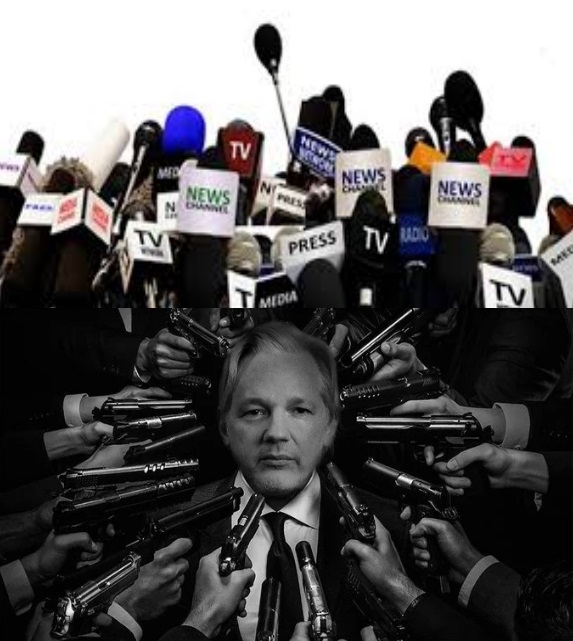
Sharp eyes will be trained on Assange in Australia, ……… He is in the bosom of the Five Eyes Alliance, permanently threatened by the prospect of recall and renewed interest by Washington. And there are dozens of journalists, indifferent to the dangers the entire effort against the publisher augurs for their own craft, wishing that to be the case.
Dr Binoy Kampmark 1 July 24 https://theaimn.com/author/binoy-kampmark/
Julian Assange of WikiLeaks fame is now back in the country of his birth, having endured conditions of captivity ranging from cramped digs in London’s Ecuadorian embassy to the maximum-security facilities of Belmarsh Prison. His return to Australia after striking a plea deal with the US Department of Justice sees him in a state with some of the most onerous secrecy provisions of any in the Western world.
As of January 2023, according to the Attorney-General’s Department, the Australian Commonwealth had 11 general secrecy offences in Part 5.6 of the Criminal Code, 542 specific secrecy offences across 178 Commonwealth laws and 296 non-disclosure duties spanning 107 Commonwealth laws criminalising unauthorised disclosure of information by current and former employees of the Commonwealth.
In November 2023, the Albanese Government agreed to 11 recommendations advanced by the final report of the review of secrecy provisions. While aspiring to thin back the excessive overgrowth of secrecy, old habits die hard. Suggested protections regarding press freedom and individuals providing information to Royal Commissions will hardly instil confidence.
With that background, it is unsurprising that Assange’s return, while delighting his family, supporters and free press advocates, has stirred the seething resentment of the national security establishment, Fourth Estate crawlers, and any number of journalistic sellouts. Damn it all, such attitudes seem to say: he transformed journalism, stole away our self-censorship, exposed readers to the original classified text, and let the public decide for itself how to react to disclosures revealing the abuse of power. Minimal editorialising; maximum textual interpretation through the eyes of the universal citizenry, a terrifying prospect for those in government.
Given that the Australian press establishment is distastefully comfortable with politicians – the national broadcaster, the Australian Broadcasting Corporation, for instance, has a central reporting bureau in Canberra’s Parliament House – Assange’s return has brought much agitation. The Canberra press corps earn their crust in a perversely symbiotic, and often uncritical relationship, with the political establishment that furnishes them with rationed morsels of information. The last thing they want is an active Assange scuppering such a neat understanding, a radical transparency warrior keenly upsetting conventions of hypocrisy long respected.
Let’s wade through the venom. Press gallery scribbler Phillip Coorey of the Australian Financial Review proved provincially ignorant, his mind ill-temperedly confused about WikiLeaks. “I have never been able to make up my mind about Assange.” Given that his profession benefits from leaks, whistleblowing and the exposure of abuses, one wonders what he is doing in it. Assange has, after all, been convicted under the US Espionage Act of 1917 for engaging in that very activity, a matter that should give Coorey pause for outrage.
For the veteran journalist, another parallel was more appropriate, something rather distant from any notions of public interest journalism that had effectively been criminalised by the US Republic. “The release of Julian Assange has closer parallels to that of David Hicks 17 years ago, who like Assange, was deemed to have broken American law while not in that country, and which eventually involved a US president cutting a favour for an Australian prime minister.”
The case of Hicks remains a ghastly reminder of Australian diplomatic and legal cowardice. Coorey is only right to assume that both cases feature tormented flights of fancy by the US imperium keen on breaking a few skulls in their quest to make the world safe for Washington. The military commissions, of which Hicks was a victim, were created during the madly named Global War on Terror pursuant to presidential military order. Intended to try non-US citizens suspected of terrorism held at the Guantánamo Bay detention facility, they were farcical exercises of executive power, a fact pointed out by the US Supreme Court in 2006. It took Congressional authorisation via the Military Commissions Actin 2009 to spare them.
Coorey’s colleague and international editor of The Sydney Morning Herald and The Age, Peter Hartcher, was similarly uninterested in what Assange exposed, babbling (paywalled) about the publisher’s return as the moment “Assangeism came into plain view”. He had no stomach for “the cult” which seemed to have infected Canberra’s cold weather. He also wondered whether Assange could constructively “use his global celebrity status to campaign for public interest journalism and human rights.” To do so – and here, teacher’s pet of the political establishment, beater of the war drum for the United States – Assange would have to “fundamentally” alter “his ways to advance the cause”.
All this was a prelude for Hartcher to take the hatchet to the journalistic exploits of a man more decorated with journalism awards that many in the Canberra gallery combined. The claim that he is “a journalist is hotly contested by actual journalists.” Despite the US government conceding that the disclosures by WikiLeaks had not resulted in harm to US sources, “there were many other victims of Assange’s project.” The returned publisher was only in Australia “on probation”, a signal reminder that the media establishment will be attempting to badger him into treacherous conformity.
Even this language was too mild for another Australian hack, Michael Ware, who had previously worked for Time Magazine and CNN. With pathological inventiveness, he thought Assange “a traitor in the sense that, during a time of war, when we had American, British and Australian troops in the field, under fire, Julian Assange published troves of unredacted documents.” Never mind truth to power; in Ware’s world, veracity is subordinate to it, even in an illegal war. What he calls “methods” and “methodology” cannot be exposed.
Such gutter journalism has its necessary cognate in gutter politics. All regard information was threatening unless appropriately handled, its more potent effects for change stilled. Leader of the opposition in the Senate, Simon Birmingham (paywalled), found it “completely unnecessary and totally inappropriate for Julian Assange to be greeted like some homecoming hero by the Australian Prime Minister.”Chorusing with hacks Coorey, Hartcher and Ware, Birmingham bleated about the publication by Assange of half a million documents “without having read them, curated them, checked to see if there was anything that could be damaging or risking the lives of others there.” Keep the distortions flying, Senator.
Dennis Richardson, former domestic intelligence chief and revolving door specialist (public servant becomes private profiteer with ease in Canberra), similarly found it inexplicable that the PM contacted Assange with a note of congratulation, or even showed any public interest in his release from a system that was killing him. “I can think of no other reason why a prime minister would ring Assange on his return to Australia except for purposes relating to politics,” moaned Richardson to the Guardian Australia.
For Richardson, Assange had been legitimately convicted, even if it was achieved via that most notorious of mechanisms, the plea deal. The inconvenient aside that Assange had been spied upon by CIA sponsored operatives, considered a possible object of abduction, rendition or assassination never clouds his uncluttered mind.
Sharp eyes will be trained on Assange in Australia, however long he wishes to say. He is in the bosom of the Five Eyes Alliance, permanently threatened by the prospect of recall and renewed interest by Washington. And there are dozens of journalists, indifferent to the dangers the entire effort against the publisher augurs for their own craft, wishing that to be the case.
Unanimous trade union opposition to Dutton’s nuclear plans
Jim Green, 1 July 24
Here’s a list of unions that endorsed a 2019 statement opposing nuclear power in Australia:
Australian Council of Trade Unions, Tasmanian Unions, Unions ACT, Unions WA, Unions SA, Unions NT, Victorian Trades Hall Council, Australian Education Union, Australian Manufacturing Workers Union, Australian Nursing and Midwifery Federation, Australian Services Union, Communication Workers Union, Electrical Trades Union, Independent Education Union (Vic – Tas), Maritime Union of Australia, National Union of Workers, United Voice, and the United Firefighters Union.
And the AWU and MEU are opposing Dutton’s nuclear plans (see below)… the only two unions previously supporting nuclear power.
Seems there is now 100% trade union opposition to nuclear power in Australia?
Undermining the frequent claim from Dutton and Ted O’Brien that ‘high energy IQ’ workers at coal plants will support nuclear power.
Two Labor-aligned unions accused of ‘backflipping’ on their ‘long held’ support for nuclear energy after Coalition policy announcement
Two Labor-aligned unions have been slammed for “backflipping” on their “long held” support for nuclear energy after they attacked the opposition’s nuclear policy despite recently calling on state and federal governments to back nuclear.
Two Labor-aligned unions accused of ‘backflipping’ on their ‘long held’ support for nuclear energy after Coalition policy announcement
Two Labor-aligned unions have been slammed for “backflipping” on their “long held” support for nuclear energy after they attacked the opposition’s nuclear policy despite recently calling on state and federal governments to back nuclear.
Sky News, 1 July 24, , 2024
Two Labor-aligned unions have been accused of “backflipping” on their “long-held” support for nuclear energy, after they attacked the Coalition’s proposal to build nuclear plants on the sites of aging coal plants.
Both the Australian Workers Union and the Mining and Energy Union (formerly the CFMEU’s mining and energy division) have long records of supporting nuclear energy, with the head of the AWU lobbying the government to lift the ban on nuclear as recently as December last year.
Despite this, both the AWU and MEU condemned the Coalition’s nuclear policy after the opposition revealed the seven sites where it is proposing to build nuclear reactors to replace aging coal-fired power plants……..
While neither the AWU or MEU reacted to the policy with images of toxic wastelands, both unions were quick to attack the policy.
The AWU hit out at the Coalition’s plans in a social media message posted just hours after the announcement, describing it as a “half-baked fantasy” that will “slam the brakes on our energy transition and put our industries in peril”.
“The Coalition must give up its nuclear dreaming and back the Future Gas Strategy,” AWU national secretary Paul Farrow was quoted as saying in the post.
In follow up posts the powerful union – which is aligned with Labor’s right faction – followed up with posts stating that this mean “investing now in firmed renewables backed up with gas.”
“It doesn’t mean sitting on our hands for decades to pay more for nuclear if and when it finally arrives,” the AWU post said.
“This proposal has no interest in solving real challenges faced by industry and workers today. Energy is not a political football: it’s our livelihoods. We deserve so much better.”………………………………….
The MEU also attacked the Coalition’s nuclear policy, despite years of advocating for nuclear as a solution to impending job losses from the closure of coal-fired power plants.
In a media release put out on June 19, the MEU described it as a “distraction” that would fail to provide jobs for workers in coal-fired plants before they shut down.
“Now is not the time for distractions. We need to be acting to deliver an orderly transition that focuses on jobs, economic activity in affected regions and positive social outcomes for affected workers while we still have the chance,” MEU General Secretary Grahame Kelly said.
1 This month

of the week – Australians for War Powers Reform (AWPR)
To see nuclear-related stories in greater depth and intensity
 Antinuclear