Will Port Adelaide, Fremantle or Port Kembla be the Australian Chernobyl?
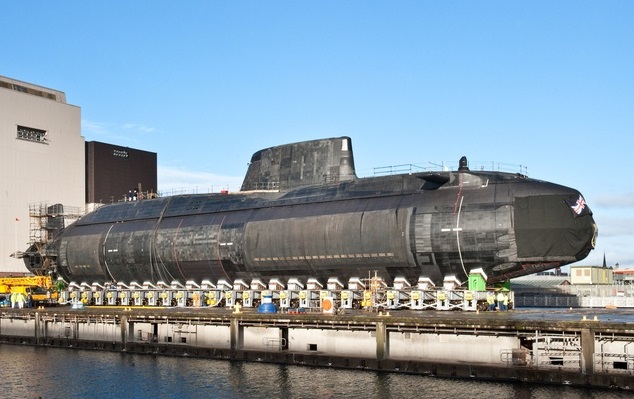
By Douglas McCartyJul 21, 2023 https://johnmenadue.com/aukus-will-adelaide-fremantle-or-port-kembla-be-the-australian-chernobyl/
While most discussion of the AUKUS Agreement has focussed on the geopolitical implications for Australia’s standing in the world, the escalation of the risk of war and the crippling cost of the nuclear submarine purchases when less expensive and more sensible non-nuclear options are available, little has been said of the risk to the civilian population posed by these nuclear-powered submarines (or other nuclear-powered naval vessels) in Australia’s home ports.
Perhaps we citizens only enter the calculations as ‘collateral damage’. Any such necessarily technical discussion is hampered by military secrecy. Some information has been released officially, but most is from generalised inference, or conjecture, and so subject to uncertainty. However, in this important matter, it is worth attempting to join the dots….
News from the war in Ukraine includes, almost every other night, a report on the situation around the Zaporizhzhia Nuclear Power Plant, the largest in Europe. Though no longer continuing to generate power for Ukraine, it is always at risk of being shelled or bombed by one side or the other, and regularly just avoiding reactor cooling water pump failure from damaged power transmission lines or lack of diesel fuel for their backup generators for the pumps. How long this situation will continue remains to be seen. And now, after the breaching of the Kakhovka Dam, it is estimated just three months of water for cooling remains.
The consequences of the catastrophic failure of a nuclear reactor are well known to both the Ukrainians and the Russians. To the Northwest of Zaporizhzhia, and just 100 kilometres North of Kyiv, lies the Chernobyl Reactor No. 4, which, on 26 April 1986, underwent meltdown after a coolant and moderator failure, exploded, and caught fire. Radioactive material and fission products were ejected into the air, spreading across the immediate countryside and into Northern Europe. Radioactive rain was reported on the mountains of Wales and Scotland, in the Alps, and contamination in reindeer herds in Northern Sweden. The principal radiological contaminant of concern across this vast area was Caesium-137, one of many fission products and representing some 6% of fission reactor spent fuel. Just 27 kg of Caesium-137, it is calculated, caused this contamination. Some 150,000 square kilometres of Ukraine, Belarus and Russia were initially contaminated. Of course, at the time of the accident, all this was part of the Soviet Union. To this day, 2600 square kilometres around the plant are considered unsafe for human habitation, or agriculture, and will remain so for between 300 and 3000 years! The Reactor used 2% enriched Uranium fuel.
Although the loss of life at Chernobyl was a small fraction of the 100,000 deaths from one of the only two uses of nuclear weapons in war, on Hiroshima in 1945, Chernobyl created 400 times more radioactive pollution. The Hiroshima bomb, “Little Boy”, contained 64 kg of enriched Uranium, though less than 2% actually underwent nuclear fission. The bomb was detonated 500 metres above ground (‘airburst’), and the fatalities were the result of blast, heat, and irradiation, in a city centre. Chernobyl occurred at ground level and so ejected debris upwards initially, followed by smoke columns from subsequent fires. . The 31 deaths at Chernobyl were plant operators and, of course, firemen. The G7, the AUKUS Partners and the Quad just met at ‘ground zero’ in a rebuilt Hiroshima City, 78 years after the bombing.
The US Navy nuclear powered warships, including the ‘Virginia’ Class submarines that Australia would buy under the AUKUS Agreement, principally use Highly Enriched Uranium (HEU) reactors. The Uranium is enriched to above 93% fissionable Uranium-235. It is weapons grade material and has in part been sourced from decommissioned nuclear weapons. The submarine reactors are intended to last for the ‘Life of Ship’ (LOS), up to 33 years, without needing refuelling. Low Enriched Uranium reactors need fuel replacement every 5 to 10 years, when, importantly, the containment pressure vessel around the reactor is physically inspected for flaws and deterioration. This is not done for the HEU, LOS reactors.
The US Navy nuclear powered warships, including the ‘Virginia’ Class submarines that Australia would buy under the AUKUS Agreement, principally use Highly Enriched Uranium (HEU) reactors. The Uranium is enriched to above 93% fissionable Uranium-235. It is weapons grade material and has in part been sourced from decommissioned nuclear weapons. The submarine reactors are intended to last for the ‘Life of Ship’ (LOS), up to 33 years, without needing refuelling. Low Enriched Uranium reactors need fuel replacement every 5 to 10 years, when, importantly, the containment pressure vessel around the reactor is physically inspected for flaws and deterioration. This is not done for the HEU, LOS reactors. In one year, at full power, (210 x 365 ÷ 940 =) 81.5 kg of U-235 would be required. Along with other decay products from the U-235 (Strontium-90, Iodine-131, Xenon-133 etc.), as noted earlier some 6% (or 4.9 kg) would be Caesium-137. The ‘neutron poisons’ also created are balanced out by ‘burnable’ neutron poisons incorporated into the core when new, to maintain reactor function over the years. So far, simple nuclear physics and thermodynamics.
Operationally, one surmises, the submarine reactor will infrequently run at full power. Actual annual production of Caesium-137 may lie between, say, 0.8 kg for 1/6th capacity operation on average for the whole year, and 2.45 kg at half capacity for the year. As the reactor is designed to not need refuelling for the ‘Life of the Ship’, the Cs-137 would continuously accumulate inside the reactor fuel elements. At the lower bound of 1/6th operation, there would be approaching 27 kg of Cs-137 in the core after 33 years, allowing for the decay of some of the Caesiun-137, given its half-life of 30.05 years. At the upper bound, it would take about 13 years for 27 kg of Caesium-137 to accumulate.
Visiting nuclear-powered submarines, from the US or UK, would be similar. Visiting US nuclear-powered aircraft carriers, each with two A1B reactors each of 700MWt, may have 27 kg of Cs-137 in their reactor cores after just two years of operation.
Visiting ships may stay in Australian ports for days or even weeks. Australian submarines will be in port not only between deployments, but also for maintenance, for months and years. The US Navy appears to have about 40 Virginia Class Subs, with some 18 undergoing long-stay maintenance, or about half. We might expect the same. So, at any one time, the AUKUS plan would see naval nuclear reactors, US, or UK, or Australian, or all, in Adelaide, and/or Fremantle, and/or Port Kembla. While peacetime only presents the risk of a nuclear accident, wartime would see these important military assets easily detectable – and targetable – while in port. In the event of a nuclear war, this may be just one of our worries.
In a conventional, non-nuclear conflict, the story may be very different. The situation of the Zaporizhzhia civilian reactors in Ukraine is most instructive. However, as legitimate military targets, would such restraint be shown towards the reactors in the submarines? What would be the impact of a conventional cruise or hypersonic or ballistic missile warhead on the pressure hull and reactor containment vessel (and plumbing) of a nuclear-powered submarine?
Should just 27 kg of the Caesium-137 in the naval reactor cores be released into the air through an explosion (as at Chernobyl) in an accident or deliberate attack, what would be the outcome? In Fremantle, especially if the ‘Fremantle Doctor’ was blowing, would sections of Fremantle and Perth become unsafe for human habitation? In Port Kembla, especially if a ‘Southery Buster’ came through, the Illawarra and, depending on the particular weather conditions, would parts of the South of Sydney become unsuitable for human habitation? For Port Adelaide, especially if a NW change came through, would the Adelaide coastal strip from Gawler to Aldinga become unsuitable for human habitation?
Imagine the number of “single mums doing it tough” who would have to be relocated to emergency accommodation – somewhere! Imagine all that social housing rendered uninhabitable! Even if we ‘won’ the war.
This is a real possibility if we have nuclear reactors in surface ships or submarines in our ports, or in our ship building and maintenance facilities.
Submarine boss refuses to answer questions over multi-billion-dollar AUKUS payments
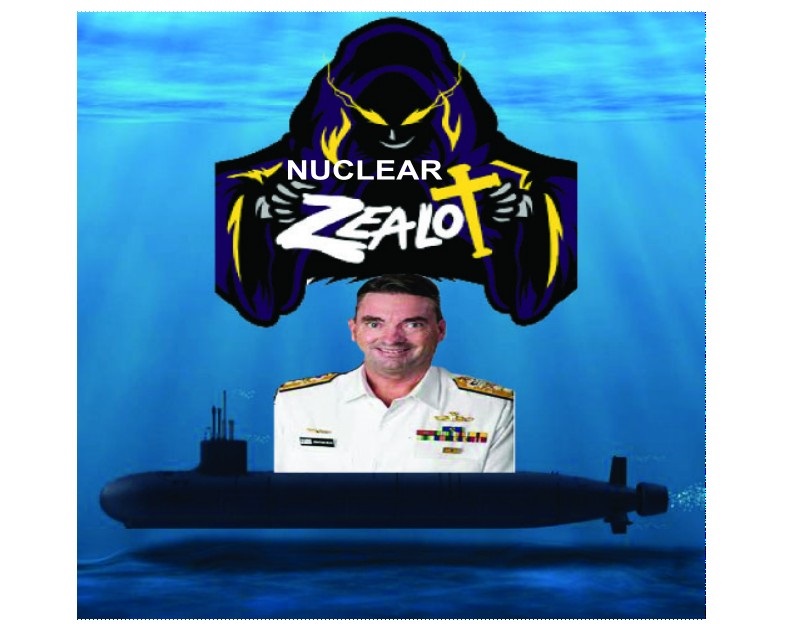
By defence correspondent Andrew Greene, https://www.abc.net.au/news/2024-06-07/submarine-bossmulti-billion-aukus-payments/103952528
The head of the AUKUS submarine program has refused to say whether an almost $5 billion government payment to the United States will be refunded if no nuclear-powered boats are delivered to Australia.
Under the tri-nation agreement, Australia is providing multi-billion-dollar contributions to the United States and United Kingdom to help expand their submarine industrial bases, but for months officials have declined to discuss details of the transfers.
During a Senate estimates hearing, Greens senator David Shoebridge attempted to extract details of the impending $4.7 billion payment to the US from the head of the Australian Submarine Agency, Vice Admiral Jonathan Mead.
Under questioning late on Thursday, the ASA boss repeatedly refused to say if a refund clause was included with Australia’s payment in case the United States fails to transfer Virginia class submarines in the 2030s.
“I just go back to the original statement — the US has committed to providing two US submarines from its submarine industrial base in the early 2030s and a third one on procurement,” the vice admiral told the committee.
What if the United States determines not to give us a nuclear submarine? Is there a clawback provision in the agreement?” Senator Shoebridge then demanded to know.
“That’s a hypothetical and I’m not going to entertain … The US has committed to transferring two nuclear-powered submarines to Australia,” the ASA boss asserted.
“It may be embarrassing that you have entered into an agreement that sees Australian taxpayers shelling out $4.7 billion — which we don’t get back if we don’t get our nuclear submarines,” Senator Shoebridge responded.
Under the final stage of AUKUS the United Kingdom will help develop a new class of nuclear-powered submarine to be known as SSN-AUKUS, with Australia’s boats to be built locally in Adelaide.
Ahead of the ambitious venture, Australia will hand almost $5 billion to British industry over the next decade for design work and to expand production of nuclear reactors that will eventually be installed on AUKUS submarines
Navy apologises to traditional land owners over nuclear expansion
Defence has apologised to traditional land owners in Western Australia who live around the Garden Island naval base for not consulting them about upgrades being made to accommodate visiting nuclear-powered submarines.
During Senate estimates, Greens senator Dorinda Cox, who is a Yamatji-Noongar woman, expressed concerns on behalf of her community about the AUKUS work that will soon occur at HMAS Stirling.
Chief of Navy Vice Admiral Mark Hammond told the Senator he wanted to discuss the matter on his next visit, an offer she accepted.
“I’m just surprised that this has been such an oversight for an extended period of time, I do apologise, I’m in Western Australia in a couple of weeks’ time and again in July. I’d like to formally engage with your concurrence.”
Experts unite to condemn Coalition nuclear policy meltdown.

Climate Media Centre
Energy and health experts as well as affected regional and global communities have condemned reports today of the Coalition’s energy policy which includes large nuclear reactors to be sited on mothballed coal-fired power stations across regional Australia, as well as a plan to rip up Australia’s commitments to the Paris Agreement.
The CSIRO’s recent GenCost report showed that renewable energy remains the fastest, safest and lowest-cost energy option is what we’re already building. Clean energy like solar and wind already makes up 40% of our national electricity grid, and one in three households have installed solar panels. Staying this course is the most responsible path toward slashing emissions this decade to avoid the worst impacts of climate change.
Andrew Bray, National Director, RE-Alliance – “The Federal Coalition’s energy policy is a false solution to Australia’s emission reduction commitments – the shift to a clean energy supply is already under way, with the latest data showing almost 40% of Australia’s electricity generation came from renewable energy sources in 2023.
“Policies relying on non-existent small modular reactor (SMR) nuclear technologies and large-scale nuclear plants that take decades to build would commit Australia to a polluting and unreliable fossil fuel powered system for the next 20 years. Our current trajectory will see these ageing plants close progressively over the next ten years.
“Renewable energy is here right now. Australians are increasingly using a cleaner and cheaper electricity supply, which we need to minimise the increasing impacts of climate change. Regional communities can greatly benefit from the rollout of renewable energy infrastructure – provided governments and industry are committed to sustained and significant investment in community engagement.
“We need to stick to the plan but shift our focus to ensure regional communities get the benefits they deserve from the roll-out.”
IEEFA Australia CEO, Amandine Denis Ryan, said: “The research by IEEFA’s nuclear experts calls into question whether nuclear makes financial sense for Australia, for a multitude of reasons – timing, cost, compatibility with renewables and liability issues to cite just a few.”
“Our research shows that nuclear reactors – both small modular reactors (SMRs) and gigawatt-scale reactors – in comparable countries have consistently taken longer and have been more expensive to build than expected. With over 50 years experience in this space, our analysts have researched nuclear projects around the world. For a country like Australia, starting from scratch, we expect that nuclear power reactors would not reach commercial operation before the 2040s, would come at a high cost, and require substantial government support.
“Nuclear plants in Australia cannot be built in time to replace Australia’s fleet of coal power stations, more than 90% of which are expected to retire in the next 10 years. Our research aligns with CSIRO and the regulators’ assessment that it would take at least 15 years to first production. The few existing SMRs in operation took over 12 years to build, despite original construction schedules of three to four years. Large reactors have a history of long delays, with most recent projects taking nine years or more from the first concrete pour, which in turn can only take place after years of planning, contracting and pre-construction works. This is in addition to the time required to develop the regulatory regime.
 Experts unite to condemn Coalition nuclear policy meltdownClimate Media CentreEnergy and health experts as well as affected regional and global communities have condemned reports today of the Coalition’s energy policy which includes large nuclear reactors to be sited on mothballed coal-fired power stations across regional Australia, as well as a plan to rip up Australia’s commitments to the Paris Agreement. Experts unite to condemn Coalition nuclear policy meltdownClimate Media CentreEnergy and health experts as well as affected regional and global communities have condemned reports today of the Coalition’s energy policy which includes large nuclear reactors to be sited on mothballed coal-fired power stations across regional Australia, as well as a plan to rip up Australia’s commitments to the Paris Agreement.The CSIRO’s recent GenCost report showed that renewable energy remains the fastest, safest and lowest-cost energy option is what we’re already building. Clean energy like solar and wind already makes up 40% of our national electricity grid, and one in three households have installed solar panels. Staying this course is the most responsible path toward slashing emissions this decade to avoid the worst impacts of climate change. To arrange interviews, please contact:Danielle Veldre +61 408972997 dan.veldre@climatemediacentre.org.auEmily Watkins +61 420622408 emily.watkins@climatemediacentre.org.au Andrew Bray, National Director, RE-AllianceAndrew has been working with regional communities hosting large scale renewable and transmission infrastructure for more than a decade. He can discuss the policy solutions that are needed to support regional communities to harness the benefits available in the shift to renewable energy.Location: Bungendore, NSW (near Canberra) “The Federal Coalition’s energy policy is a false solution to Australia’s emission reduction commitments – the shift to a clean energy supply is already under way, with the latest data showing almost 40% of Australia’s electricity generation came from renewable energy sources in 2023. “Policies relying on non-existent small modular reactor (SMR) nuclear technologies and large-scale nuclear plants that take decades to build would commit Australia to a polluting and unreliable fossil fuel powered system for the next 20 years. Our current trajectory will see these ageing plants close progressively over the next ten years. “Renewable energy is here right now. Australians are increasingly using a cleaner and cheaper electricity supply, which we need to minimise the increasing impacts of climate change. Regional communities can greatly benefit from the rollout of renewable energy infrastructure – provided governments and industry are committed to sustained and significant investment in community engagement. “We need to stick to the plan but shift our focus to ensure regional communities get the benefits they deserve from the roll-out.” IEEFA Australia CEO, Amandine Denis Ryan, said: “The research by IEEFA’s nuclear experts calls into question whether nuclear makes financial sense for Australia, for a multitude of reasons – timing, cost, compatibility with renewables and liability issues to cite just a few.” “Our research shows that nuclear reactors – both small modular reactors (SMRs) and gigawatt-scale reactors – in comparable countries have consistently taken longer and have been more expensive to build than expected. With over 50 years experience in this space, our analysts have researched nuclear projects around the world. For a country like Australia, starting from scratch, we expect that nuclear power reactors would not reach commercial operation before the 2040s, would come at a high cost, and require substantial government support. “Nuclear plants in Australia cannot be built in time to replace Australia’s fleet of coal power stations, more than 90% of which are expected to retire in the next 10 years. Our research aligns with CSIRO and the regulators’ assessment that it would take at least 15 years to first production. The few existing SMRs in operation took over 12 years to build, despite original construction schedules of three to four years. Large reactors have a history of long delays, with most recent projects taking nine years or more from the first concrete pour, which in turn can only take place after years of planning, contracting and pre-construction works. This is in addition to the time required to develop the regulatory regime. “Nuclear plants are notorious for cost overruns. Our analysts found that SMRs in operation or under construction cost three to seven times more than originally planned. Proposed SMRs in the US have also already seen cost estimates blow out by between two and four times in recent years. Large-scale reactors often face cost overruns as well. The Flamanville EPR in France is an extreme example of this, with costs having more than quadrupled despite France’s deep expertise on nuclear. |
“Nuclear plants are not a good complement for renewable generation. They can be flexible within a range, however the economics rely upon being operated in ‘baseload’ mode. In the 2040s, when the first nuclear plants could begin operating, the Australian Energy Market Operator expects that over 90% of generation will be supplied by variable renewables (wind and solar), and that the average annual utilisation factor of gas generation assets will be between 3% and 15% to complement them. Our analysts estimate that at a utilisation factor below 25%, the cost for electricity supplied by an American SMR would increase to more than AUD 600/MWh, if it was even possible to achieve such a low utilisation operationally.
| Experts unite to condemn Coalition nuclear policy meltdownClimate Media CentreEnergy and health experts as well as affected regional and global communities have condemned reports today of the Coalition’s energy policy which includes large nuclear reactors to be sited on mothballed coal-fired power stations across regional Australia, as well as a plan to rip up Australia’s commitments to the Paris Agreement. The CSIRO’s recent GenCost report showed that renewable energy remains the fastest, safest and lowest-cost energy option is what we’re already building. Clean energy like solar and wind already makes up 40% of our national electricity grid, and one in three households have installed solar panels. Staying this course is the most responsible path toward slashing emissions this decade to avoid the worst impacts of climate change. To arrange interviews, please contact:Danielle Veldre +61 408972997 dan.veldre@climatemediacentre.org.auEmily Watkins +61 420622408 emily.watkins@climatemediacentre.org.au Andrew Bray, National Director, RE-AllianceAndrew has been working with regional communities hosting large scale renewable and transmission infrastructure for more than a decade. He can discuss the policy solutions that are needed to support regional communities to harness the benefits available in the shift to renewable energy.Location: Bungendore, NSW (near Canberra) “The Federal Coalition’s energy policy is a false solution to Australia’s emission reduction commitments – the shift to a clean energy supply is already under way, with the latest data showing almost 40% of Australia’s electricity generation came from renewable energy sources in 2023. “Policies relying on non-existent small modular reactor (SMR) nuclear technologies and large-scale nuclear plants that take decades to build would commit Australia to a polluting and unreliable fossil fuel powered system for the next 20 years. Our current trajectory will see these ageing plants close progressively over the next ten years. “Renewable energy is here right now. Australians are increasingly using a cleaner and cheaper electricity supply, which we need to minimise the increasing impacts of climate change. Regional communities can greatly benefit from the rollout of renewable energy infrastructure – provided governments and industry are committed to sustained and significant investment in community engagement. “We need to stick to the plan but shift our focus to ensure regional communities get the benefits they deserve from the roll-out.” IEEFA Australia CEO, Amandine Denis Ryan, said: “The research by IEEFA’s nuclear experts calls into question whether nuclear makes financial sense for Australia, for a multitude of reasons – timing, cost, compatibility with renewables and liability issues to cite just a few.” “Our research shows that nuclear reactors – both small modular reactors (SMRs) and gigawatt-scale reactors – in comparable countries have consistently taken longer and have been more expensive to build than expected. With over 50 years experience in this space, our analysts have researched nuclear projects around the world. For a country like Australia, starting from scratch, we expect that nuclear power reactors would not reach commercial operation before the 2040s, would come at a high cost, and require substantial government support. “Nuclear plants in Australia cannot be built in time to replace Australia’s fleet of coal power stations, more than 90% of which are expected to retire in the next 10 years. Our research aligns with CSIRO and the regulators’ assessment that it would take at least 15 years to first production. The few existing SMRs in operation took over 12 years to build, despite original construction schedules of three to four years. Large reactors have a history of long delays, with most recent projects taking nine years or more from the first concrete pour, which in turn can only take place after years of planning, contracting and pre-construction works. This is in addition to the time required to develop the regulatory regime. “Nuclear plants are notorious for cost overruns. Our analysts found that SMRs in operation or under construction cost three to seven times more than originally planned. Proposed SMRs in the US have also already seen cost estimates blow out by between two and four times in recent years. Large-scale reactors often face cost overruns as well. The Flamanville EPR in France is an extreme example of this, with costs having more than quadrupled despite France’s deep expertise on nuclear. “Nuclear plants are not a good complement for renewable generation. They can be flexible within a range, however the economics rely upon being operated in ‘baseload’ mode. In the 2040s, when the first nuclear plants could begin operating, the Australian Energy Market Operator expects that over 90% of generation will be supplied by variable renewables (wind and solar), and that the average annual utilisation factor of gas generation assets will be between 3% and 15% to complement them. Our analysts estimate that at a utilisation factor below 25%, the cost for electricity supplied by an American SMR would increase to more than AUD 600/MWh, if it was even possible to achieve such a low utilisation operationally. “One of the major risks for investors in nuclear assets is the size and allocation of liability in case of an accident, with international conventions stating that operators of nuclear installations are liable should an incident occur. Such liabilities are very challenging for a company to carry by itself. In the United States, this issue was addressed with the Price–Anderson Nuclear Industries Indemnity Act (1957) by creating a shared insurance pool, now totalling AUD 22.5 billion across the almost 100 reactors covered. The US Government is exposed to costs beyond the insurance pool. Full costs associated with the 2011 Fukushima disaster could be as high as AUD 770 billion. It is unclear how Australia would be able to manage these liabilities without very material government underwriting of risk.” |
Mia Pepper, Campaign Director at the Conservation Council of WA said: “The Coalition’s nuclear power plans reported today are a clear plan to distract and delay from real action on climate change.
“Nuclear power is expensive, slow and dangerous and simply cannot deliver the energy needed in the time frame we have to decarbonise.
“WA is currently exiting coal and well advanced on the transition to cheaper, safer, cleaner alternatives like renewables. It makes no economic, environmental or energy sense to change direction now.
“The WA Liberals have already ruled out nuclear power for WA, saying it is too expensive and doesn’t make sense for WAs grid. Peter Dutton’s irresponsible reactor plan has failed to convince his own party – and it certainly hasn’t and won’t convince the wider WA community. The Liberal party energy policy is nothing more than a dangerous distraction and delay from the much needed transition out of fossil fuels.”
“Nuclear is thirsty, requiring huge volumes of water for cooling, in an uncertain climate future nuclear also becomes one of the most dangerous and unreliable forms of energy we have seen these issues emerge in nuclear powered countries like France.
There remain significant and unresolved issues with the management of High-Level nuclear waste, insurmountable issues with security, and deep connections to the production of weapons grade materials. The risks of things going wrong are catastrophic.”
Masayoshi Iyoda – 350.org Japan Campaigner, said: “You cannot call nuclear clean energy, and completely ignore the voices of the victims of nuclear disasters and the burden on future generations. Nuclear is simply too costly, too risky, too undemocratic, and too time-consuming. We already have cheaper, safer, democratic, and faster solutions to the climate crisis, and they are renewable energy and energy efficiency.”
Joseph Sikulu – 350.org Pacific Managing Director said: “The legacy of nuclear power in the Asia Pacific region is a harmful one, as is the legacy of climate-destroying fossil fuels. The possibility of Australia venturing into nuclear is dangerous and concerning, and a distraction from what we should really be focused on – the just transition to renewable energy.”
Was ABC’s firing of Antoinette Lattouf influenced by a pro-Israel group? | Real Talk – Online.
23 Jan 2024 Real Talk
Australian-Lebanese presenter Antoinette Lattouf was fired by Australia’s ABC just three days after she started. It has now surfaced that her firing may have been orchestrated by a pro-Israeli WhatsApp group. Now she’s fighting back, and she joins us to speak about it on Real Talk online. (Note: After this interview was recorded, ABC issued a statement saying that Lattouf was not fired. Lattouf responded on Twitter, saying: “If I wasn’t sacked, what was it?”) #RealTalk is a Middle East Eye interview show hosted by Mohamed Hashem that delves into the stories and experiences of a diverse range of guests.
Lockheed Martin deletes Australian F-35 ties
The world’s biggest weapons manufacturer, Lockheed Martin, has deleted from its website details about Australia’s key role in building F-35 fighter jets, which Israel is using to bomb Gaza.
MICHELLE FAHY, JUN 05, 2024 https://theklaxon.com.au/lockheed-martin-australian-government-joined-at-the-hip/
Among the details quietly scrubbed from Lockheed Martin’s website are that Australian businesses are supplying components ‘for the entire F-35 fleet’ and that, ‘Every F-35 built contains some Australian parts and components’.
The material was included in the section ‘Industrial Partnerships’, which was deleted entirely between March 15 and April 7 this year.
Around that time, Lockheed Martin and the Albanese Government were under heavy scrutiny following a February Senate hearing in which the supply of ‘weapons’ to Israel was hotly contested, specifically F-35 parts and components.
The deleted ‘Industrial Partnerships’ section of the Lockheed Martin site states: ‘As a programme partner, Australian businesses are supplying components for the entire F-35 fleet, not just Australian aircraft.’
It continues: ‘In total, more than 70 Australian companies have been awarded export contracts valued at AU$4.13 billion.’
Web archive Wayback Machine, which sporadically screenshots webpages, shows the ‘Industrial Partnerships’ section was on Lockheed Martin’s site until March 15, but had been deleted by April 7, the next time it screenshot the page.
Also deleted from the site is a profile of Melbourne F-35 parts manufacturer Marand Precision Engineering, which supplies the F-35 ‘global fleet’ with an ‘engine removal and installation mobility trailer’ comprised of ‘around 12,000 individual parts’.
The Marand article was on the Lockheed site when the Wayback Machine took a screenshot of the page on March 28, but it had been deleted by the time of the next screenshot taken on May 9.
Lockheed Martin’s Australian F-35 page now contains only information relating to the Australian Defence Force’s F-35 program.
On March 25, Greens Senator David Shoebridge tried (and failed) to move a motion in the Senate that accused the Federal Government of being ‘content to send weapons and weapons parts to Israel to literally fuel the genocide’.
On February 14, participating in a Senate committee, Shoebridge asked Hugh Jeffrey, a Department of Defence deputy secretary: ‘Do you consider parts of an F-35 fighter jet, such as the parts manufactured in Australia and used on Israeli Defence Force fighter jets to open the bomb bay doors, to be weapons?’
Jeffrey responded: ‘A pencil is used for writing. It’s not designed in and of itself to be a weapon, but it can be, if you want to use it as a weapon.’
Shoebridge said: ‘Bomb bay doors are generally used to release bombs.’
Jeffrey said that under the UN definition, ‘weapons are defined as whole systems’, such as ‘armoured vehicles’, ‘tanks’ and ‘combat helicopters’.
The Albanese government has repeatedly said that no ‘weapons’ have been sent to Israel for at least the past five years.
Focusing on the word ‘weapons’ enables the government to ignore exports of ‘ammunition/munitions’ and ‘parts and components’, all of which are covered by the 2014 Arms Trade Treaty, which Australia championed at the United Nations and ratified in 2014.
The Albanese government is coming under increasing pressure, with concerns mounting that Australia will be found to be complicit in genocide because it has not ceased military exports to Israel.
More than 800 public servants last week released a signed open letter calling on the government to immediately stop all military exports to Israel.
The Department of Defence has admitted it approved two new export permits to Israel after the October 7 attack.
In a Senate estimates hearing on February 14, the Defence Department‘s Hugh Jeffrey said: ‘Two export permits have been granted since the time of the last estimates’, the date of which was 25 October 2023. The permits were approved between October 25 and October 31. Mr Jeffrey refused to say what items the new permits covered.
The Defence Department and DFAT have also refused to answer questions about whether approved military export permits that were in place before the Hamas attacks have been suspended.
Australia’s key role in the F-35 fighter jet program
More than 70 Australian companies supply parts and components into the global supply chain of the F-35.
Several of the companies are the sole source of the parts they produce. Without them, new F-35 jets cannot be built, nor can parts be replaced.
In December last year a US Congressional hearing revealed that the F-35 joint program office had been moving ‘at a breakneck speed to support … Israel … by increasing spare part supply rates’. (Emphasis added.)
On October 30, the Defence Department issued a media release trumpeting the important role played by Australian industry in the production and maintenance of the global F-35 fleet. The release announced that Melbourne company Rosebank Engineering had established an important repair depot under the F-35 global support solution for aircraft operating in or deployed to the Indo-Pacific region. Rosebank Engineering and the Defence Department had partnered with the US F-35 joint program office and Lockheed Martin to establish the new facility.
Rosebank has been part of the F-35 supply chain since 2004 and now manufactures more than 150 components for the landing gear and weapons bay systems on the F-35, including the components that enable the bombs to be dropped on Gaza. Rosebank (formerly RUAG Australia) is the sole source global supplier of the F-35’s ‘uplock actuators’ that open and close the F-35’s weapons bay doors.
Sydney-based Quickstep Holdings is another long-term supplier to the F-35 program. In December 2020, it announced it had produced its 10,000th component – just 20% of its commitment to the program. Quickstep manufactures more than 50 components and assemblies, worth about $440,000 in each F-35, it says.
Lockheed Martin also acknowledged Queensland’s Ferra Engineering in providing products for the F-35 since 2004 and said it remained a vital partner.
Rosebank Engineering, Quickstep Holdings and Ferra Engineering have all supplied parts and components into the F-35’s supply chain during the past five years.
No nuke waste down under: Nuclear Free Local Authorities spokesperson receives assurance MOD still committed to decommissioning British nuclear subs at home
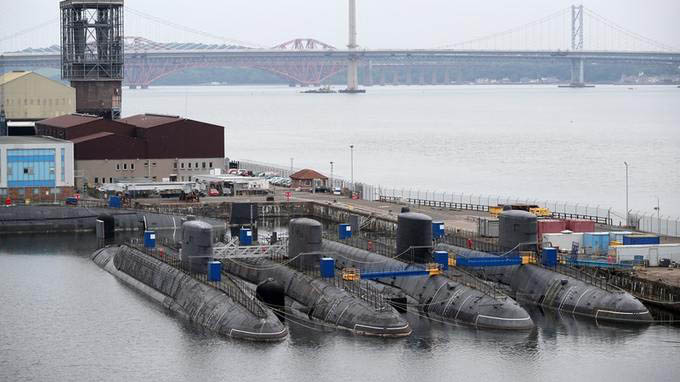
Nuclear Free Local Authorities, 4 June 24
Defence chiefs have written to the NFLA Spokesperson on Nuclear Submarine Decommissioning reassuring him that ‘the Ministry of Defence remains committed to disposing its decommissioned submarines, including the waste they produce, within the UK’.
Councillor Brian Goodall, who represents the Rosyth Ward in Scotland where decommissioning is currently taking place, wrote to the outgoing Defence and Foreign Secretaries on 17 May seeking their assurance that redundant British nuclear submarines will not be sent to Australia for disposal.
In Australia, in relation to the AUKUS defence pact, legislators have proposed a new Naval Nuclear Power Safety Bill 2024, which appears to provide under Clauses 7 and 12 of the Bill for the disposal of high level radioactive waste from British and American submarines on Australian soil, and also for the storage of such materials in Australia from ‘a submarine that is not complete (for example, because it is being constructed or disposed of)’.
Councillor Goodall is concerned that this could theoretically mean the British Government ‘permitting towing redundant UK boats from Rosyth and Devonport down under for disposal’. Councillor Goodall fears that, were this to become practice and not just theory, local expertise and the jobs of his constituents could be lost.
In their response, defence officials say they continue to work on completing the decommissioning of the submarine Swiftsure at Rosyth by 2026 ‘by adopting a unique approach that will maximise the amount of the submarine that can be recycled and minimise the amount of waste that needs to be disposed of’. Radioactive waste will be taken to Capenhurst, Cheshire for interim storage until a Geological Disposal Facility is completed for its eventual disposal. This includes the reactor from each dismantled submarine.
Knowledge acquired as a result of the submarine decommissioning work will be shared by the MOD with Australia.
The letter sent to Lord Cameron and Grant Shapps on 17 May read:……………………………………………………… more https://www.nuclearpolicy.info/news/no-nuke-waste-down-under-nflas-spokesperson-receives-assurance-mod-still-committed-to-decommissioning-british-nuclear-subs-at-home/
A Detectable Subservience – Australia’s ill-fated nuclear submarine deal?

All of this leaves one wondering about just what due diligence was done before Morrison, and the 24-hour copycat decision-maker Albanese, committed us to the folly of paying $A368 billion to purchase a subservient position embedded within the US war machine by means of a soon-to-be fully detectable and therefore likely to be destroyed fleet of nuclear-powered submarines.
June 6, 2024 by: The AIM Network, By Michael Willis, https://theaimn.com/a-detectable-subservience/
The first operational outcome of the Pillar 2 AUKUS arrangement between the US, UK and Australia has just been announced.
The three countries will share data from their submarine-hunting PA-8 Poseidon aircraft, manufactured by the troubled Boeing Corporation.
This was announced on May 29 in an “exclusive interview” given to US online website Breaking Defense by Michael Horowitz, whose office serves as the Pentagon’s day-to-day lead on AUKUS issues.
(In a deliciously ironic slip, the website referred to the United Kingdom as the “Untied Kingdom”, true of the political cohesion of both the UK and the US at this time.)
All three AUKUS nations:
“… operate the Boeing-made maritime surveillance aircraft; the US operates 120, Australia 12, and the United Kingdom nine. A key part of the P-8 is its collection of sonobuoys, which are dropped into the water to hunt down submarines. (“Sonobuoys” is the preferred US-spelling of the English language “sonar buoys”.)
According to Horowitz, the Pentagon’s Deputy Assistant Secretary of Defense for Force Development and Emerging Capabilities, a new “trilateral algorithm” will allow them to share information from P-8 sonar buoys between each other.
According to Breaking Defense, the trilateral algorithm requires a high level of trust between the three countries.
“Even among Five Eyes partners,” it says, “sonobuoy information is highly sensitive, as sharing that data not only makes clear what each country has the ability to gather and where those buoys are deployed, but because it clearly reveals what and where each country is tracking.”
Pillar 2 arrangements build on those of Pillar 1 which are solely concerned with Australia’s acquisition of the hugely expensive nuclear-powered submarines.
At a cost averaged out at $A33 million a day over 35 years, we are promised a fleet of 8 submarines with the apparent advantages of extended range and endurance, higher speed, increased payload capacity, and reduced refuelling needs.
But given our own use of sonar buoys and knowing that our own all-but-at-war with “enemy”, China, has the same or superior detection technologies, it is the claim that SSNs (nuclear-powered submarines) have greater stealth and reduced detectability that is the major sales pitch justifying our $368 billion spend.
SSNs are claimed to have reduced noise and to be able to operate at greater depths, thus making them harder to detect.
Reduced noise will affect passive sonar buoys which listen for sounds generated by submarines. These sounds can include engine noise, propeller cavitation, or other mechanical noises.
Greater depth will affect active sonar buoys, those that send out a sound wave which then bounces off the submarine, allowing the buoy to detect the “ping” that travels back to the buoy. That ping is weaker the greater distance it has to travel.
Former Senator and submariner Rex Patrick was critical of the AUKUS decision for Australia to begin its SSN acquisition with the purchase of three second-hand Virginia Class SSNs from the US.
“The first highly noticeable issue with the Virginia class is a problem that has surfaced with the submarine’s acoustic coating that’s designed to reduce the ‘target strength’ of the submarine (how much sound energy from an enemy active sonar bounces off the submarine, back to the enemy),” he said.
“The coating is prone to peeling off at high-speed leaving loose cladding that slaps against the hull, making dangerous noise, and causes turbulent water flow, which also causes dangerous hull resonance (where the hull sings at its resonant frequency, like a tuning fork) and extra propulsion noise. I know a bit about this as a former underwater acoustics specialist.”
Magnetic Anomaly Detection (MAD) is another method of detection. MAD detects disturbances in the Earth’s magnetic field caused by the metal hull of a submarine. MAD sensors are typically deployed on aircraft and can detect submarines at relatively close ranges. The signals weaken with distance.
However, the Chinese are developing the ability to detect extremely low frequency (ELF) electromagnetic signal produced by speeding subs.
Researchers from the Chinese Academy of Sciences’ Fujian Institute of Research on the Structure of Matter found an ultra-sensitive magnetic detector could pick up traces of the most advanced submarine from long distances away.
The researchers calculated that the extremely low frequency (ELF) signal produced by a submarine’s bubbles could be stronger than the sensitivities of advanced magnetic anomaly detectors by three to six orders of magnitude.
The bubbles are an inevitable consequence of the submarine’s cruising speed, which causes the water flowing around the hull to move faster as its kinetic energy increases and its potential energy – expressed as pressure – decreases. When the pressure decreases sufficiently, small bubbles form on the surface of the hull as some of the water vaporises. This process causes turbulence and can produce an electromagnetic signature, in a phenomenon known as the magnetohydrodynamic (MHD) effect.
Though faint, ELF signals can travel great distances, thanks to their ability to penetrate the water and reach the ionosphere, where they are reflected back to the Earth’s surface.
Detection by ELF turns the advantage of an SSNs higher speed into its opposite, namely the disadvantage of higher detectability.
This ability of science to increase the detection of SSNs led even the pro-US Australian Strategic Policy Institute (ASPI) to publish a warning that “the oceans of tomorrow may become ‘transparent’. The submarine era could follow the battleship era and fade into history.”
It titled its article on a study of submarine detection by Australian scientists and academics “Advances in detection technology could render AUKUS submarines useless by 2050.”
According to the authors:
“The results should ring alarm bells for the AUKUS program to equip Australia with nuclear-powered submarines. Our assessment suggests that there will only be a brief window of time between the deployment of the first SSN AUKUS boats and the onset of transparent oceans.”
However, it is the expanding frontier of quantum computing that may be the ultimate nail in the AUKUS submarines coffin.
Quantum computing is the sexy new kid on the block – witness the Australian government’s investment of almost a billion dollars in a bid to build the world’s first commercially useful quantum computer in Brisbane. It’s bound to make the shareholders of US company PsiQuantum very happy, including notorious corporate investors such as Black Rock.
In July 2016, the Australia government awarded a contract to local company Q-CTRL to develop a quantum navigation system can use the motions of a single atom to precisely determine the course and position of a submarine and maintain accuracy to a remarkable degree. This overcomes two disadvantages of navigation by GPS: GPS is vulnerable to jamming by an adversary, and its signals cannot penetrate sea water to any appreciable depth.
That’s the good news story.
The bad news is that China has already funded its multi-billion-dollar National Quantum Laboratories to develop quantum-based technology applications for “immediate use to the Chinese armed forces”, possibly including targeting stealthy submarines.
According to Zhu Jin in The Conversation:
“New quantum sensing systems offer more sensitive detection and measurement of the physical environment. Existing stealth systems, including the latest generation of warplanes and ultra-quiet nuclear submarines, may no longer be so hard to spot.”
Using devices that measure and analyse the gravitational pull exercised by the mass of a submarine on the movement of sub-atomic particles in a sensor would overcome the disadvantages of sonar buoys and magnetometers, rendering any otherwise undetectable object with mass detectable.
The other area in which China is more advanced than its competitors is the use of quantum computing for encryption and decryption of communications.
In a 2022 paper on Quantum Computing and Cryptography, the authors that:
“China has set the pace for creating secure quantum communications that cannot be intercepted or manipulated. Further advances in Chinese quantum communication networks, especially networks designed for military use, will put the Navy at increased risk when deployed to the Indo-Pacific. If Chinese communications are virtually unbreakable and U.S. Navy communications can be exploited by Chinese quantum code-breaking technology, it will quickly lose its ability to safely operate among PLAN forces.”
All of this leaves one wondering about just what due diligence was done before Morrison, and the 24-hour copycat decision-maker Albanese, committed us to the folly of paying $A368 billion to purchase a subservient position embedded within the US war machine by means of a soon-to-be fully detectable and therefore likely to be destroyed fleet of nuclear-powered submarines.
Michael Williss is a member of the Australian Anti-AUKUS Coalition (AAAC) and the Independent and Peaceful Australia Network (IPAN).
Eraring deal signals death of baseload power in Australia, and Dutton’s nuclear fantasy
Giles Parkinson, Jun 4, 2024, https://reneweconomy.com.au/eraring-deal-signals-death-of-baseload-power-in-australia-and-duttons-nuclear-fantasy/
Australia’s biggest coal generator will operate with the same capacity factor as the average solar farm as a result of the deal to delay the Eraring closure. It confirms baseload power has no future in Australia, so what does Peter Dutton think he is going to do with a big nuclear plant?
The one thing that you can say about the federal Coalition energy policy over the last two decades is that it has been consistent, at least in so far as the technology that they don’t want to support: Let’s call it “Anything but renewables.”
Two decades ago John Howard scrapped the then mandatory renewable energy target after being convinced by the fossil fuel lobby of the potential horrors of doubling wind and solar output from just one per cent to two per cent.
Nearly a decade later Tony Abbott scrapped the carbon price, and then tried to do the same with the current renewable energy target, and the institutions that supported it. He was thwarted by an unlikely combination of Al Gore and Clive Palmer, but succeeded all the same in creating a two year investment drought.
Now the Peter Dutton led Coalition is having another crack, albeit from Opposition, demanding that the rollout of large scale renewables – wind, solar and storage – be brought to a crashing halt, and promising to rip up contracts with the commonwealth if they are returned to power.
So absolute is their hatred and fear of renewables that it is just a little surprising that they haven’t yet figured out the alternative for the country’s ageing fleet of increasingly unreliable and highly polluting coal fired power stations.
The Coalition started with a fixation on new coal fired power stations – remember HELE – laughingly called high efficiency, low emissions, but in reality exactly the opposite?
That didn’t last long because they realised that no one would actually want to build one, although if you search into the bowels of X, you might just find a cosplay former Coalition minister still singing the fossil fuel’s tunes.
Then it was the turn of nuclear small modular reactors (SMRs), before it dawned on them that the sort of machines the travelling salespeople had been talking to them about with such enthusiasm don’t actually exist – and probably won’t for a while and will likely be terribly costly when they do.
Clean Energy Council boss Kane Thornton on Tuesday described the push for nuclear – six times more costly than renewables and storage and two decades until it could possibly be produced for the first time in Australia – as a “mad-hatters’ tea party”. That is the almost unanimous view in the energy industry, but the FUD – fear uncertainty and doubt being spread by the Coalition and right wing media creates a different picture in the public arena.
The nuclear boosters thought they had a victory last month when they assumed the delay in closing the country’s biggest coal generator Eraring was vindication of their insistence that wind and solar won’t work, and that the only way to replace centralised fossil fuel generation is with another centralised baseload fuel source.
But the extraordinary – and many say unnecessary – deal struck by the NSW government and the Eraring owner is anything but.
Yes, the 2.88 GW official closure is pushed back by two years – not because wind, solar and storage can’t do the job, but because it hasn’t been built quickly enough, and that’s the fault of both Eraring owner Origin and the state government.
The delay is not due to reliability concerns because there is no obligation on Eraring to be producing power at the time that the market operator says it will need it most – the “tail risk” events that might occur in the middle of summer, for instance, when an intense heatwave creates a surge of demand and renders other generation useless.
The extension is really just about the risk and fear of high prices – exacerbated by the delays in new projects – and the fact that these might occur in the lead up to the next election in early 2027.
One thing that the government can observe is that the energy industry exercises no self control about bidding practices, which is why an automatic price cap had to be imposed last month when a bunch of coal generators were out of action. There is no doubt that, given the same opportunity, they will repeat the dose.
But here’s what the Eraring deal really tells us, and it’s a big problem for Opposition leader Peter Dutton’s nuclear fantasies: It’s a signal – indeed confirmation – that the concept of “baseload” power – interpreted by most as “always one” generation and the fundamental back drop to energy markets for half a century – is now dead in the water.
The deal with the government only requires Origin to operate Eraring at just one quarter of its rated capacity, about the same capacity factor as your average solar farm, and less than most wind farms.
The deal requires it to provide little more than one third of its recent average annual output – just 6 terawatt hours. Last year it produced 16 TWh. That’s partly because the plants are getting old – but it’s also because there is simply no room in the grid for an ‘always on’ big baseload generator any more.
This has been admitted by the owners of Eraring, Origin Energy, for some time. It was clear more than a decade ago that this was going to happen, and Origin admitted as much in 2018. “The idea of base-load power stations is well and truly gone,” said Greg Jarvis, the head of markets said then.
It is expected that Origin will cycle two or three of its Eraring units over summer, and perhaps just one over winter. One thing that is for sure, it won’t be running at baseload, and so won’t likely be in the market for so-called “baseload” swaps. Which means, according to some analysts, it might just pick the moments when prices are higher.
Running a big baseload plant at low capacity factors, is clearly not economic, at least at face value. So if Origin can’t pick high priced moments for Eraring, it has at least the security of having the NSW taxpayer on the hook to underwrite its looses – up to a hefty $225 million a year – and pay for any major equipment upgrades.
The other private operators of coal generators in Australia agree that baseload is dead as a concept. AGL says there is simply not the demand to operate coal fired power stations as “baseload,” and EnergyAustralia is pushing for contracts that will allow its last remaining coal generator, Mt Piper, to switch off completely in certain seasons.
There is speculation that its Yallourn generator in Victoria will end up doing the same thing, notwithstanding the current but hidden contract to keep it open until 2028.
The CSIRO, of course, took this into account when estimating its generously low costs for large-scale nuclear in the recently released final version of the GenCost report.
The Coalition and its supporters howled their disapproval. Energy spokesman Ted O’Brien wants the CSIRO to calculate capacity factors of 92 per cent, without ever explaining how this can possibly fit into a grid where rooftop solar in many states already accounts for all, or nearly all, daytime demand.
It’s not the only problem with large scale, of course. There are questions about the need for more standby capacity for such large machines (1.4 GW) and there is the question about critical system services which in many other countries nuclear is given a grid pass on because it requires them to produce less power, which they don’t like doing.
The nuclear lobby has also been absolutely insistent that the CSIRO include integration and transmission costs for wind and solar, which the CSIRO has done. Curiously, they haven’t said a peep about the considerable integration, storage and transmission costs for nuclear, which are not included in the CSIRO report.
There was a big range of reactions to the Eraring decision – from frustration and anger from those who think it is not needed and not justified, to quiet resignation and a roll of the eyes from many in the energy market, and as some sort of validation for the renewable naysers and nuclear junketeers.
One of the most inventive responses came from the Centre for Independent Studies, which decided that fossil fuel subsidies, like the $450 million offered to Eraring to keep less than half its output going for another two years, are really subsidies to the renewable energy industry, because – they argue – it is in response to its failures.
Full marks for creativity, but none for reality. The nuclear boosters have decided, like Donald Trump, that the best way to disguise a dud deal is to make ever more outrageous claims.
It underpins the carefully choreographed claims that nuclear is cheap (it’s not), that everyone is doing it (they are not), that nuclear can be built in Australia faster than anywhere else in the world (it can’t), and that is the only technology that can keep the lights on (clearly not true)..
Denial has morphed from climate change to technology. But it doesn’t stack up. If the lowest cost “baseload” can’t find room in the market, then there’s not much hope for the most expensive “baseload.” And climate science tells us there is no time to wait.
Every day between now and the election’: Albanese ignites nuclear fight with Dutton
SMH, By James Massola, June 2, 2024
…………………….. the prime minister highlighted recent CSIRO research that found nuclear power is up to eight times more expensive than large-scale wind or solar power.
“They also found building a single nuclear power plant would cost at least $8.5 billion and take 15 years. At the next election, we will offer voters a choice between renewable energy and nuclear power,” he said.
“We will raise this every day between now and the election. [Dutton] needs to stop hiding his plans and release the locations of these planned nuclear reactors. We will join communities in campaigning against them.”………………………………..
The prime minister said Dutton had promised to look communities that could host nuclear power plants in the eye and engage with them but “he hasn’t been anywhere near [them]”.
“He has not been within 40 kilometres of a coal-fired power station. And he’s saying they’ll have six or more sites. He’s been nowhere near any of them in Gippsland, the Hunter, Flynn, Maranoa, O’Connor, seats like this,” Albanese said.
Back in 2007, when he was infrastructure spokesman in the Kevin Rudd-led opposition, Albanese helped lead Labor’s attack against John Howard’s plans to build nuclear power plants across the country – and he has not forgotten those lessons.
…………………Dutton had initially flagged the nuclear policy would be outlined before last month’s federal budget, but that timeline has since slipped.
This masthead then revealed the Coalition planned to unveil either six or seven sites had been selected to host nuclear power plants in the current parliamentary sitting fortnight but following that report, the opposition pressed pause on the announcement once more.
The Coalition’s policy announcement has now been pencilled in for the week after next, once parliament has risen at the end of next week, and is expected to take place outside of Canberra.
Possible sites for nuclear reactors include the Latrobe Valley in Victoria, the Hunter Valley in NSW, Collie in Western Australia, Port Augusta in South Australia, and even potentially a plant in Nationals leader David Littleproud’s electorate of Maranoa in south-west Queensland. All of these locations are on the site of, or near, current or former coal-fired power plants.
Coalition sources, who asked not to be named so they could detail internal discussions about the policy, said the six or seven MPs who would potentially host nuclear power plants in their seats had been notified.
…………………. Labor strategists believe that once the potential sites are named – all of which are expected to be in Coalition seats – that will sharpen the political debate and force voters to consider the implications of having a power plant in their own seat.
A Dutton-led government, if elected, would face a fight with state Labor premiers including Victoria’s Jacinta Allan, NSW’s Chris Minns and Western Australia’s Roger Cook, who have all hosed down suggestions their states could host nuclear power plants.
Queensland Opposition Leader David Crisafulli, who is widely expected to lead the LNP to victory in a state election in October, has indicated he would not back nuclear power unless it had bipartisan support at a federal level.
Albanese said the Labor government opposed the construction of nuclear power plants in Australia for four main reasons.
“Nuclear reactors are simply wrong for Australia, the International Energy Agency said that this week, they support nuclear reactors but for Australia, given the comparative costs and time frames, it makes no sense given that we have access to the best renewables on Earth, along with hydro, batteries and gas to firm them,” he said.
“Second is nuclear is too slow [to build] to keep the lights on, the CSIRO speak about 15 years at least for it to happen. So you’re talking about 2040 just small modular nuclear reactors and years later, if they want to go down the large-scale route and Australia doesn’t have that time.”
“Third, relates to cost, nuclear will push up power bills – independent analysis from CSIRO, AEMO [the Australian Energy Market Operator], says nuclear is the most expensive form of energy to build. And the fourth is communities don’t want nuclear. That includes state LNP leaders that have said that, local councils, state and indeed even [federal] coalition MPs like Darren Chester and Dan Tehan.”
Back in March, 12 Coalition MPs told this masthead they backed lifting the moratorium on nuclear power in Australia but would not commit to hosting a nuclear power plant in their own electorate.
And Nationals MP Darren Chester, who holds the Victorian seat of Gippsland, which is widely considered a probable pick for a nuclear site, said he would not accept a site unless his community was handed a significant economic package.
https://www.smh.com.au/politics/federal/every-day-between-now-and-the-election-albanese-ignites-nuclear-fight-with-dutton-20240601-p5jigh.html
If regional communities don’t want a windfarm, why would they accept a nuclear power station?
Guardian, Gabrielle Chan, 4 June 24
The Coalition’s energy policy is leveraged on regional discontent about renewables. But many farmers don’t want nuclear in their back yard either.
Here’s the thing about the Coalition’s latest nuclear policy. It tries to use one of the most contentious issues in rural areas, which is the rollout of renewables and the electricity transmission lines to carry energy around the country, to push an even more controversial energy transition.
Because nuclear power stations would also be built in the regions. And if you’re worried about renewables, hands up who wants a nuclear reactor next door?
My generation grew up with the US-Russian cold war and the Doomsday Clock.
While the conversation and the technology of nuclear energy has moved on, the cost, complexity and construction time has not, as the CSIRO found in a report released last month………………………
If there is one thing that I have learned from calling a country town home, it is that people are very attached to their place and how it is identified.
Not everyone opposes renewables but there is a significant portion of people who don’t want them in their own back yard. Others are quietly making their fortunes, having struck the formula for drought-proofing their businesses for decades to come. If the Big Dry strikes, you will probably find them on a beach somewhere.
That is because annual payments to host turbines start from $40,000 each though I know of agreements that are much higher, especially when communities collectively bargain. The New South Wales government pays landowners $200,000 to host transmission lines in annual instalments over 20 years, with Victoria paying the same over 25 years.
Those payments have crept up because of ongoing regional protests. That action has been amplified by poor community consultation from some energy companies highlighted in the Australian Energy Infrastructure Commissioner Andrew Dyer’s report. He found the rollout had created “material distrust” of developers in some communities.
Discontent is also being amplified for political purposes, including by David Littleproud, Barnaby Joyce and Matt Canavan, who spoke at a rally against renewables at parliament house.
The politics is clear. For starters, the long lead time kicks the nuclear energy can down the road to 2040. The Liberals cannot walk naked into the next election without at least a fig leaf for a net zero policy. The Nationals, on the other hand, don’t give a toss about net zero. They just want to extract the funding from the Liberals in compensation for hosting any technology that delivers on the net zero promise. Nuclear can be that fig leaf.
It is also true the Nats and the country Liberals will have to wear any pushback on where nuclear facilities are placed. They won’t be able to campaign against their own policy like some do on renewables.
Peter Dutton has not, as yet, specifically named any potential sites for a nuclear power station but he has pointed to current coal production facilities that are due to close. His announcement is imminent, perhaps even after the party room meeting on Tuesday.
Possible sites include the Hunter Valley in NSW; Anglesea and Latrobe Valley in Victoria; Port Augusta in South Australia; Collie in Western Australia; and perhaps Tarong in central Queensland – within Littleproud’s Maranoa electorate.
Since then the game has begun to get Coalition MPs to commit to host or rule out a reactor in their own back yard.
This is a bit silly really, because apart from the ACT, which renewable-supporting metropolitan MPs could commit to hosting a wind turbine or a solar farm in their city seats?
Littleproud and Joyce have both indicated their approval to host a reactor. But a dozen others would not commit when asked by Nine newspapers.
Keith Pitt told Nine he supported lifting the moratorium on nuclear power but, alas, there were technical restrictions, including earthquakes in his electorate. But if Pitt is worried about his area, other MPs might be scurrying to the Geoscience Australia map of faultlines for their own get-out-of-jail-free card.
Pitt’s seat of Hinkler looks like a shoo-in compared to the faultlines under Darren Chester’s Gippsland electorate, which covers the Latrobe Valley in Victoria, or the Liberal MP Rick Wilson’s seat of O’Connor, which covers Collie in WA…………………………………………..
Once you combine the feelings of the existing populations with younger populations, does that add up to support for nuclear over renewables in these changing back yards? I wouldn’t bet on it. https://www.theguardian.com/australia-news/article/2024/jun/04/liberal-coalition-nuclear-power-plant-policy-renewable-energy
Nuclear Shaping Up To Be The Big Issue Next Election
https://10play.com.au/theproject/articles/nuclear-shaping-up-to-be-the-big-issue-next-election/tpa240602vcgxm 2 June 24 We’ve just passed the two-year anniversary of Anthony Albanese being elected as the Prime Minister of Australia, and now rumours are swirling around when the PM will call the next election.
And there’s one issue that shapes up to be a cornerstone election issue when we go to the polls.
The battle lines have been drawn and nuclear power plants are at the centre of them.
The Prime Minister has set the agenda for the remainder of his term, saying the government will campaign on the issue until the day Australia heads to the polls.
It’s been almost two years since the opposition leader first flagged his nuclear policy proposal, but the devil is in the details, and that’s precisely what the PM says is missing.
It comes as rumours swirl around whether Anthony Albanese will call an early election when he still has more than a year left to do so.
And while the PM has repeatedly said he intends to serve a full term… There are a few reasons he may decide not to.
The impact of foreign forces could also play a role in his decision.
So will Albo stick to his guns and hold out until next year, and will the next campaign go totally nuclear.
“We haven’t been consulted:” Coal town on transition to renewables is not interested in nuclear
ReNewEconomy, Aaron Bunch, Jun 2, 2024
A Western Australian coal town lined up as a potential site for a nuclear power station by the federal Coalition says the plan is a distraction as it works to ditch fossil fuels and transition to renewables and storage.
The federal coalition has floated plans to add nuclear energy to the power grid should it win government by building reactors at sites currently home to either coal or gas-fired power stations.
The sites have not yet been announced but the list is widely reported to include Collie, 200km south of Perth and home to about 7500 people, where a state government-supported pivot away from the coal industry is underway. It is the site for two of the country’s biggest battery storage projects.
Shire President Ian Miffling said the state $662 million Just Transition plan had created a “buzz” in the town and the federal coalition’s nuclear power plan hadn’t received much attention.
“Collie hasn’t been consulted at all and we don’t know any of the details of the policy and what they propose, so we’ve not given it too much credence at this stage,” he told AAP…………………
Mr Miffling said locals were focused on bolstering their skills for jobs in new industries, like the recently approved green steel mill and Synergy’s $1.6 billion battery to store renewable energy once coal is retired as an energy supply in 2030.
“The potential for nuclear, which would be a long way down the track, is a bit of a distraction and it really doesn’t need us to spend too much time talking about it at this point,” he said………………..
Local state Labor MP Jodie Hanns said federal opposition leader Peter Dutton and the coalition were out of touch with what was happening on the ground in Collie and floating plans for a reactor in the town was “arrogant and disrespectful”……………………….
“No one I’ve spoken to is in support of a nuclear reactor being put in Collie … my house will be up for sale if this becomes a reality.”
AMWU state secretary Steve McCartney said Collie workers had been discussing for years what they wanted for the town after coal mining ended, “and I can guarantee you one of the things wasn’t a nuclear power station”…………… https://reneweconomy.com.au/we-havent-been-consulted-coal-town-on-transition-to-renewables-is-not-interested-in-nuclear
Scott Morrison on the revolving door- government nuclear AUKUS deal, to Dyne, company advising on AUKUS
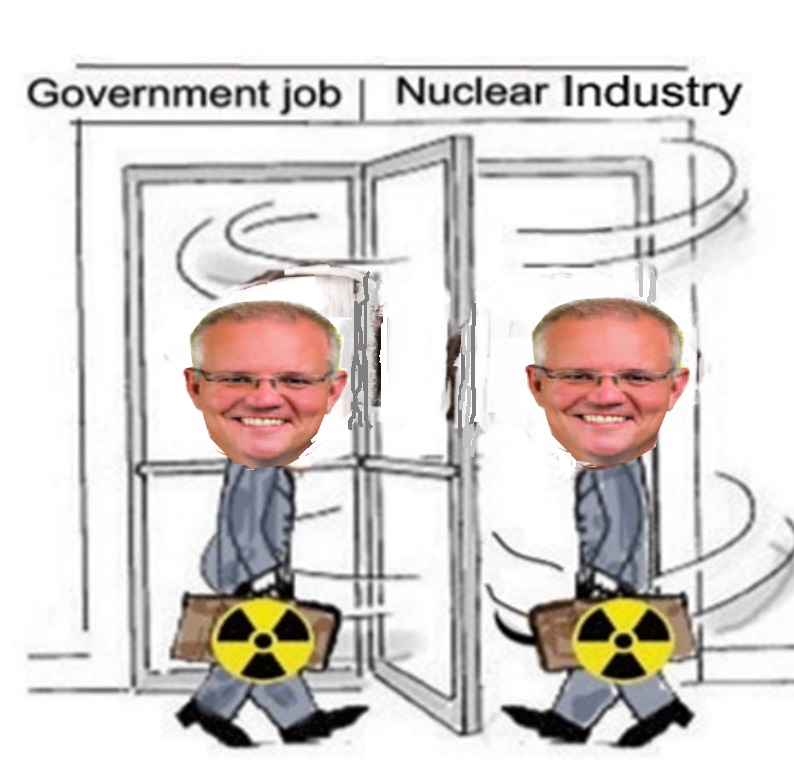
As a strategic advisor to DYNE, Morrison hopes to advance investment in dual-use technologies — inventions that have military and civilian applications. That innovation is being helped by the second pillar of AUKUS, the one that has to do with tearing down military-industrial trade barriers between the US, UK and Australia.
Facing post-Parliament poverty, multitasking Morrison looks to seafloor for riches
What to do when your taxpayer-funded salary drops from $549k, to $225k, to nothing? Multitask, of course.
Crikey, ANTON NILSSON, MAY 30, 2024
Scott Morrison has yet another new job — and like some of his other post-Parliament gigs, it’s tangentially linked to the AUKUS submarine pact he helped set up as prime minister.
The Age reports Morrison is listed as a strategic advisor at a newly created venture called the Seafloor Minerals Fund, alongside ex-US secretary of state Mike Pompeo. Both men are also behind venture capital firm DYNE, set up to support the strategic goals of AUKUS, and which also has interests in deep sea mining, according to the story.
Crikey figured it was time to have another look at Morrison’s post-politics career.
In need of cash …………………………………………..
Multitasking
So what has Morrison done to set himself up for success? His LinkedIn lists three jobs: author, non-executive vice chairman of American Global Strategies, and board member at “various companies”. The voters who brought you Scott Morrison want stronger anti-corruption protectionsRead More
As an author, he’s already published his first work: the religious memoir Plans For Your Good. The book was aimed at the $1.175 billion US Christian book market, but in Australia, it’s reportedly sold very few copies so far.
At American Global Strategies, Morrison is working with two former Donald Trump staffers to “help clients navigate a highly dynamic geopolitical landscape that presents risks and opportunities”, in the ex-PM’s own words.
As a strategic advisor to DYNE, Morrison hopes to advance investment in dual-use technologies — inventions that have military and civilian applications. That innovation is being helped by the second pillar of AUKUS, the one that has to do with tearing down military-industrial trade barriers between the US, UK and Australia. The new gig, with the Seafloor Minerals Fund, will set Morrison and Pompeo up for taking advantage of the estimated trillions of dollars in rare metals estimated to be on the seafloor. According to The Age, Australians can expect a fierce future debate about the merits and risks of mining the seabed for minerals, as China seeks to do the same. https://www.crikey.com.au/2024/05/30/scott-morrison-seafloor-minerals-fund/?utm_medium=Social&utm_source=Twitter#Echobox=1717042244
Do young people support nuclear power?

Jim Green 31 May 24
Earlier this year the Murdoch-Coalition echo-chamber was excited about younger poll respondents in a February Newspoll survey ‒ 65 percent support and 32 percent opposition among 18 to 34-year-olds to this survey question: ‘There is a proposal to build several small modular nuclear reactors around Australia to produce zero-emissions energy on the sites of existing coal-fired power stations once they are retired. Do you approve or disapprove of this proposal?’
However the Newspoll survey was a crude example of push-polling as discussed by polling experts Kevin Bonham and Murray Goot and by economist Professor John Quiggin. The question was loaded, the response options were mischievous (excluding a “neither approve nor disapprove” option, without which majority support (across all age groups) almost certainly would not have been achieved), and the Murdoch/Sky reporting on the poll was biased and dishonest.
Moreover, as Murray Goot notes, other polls reach different conclusions:
“But eighteen- to thirty-four-year-olds as the age group most favourably disposed to nuclear power is not what Essential shows, not what Savanta shows, and not what RedBridge shows.
“In October’s Essential poll, no more than 46 per cent of respondents aged eighteen to thirty-four supported “nuclear power plants” — the same proportion as those aged thirty-six to fifty-four but a smaller proportion than those aged fifty-five-plus (56 per cent); the proportion of “strong” supporters was actually lower among those aged eighteen to thirty-four than in either of the other age-groups.
“In the Savanta survey, those aged eighteen to thirty-four were the least likely to favour nuclear energy; only about 36 per cent were in favour, strongly or otherwise, not much more than half the number that Newspoll reported.
“And according to a report of the polling conducted in February by RedBridge, sourced to Tony Barry, a partner and former deputy state director of the Victorian Liberal Party, “[w]here there is support” for nuclear power “it is among only those who already vote Liberal or who are older than 65”.”
“Truly the stuff of nightmares”: unprecedented low in Antarctic sea ice recorded

By Jeremy Smith, May 31, 2024, https://johnmenadue.com/truly-the-stuff-of-nightmares-unprecedented-low-in-antarctic-sea-ice-recorded/?fbclid=IwZXh0bgNhZW0CMTEAAR0LBw8Xpve2S05Os1FH_y7RYvvv8tqj0qhXrhsM-Z3e49hH1Uu2E44lQr4_aem_AbLMAUeHwooBl6H86wLEqHTtPllDKldX5fzB5e2_5LYTTkXQuf4y_brUHNORL5PsxpdKGuD227S1VVLTWCOjJj7N
Each winter the surface of the sea freezes around Antarctica, over a vast area, mostly to a depth of about one metre. But this is starting to change. Last year, the sea ice reached an unprecedentedly low maximum extent of only 17 million square kilometres.
Why aren’t we talking about sea ice? Perhaps it’s because most people haven’t even heard of it, which is a shame because it’s important.
Each winter the surface of the sea freezes around Antarctica, over a vast area, mostly to a depth of about one metre. The continent effectively doubles in size, with 18-20 million square kilometres being covered by floating ice. That’s an area 2.5 times that of Australia; 4% of Earth’s surface.
But this is starting to change. Last year, the sea ice reached an unprecedentedly low maximum extent of only 17 million square kilometres. Although this year looks like being a little less extreme, a clear and concerning trend appears to be under way. This is emphasised in the ice minimum values in late summer. By February each year the sea ice extent shrinks typically to about three million square kilometres (mostly in two large embayments, the Weddell Sea and the Ross Sea), but through most of the present decade it has dwindled to below two million.
Why does this matter? Well for a start, it is the underside of this huge area of sea ice where algae live and multiply, which feed the shrimp-like krill that in turn sustains an entire ecosystem: fish, seals, penguins, whales, the lot. The upper surface of sea ice is also crucially important. Its albedo, or reflectivity, means that 80-90% of the incoming summer sunshine is bounced back into space. Replace the ice with dark ocean and only about 9% is reflected, the rest going to warm the water. So the loss of sea ice is not only a symptom of climate change, it also contributes to it, in a feedback loop that might accelerate.
There’s more. When sea water freezes, the developing ice crystals comprise nearly pure water. Most of the salt is extruded as a heavy brine, and this cold, dense water sinks, becoming the Antarctic Bottom Current. This circulates around the Southern Ocean before spinning off into the other major ocean basins. As this deep cold flow moves north it displaces warmer water which then up-wells and forms the main surface currents. Without the annual ‘push’ of the Antarctic Bottom Current, these warmer currents might slow and cease.
The global ocean is so vast that it changes very slowly. We are only now beginning to see the results of the ocean’s absorbance of a century of industrial environmental heating, in the form of anomalously warm seas particularly this year. Any pronounced weakening of the ocean circulation due to sea ice loss will be slow – but inexorable.
The results, which are probably not going to happen in our own lifetimes but could well become part of our legacy to future generations, are likely to be dire. It could eventually mean goodbye to the Gulf Stream and the other currents which maintain benign climates on the European Atlantic coast, around Japan, and elsewhere in the northern hemisphere.
The possible consequences of such climate change for human societies are truly the stuff of nightmares.
1 This month

of the week – Australians for War Powers Reform (AWPR)
To see nuclear-related stories in greater depth and intensity
 Antinuclear