Abbott government proceeding to slash renewable energy and climate programs
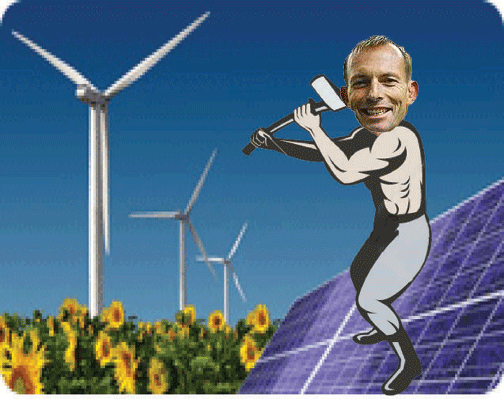 Coalition takes axe to climate programs BY:SID MAHER AND LAUREN WILSON The Australian September 11, 2013 PUBLIC servants are drawing up plans to collapse 33 climate change schemes run by seven departments and eight agencies into just three bodies run by two departments under a substantial rewrite of the administration of carbon abatement schemes under the Coalition.
Coalition climate action spokesman Greg Hunt briefed public servants on the dramatic restructure of the federal climate change bureaucracy before the election was called and yesterday confirmed the Coalition was committed to proceeding with the plan.
Under the simplification, the Department of the Environment and the Department of Resources and Energy will run all of the climate change programs under the Coalition’s direct-action program…….
The changes will see all carbon abatement schemes run by three bodies: the Australian Renewable Energy Agency, which will be overseen by the Department of Resources and Energy; and the Clean Energy Regulator and Low Carbon Australia, which will be run by the Department of the Environment……
The Climate Change Authority, which sets emissions caps, the Climate Commission, which has conducted research into climate change, and the Clean Energy Finance Corporation, which funds renewable technologies, are all slated to be abolished under the plans…… The Coalition will need to legislate to abolish the CEFC, which has amassed a $560m investment portfolio and leveraged $1.6bn in private sector investment. But the bank is understood to be lobbying a Coalition government to utilise its staff and assets as part of its Direct Action scheme, and change its investment mandate so it could work within the framework of the Coalition’s policy.
An Abbott government will need to legislate if it seeks to abolish the Climate Change Authority, which is proceeding with work on a draft report about emissions reductions targets that is due to be completed next month. In the wake of Labor and Greens declarations that they would oppose the abolition of carbon pricing, Mr Abbott said he expected the parliament to “respect the mandate that the new government has”….. http://www.theaustralian.com.au/national-affairs/election-2013/coalition-takes-axe-to-climate-programs/story-fn9qr68y-1226716471498
Australia’s new Prime Minister to carry out climate denialist agenda
 Australia rips up climate-change policies New Scientist, 11:57 10 September 2013 by Michael Slezak Australia’s landslide election result seems to be bad news for the climate. Following the election of a new government, Australia is to abolish its emissions trading scheme, disband a climate advisory body and institute a carbon reduction policy that experts say will fail to meet its meagre target. …
The carbon price – widely called a “carbon tax” – was set to increase gradually until 2015 when carbon credits would be opened for trading, allowing the market to set the price.
Abbott’s coalition also signalled that it would disband Australia’s Climate Commission – an independent scientific body that provides reliable information on climate change to the public. In response to a report the commission released, warning that extreme weather was made more likely by climate change, Abbott said: “When the carbon tax goes, all of those bureaucracies will go and I suspect we might find that the particular position you refer to goes with them.”
Contentious views
In 2009, Abbott said, when talking about climate change, that the “science is highly contentious, to say the least” and “the climate change argument is absolute crap”,…..
It is a “great leap backwards”, says Ian Lowe from Griffith University in Queensland, Australia. He says that no experts think the targets will be met and that the stance is ideological, because senior members of the government don’t think climate change is man-made He worries that the outgoing government will also see the election result as a reason to abandon serious effort on climate policy.
Despite one analysis suggesting that the direct action plan’s funding of A$3.2 billion represents less than half of what is needed to meet the 5 per cent target, Abbott indicated the government will not up this figure…….. http://www.newscientist.com/article/dn24173-australia-rips-up-climatechange-policies.html#.UjFX8NJwonE
When Tony Abbott says “mandate” he means “open season” on progressive policies
 Coalition’s election victory doesn’t mean a mandate to do anything it pleases PAUL SYVRET THE COURIER-MAIL SEPTEMBER 10, 2013 JUST what exactly is this thing we call a “mandate” beyond being arguably one of the most abused words in the political lexicon? Is mandate something to do with marriage equality or the electoral equivalent of a mankini (bright Speedo red, of course) except with a man and a … Actually, let’s not go there.
I ask this because to listen to some members of the incoming government, the word seems interchangeable with terms like carte blanche, or perhaps even “open season”. Certainly Australia’s Climate Change Minister-in-waiting Greg Hunt seems convinced that an election win equals a “mandate” and constitutes, ipso facto, a requirement that all in the Parliament bend over and offer blind obeisance to the new world order.
Bollocks. Polling consistently showed carbon pricing way down the list of voter concerns, making the election no more a referendum on carbon that it was on Bronwyn Bishop’s hair lacquer.
Secondly, the election result gives the new Government a mandate to introduce its policies and prosecute an argument for their passage through Parliament, nothing more. This may come as a shock to some conservative voters, but millions of Australians viewed the prospect of an Abbott government with a mixture of embarrassment and despair and voted for the other mob. In the process we non-Abbott voters gave the party of our choice a mandate to push their policy platforms on our behalf, not to sell us out.
Personally speaking, as someone who supports carbon pricing for both economic and environmental reasons, I would view a decision by Labor to acquiesce to the Coalition’s Wreck-It Ralph approach as an act of gross betrayal. I – and the aforesaid millions of others – cast my vote for a party that believes in tackling climate change via a market-based solution,……. HTTP://WWW.COURIERMAIL.COM.AU/NEWS/QUEENSLAND/OPINION-COALITION8217S-ELECTION-VICTORY-DOESN8217T-MEAN-A-MANDATE-TO-DO-ANYTHING-IT-PLEASES/STORY-FNIHSRF2-1226715384036
Repealing Australia’s carbon tax will be a difficult task, with an uneconomic result
 With the carbon price, the 20 per cent Renewable Energy Target and the Clean Energy Finance Corporation, Australia has the main tools required to stay competitive in the 21st century,
Abolishing the carbon price and moving to a Direct Action grant scheme will change this. Not only will we lose the momentum of a functioning market, but we will move to a scheme most economists agree won’t work
Repealing the carbon tax is not easy, ABC, CLAIRE MARIESABC Environment9 SEP 2013 ‘Axing the tax’ will not be an easy ride for new PM Tony Abbott. While the Coalition has pledged to repeal the carbon tax, none of the steps required to do so are straight-forward. THIS WEEK TONY ABBOTT WILL be sworn in as Australia’s new Prime Minister. He has vowed to do away with Australia’s main tool for tackling climate change: the price on pollution.
Since Australia’s carbon price came into effect 14 months ago, emissions from electricity have fallen by about seven per cent, coal use for electricity is down by about 17 per cent and renewable energy generation is up by 25 per cent. We’re not going it alone on pricing carbon. More than 30 other countries have carbon pricing schemes (this figure does not include state schemes like those in California and some Chinese provinces) and 74 countries have some policy measure designed to limit greenhouse pollution. Continue reading
Abbott begins his destructive action against climate change action
Abbott government begins process to repeal carbon tax; says pressure on Labor to honour mandate ABC News, By chief political correspondent Emma Griffiths 9 Sep 2013, The Coalition is already piling pressure on the Labor Party to “honour” the new government’s mandate to repeal the carbon tax.
Prime Minister-elect Tony Abbott yesterday instructed his department to begin drawing up the legislation to dump the carbon pricing scheme, and says Federal Parliament will resume in late October or early November to deal with it……. Mr Abbott’s spokesman – and likely minister – for the environment, Greg Hunt, says scrapping the carbon tax will be new government’s “first order of business”……..However, both Labor and the Greens have indicated they will not support moves to dump the carbon pricing scheme, nor will they support the Coalition’s direct action scheme to address climate change.
Senior Labor frontbencher Chris Bowen says his party’s stance is clear. “The Labor Party believes that climate change is real,” he said.”The Labor Party believes that we need to do something about it. The Labor Party believes that a market mechanism is the best way to do that, and we won’t be walking away from those beliefs.”
Labor’s opposition to the moves, would leave the bills deadlocked in the Senate and could trigger a double dissolution election – an option Mr Abbott has said is on the table. The alternative would be to wait until the newly elected senators take their seats next July, though that would mean negotiating with a disparate group including South Australian senator Nick Xenophon and, potentially, two senators from the Palmer United Party and one from the Australian Motoring Enthusiast Party…….http://www.abc.net.au/news/2013-09-09/abbott-carbon-tax/4945330
Difficult paths for Tony Abbott in trying to repeal Australia’s carbon pricing
Repealing the carbon tax is not easy, ABC, CLAIRE MARIESABC Environment 9 SEP 2013“………can Mr Abbott repeal the carbon price? Even though the Coalition lists ‘axing the tax’ as their first order of business, it may be harder than thought.
To repeal the current laws and enact Direct Action the new government may go down a couple of different avenues – but they both have potential roadblocks.
One, Mr Abbott can try to convince the ALP or Greens to back his repeal bill in the senate. The Greens hold the balance of power until the new Senate is sworn in on 1 July 2014 – and both the Greens and the ALP have stated they will vigorously defend the carbon price – so this avenue would not appear to be easy street.
Two, Mr Abbott can wait until after 1 July 2014 and negotiate with the eclectic new senate, the make-up of which is looking decidedly unpredictable. But, importantly, the government is required by law to make a series of climate change decisions before 1 July 2014.
Chief among these is choosing the number between 5 and 25 per cent that will become Australia’s legally binding cap on carbon pollution for 2020.
The Clean Energy Act enacted by the previous government has set in train a process whereby the Climate Change Authority is undertaking a review to recommend a 2020 target for Australia, taking into account what is required to keep global warming below two degrees and Australia’s fair share of the international effort. The Authority must present these to the relevant Minister by 28 February 2014 and the Minister must then set the 2020 cap by 30 May 2014. If the Minister attempts to delay the decision, a default cap is built into the legislation that will result in a target of approximately 10 per cent by 2020.
The government cannot simply abolish the Climate Change Authority, preventing it from delivering recommendations – it is established by an Act of Parliament that would be subject to similar repeal conditions as the carbon price.
Then there are international obligations. The Coalition is committed to ratifying the next phase of the Kyoto Protocol, which includes our international commitment to limit warming to two degrees and cut pollution by 5 to 25 per cent by 2020.
Mr Abbott or his representatives would have to attend the international climate negotiations and tell other world leaders Australia will be the first country to expect others to take stronger action in our national interest, while we do less. Much less.
Meanwhile climate change marches on. During the election campaign the Bureau of Meteorology confirmed that the last 12-month period was Australia’s warmest on record.
Tony Abbott will repeal Australia’s carbon tax ‘within weeks’
Tony Abbott has vowed to repeal the carbon tax within weeks once he is sworn in as prime minister. 9 News 9 Sept 13, The prime minister-elect will travel to Canberra today, along with senior members of the incoming Coalition government, after spending yesterday in Sydney meeting with some of Australia’s most senior public servants.
Mr Abbott reportedly has already told the head of the Department of Prime Minister and Cabinet he wants to move quickly to implement his agenda. The Daily Telegraph reports Mr Abbott is likely to seek a return to parliament as early as mid-October, and his first act will be introducing a bill to rescind the carbon tax.
“My top legislative priority is scrapping the carbon tax because that will be an adrenalin shot for local business and relief for families too,” he was quoted as saying. He also intends to issue an official order to the Chief of the Navy, Vice Admiral Ray Griggs, to begin turning back refugee boats from Indonesia……..
The Coalition is on track for a 32-seat lower house majority after winning several seats from Labor and independents in Tasmania, NSW and Victoria in Saturday’s federal election. It is still unclear who will have the balance of power in the Senate, however. http://news.ninemsn.com.au/national/2013/09/09/06/35/tony-abbott-back-in-canberra-today
First Aboriginal woman elected to Senate – the principled Nova Peris
 Months ago, this website criticised Nova Peris, as being “parachuted in” as a laLor candidate for the election. We saw her as a tame puppet for Labor. How wrong we were!
Australia’s new Abbott government and its love affair with polluting industries
 Australia And Renewable Energy: What Now? http://www.energymatters.com.au/index.php?main_page=news_article&article_id=3931 9 Sept 13, Some in Australia’s renewable energy industry will be starting their week scratching their heads as to what to do next. With the Coalition gaining power; there are some knowns, but many unknowns about their plans for renewable energy.
The situation was made more perplexing by the fact the Coalition’s recently released Policy for Resources and Energy left out renewables for the most part; well, almost entirely. However, it did make it clear Australia is about to embark on a re-invigorated love affair with fossil fuels.
For renewable energy, the knowns that have been cobbled together are the scrapping of the Clean Energy Finance Corporation and an attempt to reverse the carbon tax. There will be yet another costly investigation into the health impacts of wind farms; even though multiple studies have debunked so-called Wind Turbine Syndrome.
Money and other resources will be taken from the Australian Renewable Energy Agency (ARENA) by making it responsible for delivering the Coalition’s watered-down “One Million Solar Roofs” rebate. Within the first week of a Coalition government, the new Minister for Resources and Energy will commence work on (yet another) Energy White Paper, which it says will be publicly released within a year. There will also be (yet another) review of the Renewable Energy Target next year – it’s these continual reviews that are believed to be having an impact on dampening investment in renewables in Australia; particularly large scale projects.
The full details of the new Government’s “Direct Action” plan to reduce greenhouse gas emissions will not be known until at least 100 days after the new government is formed and a period of public consulting ends says The Canberra Times. Given the uncertainty over renewables and the renewed love affair with polluting fossil fuels, it would seem for Australian households (like so often in the past), the best time to go solar may be sooner rather than later.
Mining industry rejoices at Abbott victory, – gloom for renewables industries
 Abbot Victory A Boon for Miners But Bad for Renewables http://sourceable.net/abbot-victory-a-boon-for-miners-but-bad-for-renewables/#sthash.AXUY5lIf.dpuf Sourceable, Marc Howe– 9 Sept 13 While Australia’s mining companies are no doubt delighted by Abbot’s election victory over the weekend, a Coalition government is likely to hamper the development prospects of the renewable energy sector. – The mining industry will derive major benefit if Tony Abbot follows through with his plan to annul both the mining and carbon taxes introduced by his Labor predecessors. The introduction of the mining tax in particular triggered fervent opposition from Australia’s cash-rich resources sector, and played a pivotal role in Kevin Rudd’s internal ousting in 2010.
The scheme will permit investors to deduct mining exploration costs from their taxable income, and focus on particular on smaller players undertaking the risky business of mineral exploration.
“Our scheme will target small exploration companies by limiting eligibility to companies with no taxable income and will be capped at $100 over the forward estimates, Mr. Macfarlane said.
In stark contrast to the potential benefits of a Coalition win for the mining industry, the clean energy and renewables sector could face major difficulties with Abbot at the helm – particularly given his past record of climate change skepticism. Continue reading
New research dispels myth of economical “clean coal”
 Renewables Trump Coal + Carbon Capture And Storage http://www.energymatters.com.au/index.php?main_page=news_article&article_id=3930 8 Sept 13 UNSW researchers have compared fossil fuel and CCS with renewables and found coal fired electricity’s days may be numbered – the figures simply don’t stack up.
Government estimates of the prices for different generation technologies and fuels in 2030 were used in the research along with a number of possible future carbon and CCS prices.
The results demonstrate coal based electricity generation plus carbon capture and storage are likely to be not competitive with 100 percent renewable energy – and the same would apply to gas with CCS if gas pricing should hit export parity. Continue reading
Australia’s Liberal Coalition will govern in the interests of fossil fuel lobby
The document says the Coalition would look into formalising the sale of uranium to India, and would also examine the potential use of thorium as an 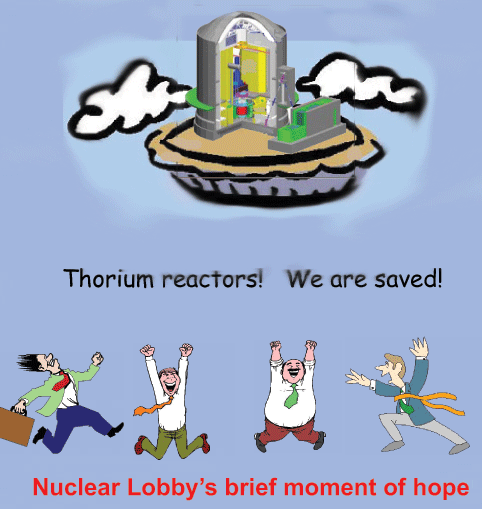 energy source, noting that Australia possesses an estimated 18.7% (489,000t) of the world’s identified resources.
 Coalition energy document focuses almost entirely on fossil fuels Giles Parkinson theguardian.com, Thursday 5 September 2013 Only reference to Australia’s $20bn renewable industry is repeat of promise to hold another investigation into the health impacts of wind farms.
The Coalition on Thursday unveiled its new energy and resources document, which focuses almost entirely on fossil fuel developments, promising to restore coal-fired power stations to profitability, boost exploration for oil and gas, and to produce another “white paper” on energy.
Other proposals in the document prepared by opposition energy spokesman Ian Macfarlane include an investigation into the use of thorium as a potential energy source of the future, and support mechanisms for the use of LNG as a transport fuel……..
the repeat of a promise made last December to hold yet another investigation into the health impacts of wind farms, and confirmation of a previously leaked commitment to require “real time” monitoring of wind turbine noise – a move that wind energy groups say would involve “crippling” costs.
There is no mention of renewables – least of all the “solar revolution” that state energy ministers admit is sweeping the country.
However, separate costing documents reveal sharp cuts to renewable support measures. This includes stripping the Australian Renewables Energy Agency of $150m over three years to fund the Coalition’s million solar roofs program, cutting a planned $40m program to support geothermal and ocean energy developments in regional towns, and cutting $185m from a “connecting renewables” program designed to support transmission infrastructure for renewables. The million solar roofs program – targeted for low income earners – will now feature a $500 rebate instead of a $1,000 rebate because of the fall in the cost of solar PV modules.
 On wind, the energy document – in an apparent gesture towards the anti-wind members of its constituency – says: “Some members of public have serious concerns over the potential impacts of wind farms on the health of people living in their vicinity…….
The renewables industry has previously said that real-time monitoring would impose unbearable costs on the wind industry, and would be almost useless because of the inability to separate other noise in real-time.
Despite the fact that there have been 19 separate studies into wind farm health, including one by the National Health and Medical Research Council, the Coalition said it would establish either an independent NHMRC research program or an independent expert panel to examine and determine any actual or potential health effects of wind farms.
A previous study by the NHMRC in 2010 found that “there are no direct pathological effects from wind farms and that any potential impact on humans can be minimised by following existing planning guidelines”. A Senate inquiry into wind farm health fell largely along party lines, although it said it was unable to establish a direct link between ill health and the noise generated by wind farms.
The Coalition has said that the inquiry would be made in response to demands from anti-wind senators John Madigan and Nick Xenophon, who may hold the balance of power in a new Senate………
The document says the Coalition would look into formalising the sale of uranium to India, and would also examine the potential use of thorium as an energy source, noting that Australia possesses an estimated 18.7% (489,000t) of the world’s identified resources.
“The primary source of thorium in Australia and globally is the mineral monazite. Thorium can be used as an alternative source of fuel for energy generation and possesses an energy content that can be utilised almost in its entirety,” it says. Thorium is often touted as a future energy source, although most experts say it is decades away from deployment…….
Leigh Ewbank from Friends of the Earth’s Yes 2 Renewables initiative says the anti-wind farm stance of some Coalition members is out of touch with mainstream views.
“All available public polling shows strong public support for wind farms,” says Ewbank. “The Coalition desperately needs to make a wind energy friendly policy announcement to reaffirm its commitment to Australia’s most affordable renewable energy source.” http://www.theguardian.com/world/2013/sep/05/coalition-energy-document-focuses-almost-entirely-on-fossil-fuels
South Australian uranium mine to be 100% Russian owned
Honeymoon Well uranium mine to go into Russian hands ABC Rural By Babs McHugh 7 Sept 13, The Honeymoon Well uranium mine in South Australia is set to be 100 per cent Russian owned by the September quarter.
Shareholders of Canadian company Uranium One have approved a buyout offer from the Russian State Corporation for Nuclear Energy, Rosatom.
A Rosatom subsidiary already owns 49 per cent of Uranium One and, once the deal is completed, the new entity will be private.
Honeymoon Well is is the smallest of Australia’s operating uranium mines. The others are Olympic Dam in South Australia, Ranger Mine in the Northern Territory and Beverley Mine in South Australia…… http://www.abc.net.au/news/2013-09-06/russia-to-own-honeymoon-well-uranium-mine/4941128
Not economic for Australia to invest in unproven, high-risk, fossil fuel technologies
 University of NSW Study Pushes for Renewable Energy Over Coal http://au.ibtimes.com/articles/504152/20130906/university-nsw-study-pushes-renewable-energy-over.htm#.UivWvNJwonE By Vittorio Hernandez | September 6, 2013 4:07 PM EST
It would make more economic sense for Australia to pursue renewable energy rather than continue the use of coal, despite the possible availability of carbon capture and storage technology, according to a study by the University of New South Wales The basis of their study is a modeling, using a range of fossil fuel scenarios with carbon capture and storage compared with 100 per cent renewable electricity scenario based on commercially available wind, solar and biomass technologies.
The researchers then used 2010 hourly electricity demand and solar and wind data to determine the proper technology mixes for each scenario to balance demand and supply of electricity with the aim of having the same reliability as the current Australian National Electricity Market.
Prices were based on government estimates of different generation technologies and fuels in 2030, plus possible future carbon prices and carbon capture and storage prices.
“The research confirms that policies pursuing very high penetrations of renewable electricity, based on commercially available technologies, offer a reliable, affordable and low risk way to dramatically cut emissions in the electricity sector,” Business Spectator quoted University of NSW Associate Professor Mark Diesendorf of the Institute of Environmental Studies, one of the co-authors of the study.
The report concluded that it is not necessary to invest in new, expensive, unproven, high-risk, fossil fuel technologies. It added that reaching the rapid and deep cuts to greenhouse gas emissions necessary to avoid dangerous global warming is expected to be more difficult in the fields of transportation and agriculture than the electricity sector.
Tony Abbott still a climate change denialist at heart
 the suspicion that the sceptic still lurks within grew stronger with an interview with Michelle Grattan forThe Conversation. People were less anxious about climate change for three reasons, Abbott said:
“First I think they’re more conscious of the fact that the argument among the experts is not quite the one way street that it might have seemed four or five years [ago].”
This election has heard no end of debate about Australia’s budget deficit but little about the environmental deficit that we are accumulating and that will take much longer to pay off.
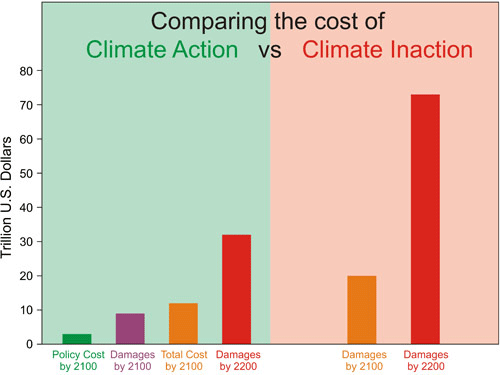
How much will climate inaction cost us? The Drum By Mike Steketee 5 Sep 2013, This election has heard no end of debate about Australia’s budget deficit; meanwhile, an environmental disaster looms that will cause us much more financial pain, writes Mike Steketee.
Victoria and other parts of eastern Australia, including Sydney, have just recorded their warmest winter on record. Was that evidence of climate change, Barrie Cassidy asked Tony Abbott on the ABC’s Insiders on Sunday. “It is evidence of the variability in our weather,” replied the person on the brink of becoming prime minister.
It was an answer at the same time unexceptional and revealing. Of course, Abbott is correct. Weather records are being broken all the time. For centuries Australia has been a land of drought and flooding rains.
But Abbott also could have given a different answer, along the lines that, whether or not specific record-breaking events were the result of human impact on the climate, they were occurring more frequently, particularly those associated with high temperatures, and that this was in line with the predictions of the overwhelming majority of climate scientists.
Here’s another record: for the whole of Australia, temperatures for the 12 months to the end of last month were the highest since reliable records were first kept 103 years ago. Continue reading
1 This month
17 October, Free Public Talk on Nuclear Issues in South Australia
David Noonan will speak on public interest concerns over the new Roxby Downs Indenture Act 2026 on BHP copper-uranium mining and ore processing in SA, and on how AUKUS may face SA with a High-Level nuclear waste agenda.
Dr Jim Green will discuss international developments in the field of nuclear power including ‘small modular reactors’ and Generation 4 ‘advanced’ nuclear reactor concepts.


Help Aunty Sue Protect Her Land and Sacred Sites From Destructive Rocket Testing.
.

Australians deserve the truth
about
AUKUS – https://aukuspublicinquiry.com/

PETITION – To: Prime Minister Anthony Albanese and the Australian Labor Government

of the week – Australians for War Powers Reform (AWPR)
To see nuclear-related stories in greater depth and intensity

